

γ-Aminobutyric acidA receptor regulation: heterologous uncoupling of modulatory site interactions induced by chronic steroid, barbiturate, benzodiazepine, or GABA treatment in culture
Open accessThe DOI matches its Crossref record; 61 of the 62 references it cites were found in a registry or an index.
Abstract
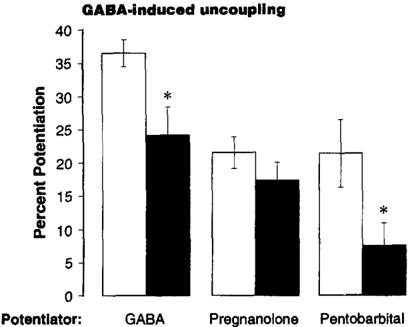
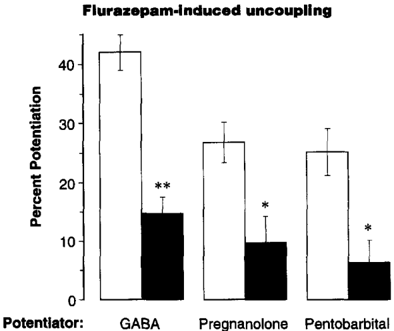
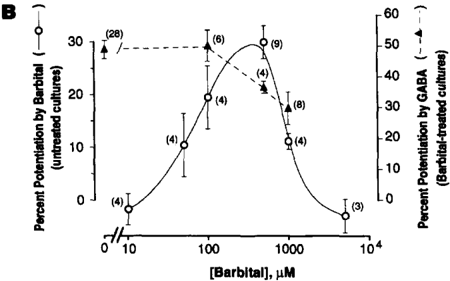
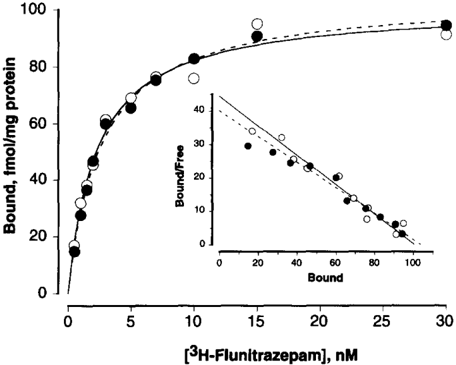
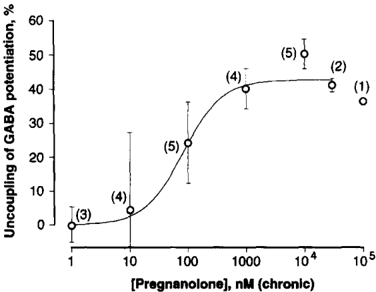
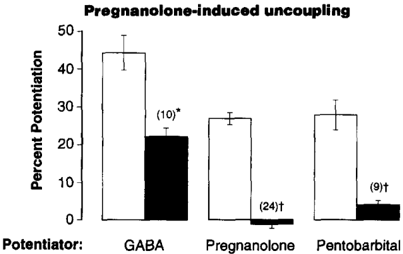
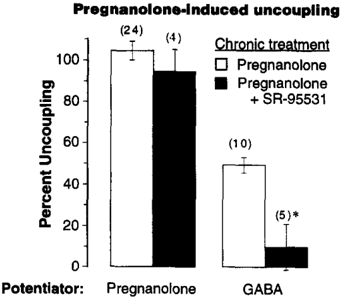
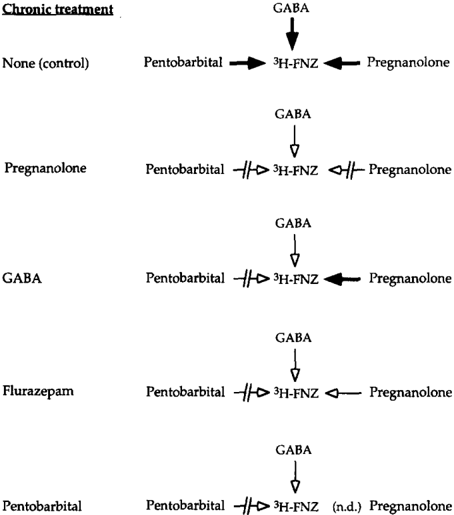
Prolonged administration of anxiolytic, sedative, and anticonvulsant drugs that act through the GABAA receptor (GABAAR) can evoke tolerance and dependence, suggesting the existence of an endogenous mechanism(s) for altering the ability of such agents to interact with the GABAAR. Uncoupling appears to be one such mechanism. This is a decrease in the allosteric interactions between the benzodiazepine (BZD) recognition site and other agonist or modulator sites on the GABAAR, as measured by potentiation of [3H]flunitrazepam ([3H]FNZ) binding. To investigate the mechanism(s) of uncoupling, neuronal cultures were treated chronically with 3 alpha-hydroxy-5 beta-pregnan-20-one (pregnanolone), pentobarbital, flurazepam, or GABA, then tested for enhancement of [3H]FNZ binding by these substances. The results indicate that BZDs, barbiturates, and steroids, as well as GABA itself, are capable of inducing both heterologous and homologous uncoupling. Surprisingly, different chronic drug treatments produce different patterns of homologous and heterologous uncoupling. Chronic exposure to pregnanolone, GABA, flurazepam or pentobarbital induces complete uncoupling of barbiturate-BZD site interactions, partial uncoupling of GABA-BZD site interactions, but different amounts of uncoupling of steroid-BZD site interactions. In addition, the EC50 for pregnanolone-induced homologous uncoupling (1.7 microM) is over an order of magnitude greater than that for heterologous uncoupling of GABA and BZD sites (82 nM). Moreover, heterologous uncoupling by pregnanolone is inhibited by the GABA site antagonist SR-95531, whereas homologous uncoupling by pregnanolone is resistant to SR-95531. Therefore, there are at least two distinct ways in which GABAAR modulatory site interactions can be regulated by chronic drug treatment.
Overview
The claims and statistics of this paper haven’t been checked yet.
Free: it reads the open-access text and checks the first 5 claims that cite a source we can check. Create a free account to check every claim.
Integrity signals
Registry
Cites
Statistics
Figures
Verification
Claims the paper makes
The claims and statistics of this paper haven’t been checked yet.
Free: it reads the open-access text and checks the first 5 claims that cite a source we can check. Create a free account to check every claim.
Claims other papers make about this one
Each is checked against this paper’s own text: does it say what the citing paper says it does?
The cited source doesn’t support the claim as written.
In the citing paper
“However, the uncoupling process is an aspecific process as it can be induced by exposure to different classes of GABAA receptor modulators acting at different modulatory sites, such as neurosteroids and barbiturates [82].”
From Mechanisms Underlying Tolerance after Long-Term Benzodiazepine Use: A Future for Subtype-Selective Receptor Modulators? (2012) · cites this paper as [82]
Checked by a reasoning model — may be wrong.
Experimental — accuracy not yet measured
Self-check
Percentages, sums and reported differences re-computed from the paper’s own numbers.
The self-check needs the paper’s full text.
Citations
Cites
PROTEIN MEASUREMENT WITH THE FOLIN PHENOL REAGENT
Lowry, O., Rosebrough, N., Farr, A. L., & Randall, R. (1951) · Journal of Biological Chemistry · doi:10.1016/s0021-9258(19)52451-6 · Cited by 317,331
Goodman and Gilman's the Pharmacological Basis of Therapeutics
Stigelman, W. H., & Pharm, D. (1986) · Military Medicine · doi:10.1093/milmed/151.1.386 · Cited by 6,782
Paul, S. M., & Purdy, R. H. (1992) · The FASEB Journal · doi:10.1096/fasebj.6.6.1347506 · Cited by 1,319
Importance of a novel GABAA receptor subunit for benzodiazepine pharmacology
Pritchett, D. B., Sontheimer, H., Shivers, B. D., Ymer, S., Kettenmann, H., Schofield, P. R., & Seeburg, P. H. (1989) · Nature · doi:10.1038/338582a0 · Cited by 1,293
Selective antagonists of benzodiazepines
Hunkeler, W., Möhler, H., Pieri, L., Polc, P., Bonetti, E. P., Cumin, R., Schaffner, R., & Haefely, W. (1981) · Nature · doi:10.1038/290514a0 · Cited by 1,232
Goodman and Gilman's The Pharmacological Basis of Therapeutics
Hastings, R. C., & Long, G. W. (1991) · JAMA · doi:10.1001/jama.1991.03460200114048 · Cited by 1,060
Non-genomic and genomic effects of steroids on neural activity
McEwen, B. S. (1991) · Trends in Pharmacological Sciences · doi:10.1016/0165-6147(91)90531-v · Cited by 722
Jerram, T. C. (1981) · Side Effects of Drugs Annual · doi:10.1016/s0378-6080(81)80009-8 · Cited by 690
Drugs effective in the therapy of the epilepsies
Tw, R. (1985) · Medical Entomology and Zoology · Cited by 522
Amin, J., & Weiss, D. S. (1993) · Nature · doi:10.1038/366565a0 · Cited by 426
Puia, G., Vicini, S., Seeburg, P. H., & Costa, E. (1991) · Molecular Pharmacology · doi:10.1016/s0026-895x(25)00452-3 · Cited by 342
Functional Modulation of GABA A Receptors by cAMP-Dependent Protein Phosphorylation
Moss, S. J., Smart, T. G., Blackstone, C. D., & Huganir, R. L. (1992) · Science · doi:10.1126/science.1323140 · Cited by 341
Chen, Q. X., Stelzer, A., Kay, A. R., & Wong, R. K. (1990) · The Journal of Physiology · doi:10.1113/jphysiol.1990.sp017908 · Cited by 310
Regulation of GABAA receptor function by protein kinase C phosphorylation
Krishek, B. J., Xie, X., Blackstone, C., Huganir, R. L., Moss, S. J., & Smart, T. G. (1994) · Neuron · doi:10.1016/0896-6273(94)90316-6 · Cited by 307
GABA A -Receptor Function in Hippocampal Cells Is Maintained by Phosphorylation Factors
Stelzer, A., Kay, A. R., & Wong, R. K. S. (1988) · Science · doi:10.1126/science.2455347 · Cited by 301
Chronic benzodiazepine treatment decreases postsynaptic GABA sensitivity
Gallager, D. W., Lakoski, J. M., Gonsalves, S. F., & Rauch, S. L. (1984) · Nature · doi:10.1038/308074a0 · Cited by 280
Friedman, L., Pellegrini-Giampietro, D., Sperber, E., Bennett, M., Moshe, S., & Zukin, R. (1994) · The Journal of Neuroscience · doi:10.1523/jneurosci.14-05-02697.1994 · Cited by 271
Self-citationModulation of the GABAA receptor by progesterone metabolites
Callachan, H., Cottrell, G. A., Hather, N. Y., Lambert, J. J., Nooney, J. M., & Peters, J. A. (1987) · Proceedings of the Royal Society of London. Series B. Biological Sciences · doi:10.1098/rspb.1987.0049 · Cited by 252
Moss, S. J., Doherty, C. A., & Huganir, R. L. (1992) · Journal of Biological Chemistry · doi:10.1016/s0021-9258(19)49736-6 · Cited by 250
Mechanisms of Action of Currently Prescribed and Newly Developed Antiepileptic Drugs
Macdonald, R. L., & Kelly, K. M. (1994) · Epilepsia · doi:10.1111/j.1528-1157.1994.tb05955.x · Cited by 139
Tolerance during chronic benzodiazepine treatment associated with decreased receptor binding
Rosenberg, H. C., & Chiu, T. H. (1981) · European Journal of Pharmacology · doi:10.1016/0014-2999(81)90356-3 · Cited by 135
Chan, C., & Farb, D. (1985) · The Journal of Neuroscience · doi:10.1523/jneurosci.05-09-02365.1985 · Cited by 122
Self-citationMajewska, M. D. (1987) · Biochemical Pharmacology · doi:10.1016/0006-2952(87)90437-0 · Cited by 119
Effects of continuous diazepam administration on GABAA subunit mRNA in rat brain
Heninger, C., Saito, N., Tallman, J. F., Garrett, K. M., Vitek, M. P., Duman, R. S., & Gallager, D. W. (1990) · Journal of Molecular Neuroscience · doi:10.1007/bf02876917 · Cited by 118
Decreased GABAAreceptor subunit mRNA concentrations following chronic lorazepam administration
Kang, I., & Miller, L. G. (1991) · British Journal of Pharmacology · doi:10.1111/j.1476-5381.1991.tb09781.x · Cited by 117
Kirkness, E. F., Bovenkerk, C. F., Ueda, T., & Turner, A. J. (1989) · Biochemical Journal · doi:10.1042/bj2590613 · Cited by 111
Gyenes, M., Farrant, M., & Farb, D. H. (1988) · Molecular Pharmacology · doi:10.1016/s0026-895x(25)10119-3 · Cited by 106
Self-citationRoca, D. J., Rozenberg, I., Farrant, M., & Farb, D. H. (1990) · Molecular Pharmacology · doi:10.1016/s0026-895x(25)09947-x · Cited by 98
Self-citationMontpied, P., Ginns, E. I., Martin, B. M., Roca, D., Farb, D. H., & Paul, S. M. (1991) · Journal of Biological Chemistry · doi:10.1016/s0021-9258(18)38073-6 · Cited by 90
Self-citationDecreased 3H-diazepam binding is a specific response to chronic benzodiazepine treatment
Rosenberg, H. C., & Chiu, T. H. (1979) · Life Sciences · doi:10.1016/0024-3205(79)90364-3 · Cited by 87
Primus, R. J., & Gallager, D. W. (1992) · European Journal of Pharmacology Molecular Pharmacology · doi:10.1016/0922-4106(92)90078-a · Cited by 87
Roca, D. J., Schiller, G. D., Friedman, L., Rozenberg, I., Gibbs, T. T., & Farb, D. H. (1990) · Molecular Pharmacology · doi:10.1016/s0026-895x(25)10901-2 · Cited by 87
Self-citationTolerance to and cross-tolerance among ethanol, pentobarbital and chlordiazepoxide
Lê, A. D., Khanna, J. M., Kalant, H., & Grossi, F. (1986) · Pharmacology Biochemistry and Behavior · doi:10.1016/0091-3057(86)90050-x · Cited by 86
Emerging Insights Into Mechanisms of Epilepsy: Implications for New Antiepileptic Drug Development
Dichter, M. A. (1994) · Epilepsia · doi:10.1111/j.1528-1157.1994.tb05956.x · Cited by 82
Sweetnam, P. M., Lloyd, J., Gallombardo, P., Malison, R. T., Gallager, D. W., Tallman, J. F., & Nestler, E. J. (1988) · Journal of Neurochemistry · doi:10.1111/j.1471-4159.1988.tb03097.x · Cited by 82
Gyenes, M., Wang, Q., Gibbs, T. T., & Farb, D. H. (1994) · Molecular Pharmacology · doi:10.1016/s0026-895x(25)09732-9 · Cited by 81
Self-citationYu, R., & Ticku, M. K. (1995) · Molecular Pharmacology · doi:10.1016/s0026-895x(25)08579-7 · Cited by 73
Zhao, T. J., Chiu, T. H., & Rosenberg, H. C. (1994) · Molecular Pharmacology · doi:10.1016/s0026-895x(25)10150-8 · Cited by 72
Friedman, L., Gibbs, T. T., & Farb, D. H. (1993) · Molecular Pharmacology · doi:10.1016/s0026-895x(25)13138-6 · Cited by 70
Self-citationGABA induces down-regulation of the benzodiazepine-GABA receptor complex in the rat cultured neurons
Maloteaux, J., Octave, J., Gossuin, A., Laterre, C. E., & Trouet, A. (1987) · European Journal of Pharmacology · doi:10.1016/0014-2999(87)90517-6 · Cited by 68
O’Donovan, M. C., Buckland, P. R., Spurlock, G., & McGuffin, P. (1992) · European Journal of Pharmacology Molecular Pharmacology · doi:10.1016/0922-4106(92)90051-v · Cited by 66
Vicini, S., Alho, H., Costa, E., Mienville, J. M., Santi, M. R., & Vaccarino, F. M. (1986) · Proceedings of the National Academy of Sciences · doi:10.1073/pnas.83.23.9269 · Cited by 65
Hu, X. J., & Ticku, M. K. (1994) · Molecular Pharmacology · doi:10.1016/s0026-895x(25)10146-6 · Cited by 64
Strategies for the Development of Drugs for Pharmacoresistant Epilepsies
Heinemann, U., Draguhn, A., Ficker, E., Stabel, J., & Zhang, C. L. (1994) · Epilepsia · doi:10.1111/j.1528-1157.1994.tb05959.x · Cited by 57
Yu, O., Chiu, T. H., & Rosenberg, H. C. (1988) · The Journal of Pharmacology and Experimental Therapeutics · doi:10.1016/s0022-3565(25)20987-9 · Cited by 53
GABA down-regulates the GABA/benzodiazepine receptor complex in developing cerebral neurons
Tehrani, M. H. J., & Barnes, E. M. (1988) · Neuroscience Letters · doi:10.1016/0304-3940(88)90463-6 · Cited by 53
Klein, R. L., Whiting, P. J., & Harris, R. A. (1994) · Journal of Neurochemistry · doi:10.1046/j.1471-4159.1994.63062349.x · Cited by 50
Benzodiazepine Receptor Synthesis and Degradation by Neurons in Culture
Borden, L. A., Czajkowski, C., Chan, C. Y., & Farb, D. H. (1984) · Science · doi:10.1126/science.6093257 · Cited by 49
Self-citationHarris, B. D., Wong, G., Moody, E. J., & Skolnick, P. (1995) · Molecular Pharmacology · doi:10.1016/s0026-895x(25)08548-7 · Cited by 48
Hernández, T. D., Heninger, C., Wilson, M. A., & Gallager, D. W. (1989) · European Journal of Pharmacology · doi:10.1016/0014-2999(89)90535-9 · Cited by 45
Roca, D. J., Schiller, G. D., & Farb, D. H. (1988) · Molecular Pharmacology · doi:10.1016/s0026-895x(25)13347-6 · Cited by 43
Self-citationHirouchi, M., Ohkuma, S., & Kuriyama, K. (1992) · Molecular Brain Research · doi:10.1016/0169-328x(92)90125-u · Cited by 39
Altered γ-aminobutyric acid/benzodiazepine interaction after chronic diazepam exposure
Heninger, C. (1988) · Neuropharmacology · doi:10.1016/0028-3908(88)90070-6 · Cited by 38
Wong, G., Lyon, T., & Skolnick, P. (1994) · Molecular Pharmacology · doi:10.1016/s0026-895x(25)09851-7 · Cited by 36
Frey, H. ‐. (1985) · Handbook of experimental pharmacology · doi:10.1007/978-3-642-69518-6_11 · Cited by 32
Barbiturate tolerance: effects on GABA-operated chloride channel function
Allan, A. M., Zhang, X., & Baier, L. D. (1992) · Brain Research · doi:10.1016/0006-8993(92)91583-z · Cited by 29
Borden, L. A., & Farb, D. H. (1988) · Molecular Pharmacology · doi:10.1016/s0026-895x(25)09746-9 · Cited by 29
Self-citationBenzodiazepine tolerance and dependence: GABAA receptor complex locus of change.
Gallager, D. W., & Primus, R. J. (1993) · PubMed · Cited by 28
La, B., Gibbs, T. T., & Farb, D. H. (1987) · Journal of Neuroscience · doi:10.1523/jneurosci.07-06-01902.1987 · Cited by 15
Self-citationBenzodiazepine receptor photoaffinity labeling: Correlation of function with binding
Gibbs, T. T., Chan, C. Y., Czajkowski, C., & Farb, D. H. (1985) · European Journal of Pharmacology · doi:10.1016/0014-2999(85)90209-2 · Cited by 14
Self-citationSchiller, G. D., & Farb, D. H. (1986) · Annals of the New York Academy of Sciences · doi:10.1111/j.1749-6632.1986.tb21552.x · Cited by 10
Self-citation
Research works printed but not linked: 3
- Browning, M.D., Bureau, M., Dudek, E.M. and Olsen, R.W., Pro- tein kinase C and cAMP-dependent protein kinase phosphorylate the fl-subunit of the purified y-aminobutyric acid A receptor, Proc. Natl. Acad. Sci. USA, 97 (1990) 1315-1318.
- Friedman, L.K., Gibbs, %% and Farb, D.H., Homologous and heterologous uncoupling of the GABA A receptor complex by GABA, 3ot-OH-DHP, flurazepam, and pentobarbital in culture, Soc. Neu- rosci. Abstr., 16 (1990) 1038.
- Roca, D.J., Rozenberg, I. and Farb, D.H., Homologous and heterolo- gous regulation of the GABA/benzodiazepine receptor complex, Soc. Neurosci. Abstr., 14 (1988) 345.
Cited by
Ethanol and neurotransmitter interactions—from molecular to integrative effects
Faingold, C. L., N'Gouemo, P., & Riaz, A. (1998) · Progress in Neurobiology · doi:10.1016/s0301-0082(98)00027-6 · Cited by 265
Neurosteroid regulation of GABAA receptors: Focus on the α4 and δ subunits
Smith, S. S., Shen, H., Gong, Q. H., & Zhou, X. (2007) · Pharmacology & Therapeutics · doi:10.1016/j.pharmthera.2007.03.008 · Cited by 244
Löscher, W., & Schmidt, D. (2006) · Epilepsia · doi:10.1111/j.1528-1167.2006.00607.x · Cited by 239
Vinkers, C. H., & Olivier, B. (2012) · Advances in Pharmacological Sciences · doi:10.1155/2012/416864 · Cited by 195
Reddy, D. S., & Rogawski, M. A. (2000) · The Journal of Pharmacology and Experimental Therapeutics · doi:10.1016/s0022-3565(24)39026-3 · Cited by 152
Metadata
- Authors
- Friedman, L. K., Gibbs, T. T., & Farb, D. H.
- Affiliations
- Boston University (US)
- Corresponding author
- Gibbs, Terrell T.
- Venue
- Brain Research
- Publisher
- Elsevier BV
- Published
- 1996-01
- Volume
- 707
- Issue
- 1
- Pages
- 100-109
- ISSN
- 0006-8993 (ISSN-L)
- OpenAlex
- W1988045452
- Cited by
- 69
- References
- 62
- Citations by year
- 2024: 1 · 2023: 1 · 2021: 1 · 2018: 1 · 2017: 1 · 2016: 4 · 2015: 1 · 2014: 1 · 2013: 3 · 2012: 5
- FWCI
- 1.21
- Type
- journal article
- Language
- en
- Open access
- hybrid
- doi.org
- Licence
- cc-by-nc-nd
- www.elsevier.com/tdm/userlicense/1.0/ (tdm)
- www.elsevier.com/legal/tdmrep-license (tdm)
- creativecommons.org/licenses/by-nc-nd/4.0/ (vor, 1155 d)
- Locations
- Brain Research (publishedVersion, cc-by-nc-nd)
- PubMed (publishedVersion)
- Topics
- Life Sciences › Neuroscience › Cellular and Molecular Neuroscience › Neuroscience and Neuropharmacology Research
- Life Sciences › Biochemistry, Genetics and Molecular Biology › Molecular Biology › Receptor Mechanisms and Signaling
- Life Sciences › Biochemistry, Genetics and Molecular Biology › Molecular Biology › Nicotinic Acetylcholine Receptors Study
- Keywords
- GABAA receptor, benzodiazepine binding site, uncoupling, allosteric interactions, chronic drug administration, pregnanolone, pentobarbital, flurazepam, GABA, flunitrazepam binding, SR95531, tolerance and dependence, neuronal culture
- MeSH terms
- Animals, Barbiturates, Benzodiazepines, Binding, Competitive, Cells, Cultured, Chick Embryo, Dose-Response Relationship, Drug, Flunitrazepam, gamma-Aminobutyric Acid, Radioligand Assay, Receptors, GABA-A, Steroids
About these checks
Registry, retraction, Cites and statistics results are computed, not judged, with one exception: a printed reference that no index lists is read once by a model before it counts as a citation error. Claims are extracted by a model and kept only when their quote appears verbatim in the text; each cited source is then checked, with a model’s help, for whether it says what the claim relies on. Those verdicts can be wrong — read the claim’s quote and the cited source before relying on one.
Statistics and arithmetic are recomputed, not judged.
Confidence bands are shown only for fields calibrated on our annotated test set. None is calibrated yet, so no band is shown.
What counts as a claim ›How we measure confidence ›How we check this ›
Are you an author, or do you see a problem with this page? Request a review
Data sources
Bibliographic data: Semantic Scholar, OpenAlex, Crossref.
Contains information from the Semantic Scholar Academic Graph Datasets, made available under the ODC Attribution License (ODC-BY 1.0).
Semantic Scholar’s data is described in: Kinney, R., et al. (2023). The Semantic Scholar Open Data Platform. arXiv:2301.10140.
