

The DOI matches its Crossref record; 83 of the 86 references it cites were found in a registry or an index.
Hot flashes: Phenomenology, quality of life, and search for treatment options
Open accessAbstract
Menopausal hot flashes are a significant problem for women. Hot flashes can impact on daily functioning, particularly when they disrupt sleep, leading to fatigue and irritability during the day. However, our knowledge about this primary complaint of menopausal women is far from complete. It is known that a hot flash is associated with thermoregulatory, cardiovascular, and endocrine changes. However, much is unknown about the phenomenology of hot flashes, such as the range of variability in the pattern and longitudinal course of hot flashes. Although estrogen plays a role in the etiology of hot flashes, the mechanism by which its withdrawal precipitates hot flashes and its replacement relieves them is not understood. Nor do we know what it is that triggers individual hot flash episodes. We are beginning to learn about factors, such as ambient temperature, that modulate the frequency of severity of hot flashes. And very new data suggest that the ingestion of certain foods may influence hot flashes via estrogenic substances present in the food plants. Although there is much anecdotal information about herbs and other nonconventional remedies, little or no research had been done to assess the efficacy or safety of these methods for the treatment of hot flashes. An immediate focus on some of the most promising of these therapies could broaden the available treatment options and should provide new insights into the mechanism underlying hot flashes.
Overview
The claims and statistics of this paper haven’t been checked yet.
Run the check — free, no account needed. It reads the open-access text and checks the sources it cites.
Integrity signals
Registry
Cites
Statistics
Figures
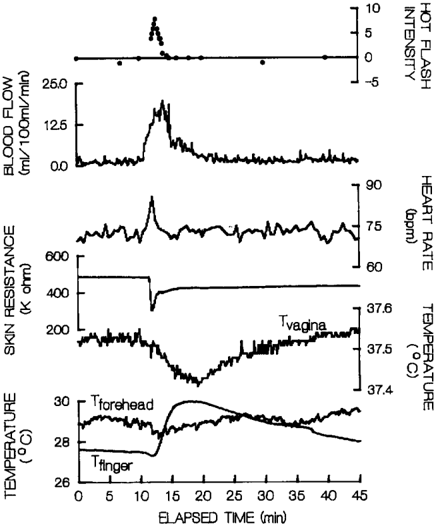
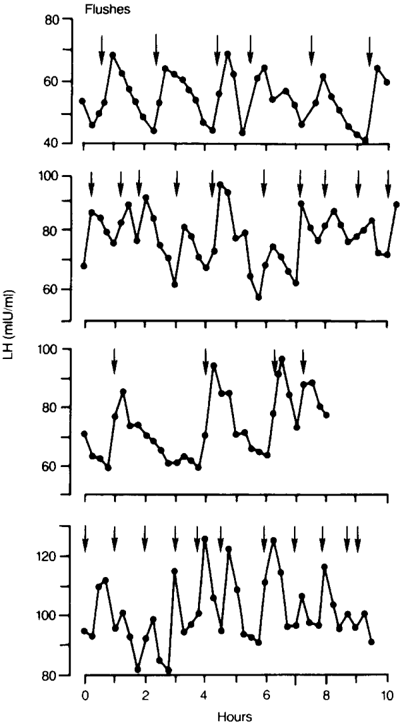
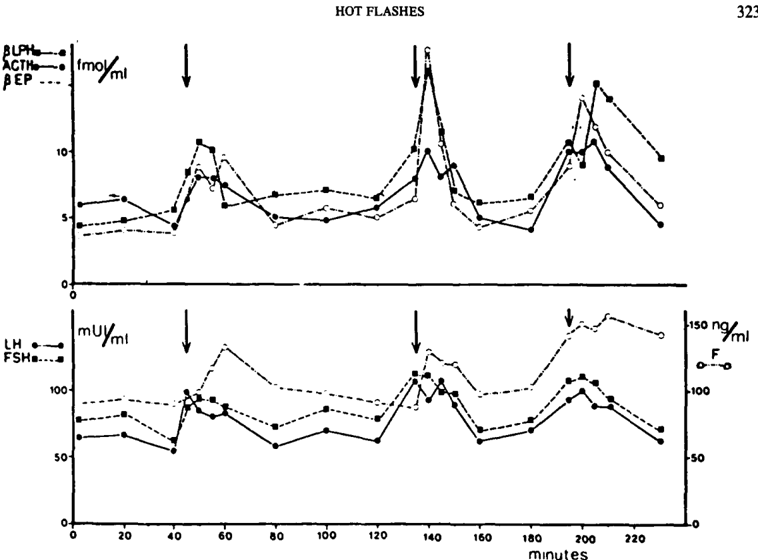
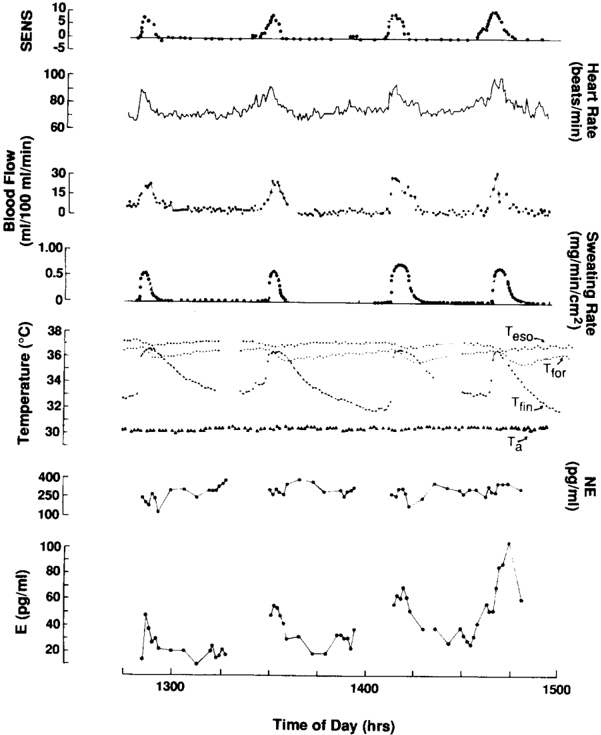
Verification
Claims the paper makes
The claims and statistics of this paper haven’t been checked yet.
Run the check — free, no account needed. It reads the open-access text and checks the sources it cites.
Claims other papers make about this one
Each is checked against this paper’s own text: does it say what the citing paper says it does?
In the citing paper
“Hot flushes do not occur in situations where estrogen is chronically absent from birth, unless exogenous estrogens are administered and then subsequently withdrawn (Kronenberg, 1994).”
From Modulation of body temperature and LH secretion by hypothalamic KNDy (kisspeptin, neurokinin B and dynorphin) neurons: A novel hypothesis on the mechanism of hot flushes (2013) · cites this paper as Kronenberg, 1994
Self-check
Percentages, sums and reported differences re-computed from the paper’s own numbers.
The self-check needs the paper’s full text.
Citations
Cites
Fever: Role of Pyrogens and Cryogens
Kluger, M. J. (1991) · Physiological Reviews · doi:10.1152/physrev.1991.71.1.93 · Cited by 1,220
The normal menopause transition
McKinlay, S. M., Brambilla, D. J., & Posner, J. G. (1992) · Maturitas · doi:10.1016/0378-5122(92)90003-m · Cited by 1,112
Hot Flashes: Epidemiology and Physiology a
KRONENBERG, F. (1990) · Annals of the New York Academy of Sciences · doi:10.1111/j.1749-6632.1990.tb30316.x · Cited by 601
Self-citationThe antiestrogenic effect of cigarette smoking in women
Baron, J. A., Vecchia, C. L., & Levi, F. (1990) · American Journal of Obstetrics and Gynecology · doi:10.1016/0002-9378(90)90420-c · Cited by 594
Oestrogen Therapy and the Menopausal Syndrome
Campbell, S. C., & Whitehead, M. I. (1977) · Clinics in Obstetrics and Gynaecology · doi:10.1016/s0306-3356(21)00374-5 · Cited by 542
Naturally occurring oestrogens in foods--a review.
Price, K., & Fenwick, G. (1985) · Food Additives and Contaminants · doi:10.1080/02652038509373531 · Cited by 465
McKinlay, S. M., & Jefferys, M. (1974) · Journal of Epidemiology & Community Health · doi:10.1136/jech.28.2.108 · Cited by 452
Adlercreutz, H., Fotsis, T., Bannwart, C., Wähälä, K., Mäkelä, T., Brunow, G., & Hase, T. (1986) · Journal of Steroid Biochemistry · doi:10.1016/0022-4731(86)90310-9 · Cited by 378
Association of Waking Episodes With Menopausal Hot Flushes
Erlik, Y. (1981) · JAMA · doi:10.1001/jama.1981.03310420031025 · Cited by 308
Dietary phyto-oestrogens and the menopause in Japan
Adlercreutz, H., Hämäläinen, E. K., Gorbach, S. L., & Goldin, B. R. (1992) · The Lancet · doi:10.1016/0140-6736(92)91174-7 · Cited by 277
Research works printed but not linked: 2
- Casper, 1979, Physical neuroendocrine and neuropharmacologic correlates during menopausal flushes, Endocr. Soc., 125
- Hammar, 1991, Does acupuncture influence the frequency of postmenopausal hot flushes?, NAMS, 76
Cited by
Sorted by citations
Items 201–217 of 217
Jacobson, J. S., Troxel, A. B., Evans, J. M., Klaus, L., Vahdat, L. T., Kinne, D. W., Steve, K. M., Moore, A. A., Rosenman, P. J., Kaufman, E. L., et al. (2001)
Plantade, A. (2010) · Springer eBooks · doi:10.1007/978-2-287-79501-5_4
Lokanatha, D., Babu, K. G., & Bhat, G. R. (2015) · OALib · doi:10.4236/oalib.1102069
MASTER'S PROGRAMME IN URBAN MANAGEMENT AND DEVELOPMENT
Wall, R. S., & Stavropoulos, S. (2014)
ACUPUNTURA NAS ONDAS DE CALOR ACUPUNCTURE ON HOT FLASHES
Lima, M. P., da Silva, M. I., & Foletto, A. D. (2013)
Vithal, S. (2016) · Journal of Evolution of Medical and Dental Sciences · doi:10.14260/jemds/2016/1716
Hormone replacement therapy : benefits and adverse effects
Ödmark, I.-S. (2004) · DiVA at Umeå University (Umeå University)
González, S. V., Puig, F. M., Martos, M. A., Sánchez, M. V. V., Capellán, M. D. M. S., & Martí, S. S. (2009) · Actas Urológicas Españolas · doi:10.4321/s0210-48062009000400001
Psychological Support for the Breast Cancer Patient
Greenberg, D. B. (2010) · Springer eBooks · doi:10.1007/978-3-540-69743-5_28
González, S. V., Puig, F. M., Sánchez, M. V. V., Capellán, M. D. M. S., Martos, M. A., & Martí, S. S. (2009) · Actas Urológicas Españolas · doi:10.4321/s0210-48062009000300005
Botanical Medicines and Phytonutrients in the Management of Menopausal Hot Flashes
Lucius, K. (2024) · Integrative and Complementary Therapies · doi:10.1089/ict.2024.29124.klu · Cited by 1
Liu, Y., He, Y., Zhang, Q., & Lu, Q. (2025) · Biological Research For Nursing · doi:10.1177/10998004251377748
naaz, S. S., Inamdar, N. K., Ahmed, K., Anjum, S. A., Afroz, P. S., & Kudchi, T. (2026) · Advances in Integrative Medicine · doi:10.1016/j.aimed.2026.100712
Hot flashes in postmenopausal women treated for breast carcinoma
Carpenter, J. S., Andrykowski, M. A., Cordova, M., Cunningham, L., Studts, J., McGrath, P., Kenady, D., Sloan, D., & Munn, R. (1998) · Cancer · doi:10.1002/(sici)1097-0142(19980501)82:9
Metadata
- Authors
- Kronenberg, F.
- Affiliations
- Columbia University (US)
- Corresponding author
- Kronenberg, Fredi
- Venue
- Experimental Gerontology
- Publisher
- Elsevier BV
- Published
- 1994-05
- Volume
- 29
- Issue
- 3-4
- Pages
- 319-336
- ISSN
- 0531-5565 (ISSN-L)
- OpenAlex
- W1991681674
- Cited by
- 217
- References
- 86
- Citations by year
- 2026: 1 · 2025: 3 · 2024: 4 · 2023: 3 · 2022: 3 · 2021: 5 · 2020: 1 · 2019: 2 · 2018: 3 · 2017: 5 · 2016: 6 · 2015: 9 · 2014: 5 · 2013: 11 · 2012: 7
- FWCI
- 1.17
- Type
- journal article
- Language
- en
- Open access
- hybrid
- doi.org
- Licence
- Locations
- Experimental Gerontology (publishedVersion, cc-by-nc-nd)
- PubMed (publishedVersion)
- Funders
- Vidda Foundation
- Topics
- Health Sciences › Medicine › Endocrinology, Diabetes and Metabolism › Menopause: Health Impacts and Treatments
- Life Sciences › Biochemistry, Genetics and Molecular Biology › Endocrinology › Estrogen and related hormone effects
- Health Sciences › Nursing › Nutrition and Dietetics › Phytoestrogen effects and research
- Keywords
- hot flashes, menopause, quality of life, sleep disruption, fatigue, estrogen withdrawal, estrogen replacement therapy, thermoregulation, cardiovascular changes, endocrine changes, ambient temperature, phytoestrogens, herbal medicine
- MeSH terms
- Behavior Therapy, Body Temperature Regulation, Climacteric, Endocrine Glands, Estrogens, Female, Humans, Quality of Life, Vitamin E, Magnoliopsida
About these checks
Registry, retraction, Cites and statistics results are computed, not judged, with one exception: a printed reference that no index lists is read once by a model before it counts as a citation error. Claims are extracted by a model and kept only when their quote appears verbatim in the text; each cited source is then checked, with a model’s help, for whether it says what the claim relies on. Those verdicts can be wrong — read the claim’s quote and the cited source before relying on one.
Statistics and arithmetic are recomputed, not judged.
Confidence bands are shown only for fields calibrated on our annotated test set. None is calibrated yet, so no band is shown.
What counts as a claim ›How we measure confidence ›How we check this ›
Are you an author, or do you see a problem with this page? Request a review
