

Mitochondrial changes associated with glutathione deficiency
Open accessThe DOI matches its Crossref record; 22 of the 23 references it cites were found in a registry or an index.
Abstract
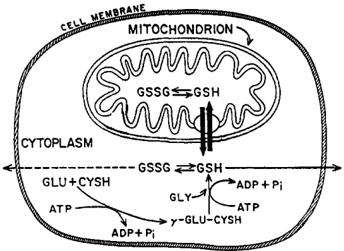
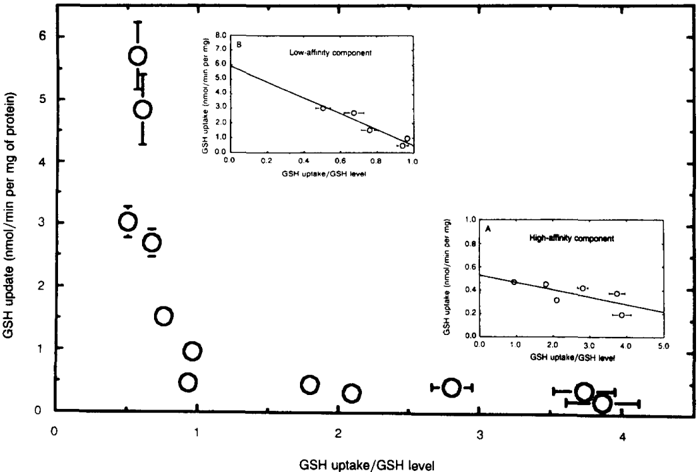
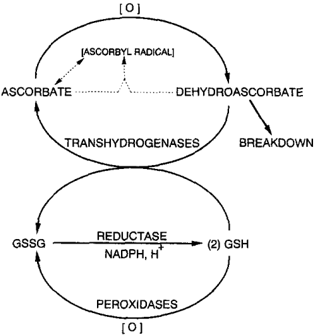
Glutathione deficiency produced by giving buthionine sulfoximine (an inhibitor of gamma-glutamylcysteine synthetase) to animals, leads to biphasic decline in cellular glutathione levels associated with sequestration of glutathione in mitochondria. Liver mitochondria lack the enzymes needed for glutathione synthesis. Mitochondrial glutathione arises from the cytosol. Rat liver mitochondria have a multicomponent system (with Kms of approx. 60 microM and 5.4 mM) that underlies their remarkable ability to transport and retain glutathione. Mitochondria produce substantial quantities of reactive oxygen species; this is opposed by reactions involving glutathione. Glutathione deficiency leads to widespread mitochondrial damage which is lethal in newborn rats and guinea pigs, animals that do not synthesize ascorbate. Glutathione esters and ascorbate protect against the lethal and other effects of glutathione deficiency. Ascorbate spares glutathione; it increases mitochondrial glutathione in glutathione-deficient animals. Glutathione esters delay onset of scurvy in ascorbate-deficient guinea pigs; thus, glutathione spares ascorbate. Glutathione and ascorbate function together in protecting mitochondria from oxidative damage.
Overview
The claims and statistics of this paper haven’t been checked yet.
Free: it reads the open-access text and checks the first 5 claims that cite a source we can check. Create a free account to check every claim.
Integrity signals
Registry
Cites
Statistics
Figures



Verification
Claims the paper makes
The claims and statistics of this paper haven’t been checked yet.
Free: it reads the open-access text and checks the first 5 claims that cite a source we can check. Create a free account to check every claim.
Claims other papers make about this one
Each is checked against this paper’s own text: does it say what the citing paper says it does?
The source backs part of the claim, not all of it — or backs it for a different population, condition or comparison.
In the citing paper
“Deficiency of cellular glutathione leads to mitochondrial damage and apoptosis (287), in part, by loss of GPx-mediated protection against mitochondrial oxidants.”
From Redox regulation of mitochondrial function (2012) · cites this paper as [287]
Experimental — accuracy not yet measuredThe source backs part of the claim, not all of it — or backs it for a different population, condition or comparison.
In the citing paper
“maintained by active transport through the dicarboxylate or 2-oxoglutarate carriers (287, 393)”
From Redox regulation of mitochondrial function (2012) · cites this paper as [287]
Experimental — accuracy not yet measured
Self-check
Percentages, sums and reported differences re-computed from the paper’s own numbers.
The self-check needs the paper’s full text.
Citations
Cites
Meister, A., & Anderson, M. E. (1983) · Annual Review of Biochemistry · doi:10.1146/annurev.bi.52.070183.003431 · Cited by 5,680
Self-citationBoveris, A., & Chance, B. (1973) · Biochemical Journal · doi:10.1042/bj1340707 · Cited by 2,626
Pryor, W. A. (1976) · Cited by 1,876
The cellular production of hydrogen peroxide
Boveris, A., Oshino, N., & Chance, B. (1972) · Biochemical Journal · doi:10.1042/bj1280617 · Cited by 1,547
Meister, A. (1991) · Pharmacology & Therapeutics · doi:10.1016/0163-7258(91)90076-x · Cited by 907
Self-citationGlutathione-ascorbic acid antioxidant system in animals
Meister, A. (1994) · Journal of Biological Chemistry · doi:10.1016/s0021-9258(17)36891-6 · Cited by 811
Self-citationDetection of catalase in rat heart mitochondria.
Radi, R., Turrens, J. F., Chang, L. Y., Bush, K. M., Crapo, J. D., & Freeman, B. A. (1991) · Journal of Biological Chemistry · doi:10.1016/s0021-9258(18)54740-2 · Cited by 573
Respiratory chain linked H2O2 production in pigeon heart mitochondria
Loschen, G., & Flohé, L. (1971) · FEBS Letters · doi:10.1016/0014-5793(71)80459-3 · Cited by 552
Wells, W. W., Xu, D. P., Yang, Y. F., & Rocque, P. A. (1990) · Journal of Biological Chemistry · doi:10.1016/s0021-9258(18)55401-6 · Cited by 450
On the antioxidant effects of ascorbic acid and glutathione
Meister, A. (1992) · Biochemical Pharmacology · doi:10.1016/0006-2952(92)90091-v · Cited by 378
Self-citation
Research works printed but not linked: 35
- Larsson, A., Orrenius, S., Holmgren, A. and Mannervik, B. (eds.) (1983) in Functions of Glutathione. Biochem. Physiol. Toxicol. Clin. Aspects. Raven Press, New York.
- Dolphin, D., Poulson, R. and Avramovic, O. (eds.) (1989) in Glutathione Chemical, Biochemical and Medical Aspects, Parts A and B, John Wiley, New York.
- Taniguchi, N., Higashi, T., Sakamoto, Y. and Meister, A. (eds.) (1989) in Glutathione Centennial Molecular Perspectives and Clini- cal Implications. Academic Press, New York.
- Levy, E.J., Anderson, M.E. and Meister, A. (1993) Proc. Natl. Acad. Sci. USA 90, 9171-9175.
- Mfirtensson, J., Steinberz, R., Jain, A. and Meister, A. (1989) Proc. Natl. Acad. Sci. USA 86, 8727-8731.
- Mårtensson, 1989, 86, 8727
- Griffith, O.W. and Meister, A. (1979) Proc. Natl. Acad. Sci. USA 76, 5606-5610.
- Mf~tensson, J. and Meister, A. (1989) Proc. Natl. Acad. Sci. USA 86, 471-475.
- Mårtensson, 1989, 86, 471
- Griffith, O.W. and Meister, A. (1985) Proc. Natl. Acad. Sci. USA 82, 4668-4672.
- Meister, A. and Griffith, O.W. (1983) Fed. Proc. Fed. Am. Soc. Exp. Biol. 42, 2642.
- Neubert, D., Wojtczak, A.B. and Lehninger, A.L. (1962) Proc. Natl. Acad. Sci. USA 48, 1651-1658.
- Lehninger, A.L., Vercesi, A. and Bababunmi, E.A. (1978) Proc. Natl. Acad. Sci. USA 75, 1690-1694.
- Meredith, M.J. and Reed, D.J. (1982) Proc. Natl. Acad. Sci. USA 257, 3746-3753.
- Fu, Y., M~"tensson, J. and Meister, A. (1989) Ninth Annual Vincent duVigneaud Memorial Research Symposium, Cornell University Medical College (CorneU Univ., New York), Abstract, p. 35.
- M&rtensson, J., Lai, J.C.K. and Meister, A. (1990) FASEB J. 4, 1562.
- M~rtensson, J., Lai, J.C.K. and Meister, A. (1990) Proc. Natl. Acad. Sci. USA 87, 7185-7189.
- M~'tensson, J., Jain, A., Frayer, W. and Meister, A. (1989) Proc. Natl. Acad. Sci. USA 86, 5296-5300.
- M~rtensson, J., Jain, A. and Meister, A. (1990) Proc. Natl. Acad. Sci. USA 87, 1715-1719.
- M~rtensson, J., Jain, A., Stole, E., Frayer, W., Auld, P.A.M. and Meister, A. (1991) Proc. Natl. Acad. Sci. USA 88, 9360-9364.
- M&rtensson, J. and Meister, A. (1991) Proc. Natl. Acad. Sci. USA 88, 4656-4660.
- Mårtensson, 1990, 87, 7185
- Mårtensson, 1989, 86, 5296
- Mårtensson, 1990, 87, 1715
- Mårtensson, 1991, 88, 9360
- Mårtensson, 1991, 88, 4656
- Jain, A., M&rtensson, J., Stole, E., Auld, P.A.M. and Meister, A. (1991) Proc. Natl. Acad. Sci. USA 88, 1913-1917.
- M~-tensson, J. and Meister, A. (1992) Proc. Natl. Acad. Sci. USA 89, 11566-11568.
- M~'tensson, J., Han, J., Griffith, O.W. and Meister, A. (1993) Proc. Natl. Acad. Sci. USA 90, 317-321.
- Mårtensson, 1992, 89, 11566
- Mårtensson, 1993, 90, 317
- Wells, W.W., Yang, Y. and Deits, T.L. (1993) Adv. Enzymol. 66, 149-201.
- Nishino, H. and Akio, I. (1990) Biochem. Intl. 20, 1059-1066.
- Jain, A., M~trtensson, J., Mehta, T., Krauss, A.N., Auld, P.A.M. and Meister, A. (1992) Proc. Natl. Acad. Sci. USA 89, 5093-5097.
- Griffith, O.W. Han, J. and M~'tensson, J. (1991) FASEB J. 5, 4708.
Cited by
Nordberg, J., & Arnér, E. S. J. (2001) · Free Radical Biology and Medicine · doi:10.1016/s0891-5849(01)00724-9 · Cited by 2,662
“Intracellularly, in the aqueous phase, ascorbate and GSH act in concert to protect the cell from oxidative damage [220].”
BackgroundMøller, I. M. (2001) · Annual Review of Plant Physiology and Plant Molecular Biology · doi:10.1146/annurev.arplant.52.1.561 · Cited by 1,664
“In mammalian mitochondria glutathione synthesis takes place in the cytosol, and GSH is taken up across the inner membrane via a special transporter (68).”
BackgroundGlutathione Homeostasis and Functions: Potential Targets for Medical Interventions
Lushchak, V. I. (2012) · Journal of Amino Acids · doi:10.1155/2012/736837 · Cited by 1,266
Mitochondrial Glutathione, a Key Survival Antioxidant
Marí, M., Morales, A., Colell, A., García-Ruiz, C., & Fernández-Checa, J. C. (2009) · Antioxidants & Redox Signaling · doi:10.1089/ars.2009.2695 · Cited by 980
“Another clinical setting inwhichmGSH levels are of critical importance is in drug toxicity (97, 98).”
BackgroundOxidative stress and regulation of glutathione in lung inflammation
Rahman, I., & MacNee, W. (2000) · European Respiratory Journal · doi:10.1034/j.1399-3003.2000.016003534.x · Cited by 923
Metadata
- Authors
- Meister, A.
- Affiliations
- Cornell University (US)
- Corresponding author
- Meister, Alton
- Venue
- Biochimica et Biophysica Acta (BBA) - Molecular Basis of Disease
- Publisher
- Elsevier BV
- Published
- 1995-05
- Volume
- 1271
- Issue
- 1
- Pages
- 35-42
- ISSN
- 0925-4439 (ISSN-L)
- OpenAlex
- W2032884792
- Cited by
- 242
- References
- 23
- Citations by year
- 2026: 2 · 2025: 1 · 2024: 1 · 2023: 5 · 2022: 3 · 2021: 2 · 2020: 6 · 2019: 1 · 2018: 3 · 2017: 4 · 2016: 4 · 2015: 3 · 2014: 6 · 2013: 12 · 2012: 6
- FWCI
- 5.10
- Type
- journal article
- Language
- en
- Open access
- hybrid
- doi.org
- Licence
- cc-by-nc-nd
- www.elsevier.com/tdm/userlicense/1.0/ (tdm)
- www.elsevier.com/legal/tdmrep-license (tdm)
- creativecommons.org/licenses/by-nc-nd/4.0/ (vor, 1666 d)
- Locations
- Biochimica et Biophysica Acta (BBA) - Molecular Basis of Disease (publishedVersion, cc-by-nc-nd)
- PubMed (publishedVersion)
- Funders
- National Institutes of Health (4r37dk012034-26)
- National Institute of Diabetes and Digestive and Kidney Diseases (2-R37-DK-12034)
- Topics
- Life Sciences › Biochemistry, Genetics and Molecular Biology › Biochemistry › Sulfur Compounds in Biology
- Life Sciences › Biochemistry, Genetics and Molecular Biology › Molecular Biology › Redox biology and oxidative stress
- Life Sciences › Biochemistry, Genetics and Molecular Biology › Molecular Biology › Mitochondrial Function and Pathology
- Keywords
- glutathione deficiency, mitochondrial glutathione, buthionine sulfoximine, liver mitochondria, glutathione transport, reactive oxygen species, oxidative damage, vitamin C, scurvy, mitochondrial damage, neonatal rats, guinea pig
- MeSH terms
- Animals, Animals, Newborn, Antimetabolites, Ascorbic Acid, Cerebral Cortex, Glutathione, Guinea Pigs, Liver, Methionine Sulfoximine, Mitochondria, Mitochondria, Liver, Models, Biological, Buthionine Sulfoximine, Mice, Rats
About these checks
Registry, retraction, Cites and statistics results are computed, not judged, with one exception: a printed reference that no index lists is read once by a model before it counts as a citation error. Claims are extracted by a model and kept only when their quote appears verbatim in the text; each cited source is then checked, with a model’s help, for whether it says what the claim relies on. Those verdicts can be wrong — read the claim’s quote and the cited source before relying on one.
Statistics and arithmetic are recomputed, not judged.
Confidence bands are shown only for fields calibrated on our annotated test set. None is calibrated yet, so no band is shown.
What counts as a claim ›How we measure confidence ›How we check this ›
Are you an author, or do you see a problem with this page? Request a review
How to cite
Cite CoChat for the checks on this page, and the paper for its own findings.
- This page
- CoChat. (2026). Citation check: Mitochondrial changes associated with glutathione deficiency. https://app.cochat.ai/papers/10.1016/0925-4439(95)00007-q
- The paper
- Meister, A. (1995). Mitochondrial changes associated with glutathione deficiency. Biochimica et Biophysica Acta (BBA) - Molecular Basis of Disease. https://doi.org/10.1016/0925-4439(95)00007-q
Data sources
Bibliographic data: Semantic Scholar, OpenAlex, Crossref.
Contains information from the Semantic Scholar Academic Graph Datasets, made available under the ODC Attribution License (ODC-BY 1.0).
Semantic Scholar’s data is described in: Kinney, R., et al. (2023). The Semantic Scholar Open Data Platform. arXiv:2301.10140.
