

The DOI matches its Crossref record; 64 of the 65 references it cites were found in a registry or an index.
Mosaic Loss of Chromosome Y in Blood Is Associated with Alzheimer Disease
Open accessAbstract
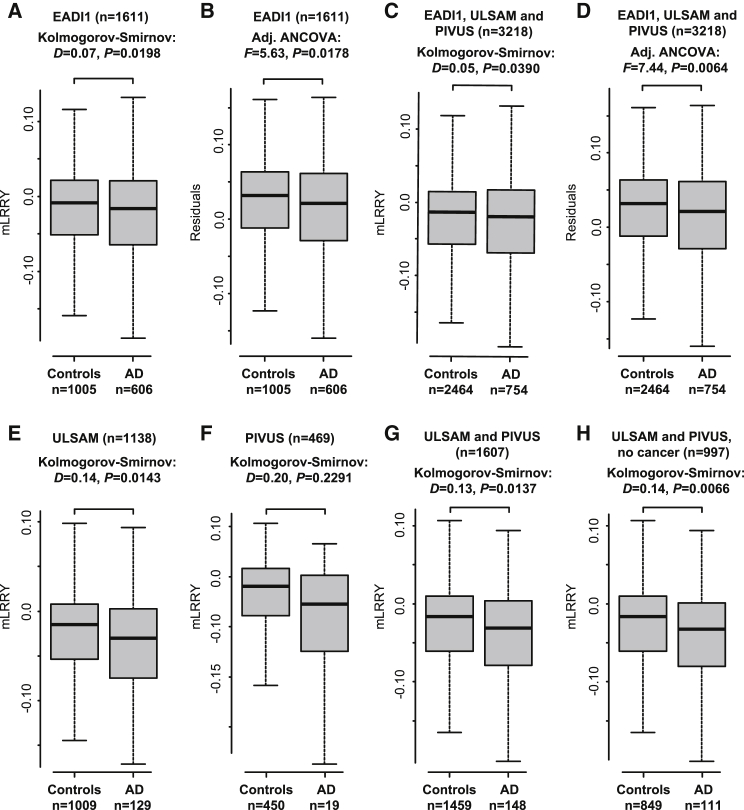
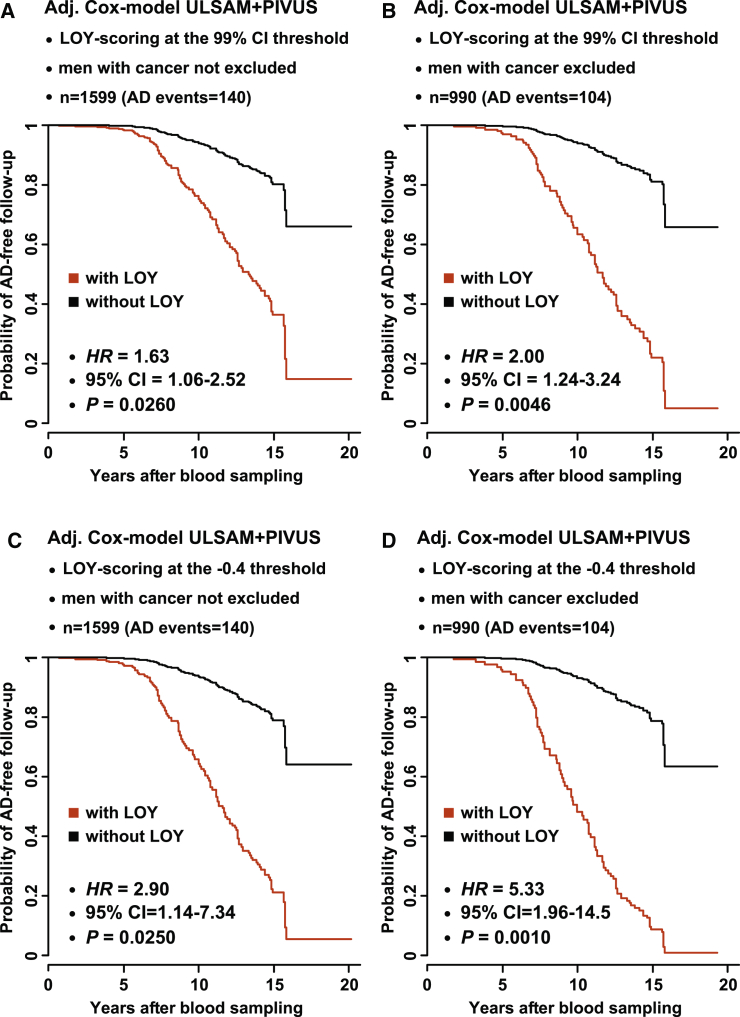
Men have a shorter life expectancy compared with women but the underlying factor(s) are not clear. Late-onset, sporadic Alzheimer disease (AD) is a common and lethal neurodegenerative disorder and many germline inherited variants have been found to influence the risk of developing AD. Our previous results show that a fundamentally different genetic variant, i.e., lifetime-acquired loss of chromosome Y (LOY) in blood cells, is associated with all-cause mortality and an increased risk of non-hematological tumors and that LOY could be induced by tobacco smoking. We tested here a hypothesis that men with LOY are more susceptible to AD and show that LOY is associated with AD in three independent studies of different types. In a case-control study, males with AD diagnosis had higher degree of LOY mosaicism (adjusted odds ratio = 2.80, p = 0.0184, AD events = 606). Furthermore, in two prospective studies, men with LOY at blood sampling had greater risk for incident AD diagnosis during follow-up time (hazard ratio [HR] = 6.80, 95% confidence interval [95% CI] = 2.16-21.43, AD events = 140, p = 0.0011). Thus, LOY in blood is associated with risks of both AD and cancer, suggesting a role of LOY in blood cells on disease processes in other tissues, possibly via defective immunosurveillance. As a male-specific risk factor, LOY might explain why males on average live shorter lives than females.
Overview
The claims and statistics of this paper haven’t been checked yet.
Run the check — free, no account needed. It reads the open-access text and checks the sources it cites.
Integrity signals
Registry
Cites
Statistics
Figures
Verification
Claims the paper makes
The claims and statistics of this paper haven’t been checked yet.
Run the check — free, no account needed. It reads the open-access text and checks the sources it cites.
Claims other papers make about this one
Each is checked against this paper’s own text: does it say what the citing paper says it does?
The source backs part of the claim, not all of it — or backs it for a different population, condition or comparison.
In the citing paper
“However, there is conflicting evidence regarding the impact of CH on Alzheimer’s disease (AD).5,10”
From TET2-mutant myeloid cells mitigate Alzheimer’s disease progression via CNS infiltration and enhanced phagocytosis in mice (2025) · cites this paper as [10]
Experimental — accuracy not yet measuredThe source backs part of the claim, not all of it — or backs it for a different population, condition or comparison.
In the citing paper
“Mosaic chromosomal alterations, including loss of the Y chromosome (LOY), are strongly associated with cardiovascular disease, stroke, and dementia risk [34,44,45].”
From Clonal Hematopoiesis of Indeterminate Potential as an Emerging Interdisciplinary Risk Factor in Alzheimer’s Disease: Current Evidence and Future Directions (2026) · cites this paper as [45]
Experimental — accuracy not yet measured
Self-check
Percentages, sums and reported differences re-computed from the paper’s own numbers.
The self-check needs the paper’s full text.
Citations
Cites
R: A Language and Environment for Statistical Computing
R Core Team (2000) · doi:10.32614/r.manuals · Cited by 355,893
Fast and accurate short read alignment with Burrows-Wheeler transform
Li, H., & Durbin, R. (2009) · Bioinformatics · doi:10.1093/bioinformatics/btp324 · Cited by 58,607
McKhann, G., Drachman, D., Folstein, M., Katzman, R., Price, D., & Stadlan, E. M. (1984) · Neurology · doi:10.1212/wnl.34.7.939 · Cited by 27,915
The Amyloid Hypothesis of Alzheimer’s Disease: Progress and Problems on the Road to Therapeutics
Hardy, J., & Selkoe, D. J. (2002) · Science · doi:10.1126/science.1072994 · Cited by 13,864
Amyloid oligomers exacerbate tau pathology in a mouse model of tauopathy
Selenica, M.-L. B., Brownlow, M., Jimenez, J. P., Lee, D. C., Pena, G., Dickey, C. A., Gordon, M. N., & Morgan, D. (2013) · Neurodegenerative Diseases · doi:10.1159/000337230 · Cited by 10,359
Age-related clonal hematopoiesis associated with adverse outcomes
Jaiswal, S., Fontanillas, P., Flannick, J., Manning, A., Grauman, P. V., Mar, B. G., Lindsley, R. C., Mermel, C. H., Burtt, N., Chavez, A., et al. (2014) · New England Journal of Medicine · doi:10.1056/nejmoa1408617 · Cited by 4,841
Meta-Analysis of 74,046 Individuals Identifies 11 New Susceptibility Loci for Alzheimer’s Disease
(EADI), E. A. D. I., Lambert, J.-C., (GERAD), G. A. E. R. I. A. D., Alzheimer's Disease Genetic Consortium (ADGC), (CHARGE), C. F. H. A. A. R. I. G. E., Ibrahim-Verbaas, C. A., Harold, D., Naj, A. C., Sims, R., Bellenguez, C., et al. (2013) · Nature Genetics · doi:10.1038/ng.2802 · Cited by 4,336
Self-citationClonal hematopoiesis and blood-cancer risk inferred from blood DNA sequence
Genovese, G., Kähler, A. K., Handsaker, R. E., Lindberg, J., Rose, S. A., Bakhoum, S. F., Chambert, K., Mick, E., Neale, B. M., Fromer, M., et al. (2014) · New England Journal of Medicine · doi:10.1056/nejmoa1409405 · Cited by 3,531
Harold, D., Abraham, R., Hollingworth, P., Sims, R., Gerrish, A., Hamshere, M. L., Pahwa, J. S., Moskvina, V., Dowzell, K., Williams, A., et al. (2009) · Nature Genetics · doi:10.1038/ng.440 · Cited by 3,326
TREM2 Variants in Alzheimer's Disease
Guerreiro, R., Wojtas, A., Bras, J., Carrasquillo, M., Rogaeva, E., Majounie, E., Cruchaga, C., Sassi, C., Kauwe, J. S. K., Younkin, S., et al. (2013) · New England Journal of Medicine · doi:10.1056/nejmoa1211851 · Cited by 3,020
Self-citation
Cited by
Sorted by citations
Bao, H., Cao, J., Chen, M., Min, C., Chen, W., Chen, X., Chen, Y., Chen, Y., Chen, Y., Chen, Z., et al. (2023) · Science China Life Sciences · doi:10.1007/s11427-023-2305-0 · Cited by 402
Mechanisms of sex differences in Alzheimer’s disease
Lopez-Lee, C., Torres, E. R. S., Carling, G., & Gan, L. (2024) · Neuron · doi:10.1016/j.neuron.2024.01.024 · Cited by 376
Genetic predisposition to mosaic Y chromosome loss in blood
Thompson, D. J., The Kidney Cancer GWAS Meta-Analysis Project, Genovese, G., Halvardson, J., Ulirsch, J. C., Wright, D. J., Terao, C., Davidsson, O. B., Day, F. R., Sulem, P., et al. (2019) · Nature · doi:10.1038/s41586-019-1765-3 · Cited by 340
Self-citationHematopoietic loss of Y chromosome leads to cardiac fibrosis and heart failure mortality
Sano, S., Horitani, K., Ogawa, H., Halvardson, J., Chavkin, N. W., Wang, Y., Sano, M., Mattisson, J., Hata, A., Danielsson, M., et al. (2022) · Science · doi:10.1126/science.abn3100 · Cited by 277
Self-citationMosaicism in health and disease — clones picking up speed
Forsberg, L. A., Gisselsson, D., & Dumanski, J. P. (2016) · Nature Reviews Genetics · doi:10.1038/nrg.2016.145 · Cited by 261
Self-citation
Metadata
- Authors
- Dumanski, J. P., Lambert, J.-C., Rasi, C., Giedraitis, V., Davies, H., Grenier-Boley, B., Lindgren, C. M., Campion, D., Dufouil, C., Pasquier, F., Amouyel, P., Lannfelt, L., Ingelsson, M., Kilander, L., Lind, L., & Forsberg, L. A.
- Affiliations
- Uppsala University (SE)
- Inserm (FR)
- Broad Institute (US)
- Corresponding author
- Dumanski, Jan P.
- Forsberg, Lars A.
- ORCID
- Venue
- The American Journal of Human Genetics
- Publisher
- Elsevier BV
- Published
- 2016-06
- Volume
- 98
- Issue
- 6
- Pages
- 1208-1219
- ISSN
- 0002-9297 (ISSN-L)
- PMC
- PMC4908225
- OpenAlex
- W2403642712
- Cited by
- 266
- References
- 65
- Citations by year
- 2026: 35 · 2025: 42 · 2024: 33 · 2023: 33 · 2022: 22 · 2021: 33 · 2020: 19 · 2019: 22 · 2018: 14 · 2017: 10 · 2016: 3
- FWCI
- 14.51
- Type
- journal article
- Language
- en
- Open access
- hybrid
- doi.org
- Licence
- Locations
- The American Journal of Human Genetics (publishedVersion, cc-by-nc-nd)
- PubMed Central (publishedVersion, cc-by-nc-nd)
- Europe PMC (PubMed Central) (publishedVersion, cc-by-nc-nd)
- PubMed (publishedVersion)
- Uppsala University Publications (Uppsala University) (submittedVersion, other-oa)
- Funders
- Wellcome Trust (WT098017, 086596, 086596/Z/08/Z, WT064890, WT090532)
- Development of Innovative Strategies for a Transdisciplinary approach to ALZheimer's disease
- Agence Nationale de la Recherche (ANR-11-LABX-0009)
- Cancerfonden
- Hjärt-Lungfonden
- Vetenskapsrådet
- Akademiska Sjukhuset
- Uppsala Universitet
- Science for Life Laboratory
- Topics
- Health Sciences › Medicine › Psychiatry and Mental health › Dementia and Cognitive Impairment Research
- Life Sciences › Neuroscience › Cellular and Molecular Neuroscience › Alzheimer's disease research and treatments
- Life Sciences › Biochemistry, Genetics and Molecular Biology › Genetics › Genetic and Clinical Aspects of Sex Determination and Chromosomal Abnormalities
- Keywords
- Y chromosome mosaicism, Alzheimer's disease, sex differences in mortality, blood cells, cancer risk, immune surveillance, smoking, all-cause mortality
- MeSH terms
- Aged, Aged, 80 and over, Alzheimer Disease, Female, Humans, Longitudinal Studies, Male, Middle Aged, Mosaicism, Prognosis, Prospective Studies, Risk Factors, Case-Control Studies, Polymorphism, Single Nucleotide, Chromosomes, Human, Y
About these checks
Registry, retraction, Cites and statistics results are computed, not judged, with one exception: a printed reference that no index lists is read once by a model before it counts as a citation error. Claims are extracted by a model and kept only when their quote appears verbatim in the text; each cited source is then checked, with a model’s help, for whether it says what the claim relies on. Those verdicts can be wrong — read the claim’s quote and the cited source before relying on one.
Statistics and arithmetic are recomputed, not judged.
Confidence bands are shown only for fields calibrated on our annotated test set. None is calibrated yet, so no band is shown.
What counts as a claim ›How we measure confidence ›How we check this ›
Are you an author, or do you see a problem with this page? Request a review
