

The DOI matches its Crossref record; 56 of the 57 references it cites were found in a registry or an index.
Usage impact on data center electricity needs: A system dynamic forecasting model
Open accessAbstract
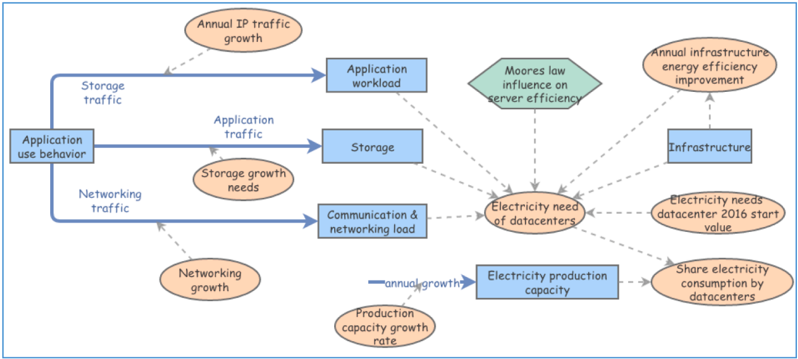
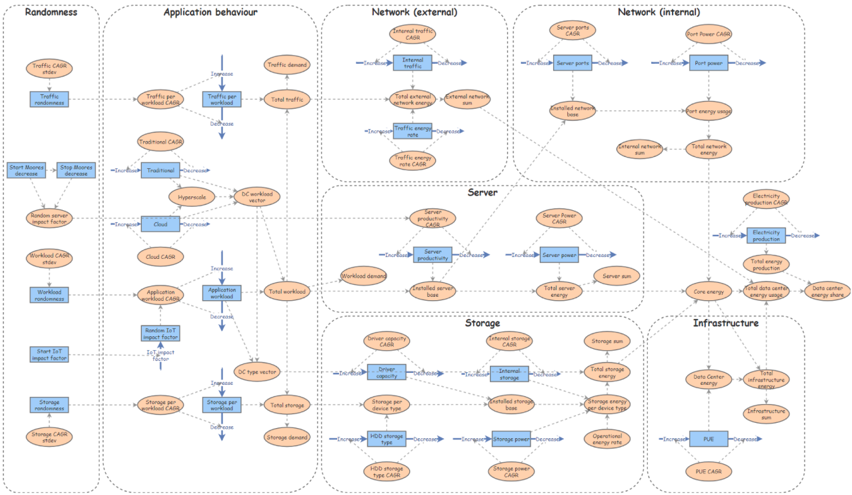
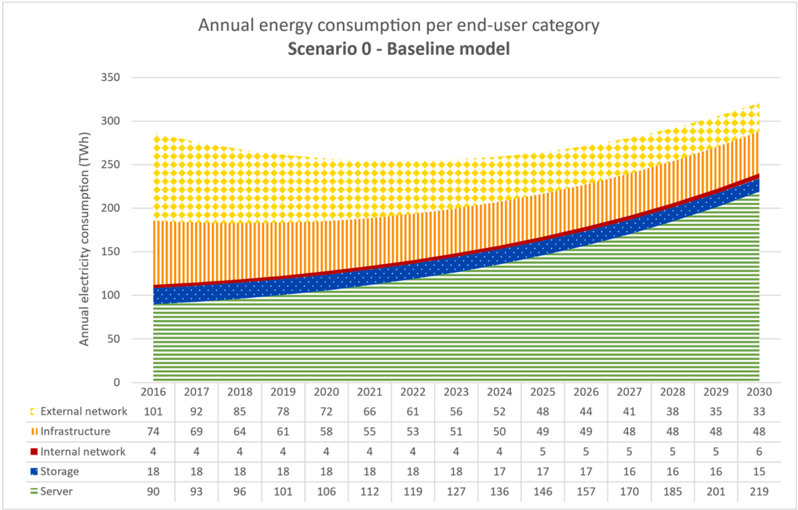
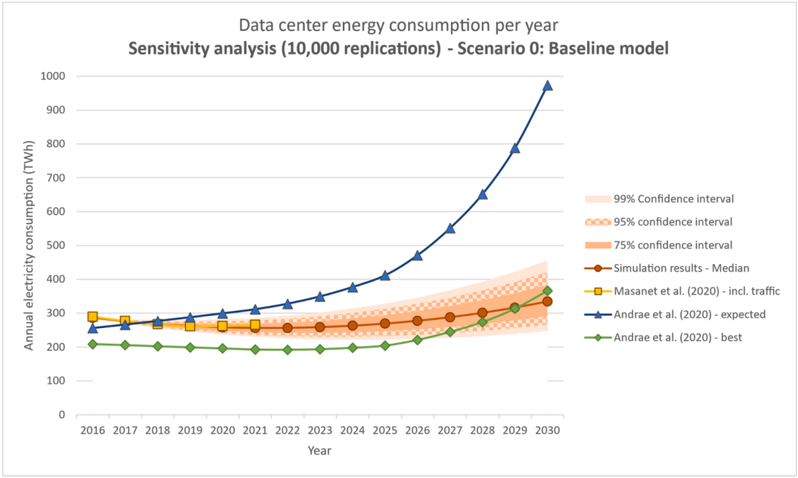
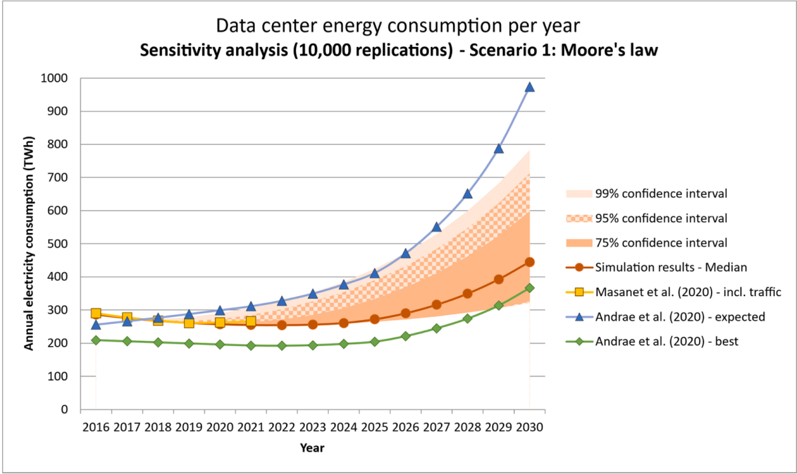
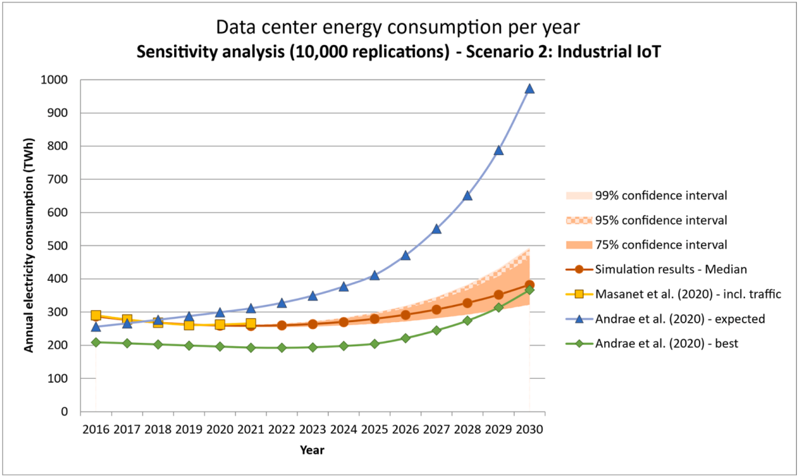
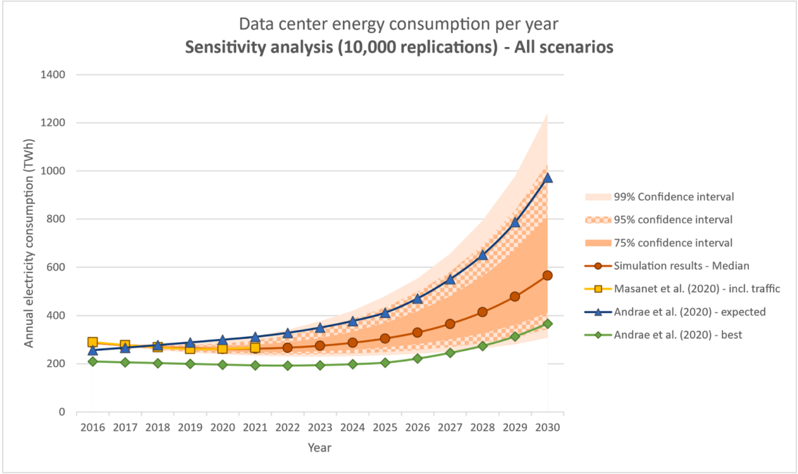
This article presents a forecasting model of data center electricity needs based on understanding usage growth and we conclude that this growth is not fully compensated by efficiency gains of data center technological innovations. We predict a combined growth of data center electricity needs of 286 TWh in 2016 until about 321 TWh in 2030, if all currently known growth factors remain the same. We next run simulations for the end of Moore’s law and the growth of industrial Internet of Things (IoT). The end of Moore’s law results in about 658 TWh for 2030 and an increase of the share of global data center electricity consumption from about 1.15% in 2016 to 1.86% in 2030. A rise of the Industrial IoT may result into total energy consumption of about 364 TWh (about 1.03%) in 2030. Moore’s law and IoT combined cause data center energy needs going up to 752 TWh in 2030, and about 2.13% of global electricity available. Our sensitivity analysis reveals that the future impact of the data centers’ electricity consumption is vulnerable to behavioral usage trends, since the 95% confidence interval of [343, 1031] TWh is relatively wide. Our forecasts, however, exclude the energy needs of mobile devices, edge and fog computing. We offer a system dynamic model and simulation input data selected from the existing literature for replicating this study and applying alternative parameters to it. We further suggest multiple research directions on usage impact on data center energy consumption.
Overview
The claims and statistics of this paper haven’t been checked yet.
Run the check — free, no account needed. It reads the open-access text and checks the sources it cites.
Integrity signals
Registry
Cites
Statistics
Figures

Verification
Claims the paper makes
The claims and statistics of this paper haven’t been checked yet.
Run the check — free, no account needed. It reads the open-access text and checks the sources it cites.
Claims other papers make about this one
Each is checked against this paper’s own text: does it say what the citing paper says it does?
The source backs part of the claim, not all of it — or backs it for a different population, condition or comparison.
In the citing paper
“The energy consumption of data centres alone will rise from 200 TWh in 2016 to 2967 TWh in 2030.”
From Energy efficiency in cloud computing data centers: a survey on software technologies (2023) · cites this paper as [2]
Experimental — accuracy not yet measured
Self-check
Percentages, sums and reported differences re-computed from the paper’s own numbers.
The self-check needs the paper’s full text.
Citations
Cites
Rogers, E. M., Singhal, A., & Quinlan, M. M. (2019) · Routledge eBooks · doi:10.4324/9780203710753-35 · Cited by 37,670
Five disruptive technology directions for 5G
Boccardi, F., Heath, R. W., Lozano, A., Marzetta, T. L., & Popovski, P. (2014) · IEEE Communications Magazine · doi:10.1109/mcom.2014.6736746 · Cited by 3,698
Scenarios: The art of strategic conversation
Schlange, L. E. (1997) · Futures · doi:10.1016/s0016-3287(97)90139-7 · Cited by 1,929
Recalibrating global data center energy-use estimates
Masanet, E., Shehabi, A., Lei, N., Smith, S., & Koomey, J. (2020) · Science · doi:10.1126/science.aba3758 · Cited by 1,545
On Global Electricity Usage of Communication Technology: Trends to 2030
Andrae, A., & Edler, T. (2015) · Challenges · doi:10.3390/challe6010117 · Cited by 1,334
Data Center Energy Consumption Modeling: A Survey
Dayarathna, M., Wen, Y., & Fan, R. (2016) · IEEE Communications Surveys & Tutorials · doi:10.1109/comst.2015.2481183 · Cited by 1,165
Valente, T. W. (2010) · Oxford University Press eBooks · doi:10.1093/acprof:oso/9780195301014.003.0010 · Cited by 1,143
A survey of blockchain from the perspectives of applications, challenges, and opportunities
Monrat, A. A., Schelen, O., & Andersson, K. (2019) · IEEE Access · doi:10.1109/access.2019.2936094 · Cited by 1,077
United States Data Center Energy Usage Report
Lawrence Berkeley National Laboratory (LBNL), B., Shehabi, A., USDOE, Smith, S., Sartor, D., Brown, R., Herrlin, M., Koomey, J., Masanet, E., Horner, N., et al. (2016) · doi:10.2172/1372902 · Cited by 1,040
All models are wrong: reflections on becoming a systems scientist
Sterman, J. D. (2002) · System Dynamics Review · doi:10.1002/sdr.261 · Cited by 1,021
Cited by
Sorted by citations
Energy efficiency in cloud computing data centers: a survey on software technologies
Katal, A., Dahiya, S., & Choudhury, T. (2023) · Cluster Computing · doi:10.1007/s10586-022-03713-0 · Cited by 516
“The energy consumption of data centres alone will rise from 200 TWh in 2016 to 2967 TWh in 2030 [2].”
BackgroundThe emerging driving force of energy consumption in China: Does digital economy development matter?
Xue, Y., Tang, C., Wu, H., Liu, J., & Hao, Y. (2022) · Energy Policy · doi:10.1016/j.enpol.2022.112997 · Cited by 402
Liquid cooling of data centers: A necessity facing challenges
Azarifar, M., Arık, M., & Chang, J.-Y. (2024) · Applied Thermal Engineering · doi:10.1016/j.applthermaleng.2024.123112 · Cited by 231
Du, J., Shen, Z., Song, M., & Zhang, L. L. (2023) · Energy Economics · doi:10.1016/j.eneco.2023.106572 · Cited by 222
Exploring the sustainability challenges facing digitalization and internet data centers
Kez, D. A., Foley, A. M., Laverty, D., Rio, D. D. F. D., & Sovacool, B. K. (2022) · Journal of Cleaner Production · doi:10.1016/j.jclepro.2022.133633 · Cited by 202
Metadata
- Authors
- Koot, M., & Wijnhoven, F.
- Affiliations
- University of Twente (NL)
- Corresponding author
- Wijnhoven, Fons
- Venue
- Applied Energy
- Publisher
- Elsevier BV
- Published
- 2021-06
- Volume
- 291
- Pages
- 116798
- ISSN
- 0306-2619 (ISSN-L)
- OpenAlex
- W3136117146
- Cited by
- 403
- References
- 57
- Citations by year
- 2026: 79 · 2025: 99 · 2024: 86 · 2023: 71 · 2022: 46 · 2021: 22
- FWCI
- 16.55
- Type
- journal article
- Language
- en
- Open access
- hybrid
- doi.org
- Licence
- Locations
- Applied Energy (publishedVersion, cc-by)
- University of Twente Research Information (publishedVersion, cc-by)
- RePEc: Research Papers in Economics (submittedVersion)
- University of Twente Research Information (submittedVersion, cc-by)
- Topics
- Physical Sciences › Engineering › Electrical and Electronic Engineering › Green IT and Sustainability
- Physical Sciences › Computer Science › Hardware and Architecture › Energy Efficiency in Computing
- Physical Sciences › Computer Science › Information Systems › Cloud Computing and Resource Management
- Keywords
- energy forecasting, Moore's law, Industrial Internet of Things, data center efficiency, system dynamics modeling, energy consumption projections
About these checks
Registry, retraction, Cites and statistics results are computed, not judged, with one exception: a printed reference that no index lists is read once by a model before it counts as a citation error. Claims are extracted by a model and kept only when their quote appears verbatim in the text; each cited source is then checked, with a model’s help, for whether it says what the claim relies on. Those verdicts can be wrong — read the claim’s quote and the cited source before relying on one.
Statistics and arithmetic are recomputed, not judged.
Confidence bands are shown only for fields calibrated on our annotated test set. None is calibrated yet, so no band is shown.
What counts as a claim ›How we measure confidence ›How we check this ›
Are you an author, or do you see a problem with this page? Request a review
