

The DOI matches its Crossref record; 104 of the 104 references it cites were found in a registry or an index.
Combined physical and cognitive training for older adults with and without cognitive impairment: A systematic review and network meta-analysis of randomized controlled trials
Open accessPublished version of a preprint
Abstract
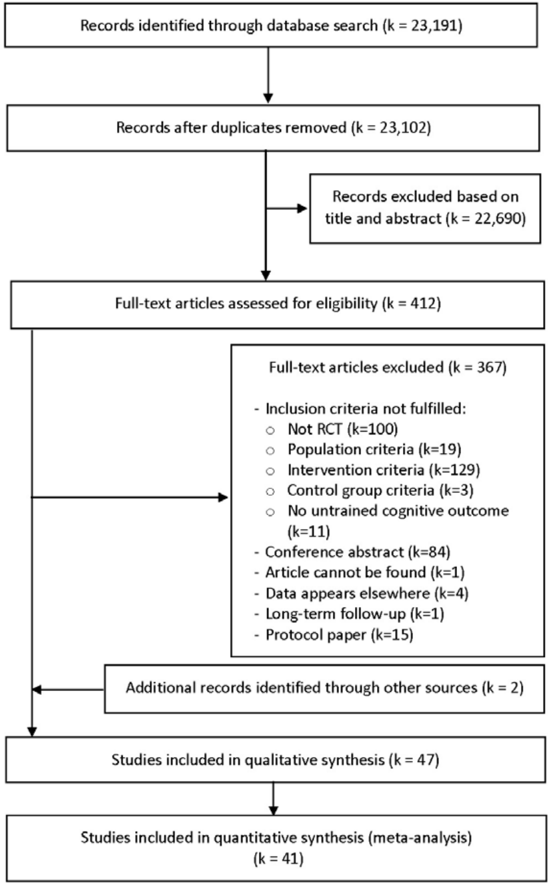
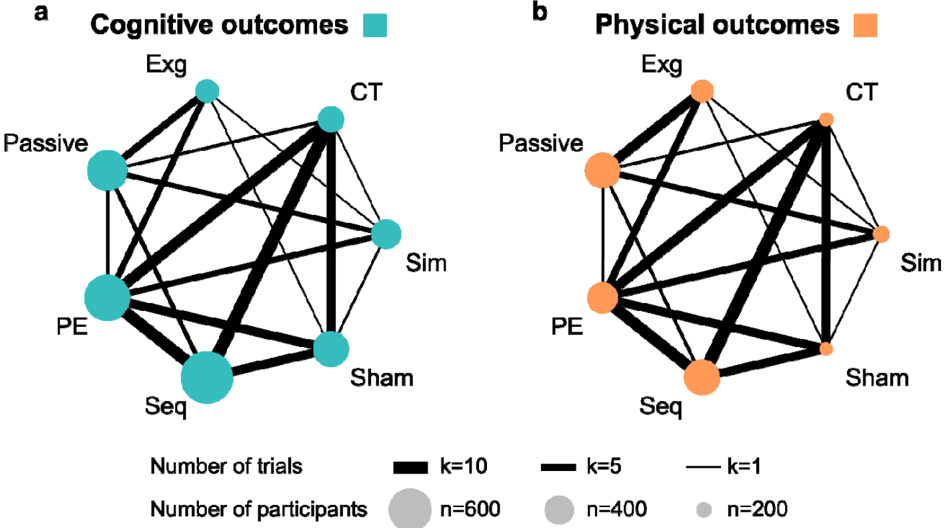
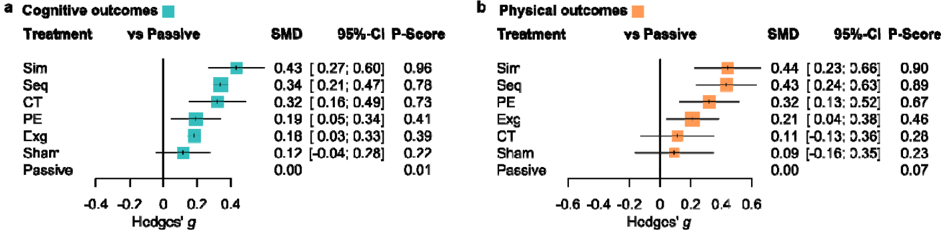
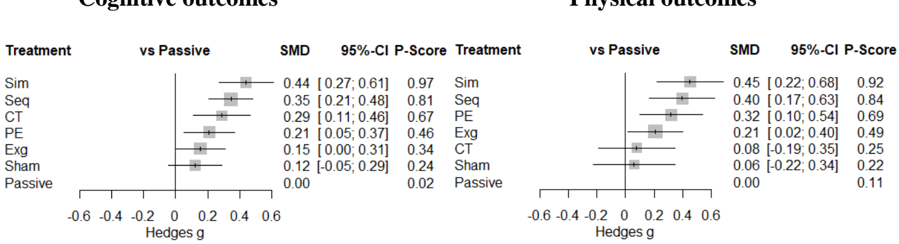
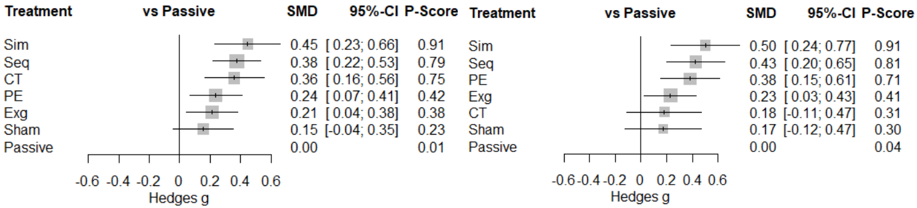
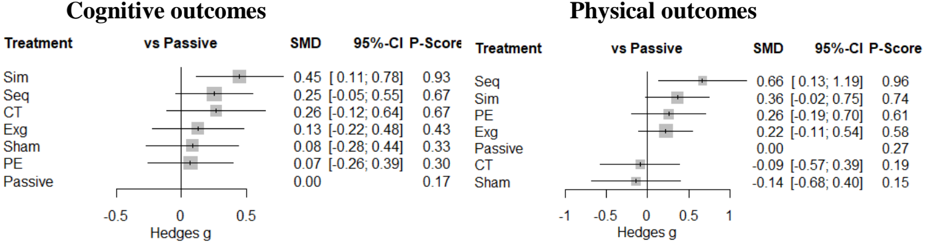
Combining physical exercise with cognitive training is a popular intervention in dementia prevention trials and guidelines. However, it remains unclear what combination strategies are most beneficial for cognitive and physical outcomes. We aimed to compare the efficacy of the three main types of combination strategies (simultaneous, sequential or exergaming) to either intervention alone or control in older adults. Randomized controlled trials of combined cognitive and physical training were included in multivariate and network meta-analyses. In cognitively healthy older adults and mild cognitive impairment, the effect of any combined intervention relative to control was small and statistically significant for overall cognitive (k = 41, Hedges' g = 0.22, 95 % CI 0.14 to 0.30) and physical function (k = 32, g = 0.25, 95 % CI 0.13 to 0.37). Simultaneous training was the most efficacious approach for cognition, followed by sequential combinations and cognitive training alone, and significantly better than physical exercise. For physical outcomes, simultaneous and sequential training showed comparable efficacy as exercise alone and significantly exceeded all other control conditions. Exergaming ranked low for both outcomes. Our findings suggest that simultaneously and sequentially combined interventions are efficacious for promoting cognitive alongside physical health in older adults, and therefore should be preferred over implementation of single-domain training.
Overview
The claims and statistics of this paper haven’t been checked yet.
Run the check — free, no account needed. It reads the open-access text and checks the sources it cites.
Integrity signals
Registry
Cites
Statistics
Figures
Verification
Claims the paper makes
The claims and statistics of this paper haven’t been checked yet.
Run the check — free, no account needed. It reads the open-access text and checks the sources it cites.
Claims other papers make about this one
Each is checked against this paper’s own text: does it say what the citing paper says it does?
The cited source says what the claim attributes to it.
In the citing paper
“The Cattell-Horn-Carroll-Miyake Model of Cognition for Clinical Assessment22 was used to categorise the tests.”
From Effectiveness of exercise for improving cognition, memory and executive function: a systematic umbrella review and meta-meta-analysis (2025) · cites this paper as [22]
Self-check
Percentages, sums and reported differences re-computed from the paper’s own numbers.
The self-check needs the paper’s full text.
Citations
Cites
1 retracted
Dementia prevention, intervention, and care: 2020 report of the Lancet Commission
Livingston, G., Huntley, J., Sommerlad, A., Ames, D., Ballard, C., Banerjee, S., Brayne, C., Burns, A., Cohen-Mansfield, J., Cooper, C., et al. (2020) · The Lancet · doi:10.1016/s0140-6736(20)30367-6 · Cited by 10,430
RetractedBias in meta-analysis detected by a simple, graphical test
Egger, M., Smith, G. D., Schneider, M., & Minder, C. (1997) · BMJ · doi:10.1136/bmj.315.7109.629 · Cited by 56,722
RoB 2: a revised tool for assessing risk of bias in randomised trials
Sterne, J. A. C., Savović, J., Page, M. J., Elbers, R. G., Blencowe, N. S., Boutron, I., Cates, C. J., Cheng, H.-Y., Corbett, M. S., Eldridge, S. M., et al. (2019) · BMJ · doi:10.1136/bmj.l4898 · Cited by 34,787
Liberati, A., Altman, D. G., Tetzlaff, J., Mulrow, C., Gøtzsche, P. C., Ioannidis, J. P. A., Clarke, M., Devereaux, P. J., Kleijnen, J., & Moher, D. (2009) · PLoS Medicine · doi:10.1371/journal.pmed.1000100 · Cited by 28,164
Hutton, B., Salanti, G., Caldwell, D. M., Chaimani, A., Schmid, C. H., Cameron, C., Ioannidis, J. P. A., Straus, S., Thorlund, K., Jansen, J. P., et al. (2015) · Annals of Internal Medicine · doi:10.7326/m14-2385 · Cited by 8,269
Sterne, J. A. C., Sutton, A. J., Ioannidis, J. P. A., Terrin, N., Jones, D. R., Lau, J., Carpenter, J., Rucker, G., Harbord, R. M., Schmid, C. H., et al. (2011) · BMJ · doi:10.1136/bmj.d4002 · Cited by 7,709
Dementia prevention, intervention, and care
Livingston, G., Sommerlad, A., Orgeta, V., Costafreda, S. G., Huntley, J., Ames, D., Ballard, C., Banerjee, S., Burns, A., Cohen-Mansfield, J., et al. (2017) · The Lancet · doi:10.1016/s0140-6736(17)31363-6 · Cited by 6,072
Ngandu, T., Lehtisalo, J., Solomon, A., Levälahti, E., Ahtiluoto, S., Antikainen, R., Bäckman, L., Hänninen, T., Jula, A., Laatikainen, T., et al. (2015) · The Lancet · doi:10.1016/s0140-6736(15)60461-5 · Cited by 3,689
Interpretation of random effects meta-analyses
Riley, R. D., Higgins, J. P. T., & Deeks, J. J. (2011) · BMJ · doi:10.1136/bmj.d549 · Cited by 2,884
Cited by
Sorted by citations
Exploring the Role of Neuroplasticity in Development, Aging, and Neurodegeneration
Marzola, P., Melzer, T., Pavesi, E., Gil-Mohapel, J., & Brocardo, P. S. (2023) · Brain Sciences · doi:10.3390/brainsci13121610 · Cited by 281
Dementia Prevention and Treatment
Reuben, D. B., Kremen, S. A., & Maust, D. T. (2024) · JAMA Internal Medicine · doi:10.1001/jamainternmed.2023.8522 · Cited by 225
An umbrella review of randomized control trials on the effects of physical exercise on cognition
Ciria, L. F., Román-Caballero, R., Vadillo, M. A., Holgado, D., Luque-Casado, A., Perakakis, P., & Sanabria, D. (2023) · Nature Human Behaviour · doi:10.1038/s41562-023-01554-4 · Cited by 157
Singh, B., Bennett, H., Miatke, A., Dumuid, D., Curtis, R., Ferguson, T., Brinsley, J., Szeto, K., Petersen, J. M., Gough, C., et al. (2025) · British Journal of Sports Medicine · doi:10.1136/bjsports-2024-108589 · Cited by 157
Self-citationWatts, E. L., Matthews, C. E., Freeman, J. R., Gorzelitz, J., Hong, H. G., Liao, L. M., McClain, K. M., Saint‐Maurice, P. F., Shiroma, E. J., & Moore, S. C. (2022) · JAMA Network Open · doi:10.1001/jamanetworkopen.2022.28510 · Cited by 119
Metadata
- Authors
- Gavelin, H. M., Dong, C., Minkov, R., Bahar-Fuchs, A., Ellis, K. A., Lautenschlager, N. T., Mellow, M. L., Wade, A. T., Smith, A. E., Finke, C., Krohn, S., & Lampit, A.
- Affiliations
- The University of Melbourne (AU)
- University of South Australia (AU)
- Humboldt-Universität zu Berlin (DE)
- Corresponding author
- Lampit, Amit
- ORCID
- Venue
- Ageing Research Reviews
- Publisher
- Elsevier BV
- Published
- 2021-03
- Volume
- 66
- Pages
- 101232
- ISSN
- 1568-1637 (ISSN-L)
- OpenAlex
- W3108507079
- Cited by
- 371
- References
- 104
- Citations by year
- 2026: 68 · 2025: 83 · 2024: 74 · 2023: 62 · 2022: 62 · 2021: 22
- FWCI
- 6.04
- Type
- journal article
- Language
- en
- Open access
- green
- doi.org
- Licence
- Locations
- Ageing Research Reviews (publishedVersion)
- medRxiv (acceptedVersion, cc-by-nc-nd)
- PubMed (publishedVersion)
- UniSA Research Outputs Repository (University of South Australia) (submittedVersion)
- Adelaide Research & Scholarship (AR&S) (University of Adelaide) (submittedVersion, other-oa)
- Figshare (submittedVersion, cc-by)
- Funders
- University of Melbourne
- National Health and Medical Research Council (GNT1171313)
- Topics
- Health Sciences › Medicine › Psychiatry and Mental health › Dementia and Cognitive Impairment Research
- Health Sciences › Medicine › Public Health, Environmental and Occupational Health › Physical Activity and Health
- Social Sciences › Psychology › Experimental and Cognitive Psychology › Cognitive Functions and Memory
- Keywords
- older adults, mild cognitive impairment, dementia prevention, simultaneous training, sequential training, exergames, physical activity, cognitive training, physical function, cognitive function
- MeSH terms
- Network Meta-Analysis, Aged, Cognition, Cognition Disorders, Humans, Randomized Controlled Trials as Topic, Cognitive Dysfunction
About these checks
Registry, retraction, Cites and statistics results are computed, not judged, with one exception: a printed reference that no index lists is read once by a model before it counts as a citation error. Claims are extracted by a model and kept only when their quote appears verbatim in the text; each cited source is then checked, with a model’s help, for whether it says what the claim relies on. Those verdicts can be wrong — read the claim’s quote and the cited source before relying on one.
Statistics and arithmetic are recomputed, not judged.
Confidence bands are shown only for fields calibrated on our annotated test set. None is calibrated yet, so no band is shown.
What counts as a claim ›How we measure confidence ›How we check this ›
Are you an author, or do you see a problem with this page? Request a review
