

The DOI matches its Crossref record; 213 of the 213 references it cites were found in a registry or an index.
Recent advances in biochar-based adsorbents for CO2 capture
Open accessAbstract
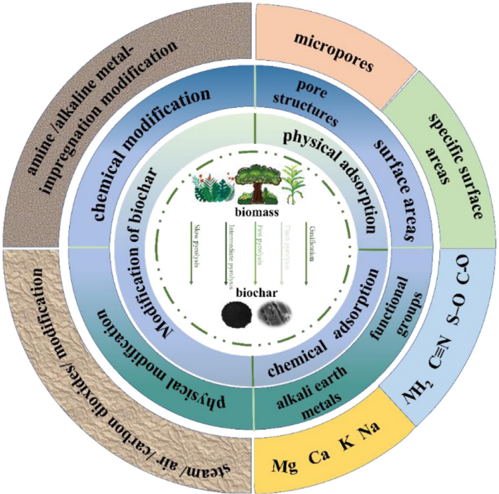
The global industrialization accelerates the use of fossil fuels and hence the excessive emissions of greenhouse gasses, especially carbon dioxide (CO2), which poses a serious threat to the ecological environment. CO2 capture is considered as a potential strategy to reduce the amount of CO2 released into the atmosphere. The development of adsorption materials that are both economically feasible and effective is the most critical issue. Biochar is a promising candidate for CO2 capture among the capture materials. It offers a diverse range of raw materials and a lower environmental impact than other adsorbent materials. Even though pristine biochar could be employed directly to CO2 capture, it generally exhibits a poor adsorption performance. Therefore, biochar needs to be modified in practical applications to improve physicochemical properties such as specific surface area, pore structure, and surface functional groups. This paper summaries recent research advances in biochar-based adsorbents for CO2 adsorption. Pre-combustion capture technology and post-combustion capture technology are investigated. The production of biochar and the influence of raw materials and process conditions on the adsorption capacity of CO2 are described in detail. The mechanism of CO2 adsorption on biochar is also discussed, which summarized physical and chemical adsorption, respectively, as well as the corresponding presentation of some current methods of physical/chemical modification of biochar. Finally, the future prospects are proposed in order to provide a guideline for the adsorption of CO2 by biochar. Despite the progress made in the production of biochar for CO2 adsorption, more efforts are needed to produce biochar with higher adsorption capacity and long-term stability for large-scale CO2 capture.
Overview
The claims and statistics of this paper haven’t been checked yet.
Run the check — free, no account needed. It reads the open-access text and checks the sources it cites.
Integrity signals
Registry
Cites
Statistics
Figures

Verification
Claims the paper makes
The claims and statistics of this paper haven’t been checked yet.
Run the check — free, no account needed. It reads the open-access text and checks the sources it cites.
Claims other papers make about this one
Each is checked against this paper’s own text: does it say what the citing paper says it does?
The source backs part of the claim, not all of it — or backs it for a different population, condition or comparison.
In the citing paper
“The adsorption capacity of zeolites decreases significantly at 30 °C, despite their enhanced stability and suitability for gas adsorption.”
From Metals incorporated agricultural waste corn Cob-based biochar used as an adsorbent for CO2 capturing (2025) · cites this paper as [21]
Experimental — accuracy not yet measuredThe cited source says what the claim attributes to it.
In the citing paper
“Numerous studies have been conducted to improve the physical and chemical properties of raw biochar through various modification processes21, resulting in the creation of modified biochar that significantly improves its adsorption capacity.”
From Metals incorporated agricultural waste corn Cob-based biochar used as an adsorbent for CO2 capturing (2025) · cites this paper as [21]
The cited source says what the claim attributes to it.
In the citing paper
“A high regeneration temperature is required to support the energy-intensive regeneration process20,21.”
From Metals incorporated agricultural waste corn Cob-based biochar used as an adsorbent for CO2 capturing (2025) · cites this paper as [21]
The cited source says what the claim attributes to it.
In the citing paper
“The primary constituents of biochar are carbon, hydrogen, oxygen, and nitrogen, with carbon making up more than 40% of the total elemental composition21.”
From Metals incorporated agricultural waste corn Cob-based biochar used as an adsorbent for CO2 capturing (2025) · cites this paper as [21]
Self-check
Percentages, sums and reported differences re-computed from the paper’s own numbers.
The self-check needs the paper’s full text.
Citations
Cites
1 retracted
Igalavithana, A. D., Choi, S. W., Shang, J., Hanif, A., Dissanayake, P. D., Tsang, D. C. W., Kwon, J., Lee, K. B., & Ok, Y. S. (2020) · The Science of The Total Environment · doi:10.1016/j.scitotenv.2020.139845 · Cited by 185
RetractedReview of fast pyrolysis of biomass and product upgrading
Bridgwater, A. V. (2012) · Biomass and Bioenergy · doi:10.1016/j.biombioe.2011.01.048 · Cited by 4,856
Biochar as a sorbent for contaminant management in soil and water: A review
Ahmad, M., Rajapaksha, A. U., Lim, J. E., Zhang, M., Bolan, N., Mohan, D., Vithanage, M., Lee, S. S., & Ok, Y. S. (2014) · Chemosphere · doi:10.1016/j.chemosphere.2013.10.071 · Cited by 4,662
Raman Spectra of Graphite Oxide and Functionalized Graphene Sheets
Kudin, K. N., Ozbas, B., Schniepp, H. C., Prud’homme, R. K., Aksay, İ. A., & Car, R. (2007) · Nano Letters · doi:10.1021/nl071822y · Cited by 4,502
Amine Scrubbing for CO 2 Capture
Rochelle, G. T. (2009) · Science · doi:10.1126/science.1176731 · Cited by 4,468
Dynamic Molecular Structure of Plant Biomass-Derived Black Carbon (Biochar)
Keiluweit, M., Nico, P. S., Johnson, M. G., & Kleber, M. (2010) · Environmental Science & Technology · doi:10.1021/es9031419 · Cited by 3,230
Biochar for environmental management: science and technology
(2009) · Choice Reviews Online · doi:10.5860/choice.47-0296 · Cited by 2,947
Adsorbent Materials for Carbon Dioxide Capture from Large Anthropogenic Point Sources
Choi, S., Drese, J. H., & Jones, C. W. (2009) · ChemSusChem · doi:10.1002/cssc.200900036 · Cited by 2,602
Porous materials with optimal adsorption thermodynamics and kinetics for CO2 separation
Nugent, P., Belmabkhout, Y., Burd, S. D., Cairns, A., Luebke, R., Forrest, K. A., Pham, T., Ma, S., Space, B., Wojtas, Ł., et al. (2013) · Nature · doi:10.1038/nature11893 · Cited by 2,388
Preparation, modification and environmental application of biochar: A review
Wang, J., & Wang, S. (2019) · Journal of Cleaner Production · doi:10.1016/j.jclepro.2019.04.282 · Cited by 2,345
Research works printed but not linked: 3
- 2020, carbon dioxide at record high levels despite reduced emissions in, Met Office
- You, 2017, A critical review on sustainable biochar system through gasification: energy and environmental applications, Bioresour. Technol., 246, 242, 10.1016/j.biortech.2017.06.177 · DOI
- Li, 2016, Influences of doping nitrogen, sulfur, and phosphorus on the activated carbons for gas adsorption of H2, CH4 and CO2, RSC Adv., 6
Cited by
Sorted by citations
Items 101–102 of 102
Feizi-Afshar, B., Vafajoo, L., & Farzi, A. (2026) · Results in Chemistry · doi:10.1016/j.rechem.2025.102921 · Cited by 4
Metals incorporated agricultural waste corn Cob-based biochar used as an adsorbent for CO2 capturing
Ahmed, S., Hossain, D., Dipti, S. S., Karim, M. A., & Azad, M. A. K. (2025) · Scientific Reports · doi:10.1038/s41598-025-31699-3 · Cited by 4
Metadata
- Authors
- Guo, S., Li, Y., Wang, Y., Wang, L., Sun, Y., & Liu, L.
- Affiliations
- Nankai University (CN)
- Beihang University (CN)
- Corresponding author
- Sun, Yifei
- Liu, Lina
- Venue
- Carbon Capture Science & Technology
- Publisher
- Elsevier BV
- Published
- 2022-09
- Volume
- 4
- Pages
- 100059
- ISSN
- 2772-6568 (ISSN-L)
- OpenAlex
- W4285405596
- Cited by
- 201
- References
- 211
- Citations by year
- 2026: 35 · 2025: 74 · 2024: 58 · 2023: 29 · 2022: 5
- FWCI
- 15.65
- Type
- journal article
- Language
- en
- Open access
- gold
- doi.org
- Licence
- Locations
- Carbon Capture Science & Technology (publishedVersion, cc-by-nc-nd)
- DOAJ (DOAJ: Directory of Open Access Journals) (submittedVersion, cc-by-sa)
- Funders
- National Natural Science Foundation of China (21976011, 22006075)
- Topics
- Physical Sciences › Chemical Engineering › Filtration and Separation › Carbon Dioxide Capture Technologies
- Physical Sciences › Energy › Fuel Technology › Thermochemical Biomass Conversion Processes
- Physical Sciences › Environmental Science › Water Science and Technology › Adsorption and biosorption for pollutant removal
- Keywords
- biochar, CO2 capture, CO2 adsorption, biochar modification, pre-combustion capture, post-combustion CO2 capture, adsorption mechanism, physisorption, chemisorption, biochar production, surface functional groups, adsorption capacity, long-term stability
About these checks
Registry, retraction, Cites and statistics results are computed, not judged, with one exception: a printed reference that no index lists is read once by a model before it counts as a citation error. Claims are extracted by a model and kept only when their quote appears verbatim in the text; each cited source is then checked, with a model’s help, for whether it says what the claim relies on. Those verdicts can be wrong — read the claim’s quote and the cited source before relying on one.
Statistics and arithmetic are recomputed, not judged.
Confidence bands are shown only for fields calibrated on our annotated test set. None is calibrated yet, so no band is shown.
What counts as a claim ›How we measure confidence ›How we check this ›
Are you an author, or do you see a problem with this page? Request a review
