

The DOI matches its Crossref record; 72 of the 73 references it cites were found in a registry or an index.
Single-Cell Transcriptomics Reveals that Differentiation and Spatial Signatures Shape Epidermal and Hair Follicle Heterogeneity
Open accessAbstract
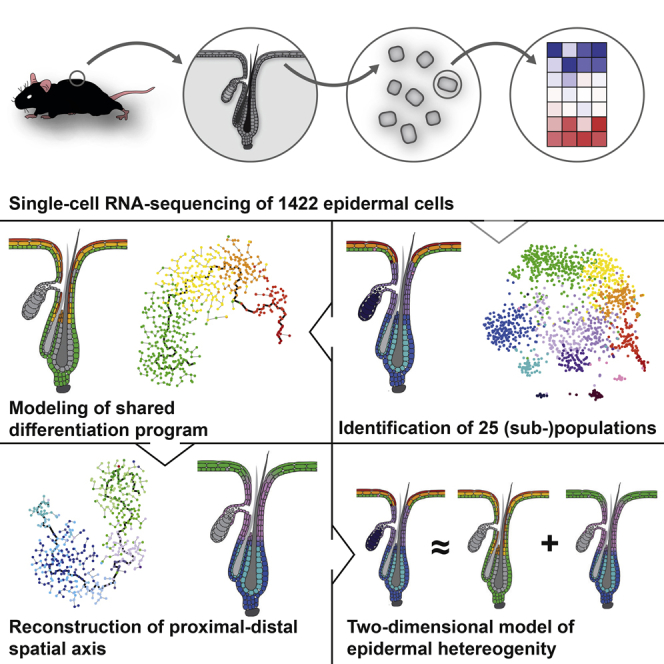
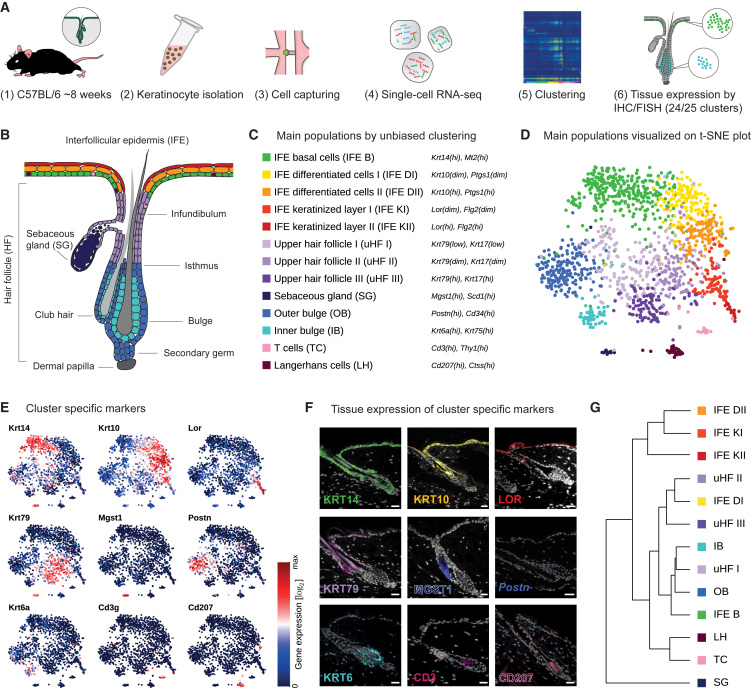
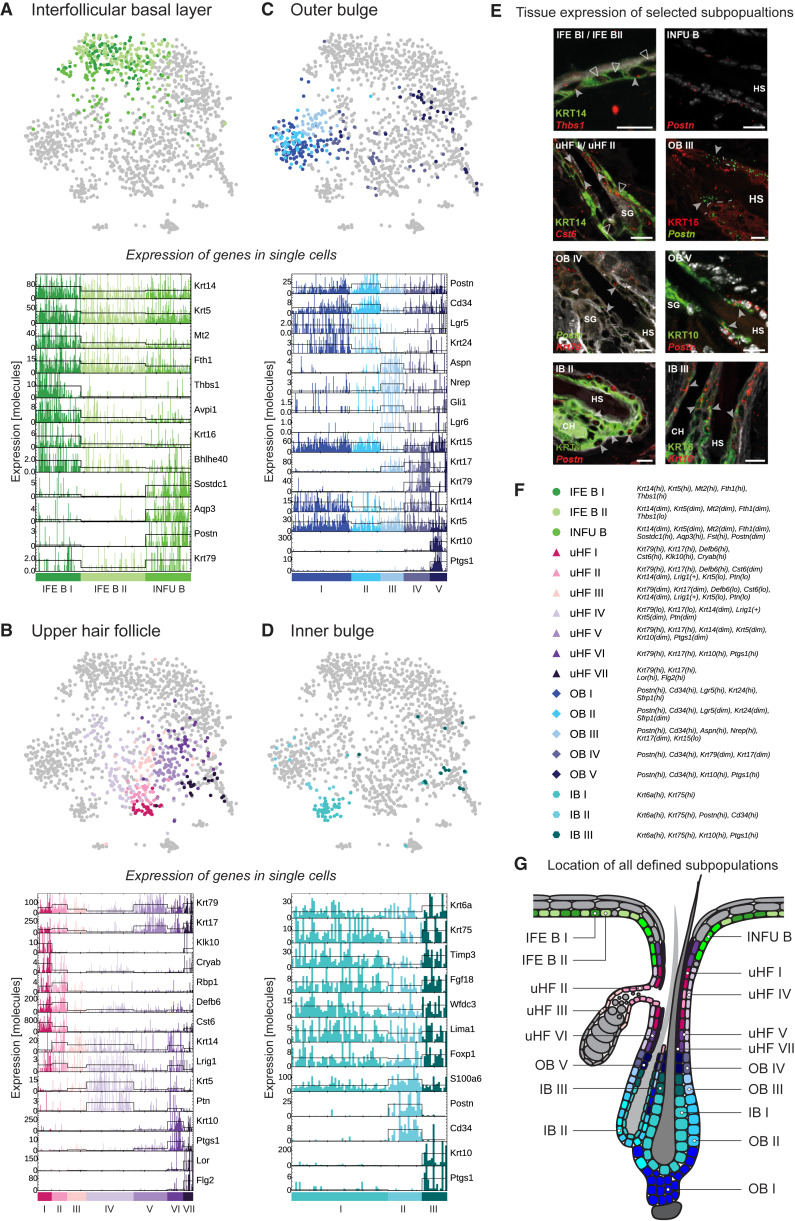
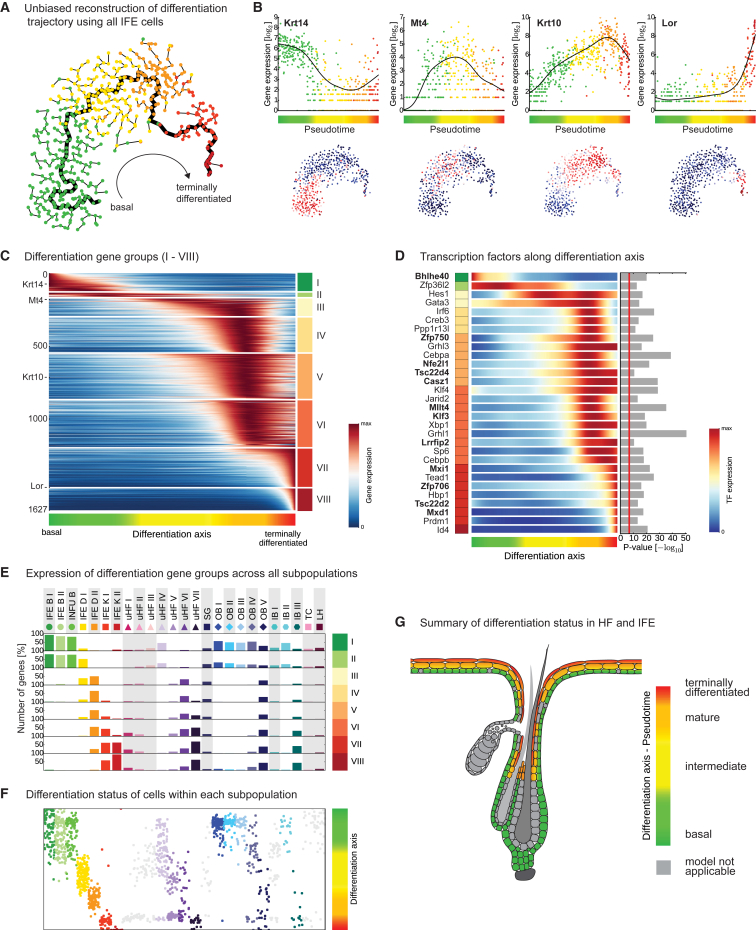
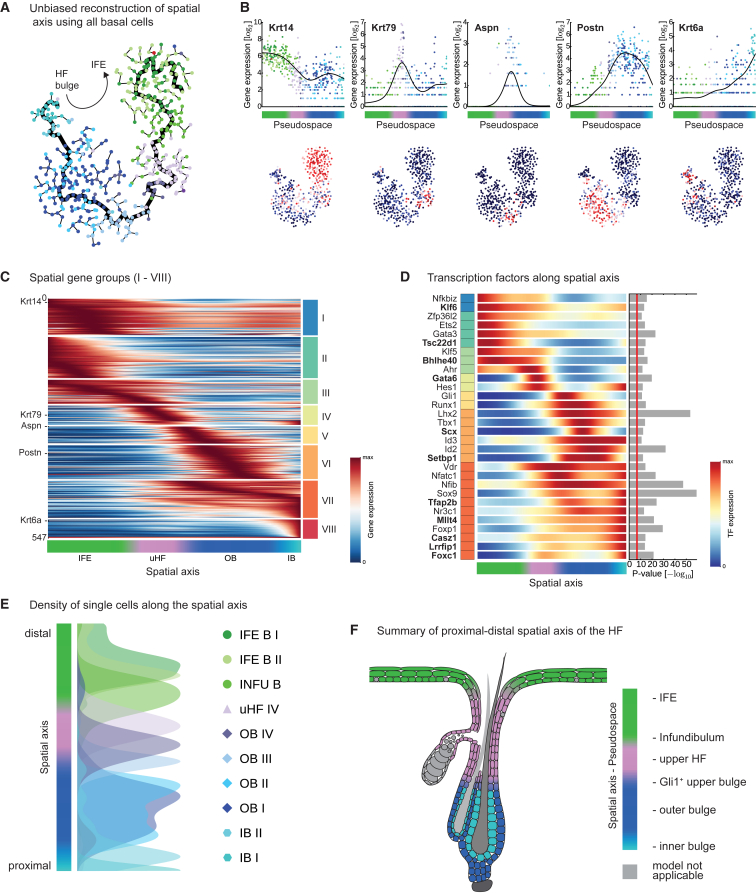
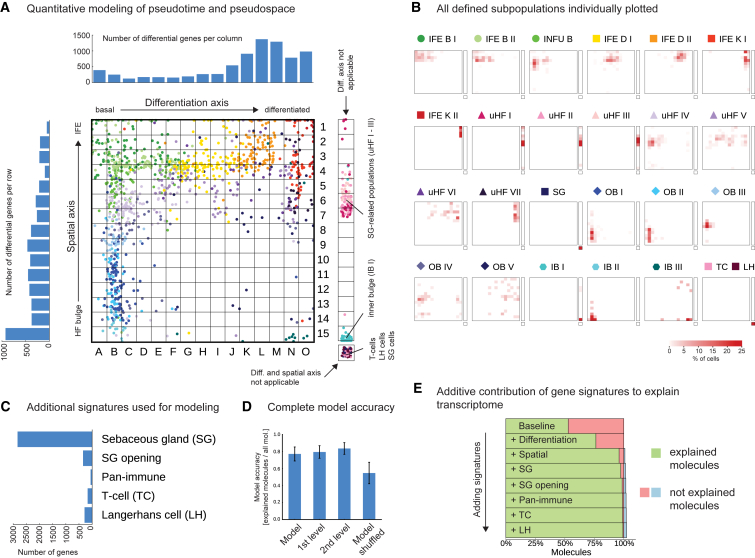
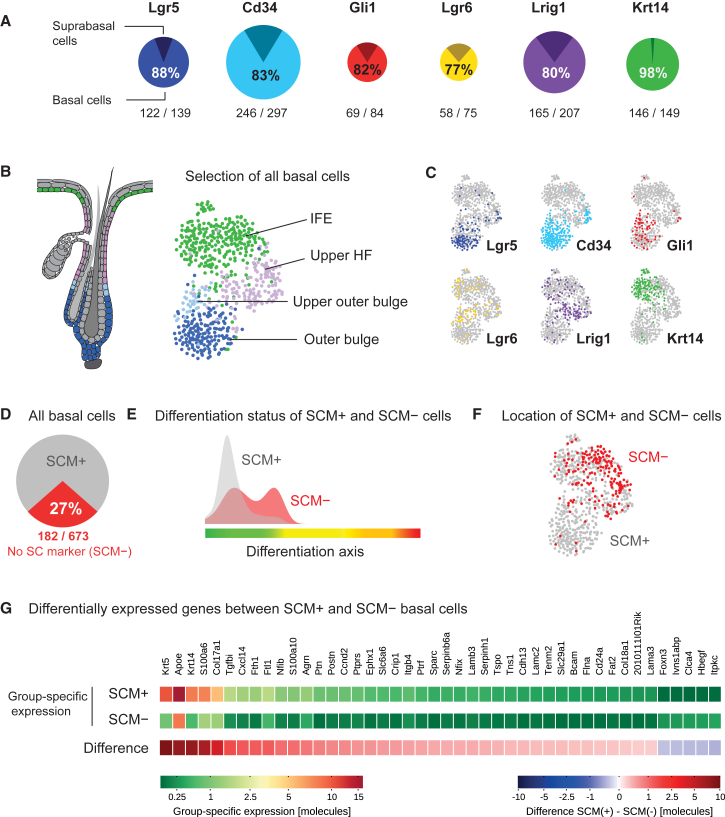
The murine epidermis with its hair follicles represents an invaluable model system for tissue regeneration and stem cell research. Here we used single-cell RNA-sequencing to reveal how cellular heterogeneity of murine telogen epidermis is tuned at the transcriptional level. Unbiased clustering of 1,422 single-cell transcriptomes revealed 25 distinct populations of interfollicular and follicular epidermal cells. Our data allowed the reconstruction of gene expression programs during epidermal differentiation and along the proximal-distal axis of the hair follicle at unprecedented resolution. Moreover, transcriptional heterogeneity of the epidermis can essentially be explained along these two axes, and we show that heterogeneity in stem cell compartments generally reflects this model: stem cell populations are segregated by spatial signatures but share a common basal-epidermal gene module. This study provides an unbiased and systematic view of transcriptional organization of adult epidermis and highlights how cellular heterogeneity can be orchestrated in vivo to assure tissue homeostasis.
Overview
The claims and statistics of this paper haven’t been checked yet.
Run the check — free, no account needed. It reads the open-access text and checks the sources it cites.
Integrity signals
Registry
Cites
Statistics
Figures
Verification
Claims the paper makes
The claims and statistics of this paper haven’t been checked yet.
Run the check — free, no account needed. It reads the open-access text and checks the sources it cites.
Claims other papers make about this one
Each is checked against this paper’s own text: does it say what the citing paper says it does?
The cited source says what the claim attributes to it.
In the citing paper
“We identified putative pilosebaceous clusters based on expression of known hair follicle markers or transcription factors (KRT15, LHX2, SOX9) and prior mouse and human studies in addition to manual cross-referencing of the Human Protein Atlas (Joost et al., 2016, Purba et al., 2015, Uhlén et al., 2015) and removed these from further analysis.”
From Multimodal Analysis of Composition and Spatial Architecture in Human Squamous Cell Carcinoma (2020) · cites this paper as Joost et al., 2016
The check wasn’t confident either way, so it gives no verdict — never disputed.
In the citing paper
“The epithelial group contained three epidermal sub-clusters: CXCL14+ basal, KRT1+ intermediate, and KRT4+ peridermal keratinocytes (Fig. 2e, Extended Data Fig. 5)22.”
From Hair-bearing human skin generated entirely from pluripotent stem cells (2020) · cites this paper as [22]
Experimental — accuracy not yet measured
Self-check
Percentages, sums and reported differences re-computed from the paper’s own numbers.
The self-check needs the paper’s full text.
Citations
Cites
Scikit-learn: Machine Learning in Python
Pedregosa, F., Varoquaux, G., Gramfort, A., Michel, V., Thirion, B., Grisel, O., Blondel, M., Müller, A., Nothman, J., Louppe, G., et al. (2012) · arXiv · doi:10.48550/arxiv.1201.0490 · Cited by 71,016
Subramanian, A., Tamayo, P., Mootha, V. K., Mukherjee, S., Ebert, B. L., Gillette, M. A., Paulovich, A., Pomeroy, S. L., Golub, T. R., Lander, E. S., et al. (2005) · Proceedings of the National Academy of Sciences · doi:10.1073/pnas.0506580102 · Cited by 53,625
(2008) · Journal of Machine Learning Research · Cited by 33,051
Exploring Network Structure, Dynamics, and Function Using NetworkX
Hagberg, A. A., Schult, D. A., & Swart, P. J. (2008) · Proceedings of the Python in Science Conference · doi:10.25080/tcwv9851 · Cited by 7,477
Trapnell, C., Cacchiarelli, D., Grimsby, J., Pokharel, P., Li, S., Morse, M., Lennon, N. J., Livak, K. J., Mikkelsen, T. S., & Rinn, J. L. (2014) · Nature Biotechnology · doi:10.1038/nbt.2859 · Cited by 7,314
Highly parallel genome-wide expression profiling of individual cells using nanoliter droplets.
Macosko, E. Z., Basu, A., Satija, R., Nemesh, J., Shekhar, K., Goldman, M., Tirosh, I., Bialas, A. R., Kamitaki, N., Martersteck, E. M., et al. (2015) · Cell · doi:10.1016/j.cell.2015.05.002 · Cited by 7,110
Clustering by Passing Messages Between Data Points
Frey, B. J., & Dueck, D. (2007) · Science · doi:10.1126/science.1136800 · Cited by 6,855
Cell types in the mouse cortex and hippocampus revealed by single-cell RNA-seq
Zeisel, A., Muñoz-Manchado, A. B., Codeluppi, S., Lönnerberg, P., La Manno, G., Juréus, A., Marques, S., Munguba, H., He, L., Betsholtz, C., et al. (2015) · Science · doi:10.1126/science.aaa1934 · Cited by 3,124
Smart-seq2 for sensitive full-length transcriptome profiling in single cells
Picelli, S., Björklund, Å. K., Faridani, O. R., Sagasser, S., Winberg, G., & Sandberg, R. (2013) · Nature Methods · doi:10.1038/nmeth.2639 · Cited by 2,358
Cotsarelis, G., Sun, T.-T., & Lavker, R. M. (1990) · Cell · doi:10.1016/0092-8674(90)90696-c · Cited by 2,276
Cited by
Sorted by citations
Items 201–300 of 431
Between Fate Choice and Self-Renewal—Heterogeneity of Adult Neural Crest-Derived Stem Cells
Höving, A. L., Windmöller, B. A., Knabbe, C., Kaltschmidt, B., Kaltschmidt, C., & Greiner, J. F. W. (2021) · Frontiers in Cell and Developmental Biology · doi:10.3389/fcell.2021.662754 · Cited by 18
Aberrant Wnt Signaling Induces Comedo-Like Changes in the Murine Upper Hair Follicle
Shang, W., Tan, A. Y. Q., Steensel, M. A. M. V., & Lim, X. (2021) · Journal of Investigative Dermatology · doi:10.1016/j.jid.2021.11.034 · Cited by 17
Vasculature-driven stem cell population coordinates tissue scaling in dynamic organs
Ichijo, R., Kabata, M., Kidoya, H., Muramatsu, F., Ishibashi, R., Abe, K., Tsutsui, K., Kubo, H., Iizuka, Y., Kitano, S., et al. (2021) · Science Advances · doi:10.1126/sciadv.abd2575 · Cited by 16
Düz, T., Törőcsik, D., Simmering, A., Wolf, P., Gallinat, S., Baumbach, J., & Holzscheck, N. (2025) · Journal of Investigative Dermatology · doi:10.1016/j.jid.2025.04.041 · Cited by 18
Mechanical control of cell fate decisions in the skin epidermis
Sahu, P., Monteiro-Ferreira, S., Canato, S., Soares, R. M., Sánchez‐Danés, A., & Hannezo, É. (2025) · Nature Communications · doi:10.1038/s41467-025-62882-9 · Cited by 21
New insights into inflammatory memory of epidermal stem cells
Cheng, D., Zhu, X., Yan, S., Shi, L., Liu, Z., Zhou, X., & Bi, X. (2023) · Frontiers in Immunology · doi:10.3389/fimmu.2023.1188559 · Cited by 18
Thalheim, T., & Schneider, M. R. (2024) · BMC Genomics · doi:10.1186/s12864-024-10008-8 · Cited by 16
“Here, we re-assessed two well-annotated scRNA-seq data sets from human [30] and mouse [9] skin to assess and compare SG transcripts in these species.”
InfluentialWang, Y. L., Jiang, Y., Ni, G., Li, S., Balderson, B., Zou, Q., Liu, H., Jiang, Y., Sun, J., & Ding, X. (2024) · Advanced Science · doi:10.1002/advs.202306703 · Cited by 16
Wang, J., Fu, Y., Huang, W., Biswas, R., Banerjee, A., Broussard, J. A., Zhao, Z., Wang, D., Bjerke, G. A., Raghavan, S., et al. (2023) · Proceedings of the National Academy of Sciences · doi:10.1073/pnas.2220635120 · Cited by 17
“2 A ), consistent with the weaker actomyosin network in the HG. Interestingly, two basal populations of the interfollicular epidermis (IFE), commonly identified in scRNA-seq dataset (28), had different actin scores, indicating that different actin cytoskeleton contributes to epidermal heterogeneity.”
GDNF promotes hair formation and cutaneous wound healing by targeting bulge stem cells
Lisse, T. S., Sharma, M., Vishlaghi, N., Pullagura, S. R. N., & Braun, R. E. (2020) · npj Regenerative Medicine · doi:10.1038/s41536-020-0098-z · Cited by 17
Cellular heterogeneity and microenvironmental control of skin cancer
Lichtenberger, B. M., & Kasper, M. (2020) · Journal of Internal Medicine · doi:10.1111/joim.13177 · Cited by 16
Transparent Touch: Insights From Model Systems on Epidermal Control of Somatosensory Innervation
Yin, C., Peterman, E., Rasmussen, J. P., & Parrish, J. Z. (2021) · Frontiers in Cellular Neuroscience · doi:10.3389/fncel.2021.680345 · Cited by 16
Haensel, D., Jin, S., Cinco, R., Sun, P., Nguyen, Q., Cang, Z., Dragan, M., Gong, Y., MacLean, A. L., Kessenbrock, K., et al. (2019) · bioRxiv (Cold Spring Harbor Laboratory) · doi:10.1101/793117 · Cited by 15
Novak, J. S. S., Polak, L., Baksh, S. C., Barrows, D., Schernthanner, M., Jackson, B. T., Thompson, E. A. N., Gola, A., Abdusselamoglu, M. D., Bonny, A. R., et al. (2025) · Cell Metabolism · doi:10.1016/j.cmet.2025.05.010 · Cited by 17
Wang, Z., Wang, Y., Hui, T., Chen, R., Xu, Y., Zhang, Y., Tian, H., Wang, W., Cong, Y., Guo, S., et al. (2021) · Frontiers in Genetics · doi:10.3389/fgene.2021.726670 · Cited by 14
Revealing lineage-related signals in single-cell gene expression using random matrix theory
Nitzan, M., & Brenner, M. P. (2021) · Proceedings of the National Academy of Sciences · doi:10.1073/pnas.1913931118 · Cited by 15
“We analyzed a single-cell dataset of the mouse epidermis, which was previously shown to include the whole hierarchy of differentiating cells (34).”
MethodWalther, R. F., Lancaster, C., Burden, J. J., & Franck Pichaud, N. (2024) · PLoS Biology · doi:10.1371/journal.pbio.3002783 · Cited by 14
Convergent evolution of monocyte differentiation in adult skin instructs Langerhans cell identity
Appios, A., Davies, J., Sirvent, S., Henderson, S. R., Trzebanski, S., Schroth, J., Law, M. L., Boal‐Carvalho, I., Pinto, M. M., Carvalho, C., et al. (2024) · Science Immunology · doi:10.1126/sciimmunol.adp0344 · Cited by 14
“Regulons enriched within resident mLC included Zeb1 or Rxra and Srebf2 , transcription factors known to be upregulated in response to hypoxia and a lipid rich environment respectively (Figure 3A) (Lengqvist et al ., 2004; Bommer and MacDougald, 2011; Joseph et al. ,”
BackgroundAn, S., Zheng, M., Park, I. G., Park, S. G., Noh, M., & Sung, J. (2024) · Frontiers in Immunology · doi:10.3389/fimmu.2024.1444777 · Cited by 14
Troy/Tnfrsf19 marks epidermal cells that govern interfollicular epidermal renewal and cornification
Kretzschmar, K., Boonekamp, K. E., Bleijs, M., Asra, P., Koomen, M., Lopes, S. M. C. D. S., Giovannone, B., & Clevers, H. C. (2021) · Stem Cell Reports · doi:10.1016/j.stemcr.2021.07.007 · Cited by 13
“In addition, Troy was found to be enriched in the basal layer of the infundibulum (INF) and IFE through single-cell transcriptomics on adult murine skin (Joost et al., 2016).”
BackgroundS100A6 as a Constituent and Potential Marker of Adult and Cancer Stem Cells
Leśniak, W., & Filipek, A. (2022) · Stem Cell Reviews and Reports · doi:10.1007/s12015-022-10403-2 · Cited by 13
Pedro, M. P., Lund, K., Kang, S. W. S., Chen, T., Stuelten, C. H., Porat‐Shliom, N., & Iglesias‐Bartolomé, R. (2023) · Journal of Investigative Dermatology · doi:10.1016/j.jid.2023.12.002 · Cited by 13
Gallant, J., Sewell, A. B., Almodovar, K., Wang, Q., Dahlman, K. B., Abramson, R. G., Kapp, M., Brown, B. T., Boyd, K. L., Gilbert, J., et al. (2019) · npj Precision Oncology · doi:10.1038/s41698-019-0077-2 · Cited by 13
Antagonistic stem cell fates under stress govern decisions between hair greying and melanoma
Mohri, Y., Nie, J., Morinaga, H., Kato, T., Aoto, T., Yamanashi, T., Nanba, D., Matsumura, H., Kirino, S., Kobiyama, K., et al. (2025) · Nature Cell Biology · doi:10.1038/s41556-025-01769-9 · Cited by 15
“Previous references were used to identify or highlight the cluster identity 81–83 .”
A single-cell transcriptome atlas of Lueyang black-bone chicken skin
Wang, L., Xue, Z., Tian, Y., Zeng, W., Zhang, T., & Lu, H. (2024) · Poultry Science · doi:10.1016/j.psj.2024.103513 · Cited by 12
“Currently, scRNA-seq has been applied in the fi eld of skin biology research in species such as humans (Joost et al., 2016; Wang et al., 2020), mice (Huang et al., 2023), rats (Zhang et al., 2023a), and fi sh (Peloggia et al., 2021).”
MethodDing, Q., Yang, W., Xue, G., Liu, H., Cai, Y., Que, J., Jin, X., Luo, M., Pang, F., Yang, Y., et al. (2024) · Genome biology · doi:10.1186/s13059-024-03385-6 · Cited by 14
“…mouse scRNA-seq datasets including Tabula [98] for the mammary gland, Klein [99] for the embryonic stem cells, Park [100] for the kidney, Joost [101] and Guerrero [102] for the skin cells, Kolodziejczyk [103] for the embryo stem cell, Zeisel [104], Usoskin [105], and Chen [106] for the mouse…”
Sphingolipid metabolism orchestrates establishment of the hair follicle stem cell compartment
Peters, F., Höfs, W., Lee, H., Brodesser, S., Kruse, K., Drexler, H. C. A., Hu, J., Raker, V., Lukas, D., von Stebut, E., et al. (2025) · The Journal of Cell Biology · doi:10.1083/jcb.202403083 · Cited by 12
The M3 Muscarinic Acetylcholine Receptor Promotes Epidermal Differentiation
Duan, J., Grando, C., Liu, S., Chernyavsky, A. I., Chen, J. K., D, B. A. M., & Grando, S. A. (2022) · Journal of Investigative Dermatology · doi:10.1016/j.jid.2022.06.013 · Cited by 12
“Using canonical marker genes (Joost et al., 2020, 2016; Lin et al., 2020), we identified three of them as basal cell clusters (basal IFE 1, n¼2,971; basal IFE 2, n¼3,041; basal IFE 3, n ¼ 3,319), identified one as a transitional cell cluster (transition IFE, n¼1,895), and identified…”
BackgroundResultUnderstanding Mammalian Hair Follicle Ecosystems by Single-Cell RNA Sequencing
Zheng, Q., Zhang, X., Bao, P., Zhou, X., Chu, M., Guo, X., Liang, C., Pan, H., & Yan, P. (2022) · Animals · doi:10.3390/ani12182409 · Cited by 12
“Interfollicular epidermis LMO1 [66], WNT4 [66], THBS1 [73], KRT14 [73,74], KRT5 [73], MT1 [73], MT2 [73,74], KRT10 [73,74], SBSN [73], MT4 [73], IVL [73], FLG2 [73,74], LOR [73,74], PTGS [74], KRT1 [73], KRT17 [73] Mice [66,73,74]”
He, W., Ye, J., Xu, H., Lin, Y., & Zheng, Y. (2019) · Journal of Cellular Biochemistry · doi:10.1002/jcb.29487 · Cited by 12
Epigenetic regulation and signalling pathways in Merkel cell development
Oss-Ronen, L., & Cohen, I. (2021) · Experimental Dermatology · doi:10.1111/exd.14415 · Cited by 14
Protein kinases involved in epidermal barrier formation: The AKT family and other animals
Rogerson, C., & O’Shaughnessy, R. F. L. (2018) · Experimental Dermatology · doi:10.1111/exd.13696 · Cited by 12
TLR9 activation in large wound induces tissue repair and hair follicle regeneration via γδT cells
Li, X., An, T., Yang, Y., Xu, Z., Chen, S., Yi, Z., Chen, D., Zhou, F., Man, Y., & Hu, C. (2024) · Cell Death and Disease · doi:10.1038/s41419-024-06994-y · Cited by 12
“6H), the expression of many genes proved to be involved in maturity and differentiation in hair follicles such as Bhlhe40, Zfp750, Grhl1, Cebpa et al. [32] increased, indicating the developmental pattern (Fig.”
BackgroundHolthaus, K. B., Steinbinder, J., Sachslehner, A. P., & Eckhart, L. (2025) · Animals · doi:10.3390/ani15030457 · Cited by 12
“During growth of the hair follicle, the hair shaft is ensheathed by the inner and outer root sheath, which are also sites of unique paths of keratinocyte differentiation [66,69,70].”
Zhang, C., Wang, D., Dowell, R. D., & Yi, R. (2023) · Frontiers in Aging · doi:10.3389/fragi.2023.1192149 · Cited by 14
Fiškin, E., Eraslan, G., Alora, M. B., Leyva-Castillo, J. M., Kim, S., Choe, H., Lareau, C. A., Lau, H., Finan, E. P., Teixeira-Soldano, I., et al. (2023) · bioRxiv (Cold Spring Harbor Laboratory) · doi:10.1101/2023.10.29.563503 · Cited by 11
Li, X., Li, S., Huang, L., Zhang, S., & Wong, K. (2021) · Briefings in Bioinformatics · doi:10.1093/bib/bbab368 · Cited by 10
Savina, A., Jaffredo, T., Saldmann, F., Faulkes, C. G., Moguelet, P., Leroy, C., del Marmol, D., Codogno, P., Foucher, L., Zalc, A., et al. (2022) · Aging · doi:10.18632/aging.204054 · Cited by 11
“Of note, Mt4, reported to specify a transitory stage from basal to spinous layer [28, 36], was expressed in cells from cluster 0, 4 and 2.”
BackgroundInfluentialWiener, D. J., Groch, K. R., Brunner, M. A. T., Leeb, T., Jagannathan, V., & Welle, M. M. (2020) · Genes · doi:10.3390/genes11080884 · Cited by 10
“Studies based on the transcriptome profiling of murine epidermis and HFs [37] and human skin [38–40] are available.”
MethodActivation of the integrated stress response in human hair follicles
Pye, D., Scholey, R., Ung, S., Dawson, M., Shahmalak, A., & Purba, T. S. (2024) · PLoS ONE · doi:10.1371/journal.pone.0303742 · Cited by 9
“For instance, KRT79 [64, 65] was increased, while the immune checkpoint gene VTCN1 (encoding B7H4) [66–68] showed decreased expression following UK-5099 treatment (S7 and S11 Figs in S1 File) .”
BackgroundYaba, A., Thalheim, T., & Schneider, M. R. (2024) · Cell Communication and Signaling · doi:10.1186/s12964-024-01835-z · Cited by 9
“Recent single-cell transcrip-tomics studies confirmed the expression of a large number of adhesion-relevant transcripts in both mouse [63] and human [64] SGs. Figure 3A, based on a re-assessment of these data focusing on sebocytes [65], indicates the number of adhesion-relevant transcripts that are…”
BackgroundOvermiller, A. M., Uchiyama, A., Hope, E., Nayak, S., O’Neill, C. G., Hasneen, K., Chen, Y., Naz, F., Dell’Orso, S., Brooks, S. R., et al. (2024) · JCI Insight · doi:10.1172/jci.insight.182844 · Cited by 11
“Pseudotime analysis of scRNA-Seq data allows for the capture of gene regulation along continuous biological processes and cell types, including epithelial differentiation (23–25).”
Emerging biomedical engineering strategies for hair follicle regeneration
Cao, X., Lu, M., Li, N., Cai, L., Wang, Y., & Zhao, Y. (2025) · Bioactive Materials · doi:10.1016/j.bioactmat.2025.06.051 · Cited by 13
Regulatory T cells in skin utilize the Cxcr4-Cxcl12 axis to promote hair follicle regeneration
Cohen, J. N., Kolluri, G., Clancy, S., Gouirand, V., Macon, C. E., Kalekar, L. A., & Rosenblum, M. D. (2025) · Cell Reports · doi:10.1016/j.celrep.2025.116467 · Cited by 11
“15,16 Keratinocytes isolated from murine skin in the resting phase (telogen) of the HF cycle can be divided into at least five distinct subsets based on expression of certain cell surface markers (e.g., EpCAM, Sca-1, CD34, and CD49f [integrin α 6]).”
Dia1 coordinates differentiation and cell sorting in a stratified epithelium
Harmon, R. M., Devany, J. M., & Gardel, M. L. (2022) · The Journal of Cell Biology · doi:10.1083/jcb.202101008 · Cited by 8
“The reference sets used were as follows: suprabasal/differentiated epidermal genes (Joost et al., 2016), skin cornification diseases (Lemke et al.”
MethodRiedl, J., Riddle, M. J., Xia, L., Eide, C. R., Boull, C. L., Ebens, C. L., & Tolar, J. (2022) · Journal of Investigative Dermatology · doi:10.1016/j.jid.2022.01.034 · Cited by 10
How can a binary switch within the pars tuberalis control seasonal timing of reproduction?
Wood, S. H. (2018) · Journal of Endocrinology · doi:10.1530/joe-18-0177 · Cited by 9
A transit-amplifying progenitor with biphasic behavior contributes to epidermal renewal
Ghuwalewala, S., Jiang, K., Ragi, S. D., Shalloway, D. I., & Tumbar, T. (2024) · Development · doi:10.1242/dev.202389 · Cited by 8
Ward, S., Crawford, G., Buang, N. B., Malactou, C., Dutton, E. E., Withnell, I., Woollard, K. J., Harwood, C. A., McSorley, H. J., Ziegenhain, C., et al. (2025) · Cell Reports · doi:10.1016/j.celrep.2025.115837 · Cited by 8
“36 These basal proliferating ECs and stem cell populations contribute to renewal and re-epithelialization after tissue damage.”
Fiškin, E., Eraslan, G., Alora-Palli, M. B., Jain, T., Leyva-Castillo, J. M., Kim, S., Choe, H., Lareau, C. A., Lau, H., Finan, E. P., et al. (2026) · Nature Communications · doi:10.1038/s41467-026-69587-7 · Cited by 23
“8a – d, “ Methods ” ), consistent with previous work 33 .”
Chen, D. Y., Ferguson, I. M., Braun, K. A., Sutton, L. A., Helton, N., Ramakrishnan, S. M., Smith, A. M., Miller, C. A., & Ley, T. J. (2021) · Proceedings of the National Academy of Sciences · doi:10.1073/pnas.2022760118 · Cited by 8
“Subdivided into the isthmus and infundibulum, the upper hair follicle bridges the follicle with the interfollicular epidermis and sebaceous gland, which is marked by the expression of Mgst1 (34).”
BackgroundSingle-cell transcriptomics defines keratinocyte differentiation in avian scutate scales
Lachner, J., Ehrlich, F., Wielscher, M., Farlik, M., Hermann, M., Tschachler, E., & Eckhart, L. (2022) · Scientific Reports · doi:10.1038/s41598-021-04082-1 · Cited by 8
Takaki, S., Shimbo, T., Ikegami, K., Kitayama, T., Yamamoto, Y., Yamazaki, S., Mori, S., & Tamai, K. (2022) · Laboratory Investigation · doi:10.1038/s41374-022-00735-5 · Cited by 8
Harris, J. C., Prouty, S. M., Nelson, M. A., Sung, D. C., Nelson, A. M., Seykora, J. T., Kambayashi, T., & Grice, E. A. (2023) · Journal of Investigative Dermatology · doi:10.1016/j.jid.2023.10.017 · Cited by 8
Physics of animal health: on the mechano-biology of hoof growth and form
Al-Agele, R. A. A., Paul, E., Taylor, S., Watson, C., Sturrock, C. J., Drakopoulos, M., Atwood, R., Rutland, C. S., Menzies‐Gow, N. J., Knowles, E., et al. (2019) · Journal of The Royal Society Interface · doi:10.1098/rsif.2019.0214 · Cited by 8
Epidermal stem cells self-renew upon neighboring differentiationPreprint
Mesa, K. R., Kawaguchi, K., Gonzalez, D. G., Cockburn, K., Boucher, J. D., Xin, T., Klein, A. M., & Greco, V. (2017) · bioRxiv (Cold Spring Harbor Laboratory) · doi:10.1101/155408 · Cited by 8
Brandt, M., Cao, Z., Krishna, C., Reedy, J. L., Gu, X., Dutko, R. A., Oliver, B. A., Tusi, B. K., Park, J., Richey, L. J., et al. (2024) · Cell Reports · doi:10.1016/j.celrep.2024.113944 · Cited by 7
MCL‑1 safeguards activated hair follicle stem cells to enable adult hair regeneration
Chin, H. S., Cheng, J., Hsu, S. H., Lum, G. G., Zaldivia, M. T. K., Nelameham, S., Guo, F., Mallavarapu, K., Jackling, F. C., Yang, J., et al. (2025) · Nature Communications · doi:10.1038/s41467-025-58150-5 · Cited by 7
“Transcriptomes of 48,777 valid single cells in six dorsal skin samples were integrated and clustered and then cell types were annotated based on known markers from previous studies 48,49 .”
Progenitor Cell Dynamics in Androgenetic Alopecia: Insights from Spatially Resolved Transcriptomics
Charoensuksira, S., Surinlert, P., Krajarng, A., Nualsanit, T., Payuhakrit, W., Panpinyaporn, P., Khumsri, W., Thanasarnaksorn, W., Suwanchinda, A., Hongeng, S., et al. (2025) · International Journal of Molecular Sciences · doi:10.3390/ijms26125792 · Cited by 7
Multi-omics and AI-driven advances in miRNA-mediated hair follicle regulation in cashmere goats
Chun-hua, Z., Le, F., Li, S., Sachula, W., Hua, B., Mu, L., Antonini, M., & Sun, H. (2025) · Frontiers in Veterinary Science · doi:10.3389/fvets.2025.1635202 · Cited by 7
“Validation of these findings was achieved through in situ RNA hybridization (RNA-ISH), confirming the localized expression of MSX1 and HOXC13 in the HM, and BMP4, RSPO4, DKK3” (Dickkopf-related protein 3)., and LGR6 in the DP (161).”
Li, G., Yang, L. I., Duan, S., Chen, M., Zhang, Y., Liu, F., Wang, Y., Li, J., Xu, S., Wu, Z., et al. (2026) · Nature Communications · doi:10.1038/s41467-026-70153-4 · Cited by 8
Quantifying the clusterness and trajectoriness of single-cell RNA-seq data
Lim, H. S., & Qiu, P. (2024) · PLoS Computational Biology · doi:10.1371/journal.pcbi.1011866 · Cited by 6
Schwalie, P. C., Ordóñez‐Morán, P., Huelsken, J., & Deplancke, B. (2017) · Stem Cells · doi:10.1002/stem.2719 · Cited by 6
“We thus focused on the IFE area and examined where high scoring cells are positioned on the previously estimated differentiation trajectory [35].”
BackgroundMethodInfluentialRevealing routes of cellular differentiation by single-cell RNA-seq
Grün, D. (2018) · Current Opinion in Systems Biology · doi:10.1016/j.coisb.2018.07.006 · Cited by 7
Oxygen-Mediated Control of the Keratinocyte Proliferation-Differentiation Axis
Koh, R., Szeverényi, I., Lee, B. T. K., Denil, S. L. I. J., Lim, J., Benny, P., Grasset, N., Tan, B., & Lane, E. B. (2019) · Journal of Investigative Dermatology · doi:10.1016/j.jid.2019.05.030 · Cited by 7
Wotherspoon, D., Rogerson, C., & O’Shaughnessy, R. F. L. (2020) · Journal of Developmental Biology · doi:10.3390/jdb8040029 · Cited by 7
Bhattacharya, N., Indra, A. K., & Ganguli‐Indra, G. (2022) · Cells · doi:10.3390/cells11132106 · Cited by 8
IRX5 promotes DNA damage repair and activation of hair follicle stem cells
Chen, J. K., Wiedemann, J., Nguyen, L. T. H., Lin, Z., Tahir, M., Hui, C., Plikus, M. V., & D, B. A. M. (2023) · Stem Cell Reports · doi:10.1016/j.stemcr.2023.03.013 · Cited by 7
IL-22RA2 Is a SMAD7 Target Mediating the Alleviation of Dermatitis and Psoriatic Phenotypes in Mice
Ke, Y., Li, B., Nguyen, K., Wang, D., Wang, S., Young, C. D., & Wang, X. (2023) · Journal of Investigative Dermatology · doi:10.1016/j.jid.2023.04.029 · Cited by 7
Meyer, M., Greenwald, M. B., Rauschendorfer, T., Sänger, C. S., Jukic, M., Iizuka, H., Kubo, F., Chen, L., Ornitz, D. M., & Werner, S. (2019) · Journal of Cellular and Molecular Medicine · doi:10.1111/jcmm.14871 · Cited by 7
Applications of Single-Cell Sequencing in Dermatology
Zou, D., Qi, J., Wu, W., Xu, D., Tu, Y., Liu, T., Zhang, J., Li, X., Lu, F., & He, L. (2021) · Medical Science Monitor · doi:10.12659/msm.931862 · Cited by 7
“In contrast, the scRNA-seq technique can identify 25 different cell populations, including previously unknown cells, based on cell marker genes [8].”
MethodTran, A., Yang, P., Yang, J. Y. H., & Ormerod, J. T. (2022) · Briefings in Functional Genomics · doi:10.1093/bfgp/elac008 · Cited by 7
“Furthermore, single cell spatial transcriptomics like Visium [55] or MERFISH [56] hold the potential to incorporate information about the local microenvironment, where the position of cells in 3D space has been implicated to play a key role in cell differentiation [57].”
BackgroundMorimoto, A., Fukuda, K., Ito, Y., Tahara, U., Sasaki, T., Shiohama, A., Kawasaki, H., Kawakami, E., Naganuma, T., Arita, M., et al. (2022) · Journal of Investigative Dermatology · doi:10.1016/j.jid.2022.06.003 · Cited by 7
Overexpression of MYB in the Skin Induces Alopecia and Epidermal Hyperplasia
Hu, Y., Song, Z., Chen, J., & Caulı́n, C. (2019) · Journal of Investigative Dermatology · doi:10.1016/j.jid.2019.10.013 · Cited by 7
Selective sweep for an enhancer involucrin allele identifies skin barrier adaptation out of Africa
Mathyer, M. E., Brettmann, E. A., Schmidt, A. D., Goodwin, Z. A., Quiggle, A., Oh, I. Y., Tycksen, E., Zhou, L., Estrada, Y. D., Wong, X. F. C. C., et al. (2021) · Nature Communications · doi:10.1038/s41467-021-22821-w · Cited by 10
Apoptosis and Cell Clearance in Skin Wound Healing
Cleene, H. K. L. D., Keçeli, B. N., & Maschalidi, S. (2025) · Advances in experimental medicine and biology · doi:10.1007/978-3-031-92785-0_5 · Cited by 6
Asami, S., Yin, C., Fan, J., Garza, L. A., & Kalhor, R. (2026) · Cell · doi:10.1016/j.cell.2026.06.014 · Cited by 7
Involucrin Modulates Vitamin D Receptor Activity in the Epidermis
Schmidt, A. D., Miciano, C., Zheng, Q., Mathyer, M. E., Grice, E. A., & Strong, C. D. G. (2023) · Journal of Investigative Dermatology · doi:10.1016/j.jid.2022.12.009 · Cited by 6
Exploring the optimization of autoencoder design for imputing single-cell RNA sequencing data
Xi, N. M., & Li, J. J. (2023) · Computational and Structural Biotechnology Journal · doi:10.1016/j.csbj.2023.07.041 · Cited by 7
Luedke, K. P., Yoshino, J., Yin, C., Jiang, N., Huang, J. M., Huynh, K., & Parrish, J. Z. (2024) · PLoS Genetics · doi:10.1371/journal.pgen.1011237 · Cited by 6
Wikramanayake, T. C., Nicu, C., Gherardini, J., Mello, A. C. G. C. V., Chéret, J., & Paus, R. (2022) · Journal of Investigative Dermatology · doi:10.1016/j.jid.2021.12.037 · Cited by 6
Kyaw, W., Chai, R. C. C., Khoo, W. H., Goldstein, L. D., Croucher, P. I., Murray, J. M., & Phan, T. G. (2023) · Bioinformatics · doi:10.1093/bioinformatics/btad765 · Cited by 6
“Specifically, different stages of differentiation within a population often correlate with microanatomical location in the tissue (Joost et al. 2016).”
BackgroundTenascin-C expressing touch dome keratinocytes exhibit characteristics of all epidermal lineages
Nguyen, M. B., Flora, P., Branch, M. C., Weber, M., Zheng, X. Y., Sivan, U., Joost, S., Annusver, K., Zheng, D., Kasper, M., et al. (2024) · Science Advances · doi:10.1126/sciadv.adi5791 · Cited by 6
HPV8-induced STAT3 activation led keratinocyte stem cell expansion in human actinic keratoses
Morgan, H. J., Olivero, C., Shorning, B. Y., Gibbs, A., Phillips, A., Ananthan, L., Lim, A. X. H., Martuscelli, L., Borgogna, C., Andrea, M. D., et al. (2024) · JCI Insight · doi:10.1172/jci.insight.177898 · Cited by 7
Lineage specification of early embryos and embryonic stem cells at the dawn of enabling technologies
Peng, G., Tam, P., & Jing, N. (2017) · National Science Review · doi:10.1093/nsr/nwx093 · Cited by 6
A probabilistic Boolean model on hair follicle cell fate regulation by TGF- β
Dinh, K., & Wang, Q. (2022) · Biophysical Journal · doi:10.1016/j.bpj.2022.05.035 · Cited by 7
Martínez-Martínez, E., Atzei, P., Vionnet, C., Roubaty, C., Kaeser-Pebernard, S., Naef, R., & Dengjel, J. (2022) · International Journal of Molecular Sciences · doi:10.3390/ijms23126860 · Cited by 6
“Despite TOP‐N53 being shown to increase the proliferative and migratory capacities of keratinocytes [15], we did not observe substantial differences in their proteome, which might be due to a lack of PDE5 expression [24,25].”
BackgroundPoised cell circuits in human skin are activated in diseasePreprint
Reynolds, G., Végh, P., Fletcher, J., Poyner, E. F. M., Stephenson, E., Goh, I., Botting, R. A., Huang, N., Olabi, B., Dubois, A., et al. (2020) · bioRxiv (Cold Spring Harbor Laboratory) · doi:10.1101/2020.11.05.369363 · Cited by 7
“S5C) recapitulate some of the previously identified genes in the literature and also in scRNA-seq analysis of murine interfollicular epidermal cells (36), including the loss of KRT5 and KRT14 and gain of IVL and FLG from basal to granular layer keratinocytes (37).”
ResultTissue-scale mechanics controls differentiation strategy and dynamics of epithelial multilayeringPreprint
Villeneuve, C., Azote, S., Albu, M., Rübsam, M., Biggs, L. C., Vinzens, S., Kruse, K., Prakash, A., Zentis, P., Lawson-Keister, E., et al. (2026) · bioRxiv (Cold Spring Harbor Laboratory) · doi:10.64898/2026.02.08.704529 · Cited by 6
Survivin Promotes Stem Cell Competence for Skin Cancer Initiation
Canato, S., Sarate, R. M., Carvalho-Marques, S., Soares, R. M., Song, Y., Monteiro-Ferreira, S., Vieugué, P., Liagre, M., Grossi, G., Cardoso, E. C., et al. (2024) · Cancer Discovery · doi:10.1158/2159-8290.cd-24-0263 · Cited by 5
Retinoic Acid Signaling Alters the Balance of Epidermal Stem Cell Populations in the Skin
Dumrongphuttidecha, T., Ishikawa, M., Cabezas‐Wallscheid, N., & Sada, A. (2025) · Journal of Investigative Dermatology · doi:10.1016/j.jid.2025.09.008 · Cited by 6
Huang, M., Hua, N., Zhuang, S., Fang, Q., Shang, J., Wang, Z., Tao, X., Niu, J., Li, X., Yu, P., et al. (2023) · Journal of Pharmaceutical Analysis · doi:10.1016/j.jpha.2023.04.004 · Cited by 5
Tahara, U., Matsui, T., Atsugi, T., Fukuda, K., Terooatea, T. W., Minoda, A., Kubo, A., & Amagai, M. (2023) · Journal of Investigative Dermatology · doi:10.1016/j.jid.2023.08.008 · Cited by 5
Interpretation of the Yak Skin Single-Cell Transcriptome Landscape
Zheng, Q., Ye, N., Bao, P., Wang, T., Ma, C., Chu, M., Wu, X., Kong, S., Guo, X., Liang, C., et al. (2023) · Animals · doi:10.3390/ani13243818 · Cited by 5
Transcription factor KROX20 marks epithelial stem cell ancestors for hair follicle formation
Ghotbi, E., Tchegnon, E., Chen, Z., Li, S., Shipman, T. E., Wang, Y., Raman, J., Zhang, Y., McKay, R. M., Liao, C.-P., et al. (2024) · Journal of Clinical Investigation · doi:10.1172/jci180160 · Cited by 5
In Silico Analysis of the Age-Dependent Evolution of the Transcriptome of Mouse Skin Stem Cells
Lorenzo‐Martín, L. F., & Bustelo, X. R. (2020) · Cells · doi:10.3390/cells9010165 · Cited by 6
“The SSCs have been extensively characterized at the transcriptomal level both in toto and in single cell-based experiments in mice [7,8].”
BackgroundDynamics and heterogeneity of Erk-induced immediate-early gene expressionPreprint
Jena, S. G., Yu, C. C., & Toettcher, J. E. (2021) · bioRxiv (Cold Spring Harbor Laboratory) · doi:10.1101/2021.04.30.442166 · Cited by 5
The molecular determinants of phenotypic plasticity in homeostasis and neoplasia
Balk, B., & Goodrich, D. W. (2024) · Cancer Heterogeneity and Plasticity · doi:10.47248/chp2401020010 · Cited by 4
“RNA data indicates cells from these different skin niches have distinct transcriptional profiles, but their transcriptional state converges as they assume the FSC phenotype, supporting the existence of substantial plasticity within skin cells [79].”
Huang, W., Qian, Z., Zhang, J., Ding, Y., Wang, B., Lin, J., Zhang, X., Zhao, H., & Chen, F. (2025) · Genomics Proteomics & Bioinformatics · doi:10.1093/gpbjnl/qzaf013 · Cited by 4
Dube, C. T., Oguz, G., Ong, Y. H. B., Samydurai, S., Prabhakar, S., Ronshaugen, M., Ramasamy, A., Lim, C. Y., & Mace, K. A. (2025) · Biogerontology · doi:10.1007/s10522-025-10340-w · Cited by 4
“B (Cheng et al. 2018; Hu et al. 2021; Joost et al. 2016).”
Metadata
- Authors
- Joost, S., Zeisel, A., Jacob, T., Sun, X., La Manno, G., Lönnerberg, P., Linnarsson, S., & Kasper, M.
- Affiliations
- Karolinska Institutet (SE)
- Corresponding author
- Linnarsson, Sten
- Kasper, Maria
- Venue
- Cell Systems
- Publisher
- Elsevier BV
- Published
- 2016-09
- Volume
- 3
- Issue
- 3
- Pages
- 221-237.e9
- ISSN
- 2405-4712 (ISSN-L)
- PMC
- PMC5052454
- OpenAlex
- W2489812534
- Cited by
- 429
- References
- 73
- Citations by year
- 2026: 42 · 2025: 35 · 2024: 45 · 2023: 40 · 2022: 55 · 2021: 45 · 2020: 68 · 2019: 39 · 2018: 40 · 2017: 18 · 2016: 1
- FWCI
- 16.98
- Type
- journal article
- Language
- en
- Open access
- hybrid
- doi.org
- Licence
- Locations
- Cell Systems (publishedVersion, cc-by-nc-nd)
- PubMed Central (publishedVersion, cc-by-nc-nd)
- PubMed (publishedVersion)
- Infoscience (Ecole Polytechnique Fédérale de Lausanne) (submittedVersion, cc-by-nc-nd)
- Topics
- Life Sciences › Biochemistry, Genetics and Molecular Biology › Molecular Biology › Single-cell and spatial transcriptomics
- Health Sciences › Medicine › Dermatology › Hair Growth and Disorders
- Life Sciences › Biochemistry, Genetics and Molecular Biology › Cell Biology › Skin and Cellular Biology Research
- Keywords
- epidermis, hair follicle, cellular heterogeneity, epidermal differentiation, telogen, interfollicular epidermis, proximal-distal axis, stem cell compartment, transcriptional organization, tissue homeostasis, spatial signatures, mouse skin
- MeSH terms
- Animals, Cell Differentiation, Epidermis, Female, Homeostasis, Mice, Inbred C57BL, Stem Cells, Hair Follicle, Mice, Transcriptome
About these checks
Registry, retraction, Cites and statistics results are computed, not judged, with one exception: a printed reference that no index lists is read once by a model before it counts as a citation error. Claims are extracted by a model and kept only when their quote appears verbatim in the text; each cited source is then checked, with a model’s help, for whether it says what the claim relies on. Those verdicts can be wrong — read the claim’s quote and the cited source before relying on one.
Statistics and arithmetic are recomputed, not judged.
Confidence bands are shown only for fields calibrated on our annotated test set. None is calibrated yet, so no band is shown.
What counts as a claim ›How we measure confidence ›How we check this ›
Are you an author, or do you see a problem with this page? Request a review
