

The DOI matches its Crossref record; 71 of the 71 references it cites were found in a registry or an index.
Differential benefits of mental training types for attention, compassion, and theory of mind
Open accessAbstract
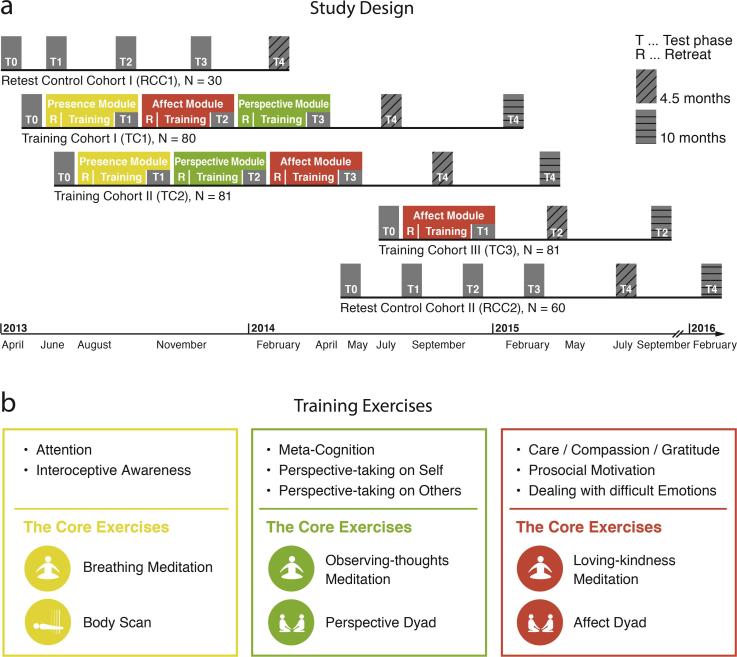
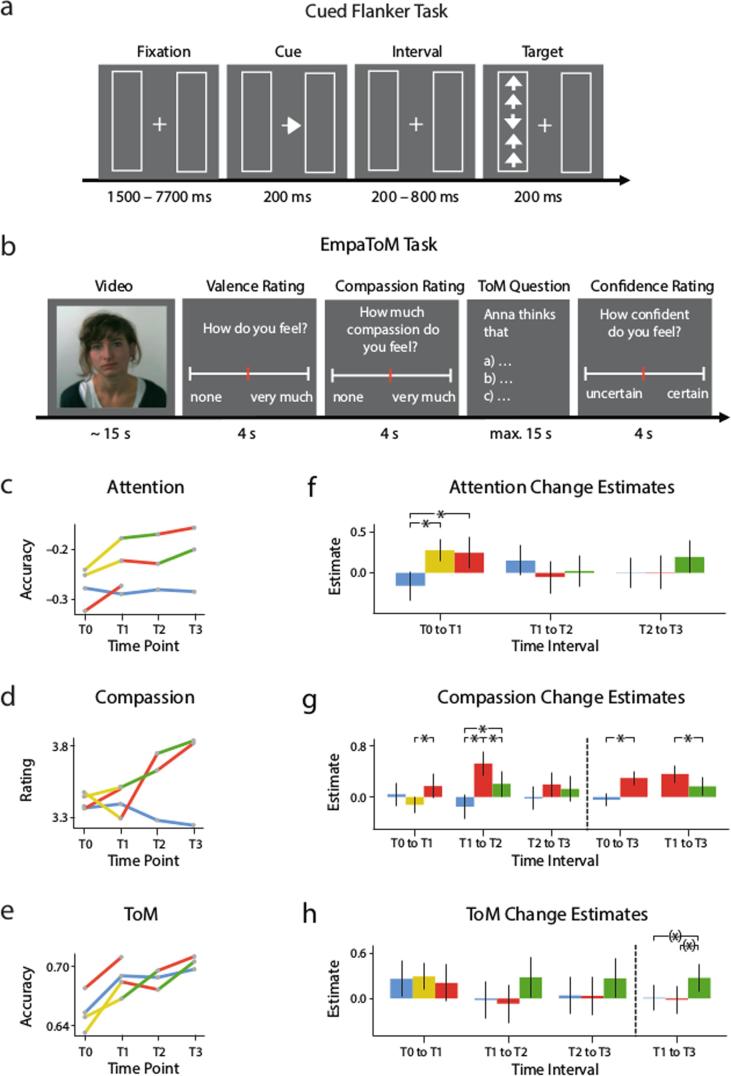
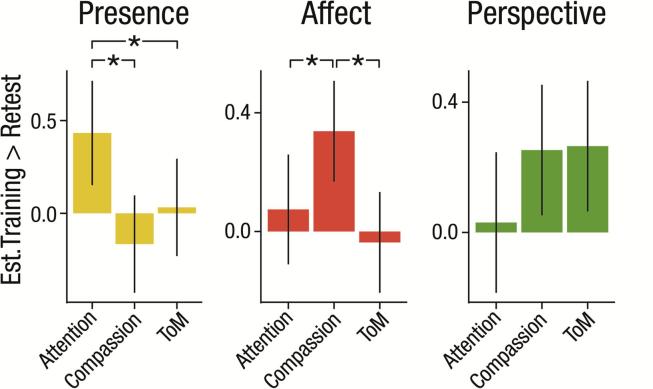
Mindfulness- and, more generally, meditation-based interventions increasingly gain popularity, effectively promoting cognitive, affective, and social capacities. It is unclear, however, if different types of practice have the same or specific effects on mental functioning. Here we tested three consecutive three-month training modules aimed at cultivating either attention, socio-affective qualities (such as compassion), or socio-cognitive skills (such as theory of mind), in three training cohorts and a retest control cohort (N = 332). While attentional performance improved most consistently after attention training, compassion increased most after socio-affective training and theory of mind partially improved after socio-cognitive training. These results show that specific mental training practices are needed to induce plasticity in different domains of mental functioning, providing a foundation for evidence-based development of more targeted interventions adapted to the needs of different education, labor, and health settings.
Overview
The claims and statistics of this paper haven’t been checked yet.
Run the check — free, no account needed. It reads the open-access text and checks the sources it cites.
Integrity signals
Registry
Cites
Statistics
Figures
Verification
Claims the paper makes
The claims and statistics of this paper haven’t been checked yet.
Run the check — free, no account needed. It reads the open-access text and checks the sources it cites.
Claims other papers make about this one
Each is checked against this paper’s own text: does it say what the citing paper says it does?
The source backs part of the claim, not all of it — or backs it for a different population, condition or comparison.
In the citing paper
“socio-affective practices led to increases in compassion and prosocial behavior and reductions in social stress [31,32,33].”
From 10-Week Trajectories of Candidate Psychological Processes Differentially Predict Mental Health Gains from Online Dyadic versus Mindfulness Interventions: A Randomized Clinical Trial (2024) · cites this paper as [31]
Experimental — accuracy not yet measuredThe source backs part of the claim, not all of it — or backs it for a different population, condition or comparison.
In the citing paper
“in a large-scale 9-month study, the ReSource project [29] employing three distinct intervention modules, it was shown that attention-focused mindfulness practices led to enhanced interoceptive awareness and attention control [30,31]”
From 10-Week Trajectories of Candidate Psychological Processes Differentially Predict Mental Health Gains from Online Dyadic versus Mindfulness Interventions: A Randomized Clinical Trial (2024) · cites this paper as [31]
Experimental — accuracy not yet measuredThe source backs part of the claim, not all of it — or backs it for a different population, condition or comparison.
In the citing paper
“socio-cognitive perspective-taking practices led to improvements in meta-cognitive awareness and Theory of Mind [30,31]”
From 10-Week Trajectories of Candidate Psychological Processes Differentially Predict Mental Health Gains from Online Dyadic versus Mindfulness Interventions: A Randomized Clinical Trial (2024) · cites this paper as [31]
Experimental — accuracy not yet measured
Self-check
Percentages, sums and reported differences re-computed from the paper’s own numbers.
The self-check needs the paper’s full text.
Citations
Cites
R: A Language and Environment for Statistical Computing
R Core Team (2000) · doi:10.32614/r.manuals · Cited by 355,893
Fitting Linear Mixed-Effects Models Using lme4
Bates, D., Mächler, M., Bolker, B., & Walker, S. (2015) · Journal of Statistical Software · doi:10.18637/jss.v067.i01 · Cited by 86,835
Posner, M. I. (1980) · Quarterly Journal of Experimental Psychology · doi:10.1080/00335558008248231 · Cited by 9,670 · cited 4×
“As a behavioral marker for attentional performance we used a cued flanker task (Eriksen & Eriksen, 1974; Posner, 1980; Trautwein et al., 2016), whereas compassion and ToM performance were assessed in the EmpaToM video task (Kanske et al., 2015).”
BackgroundMethodInfluential(2008) · Medical Entomology and Zoology · Cited by 7,477
Effects of noise letters upon the identification of a target letter in a nonsearch task
Eriksen, B. A., & Eriksen, C. W. (1974) · Perception & Psychophysics · doi:10.3758/bf03203267 · Cited by 7,230
Wimmer, H. (1983) · Cognition · doi:10.1016/0010-0277(83)90004-5 · Cited by 6,305
Shapiro, S. L., Carlson, L. E., Astin, J. A., & Freedman, B. (2006) · Journal of Clinical Psychology · doi:10.1002/jclp.20237 · Cited by 4,002
Testing the efficiency and independence of attentional networks
Fan, J., McCandliss, B. D., Sommer, T., Raz, A., & Posner, M. I. (2002) · Journal of Cognitive Neuroscience · doi:10.1162/089892902317361886 · Cited by 3,717
The attention system of the human brain: 20 years after
Petersen, S. E., & Posner, M. I. (2012) · Annual Review of Neuroscience · doi:10.1146/annurev-neuro-062111-150525 · Cited by 3,439
The Neuroscience of Mindfulness Meditation
Tang, Y.-Y., Hölzel, B. K., & Posner, M. I. (2015) · Nature reviews. Neuroscience · doi:10.1038/nrn3916 · Cited by 2,889
Research works printed but not linked: 2
- Cairncross, 2016, The effectiveness of mindfulness-based therapies for ADHD, Journal of Attention Disorders
- Singer, T., Kok, B. E., Bornemann, B., Zurborg, S., Bolz, M., & Bochow, C. A., (2016). The ReSource Project. Background, Design, Samples, and Measurements (2nd ed.). Max Planck Institute for Human Cognitive and Brain Sciences; Leipzig.
Cited by
Sorted by citations
Valk, S. L., Bernhardt, B. C., Trautwein, F.-M., Böckler, A., Kanske, P., Guizard, N., Collins, D. L., & Singer, T. (2017) · Science Advances · doi:10.1126/sciadv.1700489 · Cited by 264
“Module-specific changes inmorphology were expected to correlate with training-related behavioral changes in the same individuals, assessed viamarkersmatched to themain functions trained in a module [that is, attention for Presence, compassion forAffect, andToM for Perspective (8, 44, 47, 50)].”
InfluentialStrategic regulation of empathy
Weisz, E., & Cikara, M. (2021) · Trends in Cognitive Sciences · doi:10.1016/j.tics.2020.12.002 · Cited by 217
Whitfield, T. J., Barnhofer, T., Acabchuk, R. L., Cohen, A., Lee, M., Schlosser, M., Arenaza‐Urquijo, E. M., Böttcher, A., Britton, W. B., Coll‐Padrós, N., et al. (2021) · Neuropsychology Review · doi:10.1007/s11065-021-09519-y · Cited by 247
Singer, T., & Engert, V. (2019) · Current Opinion in Psychology · doi:10.1016/j.copsyc.2018.12.005 · Cited by 176
Self-citationStietz, J., Jauk, E., Krach, S., & Kanske, P. (2019) · Frontiers in Psychiatry · doi:10.3389/fpsyt.2019.00126 · Cited by 203
Metadata
- Authors
- Trautwein, F.-M., Kanske, P., Böckler, A., & Singer, T.
- Affiliations
- University of Haifa (IL)
- Max Planck Institute for Human Cognitive and Brain Sciences (DE)
- University of Würzburg (DE)
- Max Planck Society (DE)
- Corresponding author
- Trautwein, Fynn-Mathis
- Venue
- Cognition
- Publisher
- Elsevier BV
- Published
- 2020-01
- Volume
- 194
- Pages
- 104039
- ISSN
- 0010-0277 (ISSN-L)
- PMC
- PMC6891878
- OpenAlex
- W2779975816
- Cited by
- 139
- References
- 71
- Citations by year
- 2026: 10 · 2025: 18 · 2024: 20 · 2023: 34 · 2022: 20 · 2021: 16 · 2020: 16
- FWCI
- 16.05
- Type
- journal article
- Language
- en
- Open access
- hybrid
- doi.org
- Licence
- Locations
- Cognition (publishedVersion, cc-by)
- PubMed Central (publishedVersion, cc-by)
- PubMed (publishedVersion)
- MPG.PuRe (Max Planck Society) (submittedVersion, other-oa)
- MPG.PuRe (Max Planck Society) (submittedVersion)
- Funders
- European Research Council (205557)
- Max-Planck-Gesellschaft
- Seventh Framework Programme
- Topics
- Social Sciences › Psychology › Clinical Psychology › Mindfulness and Compassion Interventions
- Social Sciences › Psychology › Experimental and Cognitive Psychology › Cognitive Abilities and Testing
- Social Sciences › Psychology › Social Psychology › Psychological Well-being and Life Satisfaction
- Keywords
- mindfulness training, meditation, attention training, compassion, theory of mind, socioemotional skills, socio-cognitive skills, neuroplasticity, targeted interventions, cognitive training
- MeSH terms
- Social Cognition, Psychosocial Intervention, Adult, Attention, Empathy, Female, Humans, Male, Middle Aged, Meditation, Young Adult, Theory of Mind, Mindfulness
About these checks
Registry, retraction, Cites and statistics results are computed, not judged, with one exception: a printed reference that no index lists is read once by a model before it counts as a citation error. Claims are extracted by a model and kept only when their quote appears verbatim in the text; each cited source is then checked, with a model’s help, for whether it says what the claim relies on. Those verdicts can be wrong — read the claim’s quote and the cited source before relying on one.
Statistics and arithmetic are recomputed, not judged.
Confidence bands are shown only for fields calibrated on our annotated test set. None is calibrated yet, so no band is shown.
What counts as a claim ›How we measure confidence ›How we check this ›
Are you an author, or do you see a problem with this page? Request a review
