

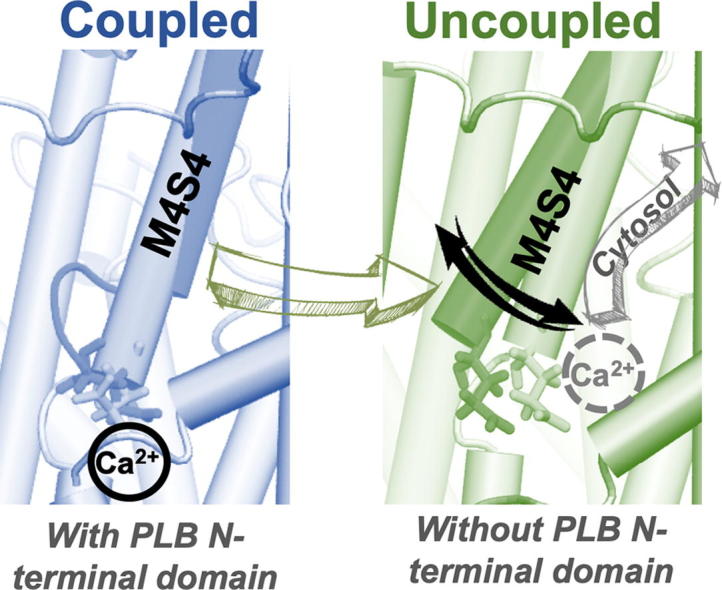
A hallmark of phospholamban functional divergence is located in the N-terminal phosphorylation domain
The DOI matches its Crossref record; 9 of the 9 references it cites were found in a registry or an index.
Overview
The claims and statistics of this paper haven’t been checked yet.
Free: it reads the open-access text and checks the first 5 claims that cite a source we can check. Create a free account to check every claim.
Integrity signals
Registry
Cites
Statistics
Figures
Verification
Claims the paper makes
The claims and statistics of this paper haven’t been checked yet.
Free: it reads the open-access text and checks the first 5 claims that cite a source we can check. Create a free account to check every claim.
Claims other papers make about this one
Each is checked against this paper’s own text: does it say what the citing paper says it does?
In the citing paper
“Notably, based on previously published structural models 36,81 -85 and mutagenesis studies by MacLennan and co-workers, 86 N34 and N30 are located at the interface of the SERCA-PLN complex which, together, form an electrostatic node with K27 that is necessary for PLN inhibitory interactions.”
From Spectroscopic Insights into Allosteric Regulation of the SERCA-Phospholamban Complex by Intrinsically Disordered HAX-1 (2026) · cites this paper as [82]
Self-check
Percentages, sums and reported differences re-computed from the paper’s own numbers.
The self-check needs the paper’s full text.
Citations
Cites
Sarcolipin is a newly identified regulator of muscle-based thermogenesis in mammals
Bal, N. C., Maurya, S. K., Sopariwala, D. H., Sahoo, S. K., Gupta, S. C., Shaikh, S. A., Pant, M., Rowland, L. A., Bombardier, E., Goonasekera, S. A., et al. (2012) · Nature Medicine · doi:10.1038/nm.2897 · Cited by 553
Modulation of Cardiac Contractility by the Phopholamban/SERCA2a Regulatome
Kranias, E. G., & Hajjar, R. J. (2012) · Circulation Research · doi:10.1161/circresaha.111.259754 · Cited by 532
The sarcoplasmic Ca2+-ATPase: design of a perfect chemi-osmotic pump
Møller, J. V., Olesen, C., Winther, A.-M. L., & Nissen, P. (2010) · Quarterly Reviews of Biophysics · doi:10.1017/s003358351000017x · Cited by 284
Phospholamban Inhibitory Function Is Activated by Depolymerization
Kimura, Y., Kurzydlowski, K., Tada, M., & MacLennan, D. H. (1997) · Journal of Biological Chemistry · doi:10.1074/jbc.272.24.15061 · Cited by 282
Crystal structures of the calcium pump and sarcolipin in the Mg2+-bound E1 state
Toyoshima, C., Iwasawa, S., Ogawa, H., Hirata, A., Tsueda, J., & Inesi, G. (2013) · Nature · doi:10.1038/nature11899 · Cited by 224
The sarcolipin-bound calcium pump stabilizes calcium sites exposed to the cytoplasm
Winther, A.-M. L., Bublitz, M., Karlsen, J. L., Møller, J. V., Hansen, J. B., Nissen, P., & Buch-Pedersen, M. J. (2013) · Nature · doi:10.1038/nature11900 · Cited by 208
Asahi, M., Sugita, Y., Kurzydlowski, K., De Leon, S., Tada, M., Toyoshima, C., & MacLennan, D. H. (2003) · Proceedings of the National Academy of Sciences · doi:10.1073/pnas.0330962100 · Cited by 159
Allosteric regulation of SERCA by phosphorylation-mediated conformational shift of phospholamban
Gustavsson, M., Verardi, R., Mullen, D. G., Mote, K. R., Traaseth, N. J., Gopinath, T., & Veglia, G. (2013) · Proceedings of the National Academy of Sciences · doi:10.1073/pnas.1303006110 · Cited by 150 · cited 2×
“Furthermore, the high alpha-helix structural stability of PLB26–52 and the inability of its cytosolic segment to undergo order-todisorder transitions in the ms timescale also provides a mechanistic explanation for the inhibitory potency retained by the isolated transmembrane domain of PLB [36].”
BackgroundResultStructure and Orientation of Sarcolipin in Lipid Environments,
Mascioni, A., Karim, C., Barany, G., Thomas, D. D., & Veglia, G. (2002) · Biochemistry · doi:10.1021/bi011243m · Cited by 97
Research works printed but not linked: 53
- Babu G.J. Bhupathy P. Carnes C.A. Billman G.E. Periasamy M. Differential expression of sarcolipin protein during muscle development and cardiac pathophysiology J Mol Cell Cardiol 43 2007 215 222 17561107 PMC2706541 · DOI
- Vangheluwe P. Schuermans M. Zador E. Waelkens E. Raeymaekers L. Wuytack F. Sarcolipin and phospholamban mRNA and protein expression in cardiac and skeletal muscle of different species Biochem J 389 2005 151 159 15801907 PMC1184547 · DOI · Paper page
- Akin B.L. Hurley T.D. Chen Z. Jones L.R. The structural basis for phospholamban inhibition of the calcium pump in sarcoplasmic reticulum J Biol Chem 288 2013 30181 30191 23996003 PMC3798486 · DOI · Paper page
- Mall S. Broadbridge R. Harrison S.L. Gore M.G. Lee A.G. East J.M. The presence of sarcolipin results in increased heat production by Ca(2+)-ATPase J Biol Chem 281 2006 36597 36602 17018526 · DOI · Paper page
- Smith W.S. Broadbridge R. East J.M. Lee A.G. Sarcolipin uncouples hydrolysis of ATP from accumulation of Ca2+ by the Ca2+-ATPase of skeletal-muscle sarcoplasmic reticulum Biochem J 361 2002 277 286 11772399 PMC1222307 · DOI · Paper page
- Maurya S.K. Bal N.C. Sopariwala D.H. Pant M. Rowland L.A. Shaikh S.A. Sarcolipin is a key determinant of the basal metabolic rate, and its overexpression enhances energy expenditure and resistance against diet-induced obesity J Biol Chem 290 2015 10840 10849 25713078 PMC4409248 · DOI · Paper page
- Gamu D. Juracic E.S. Fajardo V.A. Rietze B.A. Tran K. Bombardier E. Phospholamban deficiency does not alter skeletal muscle SERCA pumping efficiency or predispose mice to diet-induced obesity Am J Physiol Endocrinol Metab 316 2019 E432 E442 30601702 · DOI
- Bal N.C. Maurya S.K. Singh S. Wehrens X.H. Periasamy M. Increased reliance on muscle-based thermogenesis upon acute minimization of brown adipose tissue function J Biol Chem 291 2016 17247 17257 27298322 PMC5016124 · DOI
- Autry J.M. Thomas D.D. Espinoza-Fonseca L.M. Sarcolipin promotes uncoupling of the SERCA Ca2+ pump by inducing a structural rearrangement in the energy-transduction domain Biochemistry-US 55 2016 6083 6086 PMC5506494 27731980 · DOI · Paper page
- Sahoo S.K. Shaikh S.A. Sopariwala D.H. Bal N.C. Bruhn D.S. Kopec W. The N terminus of sarcolipin plays an important role in uncoupling sarco-endoplasmic reticulum Ca2+-ATPase (SERCA) ATP hydrolysis from Ca2+ transport J Biol Chem 290 2015 14057 14067 25882845 PMC4447977 · DOI · Paper page
- Asahi M. McKenna E. Kurzydlowski K. Tada M. MacLennan D.H. Physical interactions between phospholamban and sarco(endo)plasmic reticulum Ca2+-ATPases are dissociated by elevated Ca2+, but not by phospholamban phosphorylation, vanadate, or thapsigargin, and are enhanced by ATP J Biol Chem 275 2000 15034 15038 10809745 · DOI · Paper page
- Bombardier E. Smith I.C. Vigna C. Fajardo V.A. Tupling A.R. Ablation of sarcolipin decreases the energy requirements for Ca2+ transport by sarco(endo)plasmic reticulum Ca2+-ATPases in resting skeletal muscle FEBS Lett 587 2013 1687 1692 23628781 · DOI
- Reddy L.G. Jones L.R. Cala S.E. O’Brian J.J. Tatulian S.A. Stokes D.L. Functional reconstitution of recombinant phospholamban with rabbit skeletal Ca(2+)-ATPase J Biol Chem 270 1995 9390 9397 7721863 · DOI · Paper page
- Espinoza-Fonseca L.M. Autry J.M. Thomas D.D. Sarcolipin and phospholamban inhibit the calcium pump by populating a similar metal ion-free intermediate state Biochem Biophys Res Commun 463 2015 37 41 25983321 PMC4465059 · DOI
- Espinoza-Fonseca L.M. Autry J.M. Ramirez-Salinas G.L. Thomas D.D. Atomic-level mechanisms for phospholamban regulation of the calcium pump Biophys J 108 2015 1697 1708 25863061 PMC4390807 · DOI
- Sheinerman F.B. Honig B. On the role of electrostatic interactions in the design of protein-protein interfaces J Mol Biol 318 2002 161 177 12054776 · DOI · Paper page
- Singh D.R. Dalton M.P. Cho E.E. Pribadi M.P. Zak T.J. Seflova J. Newly discovered micropeptide regulators of SERCA form oligomers but bind to the pump as monomers J Mol Biol. 431 2019 4429 4443 31449798 PMC6885550 · DOI · Paper page
- Olsson M.H.M. Sondergaard C.R. Rostkowski M. Jensen J.H. PROPKA3: consistent treatment of internal and surface residues in empirical pK(a) predictions J Chem Theory Comput 7 2011 525 537 26596171 · DOI · Paper page
- Sondergaard C.R. Olsson M.H.M. Rostkowski M. Jensen J.H. Improved treatment of ligands and coupling effects in empirical calculation and rationalization of pK(a) values J Chem Theory Comput 7 2011 2284 2295 26606496 · DOI · Paper page
- Norimatsu Y. Hasegawa K. Shimizu N. Toyoshima C. Protein-phospholipid interplay revealed with crystals of a calcium pump Nature 545 2017 193 198 28467821 · DOI · Paper page
- Phillips J.C. Braun R. Wang W. Gumbart J. Tajkhorshid E. Villa E. Scalable molecular dynamics with NAMD J Comput Chem 26 2005 1781 1802 16222654 PMC2486339 · DOI · Paper page
- Weber W. Hünenberger P.H. McCammon J.A. Molecular dynamics simulations of a polyalanine octapeptide under ewald boundary conditions: influence of artificial periodicity on peptide conformation J Phys Chem B 104 2000 3668 3675 · DOI · Paper page
- Darden T. York D. Pedersen L. Particle mesh Ewald: an N·log(N) method for Ewald sums in large systems J Chem Phys 98 1993 10089 10092 · DOI · Paper page
- Essmann U. Perera L. Berkowitz M.L. A smooth particle mesh Ewald method J Chem Phys 103 1995 8577 8593 · DOI · Paper page
- Best R.B. Zhu X. Shim J. Lopes P.E. Mittal J. Feig M. Optimization of the additive CHARMM all-atom protein force field targeting improved sampling of the backbone phi, psi and side-chain chi(1) and chi(2) dihedral angles J Chem Theory Comput 8 2012 3257 3273 23341755 PMC3549273 · DOI · Paper page
- Klauda J.B. Venable R.M. Freites J.A. O'Connor J.W. Tobias D.J. Mondragon-Ramirez C. Update of the CHARMM all-atom additive force field for lipids: validation on six lipid types J Phys Chem B 114 2010 7830 7843 20496934 PMC2922408 · DOI · Paper page
- Fernandez-de Gortari E. Espinoza-Fonseca L.M. Structural basis for relief of phospholamban-mediated inhibition of the sarcoplasmic reticulum Ca(2+)-ATPase at saturating Ca(2+) conditions J Biol Chem 293 2018 12405 12414 29934304 PMC6093236 · DOI
- Espinoza-Fonseca L.M. Ramirez-Salinas G.L. Microsecond molecular simulations reveal a transient proton pathway in the calcium pump J Am Chem Soc 137 2015 7055 7058 26028459 · DOI
- El Hage K. Hedin F. Gupta P.K. Meuwly M. Karplus M. Valid molecular dynamics simulations of human hemoglobin require a surprisingly large box size Elife 7 2018 e45318 PMC6042964 29998846 · DOI
- Hellstern S. Pegoraro S. Karim C.B. Lustig A. Thomas D.D. Moroder L. Sarcolipin, the shorter homologue of phospholamban, forms oligomeric structures in detergent micelles and in liposomes J Biol Chem 276 2001 30845 30852 11413134 · DOI · Paper page
- Pallikkuth S. Blackwell D.J. Hu Z. Hou Z. Zieman D.T. Svensson B. Phosphorylated phospholamban stabilizes a compact conformation of the cardiac calcium-ATPase Biophys J 105 2013 1812 1821 24138857 PMC3797577 · DOI · Paper page
- Trieber C.A. Afara M. Young H.S. Effects of phospholamban transmembrane mutants on the calcium affinity, maximal activity, and cooperativity of the sarcoplasmic reticulum calcium pump Biochemistry-US 48 2009 9287 9296 19708671 · DOI · Paper page
- Reddy L.G. Cornea R.L. Winters D.L. McKenna E. Thomas D.D. Defining the molecular components of calcium transport regulation in a reconstituted membrane system Biochemistry-US 42 2003 4585 4592 12693956 · DOI · Paper page
- Miyazawa S. Jernigan R.L. Residue-residue potentials with a favorable contact pair term and an unfavorable high packing density term, for simulation and threading J Mol Biol 256 1996 623 644 8604144 · DOI · Paper page
- Kimura Y. Asahi M. Kurzydlowski K. Tada M. MacLennan D.H. Phospholamban domain Ib mutations influence functional interactions with the Ca2+-ATPase isoform of cardiac sarcoplasmic reticulum J Biol Chem 273 1998 14238 14241 9603928 · DOI · Paper page
- Schober P. Boer C. Schwarte L.A. Correlation coefficients: appropriate use and interpretation Anesth Analg 126 2018 1763 1768 29481436 · DOI · Paper page
- Inesi G. Ma H. Lewis D. Xu C. Ca2+ occlusion and gating function of Glu309 in the ADP-fluoroaluminate analog of the Ca2+-ATPase phosphoenzyme intermediate J Biol Chem 279 2004 31629 31637 15150270 · DOI
- Clausen J.D. Bublitz M. Arnou B. Montigny C. Jaxel C. Møller J.V. SERCA mutant E309Q binds two Ca(2+) ions but adopts a catalytically incompetent conformation EMBO J 32 2013 3231 3243 24270570 PMC3981149 · DOI
- Sun B. Stewart B.D. Kucharski A.N. Kekenes-Huskey P.M. Thermodynamics of cation binding to the sarcoendoplasmic reticulum calcium atpase pump and impacts on enzyme function J Chem Theory Comput 15 2019 2692 2705 30807147 PMC7336277 · DOI
- Raguimova O.N. Smolin N. Bovo E. Bhayani S. Autry J.M. Zima A.V. Redistribution of SERCA calcium pump conformers during intracellular calcium signaling J Biol Chem 293 2018 10843 10856 29764938 PMC6052202 · DOI
- Espinoza-Fonseca L.M. Colson B.A. Thomas D.D. Effects of pseudophosphorylation mutants on the structural dynamics of smooth muscle myosin regulatory light chain Mol Biosyst 10 2014 2693 2698 25091814 PMC4219086 · doi:10.1039/c4mb00364k
- Kast D. Espinoza-Fonseca L.M. Yi C. Thomas D.D. Phosphorylation-induced structural changes in smooth muscle myosin regulatory light chain Proc Natl Acad Sci U S A 107 2010 8207 8212 20404208 PMC2889560 · DOI
- Espinoza-Fonseca L.M. Kast D. Thomas D.D. Thermodynamic and structural basis of phosphorylation-induced disorder-to-order transition in the regulatory light chain of smooth muscle myosin J Am Chem Soc 130 2008 12208 12209 18715003 PMC2875193 · DOI
- Glaves J.P. Primeau J.O. Espinoza-Fonseca L.M. Lemieux M.J. Young H.S. The phospholamban pentamer alters function of the sarcoplasmic reticulum calcium pump SERCA Biophys J 116 2019 633 647 30712785 PMC6383005 · DOI
- Gorski P.A. Glaves J.P. Vangheluwe P. Young H.S. Sarco(endo)plasmic reticulum calcium ATPase (SERCA) inhibition by sarcolipin is encoded in its luminal tail J Biol Chem 288 2013 8456 8467 23362265 PMC3605661 · DOI · Paper page
- Toyoshima C. Nakasako M. Nomura H. Ogawa H. Crystal structure of the calcium pump of sarcoplasmic reticulum at 2.6 A resolution Nature 405 2000 647 655 10864315 · DOI · Paper page
- Frank K. Tilgmann C. Shannon T.R. Bers D.M. Kranias E.G. Regulatory Role of Phospholamban in the Efficiency of Cardiac Sarcoplasmic Reticulum Ca2+ Transport Biochemistry 39 2000 14176 14182 11087366 · DOI
- Karim C.B. Marquardt C.G. Stamm J.D. Barany G. Thomas D.D. Synthetic null-cysteine phospholamban analogue and the corresponding transmembrane domain inhibit the Ca-ATPase Biochemistry 39 2000 10892 10897 10978176 · DOI · Paper page
- Kimura Y. Asahi M. Kurzydlowski K. Tada M. MacLennan D.H. Phospholamban domain I/cytochrome b5 transmembrane sequence chimeras do not inhibit SERCA2a FEBS Lett. 425 1998 509 512 9563523 · DOI
- Kimura Y. Kurzydlowski K. Tada M. MacLennan D.H. Phospholamban regulates the Ca2+-ATPase through intramembrane interactions J Biol Chem 271 1996 21726 21731 8702967 · DOI · Paper page
- Jones L.R. Field L.J. Residues 2-25 of phospholamban are insufficient to inhibit Ca2+ transport ATPase of cardiac sarcoplasmic reticulum J Biol Chem 268 1993 11486 11488 8505284 · DOI
- Sasaki T. Inui M. Kimura Y. Kuzuya T. Tada M. Molecular Mechanism of Regulation of Ca2+ Pump ATPase by Phospholamban in Cardiac Sarcoplasmic Reticulum. Effects of Synthetic Phospholamban Peptides on Ca2+ Pump ATPase J Biol Chem 267 1992 1674 1679 1530941 · DOI · Paper page
- Ahmed Z. Reid D.G. Watts A. Middleton D.A. A solid-state NMR study of the phospholamban transmembrane domain: local structure and interactions with Ca2+-ATPase Biochim Biophys Acta 1468 2000 187 198 11018663 · DOI
Cited by
Larsen, E. K., Smith, R. A., Reddy, U. V., S, M. V., Bhagat, S., Robia, S. L., & Veglia, G. (2026) · Biochemistry · doi:10.1021/acs.biochem.6c00493
Metadata
- Authors
- Fernández-de Gortari, E., Aguayo-Ortiz, R., Autry, J. M., & Michel Espinoza-Fonseca, L.
- Affiliations
- Center for Arrhythmia Research, Department of Internal Medicine, Division of Cardiovascular Medicine, University of Michigan, Ann Arbor, MI 48109, USA
- Department of Biochemistry, Molecular Biology, and Biophysics, University of Minnesota, Minneapolis, MN 55455, USA
- Venue
- Computational and Structural Biotechnology Journal
- Published
- 2020-01
- Volume
- 18
- Pages
- 705-713
- ISSN
- 2001-0370
- PMC
- PMC7114604
- Cited by
- 7
- References
- 9
- Language
- en
- Licence
- www.elsevier.com/tdm/userlicense/1.0/ (tdm)
- www.elsevier.com/legal/tdmrep-license (tdm)
- creativecommons.org/licenses/by-nc-nd/4.0/ (vor, 53 d)
- Funders
- National Institutes of Health (R01GM120142)
About these checks
Registry, retraction, Cites and statistics results are computed, not judged, with one exception: a printed reference that no index lists is read once by a model before it counts as a citation error. Claims are extracted by a model and kept only when their quote appears verbatim in the text; each cited source is then checked, with a model’s help, for whether it says what the claim relies on. Those verdicts can be wrong — read the claim’s quote and the cited source before relying on one.
Statistics and arithmetic are recomputed, not judged.
Confidence bands are shown only for fields calibrated on our annotated test set. None is calibrated yet, so no band is shown.
What counts as a claim ›How we measure confidence ›How we check this ›
Are you an author, or do you see a problem with this page? Request a review
Data sources
Bibliographic data: Semantic Scholar, OpenAlex, Crossref.
Contains information from the Semantic Scholar Academic Graph Datasets, made available under the ODC Attribution License (ODC-BY 1.0).
Semantic Scholar’s data is described in: Kinney, R., et al. (2023). The Semantic Scholar Open Data Platform. arXiv:2301.10140.
