

The DOI matches its Crossref record; 86 of the 86 references it cites were found in a registry or an index.
Automated methods for cell type annotation on scRNA-seq data
Open accessAbstract
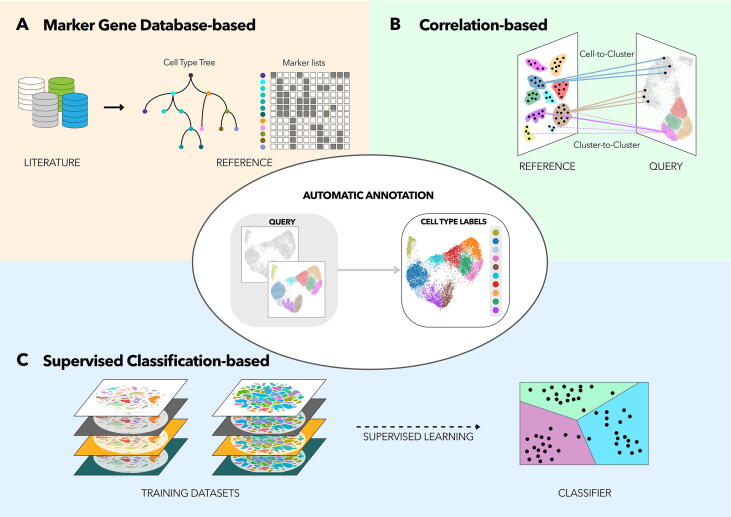
The advent of single-cell sequencing started a new era of transcriptomic and genomic research, advancing our knowledge of the cellular heterogeneity and dynamics. Cell type annotation is a crucial step in analyzing single-cell RNA sequencing data, yet manual annotation is time-consuming and partially subjective. As an alternative, tools have been developed for automatic cell type identification. Different strategies have emerged to ultimately associate gene expression profiles of single cells with a cell type either by using curated marker gene databases, correlating reference expression data, or transferring labels by supervised classification. In this review, we present an overview of the available tools and the underlying approaches to perform automated cell type annotations on scRNA-seq data.
Overview
The claims and statistics of this paper haven’t been checked yet.
Run the check — free, no account needed. It reads the open-access text and checks the sources it cites.
Integrity signals
Registry
Cites
Statistics
Figures
Verification
Claims the paper makes
The claims and statistics of this paper haven’t been checked yet.
Run the check — free, no account needed. It reads the open-access text and checks the sources it cites.
Claims other papers make about this one
Each is checked against this paper’s own text: does it say what the citing paper says it does?
In the citing paper
“Annotation results obtained with pre-trained classifiers are strongly affected by the classifier type and the quality of the training data used to create the classifier54,55.”
From Best practices for single-cell analysis across modalities (2023) · cites this paper as [55]
Self-check
Percentages, sums and reported differences re-computed from the paper’s own numbers.
The self-check needs the paper’s full text.
Citations
Cites
(2008) · Journal of Machine Learning Research · Cited by 33,051
An integrated encyclopedia of DNA elements in the human genome
The ENCODE Project Consortium (2012) · Nature · doi:10.1038/nature11247 · Cited by 18,072
Integrating single-cell transcriptomic data across different conditions, technologies, and species
Butler, A., Hoffman, P., Smibert, P., Papalexi, E., & Satija, R. (2018) · Nature Biotechnology · doi:10.1038/nbt.4096 · Cited by 13,174
Dimensionality reduction for visualizing single-cell data using UMAP
Becht, E., McInnes, L., Healy, J., Dutertre, C.-A., Kwok, I. W. H., Ng, L. G., Ginhoux, F., & Newell, E. W. (2019) · Nature Biotechnology · doi:10.1038/nbt.4314 · Cited by 5,358
Aran, D., Looney, A. P., Liu, L., Wu, E., Fong, V., Hsu, A., Chak, S., Naikawadi, R. P., Wolters, P. J., Abate, A. R., et al. (2019) · Nature Immunology · doi:10.1038/s41590-018-0276-y · Cited by 4,984
Simultaneous epitope and transcriptome measurement in single cells
Stoeckius, M., Hafemeister, C., Stephenson, W., Houck-Loomis, B., Chattopadhyay, P. K., Swerdlow, H., Satija, R., & Smibert, P. (2017) · Nature Methods · doi:10.1038/nmeth.4380 · Cited by 3,098
Single-cell transcriptomics of 20 mouse organs creates a Tabula Muris
The Tabula Muris Consortium, coordination, O., coordination, L., processing, O. C. A., sequencing, L. P. A., analysis, C. D., annotation, C. T., Writing group, Supplemental text writing group, & Principal investigators (2018) · Nature · doi:10.1038/s41586-018-0590-4 · Cited by 2,842 · cited 2×
“In tests using the Tabula Muris Atlas as a training dataset [47], ACTINN was highly accurate in classifying strictly related cellular subtypes, and was robust against batch effects arising from the use of different sequencing techniques.”
MethodMolecular Architecture of the Mouse Nervous System
Zeisel, A., Hochgerner, H., Lönnerberg, P., Johnsson, A., Memic, F., van der Zwan, J., Häring, M., Braun, E., Borm, L. E., La Manno, G., et al. (2018) · Cell · doi:10.1016/j.cell.2018.06.021 · Cited by 2,552
Regev, A., Teichmann, S. A., Lander, E. S., Amit, I., Benoist, C., Birney, E., Bodenmiller, B., Campbell, P., Carninci, P., Clatworthy, M., et al. (2017) · eLife · doi:10.7554/elife.27041 · Cited by 2,232
Current best practices in single-cell RNA-seq analysis: a tutorial
Luecken, M. D., & Theis, F. J. (2019) · Molecular Systems Biology · doi:10.15252/msb.20188746 · Cited by 2,231
Research works printed but not linked: 2
- The T.W. and Thoery C.: Past and present. J Anat Physiol 1890; 24: 253.
- 10.1038/s41592-019-0535-3 · DOI · Paper page
Cited by
Sorted by citations
Best practices for single-cell analysis across modalities
Heumos, L., Schaar, A. C., Lance, C., Litinetskaya, A., Drost, F., Zappia, L., Lücken, M. D., Strobl, D. C., Henao, J., Curion, F., et al. (2023) · Nature Reviews Genetics · doi:10.1038/s41576-023-00586-w · Cited by 1,051
“Generally, pseudobulk methods with sum aggregation and mixed models such as MAST with random effect setting were found to be superior to naive methods, such as the popular Wilcoxon rank-sum test, which does not account for within-sample correlation 88 .”
MethodYang, F., Wang, W., Wang, F., Fang, Y., Tang, D., Huang, J., Lu, H., & Yao, J. (2021) · doi:10.1101/2021.12.05.471261 · Cited by 617
Advances in spatial transcriptomic data analysisPreprint
Dries, R., Chen, J. G., Rossi, N. D., Khan, M. M., Sistig, A., & Yuan, G. (2021) · Genome Research · doi:10.1101/gr.275224.121 · Cited by 246
Shao, X., Yang, H., Zhuang, X., Liao, J., Yang, P., Cheng, J., Lu, X., Chen, H., & Fan, X. (2021) · Nucleic Acids Research · doi:10.1093/nar/gkab775 · Cited by 158
Recent Advances of Deep Learning for Computational Histopathology: Principles and Applications
Wu, Y., Cheng, M., Huang, S., Pei, Z., Zuo, Y., Liu, J., Yang, K., Zhu, Q., Zhang, J., Hong, H., et al. (2022) · Cancers · doi:10.3390/cancers14051199 · Cited by 148
Metadata
- Authors
- Pasquini, G., Rojo Arias, J. E., Schäfer, P., & Busskamp, V.
- Affiliations
- University of Bonn (DE)
- Wellcome-MRC Cambridge Stem Cell Institute, Jeffrey Cheah Biomedical Centre, Cambridge Biomedical Campus, University of Cambridge, Cambridge, UK
- Center for Regenerative Therapies Dresden (DE)
- Corresponding author
- Busskamp, Volker
- Venue
- Computational and Structural Biotechnology Journal
- Published
- 2021-01
- Volume
- 19
- Pages
- 961-969
- ISSN
- 2001-0370 (ISSN-L)
- PMC
- PMC7873570
- OpenAlex
- W3124814274
- Cited by
- 249
- References
- 85
- Citations by year
- 2026: 45 · 2025: 62 · 2024: 45 · 2023: 48 · 2022: 35 · 2021: 14
- FWCI
- 3.78
- Type
- journal article
- Language
- en
- Open access
- gold
- doi.org
- Licence
- Locations
- Computational and Structural Biotechnology Journal (publishedVersion, cc-by-nc-nd)
- PubMed Central (publishedVersion, cc-by-nc-nd)
- PubMed (publishedVersion)
- Apollo (University of Cambridge) (submittedVersion, cc-by-nc-nd)
- DOAJ (DOAJ: Directory of Open Access Journals) (submittedVersion, cc-by-sa)
- Apollo
- Funders
- H2020 European Research Council (ERC-StG-678071 – ProNeurons)
- European Research Council
- Deutsche Forschungsgemeinschaft (EXC-2068-390729961, SPP2127)
- Volkswagen Foundation
- Technische Universität Dresden (EXC-2151-390873048)
- Rheinische Friedrich-Wilhelms-Universität Bonn
- Topics
- Life Sciences › Biochemistry, Genetics and Molecular Biology › Molecular Biology › Single-cell and spatial transcriptomics
- Life Sciences › Biochemistry, Genetics and Molecular Biology › Molecular Biology › Gene expression and cancer classification
- Life Sciences › Biochemistry, Genetics and Molecular Biology › Molecular Biology › Genomics and Phylogenetic Studies
- Keywords
- cell type annotation, single-cell RNA sequencing, supervised classification, cellular heterogeneity
About these checks
Registry, retraction, Cites and statistics results are computed, not judged, with one exception: a printed reference that no index lists is read once by a model before it counts as a citation error. Claims are extracted by a model and kept only when their quote appears verbatim in the text; each cited source is then checked, with a model’s help, for whether it says what the claim relies on. Those verdicts can be wrong — read the claim’s quote and the cited source before relying on one.
Statistics and arithmetic are recomputed, not judged.
Confidence bands are shown only for fields calibrated on our annotated test set. None is calibrated yet, so no band is shown.
What counts as a claim ›How we measure confidence ›How we check this ›
Are you an author, or do you see a problem with this page? Request a review
