

The DOI matches its Crossref record; 86 of the 86 references it cites were found in a registry or an index.
Clade-wide fungal proteome analysis reveals structure–function conservation in divergent Dicer proteins
Open accessPublished version of a preprint
Abstract
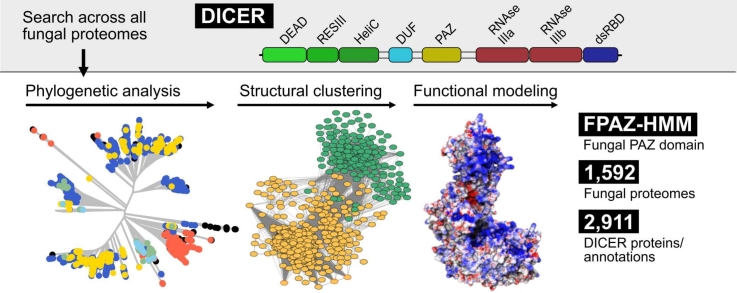
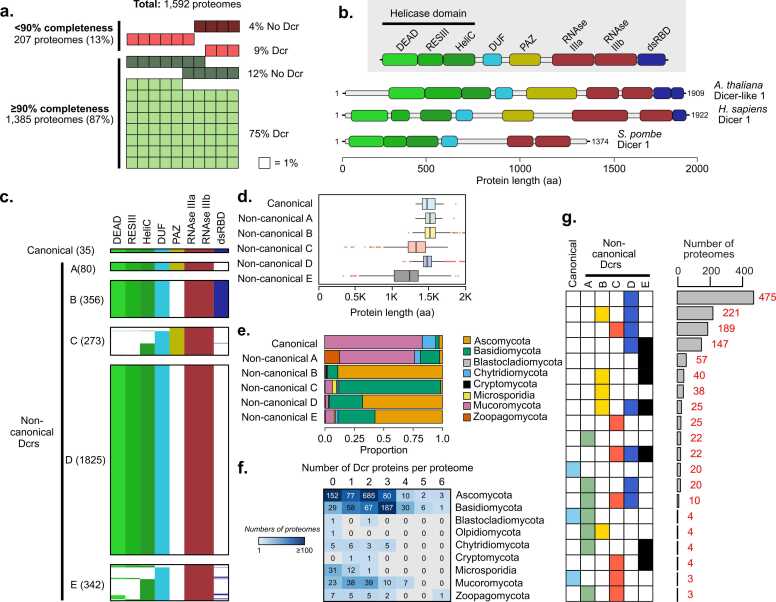
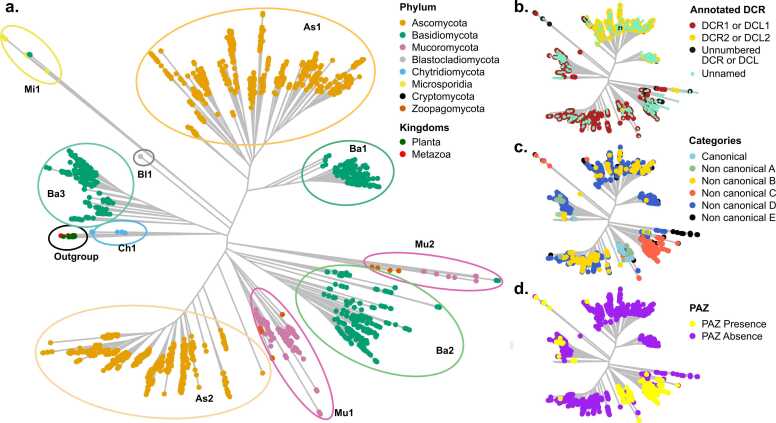
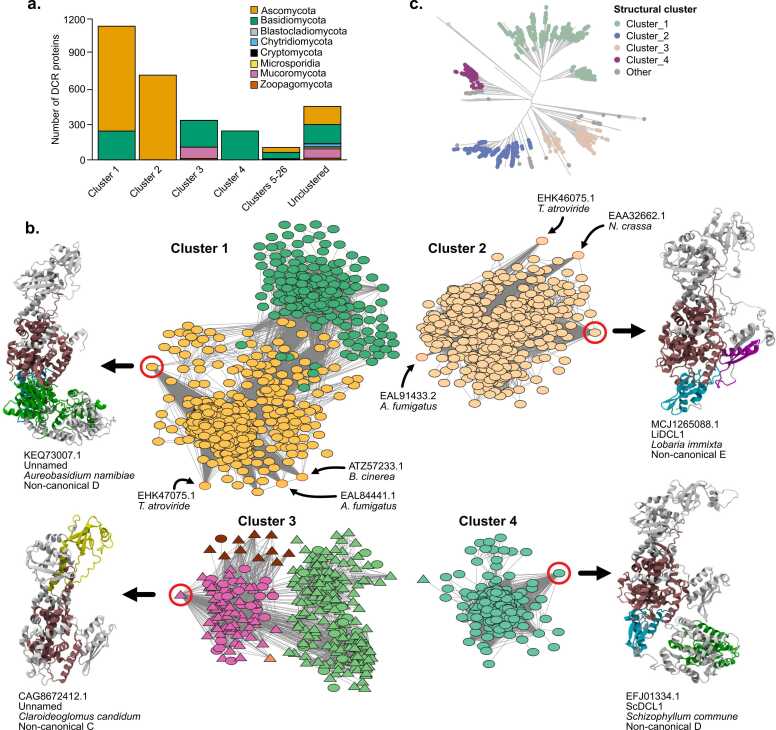
Abstract Dicers (Dcrs) are central proteins involved in the biogenesis of small RNAs (sRNAs) in eukaryotes. Most of the knowledge on Dcr structure, function and evolution comes from studies conducted in animal and plant species. Comparatively, much less is known in fungi, which are a genetically and ecologically diverse group with important roles in ecosystems, agriculture, medicine, and biotechnology. While canonical Dcrs in plants and animals contain a well-defined domain architecture, most fungal Dcrs with experimentally validated functions lack one or more identifiable canonical domains, raising questions about how RNA-binding and precise sRNA processing is retained. Here, we conducted the most extensive survey of fungal Dcr proteins, analyzing 1,593 proteomes across eight phyla. We found a diversity of Dcr domain architectures, with some of them lacking an identifiable PAZ, Helicase, and/or double-stranded RNA binding domains. Phylogenetic analyses showed that different Dcr classes are distributed across distinct clades that often align with fungal taxonomic groups. Despite the lack of canonical domain architectures, we found that fungal Dcrs fold into a characteristic L-shaped structure and show PAZ-like folds, even in proteins without detectable PAZ sequences. Molecular docking and electrostatic analyses further indicate that these divergent Dcrs maintain key RNA-binding surfaces for proper sRNA processing. Our results indicate a remarkable evolutionary plasticity of Dcr in fungi, showing that essential sRNA processing functions can be retained through structural conservation, and highlighting fungi as models to study the modular evolution of the RNAi machinery in eukaryotes. Significance statement Dicer (Dcr) proteins are central to RNA interference (RNAi), a gene regulatory mechanism conserved across eukaryotes. However, current models of Dcr structure, function, and evolution are largely based on studies in animals and plants. Here, we present the most comprehensive analysis to date of Dcr proteins in fungi, a diverse eukaryotic group including many societally important pathogens and symbiotes which are reliant on RNAi. Our findings reveal that despite widespread divergence from canonical Dcr architecture, fungal Dcrs conserve critical folds and RNA-binding features, further suggesting that core RNAi functions are maintained. This work establishes fungi as key models for studying the evolution and functional robustness of the RNAi machinery, offering broader insight into the diversity and plasticity of sRNA biogenesis pathways across eukaryotes.
Overview
The claims and statistics of this paper haven’t been checked yet.
Run the check — free, no account needed. It reads the open-access text and checks the sources it cites.
Integrity signals
Registry
Cites
Statistics
Figures
Verification
Claims the paper makes
The claims and statistics of this paper haven’t been checked yet.
Run the check — free, no account needed. It reads the open-access text and checks the sources it cites.
Self-check
Percentages, sums and reported differences re-computed from the paper’s own numbers.
The self-check needs the paper’s full text.
Citations
Cites
Thompson, J. D., Higgins, D. G., & Gibson, T. J. (1994) · Nucleic Acids Research · doi:10.1093/nar/22.22.4673 · Cited by 64,617
Cytoscape: A software Environment for integrated models of biomolecular interaction networks
Shannon, P., Markiel, A., Ozier, O., Baliga, N. S., Wang, J. T., Ramage, D., Amin, N., Schwikowski, B., & Ideker, T. (2003) · Genome Research · doi:10.1101/gr.1239303 · Cited by 51,888
MAFFT Multiple Sequence Alignment Software Version 7: Improvements in Performance and Usability
Katoh, K., & Standley, D. M. (2013) · Molecular Biology and Evolution · doi:10.1093/molbev/mst010 · Cited by 46,209
Highly accurate protein structure prediction with AlphaFold
Jumper, J., Evans, R., Pritzel, A., Green, T., Figurnov, M., Ronneberger, O., Tunyasuvunakool, K., Bates, R., Žídek, A., Potapenko, A., et al. (2021) · Nature · doi:10.1038/s41586-021-03819-2 · Cited by 43,764
IQ-TREE 2: New Models and Efficient Methods for Phylogenetic Inference in the Genomic Era
Minh, B. Q., Schmidt, H. A., Chernomor, O., Schrempf, D., Woodhams, M. D., von Haeseler, A., & Lanfear, R. (2020) · Molecular Biology and Evolution · doi:10.1093/molbev/msaa015 · Cited by 16,873
Fast and sensitive protein alignment using DIAMOND
Buchfink, B., Xie, C., & Huson, D. H. (2015) · Nature Methods · doi:10.1038/nmeth.3176 · Cited by 14,201
ColabFold - Making protein folding accessible to all
Mirdita, M., Schütze, K., Moriwaki, Y., Heo, L., Ovchinnikov, S., & Steinegger, M. (2021) · doi:10.1101/2021.08.15.456425 · Cited by 9,391
InterProScan 5: genome-scale protein function classification
Jones, P., Binns, D., Chang, H.-Y., Fraser, M., Li, W., McAnulla, C., McWilliam, H., Maslen, J., Mitchell, A., Nuka, G., et al. (2014) · Bioinformatics · doi:10.1093/bioinformatics/btu031 · Cited by 9,301
phytools: an R package for phylogenetic comparative biology (and other things)
Revell, L. J. (2012) · Methods in Ecology and Evolution · doi:10.1111/j.2041-210x.2011.00169.x · Cited by 9,277
Electrostatics of nanosystems: Application to microtubules and the ribosome
Baker, N., Sept, D., Joseph, S., Holst, M., & McCammon, J. A. (2001) · Proceedings of the National Academy of Sciences · doi:10.1073/pnas.181342398 · Cited by 7,125
Research works printed but not linked: 4
- Benavides T. and Bystroff C.: HMMSTRTM A hidden Markov Model Local Struct Predict Globul Membr Assoc Proteins [Prepr] (2023 May 2025; . Available at: 〈http://biorxiv.org/lookup/doi/10.1101/2023.02.08.527695〉. · doi:10.1101/2023.02.08.527695〉
- 10.1038/s41592-022-01488-1 · DOI · Paper page
- Zhu Q., Kosoy M. and Dittmar K.: HGTector automated method facilitating genomewide discovery putative horizontal gene transfers 2014; .
- 10.14806/ej.17.1.200 · DOI · Paper page
Metadata
- Authors
- Melet, L., Canan, J., Villalobos, P., Vidal-Veuthey, B., González-Toro, F., Orellana, I., Rivas-Pardo, J. A., Cárdenas, J. P., Moraga, C., Castro-Fernández, V., Johnson, N. R., & Vidal, E. A.
- Affiliations
- Universidad Mayor (CL)
- University of Chile (CL)
- Centro de Genómica y Bioinformática, Universidad Mayor, Santiago 8580745, Chile
- Millennium Science Initiative (CL)
- Departamento de Biología, Facultad de Ciencias, Universidad de Chile, Santiago 7800003, Chile
- Corresponding author
- Johnson, Nathan R.
- Vidal, Elena A.
- ORCID
- Venue
- Computational and Structural Biotechnology Journal
- Published
- 2025-01-01
- Volume
- 27
- Pages
- 5020-5035
- ISSN
- 2001-0370 (ISSN-L)
- PMC
- PMC12663654
- OpenAlex
- W4415972686
- Cited by
- 1
- References
- 86
- Citations by year
- 2026: 1
- FWCI
- 0.30
- Type
- journal article
- Language
- en
- Open access
- gold
- doi.org
- Licence
- cc-by
- www.elsevier.com/tdm/userlicense/1.0/ (tdm)
- www.elsevier.com/legal/tdmrep-license (tdm)
- creativecommons.org/licenses/by/4.0/ (vor, 307 d)
- Locations
- Computational and Structural Biotechnology Journal (publishedVersion, cc-by)
- bioRxiv (Cold Spring Harbor Laboratory) (acceptedVersion, cc-by)
- Europe PMC (PubMed Central) (publishedVersion, cc-by)
- PubMed (publishedVersion)
- DOAJ (DOAJ: Directory of Open Access Journals) (submittedVersion, cc-by-sa)
- Universidad de Chile (submittedVersion, cc-by-nc-nd)
- Funders
- Fondo Nacional de Desarrollo Científico y Tecnológico (IUP23\u201326, 1221667, 11220727, 11251927, ICN17_022, 1221064, 11200209, 3230600)
- National Agency for Research and Development (2022\u201321221055, FOVI230159, NCN2024_047, 2021\u201321211564)
- Universidad Mayor
- Universidad de O'Higgins
- Topics
- Life Sciences › Biochemistry, Genetics and Molecular Biology › Molecular Biology › RNA Interference and Gene Delivery
- Life Sciences › Agricultural and Biological Sciences › Plant Science › Plant Molecular Biology Research
- Life Sciences › Biochemistry, Genetics and Molecular Biology › Molecular Biology › RNA Research and Splicing
- Keywords
- fungi, small RNA biogenesis, RNA interference, PAZ domain, OB-fold, domain architecture, protein evolution, fungal proteome, phylogenetic analysis, molecular simulation
About these checks
Registry, retraction, Cites and statistics results are computed, not judged, with one exception: a printed reference that no index lists is read once by a model before it counts as a citation error. Claims are extracted by a model and kept only when their quote appears verbatim in the text; each cited source is then checked, with a model’s help, for whether it says what the claim relies on. Those verdicts can be wrong — read the claim’s quote and the cited source before relying on one.
Statistics and arithmetic are recomputed, not judged.
Confidence bands are shown only for fields calibrated on our annotated test set. None is calibrated yet, so no band is shown.
What counts as a claim ›How we measure confidence ›How we check this ›
Are you an author, or do you see a problem with this page? Request a review
How to cite
Cite CoChat for the checks on this page, and the paper for its own findings.
- This page
- CoChat. (2026). Citation check: Clade-wide fungal proteome analysis reveals structure–function conservation in divergent Dicer proteins. https://app.cochat.ai/papers/10.1016/j.csbj.2025.11.009
- The paper
- Melet, L., Canan, J., Villalobos, P., Vidal-Veuthey, B., González-Toro, F., Orellana, I., Rivas-Pardo, J. A., Cárdenas, J. P., Moraga, C., Castro-Fernández, V., Johnson, N. R., & Vidal, E. A. (2025). Clade-wide fungal proteome analysis reveals structure–function conservation in divergent Dicer proteins. Computational and Structural Biotechnology Journal. https://doi.org/10.1016/j.csbj.2025.11.009
Data sources
Bibliographic data: Semantic Scholar, OpenAlex, Crossref.
Contains information from the Semantic Scholar Academic Graph Datasets, made available under the ODC Attribution License (ODC-BY 1.0).
Semantic Scholar’s data is described in: Kinney, R., et al. (2023). The Semantic Scholar Open Data Platform. arXiv:2301.10140.
