

The DOI matches its Crossref record; 86 of the 86 references it cites were found in a registry or an index.
Clade-wide fungal proteome analysis reveals structure–function conservation in divergent Dicer proteins
Open accessPublished version of a preprint
Abstract
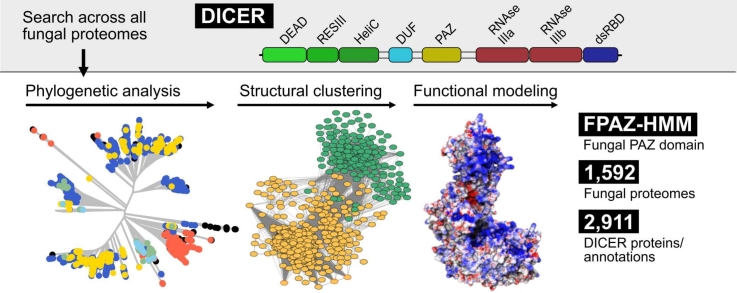
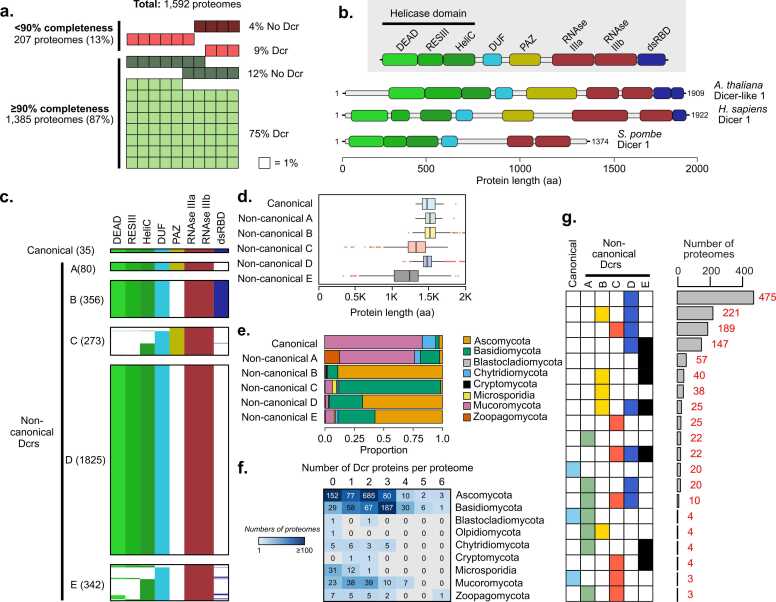
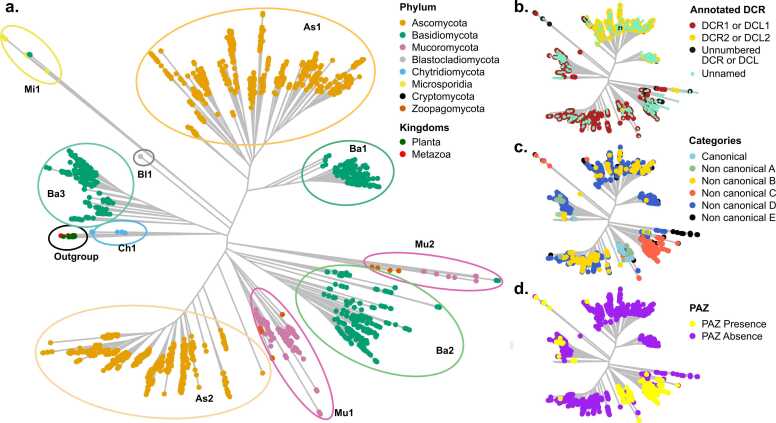
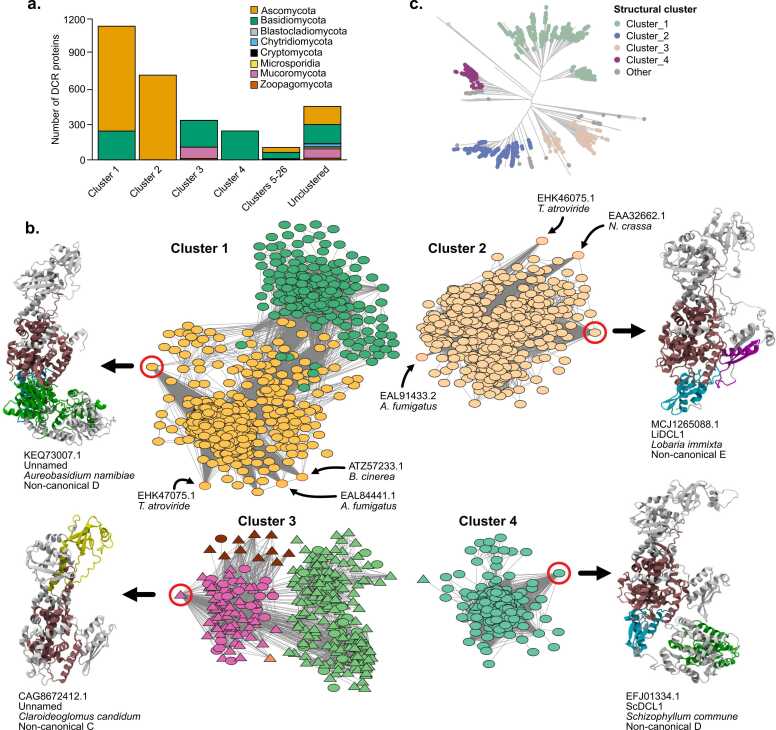
Abstract Dicers (Dcrs) are central proteins involved in the biogenesis of small RNAs (sRNAs) in eukaryotes. Most of the knowledge on Dcr structure, function and evolution comes from studies conducted in animal and plant species. Comparatively, much less is known in fungi, which are a genetically and ecologically diverse group with important roles in ecosystems, agriculture, medicine, and biotechnology. While canonical Dcrs in plants and animals contain a well-defined domain architecture, most fungal Dcrs with experimentally validated functions lack one or more identifiable canonical domains, raising questions about how RNA-binding and precise sRNA processing is retained. Here, we conducted the most extensive survey of fungal Dcr proteins, analyzing 1,593 proteomes across eight phyla. We found a diversity of Dcr domain architectures, with some of them lacking an identifiable PAZ, Helicase, and/or double-stranded RNA binding domains. Phylogenetic analyses showed that different Dcr classes are distributed across distinct clades that often align with fungal taxonomic groups. Despite the lack of canonical domain architectures, we found that fungal Dcrs fold into a characteristic L-shaped structure and show PAZ-like folds, even in proteins without detectable PAZ sequences. Molecular docking and electrostatic analyses further indicate that these divergent Dcrs maintain key RNA-binding surfaces for proper sRNA processing. Our results indicate a remarkable evolutionary plasticity of Dcr in fungi, showing that essential sRNA processing functions can be retained through structural conservation, and highlighting fungi as models to study the modular evolution of the RNAi machinery in eukaryotes. Significance statement Dicer (Dcr) proteins are central to RNA interference (RNAi), a gene regulatory mechanism conserved across eukaryotes. However, current models of Dcr structure, function, and evolution are largely based on studies in animals and plants. Here, we present the most comprehensive analysis to date of Dcr proteins in fungi, a diverse eukaryotic group including many societally important pathogens and symbiotes which are reliant on RNAi. Our findings reveal that despite widespread divergence from canonical Dcr architecture, fungal Dcrs conserve critical folds and RNA-binding features, further suggesting that core RNAi functions are maintained. This work establishes fungi as key models for studying the evolution and functional robustness of the RNAi machinery, offering broader insight into the diversity and plasticity of sRNA biogenesis pathways across eukaryotes.
Overview
The claims and statistics of this paper haven’t been checked yet.
Run the check — free, no account needed. It reads the open-access text and checks the sources it cites.
Integrity signals
Registry
Cites
Statistics
Figures
Verification
Claims the paper makes
The claims and statistics of this paper haven’t been checked yet.
Run the check — free, no account needed. It reads the open-access text and checks the sources it cites.
Self-check
Percentages, sums and reported differences re-computed from the paper’s own numbers.
The self-check needs the paper’s full text.
Citations
Cites
Thompson, J. D., Higgins, D. G., & Gibson, T. J. (1994) · Nucleic Acids Research · doi:10.1093/nar/22.22.4673 · Cited by 64,617
Cytoscape: A software Environment for integrated models of biomolecular interaction networks
Shannon, P., Markiel, A., Ozier, O., Baliga, N. S., Wang, J. T., Ramage, D., Amin, N., Schwikowski, B., & Ideker, T. (2003) · Genome Research · doi:10.1101/gr.1239303 · Cited by 51,888
MAFFT Multiple Sequence Alignment Software Version 7: Improvements in Performance and Usability
Katoh, K., & Standley, D. M. (2013) · Molecular Biology and Evolution · doi:10.1093/molbev/mst010 · Cited by 46,209
Highly accurate protein structure prediction with AlphaFold
Jumper, J., Evans, R., Pritzel, A., Green, T., Figurnov, M., Ronneberger, O., Tunyasuvunakool, K., Bates, R., Žídek, A., Potapenko, A., et al. (2021) · Nature · doi:10.1038/s41586-021-03819-2 · Cited by 43,764
IQ-TREE 2: New Models and Efficient Methods for Phylogenetic Inference in the Genomic Era
Minh, B. Q., Schmidt, H. A., Chernomor, O., Schrempf, D., Woodhams, M. D., von Haeseler, A., & Lanfear, R. (2020) · Molecular Biology and Evolution · doi:10.1093/molbev/msaa015 · Cited by 16,873
Fast and sensitive protein alignment using DIAMOND
Buchfink, B., Xie, C., & Huson, D. H. (2015) · Nature Methods · doi:10.1038/nmeth.3176 · Cited by 14,201
ColabFold - Making protein folding accessible to all
Mirdita, M., Schütze, K., Moriwaki, Y., Heo, L., Ovchinnikov, S., & Steinegger, M. (2021) · doi:10.1101/2021.08.15.456425 · Cited by 9,391
InterProScan 5: genome-scale protein function classification
Jones, P., Binns, D., Chang, H.-Y., Fraser, M., Li, W., McAnulla, C., McWilliam, H., Maslen, J., Mitchell, A., Nuka, G., et al. (2014) · Bioinformatics · doi:10.1093/bioinformatics/btu031 · Cited by 9,301
phytools: an R package for phylogenetic comparative biology (and other things)
Revell, L. J. (2012) · Methods in Ecology and Evolution · doi:10.1111/j.2041-210x.2011.00169.x · Cited by 9,277
Electrostatics of nanosystems: Application to microtubules and the ribosome
Baker, N., Sept, D., Joseph, S., Holst, M., & McCammon, J. A. (2001) · Proceedings of the National Academy of Sciences · doi:10.1073/pnas.181342398 · Cited by 7,125
T-coffee: a novel method for fast and accurate multiple sequence alignment 1 1Edited by J. Thornton
Notredame, C., Higgins, D. G., & Heringa, J. (2000) · Journal of Molecular Biology · doi:10.1006/jmbi.2000.4042 · Cited by 6,977
Manni, M., Berkeley, M. R., Seppey, M., Simão, F. A., & Zdobnov, E. M. (2021) · Molecular Biology and Evolution · doi:10.1093/molbev/msab199 · Cited by 6,187
Bailey, T. L., Johnson, J., Grant, C. E., & Noble, W. S. (2015) · Nucleic Acids Research · doi:10.1093/nar/gkv416 · Cited by 5,442
Microarray analysis shows that some microRNAs downregulate large numbers of target mRNAs
Lim, L. P., Lau, N. C., Garrett-Engele, P., Grimson, A., Schelter, J. M., Castle, J., Bartel, D. P., Linsley, P. S., & Johnson, J. M. (2005) · Nature · doi:10.1038/nature03315 · Cited by 4,755
PROPKA3: Consistent Treatment of Internal and Surface Residues in Empirical p KaPredictions
Olsson, M. H. M., Søndergaard, C. R., Rostkowski, M., & Jensen, J. H. (2011) · Journal of Chemical Theory and Computation · doi:10.1021/ct100578z · Cited by 4,435
CHARMM36 all-atom additive protein force field: Validation based on comparison to NMR data
Huang, J., & MacKerell, A. D. (2013) · Journal of Computational Chemistry · doi:10.1002/jcc.23354 · Cited by 4,430
PDB2PQR: an automated pipeline for the setup of Poisson-Boltzmann electrostatics calculations
Dolinsky, T. J., Nielsen, J. E., McCammon, J. A., & Baker, N. (2004) · Nucleic Acids Research · doi:10.1093/nar/gkh381 · Cited by 3,517
Scalable molecular dynamics on CPU and GPU architectures with NAMD
Phillips, J. C., Hardy, D. J., Maia, J. D. C., Stone, J. E., Ribeiro, J. V., Bernardi, R. C., Buch, R., Fiorin, G., Hénin, J., Jiang, W., et al. (2020) · The Journal of Chemical Physics · doi:10.1063/5.0014475 · Cited by 3,252
Asymmetry in the Assembly of the RNAi Enzyme Complex
Schwarz, D. S., Hutvágner, G., Du, T., Xu, Z., Aronin, N., & Zamore, P. D. (2003) · Cell · doi:10.1016/s0092-8674(03)00759-1 · Cited by 2,922
Potter, S. C., Luciani, A., Eddy, S. R., Park, Y., Lopez, R., & Finn, R. D. (2018) · Nucleic Acids Research · doi:10.1093/nar/gky448 · Cited by 2,607
BUSCO: Assessing Genome Assembly and Annotation Completeness
Seppey, M., Manni, M., & Zdobnov, E. M. (2019) · Methods in molecular biology · doi:10.1007/978-1-4939-9173-0_14 · Cited by 2,333
Regulation of Heterochromatic Silencing and Histone H3 Lysine-9 Methylation by RNAi
Volpe, T. A., Kidner, C., Hall, I. M., Teng, G., Grewal, S. I. S., & Martienssen, R. A. (2002) · Science · doi:10.1126/science.1074973 · Cited by 2,055
Søndergaard, C. R., Olsson, M. H. M., Rostkowski, M., & Jensen, J. H. (2011) · Journal of Chemical Theory and Computation · doi:10.1021/ct200133y · Cited by 1,966
Dicer is essential for mouse development
Bernstein, E., Kim, S. Y., Carmell, M. A., Murchison, E. P., Alcorn, H., Li, M. Z., Mills, A. A., Elledge, S. J., Anderson, K. V., & Hannon, G. J. (2003) · Nature Genetics · doi:10.1038/ng1253 · Cited by 1,627
HDOCK: a web server for protein–protein and protein–DNA/RNA docking based on a hybrid strategy
Yan, Y., Zhang, D., Zhou, P., Li, B., & Huang, S. (2017) · Nucleic Acids Research · doi:10.1093/nar/gkx407 · Cited by 1,527
Single-Stranded Antisense siRNAs Guide Target RNA Cleavage in RNAi
Martînez, J., Patkaniowska, A., Urlaub, H., Lührmann, R., & Tuschl, T. (2002) · Cell · doi:10.1016/s0092-8674(02)00908-x · Cited by 1,486
Fungal Small RNAs Suppress Plant Immunity by Hijacking Host RNA Interference Pathways
Weiberg, A., Wang, M., Lin, F.-M., Zhao, H., Zhang, Z., Kaloshian, I., Huang, H., & Jin, H. (2013) · Science · doi:10.1126/science.1239705 · Cited by 1,378
Plants send small RNAs in extracellular vesicles to fungal pathogen to silence virulence genes
Cai, Q., Qiao, L., Wang, M., He, B., Lin, F., Palmquist, J., Huang, S.-D., & Jin, H. (2018) · Science · doi:10.1126/science.aar4142 · Cited by 1,289
Structural Basis for Double-Stranded RNA Processing by Dicer
MacRae, I. J., Zhou, K., Li, F., Repic, A., Brooks, A. N., Cande, W. Z., Adams, P. D., & Doudna, J. A. (2006) · Science · doi:10.1126/science.1121638 · Cited by 962
Bidirectional cross-kingdom RNAi and fungal uptake of external RNAs confer plant protection
Wang, M., Weiberg, A., Lin, F.-M., Thomma, B. P. H. J., Huang, H.-D., & Jin, H. (2016) · Nature Plants · doi:10.1038/nplants.2016.151 · Cited by 801
Buck, A. H., Coakley, G., Simbari, F., McSorley, H. J., Quintana, J. F., Le Bihan, T., Kumar, S., Abreu-Goodger, C., Lear, M., Harcus, Y., et al. (2014) · Nature Communications · doi:10.1038/ncomms6488 · Cited by 770
Structural basis for overhang-specific small interfering RNA recognition by the PAZ domain
Ma, J.-B., Ye, K., & Patel, D. J. (2004) · Nature · doi:10.1038/nature02519 · Cited by 732
ClipKIT: A multiple sequence alignment trimming software for accurate phylogenomic inference
Steenwyk, J. L., Buida, T. J., Li, Y., Shen, X.-X., & Rokas, A. (2020) · PLOS Biology · doi:10.1371/journal.pbio.3001007 · Cited by 698
High-level classification of the Fungi and a tool for evolutionary ecological analyses
Tedersoo, L., Sánchez-Ramírez, S., Kõljalg, U., Bahram, M., Döring, M., Schigel, D., May, T., Ryberg, M., & Abarenkov, K. (2018) · Fungal Diversity · doi:10.1007/s13225-018-0401-0 · Cited by 693
Gasciolli, V., Mallory, A. C., Bartel, D. P., & Vaucheret, H. (2005) · Current Biology · doi:10.1016/j.cub.2005.07.024 · Cited by 650
Human Dicer preferentially cleaves dsRNAs at their termini without a requirement for ATP
Zhang, H. (2002) · The EMBO Journal · doi:10.1093/emboj/cdf582 · Cited by 631
Drinnenberg, I. A., Weinberg, D. E., Xie, K. T., Mower, J. P., Wolfe, K. H., Fink, G. R., & Bartel, D. P. (2009) · Science · doi:10.1126/science.1176945 · Cited by 524
The Bio3D packages for structural bioinformatics
Grant, B. J., Skjærven, L., & Yao, X. (2021) · Protein Science · doi:10.1002/pro.3923 · Cited by 462
A genome-scale phylogeny of the kingdom Fungi
Li, Y., Steenwyk, J. L., Chang, Y., Wang, Y., James, T. Y., Stajich, J. E., Spatafora, J. W., Groenewald, M., Dunn, C. W., Hittinger, C. T., et al. (2021) · Current Biology · doi:10.1016/j.cub.2021.01.074 · Cited by 365
ADAR1 Forms a Complex with Dicer to Promote MicroRNA Processing and RNA-Induced Gene Silencing
Ota, H., Sakurai, M., Gupta, R., Valente, L., Wulff, B.-E., Ariyoshi, K., Iizasa, H., Davuluri, R. V., & Nishikura, K. (2013) · Cell · doi:10.1016/j.cell.2013.03.024 · Cited by 360
RNA interference is an antiviral defence mechanism in Caenorhabditis elegans
Wilkins, C. R., Dishongh, R., Moore, S. C., Whitt, M. A., Chow, M., & Machaca, K. (2005) · Nature · doi:10.1038/nature03957 · Cited by 354
Diverse Pathways Generate MicroRNA-like RNAs and Dicer-Independent Small Interfering RNAs in Fungi
Lee, H.-C., Li, L., Gu, W., Xue, Z., Crosthwaite, S. K., Pertsemlidis, A., Lewis, Z. A., Freitag, M., Selker, E. U., Mello, C. C., et al. (2010) · Molecular Cell · doi:10.1016/j.molcel.2010.04.005 · Cited by 342
Bystroff, C., Thórsson, V., & Baker, D. A. (2000) · Journal of Molecular Biology · doi:10.1006/jmbi.2000.3837 · Cited by 313
Hiraguri, A., Itoh, R., Kondo, N., Nomura, Y., Aizawa, D., Murai, Y., Koiwa, H., Seki, M., Shinozaki, K., & Fukuhara, T. (2005) · Plant Molecular Biology · doi:10.1007/s11103-004-6853-5 · Cited by 295
Improved Placement of Multi-mapping Small RNAs
Johnson, N., Yeoh, J. M., Çoruh, C., & Axtell, M. J. (2016) · G3 Genes Genomes Genetics · doi:10.1534/g3.116.030452 · Cited by 280
Self-citationToward a Fully Resolved Fungal Tree of Life
James, T. Y., Stajich, J., Hittinger, C. T., & Rokas, A. (2020) · Annual Review of Microbiology · doi:10.1146/annurev-micro-022020-051835 · Cited by 273
Structural insights into RNA processing by the human RISC-loading complex
Wang, H.-W., Noland, C., Siridechadilok, B., Taylor, D. W., Ma, E., Felderer, K., Doudna, J. A., & Nogales, E. (2009) · Nature Structural & Molecular Biology · doi:10.1038/nsmb.1673 · Cited by 255
RNA Interference Pathways in Fungi: Mechanisms and Functions
Chang, S.-S., Zhang, Z., & Liu, Y. (2012) · Annual Review of Microbiology · doi:10.1146/annurev-micro-092611-150138 · Cited by 245
RNA Interference in Fungi: Pathways, Functions, and Applications
Dang, Y., Yang, Q., Xue, Z., & Liu, Y. (2011) · Eukaryotic Cell · doi:10.1128/ec.05109-11 · Cited by 240
The molecular architecture of human Dicer
Lau, P., Guiley, K. Z., De, N., Potter, C. S., Carragher, B. O., & MacRae, I. J. (2012) · Nature Structural & Molecular Biology · doi:10.1038/nsmb.2268 · Cited by 236
RNA silencing in fungi: Mechanisms and applications
Nakayashiki, H. (2005) · FEBS Letters · doi:10.1016/j.febslet.2005.08.016 · Cited by 203
Catalanotto, C., Pallotta, M., Refalo, P., Sachs, M. S., Vayssié, L., Macino, G., & Cogoni, C. (2004) · Molecular and Cellular Biology · doi:10.1128/mcb.24.6.2536-2545.2004 · Cited by 195
Zhu, Q., Kosoy, M., & Dittmar, K. (2014) · BMC Genomics · doi:10.1186/1471-2164-15-717 · Cited by 188
Mukherjee, K., Campos, H., & Kolaczkowski, B. (2012) · Molecular Biology and Evolution · doi:10.1093/molbev/mss263 · Cited by 181
Dicer's Helicase Domain Discriminates dsRNA Termini to Promote an Altered Reaction Mode
Welker, N. C., Maity, T., Ye, X., Aruscavage, P. J., Krauchuk, A. A., Liu, Q., & Bass, B. (2011) · Molecular Cell · doi:10.1016/j.molcel.2011.02.005 · Cited by 167
A Phosphate-Binding Pocket within the Platform-PAZ-Connector Helix Cassette of Human Dicer
Tian, Y., Simanshu, D. K., Ma, J., Park, J., Heo, I., Kim, V. N., & Patel, D. J. (2014) · Molecular Cell · doi:10.1016/j.molcel.2014.01.003 · Cited by 148
RNAi function, diversity, and loss in the fungal kingdom
Billmyre, R. B., Calo, S., Feretzaki, M., Wang, X., & Heitman, J. (2013) · Chromosome Research · doi:10.1007/s10577-013-9388-2 · Cited by 128
Structural basis of microRNA processing by Dicer-like 1
Wei, X., Ke, H., Wen, A., Gao, B., Shi, J., & Feng, Y. (2021) · Nature Plants · doi:10.1038/s41477-021-01000-1 · Cited by 116
Dicer uses distinct modules for recognizing dsRNA termini
Sinha, N. K., Iwasa, J., Shen, P. S., & Bass, B. (2017) · Science · doi:10.1126/science.aaq0921 · Cited by 115
Nicolás, F. E., Moxon, S., de Haro, J. P., Calo, S., Grigoriev, I. V., Torres‐Martínez, S., Moulton, V., Ruiz‐Vázquez, R. M., & Dalmay, T. (2010) · Nucleic Acids Research · doi:10.1093/nar/gkq301 · Cited by 104
Kadotani, N., Nakayashiki, H., Tosa, Y., & MAYAMA, S. (2004) · Journal of Biological Chemistry · doi:10.1074/jbc.m408259200 · Cited by 102
Dong, R., Pan, S., Peng, Z., Zhang, Y., & Yang, J. (2018) · Nucleic Acids Research · doi:10.1093/nar/gky430 · Cited by 102
Qin, H., Chen, F., Huan, X., Machida, S., Song, J., & Yuan, Y. A. (2010) · RNA · doi:10.1261/rna.1965310 · Cited by 99
Structure of the Human Dicer-TRBP Complex by Electron Microscopy
Lau, P., Potter, C. S., Carragher, B. O., & MacRae, I. J. (2009) · Structure · doi:10.1016/j.str.2009.08.013 · Cited by 94
Species diversity, updated classification and divergence times of the phylum Mucoromycota
Zhao, H., Nie, Y., Zong, T.-K., Wang, K., Lv, M.-L., Cui, Y., Tohtirjap, A., Chen, J., Zhao, C., Wu, F., et al. (2023) · Fungal Diversity · doi:10.1007/s13225-023-00525-4 · Cited by 88
Sinha, N. K., Trettin, K., Aruscavage, P. J., & Bass, B. (2015) · Molecular Cell · doi:10.1016/j.molcel.2015.03.012 · Cited by 80
Functional Diversity of RNAi-Associated sRNAs in Fungi
Nicolás, F. E., & Ruiz‐Vázquez, R. M. (2013) · International Journal of Molecular Sciences · doi:10.3390/ijms140815348 · Cited by 77
de Haro, J. P., Calo, S., Cervantes, M., Nicolás, F. E., Torres‐Martínez, S., & Ruiz‐Vázquez, R. M. (2009) · Eukaryotic Cell · doi:10.1128/ec.00191-09 · Cited by 72
A minimum reporting standard for multiple sequence alignments
Wong, T. K. F., Kalyaanamoorthy, S., Meusemann, K., Yeates, D. K., Misof, B. Y., & Jermiin, L. S. (2020) · NAR Genomics and Bioinformatics · doi:10.1093/nargab/lqaa024 · Cited by 68
Carreras-Villaseñor, N., Naranjo, E. U. E., Villalobos‐Escobedo, J. M., Abreu‐Goodger, C., & Herrera‐Estrella, A. (2013) · Molecular Microbiology · doi:10.1111/mmi.12261 · Cited by 65
Dicer structure and function: conserved and evolving features
Zapletal, D., Kubíček, K., Svoboda, P., & Štefl, R. (2023) · EMBO Reports · doi:10.15252/embr.202357215 · Cited by 64
Classes and phyla of the kingdom Fungi
Wijayawardene, N. N., Hyde, K. D., Mikhailov, K. V., Péter, G., Aptroot, A., Pires‐Zottarelli, C. L. A., Goto, B. T., Tokarev, Y. S., Haelewaters, D., Karunarathna, S. C., et al. (2024) · Fungal Diversity · doi:10.1007/s13225-024-00540-z · Cited by 63
Small RNA Functions Are Required for Growth and Development of Magnaporthe oryzae
Raman, V., Simon, S. A., Demirci, F., Nakano, M., Meyers, B. C., & Donofrio, N. M. (2017) · Molecular Plant-Microbe Interactions · doi:10.1094/mpmi-11-16-0236-r · Cited by 57
funRNA: a fungi-centered genomics platform for genes encoding key components of RNAi
Choi, J., Kim, K., Jeon, J., Wu, J., Song, H., Asiegbu, F. O., & Lee, Y. (2014) · BMC Genomics · doi:10.1186/1471-2164-15-s9-s14 · Cited by 56
Evolution of RNA interference proteins dicer and argonaute in Basidiomycota
Hu, Y., Stenlid, J., Elfstrand, M., & Olson, Å. (2013) · Mycologia · doi:10.3852/13-171 · Cited by 39
Qin, S., Veloso, J., Baak, M. L., Boogmans, B., Bosman, T., Puccetti, G., Shi‐Kunne, X., Smit, S., Grant‐Downton, R., Leisen, T., et al. (2022) · Molecular Plant Pathology · doi:10.1111/mpp.13269 · Cited by 37
Impact of Genome Reduction in Microsporidia
Jespersen, N. E., Monrroy, L., & Barandun, J. (2022) · Experientia supplementum · doi:10.1007/978-3-030-93306-7_1 · Cited by 32
Evolution of Dicer and Argonaute orthologs in microsporidian parasites
Huang, Q. (2018) · Infection Genetics and Evolution · doi:10.1016/j.meegid.2018.08.011 · Cited by 26
Kress, A., Poch, O., Lecompte, O., & Thompson, J. D. (2023) · Frontiers in Bioinformatics · doi:10.3389/fbinf.2023.1178926 · Cited by 21
Cánovas-Márquez, J. T., Falk, S., Nicolás, F. E., Padmanabhan, S., Perez, R. Z., Sánchez‐Ferrer, Á., Navarro, E., & Garre, V. (2021) · Nucleic Acids Research · doi:10.1093/nar/gkab238 · Cited by 15
Disruption of the Aspergillus fumigatus RNA interference machinery alters the conidial transcriptome
Kelani, A. A., Bruch, A., Rivieccio, F., Visser, C., Krüger, T., Weaver, D., Pan, X., Schäuble, S., Panagiotou, G., Kniemeyer, O., et al. (2023) · RNA · doi:10.1261/rna.079350.122 · Cited by 14
Enriquez-Felix, E. E., Pérez-Salazar, C., Rico-Ruiz, J. G., de Carvalho, A. C., Cruz‐Morales, P., Villalobos‐Escobedo, J. M., & Herrera‐Estrella, A. (2024) · Microbiology Spectrum · doi:10.1128/spectrum.03165-23 · Cited by 11
Villalobos‐Escobedo, J. M., Martínez-Hernández, J. P., Pelagio‐Flores, R., la Rosa, P. M. G. D., Carreras-Villaseñor, N., Abreu‐Goodger, C., & Herrera‐Estrella, A. (2022) · Microbial Genomics · doi:10.1099/mgen.0.000869 · Cited by 10
On use of tertiary structure characters in hidden Markov models for protein fold predictionPreprint
Malik, A. J., Puente-Lelièvre, C., Matzke, N. J., & Ascher, D. B. (2024) · bioRxiv (Cold Spring Harbor Laboratory) · doi:10.1101/2024.04.08.588419 · Cited by 6
Class-agnostic annotation of small RNAs balances sensitivity and specificity in diverse organisms
Johnson, N., González-Toro, F., & Gomez, B. B. (2025) · Computational and Structural Biotechnology Journal · doi:10.1016/j.csbj.2025.05.045 · Cited by 3
Self-citationBenavides, T. L., & Bystroff, C. (2023) · bioRxiv (Cold Spring Harbor Laboratory) · doi:10.1101/2023.02.08.527695 · Cited by 1
Research works printed but not linked: 4
- Benavides T. and Bystroff C.: HMMSTRTM A hidden Markov Model Local Struct Predict Globul Membr Assoc Proteins [Prepr] (2023 May 2025; . Available at: 〈http://biorxiv.org/lookup/doi/10.1101/2023.02.08.527695〉. · doi:10.1101/2023.02.08.527695〉
- 10.1038/s41592-022-01488-1 · DOI · Paper page
- Zhu Q., Kosoy M. and Dittmar K.: HGTector automated method facilitating genomewide discovery putative horizontal gene transfers 2014; .
- 10.14806/ej.17.1.200 · DOI · Paper page
Metadata
- Authors
- Melet, L., Canan, J., Villalobos, P., Vidal-Veuthey, B., González-Toro, F., Orellana, I., Rivas-Pardo, J. A., Cárdenas, J. P., Moraga, C., Castro-Fernández, V., Johnson, N. R., & Vidal, E. A.
- Affiliations
- Universidad Mayor (CL)
- University of Chile (CL)
- Centro de Genómica y Bioinformática, Universidad Mayor, Santiago 8580745, Chile
- Millennium Science Initiative (CL)
- Departamento de Biología, Facultad de Ciencias, Universidad de Chile, Santiago 7800003, Chile
- Corresponding author
- Johnson, Nathan R.
- Vidal, Elena A.
- ORCID
- Venue
- Computational and Structural Biotechnology Journal
- Published
- 2025-01-01
- Volume
- 27
- Pages
- 5020-5035
- ISSN
- 2001-0370 (ISSN-L)
- PMC
- PMC12663654
- OpenAlex
- W4415972686
- Cited by
- 1
- References
- 86
- Citations by year
- 2026: 1
- FWCI
- 0.30
- Type
- journal article
- Language
- en
- Open access
- gold
- doi.org
- Licence
- cc-by
- www.elsevier.com/tdm/userlicense/1.0/ (tdm)
- www.elsevier.com/legal/tdmrep-license (tdm)
- creativecommons.org/licenses/by/4.0/ (vor, 307 d)
- Locations
- Computational and Structural Biotechnology Journal (publishedVersion, cc-by)
- bioRxiv (Cold Spring Harbor Laboratory) (acceptedVersion, cc-by)
- Europe PMC (PubMed Central) (publishedVersion, cc-by)
- PubMed (publishedVersion)
- DOAJ (DOAJ: Directory of Open Access Journals) (submittedVersion, cc-by-sa)
- Universidad de Chile (submittedVersion, cc-by-nc-nd)
- Funders
- Fondo Nacional de Desarrollo Científico y Tecnológico (IUP23\u201326, 1221667, 11220727, 11251927, ICN17_022, 1221064, 11200209, 3230600)
- National Agency for Research and Development (2022\u201321221055, FOVI230159, NCN2024_047, 2021\u201321211564)
- Universidad Mayor
- Universidad de O'Higgins
- Topics
- Life Sciences › Biochemistry, Genetics and Molecular Biology › Molecular Biology › RNA Interference and Gene Delivery
- Life Sciences › Agricultural and Biological Sciences › Plant Science › Plant Molecular Biology Research
- Life Sciences › Biochemistry, Genetics and Molecular Biology › Molecular Biology › RNA Research and Splicing
- Keywords
- fungi, small RNA biogenesis, RNA interference, PAZ domain, OB-fold, domain architecture, protein evolution, fungal proteome, phylogenetic analysis, molecular simulation
About these checks
Registry, retraction, Cites and statistics results are computed, not judged, with one exception: a printed reference that no index lists is read once by a model before it counts as a citation error. Claims are extracted by a model and kept only when their quote appears verbatim in the text; each cited source is then checked, with a model’s help, for whether it says what the claim relies on. Those verdicts can be wrong — read the claim’s quote and the cited source before relying on one.
Statistics and arithmetic are recomputed, not judged.
Confidence bands are shown only for fields calibrated on our annotated test set. None is calibrated yet, so no band is shown.
What counts as a claim ›How we measure confidence ›How we check this ›
Are you an author, or do you see a problem with this page? Request a review
Data sources
Bibliographic data: Semantic Scholar, OpenAlex, Crossref.
Contains information from the Semantic Scholar Academic Graph Datasets, made available under the ODC Attribution License (ODC-BY 1.0).
Semantic Scholar’s data is described in: Kinney, R., et al. (2023). The Semantic Scholar Open Data Platform. arXiv:2301.10140.
