

Climatic constraints on the biogeographic history of Mesozoic dinosaurs
Open accessThe DOI matches its Crossref record; 170 of the 172 references it cites were found in a registry or an index; none of the 79 sources its claims cite is checked for support yet.
Abstract
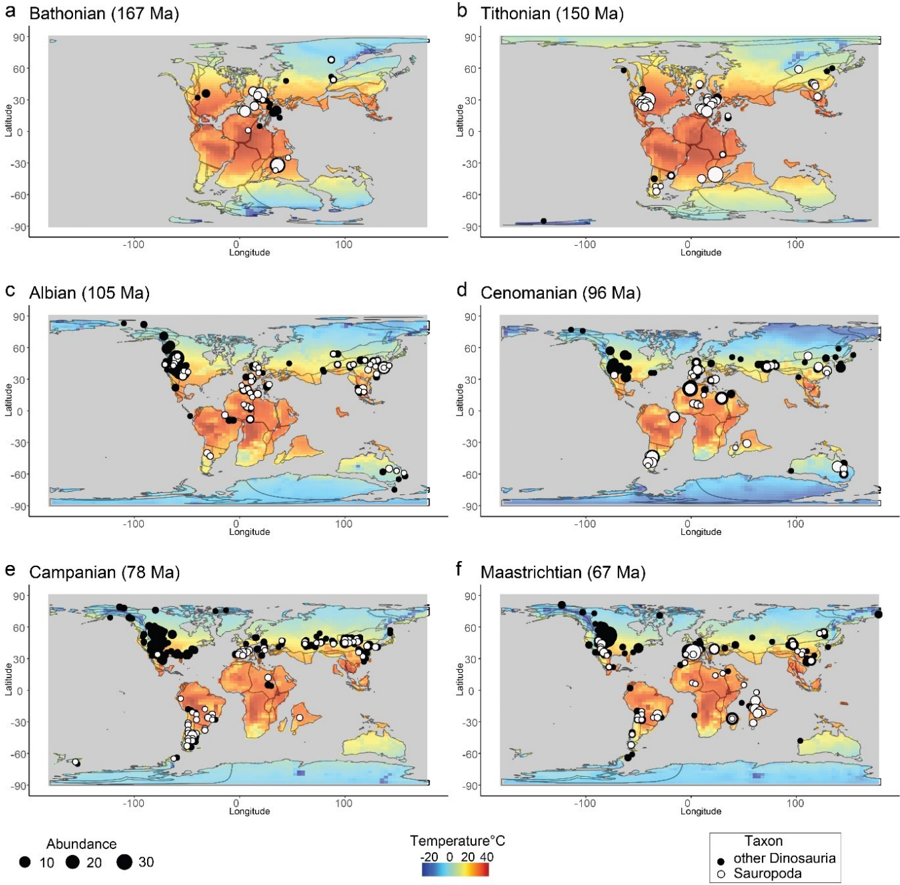
Dinosaurs dominated Mesozoic terrestrial ecosystems globally. However, whereas a pole-to-pole geographic distribution characterized ornithischians and theropods, sauropods were restricted to lower latitudes. Here, we evaluate the role of climate in shaping these biogeographic patterns through the Jurassic-Cretaceous (201-66 mya), combining dinosaur fossil occurrences, past climate data from Earth System models, and habitat suitability modeling. Results show that, uniquely among dinosaurs, sauropods occupied climatic niches characterized by high temperatures and strongly bounded by minimum cold temperatures. This constrained the distribution and dispersal pathways of sauropods to tropical areas, excluding them from latitudinal extremes, especially in the Northern Hemisphere. The greater availability of suitable habitat in the southern continents, particularly in the Late Cretaceous, might be key to explaining the high diversity of sauropods there, relative to northern landmasses. Given that ornithischians and theropods show a flattened or bimodal latitudinal biodiversity gradient, with peaks at higher latitudes, the closer correspondence of sauropods to a subtropical concentration could hint at fundamental thermophysiological differences to the other two clades.
Overview
CoChat Summary
TL;DR
Combining global dinosaur fossil occurrences, HadCM3L palaeoclimate simulations, and habitat suitability modelling, this study finds that sauropods occupied warmer, drier climatic niches than ornithischians and theropods, with cold-month minimum temperatures strongly limiting their latitudinal range. This climatic constraint kept sauropods out of high palaeolatitudes, especially in the Northern Hemisphere, while ornithischians and theropods achieved broader, often pole-to-pole distributions.
Key findings
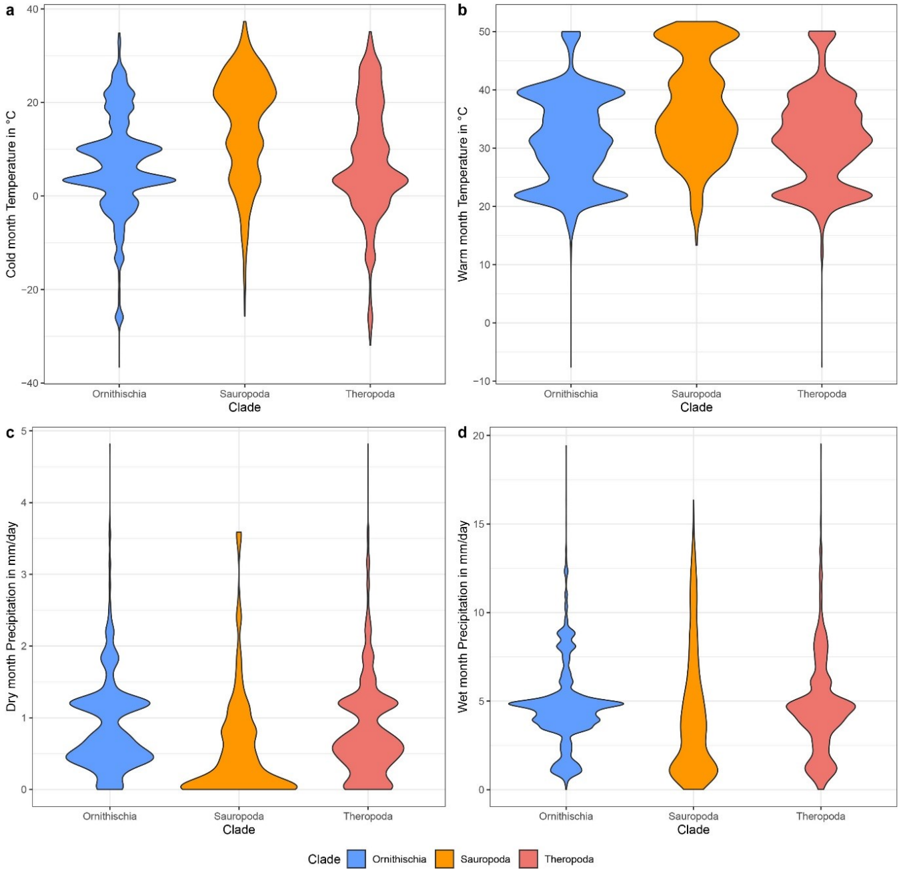
- Sauropods had significantly higher cold-month mean temperatures than Ornithischia and Theropoda (Table 1: Ornithischia–Sauropoda adjusted *p* = 3.85E-171; Sauropoda–Theropoda adjusted *p* = 1.68E-140), and higher warm-month mean temperatures than both (adjusted *p* = 1.08E-127 and 7.83E-117), whereas Ornithischia vs Theropoda warm-month difference was non-significant (adjusted *p* = 0.721).
- Sauropods occupied significantly lower dry- and wet-month precipitation than other dinosaurs (Table 1: all relevant adjusted *p* < 0.05; e.g., Ornithischia–Sauropoda dry-month adjusted *p* = 3.83E-157).
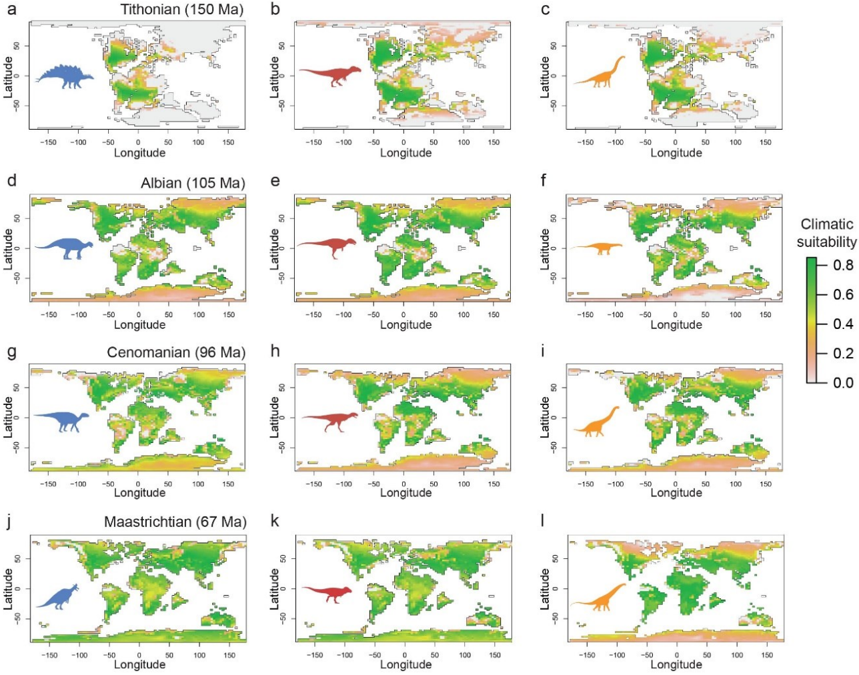
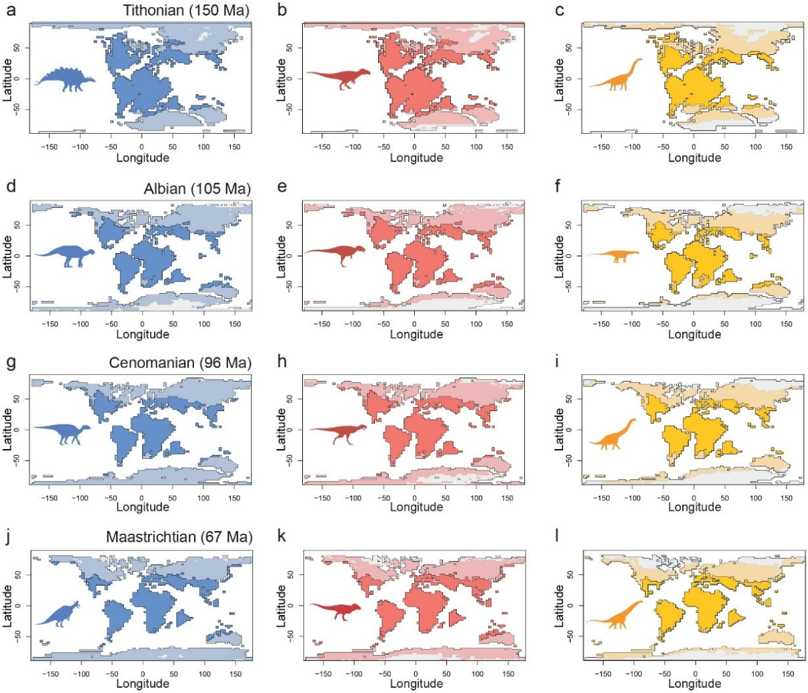
- Habitat suitability maps show sauropods excluded from latitudinally extreme areas, with sharp climatic barriers at ~50–60° in the Albian and ~60° in the Maastrichtian; by contrast, Maastrichtian theropods and ornithischians had near-cosmopolitan suitability from northern Alaska to the Antarctic interiors.
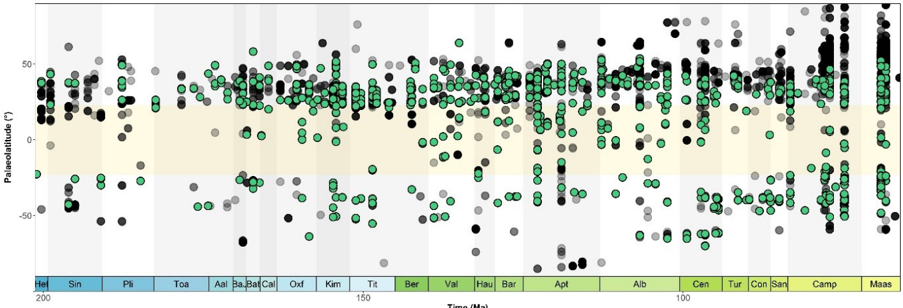
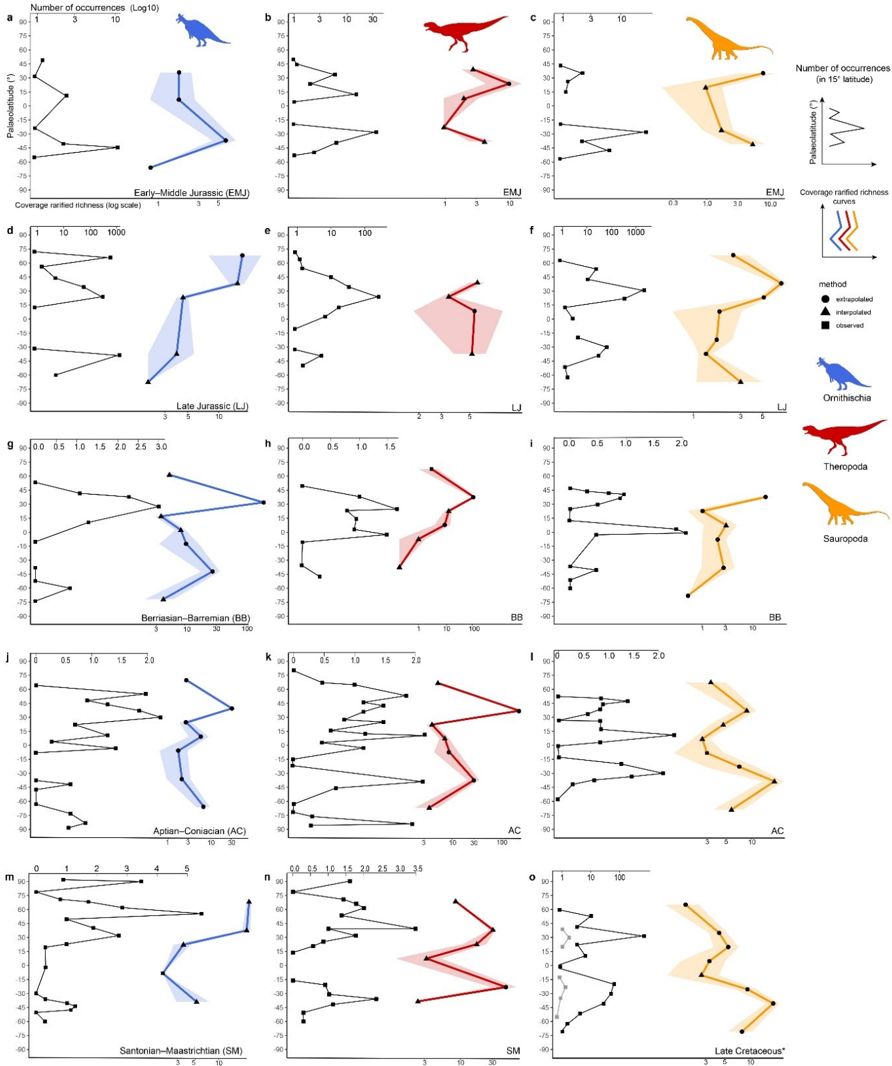
- Sauropod diversity was greatest in the Southern Hemisphere between ~20–65°, peaking at 40° in the Late Cretaceous, with a low Northern Hemisphere peak at ~20–30°; sauropods are not reported above ~65° palaeolatitude, and from the late Early Cretaceous onward they were restricted to no higher than ~50° N despite rich records of other dinosaurs from 50–90° N.
Methods
- Global Jurassic–Cretaceous dinosaur occurrence dataset from the Paleobiology Database: 7,067 fossil collections containing 14,356 occurrences; after cleaning and vetting, 12,939 occurrences representing 6,019 ornithischians, 2,154 sauropods, and 4,766 theropods. Palaeorotations used EarthByte via PaleoGIS; analyses were conducted in R.
- Palaeolatitudinal genus richness was reconstructed with coverage-based shareholder quorum subsampling (SQS) at a quorum of 0.4, using 15° latitudinal bins (with coarser 45–90° bands) and time bins: Early–Middle Jurassic, Late Jurassic, Berriasian–Barremian, Aptian–Coniacian, and Santonian–Maastrichtian.
- Palaeoclimate data came from the HadCM3L Earth System Model (CO₂ set at 1120 ppm; downscaled to 0.5° × 0.5°). Climatic niche comparisons used Kruskal–Wallis and Dunn’s tests; habitat suitability used the DOMAIN algorithm, with reclassification based on the 1st and 3rd quartiles and absolute maximum/minimum thermal ranges.
Limitations
- Stated in the paper: habitat suitability results depend on the General Circulation Model outputs and their assumptions (e.g., CO₂ concentration settings), so the modelled exclusion of sauropod suitable habitats at extreme latitudes may depend on climate model choice, though sensitivity analyses are cited.
- Stated in the paper: estimating a suitable climatic niche for fossil clades may be affected by incomplete sampling of their distributional range, especially at range edges bounded by an absence of collections rather than localities where clades are absent; coverage-based sampling standardization cannot distinguish genuine absences from sampling artefacts.
- Evident in the text: Early–Middle Jurassic habitat models performed poorly because of low training data and were not discussed; Jurassic sampling was poor between 0–30° S; and Santonian–Maastrichtian sauropod diversity could not be reconstructed via SQS, so sauropod diversity for that interval was reconstructed at the epoch level (Late Cretaceous).
Model-written summary. Check it against the paper before relying on it.
Integrity signals
Registry
Cites
Statistics
Figures
Verification
Claims the paper makes
0 Valid · 0 Not valid · 31 Not checked · 39 Own results and interpretations
A result the paper reports from its own data — it cites no other source for it, so there is none to check. The quote shows it is in the paper.
In the paper
“When considering precipitation of the driest and wettest months, sauropods occupy significantly lower precipitation values than other dinosaurs (Table 1).”
§ Climatic constraints on the biogeographic history of Mesozoic dinosaurs > Quantifying climatic niche occupation and suitable palaeogeographic area
plainstates an association- Asserted: passes — The authors put it forward as true.
- Checkable: passes — It can be checked against evidence.
- Load-bearing: passes — The paper’s conclusions depend on it.
- Based: passes — The paper gives a reason why it holds.
A result the paper reports from its own data — it cites no other source for it, so there is none to check. The quote shows it is in the paper.
In the paper
“Given that ornithischians and theropods show a flattened or bimodal latitudinal biodiversity gradient, with peaks at higher latitudes”
- Also stated in: § Palaeolatitudinal sampling and biodiversity patterns · plain
“Theropods have a bimodal gradient, with peaks at ~20-40º N and 20º S, declining equatorwards and from these peaks.”
§ Climatic constraints on the biogeographic history of Mesozoic dinosaurs > Abstract
plainstates an association- Asserted: passes — The authors put it forward as true.
- Checkable: passes — It can be checked against evidence.
- Load-bearing: passes — The paper’s conclusions depend on it.
- Based: passes — The paper gives a reason why it holds.
- Also stated in: § Palaeolatitudinal sampling and biodiversity patterns · plain
A result the paper reports from its own data — it cites no other source for it, so there is none to check. The quote shows it is in the paper.
In the paper
“Results show that uniquely among dinosaurs, sauropods occupied climatic niches characterised by high temperatures and strongly bounded by minimum cold temperatures.”
- Also stated in: § Quantifying climatic niche occupation and suitable palaeogeographic area · boosted
“Reconstructions of palaeoclimatic niche occupation throughout the Jurassic-Cretaceous interval (see Quantification and statistical tests section in the STAR★Methods) show a strikingly different climatic range for sauropods compared to other dinosaurs (Figure 4), providing additional support that they were characterized by a distinct geographic distribution (Figure 3).”
- Also stated in: § Quantifying climatic niche occupation and suitable palaeogeographic area · plain
“There is a statistically significant distinction in the temperature of the coldest and warmest months, with sauropods consistently occupying a range of higher temperatures than other dinosaurs (Table 1).”
§ Climatic constraints on the biogeographic history of Mesozoic dinosaurs > Abstract
boostedstates an association- Asserted: passes — The authors put it forward as true.
- Checkable: passes — It can be checked against evidence.
- Load-bearing: passes — The paper’s conclusions depend on it.
- Based: passes — The paper gives a reason why it holds.
- Also stated in: § Quantifying climatic niche occupation and suitable palaeogeographic area · boosted
A result the paper reports from its own data — it cites no other source for it, so there is none to check. The quote shows it is in the paper.
In the paper
“Areas maintaining high suitability across the entire time interval under study are present on most Gondwanan landmasses, particularly South America, Africa, and India.”
§ Climatic constraints on the biogeographic history of Mesozoic dinosaurs > Quantifying climatic niche occupation and suitable palaeogeographic area
plain- Asserted: passes — The authors put it forward as true.
- Checkable: passes — It can be checked against evidence.
- Load-bearing: passes — The paper’s conclusions depend on it.
- Based: passes — The paper gives a reason why it holds.
In the paper
“The palaeolatitudinal distribution of sauropod diversity is broadly similar to that of crocodylomorphs 42 , with temperature being a primary driver in shaping the latter group's latitudinal extent throughout their evolutionary history 95- 99 .”
§ Climatic constraints on the biogeographic history of Mesozoic dinosaurs > Mosaic biological traits indicating multifaceted thermal sensitivities in nonavian dinosaurs
What the sources say
- Not checked yetcites [42] Mannion, P.D., Benson, R.B.J., Upchurch, P., Butler, R.J., Carrano, M.T., and Barrett, P.M. (2012). A temperate palaeodiversity peak in Mesozoic dinosaurs and evidence for Late Cretaceous geographical partitioning. Glob. Ecol. Biogeogr. 21, 898-908. source
plainstates an association- Asserted: passes — The authors put it forward as true.
- Checkable: passes — It can be checked against evidence.
- Load-bearing: passes — The paper’s conclusions depend on it.
- Based: passes — The paper gives a reason why it holds.
27 more claims
Create a free account to see all 70 claims and to verify the 75 references still open.
- It may state two separate claims as one. 28
- Probably not a substantial claim. 16
- The quote only partly states this claim. 1
Claims other papers make about this one
Each is checked against this paper’s own text: does it say what the citing paper says it does?
In the citing paper
“Theropods and ornithischians probably possessed meso- or endothermic metabolisms and feather-like insulation, which enabled them to cope with colder conditions [44,63,207,217,218].”
From A brief review of non-avian dinosaur biogeography: state-of-the-art and prospectus (2024) · cites this paper as [207]
In the citing paper
“In Laurasia, sauropods went extinct in North America in the earliest Late Cretaceous (§4b), and it is conceivable that this group struggled to compete for resources when faced with the advanced herbivorous adaptations acquired by ornithischians [65,207].”
From A brief review of non-avian dinosaur biogeography: state-of-the-art and prospectus (2024) · cites this paper as [207]
In the citing paper
“ENM and HSM are playing an increasingly important role in Mesozoic dinosaur palaeontology (e.g. [149,207]) and other deep-time studies demonstrating their potential in palaeobiogeography, macroecology and macroevolution [244–249].”
From A brief review of non-avian dinosaur biogeography: state-of-the-art and prospectus (2024) · cites this paper as [207]
In the citing paper
“Similarly, southeast Australia’s cool temperate climate during the late Early Cretaceous probably discouraged sauropod occupation, and climatic barriers prevented dispersal from South America via Antarctica, explaining their absence in Australia 115−105 Ma [111,207,220,221].”
From A brief review of non-avian dinosaur biogeography: state-of-the-art and prospectus (2024) · cites this paper as [207]
In the citing paper
“For example, HSM suggests that the hotter and semi-arid conditions that apparently suited sauropods were more prevalent in the Southern Hemisphere during the Cretaceous [207].”
From A brief review of non-avian dinosaur biogeography: state-of-the-art and prospectus (2024) · cites this paper as [207]
7 more claims about this paper
Create a free account to see every claim other papers make about this one.
Self-check
Percentages, sums and reported differences re-computed from the paper’s own numbers.
Each contradiction between two passages listed here was confirmed by an independent check.
Rated minor: it would not touch a result — a value no result rests on, a p-value that stays on the same side of the significance level, or a conflict that is clerical, resolved elsewhere in the paper, or outside its own findings.
In the paper
§ Climatic constraints on the biogeographic history of Mesozoic dinosaurs > Palaeolatitudinal sampling and biodiversity patterns
“Sauropod occurrences are bracketed between 45° in the Northern Hemisphere and 60º in the Southern Hemisphere, with the highest number of occurrences at the palaeoequator (Figure 3L).”
§ Climatic constraints on the biogeographic history of Mesozoic dinosaurs > ADDITIONAL RESOURCES
“G-I, BB, Berriasian-Barremian; J-L, AC, Aptian-Coniacian”
Citations
Cites
Use of Ranks in One-Criterion Variance Analysis
Kruskal, W. H., & Wallis, W. A. (1952) · Journal of the American Statistical Association · doi:10.1080/01621459.1952.10483441 · Cited by 13,912
ggplot2: Elegant Graphics for Data Analysis
Ginestet, C. (2011) · Journal of the Royal Statistical Society Series A: Statistics in Society · doi:10.1111/j.1467-985x.2010.00676_9.x · Cited by 13,726
Novel methods improve prediction of species’ distributions from occurrence data
Elith*, J., H. Graham*, C., P. Anderson, R., Dudík, M., Ferrier, S., Guisan, A., J. Hijmans, R., Huettmann, F., R. Leathwick, J., Lehmann, A., et al. (2006) · Ecography · doi:10.1111/j.2006.0906-7590.04596.x · Cited by 9,088
Multiple Comparisons Using Rank Sums
Dunn, O. J. (1964) · Technometrics · doi:10.1080/00401706.1964.10490181 · Cited by 5,085
iNEXT: an R package for rarefaction and extrapolation of species diversity (Hill numbers)
Hsieh, T. C., Ma, K. H., & Chao, A. (2016) · Methods in Ecology and Evolution · doi:10.1111/2041-210x.12613 · Cited by 4,428
Impacts of climate warming on terrestrial ectotherms across latitude
Deutsch, C. A., Tewksbury, J. J., Huey, R. B., Sheldon, K. S., Ghalambor, C. K., Haak, D. C., & Martin, P. R. (2008) · Proceedings of the National Academy of Sciences · doi:10.1073/pnas.0709472105 · Cited by 3,840
THE POPULATION FREQUENCIES OF SPECIES AND THE ESTIMATION OF POPULATION PARAMETERS
GOOD, I. J. (1953) · Biometrika · doi:10.1093/biomet/40.3-4.237 · Cited by 3,437
Climate change and evolutionary adaptation
Hoffmann, A. A., & Sgrò, C. M. (2011) · Nature · doi:10.1038/nature09670 · Cited by 3,242
Extraterrestrial Cause for the Cretaceous-Tertiary Extinction
Alvarez, L. W., Alvarez, W., Asaro, F., & Michel, H. V. (1980) · Science · doi:10.1126/science.208.4448.1095 · Cited by 3,198
raster: Geographic Data Analysis and Modeling
Hijmans, R. J. (2010) · CRAN: Contributed Packages · doi:10.32614/cran.package.raster · Cited by 2,907
Research works printed but not linked: 5
- Bonaparte, J., E. (1986). History of the Terrestrial Cretaceous vertebrates of Gondwana; from J. F. Bonaparte (ed.), Evolucion de los Vertebrados Mesozoicos, 1986, IV Congreso Argentino de Paleontologia y Biostratigrafia, Mendoza, Congreso Argentino de Paleontologia y Biostratigr by Bonaparte, J. F.: Magazine / Periodical | PaleoPublications. https://www.abebooks.co.uk/magazines-periodicals/History-Terrestrial-Cretaceous- vertebrates-Gondwana-Bonaparte/11554235762/bd.
- Lockley, M.G., Meyer, C.A., Hunt, A.P., and Lucas, S.G. (1994). The distribution of sauropod tracks and trackmakers. https://www.europeana.eu/en/item/2023901/ArcaSite_obj_gaia_MNHNL_0000280_MG_DOC _web_PDF.
- Dunne, E.M., Farnsworth, A., Greene, S.E., Lunt, D.J., and Butler, R.J. Climatic drivers of latitudinal variation in Late Triassic tetrapod diversity. Palaeontology n/a. · DOI · Paper page
- Bonaparte, 1993, A new and huge titanosaur sauropod from Rio Limay Formation (Albian-Cenomanian), of Neuquen Province, Argentina, Ameghiniana, 30, 271
- Dias-Brito, 2001, Grupo Bauru: uma unidade continental do Cretáceo no Brasil – concepções baseadas em dados micropaleontológicos, isotópicos e estratigráficos, Genève. Revue Paléobiologie, 20, 245
Cited by
The Cretaceous world: plate tectonics, palaeogeography and palaeoclimate
Scotese, C. R., Vérard, C., Burgener, L., Elling, R. P., & Kocsis, Á. T. (2024) · Geological Society London Special Publications · doi:10.1144/sp544-2024-28 · Cited by 142
palaeoverse: A community‐driven R package to support palaeobiological analysis
Jones, L. A., Gearty, W., Allen, B. J., Eichenseer, K., Dean, C. D., Galván, S., Kouvari, M., Godoy, P. L., Nicholl, C. S. C., Buffan, L., et al. (2023) · Methods in Ecology and Evolution · doi:10.1111/2041-210x.14099 · Cited by 74
Self-citationThe hierarchy of factors predicting the latitudinal diversity gradient
Brodie, J. F., & Mannion, P. D. (2022) · Trends in Ecology & Evolution · doi:10.1016/j.tree.2022.07.013 · Cited by 66
Self-citationClimatic controls on the ecological ascendancy of dinosaurs
Dunne, E. M., Farnsworth, A., Benson, R. B. J., Godoy, P. L., Greene, S. E., Valdes, P. J., Lunt, D. J., & Butler, R. J. (2023) · Current Biology · doi:10.1016/j.cub.2022.11.064 · Cited by 39
Self-citationShifts in food webs and niche stability shaped survivorship and extinction at the end-Cretaceous
García‐Girón, J., Chiarenza, A. A., Alahuhta, J., DeMar, D. G., Heino, J., Mannion, P. D., Williamson, T. E., Wilson, G. P., & Brusatte, S. L. (2022) · Science Advances · doi:10.1126/sciadv.add5040 · Cited by 37
Self-citation
Metadata
- Authors
- Chiarenza, A. A., Mannion, P. D., Farnsworth, A., Carrano, M. T., & Varela, S.
- Affiliations
- University College London (GB)
- Chinese Academy of Sciences (CN)
- Smithsonian Institution (US)
- Universidade de Vigo (ES)
- Corresponding author
- Chiarenza, Alfio Alessandro
- Mannion, Philip D.
- Carrano, Matthew T.
- Venue
- Current Biology
- Publisher
- Elsevier BV
- Published
- 2022-02
- Volume
- 32
- Issue
- 3
- Pages
- 570-585.e3
- ISSN
- 0960-9822 (ISSN-L)
- OpenAlex
- W4200184737
- Cited by
- 65
- References
- 172
- Citations by year
- 2026: 20 · 2025: 15 · 2024: 13 · 2023: 10 · 2022: 7
- FWCI
- 4.25
- Type
- journal article
- Language
- en
- Open access
- hybrid
- doi.org
- Licence
- cc-by-nc-sa
- www.elsevier.com/tdm/userlicense/1.0/ (tdm)
- www.elsevier.com/legal/tdmrep-license (tdm)
- www.elsevier.com/open-access/userlicense/1.0/ (vor, 371 d)
- doi.org/10.15223/policy-017 (stm-asf)
- doi.org/10.15223/policy-037 (stm-asf)
- doi.org/10.15223/policy-012 (stm-asf)
- doi.org/10.15223/policy-029 (stm-asf)
- doi.org/10.15223/policy-004 (stm-asf)
- Locations
- Current Biology (publishedVersion, cc-by-nc-sa)
- PubMed (publishedVersion)
- Explore Bristol Research (publishedVersion, cc-by-nc-sa)
- Investigo Institutional repository of UVigo (Universidade de Vigo) (submittedVersion, cc-by-nc-nd)
- UCL Discovery (University College London) (submittedVersion)
- Funders
- Imperial College London
- Horizon 2020 Framework Programme
- European Research Council
- ERC (947921)
- Horizon 2020
- Royal Society (UF160216)
- Topics
- Physical Sciences › Earth and Planetary Sciences › Paleontology › Paleontology and Evolutionary Biology
- Physical Sciences › Earth and Planetary Sciences › Paleontology › Evolution and Paleontology Studies
- Physical Sciences › Environmental Science › Ecological Modeling › Species Distribution and Climate Change
- Keywords
- Mesozoic dinosaurs, sauropod dinosaurs, ornithischians, theropod dinosaurs, biogeography, paleoclimate, latitudinal distribution, climatic niche, habitat suitability, Jurassic-Cretaceous, thermal physiology, latitudinal diversity gradient, fossil occurrences
- MeSH terms
- Animals, Fossils, Phylogeny, Ecosystem, Dinosaurs, Biodiversity
About these checks
Registry, retraction, Cites and statistics results are computed, not judged, with one exception: a printed reference that no index lists is read once by a model before it counts as a citation error. Claims are extracted by a model and kept only when their quote appears verbatim in the text; each cited source is then checked, with a model’s help, for whether it says what the claim relies on. Those verdicts can be wrong — read the claim’s quote and the cited source before relying on one.
A language model drew the claims from the paper on 2026-11-23, under version 3 of the claim definition (model deepseek-v4.1-flash, prompt extract-v3).
A second model labelled each claim on 2026-11-23 (model jev-1.13-20260917, definition revision gold-guideline-v0.2).
Statistics and arithmetic are recomputed, not judged.
Confidence bands are shown only for fields calibrated on our annotated test set. None is calibrated yet, so no band is shown.
What counts as a claim ›How we measure confidence ›How we check this ›
Are you an author, or do you see a problem with this page? Request a review
How to cite
Cite CoChat for the checks on this page, and the paper for its own findings.
- This page
- CoChat. (2026). Citation check: Climatic constraints on the biogeographic history of Mesozoic dinosaurs. https://app.cochat.ai/papers/10.1016/j.cub.2021.11.061
- The paper
- Chiarenza, A. A., Mannion, P. D., Farnsworth, A., Carrano, M. T., & Varela, S. (2022). Climatic constraints on the biogeographic history of Mesozoic dinosaurs. Current Biology. https://doi.org/10.1016/j.cub.2021.11.061
Data sources
Bibliographic data: Semantic Scholar, OpenAlex, Crossref.
Contains information from the Semantic Scholar Academic Graph Datasets, made available under the ODC Attribution License (ODC-BY 1.0).
Semantic Scholar’s data is described in: Kinney, R., et al. (2023). The Semantic Scholar Open Data Platform. arXiv:2301.10140.
