

The DOI matches its Crossref record; 33 of the 33 references it cites were found in a registry or an index.
Global variation in the prevalence of suicidal ideation, anxiety and their correlates among adolescents: A population based study of 82 countries
Open accessAbstract
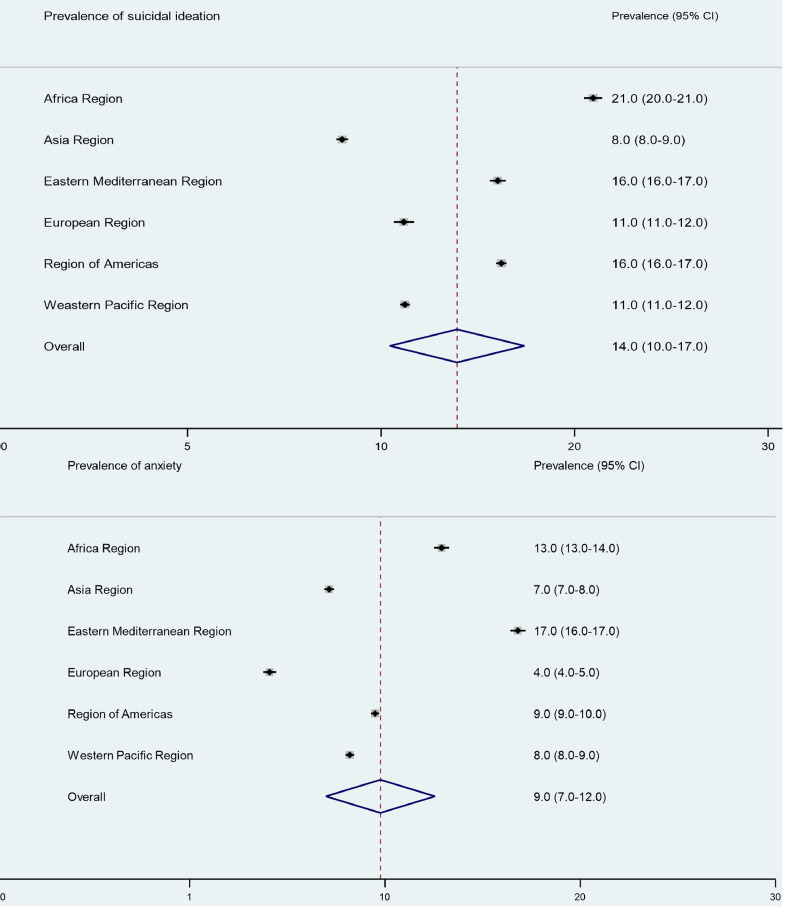
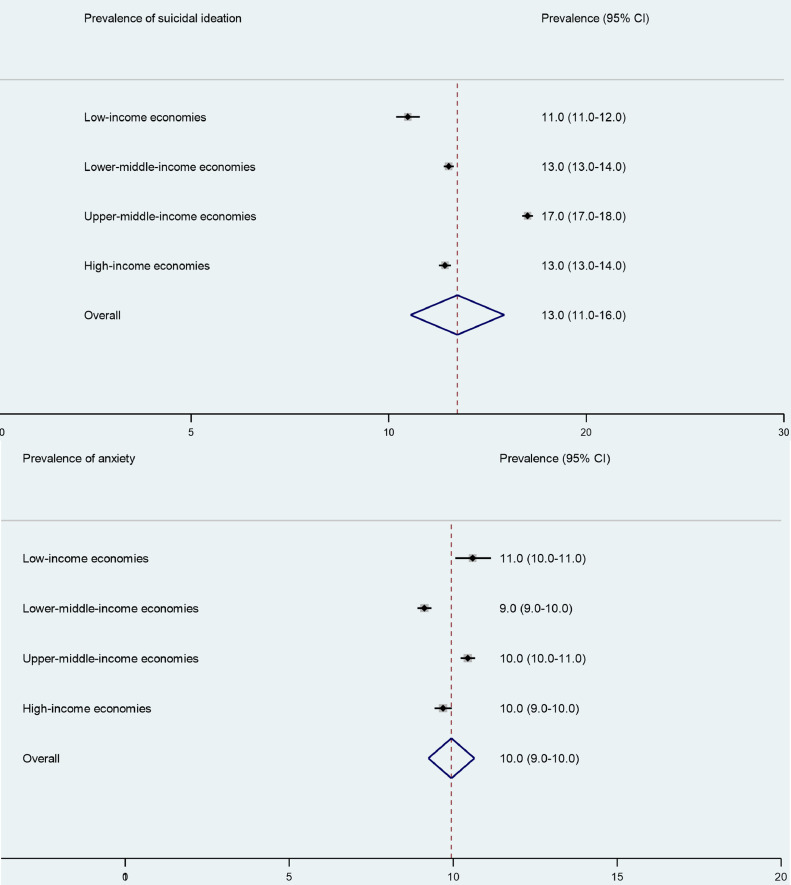
Background : Suicidal ideation and anxiety are common among adolescents although their prevalence has predominantly been studied in high income countries. This study estimated the population prevalence of suicidal ideation and anxiety and their correlates with peer support, parent-adolescent relationship, peer victimisation, conflict, isolation and loneliness across a range of low-income, lower-middle-income, upper-middle-income countries and high-income countries (LMIC-HICs). Methods: Data were drawn from the Global School-based Student Health Survey (GSGS) of adolescents aged 12–17 years between 2003 and 2015 in 82 LM-HICs from the six World Health Organization (WHO) regions. We estimated weighted prevalence of suicidal ideation and anxiety by country, region and at a global level. We used multiple binary logistic regression to estimate the adjusted association between adolescent age, sex, socioeconomic status, peer support, parent-adolescent relationship, peer victimisation, conflict, isolation and loneliness with suicidal ideation and anxiety. Findings: The sample comprised of 275,057 adolescents aged 12–17 years (mean age was 14·6 (SD 1·18) years of whom 51·8% were females). The overall pooled prevalence of suicidal ideation and anxiety were 14·0% (95% CI 10·0-17·0%) and 9·0% (7·0-12·0%) respectively. The highest pooled prevalence of suicidal ideation was observed in the Africa Region (21·0%; 20·0-21·0%) and the lowest was in the Asia region (8·0%, 8·0-8·0%). For anxiety, the highest pooled prevalence was observed in Eastern Mediterranean Region (17·0%, 16·0-17·0%) the lowest was in the European Region (4·0%, 4·0-4·0%). Being female, older age, having a lower socioeconomic status and having no close friends were associated with a greater risk of suicidal ideation and anxiety. A higher levels of parental control was positively associated with a greater likelihood of experiencing suicidal ideation (OR: 1·65, 1· 45-1·87) and anxiety (1·53, 1·30-1·80). Parental understanding and monitoring was negatively associated with mental health problems. Similarly, the odds of experiencing suicidal ideation and anxiety were higher among adolescents who had been experiencing peer conflict (1·36, 1·24-1·50; 1·54, 1·40-1·70), peer victimization (1·26, 1·15-1·38; 1·13, 1·02-1·26), peer isolation (1·69, 1·53-1·86; 1·76, 1·61-1·92) and reported loneliness (2· 56, 2·33-2·82; 5·63, 5·21-6·08). Interpretations: Suicidal ideation and anxiety are prevalent among adolescents although there is significant global variation· Reductions in suicidal ideation and anxiety may be facilitated by family and peer-based interventions aimed at increasing social connectedness between adolescents and enhancing parenting skills. Research to inform the factors that influence country and regional level differences in adolescent mental health problems may inform preventative strategies.Funding Statement: The authors stated: "None."Declaration of Interests: All authors have no conflict of interest.Ethics Approval Statement: Global School-based Student Health Survey (GSHS) data are publicly available.
Overview
The claims and statistics of this paper haven’t been checked yet.
Run the check — free, no account needed. It reads the open-access text and checks the sources it cites.
Integrity signals
Registry
Cites
Statistics
Figures
Verification
Claims the paper makes
The claims and statistics of this paper haven’t been checked yet.
Run the check — free, no account needed. It reads the open-access text and checks the sources it cites.
Claims other papers make about this one
Each is checked against this paper’s own text: does it say what the citing paper says it does?
The source backs part of the claim, not all of it — or backs it for a different population, condition or comparison.
In the citing paper
“In low-resource settings, the prevalence and time trends of mental illness and related dimensions such as loneliness vary, as shown in various recent studies.”
From The Lancet Psychiatry Commission on youth mental health (2024) · cites this paper as [83]
Experimental — accuracy not yet measured
Self-check
Percentages, sums and reported differences re-computed from the paper’s own numbers.
The self-check needs the paper’s full text.
Citations
Cites
Polanczyk, G. V., Salum, G. A., Sugaya, L. S., Caye, A., & Rohde, L. A. (2015) · Journal of Child Psychology and Psychiatry · doi:10.1111/jcpp.12381 · Cited by 3,990
Steinberg, L., & Morris, A. S. (2001) · Annual Review of Psychology · doi:10.1146/annurev.psych.52.1.83 · Cited by 2,517
Child and adolescent mental health worldwide: evidence for action
Kieling, C., Baker-Henningham, H., Belfer, M., Conti, G., Ertem, I., Omigbodun, O., Rohde, L. A., Srinath, S., Ulkuer, N., & Rahman, A. (2011) · The Lancet · doi:10.1016/s0140-6736(11)60827-1 · Cited by 2,449
Sex differences in anxiety and depression clinical perspectives
Altemus, M., Sarvaiya, N., & Neill Epperson, C. (2014) · Frontiers in Neuroendocrinology · doi:10.1016/j.yfrne.2014.05.004 · Cited by 1,413 · cited 1×
“Its higher prevalence in female adolescents, especially in LMICs may be explained by a range of biopsychosocial factors which would include gender inequity, a tendency for females to internalize their distress more than males, greater exposure of females to forms of maltreatment, particularly childhood sexual abuse in…”
BackgroundEpidemiology of mental disorders in children and adolescents
Merikangas, K. R., Nakamura, E. F., & Kessler, R. C. (2009) · Dialogues in Clinical Neuroscience · doi:10.31887/dcns.2009.11.1/krmerikangas · Cited by 1,246
Erskine, H. E., Moffitt, T. E., Copeland, W. E., Costello, E. J., Ferrari, A. J., Patton, G., Degenhardt, L., Vos, T., Whiteford, H. A., & Scott, J. G. (2015) · Psychological Medicine · doi:10.1017/s0033291714002888 · Cited by 688
Self-citationSocial relationships, mental health and wellbeing in physical disability: a systematic review
Tough, H., Siegrist, J., & Fekete, C. (2017) · BMC Public Health · doi:10.1186/s12889-017-4308-6 · Cited by 544
van der Bruggen, C. O., Stams, G. J. J. M., & Bögels, S. M. (2008) · Journal of Child Psychology and Psychiatry · doi:10.1111/j.1469-7610.2008.01898.x · Cited by 441
Bowes, L., Maughan, B., Caspi, A., Moffitt, T. E., & Arseneault, L. (2010) · Journal of Child Psychology and Psychiatry · doi:10.1111/j.1469-7610.2010.02216.x · Cited by 412
Adolescence and the next generation
Patton, G. C., Olsson, C. A., Skirbekk, V., Saffery, R., Wlodek, M. E., Azzopardi, P. S., Stonawski, M., Rasmussen, B., Spry, E., Francis, K., et al. (2018) · Nature · doi:10.1038/nature25759 · Cited by 385
Biswas, T., Scott, J. G., Münir, K., Thomas, H. J., Huda, M. M., Hasan, M. M., de Vries, T. D., Baxter, J., & Mamun, A. A. (2020) · EClinicalMedicine · doi:10.1016/j.eclinm.2020.100276 · Cited by 377
Self-citationImproving adolescent health: an evidence-based call to action
Weiss, H. A., & Ferrand, R. A. (2019) · The Lancet · doi:10.1016/s0140-6736(18)32996-9 · Cited by 366
Gerull, F. C., & Rapee, R. M. (2002) · Behaviour Research and Therapy · doi:10.1016/s0005-7967(01)00013-4 · Cited by 352
Uddin, R., Burton, N. W., Maple, M. J., Khan, S. R., & Khan, A. (2019) · The Lancet Child & Adolescent Health · doi:10.1016/s2352-4642(18)30403-6 · Cited by 307
de Rosnay, M., Cooper, P., Tsigaras, N., & Murray, L. (2006) · Behaviour Research and Therapy · doi:10.1016/j.brat.2005.09.003 · Cited by 289
Peer victimization and depression in early–mid adolescence: A longitudinal study
Sweeting, H. N., Young, R., West, P., & Der, G. (2006) · British Journal of Educational Psychology · doi:10.1348/000709905x49890 · Cited by 283
Moore, G. F., Cox, R., Evans, R., Hallingberg, B., Hawkins, J. L., Littlecott, H., Long, S. J., & Murphy, S. (2018) · Child Indicators Research · doi:10.1007/s12187-017-9524-1 · Cited by 228
World Health Assembly adopts Comprehensive Mental Health Action Plan 2013–2020
Saxena, S., Funk, M., & Chisholm, D. (2013) · The Lancet · doi:10.1016/s0140-6736(13)61139-3 · Cited by 218
A social-interactional model of the development of depressive symptoms in adolescence.
Allen, J. P., Insabella, G., Porter, M. R., Smith, F. D., Land, D. M. V. '., & Phillips, N. (2006) · Journal of Consulting and Clinical Psychology · doi:10.1037/0022-006x.74.1.55 · Cited by 201
Jordans, M. J. D., Rathod, S. D., Fekadu, A., Medhin, G., Kigozi, F. N., Kohrt, B. A., Luitel, N. P., Petersen, I., Shidhaye, R. R., Ssebunnya, J., et al. (2017) · Epidemiology and Psychiatric Sciences · doi:10.1017/s2045796017000038 · Cited by 143
Pandey, A. R., Bista, B., Dhungana, R. R., Aryal, K. K., Chalise, B., & Dhimal, M. (2019) · PLoS ONE · doi:10.1371/journal.pone.0210383 · Cited by 137
Stickley, A., Koyanagi, A., Koposov, R., Blatný, M., Hrdlička, M., Schwab-Stone, M., & Ruchkin, V. (2016) · BMC Psychiatry · doi:10.1186/s12888-016-0829-2 · Cited by 136
(2006) · PubMed · Cited by 120
Protective factors relating to decreased risks of adolescent suicidal behaviour
Cheng, Y., Tao, M.-X., Riley, L., Kann, L. K., Ye, L., Tian, X., Tian, B., Hu, J. H., & Chen, D. (2009) · Child Care Health and Development · doi:10.1111/j.1365-2214.2009.00955.x · Cited by 97
DASH - Global School-based Student Health Survey (GSHS)
(2018) · Cited by 59
Parent-Child Interactions and Adolescent Anxiety: A Systematic Review
Waite, P., Whittington, L., & Creswell, C. (2014) · Psychopathology Review · doi:10.5127/pr.033213 · Cited by 56
Rao, S., Shah, N., Jawed, N., Inam, S., & Shafique, K. (2015) · BMC Public Health · doi:10.1186/s12889-015-1762-x · Cited by 48
Nguyen, H. T. L., Nakamura, K., Seino, K., & Al‐Sobaihi, S. (2019) · BMC Psychology · doi:10.1186/s40359-019-0294-z · Cited by 46
Le, M. T. H., Nguyen, H. T., Tran, T. D., & Fisher, J. (2012) · Journal of Adolescent Health · doi:10.1016/j.jadohealth.2011.12.027 · Cited by 42
Chester, C. E., Jones, D. J., Zalot, A. A., & Sterrett, E. (2007) · Journal of Clinical Child & Adolescent Psychology · doi:10.1080/15374410701444306 · Cited by 37
Multilevel determinants of teenage childbearing in sub-Saharan Africa in the context of HIV/AIDS
Magadi, M. A. (2017) · Health & Place · doi:10.1016/j.healthplace.2017.04.006 · Cited by 23
Tough, H., Siegrist, J., & Fekete, C. (2017) · BMC Public Health · doi:10.1186/s12889-017-4448-8 · Cited by 16
Health an afterthought in a single-issue election
Lancet, T. (2017) · The Lancet · doi:10.1016/s0140-6736(17)31139-x · Cited by 2
Cited by
Sorted by citations
The Lancet Psychiatry Commission on youth mental health
McGorry, P. D., Mei, C., Dalal, N., Alvarez-Jimenez, M., Blakemore, S.-J., Browne, V., Dooley, B., Hickie, I. B., Jones, P. B., McDaid, D., et al. (2024) · The Lancet Psychiatry · doi:10.1016/s2215-0366(24)00163-9 · Cited by 663
Suicide, self-harm and suicidal ideation during COVID-19: A systematic review
Farooq, S., Tunmore, J., Wajid Ali, M., & Ayub, M. (2021) · Psychiatry Research · doi:10.1016/j.psychres.2021.114228 · Cited by 350
Sleep Deprivation and Insomnia in Adolescence: Implications for Mental Health
Uccella, S., Cordani, R., Salfi, F., Gorgoni, M., Scarpelli, S., Gemignani, A., Geoffroy, P. A., Gennaro, L. D., Palagini, L., Ferrara, M., et al. (2023) · Brain Sciences · doi:10.3390/brainsci13040569 · Cited by 170
Ahmed, I., Hazell, C. M., Edwards, B., Glazebrook, C., & Davies, E. B. (2023) · BMC Psychiatry · doi:10.1186/s12888-023-04645-8 · Cited by 130
Richardson, R., Connell, T., Foster, M., Blamires, J., Keshoor, S., Moir, C., & Zeng, I. S. (2024) · Journal of Youth and Adolescence · doi:10.1007/s10964-024-01969-w · Cited by 105
“The extracted prevalence rates of bully victimization and sleep disturbances from the GSHS were reported by Biswas et al. (2020a, 2020b) and Hasan et al. (2023), respectively.”
Method
Metadata
- Authors
- Biswas, T., Scott, J. G., Munir, K., Renzaho, A. M. N., Rawal, L. B., Baxter, J., & Mamun, A. A.
- Affiliations
- The University of Queensland (AU)
- Western Sydney University (AU)
- Corresponding author
- Biswas, Tuhin
- Venue
- eClinicalMedicine
- Publisher
- Elsevier BV
- Published
- 2020-07
- Volume
- 24
- Pages
- 100395
- ISSN
- 2589-5370 (ISSN-L)
- PMC
- PMC7525128
- OpenAlex
- W3036518845
- Cited by
- 290
- References
- 33
- Citations by year
- 2026: 48 · 2025: 53 · 2024: 72 · 2023: 58 · 2022: 34 · 2021: 21 · 2020: 4
- FWCI
- 11.71
- Type
- journal article
- Language
- en
- Open access
- gold
- doi.org
- Licence
- Locations
- EClinicalMedicine (publishedVersion, cc-by-nc-nd)
- SSRN Electronic Journal (publishedVersion)
- PubMed (publishedVersion)
- DOAJ (DOAJ: Directory of Open Access Journals) (submittedVersion, cc-by-sa)
- Figshare (submittedVersion, cc-by-nc-nd)
- Funders
- US
- Topics
- Social Sciences › Psychology › Clinical Psychology › Suicide and Self-Harm Studies
- Health Sciences › Medicine › Psychiatry and Mental health › Mental Health Treatment and Access
- Social Sciences › Psychology › Clinical Psychology › Child and Adolescent Psychosocial and Emotional Development
- Keywords
- suicidal ideation, adolescent anxiety, global prevalence, low- and middle-income countries, peer victimization, peer support, parent-adolescent relationships, parental control, loneliness, socioeconomic status, sex differences, adolescent mental health, cross-national comparison, Global School-based Student Health Survey, suicide risk factors, WHO regions, Africa, Eastern Mediterranean, Europe, Asia, Pacific Ocean, Americas, Oceania
About these checks
Registry, retraction, Cites and statistics results are computed, not judged, with one exception: a printed reference that no index lists is read once by a model before it counts as a citation error. Claims are extracted by a model and kept only when their quote appears verbatim in the text; each cited source is then checked, with a model’s help, for whether it says what the claim relies on. Those verdicts can be wrong — read the claim’s quote and the cited source before relying on one.
Statistics and arithmetic are recomputed, not judged.
Confidence bands are shown only for fields calibrated on our annotated test set. None is calibrated yet, so no band is shown.
What counts as a claim ›How we measure confidence ›How we check this ›
Are you an author, or do you see a problem with this page? Request a review
