

The Impact of Homelessness on Kidney Outcomes Among Adults With Diabetes
Open accessThe DOI matches its Crossref record; 36 of the 38 references it cites were found in a registry or an index, and 2 are not checked yet; none of the 44 sources its claims cite is checked for support yet.
Abstract
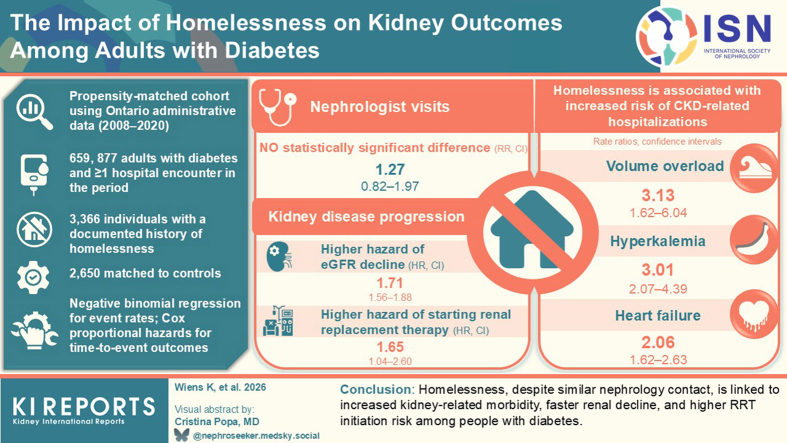
Introduction: People with diabetes experiencing homelessness face barriers to self-management, contributing to suboptimal glycemia and reduced screening for microvascular complications. The objective of the study was to assess whether a history of homelessness is associated with kidney-related outcomes among people with diabetes. Methods: A propensity-matched cohort study using administrative health data from Ontario, Canada, was conducted, including residents with diabetes who had ≥1 hospital encounter during the study period (2008-2020). Having a history of homelessness was identified using a validated algorithm. Outcomes of interest included nephrologist visits, reduction in estimated glomerular filtration rate (eGFR), initiation of renal replacement therapy, and acute care visits for kidney-related ambulatory care-sensitive conditions. Negative binomial regression and Cox proportional hazard models were used to assess outcomes. Results: Of 659,877 eligible people with diabetes living in Ontario, 3366 had a history of homelessness, with 2650 successfully matched to non-homeless controls. People with a history of homelessness had similar rates of nephrologist visits compared with those with no history of homelessness (rate ratio [RR] = 1.27; 95% confidence interval [CI]: 0.82-1.97), but had higher rates of hospitalization for chronic kidney disease (CKD)-related conditions, including volume overload (RR = 3.13; 95% CI: 1.62-6.04), hyperkalemia (RR = 3.01; 95% CI: 2.07-4.39), and heart failure (RR = 2.06; 95% CI: 1.62-2.63). They had a higher hazard of eGFR decline (hazard ratio [HR] = 1.71; 95% CI: 1.56-1.88), and renal replacement therapy (HR = 1.65; 95% CI: 1.04-2.60) compared with nonhomeless controls. Conclusion: Homelessness is associated with higher rates of kidney-related adverse events in people living with diabetes, supporting the need for tailored approaches that reduce barriers to accessing diabetes care.
Overview
CoChat Summary
TL;DR
In Ontario, Canada, adults with diabetes and a history of homelessness had higher hazards of eGFR decline and renal replacement therapy and higher rates of hospital encounters for CKD-related ambulatory care–sensitive conditions than propensity-matched nonhomeless controls, despite similar nephrologist visit rates. The findings suggest homelessness is associated with adverse kidney outcomes beyond low income alone.
Key findings
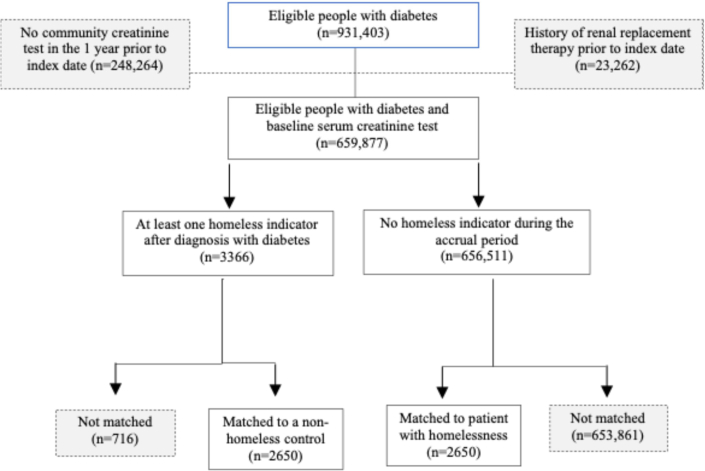
- Among 659,877 eligible adults with diabetes, 3,366 had a documented history of homelessness; 2,650 were matched to nonhomeless controls. Nephrologist visit rates were similar (RR = 1.27; 95% CI: 0.82–1.97).
- Hospital visits for any CKD-related ambulatory care–sensitive condition were higher among people with a history of homelessness (RR = 2.26; 95% CI: 1.82–2.80), including volume overload (RR = 3.13; 95% CI: 1.62–6.04), hyperkalemia (RR = 3.01; 95% CI: 2.07–4.39), and heart failure (RR = 2.06; 95% CI: 1.62–2.63).
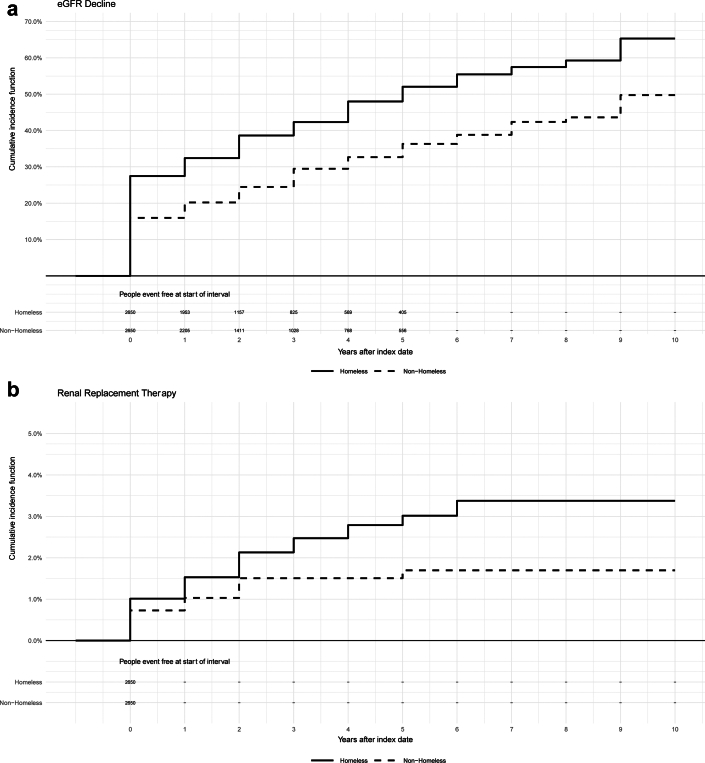
- People with a history of homelessness had a higher hazard of eGFR decline (HR = 1.71; 95% CI: 1.56–1.88) and renal replacement therapy (HR = 1.65; 95% CI: 1.04–2.60).
- In sensitivity analyses versus low-income controls, findings were similar for any CKD-related ACSC (RR = 2.20; 95% CI: 1.74–2.78) and eGFR decline (HR = 1.71; 95% CI: 1.54–1.89); renal replacement therapy was HR = 1.52 (95% CI: 0.95–2.41).
Methods
- Propensity-matched retrospective cohort using Ontario, Canada administrative health data at ICES, including adults with diabetes and ≥1 hospital encounter between April 1, 2008, and March 31, 2019; outcomes were ascertained to March 31, 2020. Homelessness exposure was ≥1 hospital encounter with documented homelessness using a validated algorithm; index date was discharge from first such encounter after diabetes diagnosis and 18th birthday, with randomly assigned index dates for nonhomeless controls.
- Matching used a propensity score from logistic regression on sex, diabetes duration, diabetes type, past hospitalization for major adverse cardiovascular event, hypertension history, and eGFR category; pairs were matched on index year, age (±5 years), hospital encounter type within 6 months, geographical region, mental illness or substance use disorder, and propensity score logit within 0.2 calipers, using greedy matching without replacement.
- Negative binomial regression estimated rate ratios for nephrologist visits and CKD-related acute care encounters; cause-specific hazard models with cumulative incidence functions accounting for competing death risk estimated eGFR decline, renal replacement therapy, and kidney-related mortality, with robust variance for the matched sample.
Limitations
- Paper-stated: administrative data limited inclusion of relevant covariates such as smoking status; the homelessness algorithm had low sensitivity and was more likely to identify people with frequent hospital visits; the approach could not capture changes in homelessness status over time, though the authors anticipated this would bias results toward the null; the cohort was restricted to people who used hospital services and had an outpatient serum creatinine test before index date, limiting generalizability.
- Paper-stated: kidney-related mortality could not be further assessed because there were <6 events per group (11 deaths due to kidney disease during the study period).
- Text-evident: the observational cohort design cannot establish causality, and residual confounding may remain despite propensity matching.
Model-written summary. Check it against the paper before relying on it.
Integrity signals
Registry
Cites
Statistics
Figures
Verification
Claims the paper makes
0 Valid · 0 Not valid · 31 Not checked · 43 Own results and interpretations
A result the paper reports from its own data — it cites no other source for it, so there is none to check. The quote shows it is in the paper.
In the paper
“There were higher rates of hospital visits for volume overload (RR = 3.13, 95% CI: 1.62–6.04)”
§ The Impact of Homelessness on Kidney Outcomes Among Adults With Diabetes > Results
plainstates an association- Asserted: passes — The authors put it forward as true.
- Checkable: passes — It can be checked against evidence.
- Load-bearing: passes — The paper’s conclusions depend on it.
- Based: passes — The paper gives a reason why it holds.
A result the paper reports from its own data — it cites no other source for it, so there is none to check. The quote shows it is in the paper.
In the paper
“Similarly, the hazard of renal replacement therapy was 1.65 (95% CI: 1.04–2.60) times higher among people with a history of homelessness compared with nonhomeless controls.”
§ The Impact of Homelessness on Kidney Outcomes Among Adults With Diabetes > Results
plainstates an association- Asserted: passes — The authors put it forward as true.
- Checkable: passes — It can be checked against evidence.
- Load-bearing: passes — The paper’s conclusions depend on it.
- Based: passes — The paper gives a reason why it holds.
A result the paper reports from its own data — it cites no other source for it, so there is none to check. The quote shows it is in the paper.
In the paper
“After excluding those with no serum creatinine tests and those receiving renal replacement therapy, there were 659,877 eligible individuals with diabetes living in Ontario who used hospital services during the observation window (Figure 1).”
§ The Impact of Homelessness on Kidney Outcomes Among Adults With Diabetes > Results
plainn = 659,877- Asserted: passes — The authors put it forward as true.
- Checkable: passes — It can be checked against evidence.
- Load-bearing: passes — The paper’s conclusions depend on it.
- Based: passes — The paper gives a reason why it holds.
A result the paper reports from its own data — it cites no other source for it, so there is none to check. The quote shows it is in the paper.
In the paper
“The hazard of eGFR decline was 1.71 (95% CI: 1.56–1.88) times higher for people with a history of homelessness than for controls with no history of homelessness.”
§ The Impact of Homelessness on Kidney Outcomes Among Adults With Diabetes > Results
plainstates an association- Asserted: passes — The authors put it forward as true.
- Checkable: passes — It can be checked against evidence.
- Load-bearing: passes — The paper’s conclusions depend on it.
- Based: passes — The paper gives a reason why it holds.
A result the paper reports from its own data — it cites no other source for it, so there is none to check. The quote shows it is in the paper.
In the paper
“but had higher rates of hospitalization for chronic kidney disease (CKD)-related conditions, including volume overload (RR = 3.13; 95% CI: 1.62–6.04)”
§ The Impact of Homelessness on Kidney Outcomes Among Adults With Diabetes > Abstract > Results
plainstates an association- Asserted: passes — The authors put it forward as true.
- Checkable: passes — It can be checked against evidence.
- Load-bearing: passes — The paper’s conclusions depend on it.
- Based: passes — The paper gives a reason why it holds.
36 more claims
Create a free account to see all 74 claims and to verify the 44 references still open.
- Probably not a substantial claim. 20
- It may state two separate claims as one. 18
Self-check
Percentages, sums and reported differences re-computed from the paper’s own numbers.
Each contradiction between two passages listed here was confirmed by an independent check.
Rated minor: it would not touch a result — a value no result rests on, a p-value that stays on the same side of the significance level, or a conflict that is clerical, resolved elsewhere in the paper, or outside its own findings.
In the paper
§ The Impact of Homelessness on Kidney Outcomes Among Adults With Diabetes > Methods > Variables of Interest
“We calculated diabetes duration from the date of entry into the Ontario diabetes dataset and categorized it as < 2 years, 2–5 years, 6–10 years, and ≥ 10 years.”
§ The Impact of Homelessness on Kidney Outcomes Among Adults With Diabetes > Results
“| < 5 yrs | 639 (19.0%) | 93,272 (14.2%) | 0.129 | < 0.0001 | 459 (17.3%) | 457 (17.2%) | 0.002 | | 5-10 yrs | 629 (18.7%) | 122,151 (18.6%) | 0.002 | | 500 (18.9%) | 568 (21.4%) | 0.064 |”
Rated minor: it would not touch a result — a value no result rests on, a p-value that stays on the same side of the significance level, or a conflict that is clerical, resolved elsewhere in the paper, or outside its own findings.
In the paper
§ The Impact of Homelessness on Kidney Outcomes Among Adults With Diabetes > Results
“admissions for psychiatric (77%) and nonpsychiatric (11%) causes”
§ The Impact of Homelessness on Kidney Outcomes Among Adults With Diabetes > Results
“| Psychiatric inpatient admission to designated mental health bed (OMHRS) | 1317 (39.1%) | 8588 (1.3%) | 1.067 | < 0.0001 | 820 (30.9%) | 820 (30.9%) | 0 |”
Citations
Cites
KDIGO 2024 clinical practice guideline for the evaluation and management of chronic kidney disease
Stevens, P. E., Ahmed, S. B., Carrero, J. J., Foster, B., Francis, A., Hall, R. K., Herrington, W. G., Hill, G., Inker, L. A., Kazancıoğlu, R., et al. (2024) · Kidney International · doi:10.1016/j.kint.2023.10.018 · Cited by 8,530
Austin, P. C. (2009) · Statistics in Medicine · doi:10.1002/sim.3697 · Cited by 6,758
Self-citationAustin, P. C. (2011) · Pharmaceutical Statistics · doi:10.1002/pst.433 · Cited by 3,949
Self-citationHux, J. E., Ivis, F., Flintoft, V., & Bica, A. (2002) · Diabetes Care · doi:10.2337/diacare.25.3.512 · Cited by 1,290
Housing instability and food insecurity as barriers to health care among low-income americans
Kushel, M. B., Gupta, R., Gee, L., & Haas, J. S. (2006) · Journal of General Internal Medicine · doi:10.1111/j.1525-1497.2005.00278.x · Cited by 834
Zoungas, S., Arima, H., Gerstein, H. C., Holman, R. R., Woodward, M., Reaven, P., Hayward, R. A., Craven, T., Coleman, R. L., & Chalmers, J. (2017) · The Lancet Diabetes & Endocrinology · doi:10.1016/s2213-8587(17)30104-3 · Cited by 529
Validation of a case definition to define hypertension using administrative data
Quan, H., Khan, N., Hemmelgarn, B. R., Tu, K., Chen, G., Campbell, N., Hill, M. D., Ghali, W. A., & McAlister, F. A. (2009) · Hypertension · doi:10.1161/hypertensionaha.109.139279 · Cited by 350 · cited 1×
“15 To classify the type of diabetes, we used an algorithm at ICES, which relies on age of diagnosis and prescription of insulin or insulin pump therapy without any oral antihyperglycemic agents to identify type 1 diabetes.”
Xia, J., Wang, L., Ma, Z., Zhong, L., Wang, Y., Gao, Y., He, L., & Su, X. (2017) · Nephrology Dialysis Transplantation · doi:10.1093/ndt/gfw452 · Cited by 285
Socioeconomic Disparities in Chronic Kidney Disease
Nicholas, S. B., Kalantar-Zadeh, K., & Norris, K. C. (2015) · Advances in Chronic Kidney Disease · doi:10.1053/j.ackd.2014.07.002 · Cited by 260
Barry, R., Anderson, J., Tran, L., Bahji, A., Dimitropoulos, G., Ghosh, S. M., Kirkham, J., Messier, G., Patten, S. B., Rittenbach, K., et al. (2024) · JAMA Psychiatry · doi:10.1001/jamapsychiatry.2024.0426 · Cited by 195
Poverty, Race, and CKD in a Racially and Socioeconomically Diverse Urban Population
Crews, D. C., Charles, R. F., Evans, M. K., Zonderman, A. B., & Powe, N. R. (2010) · American Journal of Kidney Diseases · doi:10.1053/j.ajkd.2009.12.032 · Cited by 184
Propensity-score matching with competing risks in survival analysis
Austin, P. C., & Fine, J. P. (2019) · Statistics in Medicine · doi:10.1002/sim.8008 · Cited by 143
Self-citationSocial exclusion, health and hidden homelessness
Watson, J., Crawley, J., & Kane, D. (2016) · Public Health · doi:10.1016/j.puhe.2016.05.017 · Cited by 90
Houlden, R. L. (2018) · Canadian Journal of Diabetes · doi:10.1016/j.jcjd.2017.10.001 · Cited by 81
Chronic kidney disease in diabetes
McFarlane, P., Cherney, D., Gilbert, R. E., & Senior, P. (2018) · Canadian Journal of Diabetes · doi:10.1016/j.jcjd.2017.11.004 · Cited by 77
Tracking and follow-up of marginalized populations: a review
McKenzie, M., Tulsky, J. P., Long, H. L., Chesney, M., & Moss, A. (1999) · Journal of Health Care for the Poor and Underserved · doi:10.1353/hpu.2010.0697 · Cited by 65
Weisman, A., Tu, K., Young, J., Kumar, M., Austin, P. C., Jaakkimainen, L., Lipscombe, L., Aronson, R., & Booth, G. L. (2020) · BMJ Open Diabetes Research & Care · doi:10.1136/bmjdrc-2020-001224 · Cited by 62 · cited 1×
“16 We calculated diabetes duration from the date of entry into the Ontario diabetes dataset and categorized it as 2 years, 2–5 years, 6–10 years, and $ 10 years.”
Self-citationRichard, L., Hwang, S. W., Forchuk, C., Nisenbaum, R., Clemens, K., Wiens, K., Booth, R., Azimaee, M., & Shariff, S. Z. (2019) · BMJ Open · doi:10.1136/bmjopen-2019-030221 · Cited by 61
Self-citationCrews, D. C., McClellan, W. M., Shoham, D. A., Gao, L., Warnock, D. G., Judd, S., Muntner, P., Miller, E. R., & Powe, N. R. (2012) · American Journal of Kidney Diseases · doi:10.1053/j.ajkd.2012.05.010 · Cited by 60
The challenges of managing diabetes while homeless: a qualitative study using photovoice methodology
Campbell, R. B., Larsen, M., DiGiandomenico, A., Davidson, M. A., Booth, G. L., Hwang, S. W., McBrien, K. A., & Campbell, D. J. T. (2021) · Canadian Medical Association Journal · doi:10.1503/cmaj.202537 · Cited by 47
Self-citationHomelessness and CKD: a cohort study
Hall, Y. N., Choi, A. I., Himmelfarb, J., Chertow, G. M., & Bindman, A. B. (2012) · Clinical Journal of the American Society of Nephrology · doi:10.2215/cjn.00060112 · Cited by 37
Sharan, R., Wiens, K., Ronksley, P. E., Hwang, S. W., Booth, G. L., Austin, P. C., Spackman, E., Bai, L., & Campbell, D. J. T. (2023) · Diabetes Care · doi:10.2337/dc23-0211 · Cited by 30 · cited 1×
“7,23,24 Research from the United States has previously re-ported associations between housing instability and decreased kidney function among people without CKD, 25 and higher rates of dialysis or kidney transplant among people with CKD. 26,27 The current study adds to this literature by describing…”
Self-citationGrewal, E. K., Campbell, R. B., Booth, G. L., McBrien, K. A., Hwang, S. W., O’Campo, P., & Campbell, D. J. T. (2021) · International Journal for Equity in Health · doi:10.1186/s12939-021-01494-3 · Cited by 24
Self-citationTariq, S., Grewal, E. K., Booth, R., Nat, B., Ka-Caleni, T., Larsen, M., Lawson, J., Whaley, A., Walsh, C. A., & Campbell, D. J. T. (2023) · Research Involvement and Engagement · doi:10.1186/s40900-023-00456-z · Cited by 23
Self-citationHousing insecurity and risk of adverse kidney outcomes
Novick, T. K., Omenyi, C., Han, D., Zonderman, A. B., Evans, M. K., & Crews, D. C. (2020) · Kidney360 · doi:10.34067/kid.0000032019 · Cited by 20
Homelessness and risk of end-stage renal disease
Maziarz, M., Chertow, G. M., Himmelfarb, J., & Hall, Y. N. (2014) · Journal of Health Care for the Poor and Underserved · doi:10.1353/hpu.2014.0136 · Cited by 18
Gavina, C., Carvalho, D. S., Dias, D. M., Bernardo, F., Martinho, H., Couceiro, J., Santos-Araújo, C., Dinis-Oliveira, R. J., & Taveira-Gomes, T. (2022) · Journal of Clinical Medicine · doi:10.3390/jcm11082131 · Cited by 16
Long-term association between homelessness and mortality among people with diabetes
Wiens, K., Bai, L., Austin, P. C., Ronksley, P. E., Hwang, S. W., Spackman, E., Booth, G. L., & Campbell, D. J. T. (2023) · The Lancet Diabetes & Endocrinology · doi:10.1016/s2213-8587(22)00358-8 · Cited by 15
Self-citationHealth care utilization of homeless minors with diabetes in New York State from 2009 to 2014
Sakai-Bizmark, R., Mena, L. A., Estevez, D., Webber, E. J., Marr, E. H., Bedel, L. E. M., & Yee, J. K. (2020) · Diabetes Care · doi:10.2337/dc19-2219 · Cited by 13
Management of chronic kidney disease and dialysis in homeless persons
Podymow, T., & Turnbull, J. (2013) · Kidney International Supplements · doi:10.1038/kisup.2013.21 · Cited by 11
Housing instability and health care engagement among people with CKD
Novick, T. K., Han, D., Tuot, D. S., Jacobs, E. A., Zonderman, A., Evans, M. K., & Crews, D. C. (2020) · Kidney Medicine · doi:10.1016/j.xkme.2019.12.009 · Cited by 11
Wiens, K., Bai, L., Hwang, S. W., Ronksley, P. E., Austin, P. C., Booth, G. L., Spackman, E., & Campbell, D. J. T. (2024) · Diabetes Research and Clinical Practice · doi:10.1016/j.diabres.2024.111748 · Cited by 9
Self-citationHealth-related social needs and kidney risk factor control in an urban population
Novick, T. K., Han, D., Jacobs, E. A., Zonderman, A., Evans, M. K., & Crews, D. C. (2021) · Kidney Medicine · doi:10.1016/j.xkme.2021.03.005 · Cited by 9
Wiens, K., Bai, L., Austin, P. C., Ronksley, P. E., Hwang, S. W., Spackman, E., Booth, G. L., & Campbell, D. J. (2022) · doi:10.1101/2022.08.11.22278127 · Cited by 7
Self-citationHomelessness and risk of end-stage kidney disease and death in veterans with chronic kidney disease
Koyama, A. K., Nee, R., Yu, W., Choudhury, D., Heng, F., Cheung, A. K., Cho, M. E., Norris, K. C., & Yan, G. (2024) · JAMA Network Open · doi:10.1001/jamanetworkopen.2024.31973 · Cited by 4
Sharan, R., Wiens, K., Bai, L., Ronksley, P. E., Booth, G. L., Hwang, S. W., Austin, P. C., Spackman, E., Ells, A., Fielden, M., et al. (2025) · Canadian Journal of Ophthalmology · doi:10.1016/j.jcjo.2025.05.004 · Cited by 3
Self-citationHomelessness and psychosocial resources: the role of stress and psychological capital
Cassidy, T., & Reilly, P. (2024) · Journal of Psychology & Clinical Psychiatry · doi:10.15406/jpcpy.2024.15.00755 · Cited by 2
Tariq, S., Grewal, E. K., Nat, B., Booth, R., Ka-Caleni, T., Larsen, M., Lawson, J., Whaley, A., Walsh, C. A., & Campbell, D. J. T. (2023) · Healthy Populations Journal · doi:10.15273/hpj.v3i4.11597
Self-citation
Cited by
Still being checked.
Metadata
- Authors
- Wiens, K., Tariq, S., Reed, T., Bai, L., Ronksley, P. E., Hwang, S. W., Austin, P. C., Booth, G. L., Spackman, E., & Campbell, D. J. T.
- Affiliations
- University of Toronto (CA)
- University of Calgary (CA)
- Institute for Clinical Evaluative Sciences (CA)
- St. Michael's Hospital (CA)
- Corresponding author
- Campbell, David J.T.
- ORCID
- Venue
- Kidney International Reports
- Publisher
- Elsevier BV
- Published
- 2026-02
- Volume
- 11
- Issue
- 2
- Pages
- 103707
- ISSN
- 2468-0249 (ISSN-L)
- PMC
- PMC12805024
- OpenAlex
- W4416812475
- Cited by
- 4
- References
- 38
- Citations by year
- 2026: 4
- FWCI
- 2.85
- Type
- journal article
- Language
- en
- Open access
- gold
- doi.org
- Licence
- cc-by-nc-nd
- www.elsevier.com/tdm/userlicense/1.0/ (tdm)
- www.elsevier.com/legal/tdmrep-license (tdm)
- creativecommons.org/licenses/by-nc-nd/4.0/ (vor)
- Locations
- Kidney International Reports (publishedVersion, cc-by-nc-nd)
- PubMed Central (publishedVersion, cc-by-nc-nd)
- PubMed (publishedVersion)
- DOAJ (DOAJ: Directory of Open Access Journals) (submittedVersion)
- Funders
- MSI Foundation
- Diabetes Action Canada
- Institut canadien d'information sur la santé
- Ontario Ministry of Health and Long-Term Care
- Institute for Clinical Evaluative Sciences
- Topics
- Social Sciences › Sociology and Political Science › Homelessness and Social Issues
- Health Sciences › Medicine › Nephrology › Chronic Kidney Disease and Diabetes
- Health Sciences › Medicine › Endocrinology, Diabetes and Metabolism › Diabetes Management and Research
- Keywords
- homelessness, diabetes mellitus, chronic kidney disease, estimated glomerular filtration rate decline, renal replacement therapy, hyperkalemia, heart failure, fluid overload, access to diabetes care, health disparities
About these checks
Registry, retraction, Cites and statistics results are computed, not judged, with one exception: a printed reference that no index lists is read once by a model before it counts as a citation error. Claims are extracted by a model and kept only when their quote appears verbatim in the text; each cited source is then checked, with a model’s help, for whether it says what the claim relies on. Those verdicts can be wrong — read the claim’s quote and the cited source before relying on one.
A language model drew the claims from the paper on 2026-11-25, under version 3 of the claim definition (model deepseek-v4.1-flash, prompt extract-v3).
A second model labelled each claim on 2026-11-25 (model jev-1.13-20260917, definition revision gold-guideline-v0.2).
Statistics and arithmetic are recomputed, not judged.
Confidence bands are shown only for fields calibrated on our annotated test set. None is calibrated yet, so no band is shown.
What counts as a claim ›How we measure confidence ›How we check this ›
Are you an author, or do you see a problem with this page? Request a review
Data sources
Bibliographic data: Semantic Scholar, OpenAlex, Crossref.
Contains information from the Semantic Scholar Academic Graph Datasets, made available under the ODC Attribution License (ODC-BY 1.0).
Semantic Scholar’s data is described in: Kinney, R., et al. (2023). The Semantic Scholar Open Data Platform. arXiv:2301.10140.
