

Data-efficient digital twin for turbine heat rate of industrial thermal power plant
Open accessThe DOI matches its Crossref record; 54 of the 54 references it cites were found in a registry or an index; none of the 33 sources its claims cite is checked for support yet.
Abstract
Developing a robust and efficient data-driven digital twin system for industrial thermal power systems remains challenging due to data drift, change in operating behaviour of the system and ineffective data-sampling issues for data-driven model development. We present data-efficient model training framework that incorporates effective data sampling from large volumes of asymmetric and controlled data regimes of industrial power systems. Artificial Neural Network (ANN) model is trained on the sampled and representative dataset to predict turbine heat rate (THR) of 660-megawatt (MW) capacity thermal power plant. Later, THR is minimized by a constrained non-linear optimisation technique at 50%, 75%, and 100% capacity discharge of power plant, and the optimisation-based results are validated in the operation of the power plant with the mean absolute percentage errors of 0.79%, 2.98% and 0.33% respectively. The analysis on cost of operation and carbon dioxide (CO 2 ) reduction reveals that optimising THR through the data-efficient model training and optimisation framework can save around 13 million USD with a reduction of 28 kilotonnes (kt) of CO 2 per year. Finally, the data-efficient trained ANN model is deployed as a digital twin system for monitoring the THR and is found to be more than 90% accurate on 19000 minutes of real-time monitoring window. This research paves the way for data-efficient sampling from the controlled datasets of thermal power plants that leads to improved generalisation capacity of the trained machine learning models for their integration in the digital twin systems for monitoring the performance of industrial power systems.
Overview
CoChat Summary
TL;DR
The paper develops a data-efficient ANN-based digital twin for turbine heat rate (THR) of a 660 MW supercritical coal-fired power plant, using cleaned and re-sampled historical industrial data to improve generalization across skewed operating regimes. The deployed digital twin predicts THR with R² = 0.93, RMSE = 41.8 kJ/kWh, and MAPE = 0.34% on real-time plant data, and optimization estimates 13 million USD/year fuel savings and 28 kt/year CO₂ reduction.
Key findings
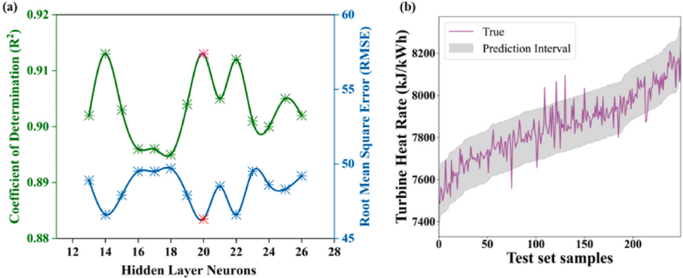
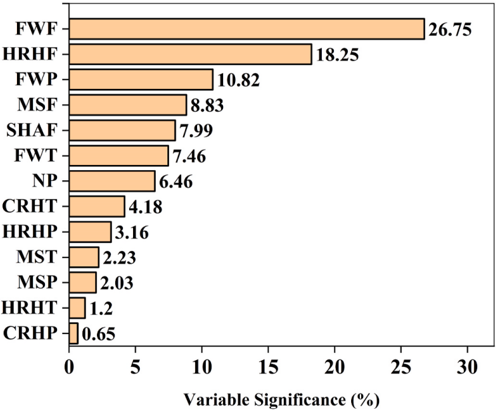
- The best ANN model, with 20 hidden-layer neurons, achieved validation R² = 0.913 and RMSE = 46.3 kJ/kWh; Monte Carlo significance analysis identified feed water flow rate (26.75%) and hot reheat steam flow rate (18.25%) as the two most significant inputs for THR.
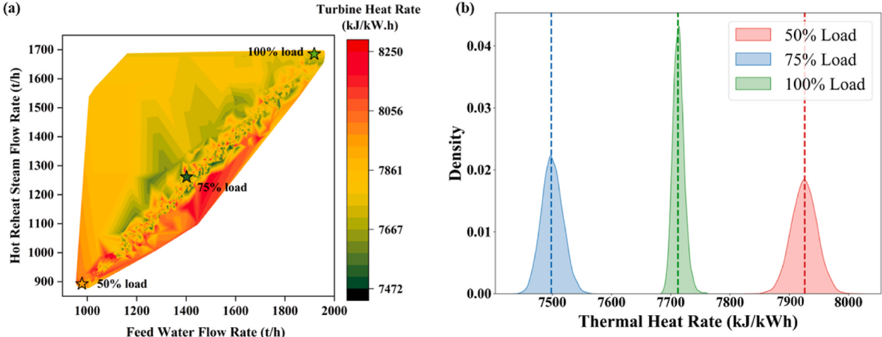
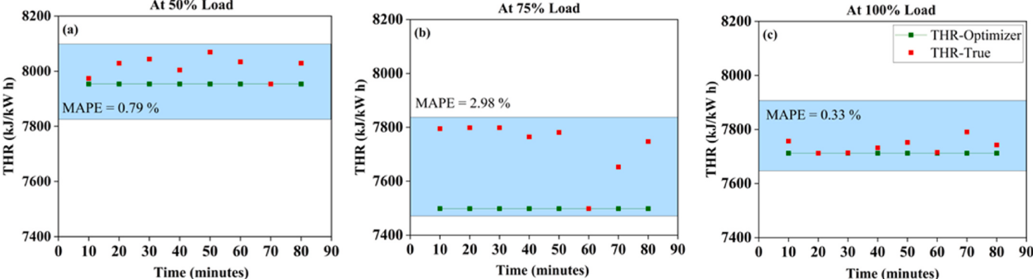
- NLP/SQP optimization estimated minimum THR values of 7926 kJ/kWh at 50% load, 7498 kJ/kWh at 75% load, and 7712 kJ/kWh at 100% load; experimental validation MAPE was 0.79%, 2.98%, and 0.33% at those loads, respectively.
- The deployed digital twin predicted THR on 19,118 real-time observations with R² = 0.93, RMSE = 41.8 kJ/kWh, and MAPE = 0.34%.
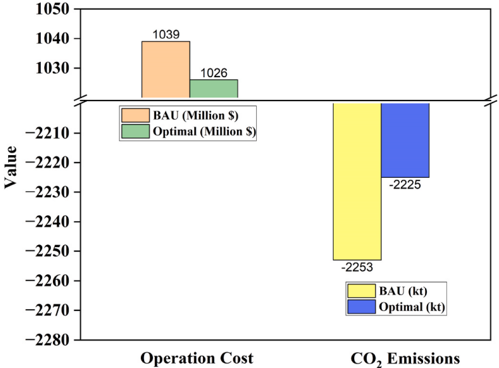
- Cost and emissions analysis compared business-as-usual (BAU) with optimal operation: annual cost fell from 1039 million USD to 1026 million USD, saving about 13 million USD/year, while CO₂ emissions fell from 2.253 Mt to 2.225 Mt, a reduction of 28 kt/year.
Methods
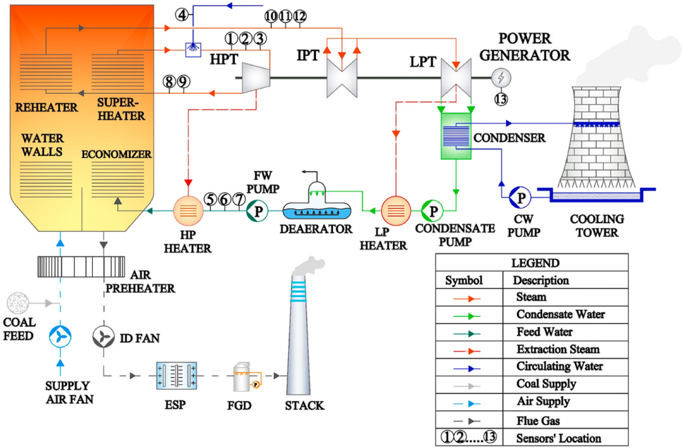
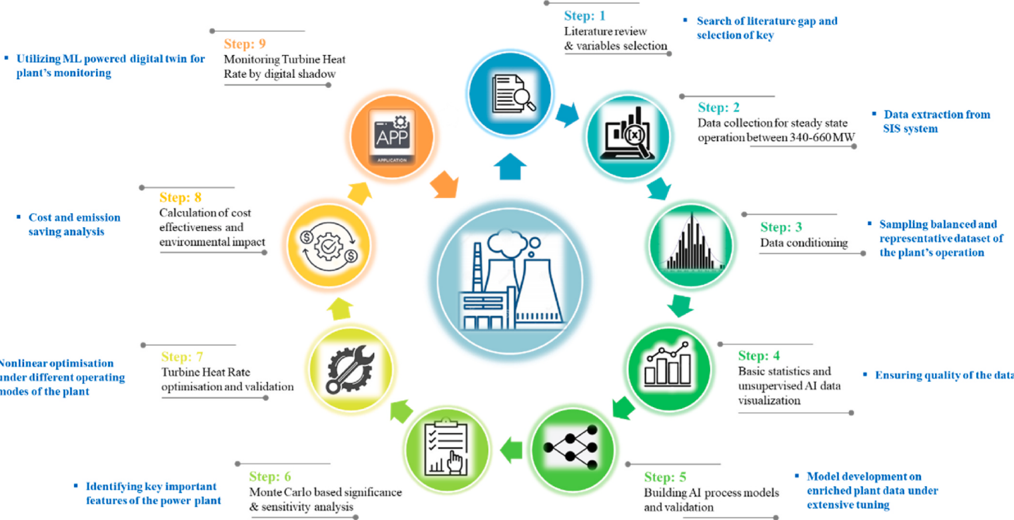
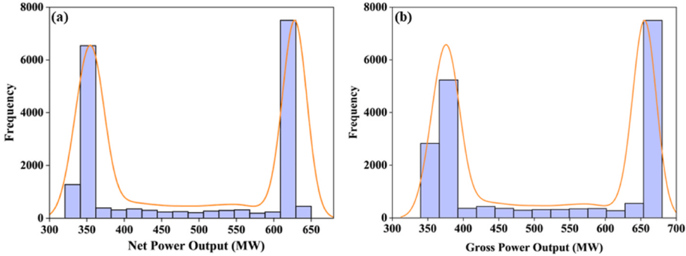
- Data came from the Sahiwal coal-fired power plant, Pakistan, which has two 660 MW supercritical units; historical data from November 2019 to October 2020 were averaged over 600-s intervals, giving 28,200 observations per variable. Cleaning removed sensor errors and shutdown-state observations, then data-efficient sampling across five load ranges (340–360, 360–380, 380–400, 400–640, and 640–660 MW) used random selection from large clusters, Freedman-Diaconis rule filtering, histograms, and Kohonen self-organizing feature maps; the final dataset was reported as 2,506 samples.
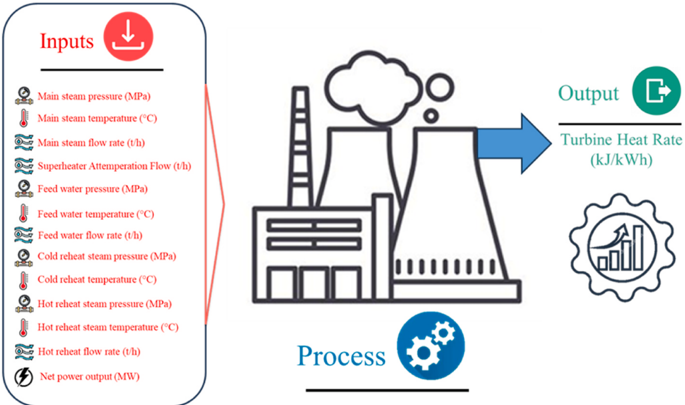
- The ANN used 13 input variables, hidden-layer neurons varied from 13 to 26, Levenberg-Marquardt backpropagation, tan-sigmoid hidden activation, linear output activation, and an 80/10/10 training/validation/testing split; ANN_20 was selected, and inductive conformal prediction was used for uncertainty quantification.
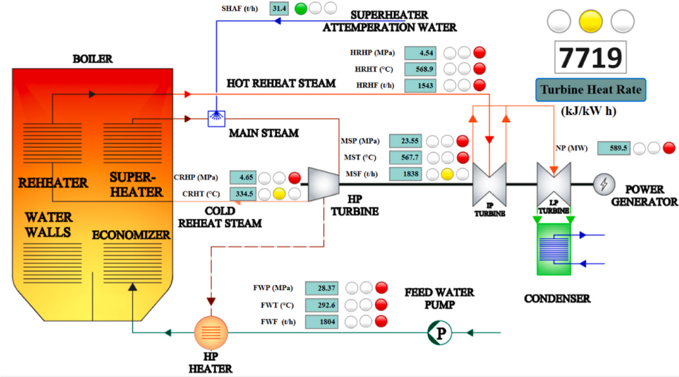
- THR minimization used nonlinear programming with a sequential quadratic programming solver under input bounds at 50%, 75%, and 100% load, with about 200 initial starting points and 1% input perturbation robustness checks; the trained ANN was then embedded in a GUI digital twin for real-time THR monitoring.
Limitations
- The paper states that its emission-reduction estimates do not encompass the spectrum of potent greenhouse gases from thermal power plants, and it identifies future work on transferable and efficient model-update strategies, domain knowledge integration, and reliable domain-consistent digital twin performance in safety-critical industrial systems.
- Evident from the text: the study uses historical data from a single plant over one year, real-time data distributions were asymmetric and broader than the training data, the digital twin underpredicted some upper THR peaks, and the authors note that real-time sensors may produce faulty or missing observations and that concept drift requires preprocessing and model updating.
Model-written summary. Check it against the paper before relying on it.
Integrity signals
Registry
Cites
Statistics
Figures

Verification
Claims the paper makes
0 Valid · 4 Not valid · 22 Not checked · 63 Own results and interpretations
A result the paper reports from its own data — it cites no other source for it, so there is none to check. The quote shows it is in the paper.
In the paper
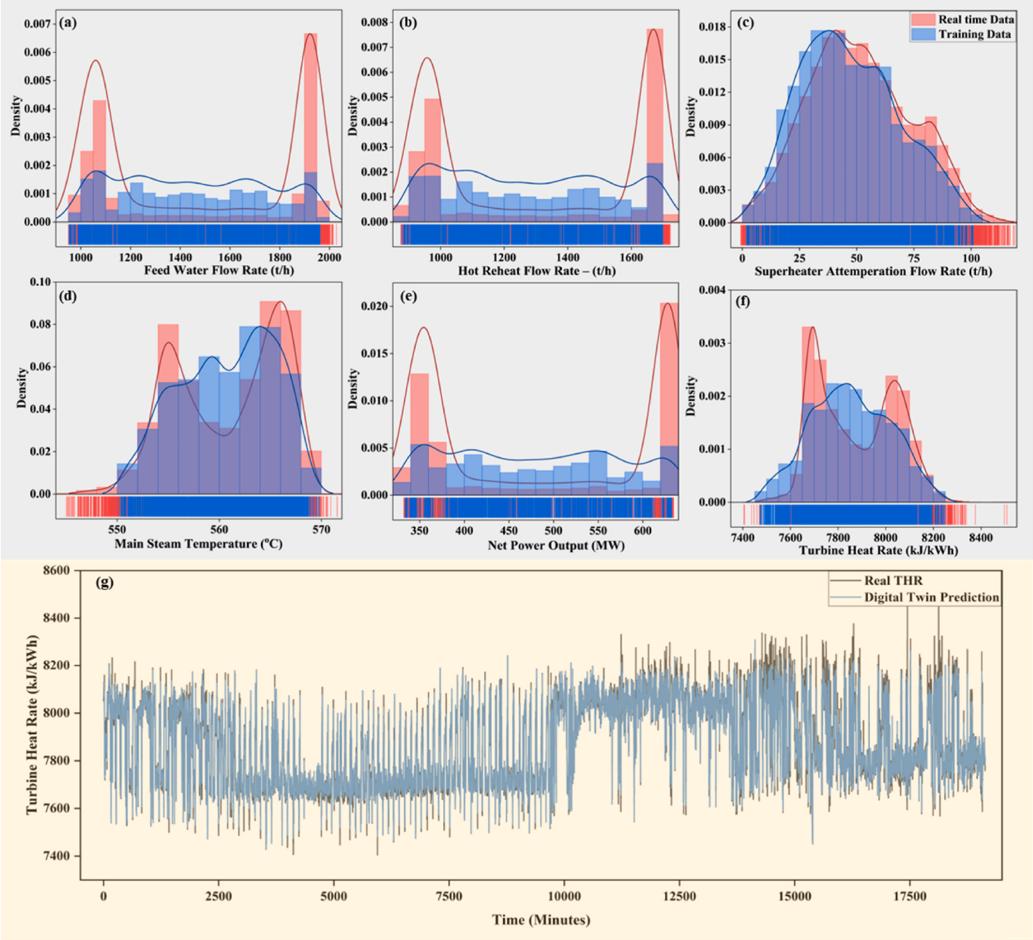
“The deployed digital twin exhibits good prediction performance to monitor THR as compared with Real THR value.”
§ Data-efficient digital twin for turbine heat rate of industrial thermal power plant > 6. Limitation and future work
plainstates an associationSingle case- Asserted: passes — The authors put it forward as true.
- Checkable: passes — It can be checked against evidence.
- Load-bearing: passes — The paper’s conclusions depend on it.
- Based: passes — The paper gives a reason why it holds.
A result the paper states — it cites no source for it, so there is none to check. The quote shows it is in the paper.
In the paper
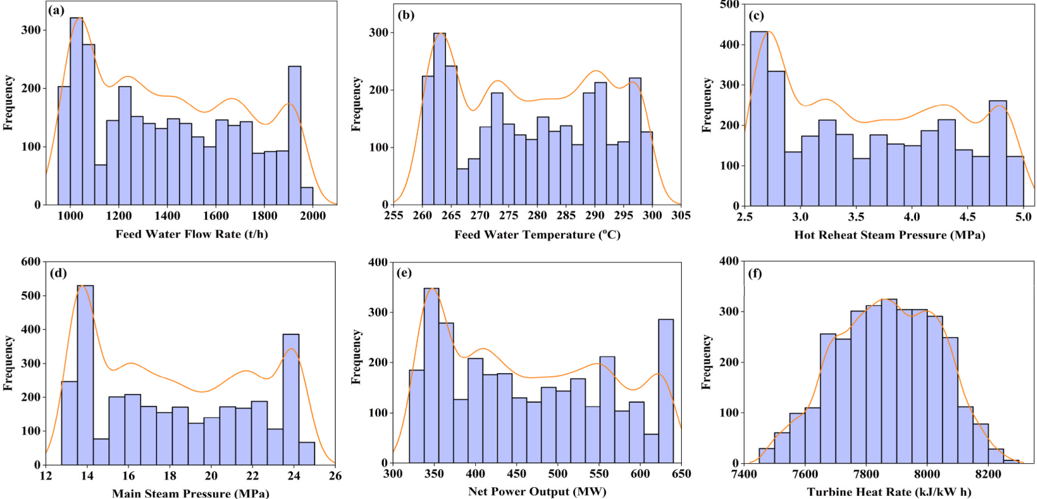
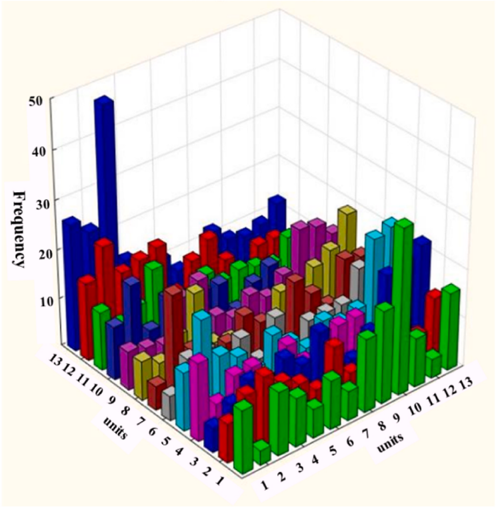
“The count of randomly selected data points from big data clusters associated with Net Power Output are nearly equal to those of all load intervals to maintain nearly the uniform data distribution for Net Power Output on its operating range.”
§ Data-efficient digital twin for turbine heat rate of industrial thermal power plant > 3.2. Data-efficient sampling and data visualization
plain- Asserted: passes — The authors put it forward as true.
- Checkable: passes — It can be checked against evidence.
- Load-bearing: passes — The paper’s conclusions depend on it.
- Based: passes — The paper gives a reason why it holds.
A result the paper reports from its own data — it cites no other source for it, so there is none to check. The quote shows it is in the paper.
In the paper
“Fig. 5(a-f) reveal that the frequencies of data points are consistently similar within data-distribution on the bins”
§ Data-efficient digital twin for turbine heat rate of industrial thermal power plant > 3.2. Data-efficient sampling and data visualization
plainn = 2,506- Asserted: passes — The authors put it forward as true.
- Checkable: passes — It can be checked against evidence.
- Load-bearing: passes — The paper’s conclusions depend on it.
- Based: passes — The paper gives a reason why it holds.
A result the paper states — it cites no source for it, so there is none to check. The quote shows it is in the paper.
In the paper
“Digital twin system to predict THR of 660 MW supercritical coal power plant.”
§ Data-efficient digital twin for turbine heat rate of industrial thermal power plant > 6. Limitation and future work
plainSingle case- Asserted: passes — The authors put it forward as true.
- Checkable: passes — It can be checked against evidence.
- Load-bearing: passes — The paper’s conclusions depend on it.
- Based: passes — The paper gives a reason why it holds.
A result the paper reports from its own data — it cites no other source for it, so there is none to check. The quote shows it is in the paper.
In the paper
“The data-distribution profiles of the input (a-g) and output variables (f) made on the real-time data during the plant operation are skewed and asymmetric with reference to the training data, the model is trained upon.”
§ Data-efficient digital twin for turbine heat rate of industrial thermal power plant > 6. Limitation and future work
plain- Asserted: passes — The authors put it forward as true.
- Checkable: passes — It can be checked against evidence.
- Load-bearing: unclear — It is unclear whether the paper’s conclusions depend on it.
- Based: passes — The paper gives a reason why it holds.
24 more claims
Create a free account to see all 89 claims and to verify the 24 references still open.
- It may state two separate claims as one. 32
- The quote only partly states this claim. 2
- Probably not a substantial claim. 35
Citations
Cites
Learning representations by back-propagating errors
Rumelhart, D. E., Hinton, G. E., & Williams, R. J. (1986) · Nature · doi:10.1038/323533a0 · Cited by 31,892
Digital Twin in Industry: State-of-the-Art
Tao, F., Zhang, H., Liu, A., & Nee, A. Y. C. (2019) · IEEE Transactions on Industrial Informatics · doi:10.1109/tii.2018.2873186 · Cited by 5,871
Digital twin: Enabling technologies, challenges and open research
Fuller, A., Fan, Z., Day, C., & Barlow, C. (2020) · IEEE Access · doi:10.1109/access.2020.2998358 · Cited by 2,965
Kohonen, T. (1998) · Neurocomputing · doi:10.1016/s0925-2312(98)00030-7 · Cited by 1,968
Review of digital twin about concepts, technologies, and industrial applications
Liu, M., Fang, S., Dong, H., & Xu, C. (2021) · Journal of Manufacturing Systems · doi:10.1016/j.jmsy.2020.06.017 · Cited by 1,875
Sequential quadratic programming
Boggs, P. T., & Tolle, J. W. (1995) · Acta Numerica · doi:10.1017/s0962492900002518 · Cited by 1,858
On the histogram as a density estimator:L 2 theory
Freedman, D., & Diaconis, P. (1981) · Zeitschrift f�r Wahrscheinlichkeitstheorie und Verwandte Gebiete · doi:10.1007/bf01025868 · Cited by 1,601
A new metric of absolute percentage error for intermittent demand forecasts
Kim, S., & Kim, H. (2016) · International Journal of Forecasting · doi:10.1016/j.ijforecast.2015.12.003 · Cited by 1,146
An Energy Sector Roadmap to Carbon Neutrality in China
International Energy Agency (2021) · OECD eBooks · doi:10.1787/5f517ddb-en · Cited by 647
Net-zero emissions targets are vague: three ways to fix
Rogelj, J., Geden, O., Cowie, A., & Reisinger, A. (2021) · Nature · doi:10.1038/d41586-021-00662-3 · Cited by 554
Research works printed but not linked: 8
- Marks KM. Analysis of VLSI process data based on self-organizing feature maps. Proceedings of the Nuero-Nimes' 88. 1988. p. 337-47.
- Hassoun MH. Fundamentals of artificial neural networks. MIT press; 1995.
- Walczak S, Cerpa N. Artificial neural networks. In: Meyers RA, editor. Encyclopedia of physical science and technology. third ed. New York: Academic Press; 2003. p. 631-45.
- Haykin S. Neural networks and learning machines, 3/E. Pearson Education India; 2009.
- Gammerman A, Vovk V, Vapnik V. Learning by transduction. Proceedings of the Fourteenth conference on Uncertainty in artificial intelligence. Madison, Wisconsin: Morgan Kaufmann Publishers Inc.; 1998. p. 148-55.
- Muhammad Ashraf W, Moeen Uddin G, Muhammad Arafat S, Afghan S, Hassan Kamal A, Asim M, et al. Optimization of a 660 MWe Supercritical power plant performance-A case of industry 4.0 in the data-driven operational management part 1. Thermal Efficiency 2020;13:5592.
- Ashraf WM, Uddin GM, Tariq R, Ahmed A, Farhan M, Nazeer MA, et al. Artificial intelligence modeling-based optimization of an industrial-scale steam turbine for moving toward net-zero in the energy sector. ACS Omega 2023;8:21709-25. · DOI · Paper page
- Cengel YA, Boles MA, Kanoglu M. Thermodynamics: an engineering approach. New York: McGraw-hill; 2011.
Cited by
Mohammadi, M., & Esfahanian, V. (2026) · Energy · doi:10.1016/j.energy.2026.140838 · Cited by 3
Shin, H., & Goo, J. (2026) · SSRN Electronic Journal · doi:10.2139/ssrn.7428940
Artificial intelligence for thermal and exergy optimization of steam cycle power plants: a review
Ahmed, F., & Mewada, H. K. (2026) · Journal of Thermal Analysis and Calorimetry · doi:10.1007/s10973-026-16477-1
Generative-Reflective Agent-Based Method for the Extraction of Chemical Information
Alshehri, A. S. (2026) · Procedia Computer Science · doi:10.1016/j.procs.2026.09.482
Self-citationLocal optimization of CHP plant operation: an adaptively updated digital twin and linear programming
Repin, I., Аникина, И., & Guryanov, A. (2026) · Applied Energy · doi:10.1016/j.apenergy.2026.129220
Metadata
- Authors
- Ashraf, W. M., Muzammil, S., Nasir, M. W., Muneeb, M., Arafat, S. M., Alshehri, A. S., bin Jumah, A., Debnath, R., Dua, V., & Uddin, G. M.
- Affiliations
- University of Cambridge (GB)
- University of Engineering and Technology Lahore (PK)
- University of Lahore (PK)
- King Saud University (SA)
- University College London (GB)
- Corresponding author
- Dua, Vivek
- Uddin, Ghulam Moeen
- ORCID
- Venue
- Energy
- Publisher
- Elsevier BV
- Published
- 2026-02
- Volume
- 345
- Pages
- 140238
- ISSN
- 0360-5442 (ISSN-L)
- OpenAlex
- W7126120040
- Cited by
- 9
- References
- 54
- Citations by year
- 2026: 9
- FWCI
- 8.63
- Type
- journal article
- Language
- en
- Open access
- hybrid
- doi.org
- Licence
- cc-by
- www.elsevier.com/tdm/userlicense/1.0/ (tdm)
- www.elsevier.com/legal/tdmrep-license (tdm)
- creativecommons.org/licenses/by/4.0/ (vor)
- Locations
- Energy (publishedVersion, cc-by)
- Apollo (University of Cambridge) (submittedVersion, cc-by)
- Funders
- Alan Turing Institute
- King Saud University Deanship of Scientific Research (ISPP25-3)
- Topics
- Physical Sciences › Energy › Energy Engineering and Power Technology › Advanced Power Generation Technologies
- Physical Sciences › Engineering › Mechanical Engineering › Thermodynamic and Exergetic Analyses of Power and Cooling Systems
- Physical Sciences › Engineering › Control and Systems Engineering › Fault Detection and Control Systems
- Keywords
- digital twin, data-efficient training, data sampling, artificial neural networks, CO2 emission reduction, real-time performance monitoring, data drift
About these checks
Registry, retraction, Cites and statistics results are computed, not judged, with one exception: a printed reference that no index lists is read once by a model before it counts as a citation error. Claims are extracted by a model and kept only when their quote appears verbatim in the text; each cited source is then checked, with a model’s help, for whether it says what the claim relies on. Those verdicts can be wrong — read the claim’s quote and the cited source before relying on one.
A language model drew the claims from the paper on 2026-11-29, under version 3 of the claim definition (model deepseek-v4.1-flash, prompt extract-v3).
A second model labelled each claim on 2026-11-29 (model jev-1.13-20260917, definition revision gold-guideline-v0.2).
Statistics and arithmetic are recomputed, not judged.
Confidence bands are shown only for fields calibrated on our annotated test set. None is calibrated yet, so no band is shown.
What counts as a claim ›How we measure confidence ›How we check this ›
Are you an author, or do you see a problem with this page? Request a review
Data sources
Bibliographic data: Semantic Scholar, OpenAlex, Crossref.
Contains information from the Semantic Scholar Academic Graph Datasets, made available under the ODC Attribution License (ODC-BY 1.0).
Semantic Scholar’s data is described in: Kinney, R., et al. (2023). The Semantic Scholar Open Data Platform. arXiv:2301.10140.
