

The DOI matches its Crossref record; 2 of the 2 references it cites were found in a registry or an index.
Extracellular vesicle‐mediated transfer of long non‐coding RNA ROR modulates chemosensitivity in human hepatocellular cancer
Abstract
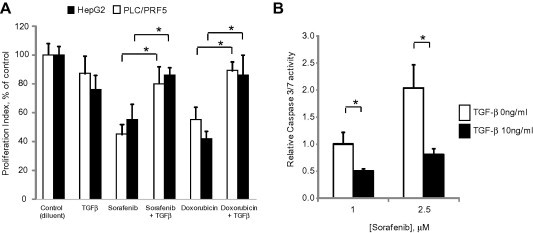
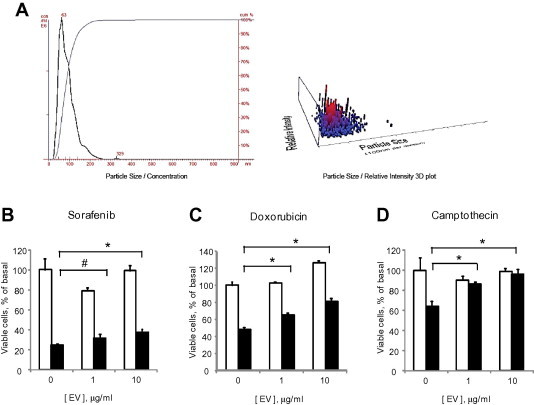
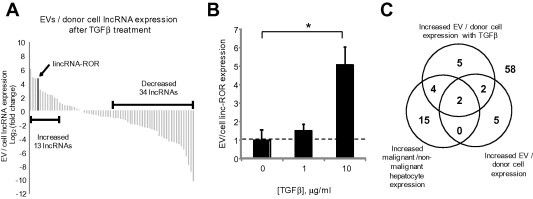
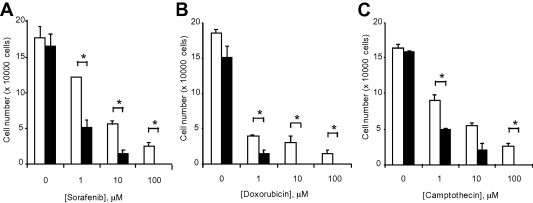
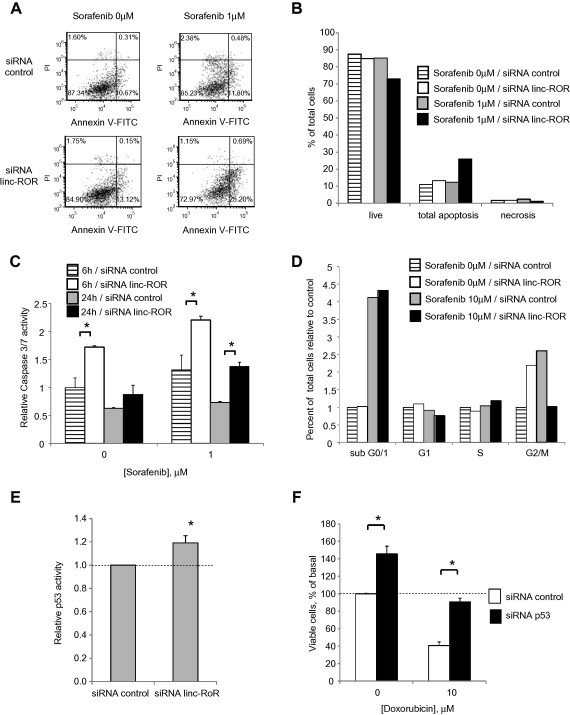
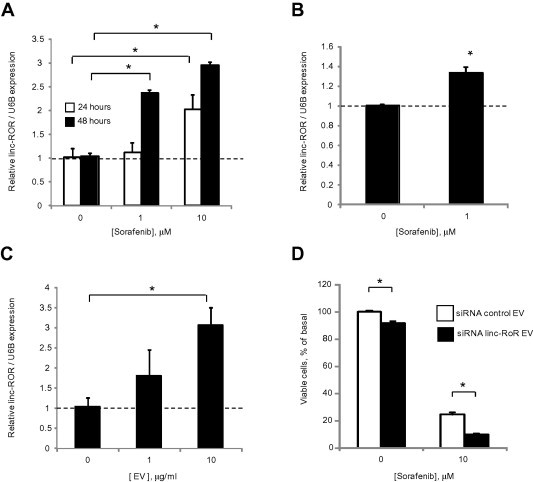
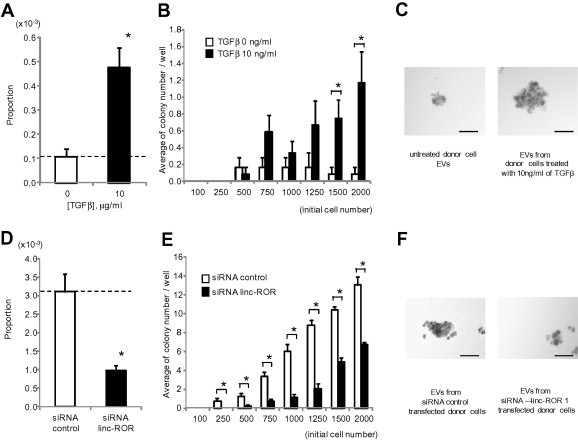
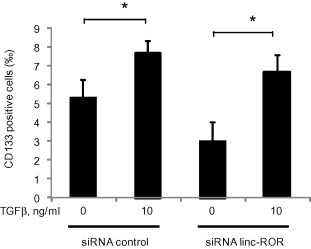
Hepatocellular cancers (HCC) are highly resistant to chemotherapy. TGFβ has been associated with chemoresistance in some human cancers but the mechanisms involved are unknown. We explored how TGFβ might contribute to altered responses to therapy by assessing the involvement and mechanistic contribution of extracellular vesicle long non‐coding RNA (lncRNA) in mediating TGFβ‐dependent chemoresistance. TGFβ reduced the sensitivity of HCC cells to sorafenib or doxorubicin and altered the release of both extracellular vesicles and of selected lncRNA within these vesicles. Amongst these, lincRNA‐ROR (linc‐ROR), a stress‐responsive lncRNA was highly expressed in HCC cells and enriched within extracellular vesicles derived from tumor cells. Incubation with HCC‐derived extracellular vesicles increased linc‐ROR expression and reduced chemotherapy‐induced cell death in recipient cells. Sorafenib increased linc‐ROR expression in both tumor cells and extracellular vesicles, whereas siRNA to linc‐ROR increased chemotherapy‐induced apoptosis and cytotoxicity. Tumor‐initiating cells that express CD133 have an increased resistance to therapy. TGFβ increased expression of CD133+ cells and colony growth in limiting dilution assays, both of which were attenuated by linc‐ROR knockdown. These data provide mechanistic insights into primary chemoresistance in HCC by showing that: (a) TGFβ selectively enriches linc‐RoR within extracellular vesicles, which has a potential role in intercellular signaling in response to TGFβ; (b) expression and enrichment of linc‐ROR during chemotherapeutic stress plays a functional role in chemoresistance; and (c) the effects of TGFβ on chemoresistance in HCC may involve linc‐RoR‐dependent effects on tumor‐initiating cells. These findings implicate extracellular vesicle lncRNA as mediators of the chemotherapeutic response, and support targeting linc‐ROR to enhance chemosensitivity in HCC.
Overview
The claims and statistics of this paper haven’t been checked yet.
Run the check — free, no account needed. It reads the open-access text and checks the sources it cites.
Integrity signals
Registry
Cites
Statistics
Figures
Verification
Claims the paper makes
The claims and statistics of this paper haven’t been checked yet.
Run the check — free, no account needed. It reads the open-access text and checks the sources it cites.
Claims other papers make about this one
Each is checked against this paper’s own text: does it say what the citing paper says it does?
In the citing paper
“Takahashi et al. discovered that drug therapy could increase exosomal linc-RoR levels in HCC cells, which inhibits p53 level and diminishes sorafenib-triggered apoptosis [115].”
From Emerging role of exosomes in cancer therapy: progress and challenges (2025) · cites this paper as [115]
Self-check
Percentages, sums and reported differences re-computed from the paper’s own numbers.
The self-check needs the paper’s full text.
Citations
Cites
Sorafenib in advanced hepatocellular carcinoma
Llovet, J. M., Ricci, S., Mazzaferro, V., Hilgard, P., Gane, E., Blanc, J.-F., de Oliveira, A. C., Santoro, A., Raoul, J.-L., Forner, A., et al. (2008) · New England Journal of Medicine · doi:10.1056/nejmoa0708857 · Cited by 13,097
Valadi, H., Ekström, K., Bossios, A., Sjöstrand, M., Lee, J. J., & Lötvall, J. O. (2007) · Nature Cell Biology · doi:10.1038/ncb1596 · Cited by 12,834
Research works printed but not linked: 29
- 10.1053/j.gastro.2007.04.061 · DOI
- 10.1016/j.jhep.2011.07.031 · DOI
- 10.1053/j.gastro.2013.01.002 · DOI
- 10.1073/pnas.1214136110 · DOI
- 10.1016/S0002-9440(10)62324-3 · DOI
- 10.1053/j.gastro.2005.09.055 · DOI
- 10.1016/j.cell.2008.07.001 · DOI · Paper page
- 10.1038/cr.2008.316 · DOI
- 10.1038/nrgastro.2012.114 · DOI
- 10.1172/JCI30740 · DOI
- 10.1002/hep.24504 · DOI · Paper page
- 10.1038/nri2567 · DOI
- 10.4049/jimmunol.180.12.8146 · DOI
- 10.1038/ncb1800 · DOI · Paper page
- 10.1007/978-1-62703-453-1_2 · DOI
- 10.1038/cr.2012.164 · DOI
- 10.1186/1476-4598-10-38 · DOI
- 10.1038/ng.710 · DOI
- 10.1158/0008-5472.CAN-12-1013 · DOI
- 10.1016/j.yexcr.2012.09.007 · DOI
- 10.1158/0008-5472.CAN-04-1443 · DOI
- 10.1016/S1470-2045(08)70285-7 · DOI · Paper page
- 10.1038/nature04733 · DOI
- Braconi C., 2012, Non-coding RNAs as therapeutic targets in hepatocellular cancer, Curr. Cancer Drug Targets, 12, 1073
- 10.1016/j.jhep.2010.12.043 · DOI
- 10.1002/hep.23544 · DOI
- 10.3171/2009.11.JNS091396 · DOI
- 10.1002/hep.26168 · DOI
- Zhu Z., 2010, Cancer stem/progenitor cells are highly enriched in CD133+CD44+ population in hepatocellular carcinoma, Int. J. Cancer, 126, 2067, 10.1002/ijc.24868 · DOI
Cited by
Sorted by citations
Emerging role of exosomes in cancer therapy: progress and challenges
Li, J., Wang, J., & Chen, Z. (2025) · Molecular Cancer · doi:10.1186/s12943-024-02215-4 · Cited by 297
Liquid biopsy in the clinical management of hepatocellular carcinoma
von Felden, J., Garcia-Lezana, T., Schulze, K., Losic, B., & Villanueva, A. (2020) · Gut · doi:10.1136/gutjnl-2019-320282 · Cited by 141
Sullivan, R., Maresh, G., Zhang, X., Salomon, C., Hooper, J., Margolin, D., & Li, L. (2017) · Frontiers in Endocrinology · doi:10.3389/fendo.2017.00194 · Cited by 112
Metadata
- Authors
- Takahashi, K., Yan, I. K., Kogure, T., Haga, H., & Patel, T.
- Venue
- FEBS Open Bio
- Publisher
- Wiley
- Published
- 2014-01
- Volume
- 4
- Issue
- 1
- Pages
- 458-467
- ISSN
- 2211-5463
- PMC
- PMC4050189
- Cited by
- 376
- References
- 2
- Language
- en
About these checks
Registry, retraction, Cites and statistics results are computed, not judged, with one exception: a printed reference that no index lists is read once by a model before it counts as a citation error. Claims are extracted by a model and kept only when their quote appears verbatim in the text; each cited source is then checked, with a model’s help, for whether it says what the claim relies on. Those verdicts can be wrong — read the claim’s quote and the cited source before relying on one.
Statistics and arithmetic are recomputed, not judged.
Confidence bands are shown only for fields calibrated on our annotated test set. None is calibrated yet, so no band is shown.
What counts as a claim ›How we measure confidence ›How we check this ›
Are you an author, or do you see a problem with this page? Request a review
