

The DOI matches its Crossref record; 53 of the 53 references it cites were found in a registry or an index.
Mixing plant-based proteins: Gel properties of hemp, pea, lentil proteins and their binary mixtures
Abstract
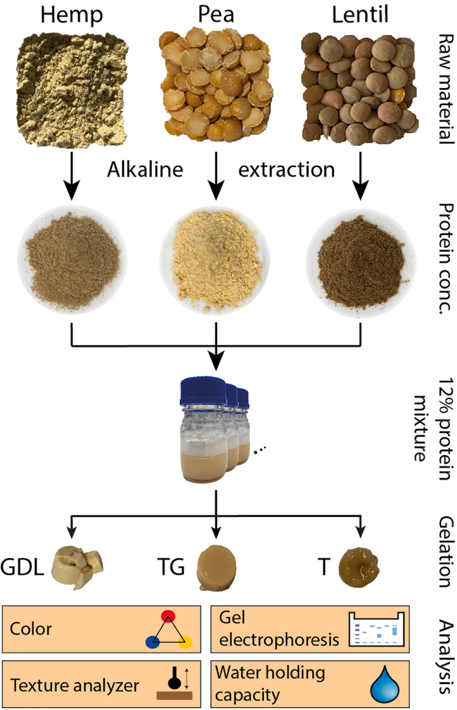
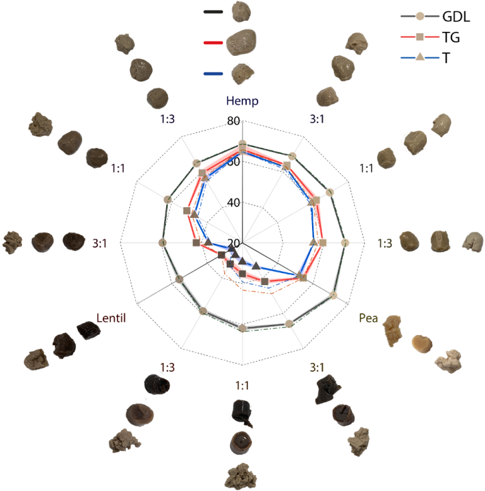
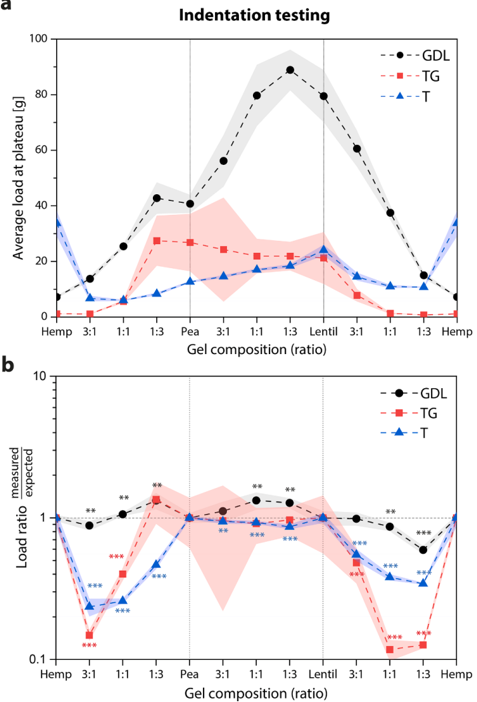
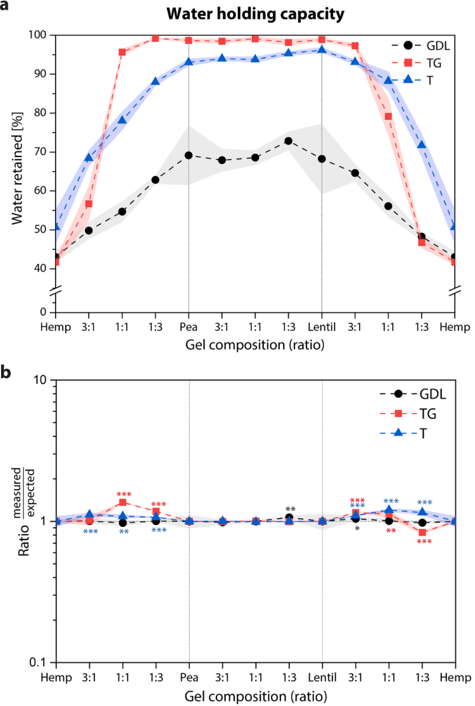
One of the challenges in substituting dairy products by alternative proteins is that the properties of mixed protein gels cannot necessarily be predicted by those of single protein gels, whereas the need of mixing is often driven by nutritional aspects. However, mixing plant proteins could also open a door to new textures. The main goal of this study was to investigate the impact of binary mixing of hemp (H), yellow pea (P), and brown lentil (L) protein concentrates/isolates on their gel and water-holding properties. Dispersions of reconstituted proteins and mixtures thereof were gelled using glucono-δ-lactone (GDL), transglutaminase (TG), and temperature (T) at a protein content of 12% (w/w). Mixtures of pea and lentil proteins showed gel strengths for TG- and T-induced gels that are proportional to the ratio of the mixture constituents (linear mixing behavior), whereas synergistic effects were observed for GDL-induced gelation. In contrast, all mixtures containing hemp exhibited a non-linear mixing behavior for the three gelation methods, usually resulting in lower gel strengths compared to theoretically expected values. The study showed that mixing plant-based proteins of different protein sources can lead to very different mixing behaviors in terms of gel properties, showing either a reinforcing, an indifferent or a weakening effect compared to the theoretically expected properties. The results can help developing more targeted plant protein-based soft gel products such as yogurt alternatives with specific techno-functional properties, while adjusting the nutritional characteristics.
Overview
The claims and statistics of this paper haven’t been checked yet.
Run the check — free, no account needed. It reads the open-access text and checks the sources it cites.
Integrity signals
Registry
Cites
Statistics
Figures
Verification
Claims the paper makes
The claims and statistics of this paper haven’t been checked yet.
Run the check — free, no account needed. It reads the open-access text and checks the sources it cites.
Claims other papers make about this one
Each is checked against this paper’s own text: does it say what the citing paper says it does?
The cited source says what the claim attributes to it.
In the citing paper
“Additionally, some studies indicated that the source and composition of plant proteins also affect gelling properties ( James and Yang 2016; Guidi et al. 2022).”
From A Review of Gelation of Plant Proteins and Their Influencing Factors (2025) · cites this paper as Guidi et al. 2022
Self-check
Percentages, sums and reported differences re-computed from the paper’s own numbers.
The self-check needs the paper’s full text.
Citations
Cites
MMseqs2 enables sensitive protein sequence searching for the analysis of massive data sets
Steinegger, M., & Söding, J. (2017) · Nature Biotechnology · doi:10.1038/nbt.3988 · Cited by 4,840
Khoo, H. E., Azlan, A., Tang, S. T., & Lim, S. M. (2017) · Food & Nutrition Research · doi:10.1080/16546628.2017.1361779 · Cited by 3,205
Converting Nitrogen into Protein—Beyond 6.25 and Jones' Factors
Mariotti, F., Tomé, D., & Mirand, P. P. (2008) · Critical Reviews in Food Science and Nutrition · doi:10.1080/10408390701279749 · Cited by 1,400
Protein content and amino acid composition of commercially available plant-based protein isolates
Gorissen, S. H. M., Crombag, J. J. R., Senden, J. M. G., Waterval, W. A. H., Bierau, J., Verdijk, L. B., & van Loon, L. J. C. (2018) · Amino Acids · doi:10.1007/s00726-018-2640-5 · Cited by 1,169
Plant-based milk alternatives an emerging segment of functional beverages: a review
Sethi, S., Tyagi, S. K., & Anurag, R. K. (2016) · Journal of Food Science and Technology · doi:10.1007/s13197-016-2328-3 · Cited by 1,097
Hempseed as a nutritional resource: An overview
Callaway, J. C. (2004) · Euphytica · doi:10.1007/s10681-004-4811-6 · Cited by 910
Pea protein isolates: Structure, extraction, and functionality
Lam, A. C. Y., Can Karaca, A., Tyler, R. T., & Nickerson, M. T. (2018) · Food Reviews International · doi:10.1080/87559129.2016.1242135 · Cited by 902
Composition, physicochemical properties of pea protein and its application in functional foods
Lu, Z. X., He, J. F., Zhang, Y. C., & Bing, D. J. (2020) · Critical Reviews in Food Science and Nutrition · doi:10.1080/10408398.2019.1651248 · Cited by 529
A review of physical and chemical protein-gel induction
Totosaus, A., Montejano, J. G., Salazar, J. A., & Guerrero, I. (2002) · International Journal of Food Science and Technology · doi:10.1046/j.1365-2621.2002.00623.x · Cited by 488
Physicochemical and Functional Properties of Hemp ( Cannabis sativa L.) Protein Isolate
Tang, C.-H., Ten, Z., Wang, X.-S., & Yang, X.-Q. (2006) · Journal of Agricultural and Food Chemistry · doi:10.1021/jf0619176 · Cited by 405
Research works printed but not linked: 1
- Liu, 2022, Composition and Functional Properties of Hemp Seed Protein Isolates from Various Hemp Cultivars (preprint), Biochemistry
Cited by
Effect of pH-shifting and ultrasound on soy/potato protein structure and gelation
Sun, Y., Wang, L., Wang, H., Zhou, B., Jiang, L., & Zhu, X. (2025) · Food Hydrocolloids · doi:10.1016/j.foodhyd.2024.110672 · Cited by 106
Zhou, H., Hu, X., Xiang, X., & McClements, D. J. (2023) · Food Hydrocolloids · doi:10.1016/j.foodhyd.2023.108909 · Cited by 105
A Review of Gelation of Plant Proteins and Their Influencing Factors
Hui, D., Liang, W., Wang, R., Feng, X., & Tang, X. (2025) · Sustainable Food Proteins · doi:10.1002/sfp2.70037 · Cited by 12
Marinacci, A., Piermaria, J., & Speroni, F. (2024) · Food Biophysics · doi:10.1007/s11483-023-09822-6 · Cited by 10
Metadata
- Authors
- Guidi, S., Formica, F. A., & Denkel, C.
- Venue
- Food Research International
- Publisher
- Elsevier BV
- Published
- 2022-11
- Volume
- 161
- Pages
- 111752
- ISSN
- 0963-9969
- Cited by
- 83
- References
- 53
- Language
- en
- Licence
- www.elsevier.com/tdm/userlicense/1.0/ (tdm)
- www.elsevier.com/legal/tdmrep-license (tdm)
- creativecommons.org/licenses/by/4.0/ (vor)
About these checks
Registry, retraction, Cites and statistics results are computed, not judged, with one exception: a printed reference that no index lists is read once by a model before it counts as a citation error. Claims are extracted by a model and kept only when their quote appears verbatim in the text; each cited source is then checked, with a model’s help, for whether it says what the claim relies on. Those verdicts can be wrong — read the claim’s quote and the cited source before relying on one.
Statistics and arithmetic are recomputed, not judged.
Confidence bands are shown only for fields calibrated on our annotated test set. None is calibrated yet, so no band is shown.
What counts as a claim ›How we measure confidence ›How we check this ›
Are you an author, or do you see a problem with this page? Request a review
How to cite
Cite CoChat for the checks on this page, and the paper for its own findings.
- This page
- CoChat. (2026). Citation check: Mixing plant-based proteins: Gel properties of hemp, pea, lentil proteins and their binary mixtures. https://app.cochat.ai/papers/10.1016/j.foodres.2022.111752
- The paper
- Guidi, S., Formica, F. A., & Denkel, C. (2022). Mixing plant-based proteins: Gel properties of hemp, pea, lentil proteins and their binary mixtures. Food Research International. https://doi.org/10.1016/j.foodres.2022.111752
Data sources
Bibliographic data: Semantic Scholar, OpenAlex, Crossref.
Contains information from the Semantic Scholar Academic Graph Datasets, made available under the ODC Attribution License (ODC-BY 1.0).
Semantic Scholar’s data is described in: Kinney, R., et al. (2023). The Semantic Scholar Open Data Platform. arXiv:2301.10140.
