

The DOI matches its Crossref record; 91 of the 93 references it cites were found in a registry or an index.
Mutational signatures: the patterns of somatic mutations hidden in cancer genomes
Open accessAbstract
All cancers originate from a single cell that starts to behave abnormally due to the acquired somatic mutations in its genome. Until recently, the knowledge of the mutational processes that cause these somatic mutations has been very limited. Recent advances in sequencing technologies and the development of novel mathematical approaches have allowed deciphering the patterns of somatic mutations caused by different mutational processes. Here, we summarize our current understanding of mutational patterns and mutational signatures in light of both the somatic cell paradigm of cancer research and the recent developments in the field of cancer genomics.
Overview
The claims and statistics of this paper haven’t been checked yet.
Run the check — free, no account needed. It reads the open-access text and checks the sources it cites.
Integrity signals
Registry
Cites
Statistics
Figures
Verification
Claims the paper makes
The claims and statistics of this paper haven’t been checked yet.
Run the check — free, no account needed. It reads the open-access text and checks the sources it cites.
Claims other papers make about this one
Each is checked against this paper’s own text: does it say what the citing paper says it does?
In the citing paper
“This suggests that pol h may be mutagenic only in some types of blood cancer, consistent with the results of previous studies 39 .”
From DNA polymerase η mutational signatures are found in a variety of different types of cancer (2018) · cites this paper as [39]
In the citing paper
“The excess of pol h mutable motifs in chronic lymphocytic leukemia and GCB lymphomas that we detected in our work is consistent with the studies of Alexandrov et al. 39”
From DNA polymerase η mutational signatures are found in a variety of different types of cancer (2018) · cites this paper as [39]
Self-check
Percentages, sums and reported differences re-computed from the paper’s own numbers.
The self-check needs the paper’s full text.
Citations
Cites
DNA sequencing with chain-terminating inhibitors
Sanger, F., Nicklen, S., & Coulson, A. R. (1977) · Proceedings of the National Academy of Sciences · doi:10.1073/pnas.74.12.5463 · Cited by 68,572
Learning the parts of objects by non-negative matrix factorization
Lee, D. D., & Seung, H. S. (1999) · Nature · doi:10.1038/44565 · Cited by 14,193
Molecular Structure of Nucleic Acids: A Structure for Deoxyribose Nucleic Acid
WATSON, J. D., & CRICK, F. H. C. (1953) · Nature · doi:10.1038/171737a0 · Cited by 13,584
Signatures of mutational processes in human cancer
Initiative, A. P. C. G., Alexandrov, L. B., ICGC Breast Cancer Consortium, ICGC MMML-Seq Consortium, PedBrain, I., Nik-Zainal, S., Wedge, D. C., Aparicio, S. A. J. R., Behjati, S., Biankin, A. V., et al. (2013) · Nature · doi:10.1038/nature12477 · Cited by 9,660
Self-citationComprehensive molecular characterization of human colon and rectal cancer
The Cancer Genome Atlas Network (2012) · Nature · doi:10.1038/nature11252 · Cited by 8,499
p53 Mutations in Human Cancers
Hollstein, M., Sidransky, D., Vogelstein, B., & Harris, C. C. (1991) · Science · doi:10.1126/science.1905840 · Cited by 8,018
An Integrated Genomic Analysis of Human Glioblastoma Multiforme
Parsons, D. W., Jones, S., Zhang, X., Lin, J. C.-H., Leary, R. J., Angenendt, P., Mankoo, P., Carter, H., Siu, I.-M., Gallia, G. L., et al. (2008) · Science · doi:10.1126/science.1164382 · Cited by 5,857
Integrated genomic characterization of endometrial carcinoma
The Cancer Genome Atlas Research Network, & Levine, D. A. (2013) · Nature · doi:10.1038/nature12113 · Cited by 5,784
Stratton, M. R., Campbell, P. J., & Futreal, P. A. (2009) · Nature · doi:10.1038/nature07943 · Cited by 3,625
Self-citationComprehensive molecular characterization of clear cell renal cell carcinoma
The Cancer Genome Atlas Research Network (2013) · Nature · doi:10.1038/nature12222 · Cited by 3,485
Cited by
Sorted by citations
Items 401–490 of 490
Latent Evolutionary Signatures: A General Framework for Analyzing Music and Cultural EvolutionPreprint
Warrell, J., Salichos, L., Gancz, M., & Gerstein, M. (2020) · bioRxiv (Cold Spring Harbor Laboratory) · doi:10.1101/2020.10.23.352930 · Cited by 1
McLaughlin, R. T., Asthana, M., Meo, M. A. D., Ceccarelli, M., Jacob, H. J., & Masica, D. L. (2021) · bioRxiv (Cold Spring Harbor Laboratory) · doi:10.1101/2021.12.07.471513 · Cited by 1
“Somatic mutations may exhibit characteristic genomic distribution and nucleotide substitution patterns(Alexandrov and Stratton 2014; Milholland et al. 2017), offering modest advantage for somatic vs germline classification in some tumor-types.”
BackgroundFolate induced mutagenesis and identification of folate-specific mutation profiles in somatic cells
Stephanie Diaz, G. (2019) · doi:10.22215/etd/2019-13918 · Cited by 1
FINDEL: A Deep Learning Approach to Efficient Artifact Removal From Cancer GenomesPreprint
Tan, D., Zhou, P., Zhang, S., Wong, V., Zhang, J., & Long, E. (2022) · bioRxiv (Cold Spring Harbor Laboratory) · doi:10.1101/2022.11.12.516244 · Cited by 1
“Mutational signatures have been linked to mutational processes which drive somatic mutations in cancer genomes [57].”
BackgroundWang, G., Li, Q., Sang, J., Xiao, Y., Zhang, P., Chen, W., Tran, T., Li, Z., Li, S., & Zhang, T. (2026) · Research Square · doi:10.21203/rs.3.rs-9949149/v1 · Cited by 1
Xu, Y., Cui, J., & Puett, D. (2014) · Springer eBooks · doi:10.1007/978-1-4939-1381-7_1
Helping the Hypermutator: The Fhit-APOBEC Connection
(2015) · Cancer Cell & Microenvironment · doi:10.14800/ccm.713
Future Role of Molecular Profiling in Small Breast Samples and Personalised Medicine
Sim, S., Simpson, P. T., Cummings, M. C., & Lakhani, S. R. (2016) · Springer eBooks · doi:10.1007/978-3-319-26291-8_23
Ridolfi, R. (2016) · DOAJ (DOAJ: Directory of Open Access Journals) · doi:10.19204/2016/thhg5
“that each mutagen induces a characteristic ‘mutational signature’ [22, 23].”
BackgroundModeling Functional Genetic Alteration in Cancer Reveals New Candidate Driver GenesPreprint
Brandes, N., Linial, N., & Linial, M. (2018) · bioRxiv · doi:10.1101/242354
“This approach overcomes biases caused by inherent differences that exist among cancer types, such as cancer-specific nucleotide substitution frequencies 3,27 .”
BackgroundGenetic Classification of Uveal Melanoma
Yavuzyiğitoğlu, S. (2018) · RePub (Erasmus University Rotterdam)
Large-scale study of rna processing alterations in multiple cancers
Singh, B. (2017) · LA Referencia (Red Federada de Repositorios Institucionales de Publicaciones Científicas)
Zhang, L., Dong, X., Lee, M., Maslov, A. Y., & Vijg, J. (2018) · SSRN Electronic Journal · doi:10.2139/ssrn.3155603
Zhang, J., Liu, J. J., Lee, D., Feng, J.-J., Lochovsky, L., Lou, S., Rutenberg-Schoenberg, M., & Gerstein, M. (2018) · bioRxiv (Cold Spring Harbor Laboratory) · doi:10.1101/474072
A DNS-hibaelkerülő útvonalak szabályozásának genetikai vizsgálata
Gervai, J. Z. (2018) · Eötvös Loránd Tudományegyetem · doi:10.15476/elte.2017.136
Improving Outcomes in Prostate Cancer
Gilson, C. (2019) · UCL Discovery (University College London)
Mutational profiling of micro-dissected pre-malignant lesions from archived specimensPreprint
Nachmanson, D., Steward, J., Yao, H., Officer, A., Jeong, E., O’Keefe, T. J., Hasteh, F., Jepsen, K., Hirst, G. L., Esserman, L. J., et al. (2020) · bioRxiv (Cold Spring Harbor Laboratory) · doi:10.1101/2020.04.05.026708
Molecular and morphologic study of pancreatic cancer evolution
Noë, M. (2020) · Utrecht University Repository (Utrecht University) · doi:10.33540/3
Characterization of the Mutational Signature of Formaldehyde to Elucidate Its Role in Carcinogenesis
Fabros, R. M. (2020) · uO Research (University of Ottawa) · doi:10.20381/ruor-25058
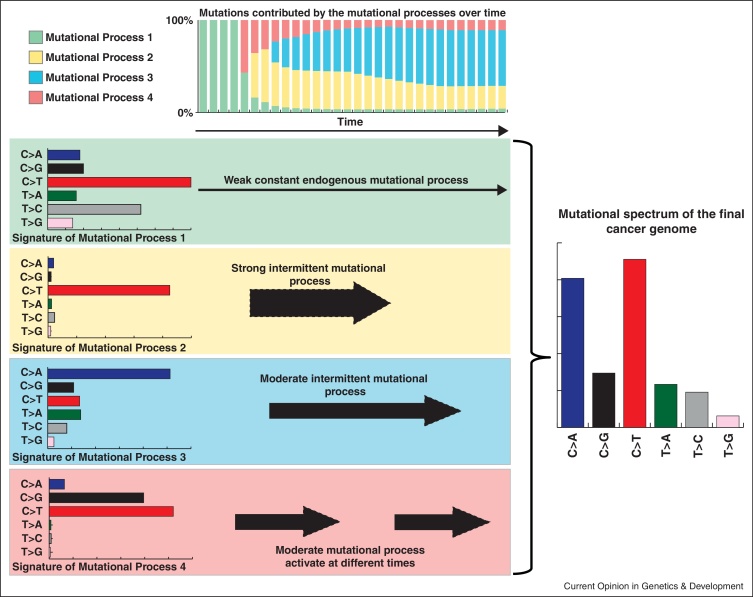
“Because many mutational processes had been operative in a single cancer cell, its genome has become a complex landscape of overlapping mutations[5, 30].”
BackgroundFolate induced mutagenesis and identification of folate-specific mutation spectra in somatic cells
González, D., & Stephanie, A. (2019)
Mechanisms of Clearance of MHC I-deficient Tumors Induced by STING Agonists
Nicolai, C. J. (2020) · eScholarship (California Digital Library)
Mechanisms Underlying Mutational Signatures in Human Cancer
Baez‐Ortega, A. (2020) · Wiley eBooks · doi:10.1002/9780470015902.a0026931
Phylomedicine of mutational processes in somatic cancer cell populationsPreprint
Miura, S., Vu, T., Choi, J., & Kumar, S. (2021) · bioRxiv (Cold Spring Harbor Laboratory) · doi:10.1101/2021.04.02.438268
2 ANCA関連血管炎に対するγグロブリン大量療法(5 自己免疫疾患の新しい治療法, 第55回日本アレルギー学会秋季学術大会)
武曾, 恵. (2005) · アレルギー
Li, Z., Liang, H., Zhang, S., & Luo, W. (2021) · bioRxiv (Cold Spring Harbor Laboratory) · doi:10.1101/2021.08.12.456096
“These mutational processes are cumulative effects of DNA damage and repair processes, indicating unique patterns in tumorigenesis, namely mutational signatures [2-5].”
BackgroundGenetic and genomic medicine relevance to cancer prevention, diagnosis, and treatment
Smith, M. (2021) · Elsevier eBooks · doi:10.1016/b978-0-323-91547-2.00004-x
Oxidized DNA Base Damage Repair and Transcription
Pramanik, S., Roychoudhury, S., & Bhakat, K. K. (2021) · Springer eBooks · doi:10.1007/978-981-15-4501-6_156-1
Tsukaguchi, M., Furukawa, Y., & Kitani, T. (1998) · PubMed
Racial differences in genomic features and new trans-ancestry prognosis subtypes in bladder cancerPreprint
Zhang, B., Jia, P., Wang, J., Pei, G., Wang, C., Pei, S.-M., Li, X., Ding, S., Zhao, Z., Yi, X., et al. (2021) · Research Square · doi:10.21203/rs.3.rs-1157888/v1
Advancement of Single-Cell Sequencing in Medulloblastoma
Verma, D., Nayak, N., Singh, A., Singh, A. K., & Garg, N. (2022) · Methods in molecular biology · doi:10.1007/978-1-0716-1952-0_7
Awad, A. S., Ramírez-Suástegui, C., Clarke, J. D., Panwar, B., Wood, O., Chee, S., Thomas, G. J., Sánchez-Elsner, T., Ottensmeier, C. H. H., Friedmann, P. S., et al. (2022) · Research Square · doi:10.21203/rs.3.rs-1294352/v1
Searching for Essential Genes in the Cancer Genome
Pyatnitskiy, M. A., Karpov, D. S., & Moshkovskii, S. A. (2018) · Biochemistry (Moscow) Supplement Series B Biomedical Chemistry · doi:10.1134/s1990750818040078
Ko, C. J. (2019) · Faculty Opinions – Post-Publication Peer Review of the Biomedical Literature · doi:10.3410/f.733997741.793565634
Beal, M. A. (2017) · Carleton University's Institutional Repository (MacOdrum Library, Carleton University) · doi:10.22215/etd/2017-11975
Arginine limitation causes a directed DNA sequence evolution response in colorectal cancer cellsPreprint
Hsu, D. J., Gao, J., Yamaguchi, N., Pinzaru, A. M., Nandan, M. O., Liberti, M. V., Heissel, S., Alwaseem, H., Tavazoie, S., & Tavazoie, S. F. (2023) · bioRxiv (Cold Spring Harbor Laboratory) · doi:10.1101/2023.01.02.521806
“Mutational processes have been shown to act more frequently at specific nucleotides based on their surrounding contexts(3, 4).”
Deciphering gene contributions and etiologies of somatic mutational signatures of cancer
Ji, X., Wang, E., & Cui, Q. (2023) · Briefings in Bioinformatics · doi:10.1093/bib/bbad017
Findel: A Deep Learning Approach To Efficient Artifact Removal from Cancer Genomes
(2022) · Stem Cell Research International · doi:10.33140/scri.06.02.11
Srinivasan, S., Kalinava, N., Aldana, R., Li, Z., van Hagen, S., Rodenburg, S. Y. A., Wind‐Rotolo, M., Qian, X., Sasson, A., Tang, H., et al. (2023) · doi:10.1158/0008-5472.c.6512701.v1
Data from Biomarkers of Response and Resistance to DNA Repair Targeted Therapies
Stover, E. H., Konstantinopoulos, P. A., Matulonis, U. A., & Swisher, E. M. (2023) · doi:10.1158/1078-0432.c.6526236
Data from Biomarkers of Response and Resistance to DNA Repair Targeted Therapies
Stover, E. H., Konstantinopoulos, P. A., Matulonis, U. A., & Swisher, E. M. (2023) · doi:10.1158/1078-0432.c.6526236.v1
Guan, Z., Begg, C. B., & Shen, R. (2023) · doi:10.1158/2767-9764.c.6551251
Guan, Z., Begg, C. B., & Shen, R. (2023) · doi:10.1158/2767-9764.c.6551251.v1
Guan, Z., Begg, C. B., & Shen, R. (2023) · doi:10.1158/2767-9764.22546849.v1
Update Mammakarzinom 2022 Teil 6 – Brustkrebs in fortgeschrittenen Krankheitsstadien
Lüftner, D., Lux, M. P., Fehm, T. N., Welslau, M., Müller, V., Schütz, F., Fasching, P. A., Janni, W., Thomssen, C., Witzel, I., et al. (2023) · Senologie - Zeitschrift für Mammadiagnostik und -therapie · doi:10.1055/a-2079-8481
“In der Pathogenese von Tumoren können unterschiedliche Reize und Umstände zu Mutationen führen, die alle ein charakteristisches Mutationsprofil aufweisen [30].”
Natsume, H., Szczepaniak, K., Yamada, H., Iwashita, Y., Gędek, M., Šuto, J., Ishino, K., Kasajima, R., Matsuda, T., Manirakiza, F., et al. (2023) · Figshare · doi:10.6084/m9.figshare.22606529
Zhang, J., Liu, J. J., Lee, D., Feng, J.-J., Lochovsky, L., Lou, S., Rutenberg-Schoenberg, M., & Gerstein, M. (2020) · Figshare · doi:10.6084/m9.figshare.12737169
Stosic, M. S., Costanzi, J., Ambur, O. H., & Rounge, T. B. (2024) · bioRxiv (Cold Spring Harbor Laboratory) · doi:10.1101/2024.08.14.607907
“In humans, the accumulation of subclonal low-frequency somatic mutations is a major cause of cancer development 8–12 .”
BackgroundA Gateway to Multi‐Omics‐Based Clinical Research
Sahoo, A., Verma, D., & Panda, P. (2024) · Wiley eBooks · doi:10.1002/9781119896869.ch10
DNA Damage, Repair, and Advanced DNA Damage Detection Technologies
Hernandez, A., Goel, K., Hussain, S., & Gassman, N. R. (2024) · Elsevier eBooks · doi:10.1016/b978-0-323-95488-4.00179-0 · Cited by 1
Adoptive Immune Cell Therapy in Pediatric Solid Tumors
Rostami, T., Kiumarsi, A., Biglari, M., Rostami, M. R., & Janbabaei, G. (2024) · Biochemistry · doi:10.5772/intechopen.1007383
Immune and Mutational Profile of Gene-Edited Low-Immunogenic Human Primary Cholangiocyte OrganoidsPreprint
Petrus-Reurer, S., Baez‐Ortega, A., Lei, W., Kumaran, G. K., Williamson, J. C., Jones, J. L., Trajkovski, D., Lawson, A. R. J., Mahbubani, K. T. A., Brodie, C. R., et al. (2025) · bioRxiv (Cold Spring Harbor Laboratory) · doi:10.1101/2025.01.20.628680
3A or not 3A: Cytidine deaminases in the etiology of the CAG-repeat expansion diseases
Usdin, K. (2025) · Proceedings of the National Academy of Sciences · doi:10.1073/pnas.2426776122
“The preferred target of A3A is the cytidine in a TpC dinu - cleotide particularly when it is at the 3 ′ end of a small hairpin loop ( 21 – 23 ), although in the right sequence con - text other cytidines can sometimes also be good A3A sub - strates ( 17 , 23 ).”
Schneeweiss, A., Brucker, S. Y., Huebner, H., Volmer, L. L., Hack, C. C., Seitz, K., Ruebner, M., Heublein, S., Thewes, V., Lüftner, D., et al. (2025) · Senologie - Zeitschrift für Mammadiagnostik und -therapie · doi:10.1055/a-2453-4561
Selway‐Clarke, H., Gowers, K. H. C., TEIXEIRA, V. H., Gabbutt, C., Martínez‐Ruiz, C., Alhendi, A. S. N., Simons, B. D., Hall, B. A., McGranahan, N., Chakrabarti, A. M., et al. (2025) · bioRxiv (Cold Spring Harbor Laboratory) · doi:10.1101/2025.08.26.672394
“…cell over the course of the individual’s lifetime; • Counts of mutations attributable to each known mutational signature (by trinucleotide context 47 ), in particular those signatures whose aetiologies are known to be related to tobacco smoking (see above); • Features of phylogenetic trees…”
RNA editing sites in coding sequences of ABO blood group alleles
Chakraborty, S., Sharma, D., Das, J. C., Bharadaj, S. K., & Bharadaj, S. (2025) · Human Immunology · doi:10.1016/j.humimm.2025.111586
Natsume, H., Szczepaniak, K., Yamada, H., Iwashita, Y., Gędek, M., Šuto, J., Ishino, K., Kasajima, R., Matsuda, T., Manirakiza, F., et al. (2023) · Figshare · doi:10.6084/m9.figshare.22606526
Zhang, J., Liu, J. J., Lee, D., Feng, J.-J., Lochovsky, L., Lou, S., Rutenberg-Schoenberg, M., & Gerstein, M. (2020) · Figshare · doi:10.6084/m9.figshare.12737172
Nachmanson, D., Steward, J., Yao, H., Officer, A., Jeong, E., O’Keefe, T. J., Hasteh, F., Jepsen, K., Hirst, G. L., Esserman, L. J., et al. (2020) · Figshare · doi:10.6084/m9.figshare.13257780
Natsume, H., Szczepaniak, K., Yamada, H., Iwashita, Y., Gędek, M., Šuto, J., Ishino, K., Kasajima, R., Matsuda, T., Manirakiza, F., et al. (2023) · Figshare · doi:10.6084/m9.figshare.22606514
Additional file 1 of The spectrum of TP53 mutations in Rwandan patients with gastric cancer
Nzitakera, A., Surwumwe, J. B., Ndoricyimpaye, E. L., Uwamungu, S., Uwamariya, D., Manirakiza, F., Ndayisaba, M. C., Ntakirutimana, G., Seminega, B., Dusabejambo, V., et al. (2024) · Figshare · doi:10.6084/m9.figshare.25374782
van den Heuvel, G. R. M., Kroeze, L. I., Ligtenberg, M. J. L., Grünberg, K., Jansen, E. A. M., von Rhein, D. T., de Voer, R. M., & van den Heuvel, M. M. (2021) · Figshare · doi:10.6084/m9.figshare.17079563
Natsume, H., Szczepaniak, K., Yamada, H., Iwashita, Y., Gędek, M., Šuto, J., Ishino, K., Kasajima, R., Matsuda, T., Manirakiza, F., et al. (2023) · Figshare · doi:10.6084/m9.figshare.22606517
Natsume, H., Szczepaniak, K., Yamada, H., Iwashita, Y., Gędek, M., Šuto, J., Ishino, K., Kasajima, R., Matsuda, T., Manirakiza, F., et al. (2023) · Figshare · doi:10.6084/m9.figshare.22606523
Natsume, H., Szczepaniak, K., Yamada, H., Iwashita, Y., Gędek, M., Šuto, J., Ishino, K., Kasajima, R., Matsuda, T., Manirakiza, F., et al. (2023) · Figshare · doi:10.6084/m9.figshare.22606520
Bergstrom, E. N., Barnes, M., Martincorena, I., & Alexandrov, L. B. (2020) · Figshare · doi:10.6084/m9.figshare.13065391
Self-citationAdditional file 2 of The spectrum of TP53 mutations in Rwandan patients with gastric cancer
Nzitakera, A., Surwumwe, J. B., Ndoricyimpaye, E. L., Uwamungu, S., Uwamariya, D., Manirakiza, F., Ndayisaba, M. C., Ntakirutimana, G., Seminega, B., Dusabejambo, V., et al. (2024) · Figshare · doi:10.6084/m9.figshare.25374843
Najnin, T., Saimon, S. H., Zand, M., Adnan, N., Liu, Z., Huang, T. H. ‐., & Ruan, J. (2025) · IEEE Transactions on Computational Biology and Bioinformatics · doi:10.1109/tcbbio.2025.3647659
Li, Y. R., Kandyba, E. E., Halliwill, K. D., Delrosario, R., Tran, Q., Bayani, N., Wu, D., Mirzoeva, O. K., Reeves, M. M., Islam, M., et al. (2024) · bioRxiv (Cold Spring Harbor Laboratory) · doi:10.1101/2024.01.24.577147
Self-citationFlorian, M. C., Amoah, A., Nattamai, K., Soller, K., Vollmer, A., Hoenicka, M., Liebold, A., Bauer, K., Mallm, J., Geiger, H., et al. (2026) · bioRxiv (Cold Spring Harbor Laboratory) · doi:10.64898/2026.01.24.701060
Investigating cancer aetiology through the analysis of somatic mutation signatures
Ardin, M. (2016) · theses.fr (ABES) · doi:10.70675/c508b0eez4695z40dez83c2z943ce312732c
“Combining mutations from multiple samples from the same cancer type may indicate strong mutational processes, but provides little information about the quantity and individual characteristics of other mutational activities [41].”
BackgroundRodrigues, M. J. (2018) · theses.fr (ABES) · doi:10.70675/5324f18az84f8z46d5z8365zd1bc1666321d
Amine, R. E. (2017) · theses.fr (ABES) · doi:10.70675/79702f70za566z4f62z8665zfa738acf7b3f
Functional genomics characterization of genetic predisposing factors in uveal melanoma
Derrien, A. (2021) · theses.fr (ABES) · doi:10.70675/a794a7dfz4352z46f0zb97az064f9ea78e46
Cancers associés au VIH : immunogénomique, immunogénicité et immunothérapie
Abbar, B. (2024) · theses.fr (ABES) · doi:10.70675/4f30d250zc7b8z462ez9893z38a97714c288
Wong, H., Korsakova, A., Wu, A., Kularatnarajah, L., Patro, C. P. K., Perera, A. R., Walsh, R. J., Tan, T. Z., Venkitaraman, A. R., & Pitt, J. J. (2026) · Cancer Research · doi:10.1158/0008-5472.can-25-2569
Bhatia, P., Sharun, S., Palla, S., Brady, S. W., Kirubanandhan, S., Ansari, S., Singh, M., Sreedharanunni, S., Das, A., & Trehan, A. (2026) · British Journal of Haematology · doi:10.1111/bjh.70560
“40,41 SBS87 is characterised by C>T transitions at CpG sites and represents the direct incorporation of thioguanine nucleotides during DNA replication, 42 whereas MMR signatures arise when replication errors escape correction, resulting in characteristic C>T transitions at NpCpG and broader…”
Sandhu, K., Pacey, S., Brewer, D. S., & Gnanapragasam, V. J. (2026) · Current Oncology · doi:10.3390/curroncol33060370
“The classical view of tumorigeneses involves a sequence of stepwise mutations— germline or somatic susceptible prostate epithelial cells acquiring further gradual point mutations, insertions/deletions, and copy-number alterations incrementally over years/decades (Figure 1) [114].”
Bayesian selection and refitting of reference mutational signatures in cancer genomics
Hua, M., & Zhu, B. (2026) · The Annals of Applied Statistics · doi:10.1214/26-aoas2138
Chen, Y.-T., Qi, R., Ma, J. F., Cai, A., Cho, B. P., & Li, D. (2026) · Toxics · doi:10.3390/toxics14070620
Wójcik, A., Meher, P. K., & Wakeford, R. (2026) · Radiation and Environmental Biophysics · doi:10.1007/s00411-026-01243-6
“Inherent to this theory is that cancer is derived from a single somatic cell that has accumulated multiple DNA mutations resulting in autonomous, uncontrolled proliferation free from normal constraints of growth and development exerted by the surrounding tissue (Alexandrov and Stratton 2014).”
Genomic and Transcriptomic Analysis of Sinonasal Mucosal Melanoma and Conjunctival Melanoma
Cui, J., Zhao, X., Zhang, H., Ma, D., Li, R., & Piao, Y. (2026) · International Journal of Cancer · doi:10.1002/ijc.70671
Somatic mutations in human ontogenesis and their impact on health
Sergeyev, O., Ашапкин, В., Korostin, D. O., Bezuglov, V., Suvorov, A., Rebrikov, D., & Chernykh, V. (2026) · Ageing Research Reviews · doi:10.1016/j.arr.2026.103338
A guide to understanding tumour evolution through the lens of population genetics
Caravagna, G., Graham, T. A., & Sottoriva, A. (2026) · Nature reviews. Cancer · doi:10.1038/s41568-026-00973-5
Deep Learning-Based Inference of Mutational Signature Exposures from Histology Across Tumour Types
Sim, B. C., Kim, J., Park, J., Kim, Y., Park, J., Ko, T., Chun, J., & Kim, T.-M. (2026) · Cancers · doi:10.3390/cancers18213446
Metadata
- Authors
- Alexandrov, L. B., & Stratton, M. R.
- Affiliations
- Wellcome Sanger Institute (GB)
- Corresponding author
- Alexandrov, Ludmil B
- Venue
- Current Opinion in Genetics & Development
- Publisher
- Elsevier BV
- Published
- 2014-02
- Volume
- 24
- Pages
- 52-60
- ISSN
- 0959-437X (ISSN-L)
- PMC
- PMC3990474
- OpenAlex
- W1973702005
- Cited by
- 488
- References
- 93
- Citations by year
- 2026: 17 · 2025: 25 · 2024: 32 · 2023: 37 · 2022: 38 · 2021: 52 · 2020: 53 · 2019: 61 · 2018: 57 · 2017: 48 · 2016: 35 · 2015: 23 · 2014: 8
- FWCI
- 3.77
- Type
- journal article
- Language
- en
- Open access
- hybrid
- doi.org
- Licence
- Locations
- Current Opinion in Genetics & Development (publishedVersion, cc-by)
- Europe PMC (PubMed Central) (publishedVersion, cc-by)
- PubMed Central (publishedVersion, cc-by)
- PubMed (publishedVersion)
- Funders
- Wellcome Trust (098051)
- Topics
- Life Sciences › Biochemistry, Genetics and Molecular Biology › Cancer Research › Cancer Genomics and Diagnostics
- Life Sciences › Biochemistry, Genetics and Molecular Biology › Molecular Biology › Chromatin Remodeling and Cancer
- Life Sciences › Biochemistry, Genetics and Molecular Biology › Molecular Biology › DNA Repair Mechanisms
- Keywords
- mutational signatures, somatic mutations, mutational processes, cancer genomics, mutation patterns
- MeSH terms
- Humans, Mutation, Neoplasms, Genome, Human, Tumor Suppressor Protein p53, Genomics, High-Throughput Nucleotide Sequencing
About these checks
Registry, retraction, Cites and statistics results are computed, not judged, with one exception: a printed reference that no index lists is read once by a model before it counts as a citation error. Claims are extracted by a model and kept only when their quote appears verbatim in the text; each cited source is then checked, with a model’s help, for whether it says what the claim relies on. Those verdicts can be wrong — read the claim’s quote and the cited source before relying on one.
Statistics and arithmetic are recomputed, not judged.
Confidence bands are shown only for fields calibrated on our annotated test set. None is calibrated yet, so no band is shown.
What counts as a claim ›How we measure confidence ›How we check this ›
Are you an author, or do you see a problem with this page? Request a review
