

The DOI matches its Crossref record; 113 of the 115 references it cites were found in a registry or an index.
The role of gamified learning strategies in student's motivation in high school and higher education: A systematic review
Open accessAbstract
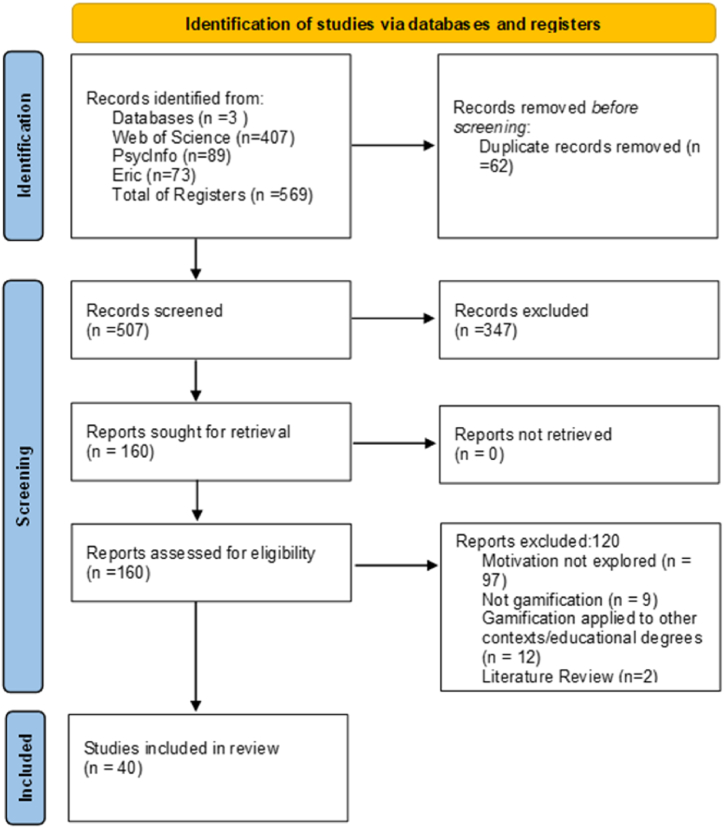
Gamification, defined as the integration of videogame components to promote a gameful experience, is increasingly being implemented in education with the aim of enhancing students' engagement and motivation. Accordingly, since 2010 it has constituted an area of growing interest for researchers and teachers. Following PRISMA 2020's methodology, a systematic review (SR) was conducted in November 2022 seeking to explore the influence of gamification strategies on students' motivation to learn. Having identified 548 articles, 40 studies were chosen based on the selection criteria set and analyzed to reveal that game elements such as points, badges and rankings are widely used to motivate students. From a theoretical perspective, gamification studies focus on the dichotomy of intrinsic and extrinsic motivation. The results suggest a positive influence of gamification strategies on students' motivation, although in the long run, such motivation can decline. Furthermore, the influence of a novelty effect and extrinsic rewards on motivation is identified, which can lead to greater motivation in the short term, followed by a decrease with further exposure to gamification. Future studies should focus on the influence of students' individual traits (e.g., gaming experience, openness to competition and cooperation) on gamification strategies. Moreover, long-term exposure to gamification as well as the novelty effect should be explored.
Overview
The claims and statistics of this paper haven’t been checked yet.
Run the check — free, no account needed. It reads the open-access text and checks the sources it cites.
Integrity signals
Registry
Cites
Statistics
Figures
Verification
Claims the paper makes
The claims and statistics of this paper haven’t been checked yet.
Run the check — free, no account needed. It reads the open-access text and checks the sources it cites.
Claims other papers make about this one
Each is checked against this paper’s own text: does it say what the citing paper says it does?
The source backs part of the claim, not all of it — or backs it for a different population, condition or comparison.
In the citing paper
“In mathematics, particularly at the secondary and higher education levels, research remains scarce and often constrained by small samples or limited methodological rigor (Elmawati et al., 2023;Ratinho & Martins, 2023).”
From Gamification on Mathematics Engagement and Motivation in Secondary School and Higher Education: A Systematic Review and Meta-Analysis (2026) · cites this paper as Ratinho & Martins, 2023
Experimental — accuracy not yet measuredThe source backs part of the claim, not all of it — or backs it for a different population, condition or comparison.
In the citing paper
“motivation was predominantly examined through SDT, followed by SCT and the ARCS model, confirming SDT's role as the dominant framework (Alsawaier, 2018;Ratinho & Martins, 2023).”
From Gamification on Mathematics Engagement and Motivation in Secondary School and Higher Education: A Systematic Review and Meta-Analysis (2026) · cites this paper as Ratinho & Martins, 2023
Experimental — accuracy not yet measuredThe cited source says what the claim attributes to it.
In the citing paper
“Still, gamification may produce unintended negative effects, especially in secondary and higher education (Elmawati et al., 2023;Ratinho & Martins, 2023).”
From Gamification on Mathematics Engagement and Motivation in Secondary School and Higher Education: A Systematic Review and Meta-Analysis (2026) · cites this paper as Ratinho & Martins, 2023
The cited source says what the claim attributes to it.
In the citing paper
“Gamification can enhance students' motivation when grounded in established theories.”
From Gamification on Mathematics Engagement and Motivation in Secondary School and Higher Education: A Systematic Review and Meta-Analysis (2026) · cites this paper as Ratinho & Martins, 2023
The cited source says what the claim attributes to it.
In the citing paper
“yet evidence of its effectiveness in enhancing motivation and engagement remains mixed (Ratinho & Martins, 2023).”
From Gamification on Mathematics Engagement and Motivation in Secondary School and Higher Education: A Systematic Review and Meta-Analysis (2026) · cites this paper as Ratinho & Martins, 2023
The cited source says what the claim attributes to it.
In the citing paper
“Skills can then be tested with trivia and quiz platforms like Kahoot, which incorporate game elements such as points, rankings, competition, and cooperation, which are increasingly emphasized in classroom settings [54].”
From Health Benefits of Video Games in Adolescents and Young Adults (2026) · cites this paper as [54]
Self-check
Percentages, sums and reported differences re-computed from the paper’s own numbers.
The self-check needs the paper’s full text.
Citations
Cites
Intrinsic Motivation and Self-Determination in Human Behavior
Deci, E. L., & Ryan, R. M. (1985) · doi:10.1007/978-1-4899-2271-7 · Cited by 26,772
Self-efficacy: the exercise of control
(1997) · Choice Reviews Online · doi:10.5860/choice.35-1826 · Cited by 24,451
Intrinsic and Extrinsic Motivations: Classic Definitions and New Directions
Ryan, R. M., & Deci, E. L. (2000) · Contemporary Educational Psychology · doi:10.1006/ceps.1999.1020 · Cited by 18,666 · cited 3×
“Several studies identified in this systematic review centred their analysis on gamification’s influence on basic psychological needs, but it seems that self-efficacy has been relatively less explored, even though self-determination theory as well as the IMI have proved to be especially popular [81].”
BackgroundPage, M. J., Moher, D., Bossuyt, P. M., Boutron, I., Hoffmann, T. C., Mulrow, C. D., Shamseer, L., Tetzlaff, J. M., Akl, E. A., Brennan, S. E., et al. (2021) · BMJ · doi:10.1136/bmj.n160 · Cited by 13,262 · cited 2×
“The SR followed PRISMA 2020 guideline [51] to assure a rigorous and thorough process.”
BackgroundMethodMunn, Z., Peters, M. D. J., Stern, C., Tufanaru, C., McArthur, A., & Aromataris, E. (2018) · BMC Medical Research Methodology · doi:10.1186/s12874-018-0611-x · Cited by 11,385
From game design elements to gamefulness: defining "gamification"
Deterding, S., Dixon, D., Khaled, R., & Nacke, L. (2011) · Proceedings of the 15th International Academic MindTrek Conference: Envisioning Future Media Environments · doi:10.1145/2181037.2181040 · Cited by 8,402
Does Gamification Work? -- A Literature Review of Empirical Studies on Gamification
Hamari, J., Koivisto, J., & Sarsa, H. (2014) · 2014 47th Hawaii International Conference on System Sciences · doi:10.1109/hicss.2014.377 · Cited by 5,201
Kapp, K. M. (2012) · Cited by 3,753
Motivational determinants of risk-taking behavior.
Atkinson, J. W. (1957) · Psychological Review · doi:10.1037/h0043445 · Cited by 3,706
The Academic Motivation Scale: A Measure of Intrinsic, Extrinsic, and Amotivation in Education
Vallerand, R. J., Pelletier, L. G., Blais, M. R., Brière, N., Senécal, C. B., & Vallières, É. F. (1992) · Educational and Psychological Measurement · doi:10.1177/0013164492052004025 · Cited by 2,890
Research works printed but not linked: 4
- Hunicke, 2004, MDA: a formal approach to game design and game research, Proceedings of the AAAI Workshop on Challenges in Game AI, 4, 1722
- Jakubowski, 2014, Designing gamified course for students–framework and examples, The Shift from Teaching to Learning: Ind Collect Org Learn Thr Gam Simul, 248
- Stott, 2013, Analysis of gamification in education, Surrey, BC, Canada, 8, 36
- Oliveira, 2016, A evolução tecnológica e sua influência na educação, Revista Interface Tecnológica, 13, 23, 10.31510/infa.v13i1.123 · DOI
Cited by
Sorted by citations
Impact of gamification on school engagement: a systematic review
Ruiz, J. J. R., Sánchez, A. D. V., & Figueredo, Ó. R. B. (2024) · Frontiers in Education · doi:10.3389/feduc.2024.1466926 · Cited by 193
Coelho, F., Rando, B., Aparício, D., Ribeiro, P. C. P. S. V., Gonçalves, D. J. V., & Abreu, A. M. (2025) · Journal of Computers in Education · doi:10.1007/s40692-025-00366-x · Cited by 88
The role of rewards in motivation—Beyond dichotomies
Bardach, L., & Murayama, K. (2024) · Learning and Instruction · doi:10.1016/j.learninstruc.2024.102056 · Cited by 72
The role and scope of gamification in education: A scientometric literature review
Gini, F., Bassanelli, S., Bonetti, F., Mogavi, R. H., Bucchiarione, A., & Marconi, A. (2025) · Acta Psychologica · doi:10.1016/j.actpsy.2025.105418 · Cited by 67
Lee, K. C. (2023) · Heliyon · doi:10.1016/j.heliyon.2023.e20420 · Cited by 74
Metadata
- Authors
- Ratinho, E., & Martins, C.
- Affiliations
- University of Algarve (PT)
- Corresponding author
- Ratinho, Elias
- Venue
- Heliyon
- Publisher
- Elsevier BV
- Published
- 2023-08
- Volume
- 9
- Issue
- 8
- Pages
- e19033
- ISSN
- 2405-8440 (ISSN-L)
- PMC
- PMC10448467
- OpenAlex
- W4385648798
- Cited by
- 221
- References
- 115
- Citations by year
- 2026: 93 · 2025: 82 · 2024: 36 · 2023: 10
- FWCI
- 12.70
- Type
- journal article
- Language
- en
- Open access
- gold
- doi.org
- Licence
- Locations
- Heliyon (publishedVersion, cc-by)
- PubMed Central (publishedVersion, cc-by)
- PubMed (publishedVersion)
- DOAJ (DOAJ: Directory of Open Access Journals) (submittedVersion, cc-by-sa)
- Portuguese National Funding Agency for Science, Research and Technology (RCAAP Project by FCT) (submittedVersion, cc-by)
- Funders
- Fundação para a Ciência e a Tecnologia (CIP - Ref a UID/ PSI /04345/2020, UID/PSI/04345/2020)
- Topics
- Social Sciences › Psychology › Developmental and Educational Psychology › Educational Games and Gamification
- Social Sciences › Sociology and Political Science › Digital Games and Media
- Physical Sciences › Computer Science › Computer Science Applications › Online Learning and Analytics
- Keywords
- gamification, gamified learning, student motivation, intrinsic motivation, extrinsic motivation, novelty effect, extrinsic rewards, student engagement, upper secondary school, higher education
About these checks
Registry, retraction, Cites and statistics results are computed, not judged, with one exception: a printed reference that no index lists is read once by a model before it counts as a citation error. Claims are extracted by a model and kept only when their quote appears verbatim in the text; each cited source is then checked, with a model’s help, for whether it says what the claim relies on. Those verdicts can be wrong — read the claim’s quote and the cited source before relying on one.
Statistics and arithmetic are recomputed, not judged.
Confidence bands are shown only for fields calibrated on our annotated test set. None is calibrated yet, so no band is shown.
What counts as a claim ›How we measure confidence ›How we check this ›
Are you an author, or do you see a problem with this page? Request a review
