

The DOI matches its Crossref record; 113 of the 115 references it cites were found in a registry or an index.
The role of gamified learning strategies in student's motivation in high school and higher education: A systematic review
Open accessAbstract
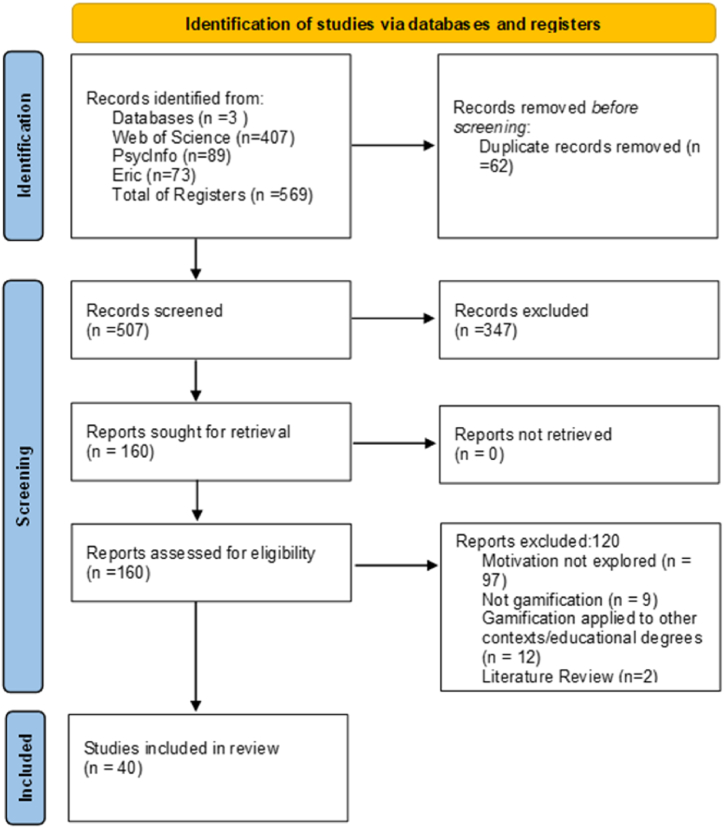
Gamification, defined as the integration of videogame components to promote a gameful experience, is increasingly being implemented in education with the aim of enhancing students' engagement and motivation. Accordingly, since 2010 it has constituted an area of growing interest for researchers and teachers. Following PRISMA 2020's methodology, a systematic review (SR) was conducted in November 2022 seeking to explore the influence of gamification strategies on students' motivation to learn. Having identified 548 articles, 40 studies were chosen based on the selection criteria set and analyzed to reveal that game elements such as points, badges and rankings are widely used to motivate students. From a theoretical perspective, gamification studies focus on the dichotomy of intrinsic and extrinsic motivation. The results suggest a positive influence of gamification strategies on students' motivation, although in the long run, such motivation can decline. Furthermore, the influence of a novelty effect and extrinsic rewards on motivation is identified, which can lead to greater motivation in the short term, followed by a decrease with further exposure to gamification. Future studies should focus on the influence of students' individual traits (e.g., gaming experience, openness to competition and cooperation) on gamification strategies. Moreover, long-term exposure to gamification as well as the novelty effect should be explored.
Overview
The claims and statistics of this paper haven’t been checked yet.
Run the check — free, no account needed. It reads the open-access text and checks the sources it cites.
Integrity signals
Registry
Cites
Statistics
Figures
Verification
Claims the paper makes
The claims and statistics of this paper haven’t been checked yet.
Run the check — free, no account needed. It reads the open-access text and checks the sources it cites.
Claims other papers make about this one
Each is checked against this paper’s own text: does it say what the citing paper says it does?
The source backs part of the claim, not all of it — or backs it for a different population, condition or comparison.
In the citing paper
“In mathematics, particularly at the secondary and higher education levels, research remains scarce and often constrained by small samples or limited methodological rigor (Elmawati et al., 2023;Ratinho & Martins, 2023).”
From Gamification on Mathematics Engagement and Motivation in Secondary School and Higher Education: A Systematic Review and Meta-Analysis (2026) · cites this paper as Ratinho & Martins, 2023
Experimental — accuracy not yet measuredThe source backs part of the claim, not all of it — or backs it for a different population, condition or comparison.
In the citing paper
“motivation was predominantly examined through SDT, followed by SCT and the ARCS model, confirming SDT's role as the dominant framework (Alsawaier, 2018;Ratinho & Martins, 2023).”
From Gamification on Mathematics Engagement and Motivation in Secondary School and Higher Education: A Systematic Review and Meta-Analysis (2026) · cites this paper as Ratinho & Martins, 2023
Experimental — accuracy not yet measuredThe cited source says what the claim attributes to it.
In the citing paper
“Still, gamification may produce unintended negative effects, especially in secondary and higher education (Elmawati et al., 2023;Ratinho & Martins, 2023).”
From Gamification on Mathematics Engagement and Motivation in Secondary School and Higher Education: A Systematic Review and Meta-Analysis (2026) · cites this paper as Ratinho & Martins, 2023
The cited source says what the claim attributes to it.
In the citing paper
“Gamification can enhance students' motivation when grounded in established theories.”
From Gamification on Mathematics Engagement and Motivation in Secondary School and Higher Education: A Systematic Review and Meta-Analysis (2026) · cites this paper as Ratinho & Martins, 2023
The cited source says what the claim attributes to it.
In the citing paper
“yet evidence of its effectiveness in enhancing motivation and engagement remains mixed (Ratinho & Martins, 2023).”
From Gamification on Mathematics Engagement and Motivation in Secondary School and Higher Education: A Systematic Review and Meta-Analysis (2026) · cites this paper as Ratinho & Martins, 2023
The cited source says what the claim attributes to it.
In the citing paper
“Skills can then be tested with trivia and quiz platforms like Kahoot, which incorporate game elements such as points, rankings, competition, and cooperation, which are increasingly emphasized in classroom settings [54].”
From Health Benefits of Video Games in Adolescents and Young Adults (2026) · cites this paper as [54]
Self-check
Percentages, sums and reported differences re-computed from the paper’s own numbers.
The self-check needs the paper’s full text.
Citations
Cites
Intrinsic Motivation and Self-Determination in Human Behavior
Deci, E. L., & Ryan, R. M. (1985) · doi:10.1007/978-1-4899-2271-7 · Cited by 26,772
Self-efficacy: the exercise of control
(1997) · Choice Reviews Online · doi:10.5860/choice.35-1826 · Cited by 24,451
Intrinsic and Extrinsic Motivations: Classic Definitions and New Directions
Ryan, R. M., & Deci, E. L. (2000) · Contemporary Educational Psychology · doi:10.1006/ceps.1999.1020 · Cited by 18,666 · cited 3×
“Several studies identified in this systematic review centred their analysis on gamification’s influence on basic psychological needs, but it seems that self-efficacy has been relatively less explored, even though self-determination theory as well as the IMI have proved to be especially popular [81].”
BackgroundPage, M. J., Moher, D., Bossuyt, P. M., Boutron, I., Hoffmann, T. C., Mulrow, C. D., Shamseer, L., Tetzlaff, J. M., Akl, E. A., Brennan, S. E., et al. (2021) · BMJ · doi:10.1136/bmj.n160 · Cited by 13,262 · cited 2×
“The SR followed PRISMA 2020 guideline [51] to assure a rigorous and thorough process.”
BackgroundMethodMunn, Z., Peters, M. D. J., Stern, C., Tufanaru, C., McArthur, A., & Aromataris, E. (2018) · BMC Medical Research Methodology · doi:10.1186/s12874-018-0611-x · Cited by 11,385
From game design elements to gamefulness: defining "gamification"
Deterding, S., Dixon, D., Khaled, R., & Nacke, L. (2011) · Proceedings of the 15th International Academic MindTrek Conference: Envisioning Future Media Environments · doi:10.1145/2181037.2181040 · Cited by 8,402
Does Gamification Work? -- A Literature Review of Empirical Studies on Gamification
Hamari, J., Koivisto, J., & Sarsa, H. (2014) · 2014 47th Hawaii International Conference on System Sciences · doi:10.1109/hicss.2014.377 · Cited by 5,201
Kapp, K. M. (2012) · Cited by 3,753
Motivational determinants of risk-taking behavior.
Atkinson, J. W. (1957) · Psychological Review · doi:10.1037/h0043445 · Cited by 3,706
The Academic Motivation Scale: A Measure of Intrinsic, Extrinsic, and Amotivation in Education
Vallerand, R. J., Pelletier, L. G., Blais, M. R., Brière, N., Senécal, C. B., & Vallières, É. F. (1992) · Educational and Psychological Measurement · doi:10.1177/0013164492052004025 · Cited by 2,890
Motivation and Education: The Self-Determination Perspective
Deci, E. L., Vallerand, R. J., Pelletier, L. G., & Ryan, R. M. (1991) · Educational Psychologist · doi:10.1080/00461520.1991.9653137 · Cited by 2,740
The gamification of learning: a meta-analysis
Sailer, M., & Homner, L. (2020) · Educational Psychology Review · doi:10.1007/s10648-019-09498-w · Cited by 2,594 · cited 1×
“Although some reviews on this topic already exist [15,69,70], motivational effects have yet to be fully explored in a psychological perspective, while some features (e.”
BackgroundFoundations of Game-Based Learning
Plass, J. L., Homer, B. D., & Kinzer, C. K. (2015) · Educational Psychologist · doi:10.1080/00461520.2015.1122533 · Cited by 2,537
Gamification in theory and action: a survey
Seaborn, K., & Fels, D. I. (2015) · International Journal of Human-Computer Studies · doi:10.1016/j.ijhcs.2014.09.006 · Cited by 2,515 · cited 1×
“Both intrinsic and extrinsic motivation are among the most commonly explored motivational outcomes of gamification [83].”
BackgroundGamification by Design: Implementing Game Mechanics in Web and Mobile Apps
Zichermann, G., & Cunningham, C. J. L. (2011) · Cited by 2,378
(2012) · Swinburne figshare (Swinburne University of Technology) · Cited by 2,354
Development and use of the ARCS model of instructional design
Keller, J. M. (1987) · Journal of Instructional Development · doi:10.1007/bf02905780 · Cited by 2,332
Toward a Theory of Intrinsically Motivating Instruction*
Malone, T. W. (1981) · Cognitive Science · doi:10.1207/s15516709cog0504_2 · Cited by 2,197
Serious Games: Games That Educate, Train, and Inform
Michael, D. R., & Chen, S. L. (2005) · Cited by 2,079
Sailer, M., Hense, J. U., Mayr, S. K., & Mandl, H. (2017) · Computers in Human Behavior · doi:10.1016/j.chb.2016.12.033 · Cited by 2,064 · cited 1×
“Therefore, more research is needed to understand the motivational learning effects of gamification [16,65].”
BackgroundHanus, M. D., & Fox, J. (2015) · Computers & Education · doi:10.1016/j.compedu.2014.08.019 · Cited by 1,918
The Hierarchical Model of Approach-Avoidance Motivation
Elliot, A. J. (2006) · Motivation and Emotion · doi:10.1007/s11031-006-9028-7 · Cited by 1,385
Huotari, K., & Hamari, J. (2012) · International Academic Mindtrek Conference (Mindtrek) · doi:10.1145/2393132.2393137 · Cited by 1,343
A definition for gamification: anchoring gamification in the service marketing literature
Huotari, K., & Hamari, J. (2016) · Electronic Markets · doi:10.1007/s12525-015-0212-z · Cited by 1,284
The impact of gamification on learning and instruction: A systematic review of empirical evidence
Zainuddin, Z., Chu, S. K. W., Shujahat, M., & Perera, C. J. (2020) · Educational Research Review · doi:10.1016/j.edurev.2020.100326 · Cited by 1,276
Motivational Design of Instruction
Keller, J. M. (1983) · Medical Entomology and Zoology · Cited by 1,241
Developing a Theory of Gamified Learning: Linking Serious Games and Gamification of Learning
Landers, R. N. (2014) · Simulation & Gaming · doi:10.1177/1046878114563660 · Cited by 918
Page, M. J., Moher, D., Bossuyt, P., Boutron, I., Hoffmann, T., mulrow, C., Shamseer, L., Tetzlaff, J., Akl, E., Brennan, S. E., et al. (2020) · doi:10.31222/osf.io/gwdhk · Cited by 916
Gamification and student motivation
Buckley, P. G., & Doyle, E. (2014) · Interactive Learning Environments · doi:10.1080/10494820.2014.964263 · Cited by 883
Proceedings of the 22nd international conference on World Wide Web
(2013) · doi:10.1145/2488388 · Cited by 702
How to write a systematic review
Harris, J. D., Quatman, C. E., Manring, M. M., Siston, R. A., & Flanigan, D. C. (2014) · The American Journal of Sports Medicine · doi:10.1177/0363546513497567 · Cited by 606
2015 48th Hawaii International Conference on System Sciences
(2015) · doi:10.1109/hicss35350.2015 · Cited by 522
Between Level Up and Game Over: A Systematic Literature Review of Gamification in Education
Manzano-León, A., Camacho-Lazarraga, P., Guerrero, M. A., Guerrero-Puerta, L., Aguilar-Parra, J. M., Trigueros, R., & Alias, A. (2021) · Sustainability · doi:10.3390/su13042247 · Cited by 512
Educational Gamification Vs. Game Based Learning: Comparative Study
Al-Azawi, R., Al-Faliti, F., & Al-Blushi, M. (2016) · International Journal of Innovation Management and Technology · doi:10.18178/ijimt.2016.7.4.659 · Cited by 457
Science Motivation Questionnaire: Construct validation with nonscience majors
Glynn, S. M., Taasoobshirazi, G., & Brickman, P. (2008) · Journal of Research in Science Teaching · doi:10.1002/tea.20267 · Cited by 404
(Re)Defining Gamification: A Process Approach
Werbach, K. D. (2014) · Lecture notes in computer science · doi:10.1007/978-3-319-07127-5_23 · Cited by 394
Kyewski, E., & Krämer, N. C. (2017) · Computers & Education · doi:10.1016/j.compedu.2017.11.006 · Cited by 394
Psychological Perspectives on Motivation through Gamification
Sailer, M., Hense, J., Mandl, H., & Klevers, M. (2013) · Interaction Design and Architecture(s) · doi:10.55612/s-5002-019-002 · Cited by 380
Steering user behavior with badges
Anderson, A., Huttenlocher, D. P., Kleinberg, J. M., & Leskovec, J. (2013) · International World Wide Web Conference (WWW) · doi:10.1145/2488388.2488398 · Cited by 367
(2018) · Tampere University Institutional Repository (Tampere University) · Cited by 349
Högberg, J., Hamari, J., & Wästlund, E. (2019) · User Modeling and User-Adapted Interaction · doi:10.1007/s11257-019-09223-w · Cited by 337
Gamified crowdsourcing: Conceptualization, literature review, and future agenda
Morschheuser, B., Hamari, J., Koivisto, J., & Maedche, A. (2017) · International Journal of Human-Computer Studies · doi:10.1016/j.ijhcs.2017.04.005 · Cited by 333
Students' learning performance and perceived motivation in gamified flipped-class instruction
Zainuddin, Z. (2018) · Computers & Education · doi:10.1016/j.compedu.2018.07.003 · Cited by 324
Enhancing student learning experience with technology-mediated gamification: An empirical study
Tsay, C. H., Kofinas, A., & Luo, J. (2018) · Computers & Education · doi:10.1016/j.compedu.2018.01.009 · Cited by 323
Need-supporting gamification in education: An assessment of motivational effects over time
van Roy, R., & Zaman, B. (2018) · Computers & Education · doi:10.1016/j.compedu.2018.08.018 · Cited by 319
Férriz-Valero, A., Østerlie, O., Martínez, S. G., & García-Jaén, M. (2020) · International Journal of Environmental Research and Public Health · doi:10.3390/ijerph17124465 · Cited by 245
Loorbach, N., Peters, O., Karreman, J., & Steehouder, M. F. (2014) · British Journal of Educational Technology · doi:10.1111/bjet.12138 · Cited by 243
Özhan, Ş. Ç., & Kocadere, S. A. (2020) · Journal of Educational Computing Research · doi:10.1177/0735633118823159 · Cited by 235
Gamification of in‐class activities in flipped classroom lectures
Sailer, M., & Sailer, M. (2021) · British Journal of Educational Technology · doi:10.1111/bjet.12948 · Cited by 234
Ferrer, J. M. C., Martínez, P. M., & Ibáñéz, R. S. (2020) · Sustainability · doi:10.3390/su12124822 · Cited by 220
Research Note—Gamification of Technology-Mediated Training: Not All Competitions Are the Same
Santhanam, R., Liu, D., & Shen, W.-C. M. (2016) · Information Systems Research · doi:10.1287/isre.2016.0630 · Cited by 213
González, M. E. P., López-Belmonte, J., Robles, A. S., & Cabrera, A. F. (2020) · Sustainability · doi:10.3390/su12020602 · Cited by 196
Abductive science inquiry using mobile devices in the classroom
Ahmed, S., & Parsons, D. (2012) · Computers & Education · doi:10.1016/j.compedu.2012.11.017 · Cited by 194
Main gamification concepts: A systematic mapping study
Rodrigues, L. F., Oliveira, A., & Rodrigues, H. (2019) · Heliyon · doi:10.1016/j.heliyon.2019.e01993 · Cited by 183
Dynamical model for gamification of learning (DMGL)
Kim, J. T., & Lee, W.-H. (2013) · Multimedia Tools and Applications · doi:10.1007/s11042-013-1612-8 · Cited by 182
Analysis of Gamification Models in Education Using MDA Framework
Kusuma, G. P., Wigati, E. K., Utomo, Y., & Suryapranata, L. K. P. (2018) · Procedia Computer Science · doi:10.1016/j.procs.2018.08.187 · Cited by 180
Gamification through leaderboards: An empirical study in engineering education
Ortíz-Rojas, M., Chiluiza, K., & Valcke, M. (2019) · Computer Applications in Engineering Education · doi:10.1002/cae.12116 · Cited by 175
Gamification and Web-based Homework
Goehle, G. (2013) · PRIMUS · doi:10.1080/10511970.2012.736451 · Cited by 170
Gamification and reputation: key determinants of e-commerce usage and repurchase intention
Aparício, M., Costa, C. J. D. C., & Moisés, R. D. S. (2021) · Heliyon · doi:10.1016/j.heliyon.2021.e06383 · Cited by 170
From Gamification to Gameful Design and Gameful Experience in Learning
Dichev, C., Dicheva, D., Angelova, G., & Agre, G. (2015) · Cybernetics and Information Technologies · doi:10.1515/cait-2014-0007 · Cited by 169
Su, C.-H. (2015) · Multimedia Tools and Applications · doi:10.1007/s11042-015-2799-7 · Cited by 166
2016 IEEE Frontiers in Education Conference (FIE)
(2016) · doi:10.1109/fie33583.2016 · Cited by 159
Murcia, J. A. M., González‐Cutre, D., Garzón, M. C., & Rojas, N. P. (2008) · Redalyc (Universidad Autónoma del Estado de México) · Cited by 156
Cai, S., Liu, E., Yang, Y., & Liang, J. (2019) · British Journal of Educational Technology · doi:10.1111/bjet.12718 · Cited by 156
Landers, R. N., Tondello, G. F., Kappen, D. L., Collmus, A. B., Mekler, E. D., & Nacke, L. E. (2018) · International Journal of Human-Computer Studies · doi:10.1016/j.ijhcs.2018.08.003 · Cited by 150
Applying gamifications to asynchronous online discussions: A mixed methods study
Ding, L. (2018) · Computers in Human Behavior · doi:10.1016/j.chb.2018.09.022 · Cited by 141
The effects of gamification on students’ academic achievement: a meta-analysis study
Yıldırım, İ., & Şen, S. (2019) · Interactive Learning Environments · doi:10.1080/10494820.2019.1636089 · Cited by 136
Chiu, T. K. F., Sun, J. C., & Ismailov, M. (2022) · Educational Psychology · doi:10.1080/01443410.2022.2074966 · Cited by 130
Segura-Robles, A., Cabrera, A. F., González, M. E. P., & López-Belmonte, J. (2020) · Frontiers in Psychology · doi:10.3389/fpsyg.2020.01103 · Cited by 123
Aguilar, S. J., Holman, C., & Fishman, B. (2015) · Games and Culture · doi:10.1177/1555412015600305 · Cited by 108
Gamification of Entrepreneurship Education
Isabelle, D. A. (2020) · Decision Sciences Journal of Innovative Education · doi:10.1111/dsji.12203 · Cited by 108
Extremera, A. B., Granero‐Gallegos, A., Bracho-Amador, C., & Pérez-Quero, F. J. (2012) · Revista de Psicodidáctica · doi:10.1387/revpsicodidact.4037 · Cited by 102
Khan academy gamifies computer science
Morrison, B. B., & DiSalvo, B. J. (2014) · ACM Technical Symposium on Computer Science Education (SIGCSE) · doi:10.1145/2538862.2538946 · Cited by 100
Teaching mathematics with technology: a multidimensional analysis of teacher beliefs
Thurm, D., & Barzel, B. (2021) · Educational Studies in Mathematics · doi:10.1007/s10649-021-10072-x · Cited by 97
Aşıksoy, G. (2017) · Quality & Quantity · doi:10.1007/s11135-017-0597-1 · Cited by 96
Exploring Graduate Students' Perspectives towards Using Gamification Techniques in Online Learning
Alabbasi, D. (2017) · Turkish Online Journal of Distance Education · doi:10.17718/tojde.328951 · Cited by 91
Proceedings of the 45th ACM technical symposium on Computer science education
Dougherty, J., Nagel, K., Decker, A., & Eiselt, K. (2014) · doi:10.1145/2538862 · Cited by 86
Do Badges Affect Intrinsic Motivation in Introductory Programming Students?
Facey-Shaw, L., Specht, M. M., van Rosmalen, P., & Bartley-Bryan, J. (2019) · Simulation & Gaming · doi:10.1177/1046878119884996 · Cited by 86
Effectiveness of Gamification Elements in Blended Learning Environments
MESE, C., & DURSUN, O. O. (2019) · Turkish Online Journal of Distance Education · doi:10.17718/tojde.601914 · Cited by 83
Chen, Y., & Zhao, S. (2022) · Sustainability · doi:10.3390/su141811288 · Cited by 82
Sánchez, S. P., López-Belmonte, J., Cabrera, A. F., & Núñez, J. A. L. (2020) · Multimodal Technologies and Interaction · doi:10.3390/mti4020012 · Cited by 81
Überprüfung einer Kurzskala intrinsischer Motivation (KIM)
Wilde, M., Bätz, K., Kovaleva, A., & Urhahne, D. (2009) · Pedocs (German Institute for International Educational Research) · doi:10.25656/01:31663 · Cited by 79
Meaningful Gamification in an Industrial/Organizational Psychology Course
Stansbury, J. A., & Earnest, D. R. (2016) · Teaching of Psychology · doi:10.1177/0098628316677645 · Cited by 78
Johansen, M. O., Eliassen, S., & Jeno, L. M. (2023) · Frontiers in Education · doi:10.3389/feduc.2023.1153647 · Cited by 77
Fostering Development of Work Competencies and Motivation via Gamification
Sailer, M., Hense, J., Mandl, H., & Klevers, M. (2017) · Technical and Vocational Education and Training: Issues, Concerns and Prospects · doi:10.1007/978-3-319-41713-4_37 · Cited by 74
Zabala-Vargas, S. A., Mora, L. H. G., Arciniegas-Hernández, E., Reina-Medrano, J. I., Crosetti, B. D. B., & Mesquida, A. D. (2021) · International Journal of Emerging Technologies in Learning (iJET) · doi:10.3991/ijet.v16i06.16163 · Cited by 71
García‐Cabot, A., García‐López, E., Caro‐Álvaro, S., Martínez, J. M. G., & de‐Marcos, L. (2019) · Computer Applications in Engineering Education · doi:10.1002/cae.22186 · Cited by 70
Gamification Effects on Motivation and Learning: Application to Primary and College Students
Papp, T. A. (2017) · International Journal for Cross-Disciplinary Subjects in Education · doi:10.20533/ijcdse.2042.6364.2017.0428 · Cited by 61
Science to practice: Does gamification enhance intrinsic motivation?
Jones, M., Blanton, J. E., & Williams, R. E. (2023) · Active Learning in Higher Education · doi:10.1177/14697874211066882 · Cited by 56
Durrani, U. K., Al‐Naymat, G., Ayoubi, R., Kamal, M. M., & Hussain, H. (2021) · The International Journal of Management Education · doi:10.1016/j.ijme.2021.100595 · Cited by 54
Play hard, study hard? The influence of gamification on students’ study engagement
Chen, J., & Liang, M. (2022) · Frontiers in Psychology · doi:10.3389/fpsyg.2022.994700 · Cited by 54
Enhancing Higher Education Student Class Attendance through Gamification
Pintér, R., Čisar, S. M., Balogh, Z., & Manojlović, H. (2020) · Acta Polytechnica Hungarica · doi:10.12700/aph.17.2.2020.2.2 · Cited by 48
Development of a self-efficacy scale for digital competences in schools
Norden, L.-A., Mannila, L., & Pears, A. (2017) · 2017 IEEE Frontiers in Education Conference (FIE) · doi:10.1109/fie.2017.8190673 · Cited by 38
The Gamification As A Tool To Improve Risk Management In The Enterprise
Bajdor, P., & Dragolea, L.-L. (2011) · Annales Universitatis Apulensis Series Oeconomica · doi:10.29302/oeconomica.2011.13.2.38 · Cited by 37
López-Martínez, A. B., Meroño, L., Cánovas-López, M., García-de-Alcaráz, A., & Martínez-Aranda, L. M. (2022) · Sustainability · doi:10.3390/su141711014 · Cited by 37
Inoue, N. (2013) · The Encyclopedia of Cross‐Cultural Psychology · doi:10.1002/9781118339893.wbeccp005 · Cited by 36
DESARROLLO DE UN CUESTIONARIO PARA VALORAR LA MOTIVACIÓN EN EDUCACIÓN FÍSICA
Sánchez‐Oliva, D., Marcos, F. M. L., Alonso, D. A., González‐Ponce, I., & García‐Calvo, T. (2012) · Acceda (Universidad de Las Palmas de Gran Canaria) · Cited by 29
Development and evaluation of educational android application
Kocakoyun, S., & Bicen, H. (2017) · Cypriot Journal of Educational Sciences · doi:10.18844/cjes.v12i2.1938 · Cited by 29
Cao, Y., Gong, S., Wang, Z., Cheng, Y. J., & Wang, Y. (2022) · Journal of Computer Assisted Learning · doi:10.1111/jcal.12652 · Cited by 29
A Mixed-Methods Study of Marketing Students’ Game-Playing Motivations and Gamification Elements
Jaskari, M.-M. E., & Syrjälä, H. (2022) · Journal of Marketing Education · doi:10.1177/02734753221083220 · Cited by 29
Laubersheimer, J., Ryan, D., & Champaign, J. (2016) · Journal of Library Administration · doi:10.1080/01930826.2015.1123588 · Cited by 23
Skalen zur motivationalen Regulation beim Lernen von Schülerinnen und Schülern
Thomas, A., & Müller, F. H. (2011) · Cited by 23
Valenzuela‐Pascual, F., Pàmies-Fabra, J., García‐Martínez, E., Martínez-Navarro, O., Climent‐Sanz, C., Gea‐Sánchez, M., Virgili‐Gomà, J., Rubí‐Carnacea, F., Garcia-Escudero, M., & Blanco‐Blanco, J. (2022) · BMC Medical Education · doi:10.1186/s12909-022-03457-w · Cited by 23
Jeno, L. M., Egelandsdal, K., & Grytnes, J. (2022) · Computers and Education Open · doi:10.1016/j.caeo.2022.100108 · Cited by 23
GAMIFICATION OF AN UNDERGRADUATE PSYCHOLOGY STATISTICS LAB: BENEFITS TO PERCEIVED COMPETENCE
Hazan, B., Zhang, W., Olcum, E., Bergdoll, R., Grandoit, E., Mandelbaum, F., Wilson-Doenges, G. J., & Rabin, L. A. (2018) · Statistics Education Research Journal · doi:10.52041/serj.v17i2.169 · Cited by 21
Erratum: Competence-based Vocational and Professional Education
Mulder, M. (2017) · Technical and vocational education and training · doi:10.1007/978-3-319-41713-4_51 · Cited by 21
Using Codecademy Interactive Lessons as an Instructional Supplement in a Python Programming Course.
Sharp, J. H. (2019) · Information Systems Education Journal · Cited by 16
Erümit, S. F., & Yılmaz, T. K. (2021) · Technology Pedagogy and Education · doi:10.1080/1475939x.2021.2006077 · Cited by 16
Gamification: A Motivation Metric Based in a Markov Model
Aguiar-Castillo, L., Arce-Santana, E., Guerra-Yánez, C., Guerra-Yanez, V., & Pérez‐Jiménez, R. (2021) · International Journal of Emerging Technologies in Learning (iJET) · doi:10.3991/ijet.v17i13.30781 · Cited by 15
Psychometric Properties of the "Sport Motivation Scale (SMS)" Adapted to Physical Education.
Granero‐Gallegos, A., Extremera, A. B., López, M. G., Sánchez-Fuentes, J. A., & Abraldes, J. A. (2014) · Europe PMC (PubMed Central) · Cited by 13
A Turkish Version of the School Social Behavior Scales (SSBS).
Yukay-Yuksel, M. (2009) · Dspace Repository (Marmara Üniversitesi) · Cited by 12
Gamified Moodle Course for Teaching UML
Jurgelaitis, M., Drungilas, V., & Čeponienė, L. (2018) · Baltic Journal of Modern Computing · doi:10.22364/bjmc.2018.6.2.03 · Cited by 12
Almalki, L., & Meccawy, M. (2022) · Computers in the Schools · doi:10.1080/07380569.2022.2071229 · Cited by 8
Evaluating Technology-Based Educational Interventions: A Review of Two Projects
Adamo‐Villani, N., & Dib, H. N. (2013) · Journal of Educational Technology Systems · doi:10.2190/et.41.4.b · Cited by 7
Research works printed but not linked: 4
- Hunicke, 2004, MDA: a formal approach to game design and game research, Proceedings of the AAAI Workshop on Challenges in Game AI, 4, 1722
- Jakubowski, 2014, Designing gamified course for students–framework and examples, The Shift from Teaching to Learning: Ind Collect Org Learn Thr Gam Simul, 248
- Stott, 2013, Analysis of gamification in education, Surrey, BC, Canada, 8, 36
- Oliveira, 2016, A evolução tecnológica e sua influência na educação, Revista Interface Tecnológica, 13, 23, 10.31510/infa.v13i1.123 · DOI
Cited by
Sorted by citations
Impact of gamification on school engagement: a systematic review
Ruiz, J. J. R., Sánchez, A. D. V., & Figueredo, Ó. R. B. (2024) · Frontiers in Education · doi:10.3389/feduc.2024.1466926 · Cited by 193
Coelho, F., Rando, B., Aparício, D., Ribeiro, P. C. P. S. V., Gonçalves, D. J. V., & Abreu, A. M. (2025) · Journal of Computers in Education · doi:10.1007/s40692-025-00366-x · Cited by 88
The role of rewards in motivation—Beyond dichotomies
Bardach, L., & Murayama, K. (2024) · Learning and Instruction · doi:10.1016/j.learninstruc.2024.102056 · Cited by 72
The role and scope of gamification in education: A scientometric literature review
Gini, F., Bassanelli, S., Bonetti, F., Mogavi, R. H., Bucchiarione, A., & Marconi, A. (2025) · Acta Psychologica · doi:10.1016/j.actpsy.2025.105418 · Cited by 67
Lee, K. C. (2023) · Heliyon · doi:10.1016/j.heliyon.2023.e20420 · Cited by 74
Metadata
- Authors
- Ratinho, E., & Martins, C.
- Affiliations
- University of Algarve (PT)
- Corresponding author
- Ratinho, Elias
- Venue
- Heliyon
- Publisher
- Elsevier BV
- Published
- 2023-08
- Volume
- 9
- Issue
- 8
- Pages
- e19033
- ISSN
- 2405-8440 (ISSN-L)
- PMC
- PMC10448467
- OpenAlex
- W4385648798
- Cited by
- 221
- References
- 115
- Citations by year
- 2026: 93 · 2025: 82 · 2024: 36 · 2023: 10
- FWCI
- 12.70
- Type
- journal article
- Language
- en
- Open access
- gold
- doi.org
- Licence
- Locations
- Heliyon (publishedVersion, cc-by)
- PubMed Central (publishedVersion, cc-by)
- PubMed (publishedVersion)
- DOAJ (DOAJ: Directory of Open Access Journals) (submittedVersion, cc-by-sa)
- Portuguese National Funding Agency for Science, Research and Technology (RCAAP Project by FCT) (submittedVersion, cc-by)
- Funders
- Fundação para a Ciência e a Tecnologia (CIP - Ref a UID/ PSI /04345/2020, UID/PSI/04345/2020)
- Topics
- Social Sciences › Psychology › Developmental and Educational Psychology › Educational Games and Gamification
- Social Sciences › Sociology and Political Science › Digital Games and Media
- Physical Sciences › Computer Science › Computer Science Applications › Online Learning and Analytics
- Keywords
- gamification, gamified learning, student motivation, intrinsic motivation, extrinsic motivation, novelty effect, extrinsic rewards, student engagement, upper secondary school, higher education
About these checks
Registry, retraction, Cites and statistics results are computed, not judged, with one exception: a printed reference that no index lists is read once by a model before it counts as a citation error. Claims are extracted by a model and kept only when their quote appears verbatim in the text; each cited source is then checked, with a model’s help, for whether it says what the claim relies on. Those verdicts can be wrong — read the claim’s quote and the cited source before relying on one.
Statistics and arithmetic are recomputed, not judged.
Confidence bands are shown only for fields calibrated on our annotated test set. None is calibrated yet, so no band is shown.
What counts as a claim ›How we measure confidence ›How we check this ›
Are you an author, or do you see a problem with this page? Request a review
