

The DOI matches its Crossref record; 195 of the 201 references it cites were found in a registry or an index, and 6 are not checked yet.
Assessing AI adoption in developing country academia: A trust and privacy-augmented UTAUT framework
Open accessAbstract
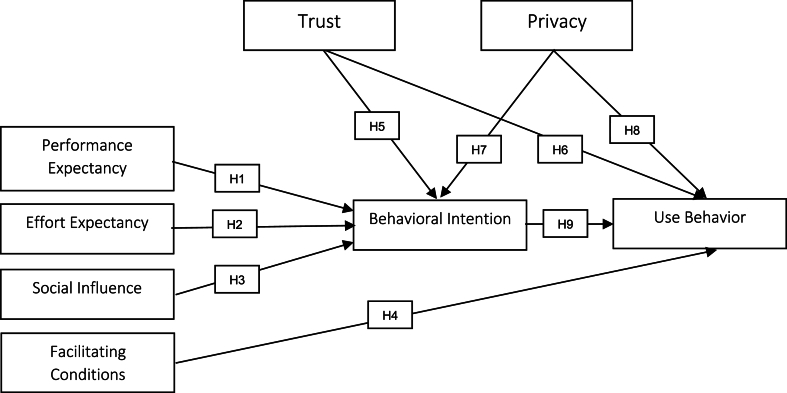
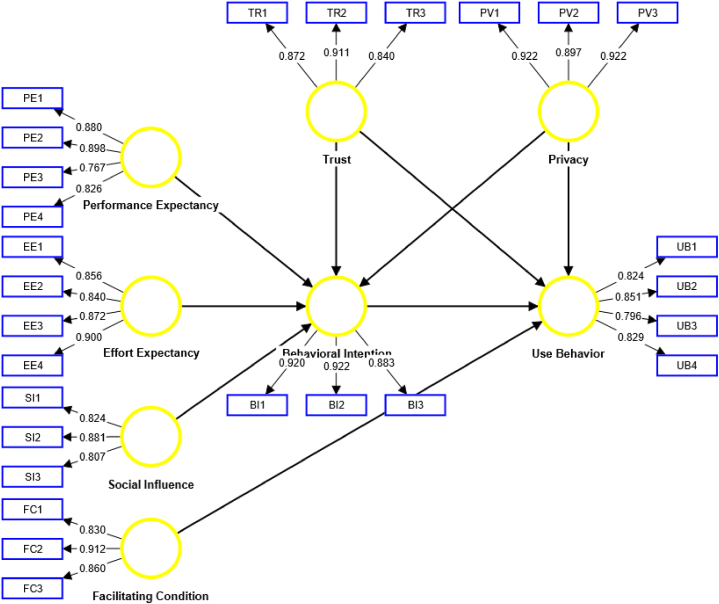
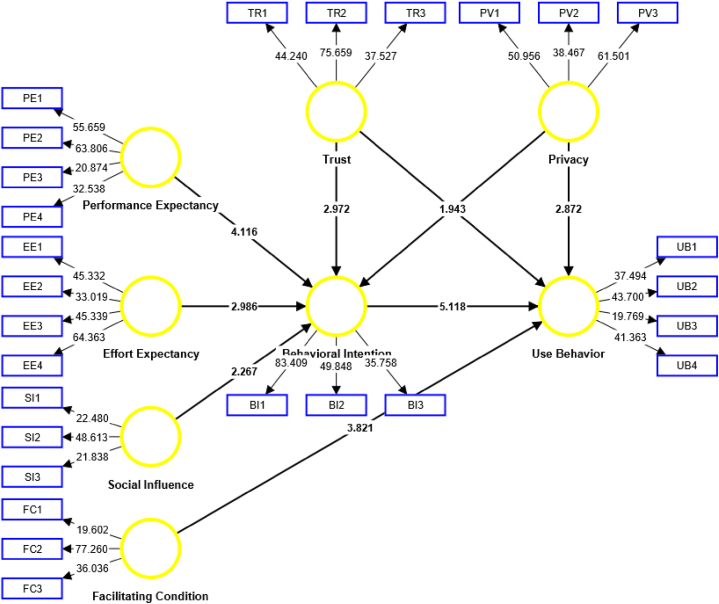
The rapid evolution of Artificial Intelligence (AI) and its widespread adoption have given rise to a critical need for understanding the underlying factors that shape users' behavioral intentions. Therefore, the main objective of this study is to explain user perceived behavioral intentions and use behavior of AI technologies for academic purposes in a developing country. This study has adopted the unified theory of acceptance and use of technology (UTAUT) model and extended it with two dimensions: trust and privacy. Data have been collected from 310 AI users including teachers, researchers, and students. This study finds that users' behavioral intention is positively and significantly associated with trust, social influence, effort expectancy, and performance expectancy. Privacy, on the other hand, has a negative yet significant relationship with behavioral intention unveiling that concerns over privacy can deter users from intending to use AI technologies which is a valuable insight for developers and educators. In determining use behavior, facilitating condition, behavioral intention, and privacy have significant positive impact. This study hasn't found any significant relationship between trust and use behavior elucidating that service providers should have unwavering focus on security measures, credible endorsements, and transparency to build user confidence. In an era dominated by the fourth industrial revolution, this research underscores the pivotal roles of trust and privacy in technology adoption. In addition, this study sheds light on users' perspective to effectively align AI-based technologies with the education system of developing countries. The practical implications encompass insights for service providers, educational institutions, and policymakers, facilitating the smooth adoption of AI technologies in developing countries while emphasizing the importance of trust, privacy, and ongoing refinement.
Overview
The claims and statistics of this paper haven’t been checked yet.
Run the check — free, no account needed. It reads the open-access text and checks the sources it cites.
Integrity signals
Registry
Cites
Statistics
Figures
Verification
Claims the paper makes
The claims and statistics of this paper haven’t been checked yet.
Run the check — free, no account needed. It reads the open-access text and checks the sources it cites.
Claims other papers make about this one
Each is checked against this paper’s own text: does it say what the citing paper says it does?
The source backs part of the claim, not all of it — or backs it for a different population, condition or comparison.
In the citing paper
“Recent expansions of UTAUT have integrated trust, privacy concerns, and ethical considerations as critical moderators, which mirrors the distinctive challenges introduced by AI systems (Rana et al., 2024).”
From A Multi-Dimensional Decision Framework for Evaluating and Selecting AI-Enabled Instructional Technology in U.S. Higher Education (2025) · cites this paper as Rana et al., 2024
Experimental — accuracy not yet measuredThe source backs part of the claim, not all of it — or backs it for a different population, condition or comparison.
In the citing paper
“Trust in the credibility of the AI system's output, defined as the conviction that the tool will deliver accurate, reliable, and impartial information, was consistently linked to higher adoption intentions (Rana et al., 2024).”
From A Multi-Dimensional Decision Framework for Evaluating and Selecting AI-Enabled Instructional Technology in U.S. Higher Education (2025) · cites this paper as Rana et al., 2024
Experimental — accuracy not yet measured
Self-check
Percentages, sums and reported differences re-computed from the paper’s own numbers.
The self-check needs the paper’s full text.
Citations
Cites
The theory of planned behavior
Ajzen, I. (1991) · Organizational Behavior and Human Decision Processes · doi:10.1016/0749-5978(91)90020-t · Cited by 90,587
Perceived usefulness, perceived ease of use, and user acceptance of information technology
Davis, F. D. (1989) · MIS Quarterly · doi:10.2307/249008 · Cited by 68,483
User Acceptance of Information Technology: Toward A Unified View1
Venkatesh, V., Morris, M. G., Davis, G. B., & Davis, F. D. (2003) · MIS Quarterly · doi:10.2307/30036540 · Cited by 45,035
Principles and Practice of Structural Equation Modeling
Tabri, N., & Elliott, C. M. (2012) · Canadian Graduate Journal of Sociology and Criminology · doi:10.15353/cgjsc.v1i1.3787 · Cited by 39,094
A new criterion for assessing discriminant validity in variance-based structural equation modeling
Henseler, J., Ringle, C. M., & Sarstedt, M. (2015) · Journal of the Academy of Marketing Science · doi:10.1007/s11747-014-0403-8 · Cited by 38,459
(1975) · PhilPapers (PhilPapers Foundation) · Cited by 36,737
Statistical Power Analysis for the Behavioral Sciences
Cohen, J. (2013) · doi:10.4324/9780203771587 · Cited by 25,373
A Theoretical Extension of the Technology Acceptance Model: Four Longitudinal Field Studies
Venkatesh, V., & Davis, F. D. (2000) · Management Science · doi:10.1287/mnsc.46.2.186.11926 · Cited by 23,066
Venkatesh, V., Thong, J. Y. L., & Xu, X. (2012) · MIS Quarterly · doi:10.2307/41410412 · Cited by 15,756
Structural equation models with unobservable variables and measurement error: Algebra and statistics
Fornell, C., & Larcker, D. F. (1981) · Journal of Marketing Research · doi:10.1177/002224378101800313 · Cited by 13,287
Research works printed but not linked: 27
- Quon, 2022, AiED: artificial intelligence for the detection of intracranial interictal epileptiform discharges, Clin. Neurophysiol., 133, 1, 10.1016/j.clinph.2021.09.018 · DOI
- Tapalova, 2022, Artificial intelligence in education: AIEd for personalised learning pathways, electron, J. E-Learn., 20, 639
- Dastjerdi, 2023, A novel framework for investigating organizational adoption of AI-integrated CRM systems in the healthcare sector; using a hybrid fuzzy decision-making approach, Telemat. Inform. Rep., 11
- Ocaña-Fernández, 2019, Artificial intelligence and its implications in higher education, J. Educ. Psychol. - Propos. Represent., 7, 553
- Purdy, 2016, Why artificial intelligence is the future of growth, Remarks AI Soc. Econ. Implic, Artif. Intell. Technol., 1
- Kizilcec, 2023, To advance AI use in education, focus on understanding educators, Int. J. Artif. Intell. Educ.
- Wang, 2020, When artificial intelligence meets educational leaders' data-informed decision-making: a cautionary tale, Stud. Educ. Eval., 69
- Sattikar, 2012, vol. 2
- Saxena, 2023, Structure, objectives, and operational framework for ethical integration of artificial intelligence in educational, Sage Sci. Rev. Educ. Technol., 6, 88
- Khosravi, 2022, Explainable artificial intelligence in education, Comput. Educ. Artif. Intell., 3, 10.1016/j.caeai.2022.100074 · DOI · Paper page
- Kronemann, 2023, How AI encourages consumers to share their secrets? The role of anthropomorphism, personalisation, and privacy concerns and avenues for future research, Span, J. Mark.-ESIC, 27, 3
- Saunders, 2016
- Hooper, 2008, Structural equation modelling: guidelines for determining model fit, Electron, J. Bus. Res. Methods, 6, 53
- Kock, 2020, Harman's single factor test in PLS-SEM: checking for common method bias, Data Anal. Perspect. J., 2, 1
- Saunders, 2016
- Rana, 2022, Drivers of consumers' online purchase intention in Bangladesh, Dhaka Univ. J. Manag., 14, 115
- Venkatesh, 2000, A theoretical extension of the technology acceptance model: four longitudinal field studies, Manag. Sci., 46, 186, 10.1287/mnsc.46.2.186.11926 · DOI · Paper page
- Dwivedi, 2019, Re-examining the unified theory of acceptance and use of technology (UTAUT): towards a revised theoretical model, Inf. Syst. Front, 21, 719, 10.1007/s10796-017-9774-y · DOI · Paper page
- Almatari, 2013, Factors influencing students' intention to use M-learning, J. Inf. Syst. Res. Innov. JISRII, 5, 1
- Bakar, 2014, The role of facilitating condition and social influence towards continuance intention to use e-learning, Int. J. Tech. Res. Appl., 2, 12
- Muhaimin, 2019, Predicting factors affecting intention to use Web 2.0 in learning: evidence from science education, J. Balt, Sci. Educ., 18, 595
- Guleria, 2023, ChatGPT: ethical concerns and challenges in academics and research, J. Infect. Dev. Ctries., 17, 1292, 10.3855/jidc.18738 · DOI
- Xu, 2011, Florida Atlantic University, information privacy concerns: linking individual perceptions with institutional privacy assurances, J. Assoc. Inf. Syst. Online, 12, 798
- Wang, 2021, Managing privacy in the digital economy, Fundam. Res., 1, 543, 10.1016/j.fmre.2021.08.009 · DOI
- Mardjo, 2018, Exploring Facebook users' willingness to accept f-commerce using the integrated unified theory of acceptance and use of technology 2 (UTAUT2), trust and risk under the moderating role of age and gender Literature review, UTCC Int. J. Bus. Econ. UTCC IJBE, 10, 139
- Chatterjee, 2021, Understanding AI adoption in manufacturing and production firms using an integrated TAM-TOE model, Technol. Forecast. Soc. Change, 170, 10.1016/j.techfore.2021.120880 · DOI · Paper page
- Dwivedi, 2021, Artificial Intelligence (AI): multidisciplinary perspectives on emerging challenges, opportunities, and agenda for research, practice and policy, Int. J. Inf. Manag., 57
Cited by
Sorted by citations
Items 101–195 of 195
AI-Powered academic search systems: An exploratory study from the perspective of academics in LIS
Ramzy, M., & Zakaria, M. S. (2025) · Information Development · doi:10.1177/02666669251403163
IA y liderazgo educativo: un análisis bibliométrico global
Anzules, C. R. S. D. V., Badaraco, J. A. V., Vera, S. S., Pignataro, D., Maridueña, R. V., & Valverde, J. V. (2025) · Simbiosis Educativa · doi:10.60085/se.v4n1a4
Naik, N. S., Upendra, S., Kaur, J., Vikhe, R., & Kumar, R. (2025) · Springer eBooks · doi:10.1007/978-3-031-94302-7_31
Banyani, M. A., Sanga, S. A., Masika, B., & Lucian, C. A. (2025) · Property Management · doi:10.1108/pm-02-2025-0014
Deniswara, B. H., & Widiantoro, A. D. (2025) · International Conference on Informatics and Computing (ICIC) · doi:10.1109/icic68054.2025.11309609
Hye, N. M. (2025) · Education Journal · doi:10.11648/j.edu.20251406.16
Predicting User Satisfaction with Artificial Intelligence: A Study of ChatGPT
Tang, T.-C., Chi, L.-C., & Tang, E. (2025) · IEEE International Conference on Big Data and Artificial Intelligence (BDAI) · doi:10.1109/bdai66031.2025.11325481
Enhancing Student Engagement With AI
Asrifan, A., Rismawati, R., Sulaiman, I., Abdullah, A., & Noni, N. (2026) · Advances in computational intelligence and robotics book series · doi:10.4018/979-8-3373-3000-6.ch007
Alimohammadirokni, M., İskender, A., & Rasouli, N. (2026) · Journal of Hospitality and Tourism Insights · doi:10.1108/jhti-09-2025-1082
Racheru, C.-I., Despa, A.-R., & Militaru, G. (2025) · International Conference of Management and Industrial Engineering · doi:10.56177/12icmie2025.180
Karim, D., Sumendap, L. A., & Limantara, N. (2025) · International Conference on Information System & Information Technology (ICISIT) · doi:10.1109/icisit66233.2025.11402975
Bisaso, S., & Fava, S. (2026) · Journal of Artificial Intelligence and Technological Development · doi:10.59324/jaitd.2026.2(2).07
Aktepe, B., Çıtak, B., Temizkan, S. P., Temizkan, R., & Cankül, D. (2026) · Journal of Hospitality, Leisure, Sport & Tourism Education · doi:10.1016/j.jhlste.2026.100603
Ratnawati, S., Mujib, M., Fathony, I. A. N., Ikhwan, K., Anggraeni, D., & Azhari, B. F. (2026) · Annals of Human Resource Management Research · doi:10.35912/ahrmr.v6i1.3640
Shi, Y., Chen, J., Dong, Q., & Cheng, X. (2026) · Lecture notes in computer science · doi:10.1007/978-981-95-8420-8_28
Factors Associated with AI Use in a Norwegian Sample
Thorp, S. O., Rimol, L. M., Fleten, M. K., & Hoel, S. K. B. (2026) · Behavioral Sciences · doi:10.3390/bs16040537
Islam, M. R., Parvez, S. M., & Hossain, M. A. (2025) · International Conference on Emerging Innovation and Digital Technology (ICEIDT) · doi:10.1109/iceidt66693.2025.11473581
Yang, Y., Wang, Z., Ma, R., & Schaub, F. (2026) · CHI Conference on Human Factors in Computing Systems · doi:10.1145/3772318.3790881
Salam, M. A., Shareef, I., Manprisio, R., Moriarty, I., Alkhaldi, S., & Anderson, P. (2026) · International Conference on Artificial Intelligence, Computer, Data Sciences and Applications (ACDSA) · doi:10.1109/acdsa67686.2026.11468138
Adoption and Usability of AI Tools in Bangladesh: Opportunities and Challenges
Hossain, D. T., & Sakib, N. (2025) · International Conference on Computer and Information Technology (ICCIT) · doi:10.1109/iccit68739.2025.11491700
Using UTAUT2 to Study the Impact of Chatbot on the Development of M-Commerce in Jordan
Shdaifat, A. M., Obeidallah, R. A., & Abu-Srhan, A. (2026) · Studies in computational intelligence · doi:10.1007/978-3-032-23897-9_5
Alkhwaldi, A. F. (2026) · EuroMed Journal of Business · doi:10.1108/emjb-05-2025-0185
Face value: How avatar identity shapes epistemic trust in AI-mediated learning
Anthis, Z., & Kyriakidou-Zacharoudiou, A. (2026) · Computers and Education Artificial Intelligence · doi:10.1016/j.caeai.2026.100610 · Cited by 1
Wang, X., Li, L., Cai, X., Luo, W., Shen, M., Zuo, Y., Zhang, J., Bai, Z., Yao, Y., Zhang, M., et al. (2026) · Frontiers in Public Health · doi:10.3389/fpubh.2026.1779200
Rifai, A., Usu, I., & Suyanto, M. A. (2026) · International Journal Of Education Social Studies And Management (IJESSM) · doi:10.52121/ijessm.v6i1.1059
Jamil, M. T., & Haque, N. (2026) · Research Square · doi:10.21203/rs.3.rs-9407508/v1
Trust in Artificial Intelligence and AI Adoption Intention in Enterprises
An, N. T. (2026) · International Journal of Social Science Humanity & Management Research · doi:10.58806/ijsshmr.2026.v5i5n39
Sharaf, S. A., & Bahnasy, H. A. (2026) · Research Square · doi:10.21203/rs.3.rs-9456333/v1
Exploring University Students Behavioral Intentions Toward Generative AI
Angelica, M., Gui, A., Georgiana, V., So, I. G., Riki, R., & Kowirya, P. C. (2025) · International Conference on Intelligent & Innovative Practices in Engineering & Management (IIPEM) · doi:10.1109/iipem65914.2025.11548326
Halim, J. J., Yuwana, K. M., & Gui, A. (2025) · International Conference on Intelligent & Innovative Practices in Engineering & Management (IIPEM) · doi:10.1109/iipem65914.2025.11548245
Exploring Factors Influencing AI Adoption in Accounting and Auditing Practices
Gui, A., Wangsadjaja, A., Chandra, C. S., Ganesan, Y., Karmawan, I. G. M., & Riki (2025) · International Conference on Intelligent & Innovative Practices in Engineering & Management (IIPEM) · doi:10.1109/iipem65914.2025.11548425
Truong, V. L. (2026) · Journal of Information Technology Education Research · doi:10.28945/5791
Cahyo, A. A., & Lediwara, N. (2026) · Jurnal Siber Multi Disiplin · doi:10.38035/jsmd.v4i1.741
Privacy Concerns and AI Hallucination Risks in Generative AI Continuance for Self-Directed Learning
Adi, V. M. I. B., & Usman, O. (2026) · Journal of Digital Business and Global Economy · doi:10.64243/jodigbi.02.3.10
Asghar, M. Z., Fabusoye, O. A., & Özbilen, F. M. (2026) · Discover Computing · doi:10.1007/s10791-026-10313-8
Regulations Addressing Key Challenges of Artificial Intelligence: Managing Usage Knowledge
Lawson‐Body, A., & Jensen, J. J. (2026) · Journal of Computer Information Systems · doi:10.1080/08874417.2026.2688779
Fatmawati, S., Ismiyanti, Y., & Pratama, G. C. (2026) · Community Empowerment Journal · doi:10.61251/cej.v4i2.385
A sensemaking approach for AI adoption: the role of AI framing and digital culture
Liu, S. Y. H., Gustafson, B., & Gustafson, M. (2026) · Marketing Intelligence & Planning · doi:10.1108/mip-03-2025-0276
Alubthane, F. O. (2026) · Education Sciences · doi:10.3390/educsci16071118
From Innovation to Investigation: A Forensic-Centric Approach to AI Adoption in Healthcare
Qureshi, O. A., & Saoud, L. S. (2026) · International Conference on Smart Applications, Communications and Networking (SmartNets) · doi:10.1109/smartnets69662.2026.11604936
Diffusion of Innovation Factors Influencing User Trust and Adoption of AI-Based Cybersecurity Tools
Muhudin, A., Hussein, O. D., Osoble, A. M., Mondal, J., Mohamud, A. A., Omar, A. A., & Ali, I. M. (2026) · International Journal of Human-Computer Interaction · doi:10.1080/10447318.2026.2702157
A Governance Framework for Responsible AI Integration in Higher Education: A Fuzzy Delphi Study
Kamrozzaman, N. A., Muhiddin, N. ‘., Dan, W. C., & Wahid, F. N. (2026) · International Research Journal of Multidisciplinary Scope · doi:10.47857/irjms.2026.v07i03.011001
Dang, N., Nguyen, D., Nguyen, L. T., & Vo, T. (2026) · IntechOpen eBooks · doi:10.5772/intechopen.1016266
Teacher educators’ adoption of artificial intelligence: A qualitative UTAUT study
Kurt, G., Bayram, D., & Han-Tosunoğlu, Ç. (2026) · European Journal of Teacher Education · doi:10.1080/02619768.2026.2701094
Enhancing Arab University Governance through Multi-Criteria Decision-Making
Atef, R. (2026) · Journal of Decision Science and Optimization · doi:10.55578/jdso.2607.008
Malakar, R., & Rahman, M. S. (2026) · Journal of Technology in Behavioral Science · doi:10.1007/s41347-026-00681-9
A UTAUT-Based Study of AI Acceptance and Dependency in L2 Writing Among Chinese EFL Students
Sun, W., Liu, Y., & Shin, Y. (2026) · SAGE Open · doi:10.1177/21582440261422350
Salad, A. M., Omar, M. M., Ahmed, A. B., Yusuf, S. A., MOHAMED, A. A., & Abdalla, H. H. (2026) · Cogent Education · doi:10.1080/2331186x.2026.2707679
Ojo, J., Koch, L., Becker, A., & Svensson, F. (2026) · SSRN Electronic Journal · doi:10.2139/ssrn.7155019
Generative AI Adoption in Local Government: A PLS-SEM and fsQCA Study of Vietnamese Civil Servants
Duy, P. N., Ruangthamsing, C., Kamnuansilpa, P., Lowatcharin, G., & Setthasuravich, P. (2026) · Administrative Sciences · doi:10.3390/admsci16080365
Guerra, M. A. D., Ramírez, A. M., Castañeda, G. M. F., Cortés, C. H., & Reyes, J. D. J. A. (2026) · Interfases · doi:10.26439/interfases2026.n023.8785
Neurosurveillance in academic settings
Fernández-Delgado, J. C. M. (2026) · NeuroData · doi:10.63688/neurodata2026151
Fatmawati, S., Margarena, A. N., & Ismiyanti, Y. (2026) · Advances in Science, Technology & Innovation/Advances in science, technology & innovation · doi:10.1007/978-3-032-21822-3_21
Laizer, J. E., Mwalukasa, N., & Kavishe, G. F. (2026) · African Journal of Empirical Research · doi:10.51867/ajernet.7.3.60
Dittmar, E. C., & Sposato, M. (2026) · International Journal of Sustainability in Higher Education · doi:10.1108/ijshe-12-2025-1534
Virmani, N., Sharma, D., Lahri, V., & Garza‐Reyes, J. A. (2026) · Operations Management Research · doi:10.1007/s12063-026-00609-9
Advancing Generative AI Adoption in Education: Extending the UTAUT Framework
Hidayat, A. A., Rospricilia, T. A., Rosidah, N. A., Fauzia, R. V., & Putra, I. M. (2026) · International Conference on Advancement in Data Science, E-learning and Information System (ICADEIS) · doi:10.1109/icadeis71120.2026.11644529
Neither Luddite nor enthusiast: interpreting teachers’ AI use in teaching
Cheung, N. Y. Y., & Cheung, A. K. F. (2026) · Frontiers in Education · doi:10.3389/feduc.2026.1883017
Evaluating the Adoption and Impact of Next-Generation E-Government Services in Nepal
Acharya, I., Thakur, P. D. R., & Gurung, D. (2026) · LBEF Research Journal of Science Technology and Management · doi:10.67825/lrjstm.2026.8013955
Liu, Y., Liu, X., & Guan, M. (2026) · Humanities and Social Sciences Communications · doi:10.1057/s41599-026-08561-6
Arrayed, S. H. A. (2026) · Multidimensional Research Insights · doi:10.64220/mri.v2i2.004
AI in Cameroonian Newsrooms: Exploring Daily Use and Challenges Among Journalists in Four Regions
Nfor, E. (2026) · Media and Communication · doi:10.17645/mac.12485
Ţimiraş, L. C., Nichifor, B., Zaiț, L., Brycz, M., & Danu, M. (2026) · Journal of Business Economics and Management · doi:10.3846/jbem.2026.28058
Danladi, G. P. (2026) · Artificial Intelligence in Educational Decision Sciences · doi:10.66053/aieds.v1i2.53
Abubakar, S. E., Umar, M., & Yakubu, J. J. (2026) · Artificial Intelligence in Educational Decision Sciences · doi:10.66053/aieds.v1i2.91
Ismail, M. H. (2026) · Journal of Technology and Operations Management/Journal of technology and operations management · doi:10.32890/jtom2026.21.2.6
Osuizugbo, I. C., Awuzie, B. O., & Odekunle, F. J. (2026) · Journal of Information Technology Case and Application Research · doi:10.1080/15228053.2026.2731295
Gamboa, A. B., & Miranda, J. P. P. (2026) · International Journal of Advances in Applied Sciences · doi:10.11591/ijaas.v15.i3.pp998-1005
Intention to Use Generative AI for Vocational College Administration
Chooppawa, P., Limpinan, P., & Jantakoon, T. (2026) · World Journal of Education · doi:10.5430/wje.v16n3p157
Exploring the impact of AI-Enabled Marketing on business performance in SMEs
Gómez, Y. A. C., Guerrero, L. M. B., & Rozo, J. J. P. (2026) · Revista Venezolana de Gerencia · doi:10.52080/rvgluz.31.116.11
Jasim, T. G., Al-weead, A. A. M., Ramo, R. M., Alshaher, A. A., & Zaker, R. A. (2026) · Management & Sustainability An Arab Review · doi:10.1108/msar-01-2026-0039
Hassan, J., Al-Kharusi, H., Al-Farsi, H., Al-Kharusi, R., Al-Tamtami, Z., Al-Tubi, I., Al-Ruqieshi, A., Al-Balushi, S., & Azri, Z. A. (2026) · Nursing Forum · doi:10.1155/nuf/4700220
Kamaludeen, S., & Daure, H. (2026) · IBSUniversity Journal of Business and Research · doi:10.68224/nzqy9937
Rupa, R. A., Haque, A., Sultana, F., Sultana, A., Mosharrafa, R. A., & Amin, M. A. (2026) · Human Behavior and Emerging Technologies · doi:10.1155/hbe2/8847712
Naher, K., Siddiqi, K. O., Mamun, M. A. A., Chakma, S., Rashid, F., Arju, U. H., Alam, S., & Tanchangya, T. (2026) · Discover Education · doi:10.1007/s44217-026-02075-8
Vasileva, V., Reiser, T., & Jürjens, J. (2026) · Annals of Computer Science and Information Systems · doi:10.15439/2026f3410
Consumer Acceptance of Whatsapp-Enabled Conversational Commerce in Indonesia: A UTAUT2 Study
Widyanti, G., Cen, G., Mangkubumi, A., Widjaja, P., & Hentihu, M. T. R. (2026) · International Conference on Information Management and Technology (ICIMTech) · doi:10.1109/icimtech202671078.2026.11698950
Algethami, N., Tolah, A., Bakheet, E. M., & Alharthi, H. (2026) · Journal of Education and e-Learning Research · doi:10.20448/jeelr.v13i3.9384
From technological perceptions to educational value in AI chatbot adoption among graduate students
Garro-Aburto, L. L., Chávez-Díaz, J., Clemente-Castillo, C. D. P., Sanchez-Atuncar, G., & Sandoval, S. P. S. (2026) · Social Sciences & Humanities Open · doi:10.1016/j.ssaho.2026.103677
Mozumdar, S. K., Hasan, D. B., Tamzid, M., & Hasan, M. N. (2026) · International Journal of Artificial Intelligence and Machine Learning · doi:10.51483/ijaiml.6.11s.2026.684-696
KI in der Psychotherapie: Ersatz, Werkzeug oder Projektionsfläche?
Raile, P. (2026) · Psychotherapie-Wissenschaft · doi:10.30820/1664-9583-2026-2-7
Putri, M. A., & Pangestu, H. (2026) · International Conference on ICT for Smart Society (ICISS) · doi:10.1109/iciss71466.2026.11715273
From AI Readiness to Knowledge Advantage: Explaining SME Performance through a TAM-TOE-KBV Framework
Opoku, S., & Gyan, R. B. (2026) · Journal of Economics Innovative Management and Entrepreneurship · doi:10.59652/shnz4g84
Trust, AI-Driven HR Transformation, and the Future of Work
Kadyan, P., & Pillai, S. (2026) · Advances in computational intelligence and robotics book series · doi:10.4018/979-8-2600-4780-4.ch004
Rusike, H. (2025) · IJARKE Science & Technology Journal · doi:10.32898/istj.03/8.1article01
Basla, S., Achaq, H., Jaima, B., Moudden, M. E., Amahmid, O., & Chakiri, S. (2026) · International Journal of Information and Education Technology · doi:10.18178/ijiet.2026.16.10.2714
Global Insights on AI Adoption in Higher Education: A Systematic Review of Educator Acceptance
Amir, S. A. S., Ghazali, N. E., & Amir, S. A. S. (2025) · Research in Engineering Education Symposium (REES) · doi:10.52202/086293-0084
Hiram, L.-R. F., Francisco, A. G. J., & Virginia, B. Q. R. (2025) · IEEE Baja California Conference (BCC) · doi:10.1109/bcc63751.2025.11725737
Integrasi Lean Six Sigma dan Sistem Informasi untuk Meningkatkan Efisiensi Layanan Publik
Alfian, A. N., Priyadi, W., Muis, S., Ramadhan, F. M., & Akmal, M. (2026) · TeknoIS Jurnal Ilmiah Teknologi Informasi dan Sains · doi:10.36350/jbs.v16i2.345
Beyond AI skills: Understanding generative AI engagement in graduate business education
Fernández, R. C., & Lazarte-Aguirre, A. (2026) · The International Journal of Management Education · doi:10.1016/j.ijme.2026.101568
Thảo, T. P., Lự, B. T., Hồng, N. T. T., Nguyen, T. H. A., Dũng, T. T., & Nguyet, N. T. B. (2026) · Tạp chí Khoa học Trường Đại học Mở Hà Nội · doi:10.59266/houjs.2026.1497
Duneeh, R. V., Addai‐Mensah, O., Sackey, B., Adankwah, E., Afriyie, E. Y., Agyemang, V., Kwadzokpui, P. K., Ativi, E., Klugah, M. A., Amponsah, F. A., et al. (2026) · Health Science Reports · doi:10.1002/hsr2.73451
Rizqullah, R. A., & Ranu, M. E. (2026) · EDUTECH Jurnal Inovasi Pendidikan Berbantuan Teknologi · doi:10.51878/edutech.v6i4.16482
Ashour, K., Alazmi, M. Q., Alkhurinej, A., Alhammadi, M. M., Al-Taii, A., & Noufal, Z. M. (2026) · Frontiers in Sociology · doi:10.3389/fsoc.2026.1902517
Aidarus, F. (2026) · Journal of Intelligent Decision Making and Information Science · doi:10.17762/jidmis.v3.5756
Metadata
- Authors
- Rana, M. M., Siddiqee, M. S., Sakib, M. N., & Ahamed, M. R.
- Affiliations
- University of Dhaka (BD)
- Corresponding author
- Sakib, Md. Nazmus
- ORCID
- Sakib, Md. Nazmus
- Venue
- Heliyon
- Publisher
- Elsevier BV
- Published
- 2024-09
- Volume
- 10
- Issue
- 18
- Pages
- e37569
- ISSN
- 2405-8440 (ISSN-L)
- PMC
- PMC11417232
- OpenAlex
- W4402404634
- Cited by
- 143
- References
- 197
- Citations by year
- 2026: 80 · 2025: 61 · 2024: 2
- FWCI
- 53.36
- Type
- journal article
- Language
- en
- Open access
- gold
- doi.org
- Licence
- Locations
- Heliyon (publishedVersion, cc-by-nc-nd)
- SSRN Electronic Journal (acceptedVersion)
- PubMed Central (publishedVersion, cc-by-nc-nd)
- PubMed (publishedVersion)
- DOAJ (DOAJ: Directory of Open Access Journals) (submittedVersion, cc-by-sa)
- Topics
- Social Sciences › Decision Sciences › Information Systems and Management › Technology Adoption and User Behaviour
- Social Sciences › Education › Artificial Intelligence in Education
- Social Sciences › Sociology and Political Science › Privacy, Security, and Data Protection
- Keywords
- artificial intelligence adoption, technology acceptance, UTAUT, trust, privacy concerns, behavioral intention, use behavior, developing countries, academia, social influence, effort expectancy, performance expectancy, facilitating conditions, artificial intelligence in education
About these checks
Registry, retraction, Cites and statistics results are computed, not judged, with one exception: a printed reference that no index lists is read once by a model before it counts as a citation error. Claims are extracted by a model and kept only when their quote appears verbatim in the text; each cited source is then checked, with a model’s help, for whether it says what the claim relies on. Those verdicts can be wrong — read the claim’s quote and the cited source before relying on one.
Statistics and arithmetic are recomputed, not judged.
Confidence bands are shown only for fields calibrated on our annotated test set. None is calibrated yet, so no band is shown.
What counts as a claim ›How we measure confidence ›How we check this ›
Are you an author, or do you see a problem with this page? Request a review
