

The DOI matches its Crossref record; 38 of the 40 references it cites were found in a registry or an index.
Positive psychotherapy for distressed cancer survivors: Posttraumatic growth facilitation reduces posttraumatic stress
Open accessAbstract
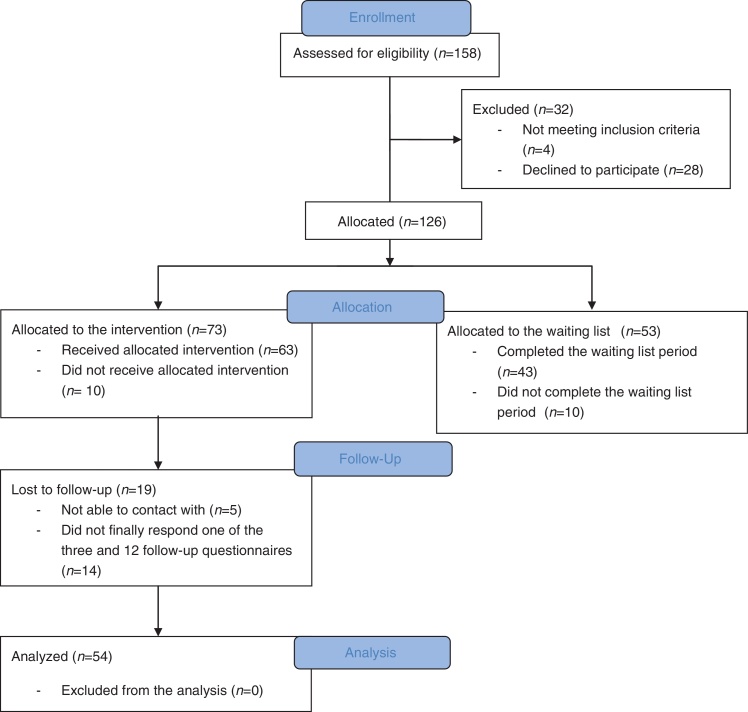
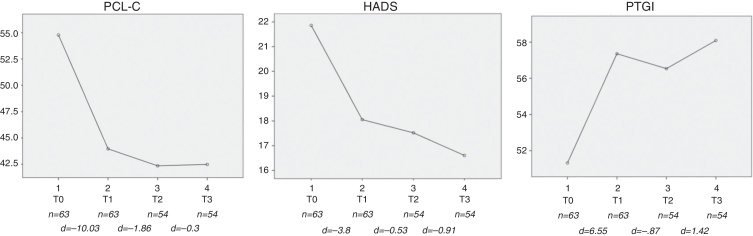
There is increasing evidence that positive life changes, such as posttraumatic growth (PTG), can result from the experience of coping with cancer. However, no interventions have been specifically designed to facilitate the development of PTG in cancer. In this article, we describe and assess the results of Positive Psychotherapy for Cancer (PPC) survivors. It aims to facilitate PTG as a way of achieving significant reductions in the symptoms of emotional distress and posttraumatic stress. In addition, the corroboration of this PTG facilitation is assessed using interpersonal indicators. Method: We allocated 126 consecutive survivors of cancer with high levels of emotional distress and who were seeking psychological support to either an experimental group (PPC) or a waiting list group. Results: The PPC group obtained significantly better results after treatment than the control group, showing reduced distress, decreased posttraumatic symptoms, and increased PTG. The benefits were maintained at 3 and 12 months’ follow-up. Participants’ PTG was correlated to the PTG that their significant others attributed to them, corroborating PTG facilitation. Conclusions: PPC appears to promote significant long-term PTG and can reduce emotional distress and posttraumatic stress in cancer survivors. In addition, PTG facilitation induced by PPC is corroborated by significant others. La evidencia científica muestra la importante presencia de cambios vitales positivos, como el crecimiento postraumático (CPT), tras afrontar un cáncer. Sin embargo, ninguna intervención ha sido específicamente diseñada para facilitar el CPT en pacientes con cáncer. En este artículo, se describen y evalúan los resultados de la Psicoterapia Positiva dirigida a supervivientes de Cáncer (PPC), diseñada para facilitar el CPT como vía para reducir el malestar emocional y estrés postraumático. Utilizamos indicadores interpersonales para validar la autenticidad del CPT. Método: Ciento veintiséis supervivientes de cáncer con elevados niveles de malestar emocional fueron consecutivamente asignados al grupo experimental (PPC) o al grupo de lista de espera. Resultados: El grupo de PPC obtuvo significativamente mejores resultados después del tratamiento que el grupo control, mostrando una reducción del malestar psicológico, de los síntomas de estrés postraumático y un incremento del CPT. Los beneficios se mantuvieron a los 3 y 12 meses. El CPT fue corroborado por los seres queridos de los participantes. Conclusiones: La PPC parece promover de forma significativa el CPT y reduce el malestar emocional y el estrés postraumático en supervivientes de cáncer. Además, la facilitación de CPT inducido por la PPC es corroborada por los seres queridos.
Overview
The claims and statistics of this paper haven’t been checked yet.
Run the check — free, no account needed. It reads the open-access text and checks the sources it cites.
Integrity signals
Registry
Cites
Statistics
Figures
Verification
Claims the paper makes
The claims and statistics of this paper haven’t been checked yet.
Run the check — free, no account needed. It reads the open-access text and checks the sources it cites.
Claims other papers make about this one
Each is checked against this paper’s own text: does it say what the citing paper says it does?
The source backs part of the claim, not all of it — or backs it for a different population, condition or comparison.
In the citing paper
“Also, lack of attention and treatment of post-traumatic stress symptoms in patients with cancer and their survivors can increase pain experience, wish to die, disability, poor selfcare, and less healthy lifestyle (6, 9).”
From Acceptance and commitment therapy for demoralization syndrome and cancer-related trauma: A randomized clinical trial study (2021) · cites this paper as [9]
Experimental — accuracy not yet measured
Self-check
Percentages, sums and reported differences re-computed from the paper’s own numbers.
The self-check needs the paper’s full text.
Citations
Cites
The Hospital Anxiety and Depression Scale
Zigmond, A. S., & Snaith, R. P. (1983) · Acta Psychiatrica Scandinavica · doi:10.1111/j.1600-0447.1983.tb09716.x · Cited by 47,139
Depression and quality of life in older persons: A review
Sivertsen, H., Bjørkløf, G. H., Engedal, K., Selbæk, G., & Helvik, A.-S. (2015) · Dementia and Geriatric Cognitive Disorders · doi:10.1159/000437299 · Cited by 14,152
The posttraumatic growth inventory: measuring the positive legacy of trauma
Tedeschi, R. G., & Calhoun, L. G. (1996) · Journal of Traumatic Stress · doi:10.1002/jts.2490090305 · Cited by 7,061 · cited 2×
“According to the influential model of Tedeschi and Calhoun (1996), positive changes can be observed in several domains: a) self-concept (e.g., new valuation of one’s own strength and resilience); b) appreciation of new possibilities in life; c) social relationships (e.g., feeling emotionally closer…”
BackgroundA meta-analytic review of benefit finding and growth.
Helgeson, V. S., Reynolds, K. A., & Tomich, P. L. (2006) · Journal of Consulting and Clinical Psychology · doi:10.1037/0022-006x.74.5.797 · Cited by 1,864
Psychological resources, positive illusions, and health.
Taylor, S. E., Kemeny, M. E., Reed, G. M., Bower, J. E., & Gruenewald, T. L. (2000) · American Psychologist · doi:10.1037/0003-066x.55.1.99 · Cited by 1,313
Growth following adversity: Theoretical perspectives and implications for clinical practice
Joseph, S., & Linley, P. A. (2006) · Clinical Psychology Review · doi:10.1016/j.cpr.2005.12.006 · Cited by 585
The revised cognitive therapy scale (CTS-R): psychometric properties.
Blackburn, I.-M., James, I. A., Milne, D. L., Baker, C., Standart, S., Garland, A., & Reichelt, F. K. (2001) · Behavioural and Cognitive Psychotherapy · doi:10.1017/s1352465801004040 · Cited by 568
Screening for Distress and Unmet Needs in Patients With Cancer: Review and Recommendations
Carlson, L. E., Waller, A., & Mitchell, A. J. (2012) · Journal of Clinical Oncology · doi:10.1200/jco.2011.39.5509 · Cited by 550
Perepletchikova, F., Treat, T. A., & Kazdin, A. E. (2007) · Journal of Consulting and Clinical Psychology · doi:10.1037/0022-006x.75.6.829 · Cited by 533
PTSD Checklist—Civilian Version
Weathers, F. W., Litz, B., Herman, D., Juska, J., & Keane, T. (2012) · PsycTESTS Dataset · doi:10.1037/t02622-000 · Cited by 527
How Stress Management Improves Quality of Life After Treatment for Breast Cancer.
Antoni, M. H., Lechner, S. C., Kazi, A., Wimberly, S. R., Sifre, T., Urcuyo, K. R., Phillips, K. K., Glück, S., & Carver, C. S. (2006) · Journal of Consulting and Clinical Psychology · doi:10.1037/0022-006x.74.6.1152 · Cited by 366
Predictors of Posttraumatic Growth Following Bone Marrow Transplantation for Cancer.
Widows, M. R., Jacobsen, P. B., Booth‐Jones, M., & Fields, K. K. (2005) · Health Psychology · doi:10.1037/0278-6133.24.3.266 · Cited by 357
Casellas-Grau, A., Font, A., & Vives, J. (2014) · Psycho-Oncology · doi:10.1002/pon.3353 · Cited by 299
Self-citationPosttraumatic growth in cancer: Reality or illusion?
Sumalla, E. C., Ochoa, C., & Blanco, I. (2009) · Clinical Psychology Review · doi:10.1016/j.cpr.2008.09.006 · Cited by 290
Self-citationPosttraumatic growth and adjustment among individuals with cancer or HIV/AIDS: A meta-analysis
Sawyer, A., Ayers, S., & Field, A. P. (2010) · Clinical Psychology Review · doi:10.1016/j.cpr.2010.02.004 · Cited by 271
Morrill, E. F., Brewer, N. T., O’Neill, S. C., Lillie, S. E., Dees, E. C., Carey, L., & Rimer, B. K. (2008) · Psycho-Oncology · doi:10.1002/pon.1313 · Cited by 254
Psychosocial interventions and posttraumatic growth: A meta-analysis.
Roepke, A. M. (2014) · Journal of Consulting and Clinical Psychology · doi:10.1037/a0036872 · Cited by 229
Penedo, F. J., Molton, I., Dahn, J. R., Shen, B.-J., Kinsinger, D., Traeger, L., Siegel, S., Schneiderman, N., & Antoni, M. (2006) · Annals of Behavioral Medicine · doi:10.1207/s15324796abm3103_8 · Cited by 223
Antoni, M. H. (2012) · Brain Behavior and Immunity · doi:10.1016/j.bbi.2012.05.009 · Cited by 188
The SEPOS Group, Gil, F., Grassi, L. G., Travado, L., Tomamichel, M., & González, J. R. (2005) · Supportive Care in Cancer · doi:10.1007/s00520-005-0780-0 · Cited by 163
Stress management intervention for women with breast cancer.
Antoni, M. H. (2003) · doi:10.1037/10488-000 · Cited by 148
Mind matters in cancer survival
Spiegel, D. (2012) · Psycho-Oncology · doi:10.1002/pon.3067 · Cited by 144
Cancer Distress Reduction with a Couple-Based Skills Training: A Randomized Controlled Trial
Heinrichs, N., Zimmermann, T., Huber, B., Herschbach, P., Russell, D. W., & Baucom, D. H. (2012) · Annals of Behavioral Medicine · doi:10.1007/s12160-011-9314-9 · Cited by 128
Moore, A. M., Gamblin, T. C., Geller, D. A., Youssef, M. N., Hoffman, K. E., Gemmell, L., Likumahuwa-Ackman, S., Bovbjerg, D. H., Marsland, A. L., & Steel, J. L. (2010) · Psycho-Oncology · doi:10.1002/pon.1746 · Cited by 117
Sex differences in the effects of adolescent stress on adult brain inflammatory markers in rats
Pyter, L. M., Kelly, S. D., Harrell, C. S., & Neigh, G. N. (2013) · Brain Behavior and Immunity · doi:10.1016/j.bbi.2013.01.075 · Cited by 103
Behavioural changes add validity to the construct of posttraumatic growth
Shakespeare‐Finch, J., & Barrington, A. J. (2012) · Journal of Traumatic Stress · doi:10.1002/jts.21730 · Cited by 98
Psychological treatments to improve quality of life in cancer contexts: a meta-analysis
de la Torre-Luque, A., Gambara, H., López, E., & Cruzado, J. A. (2016) · International Journal of Clinical and Health Psychology · doi:10.1016/j.ijchp.2015.07.005 · Cited by 67
Costa‐Requena, G., & Gil, F. (2009) · Psycho-Oncology · doi:10.1002/pon.1601 · Cited by 60
Joseph, S., Linley, P. A., Shevlin, M. E., Goodfellow, B., & Butler, L. D. (2005) · Journal of Loss and Trauma · doi:10.1080/15325020500358241 · Cited by 54
Posttraumatic Growth: Challenges from a Cross-Cultural Viewpoint
Vázquez, C., Pérez-Sales, P., & Ochoa, C. (2014) · Cross-Cultural Advancements in Positive Psychology · doi:10.1007/978-94-017-8669-0_4 · Cited by 35
Self-citationCorrelates of depressive symptomatology in African-American breast cancer patients
Sheppard, V. B., Llanos, A. A. M., Hurtado‐de‐Mendoza, A., Taylor, T. R., & Adams-Campbell, L. L. (2013) · Journal of Cancer Survivorship · doi:10.1007/s11764-013-0273-y · Cited by 35
Happy Days: Positive Psychology interventions effects on affect in an N-of-1 trial
Woodworth, R. J., O’Brien-Malone, A., Diamond, M. R., & Schüz, B. (2015) · International Journal of Clinical and Health Psychology · doi:10.1016/j.ijchp.2015.07.006 · Cited by 29
Haberkorn, J., Burbaum, C., Fritzsche, K., Geser, W., Fuchs, D., Ocaña‐Peinado, F. M., & Schubert, C. (2013) · Psychoneuroendocrinology · doi:10.1016/j.psyneuen.2013.03.001 · Cited by 25
Ochoa, C., Castejón, V., Sumalla, E. C., & Blanco, I. (2013) · Terapia psicológica · doi:10.4067/s0718-48082013000100008 · Cited by 25
Self-citationPérez‐Sales, P., Eiroá‐Orosa, F. J., Olivos‐Jara, P., Val, E. B., Fernández-Liria, A., & Vergara, M. (2012) · Journal of Loss and Trauma · doi:10.1080/15325024.2011.616828 · Cited by 24
Costa‐Requena, G., Pérez, X. M., Baró, M. S., & Gil, F. (2009) · Ansiedad y Estrés · Cited by 19
Ochoa, C., Sumalla, E. C., Maté-Méndez, J., Castejón, V., Rodriguez-Ortega, A., Blanco, I., & Gil, F. (2010) · RECERCAT (Consorci de Serveis Universitaris de Catalunya) · Cited by 15
Self-citationOchoa, C., & Casellas‐Grau, A. (2015) · Springer eBooks · doi:10.1007/978-3-319-08613-2_77-1 · Cited by 12
Self-citation
Cited by
Sorted by citations
Marziliano, A. M., Tuman, M., & Moyer, A. E. (2019) · Psycho-Oncology · doi:10.1002/pon.5314 · Cited by 217
Guarino, A., Polini, C., Forte, G., Favieri, F., Boncompagni, I., & Casagrande, M. (2020) · Journal of Clinical Medicine · doi:10.3390/jcm9010209 · Cited by 106
Psychometric properties of the Connor-Davidson Resilience Scale in women with breast cancer
Alarcón, R., Cerezo, M. V., Hevilla, S., & Blanca, M. J. (2019) · International Journal of Clinical and Health Psychology · doi:10.1016/j.ijchp.2019.11.001 · Cited by 91
Rashid, T., & Seligman, M. (2018) · doi:10.1093/med-psych/9780195325386.001.0001 · Cited by 77
Psychometric properties of the perceived stress scale (pss‐10) with breast cancer patients
Soria‐Reyes, L. M., Cerezo, M. V., Alarcón, R., & Blanca, M. J. (2022) · Stress and Health · doi:10.1002/smi.3170 · Cited by 79
Metadata
- Authors
- Ochoa, C., Casellas-Grau, A., Vives, J., Font, A., & Borràs, J.-M.
- Affiliations
- Institut d'Investigació Biomédica de Bellvitge (ES)
- Universitat Autònoma de Barcelona (ES)
- Corresponding author
- Ochoa, Cristian
- Venue
- International Journal of Clinical and Health Psychology
- Publisher
- Elsevier BV
- Published
- 2017-01
- Volume
- 17
- Issue
- 1
- Pages
- 28-37
- ISSN
- 1697-2600 (ISSN-L)
- PMC
- PMC6236322
- OpenAlex
- W2539335273
- Cited by
- 136
- References
- 40
- Citations by year
- 2026: 8 · 2025: 9 · 2024: 9 · 2023: 17 · 2022: 15 · 2021: 16 · 2020: 12 · 2019: 10 · 2018: 38 · 2017: 2
- FWCI
- 8.99
- Type
- journal article
- Language
- en
- Open access
- gold
- doi.org
- Licence
- Locations
- International Journal of Clinical and Health Psychology (publishedVersion, cc-by-nc-nd)
- Europe PMC (PubMed Central) (publishedVersion, cc-by-nc-nd)
- PubMed Central (publishedVersion, cc-by-nc-nd)
- PubMed (publishedVersion)
- Dipòsit Digital de la Universitat de Barcelona (Universitat de Barcelona) (publishedVersion, cc-by-nc-nd)
- Dipòsit Digital de Documents de la UAB (Universitat Autònoma de Barcelona) (submittedVersion, cc-by-nc-nd)
- LA Referencia (Red Federada de Repositorios Institucionales de Publicaciones Científicas) (submittedVersion, cc-by-nc-nd)
- RECERCAT (Consorci de Serveis Universitaris de Catalunya) (submittedVersion, cc-by-nc-nd)
- Funders
- Instituto de Salud Carlos III (FIS PI15/01278, PI15/01278)
- European Regional Development Fund (PI15/01278)
- Topics
- Health Sciences › Medicine › Oncology › Cancer survivorship and care
- Social Sciences › Psychology › Clinical Psychology › Posttraumatic Stress Disorder Research
- Health Sciences › Medicine › Pediatrics, Perinatology and Child Health › Childhood Cancer Survivors' Quality of Life
- Keywords
- positive psychotherapy, cancer survivors, posttraumatic growth, post-traumatic stress, emotional distress, psychological intervention, significant others, long-term follow-up, coping with cancer
About these checks
Registry, retraction, Cites and statistics results are computed, not judged, with one exception: a printed reference that no index lists is read once by a model before it counts as a citation error. Claims are extracted by a model and kept only when their quote appears verbatim in the text; each cited source is then checked, with a model’s help, for whether it says what the claim relies on. Those verdicts can be wrong — read the claim’s quote and the cited source before relying on one.
Statistics and arithmetic are recomputed, not judged.
Confidence bands are shown only for fields calibrated on our annotated test set. None is calibrated yet, so no band is shown.
What counts as a claim ›How we measure confidence ›How we check this ›
Are you an author, or do you see a problem with this page? Request a review
