

The DOI matches its Crossref record; 34 of the 34 references it cites were found in a registry or an index.
Saturation in qualitative research: An evolutionary concept analysis
Open accessAbstract
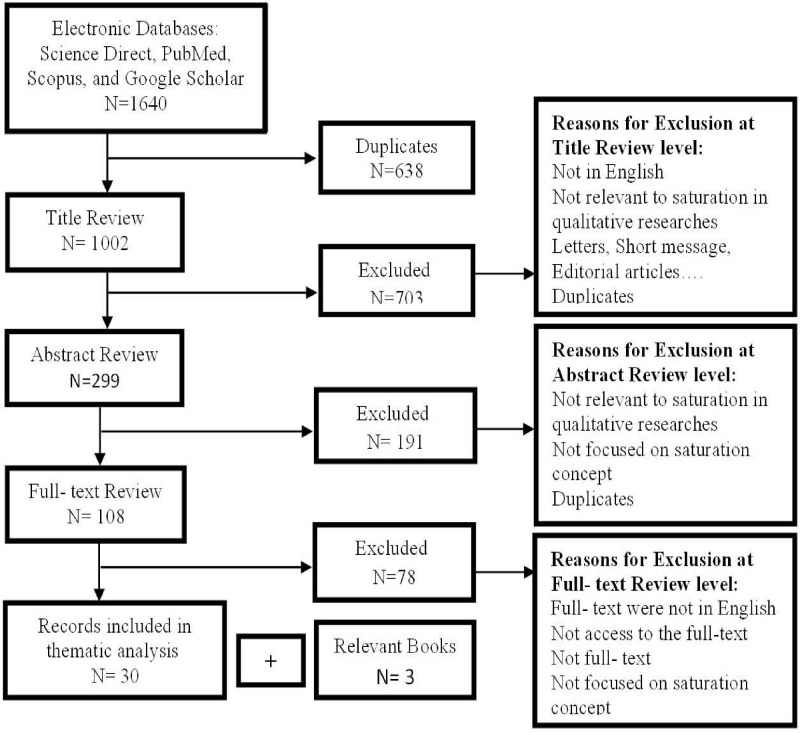
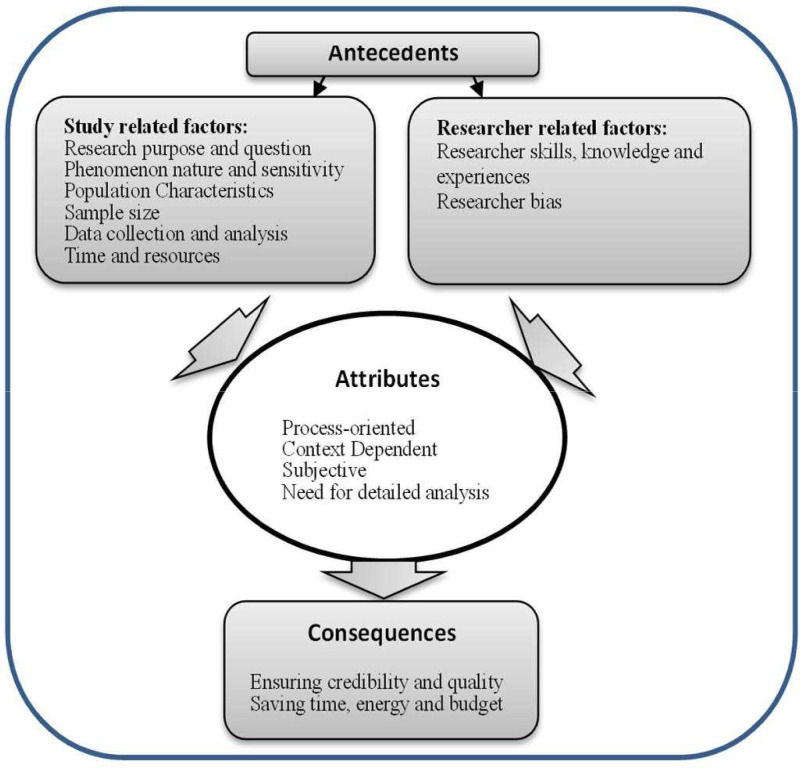
Background and Aim: Qualitative research plays an important role in improving nursing knowledge. Understanding the concept of saturation is essential to conducting rigorous qualitative research that contributes to evidence-based practice. The purpose of this study is to clarify the concept of saturation in qualitative research. Method: Evolutionary concept analysis was performed. A literature search was conducted using a variety of online databases for the years 2005- 2023. In total, 33 articles and books were analyzed using thematic analysis to identify the attributes, antecedents and consequences of saturation. The validity of the data was obtained by examining the analysis process by two independent researchers. Results: Saturation in qualitative research is a context-dependent, subjective process that requires detailed systematic analysis. Saturation is used in four ways in qualitative research: theoretical saturation, data saturation, code or thematic saturation, and meaning saturation. The antecedents of saturation were classified into two categories: study related factors and researcher related factors. The consequences of saturation were identified as: ensuring credibility and quality in qualitative research and time, energy and budget saving. Conclusion: This concept analysis serves to enhance the understanding of the concept of saturation, thereby offering valuable resources for qualitative researchers. By gaining a profound comprehension of saturation and its various types, researchers can ensure the validity of their studies while also optimizing time and resource allocation by avoiding redundant data collection. Future investigation warranted to elucidate how factors associated with reaching saturation impact estimations sample size.
Overview
The claims and statistics of this paper haven’t been checked yet.
Run the check — free, no account needed. It reads the open-access text and checks the sources it cites.
Integrity signals
Registry
Cites
Statistics
Figures
Verification
Claims the paper makes
The claims and statistics of this paper haven’t been checked yet.
Run the check — free, no account needed. It reads the open-access text and checks the sources it cites.
Claims other papers make about this one
Each is checked against this paper’s own text: does it say what the citing paper says it does?
The source backs part of the claim, not all of it — or backs it for a different population, condition or comparison.
In the citing paper
“The number of participating services in the research was determined by theoretical saturation from the qualitative analyses (25) in which the data collection was concluded when the information started to become redundant or repeated, even with the inclusion of new participants and services, as detected through a floating reading of the transcripts of the conducted interviews and fields diaries.”
From A mindfulness-based intervention for Substance Use Disorder in a Brazilian vulnerable population: a feasibility mixed method study (2024) · cites this paper as [25]
Experimental — accuracy not yet measured
Self-check
Percentages, sums and reported differences re-computed from the paper’s own numbers.
The self-check needs the paper’s full text.
Citations
Cites
Qualitative Inquiry and Research Design: Choosing Among Five Approaches
Lewis, S. (2015) · Health Promotion Practice · doi:10.1177/1524839915580941 · Cited by 22,105
How Many Interviews Are Enough?: An Experiment with Data Saturation and Variability
Guest, G., Bunce, A., & Johnson, L. (2006) · Field Methods · doi:10.1177/1525822x05279903 · Cited by 20,808 · cited 10×
“There are several reasons for pseudo-saturation, such as prematurely ending data collection, not exploring different perspectives or contexts, or overlooking important sources of information (Aldiabat & Le Navenec, 2018; Guest et al., 2006; Morse, 2015a).”
BackgroundInfluentialSaturation in qualitative research: exploring its conceptualization and operationalization
Saunders, B., Sim, J., Kingstone, T., Baker, S., Waterfield, J., Bartlam, B., Burroughs, H., & Jinks, C. (2018) · Quality & Quantity · doi:10.1007/s11135-017-0574-8 · Cited by 12,033 · cited 9×
“…still susceptible to false saturation due to the lack of discovery of relationships between codes and obtained themes, and still requires more data for the researcher to fully understand the depth, richness, and complexity of the phenomenon (Hennink et al., 2017; Low, 2019; Saunders et al., 2018).”
BackgroundMethodInfluentialBasics of Qualitative Research: Techniques and Procedures for Developing Grounded Theory
Wuetherick, B. (2010) · Canadian Journal of University Continuing Education · doi:10.21225/d5g01t · Cited by 8,333
(2011) · Cited by 7,157
Sample sizes for saturation in qualitative research: A systematic review of empirical tests
Hennink, M., & Kaiser, B. N. (2022) · Social Science & Medicine · doi:10.1016/j.socscimed.2021.114523 · Cited by 6,311 · cited 10×
“…still susceptible to false saturation due to the lack of discovery of relationships between codes and obtained themes, and still requires more data for the researcher to fully understand the depth, richness, and complexity of the phenomenon (Hennink et al., 2017; Low, 2019; Saunders et al., 2018).”
BackgroundMethodInfluentialBraun, V., & Clarke, V. (2021) · Qualitative Research in Sport, Exercise and Health · doi:10.1080/2159676x.2019.1704846 · Cited by 4,776 · cited 3×
“Information redundancy helps conceptualize saturation (Alam, 2021; Braun & Clarke, 2021; Bryman, 2006).”
BackgroundCode Saturation Versus Meaning Saturation: How Many Interviews Are Enough?
Hennink, M. M., Kaiser, B. N., & Marconi, V. C. (2017) · Qualitative Health Research · doi:10.1177/1049732316665344 · Cited by 4,597
Are We There Yet? Data Saturation in Qualitative Research
Fusch, P., & Ness, L. (2015) · The Qualitative Report · doi:10.46743/2160-3715/2015.2281 · Cited by 4,460
Sample size in qualitative research
Sandelowski, M. (1995) · Research in Nursing & Health · doi:10.1002/nur.4770180211 · Cited by 4,372 · cited 1×
“An important aspect of theoretical saturation is that in an iterative process, the researcher simultaneously engages in sampling, data collection, and data analysis (Sandelowski, 1995).”
BackgroundWhat is an adequate sample size? Operationalising data saturation for theory-based interview studies
Francis, J. J., Johnston, M., Robertson, C., Glidewell, L., Entwistle, V., Eccles, M. P., & Grimshaw, J. M. (2010) · Psychology & Health · doi:10.1080/08870440903194015 · Cited by 3,429
Integrating quantitative and qualitative research: How is it done
Bryman, A. (2006) · Qualitative Research · doi:10.1177/1468794106058877 · Cited by 3,354 · cited 1×
“Information redundancy helps conceptualize saturation (Alam, 2021; Braun & Clarke, 2021; Bryman, 2006).”
BackgroundA simple method to assess and report thematic saturation in qualitative research
Guest, G., Namey, E., & Chen, M. (2020) · PLOS ONE · doi:10.1371/journal.pone.0232076 · Cited by 2,929 · cited 8×
“S. Rahimi and M. khatooni 2017; Saunders et al., 2018), thematic saturation (Bowen, 2008; Faulkner & Trotter, 2017; Guest et al., 2006; Guest et al., 2020; Hennink & Kaiser, 2022; Hennink et al., 2017; Kerr et al., 2010; Low, 2019; Saunders et al., 2018) and, meaning saturation as a surrogate term,…”
BackgroundMethodInfluentialCritical analysis of strategies for determining rigor in qualitative inquiry
Morse, J. M. (2015) · Qualitative Health Research · doi:10.1177/1049732315588501 · Cited by 2,809 · cited 11×
“There are several reasons for pseudo-saturation, such as prematurely ending data collection, not exploring different perspectives or contexts, or overlooking important sources of information (Aldiabat & Le Navenec, 2018; Guest et al., 2006; Morse, 2015a).”
BackgroundMethodInfluentialThe SAGE Handbook of Grounded Theory
Bryant, A., & Charmaz, K. (2007) · SAGE · doi:10.4135/9781848607941 · Cited by 2,798 · cited 1×
“The researcher continues data collection until the emerging theory becomes strong and accounts for all the evidence (Bryant & Charmaz, 2007).”
BackgroundSample Size and Saturation in PhD Studies Using Qualitative Interviews
Mason, M. (2010) · Forum Qualitative Sozialforschung / Forum: Qualitative Social Research · doi:10.17169/fqs-11.3.1428 · Cited by 2,786 · cited 1×
“On the other hand, lengthy interviews can lead to participant fatigue or decreased efficiency due to repetitive data collection (Mason, 2010).”
BackgroundNaturalistic inquiry and the saturation concept: a research note
Bowen, G. A. (2008) · Qualitative Research · doi:10.1177/1468794107085301 · Cited by 2,749 · cited 12×
“In contrast, the positivist paradigm prioritizes objectivity and generalizability and sees saturation as a point that can be reached through precise data analysis (Bowen, 2008; Creswell & Poth, 2016), so it may be possible to achieve saturation with a smaller sample size (Creswell & Poth, 2016).”
BackgroundMethodInfluentialO’Reilly, M., & Parker, N. (2013) · Qualitative Research · doi:10.1177/1468794112446106 · Cited by 1,943 · cited 1×
“Reaching partial saturation is vital in qualitative research as it helps ensure the strength and validity of data collection (Bowen, 2008; Fusch & Ness, 2015; O ’ reilly & Parker, 2013).”
BackgroundDoes Sample Size Matter in Qualitative Research?: A Review of Qualitative Interviews in is Research
Marshall, B., Cardon, P., Poddar, A., & Fontenot, R. (2013) · Journal of Computer Information Systems · doi:10.1080/08874417.2013.11645667 · Cited by 1,636
What Influences Saturation? Estimating Sample Sizes in Focus Group Research
Hennink, M. M., Kaiser, B. N., & Weber, M. B. (2019) · Qualitative Health Research · doi:10.1177/1049732318821692 · Cited by 1,409 · cited 2×
“The sample size is always a topic of discussion among qualitative researchers (Guest et al., 2020; Hennink & Kaiser, 2022; Hennink et al., 2017; Hennink et al., 2019; Mwita, 2022).”
Background‘Clear as Mud’: Toward Greater Clarity in Generic Qualitative Research
Caelli, K., Ray, L., & Mill, J. (2003) · International Journal of Qualitative Methods · doi:10.1177/160940690300200201 · Cited by 1,256
(1999) · Cited by 1,140
What about N? A methodological study of sample-size reporting in focus group studies
Carlsen, B., & Glenton, C. (2011) · BMC Medical Research Methodology · doi:10.1186/1471-2288-11-26 · Cited by 670
Kerr, C., Nixon, A., & Wild, D. J. (2010) · Expert Review of Pharmacoeconomics & Outcomes Research · doi:10.1586/erp.10.30 · Cited by 622 · cited 6×
“This means that simply stating that codes or themes have been repeated and no new code or theme has been found is not enough (Kerr et al., 2010), and the explanatory and interpretive dimension of each code or theme must start repeating and no further explanation is found to claim that saturation…”
BackgroundMethodInfluentialA systematic qualitative case study: questions, data collection, NVivo analysis and saturation
Alam, M. K. (2020) · Qualitative Research in Organizations and Management An International Journal · doi:10.1108/qrom-09-2019-1825 · Cited by 510 · cited 1×
“Information redundancy helps conceptualize saturation (Alam, 2021; Braun & Clarke, 2021; Bryman, 2006).”
BackgroundA Pragmatic Definition of the Concept of Theoretical Saturation
Low, J. (2019) · Sociological Focus · doi:10.1080/00380237.2018.1544514 · Cited by 445 · cited 3×
“Code or thematic saturation refers to a stage in the data analysis process where repetitive codes or themes are identified, and no new information or relationships between them emerge (Bowen, 2008; Guest et al., 2020; Hennink et al., 2017; Low, 2019; Saunders et al., 2018; Yang et al., 2022).”
BackgroundMethodConcept analysis : an evolutionary view
Rodgers, B. L. (2000) · Medical Entomology and Zoology · Cited by 370
Factors influencing data saturation in qualitative studies
Mwita, K. (2022) · International Journal of Research in Business and Social Science (2147-4478) · doi:10.20525/ijrbs.v11i4.1776 · Cited by 348 · cited 12×
“…a homogeneous population, a diverse sample in the study population requires the collection of more data to encompass all perspectives and experiences, thus increasing the likelihood of reaching saturation (Guest et al., 2006; Hennink et al., 2017; Hennink et al., 2019; Morse, 2015b; Mwita, 2022).”
BackgroundMethodInfluentialRodgers’ evolutionary concept analysis-a valid method for developing knowledge in nursing science
Tofthagen, R., & Fagerstrøm, L. M. (2010) · Scandinavian Journal of Caring Sciences · doi:10.1111/j.1471-6712.2010.00845.x · Cited by 319
Information Overload: An Introduction
Bawden, D., & Robinson, L. (2020) · Oxford Research Encyclopedia of Politics · doi:10.1093/acrefore/9780190228637.013.1360 · Cited by 249
Conlon, C., Timonen, V., Elliott-O’Dare, C., O’Keeffe, S., & Foley, G. (2020) · Qualitative Health Research · doi:10.1177/1049732319899139 · Cited by 220 · cited 1×
“Generally, data, code, or thematic saturation focuses on the breadth of collected data, while meaning saturation and theoretical saturation focus on the depth of research data (Conlon et al., 2020; Saunders et al., 2018).”
BackgroundAre We There Yet? A Technique to Determine Theoretical Saturation
Rowlands, T., Waddell, N., & McKenna, B. J. (2015) · Journal of Computer Information Systems · doi:10.1080/08874417.2015.11645799 · Cited by 115
Concepts and evaluation of saturation in qualitative research
Yang, L., Qi, L., & Zhang, B. (2022) · Advances in Psychological Science · doi:10.3724/sp.j.1042.2022.00511 · Cited by 92
Faulkner, S. L., & Trotter, S. P. (2017) · The International Encyclopedia of Communication Research Methods · doi:10.1002/9781118901731.iecrm0250 · Cited by 76
Research works printed but not linked: 3
- Aldiabat, 2018, Data saturation: The mysterious step in grounded theory methodology, The qualitative report, 23, 245
- Morse, 2015, 25, 587
- Thomson, 2010, Sample size and grounded theory. Thomson, SB (2010), Grounded Theory-Sample Size. Journal of Administration and Governance, 5, 45
Cited by
Sorted by citations
Wutich, A., Beresford, M., & Bernard, H. R. (2024) · International Journal of Qualitative Methods · doi:10.1177/16094069241296206 · Cited by 416
“…size estimation shifted, centering on what “ saturation ” means and how to study it (Aldiabat & Le Navenec, 2018; Daher, 2023; Daniel, 2019; Hennink et al., 2017; Leese et al., 2021; Marshall et al., 2013; Mason, 2010; Naeem et al., 2024; Rahimi, 2024; Saunders et al., 2018; Sebele-Mpofu, 2020).”
Sample Size in Qualitative Research: Moving from Data Saturation to Theoretical Saturation
Lim, W. M. (2025) · Journal of Global Marketing · doi:10.1080/08911762.2025.2590757 · Cited by 84
“…discussions often suffice for code coverage under homogeneity/narrow aims while diversity/ multi-site or meaning/theory goals require larger samples. rahimi and khatooni (2024) • engages in a concept analysis that classifies four models of saturation (code/thematic, data, meaning, theoretical)…”
Ensuring validity and reliability in qualitative research
Noble, H. R., & Smith, J. (2025) · Evidence-Based Nursing · doi:10.1136/ebnurs-2024-104232 · Cited by 44
Ghimire, A., & Qiu, Y. (2025) · Nurse Education in Practice · doi:10.1016/j.nepr.2025.104330 · Cited by 52
Metadata
- Authors
- Rahimi, S., & khatooni, M.
- Affiliations
- Qazvin University of Medical Sciences (IR)
- Corresponding author
- Rahimi, Sara
- Venue
- International Journal of Nursing Studies Advances
- Publisher
- Elsevier BV
- Published
- 2024-06
- Volume
- 6
- Pages
- 100174
- ISSN
- 2666-142X (ISSN-L)
- PMC
- PMC11080421
- OpenAlex
- W4390604507
- Cited by
- 560
- References
- 34
- Citations by year
- 2026: 273 · 2025: 236 · 2024: 51
- FWCI
- 704.99
- Type
- journal article
- Language
- en
- Open access
- gold
- doi.org
- Licence
- Locations
- International Journal of Nursing Studies Advances (publishedVersion, cc-by-nc-nd)
- PubMed Central (publishedVersion, cc-by)
- PubMed (publishedVersion)
- DOAJ (DOAJ: Directory of Open Access Journals) (submittedVersion)
- Funders
- Qazvin University of Medical Sciences
- Topics
- Social Sciences › Education › Qualitative Research Methods and Applications
- Social Sciences › Sociology and Political Science › Qualitative Research Methods and Ethics
- Social Sciences › Sociology and Political Science › Focus Groups and Qualitative Methods
- Keywords
- saturation, qualitative research, data saturation, theoretical saturation, research credibility, sample size determination, nursing research
About these checks
Registry, retraction, Cites and statistics results are computed, not judged, with one exception: a printed reference that no index lists is read once by a model before it counts as a citation error. Claims are extracted by a model and kept only when their quote appears verbatim in the text; each cited source is then checked, with a model’s help, for whether it says what the claim relies on. Those verdicts can be wrong — read the claim’s quote and the cited source before relying on one.
Statistics and arithmetic are recomputed, not judged.
Confidence bands are shown only for fields calibrated on our annotated test set. None is calibrated yet, so no band is shown.
What counts as a claim ›How we measure confidence ›How we check this ›
Are you an author, or do you see a problem with this page? Request a review
