

The DOI matches its Crossref record; 34 of the 34 references it cites were found in a registry or an index.
Saturation in qualitative research: An evolutionary concept analysis
Open accessAbstract
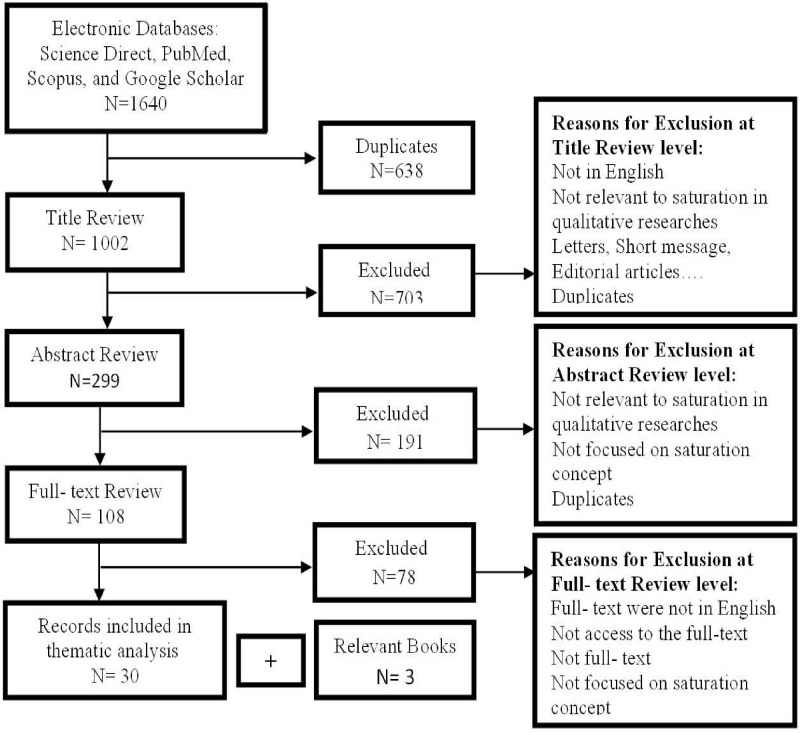
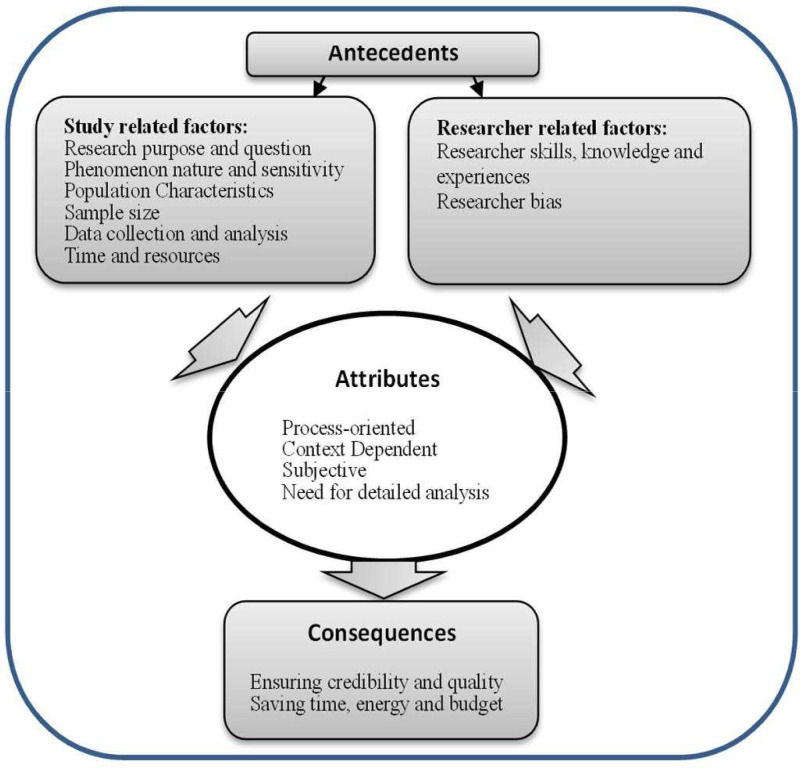
Background and Aim: Qualitative research plays an important role in improving nursing knowledge. Understanding the concept of saturation is essential to conducting rigorous qualitative research that contributes to evidence-based practice. The purpose of this study is to clarify the concept of saturation in qualitative research. Method: Evolutionary concept analysis was performed. A literature search was conducted using a variety of online databases for the years 2005- 2023. In total, 33 articles and books were analyzed using thematic analysis to identify the attributes, antecedents and consequences of saturation. The validity of the data was obtained by examining the analysis process by two independent researchers. Results: Saturation in qualitative research is a context-dependent, subjective process that requires detailed systematic analysis. Saturation is used in four ways in qualitative research: theoretical saturation, data saturation, code or thematic saturation, and meaning saturation. The antecedents of saturation were classified into two categories: study related factors and researcher related factors. The consequences of saturation were identified as: ensuring credibility and quality in qualitative research and time, energy and budget saving. Conclusion: This concept analysis serves to enhance the understanding of the concept of saturation, thereby offering valuable resources for qualitative researchers. By gaining a profound comprehension of saturation and its various types, researchers can ensure the validity of their studies while also optimizing time and resource allocation by avoiding redundant data collection. Future investigation warranted to elucidate how factors associated with reaching saturation impact estimations sample size.
Overview
The claims and statistics of this paper haven’t been checked yet.
Run the check — free, no account needed. It reads the open-access text and checks the sources it cites.
Integrity signals
Registry
Cites
Statistics
Figures
Verification
Claims the paper makes
The claims and statistics of this paper haven’t been checked yet.
Run the check — free, no account needed. It reads the open-access text and checks the sources it cites.
Claims other papers make about this one
Each is checked against this paper’s own text: does it say what the citing paper says it does?
The source backs part of the claim, not all of it — or backs it for a different population, condition or comparison.
In the citing paper
“The number of participating services in the research was determined by theoretical saturation from the qualitative analyses (25) in which the data collection was concluded when the information started to become redundant or repeated, even with the inclusion of new participants and services, as detected through a floating reading of the transcripts of the conducted interviews and fields diaries.”
From A mindfulness-based intervention for Substance Use Disorder in a Brazilian vulnerable population: a feasibility mixed method study (2024) · cites this paper as [25]
Experimental — accuracy not yet measured
Self-check
Percentages, sums and reported differences re-computed from the paper’s own numbers.
The self-check needs the paper’s full text.
Citations
Cites
Qualitative Inquiry and Research Design: Choosing Among Five Approaches
Lewis, S. (2015) · Health Promotion Practice · doi:10.1177/1524839915580941 · Cited by 22,105
How Many Interviews Are Enough?: An Experiment with Data Saturation and Variability
Guest, G., Bunce, A., & Johnson, L. (2006) · Field Methods · doi:10.1177/1525822x05279903 · Cited by 20,808 · cited 10×
“There are several reasons for pseudo-saturation, such as prematurely ending data collection, not exploring different perspectives or contexts, or overlooking important sources of information (Aldiabat & Le Navenec, 2018; Guest et al., 2006; Morse, 2015a).”
BackgroundInfluentialSaturation in qualitative research: exploring its conceptualization and operationalization
Saunders, B., Sim, J., Kingstone, T., Baker, S., Waterfield, J., Bartlam, B., Burroughs, H., & Jinks, C. (2018) · Quality & Quantity · doi:10.1007/s11135-017-0574-8 · Cited by 12,033 · cited 9×
“…still susceptible to false saturation due to the lack of discovery of relationships between codes and obtained themes, and still requires more data for the researcher to fully understand the depth, richness, and complexity of the phenomenon (Hennink et al., 2017; Low, 2019; Saunders et al., 2018).”
BackgroundMethodInfluentialBasics of Qualitative Research: Techniques and Procedures for Developing Grounded Theory
Wuetherick, B. (2010) · Canadian Journal of University Continuing Education · doi:10.21225/d5g01t · Cited by 8,333
(2011) · Cited by 7,157
Sample sizes for saturation in qualitative research: A systematic review of empirical tests
Hennink, M., & Kaiser, B. N. (2022) · Social Science & Medicine · doi:10.1016/j.socscimed.2021.114523 · Cited by 6,311 · cited 10×
“…still susceptible to false saturation due to the lack of discovery of relationships between codes and obtained themes, and still requires more data for the researcher to fully understand the depth, richness, and complexity of the phenomenon (Hennink et al., 2017; Low, 2019; Saunders et al., 2018).”
BackgroundMethodInfluentialBraun, V., & Clarke, V. (2021) · Qualitative Research in Sport, Exercise and Health · doi:10.1080/2159676x.2019.1704846 · Cited by 4,776 · cited 3×
“Information redundancy helps conceptualize saturation (Alam, 2021; Braun & Clarke, 2021; Bryman, 2006).”
BackgroundCode Saturation Versus Meaning Saturation: How Many Interviews Are Enough?
Hennink, M. M., Kaiser, B. N., & Marconi, V. C. (2017) · Qualitative Health Research · doi:10.1177/1049732316665344 · Cited by 4,597
Are We There Yet? Data Saturation in Qualitative Research
Fusch, P., & Ness, L. (2015) · The Qualitative Report · doi:10.46743/2160-3715/2015.2281 · Cited by 4,460
Sample size in qualitative research
Sandelowski, M. (1995) · Research in Nursing & Health · doi:10.1002/nur.4770180211 · Cited by 4,372 · cited 1×
“An important aspect of theoretical saturation is that in an iterative process, the researcher simultaneously engages in sampling, data collection, and data analysis (Sandelowski, 1995).”
Background
Research works printed but not linked: 3
- Aldiabat, 2018, Data saturation: The mysterious step in grounded theory methodology, The qualitative report, 23, 245
- Morse, 2015, 25, 587
- Thomson, 2010, Sample size and grounded theory. Thomson, SB (2010), Grounded Theory-Sample Size. Journal of Administration and Governance, 5, 45
Cited by
Sorted by citations
Wutich, A., Beresford, M., & Bernard, H. R. (2024) · International Journal of Qualitative Methods · doi:10.1177/16094069241296206 · Cited by 416
“…size estimation shifted, centering on what “ saturation ” means and how to study it (Aldiabat & Le Navenec, 2018; Daher, 2023; Daniel, 2019; Hennink et al., 2017; Leese et al., 2021; Marshall et al., 2013; Mason, 2010; Naeem et al., 2024; Rahimi, 2024; Saunders et al., 2018; Sebele-Mpofu, 2020).”
Sample Size in Qualitative Research: Moving from Data Saturation to Theoretical Saturation
Lim, W. M. (2025) · Journal of Global Marketing · doi:10.1080/08911762.2025.2590757 · Cited by 84
“…discussions often suffice for code coverage under homogeneity/narrow aims while diversity/ multi-site or meaning/theory goals require larger samples. rahimi and khatooni (2024) • engages in a concept analysis that classifies four models of saturation (code/thematic, data, meaning, theoretical)…”
Ensuring validity and reliability in qualitative research
Noble, H. R., & Smith, J. (2025) · Evidence-Based Nursing · doi:10.1136/ebnurs-2024-104232 · Cited by 44
Ghimire, A., & Qiu, Y. (2025) · Nurse Education in Practice · doi:10.1016/j.nepr.2025.104330 · Cited by 52
Metadata
- Authors
- Rahimi, S., & khatooni, M.
- Affiliations
- Qazvin University of Medical Sciences (IR)
- Corresponding author
- Rahimi, Sara
- Venue
- International Journal of Nursing Studies Advances
- Publisher
- Elsevier BV
- Published
- 2024-06
- Volume
- 6
- Pages
- 100174
- ISSN
- 2666-142X (ISSN-L)
- PMC
- PMC11080421
- OpenAlex
- W4390604507
- Cited by
- 560
- References
- 34
- Citations by year
- 2026: 273 · 2025: 236 · 2024: 51
- FWCI
- 704.99
- Type
- journal article
- Language
- en
- Open access
- gold
- doi.org
- Licence
- Locations
- International Journal of Nursing Studies Advances (publishedVersion, cc-by-nc-nd)
- PubMed Central (publishedVersion, cc-by)
- PubMed (publishedVersion)
- DOAJ (DOAJ: Directory of Open Access Journals) (submittedVersion)
- Funders
- Qazvin University of Medical Sciences
- Topics
- Social Sciences › Education › Qualitative Research Methods and Applications
- Social Sciences › Sociology and Political Science › Qualitative Research Methods and Ethics
- Social Sciences › Sociology and Political Science › Focus Groups and Qualitative Methods
- Keywords
- saturation, qualitative research, data saturation, theoretical saturation, research credibility, sample size determination, nursing research
About these checks
Registry, retraction, Cites and statistics results are computed, not judged, with one exception: a printed reference that no index lists is read once by a model before it counts as a citation error. Claims are extracted by a model and kept only when their quote appears verbatim in the text; each cited source is then checked, with a model’s help, for whether it says what the claim relies on. Those verdicts can be wrong — read the claim’s quote and the cited source before relying on one.
Statistics and arithmetic are recomputed, not judged.
Confidence bands are shown only for fields calibrated on our annotated test set. None is calibrated yet, so no band is shown.
What counts as a claim ›How we measure confidence ›How we check this ›
Are you an author, or do you see a problem with this page? Request a review
