

The DOI matches its Crossref record; 113 of the 120 references it cites were found in a registry or an index, and 7 are not checked yet.
The application of large language models in medicine: A scoping review
Open accessAbstract
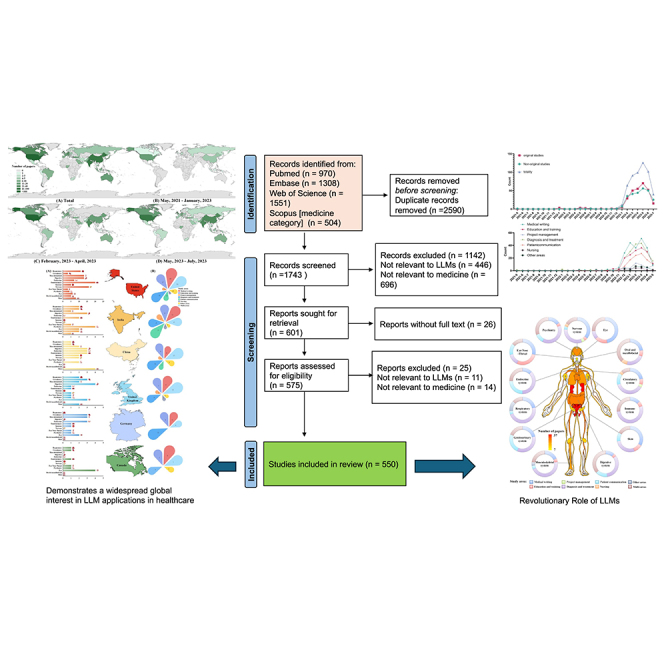
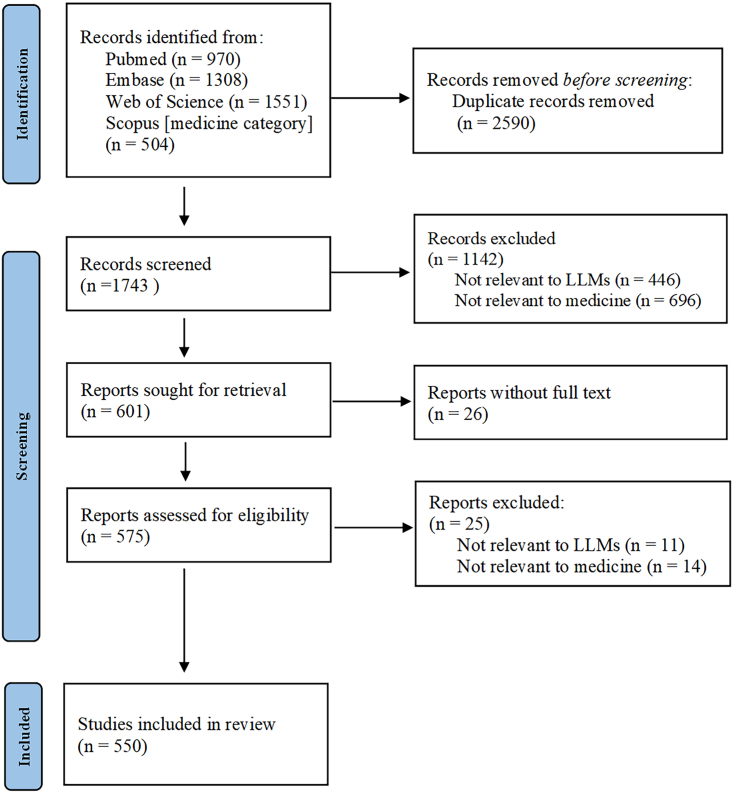
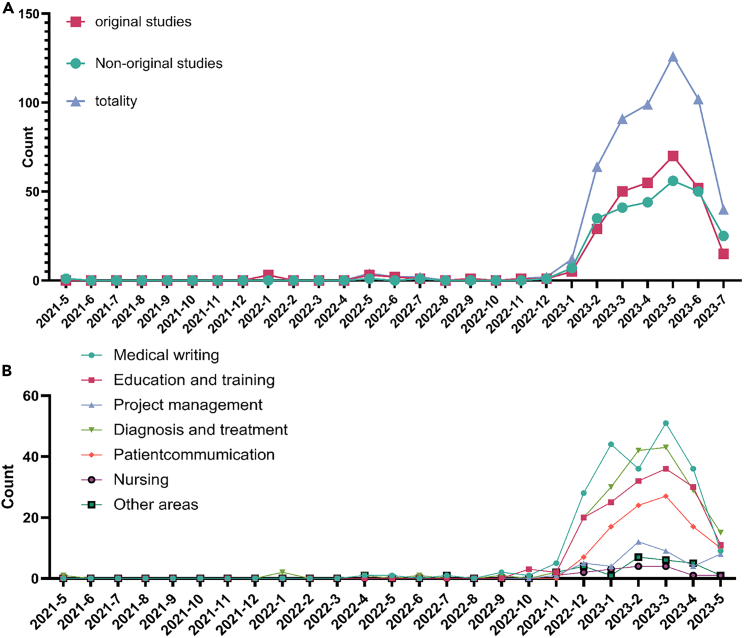
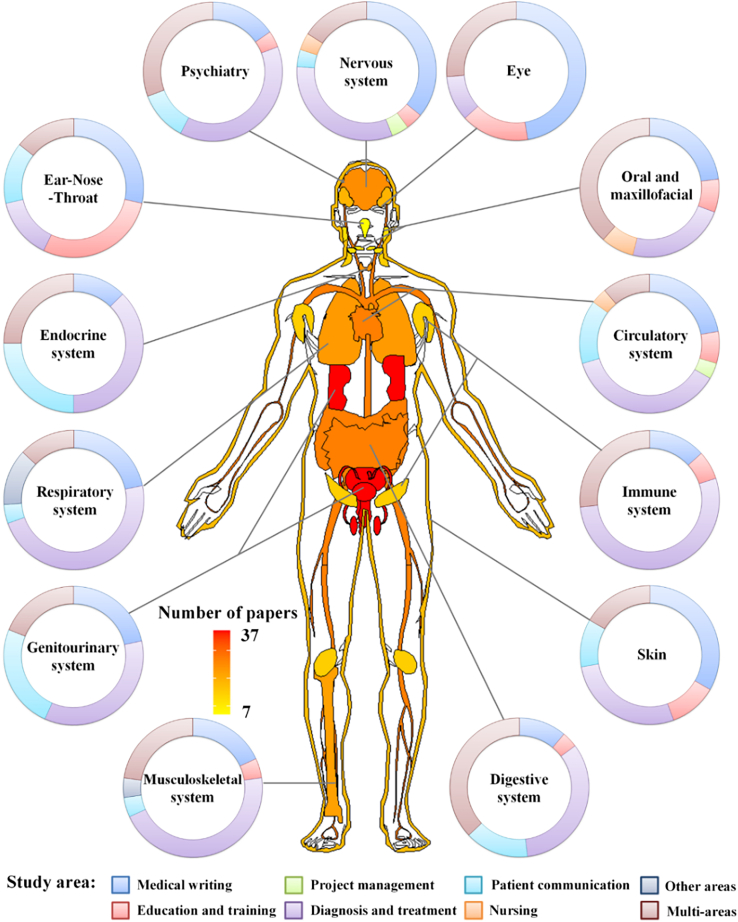
This study systematically reviewed the application of large language models (LLMs) in medicine, analyzing 550 selected studies from a vast literature search. LLMs like ChatGPT transformed healthcare by enhancing diagnostics, medical writing, education, and project management. They assisted in drafting medical documents, creating training simulations, and streamlining research processes. Despite their growing utility in assisted diagnosis and improving doctor-patient communication, challenges persisted, including limitations in contextual understanding and the risk of over-reliance. The surge in LLM-related research indicated a focus on medical writing, diagnostics, and patient communication, but highlighted the need for careful integration, considering validation, ethical concerns, and the balance with traditional medical practice. Future research directions suggested a focus on multimodal LLMs, deeper algorithmic understanding, and ensuring responsible, effective use in healthcare.
Overview
The claims and statistics of this paper haven’t been checked yet.
Run the check — free, no account needed. It reads the open-access text and checks the sources it cites.
Integrity signals
Registry
Cites
Statistics
Figures
Verification
Claims the paper makes
The claims and statistics of this paper haven’t been checked yet.
Run the check — free, no account needed. It reads the open-access text and checks the sources it cites.
Claims other papers make about this one
Each is checked against this paper’s own text: does it say what the citing paper says it does?
The cited source says what the claim attributes to it.
In the citing paper
“Large Language Models (LLMs) are increasingly used by healthcare professionals and patients for medical information synthesis.”
From Large Language Model Hallucinations in Spine Surgery: A Comparative Analysis of Clinician vs Patient-Level Prompts (2026) · cites this paper as [1]
The check wasn’t confident either way, so it gives no verdict — never disputed.
In the citing paper
“Existing reviews of LLMs in healthcare have largely neglected a deeper analysis of explainability methods.”
From Explainability of decoder-only clinical large language models: A scoping review (2026) · cites this paper as [48]
Experimental — accuracy not yet measured
Self-check
Percentages, sums and reported differences re-computed from the paper’s own numbers.
The self-check needs the paper’s full text.
Citations
Cites
Scoping studies: advancing the methodology
Levac, D., Colquhoun, H., & O'Brien, K. K. (2010) · Implementation Science · doi:10.1186/1748-5908-5-69 · Cited by 15,268
Chain-Of-Thought Prompting Elicits Reasoning in Large Language Models
Wei, J., Wang, X., Schuurmans, D., Bosma, M., Ichter, B., Xia, F., Chi, E., Le, Q. V., & Zhou, D. (2022) · Advances in Neural Information Processing Systems 35 · doi:10.52202/068431-1800 · Cited by 4,505
Self-citationTraining language models to follow instructions with human feedback
Ouyang, L., Wu, J., Jiang, X., Almeida, D., Wainwright, C. L., Mishkin, P., Zhang, C., Agarwal, S., Slama, K., Ray, A., et al. (2022) · arXiv · doi:10.48550/arxiv.2203.02155 · Cited by 4,208
Large language models encode clinical knowledge
Singhal, K., Azizi, S., Tu, T., Mahdavi, S. S., Wei, J., Chung, H. W., Scales, N., Tanwani, A., Cole-Lewis, H., Pfohl, S., et al. (2023) · Nature · doi:10.1038/s41586-023-06291-2 · Cited by 4,083
Large Language Models Encode Clinical Knowledge
Singhal, K., Azizi, S., Tu, T., Mahdavi, S. S., Wei, J., Chung, H. W., Scales, N., Tanwani, A., Cole-Lewis, H., Pfohl, S., et al. (2022) · arXiv · doi:10.48550/arxiv.2212.13138 · Cited by 4,083
Large language models in medicine
Thirunavukarasu, A. J., Ting, D. S. J., Elangovan, K., Gutierrez, L., Tan, T. F., & Ting, D. S. W. (2023) · Nature Medicine · doi:10.1038/s41591-023-02448-8 · Cited by 3,944
Revolutionizing healthcare: the role of artificial intelligence in clinical practice
Alowais, S. A., Alghamdi, S. S., Alsuhebany, N., Alqahtani, T., Alshaya, A. I., Almohareb, S. N., Aldairem, A., Alrashed, M., Bin Saleh, K., Badreldin, H. A., et al. (2023) · BMC Medical Education · doi:10.1186/s12909-023-04698-z · Cited by 3,146
Training Language Models to Follow Instructions with Human Feedback
Ouyang, L., Wu, J., Jiang, X., Almeida, D., Wainwright, C., Mishkin, P., Zhang, C., Agarwal, S., Slama, K., Ray, A., et al. (2022) · Advances in Neural Information Processing Systems 35 · doi:10.52202/068431-2011 · Cited by 3,117
A Survey of Large Language Models
Zhao, W. X., Zhou, K., Li, J., Tang, T., Dong, Z., Hou, Y., Zhang, B., Min, Y., Zhang, J., Liu, P., et al. (2026) · Frontiers of Computer Science · doi:10.1007/s11704-026-60308-3 · Cited by 2,093
Self-citationA Survey of Large Language Models
Zhao, W. X., Zhou, K., Li, J., Tang, T., Wang, X., Hou, Y., Min, Y., Zhang, B., Zhang, J., Dong, Z., et al. (2023) · arXiv · doi:10.48550/arxiv.2303.18223 · Cited by 2,090
Self-citation
Research works printed but not linked: 2
- Thirunavukarasu, 2023, Large language models in medicine, Nat. Med., 29, 1930, 10.1038/s41591-023-02448-8 · DOI · Paper page
- Chen, 2023, Large language models in biomedical natural language processing: benchmarks, baselines, and recommendations, arXiv
Cited by
Sorted by citations
Large language models in patient education: a scoping review of applications in medicine
Aydin, S., Karabacak, M., Vlachos, V., & Margetis, K. (2024) · Frontiers in Medicine · doi:10.3389/fmed.2024.1477898 · Cited by 318
Large Language Models in Healthcare and Medical Applications: A Review
Maity, S., & Saikia, M. J. (2025) · Bioengineering · doi:10.3390/bioengineering12060631 · Cited by 249
Large language models for disease diagnosis: a scoping review
Zhou, S., Xu, Z., Zhang, M., Xu, C., Guo, Y., Zhan, Z., Fang, Y., Ding, S., Wang, J., Xu, K., et al. (2025) · npj Artificial Intelligence · doi:10.1038/s44387-025-00011-z · Cited by 188
Self-citationRevolutionizing Health Care: The Transformative Impact of Large Language Models in Medicine
Zhang, K., Meng, X., Yan, X., Ji, J., Liu, J., Xu, H., Zhang, H., Liu, D., Wang, J., Wang, X., et al. (2024) · Journal of Medical Internet Research · doi:10.2196/59069 · Cited by 148
Self-citationArtsi, Y., Sorin, V., Glicksberg, B. S., Korfiatis, P. D., Nadkarni, G. N., & Klang, E. (2025) · Frontiers in Digital Health · doi:10.3389/fdgth.2025.1659134 · Cited by 113
Metadata
- Authors
- Meng, X., Yan, X., Zhang, K., Liu, D., Cui, X., Yang, Y., Zhang, M., Cao, C., Wang, J., Wang, X., Gao, J., Wang, Y.-G.-S., Ji, J.-M., Qiu, Z., Li, M., Qian, C., Guo, T., Ma, S., Wang, Z., Guo, Z., Lei, Y., Shao, C., Wang, W., Fan, H., & Tang, Y.-D.
- Affiliations
- Peking University (CN)
- Tianjin University (CN)
- Chinese Academy of Medical Sciences & Peking Union Medical College (CN)
- Hebei Medical University (CN)
- Peking University Third Hospital (CN)
- Beihang University (CN)
- Corresponding author
- Fan, Haojun
- Tang, Yi-Da
- ORCID
- Venue
- iScience
- Publisher
- Elsevier BV
- Published
- 2024-05
- Volume
- 27
- Issue
- 5
- Pages
- 109713
- ISSN
- 2589-0042 (ISSN-L)
- PMC
- PMC11091685
- OpenAlex
- W4395052272
- Cited by
- 414
- References
- 114
- Citations by year
- 2026: 188 · 2025: 188 · 2024: 38
- FWCI
- 9.44
- Type
- journal article
- Language
- en
- Open access
- gold
- doi.org
- Licence
- Locations
- iScience (publishedVersion, cc-by-nc-nd)
- PubMed Central (publishedVersion, cc-by-nc-nd)
- PubMed (publishedVersion)
- DOAJ (DOAJ: Directory of Open Access Journals) (submittedVersion)
- Funders
- National Key Research and Development Program of China Stem Cell and Translational Research (2020YFC2004705)
- National Natural Science Foundation of China (81825003, 82270376, 91957123)
- China Scholarship Council (CSCF2021A04)
- CAMS Innovation Fund for Medical Sciences
- Chinese Academy of Meteorological Sciences (2021-I2M-5-003, T-B-119)
- National Key Research and Development Program of China
- Beijing Municipal Science and Technology Commission, Adminitrative Commission of Zhongguancun Science Park
- Beijing Nova Program (Z201100006820002)
- Topics
- Health Sciences › Medicine › Health Informatics › Artificial Intelligence in Healthcare and Education
- Health Sciences › Health Professions › Health Information Management › Artificial Intelligence in Healthcare
- Physical Sciences › Computer Science › Artificial Intelligence › Machine Learning in Healthcare
- Keywords
- large language models, ChatGPT, medical applications of AI, medical diagnostics, medical writing, medical education, training simulation, physician-patient communication, overreliance on AI, multimodal large language models, ethics of AI in healthcare
About these checks
Registry, retraction, Cites and statistics results are computed, not judged, with one exception: a printed reference that no index lists is read once by a model before it counts as a citation error. Claims are extracted by a model and kept only when their quote appears verbatim in the text; each cited source is then checked, with a model’s help, for whether it says what the claim relies on. Those verdicts can be wrong — read the claim’s quote and the cited source before relying on one.
Statistics and arithmetic are recomputed, not judged.
Confidence bands are shown only for fields calibrated on our annotated test set. None is calibrated yet, so no band is shown.
What counts as a claim ›How we measure confidence ›How we check this ›
Are you an author, or do you see a problem with this page? Request a review
