

Integrative analysis of pooled CRISPR screens provide functional insights into AD GWAS risk genes
Open accessThe DOI matches its Crossref record; 78 of the 78 references it cites were found in a registry or an index; none of the 90 sources its claims cite is checked for support yet.
Abstract
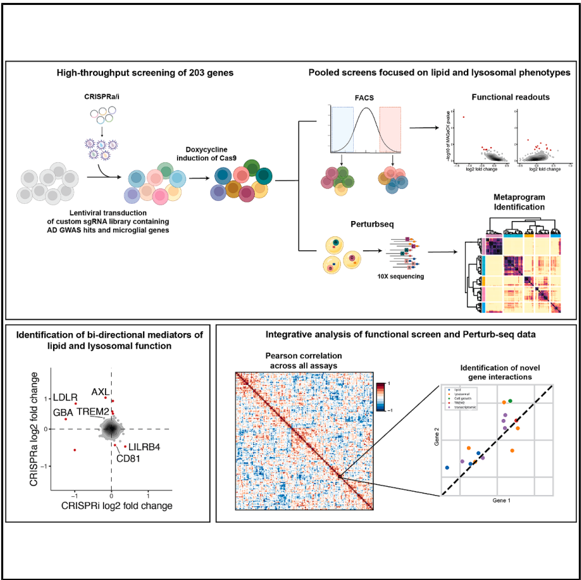
Microglia pathways such as lipid transport and metabolism, phagocytosis, and lysosomal function are implicated Alzheimer's disease (AD) pathology, but the mechanisms underlying these pathways remain poorly understood. To map these pathways, custom CRISPR activation and interference (CRISPRa/i) libraries were constructed targeting 203 microglial and genome-wide association study (GWAS)-associated risk genes. Pooled CRISPRa/i screens in THP-1 cells identified core functional regulators of lipid metabolism and lysosomal function, a subset of which were validated in primary macrophages. We also captured transcriptomic changes caused by these genes by performing Perturb-seq in primary macrophages. Through non-negative matrix factorization, we identified five gene programs altered by our perturbation library. We then used an integrative analysis of functional screen data with Perturb-seq data that enabled us to uncover novel functions and genetic relationships between perturbations. This multidimensional resource links genetic perturbations to phenotypes and transcriptional programs, establishing a scalable framework for systematic gene discovery in neurodegeneration and beyond.
Overview
CoChat Summary
TL;DR
This study built custom CRISPRa/i sgRNA libraries targeting 203 microglial and AD GWAS-associated genes and screened them in THP-1 cells and primary human macrophages, identifying regulators of surface TREM2, lipid uptake, and lysosomal function. Integrating functional screens with Perturb-seq revealed five gene programs and enabled gene-function prediction from correlated perturbation profiles.
Key findings
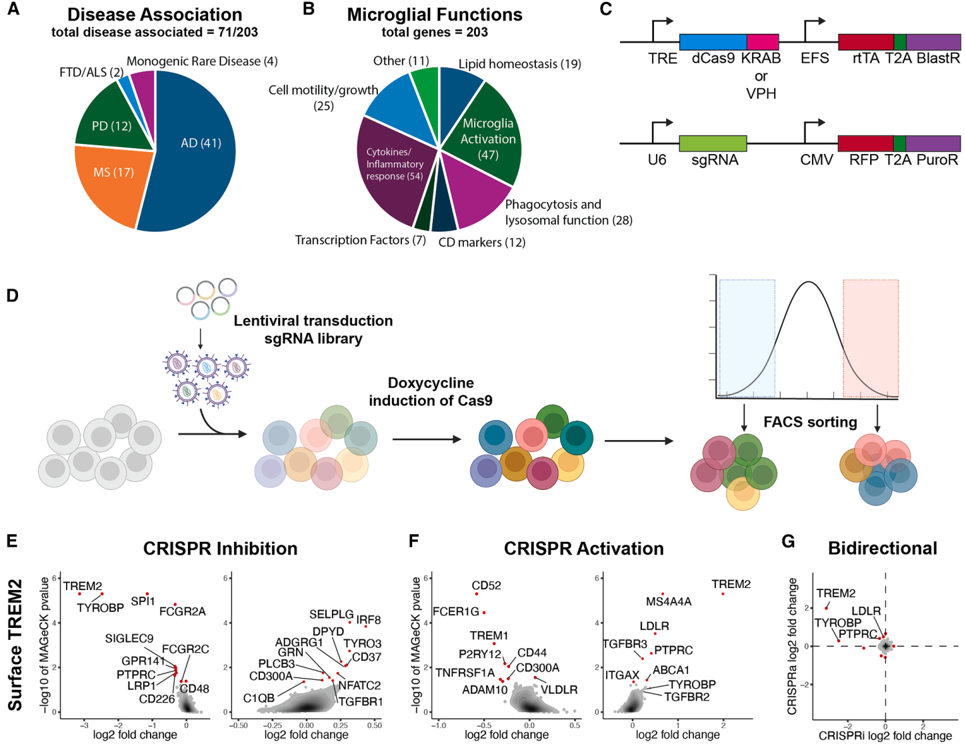
- In THP-1 screens, TGFBR2 and its coreceptor TGFBR3 regulated surface TREM2; TGF-β treatment increased surface and soluble TREM2. MS4A4A was the strongest regulator of surface TREM2 in the CRISPRa screen, and TYROBP/DAP12, PTPRC/CD45, and LDLR bidirectionally regulated surface TREM2.
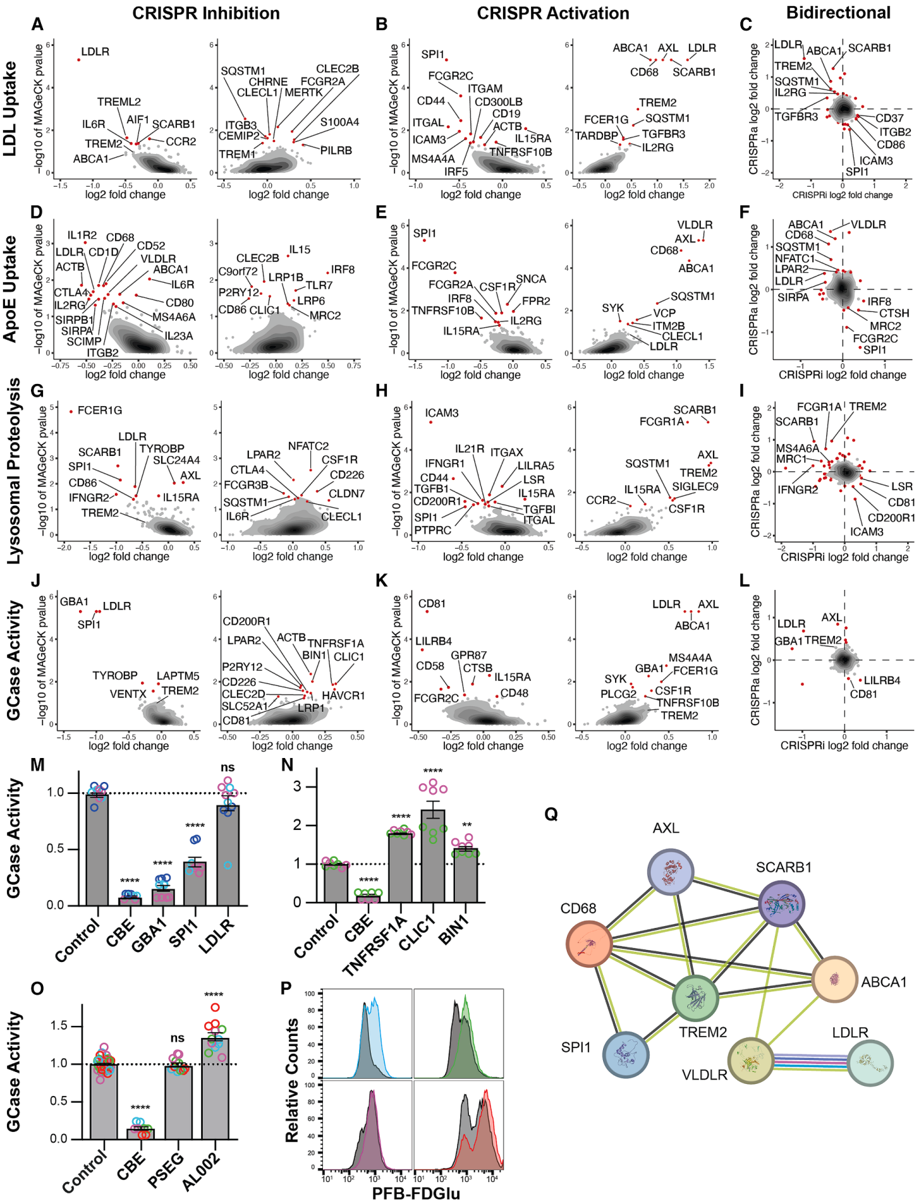
- Lipid and lysosome screens identified LDLR, SCARB1, and ABCA1 as top LDL-uptake hits; TREM2, TGFBR3, and SQSTM1 as bidirectional LDL-uptake regulators; SCARB1 and TREM2 as LDL-specific, and VLDLR and SIRPA as ApoE4-specific. GCase activity was bidirectionally regulated by LDLR, AXL, TREM2, CD81, and LILRB4.
- In primary hMΦ validation, GBA1 KO reduced GCase activity; KO of SPI1, TNFRSF1A, CLIC1, and BIN1 but not LDLR produced expected GCase phenotypes; the TREM2-activating antibody AL002 increased GCase activity in hMΦ from 4 donors.
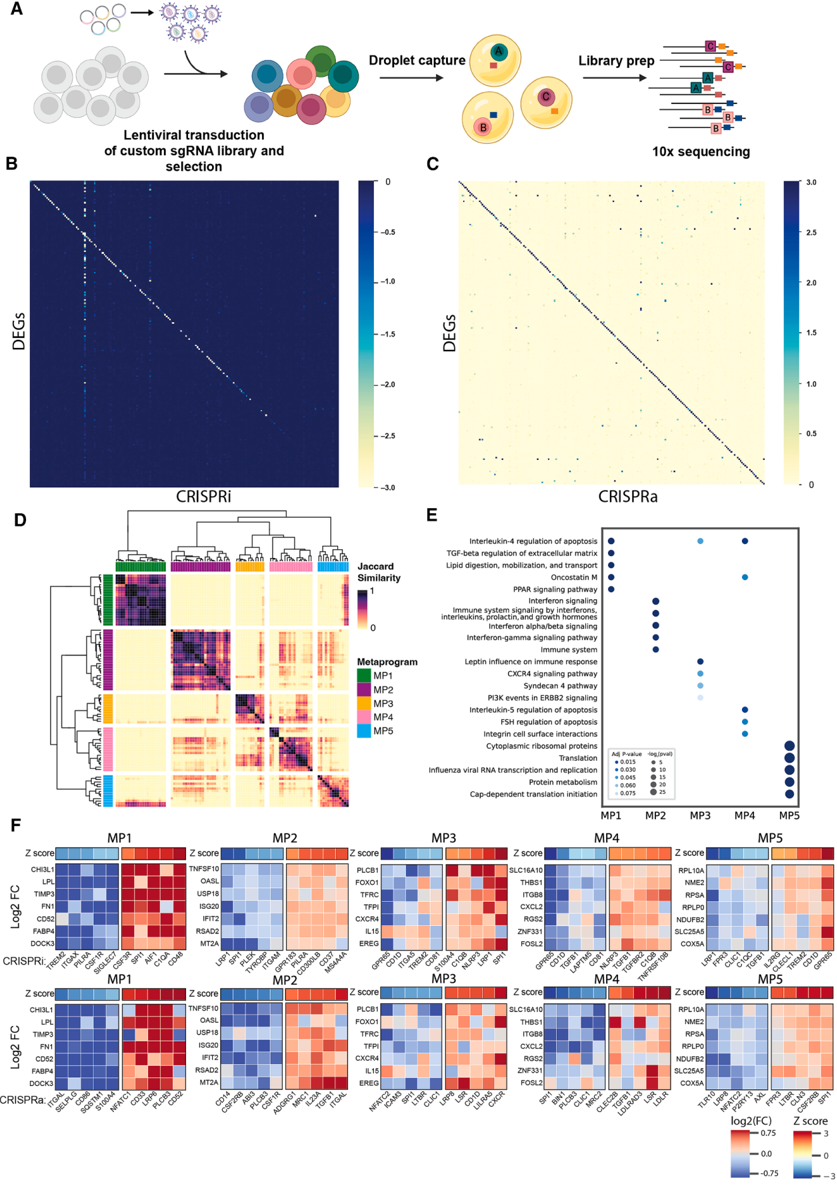
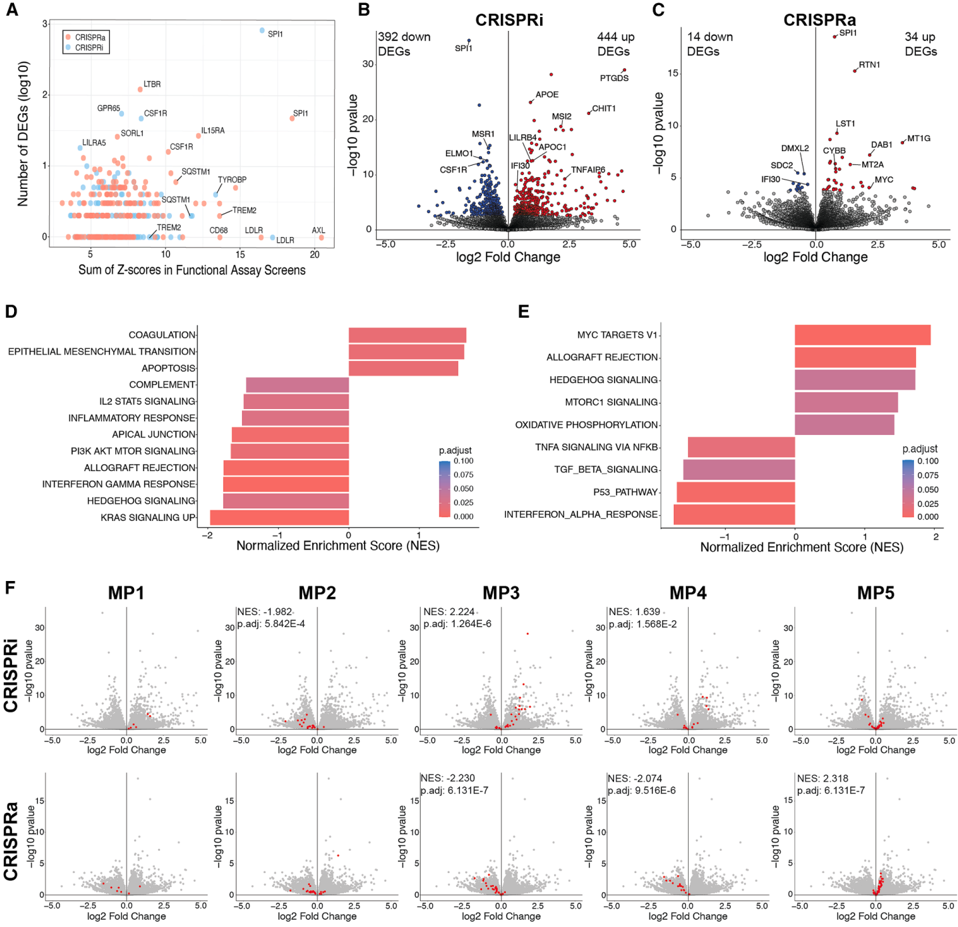
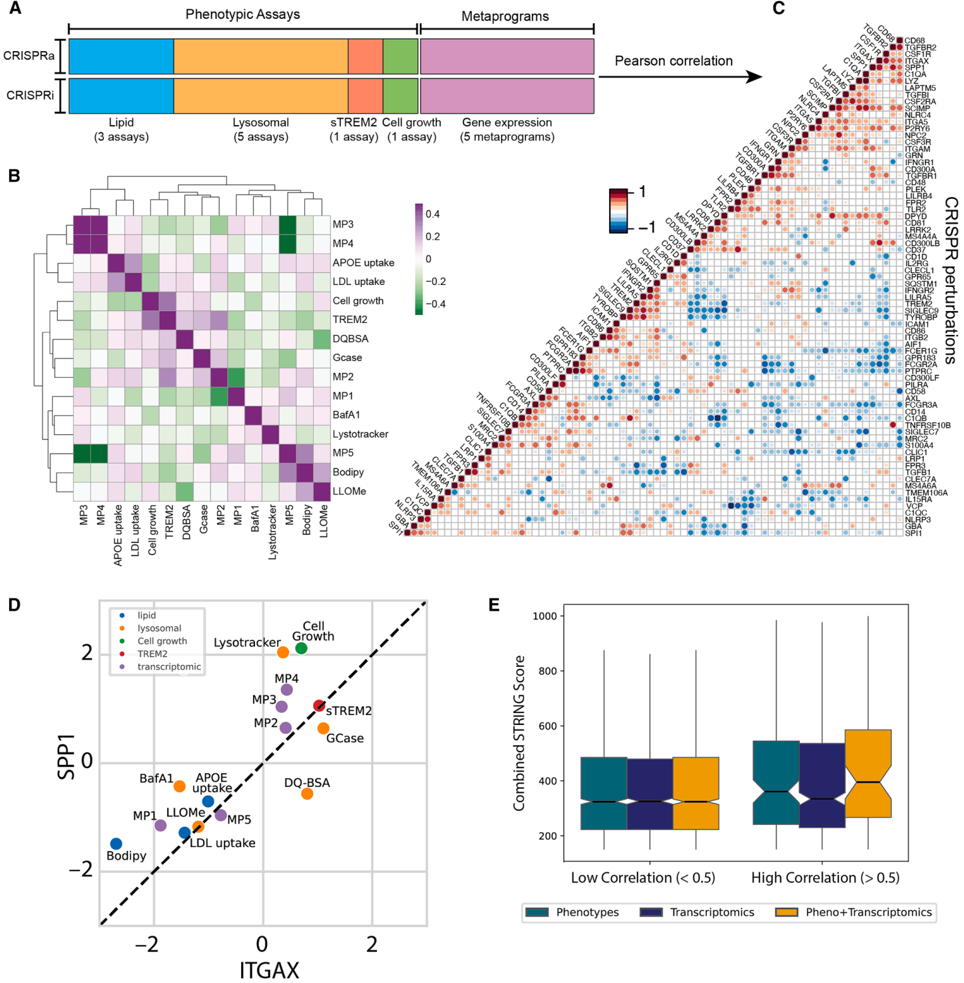
- Perturb-seq in primary hMΦ (28,446 CRISPRi cells, 23,509 CRISPRa cells) achieved median target KD of 57.4% (log2FC = −1.228) and OE of 289% (log2FC = 1.950), identified 5 metaprograms, and showed SPI1 CRISPRi caused 444 upregulated and 392 downregulated DEGs (67.6% SPI1 reduction, log2FC = −1.637) versus 34 upregulated and 14 downregulated DEGs with CRISPRa. SPP1 and ITGAX were highly correlated (Pearson r = 0.791), and gene pairs with r ≥ 0.5 had higher STRING interaction scores.
Methods
- Custom CRISPRa/i sgRNA libraries targeted 203 genes (5 sgRNAs/gene) plus 100 non-targeting controls; THP-1 cells expressing dCas9-KRAB or dCas9-VPH were screened with FACS sorting top/bottom 10% for surface TREM2, LDL/ApoE4 uptake, DQ-BSA lysosomal proteolysis, GCase, Bodipy, Lysotracker, lysosomal stressors, and growth; MAGeCK was used for enrichment.
- Perturb-seq was performed in primary human macrophages from 2 donors using lentiviral sgRNA libraries and adenoviral dCas9-VPH/KRAB, with 10x scRNA-seq; guide assignment used a 5-UMI threshold, glmGamPoi with donor covariate for DEGs, GeneNMF for metaprograms, Enrichr for enrichment, Pearson correlations, and STRING scores.
- Validation used primary hMΦ electroporated with Cas9 RNPs and sgRNAs, iPSC-derived microglia transduced with an arrayed CRISPRa library followed by bulk RNA-seq, and TREM2-activating antibody AL002 treatment.
Limitations
- Stated: the sgRNA library was restricted to 203 curated genes, precluding genome-wide mapping; THP-1 cells lack robust baseline expression of key microglial components (e.g., MS4A6A) and do not fully mirror brain-resident microglia; primary hMΦ and iPSC-derived microglia failed to capture homeostatic in vivo microglial states; screens were at baseline steady-state, not AD-relevant stimuli; Perturb-seq multi-guide occupancy was resolved by highest UMI rather than SCEPTRE; scRNA-seq depth and transcript sparsity may reduce sensitivity for weak perturbations.
- Stated in discussion: overreliance on bidirectional phenotypes can be misleading due to technical (weak sgRNA efficacy) or biological (heteromultimeric complex) reasons; limited sequencing depth is common in Perturb-seq; in vitro models may not recapitulate homeostatic microglia.
- Evident from text: Perturb-seq used n = 2 donors; samples were fully de-identified and sex was not tracked, so sex-related conclusions cannot be drawn; the targeted library limits generalizability beyond the selected genes.
Model-written summary. Check it against the paper before relying on it.
Integrity signals
Registry
Cites
Statistics
Figures




Verification
Claims the paper makes
0 Valid · 0 Not valid · 51 Not checked · 169 Own results and interpretations
A result the paper reports from its own data — it cites no other source for it, so there is none to check. The quote shows it is in the paper.
In the paper
“and validated a subset of these genes in primary human macrophages (hMΦ).”
§ Integrative analysis of pooled CRISPR screens provide functional insights into AD GWAS risk genes > Introduction
plain- Asserted: passes — The authors put it forward as true.
- Checkable: passes — It can be checked against evidence.
- Load-bearing: passes — The paper’s conclusions depend on it.
- Based: passes — The paper gives a reason why it holds.
A result the paper reports from its own data — it cites no other source for it, so there is none to check. The quote shows it is in the paper.
In the paper
“Our surface TREM2 CRISPRa screen identified both TGFBR2 as well as its coreceptor TGFBR3 (Figure 1F).”
§ Integrative analysis of pooled CRISPR screens provide functional insights into AD GWAS risk genes > Results > Targeted screen for regulators of surface TREM2
plainstates a cause- Asserted: passes — The authors put it forward as true.
- Checkable: passes — It can be checked against evidence.
- Load-bearing: passes — The paper’s conclusions depend on it.
- Based: passes — The paper gives a reason why it holds.
In the paper
“For example, upregulation by CRISPRa of AXL, which encodes a phagocytosis regulator,34 led to increased LDL and ApoE4 uptake (Figures 2B and 2E).”
§ Integrative analysis of pooled CRISPR screens provide functional insights into AD GWAS risk genes > Results > Targeted screens for regulators of lipid homeostasis and lysosomal function
What the sources say
- Not checked yetcites [34] Burstyn-Cohen T. Fresia R. TAM receptors in phagocytosis: Beyond the mere internalization of particles Immunol. Rev. 319 2023 7 26 10.1111/imr.13267 37596991 source
plainstates a cause- Asserted: passes — The authors put it forward as true.
- Checkable: passes — It can be checked against evidence.
- Load-bearing: passes — The paper’s conclusions depend on it.
- Based: passes — The paper gives a reason why it holds.
A check of a cited source is scheduled, or we don’t hold its full text yet; the claim is checked once it runs.
In the paper
“LDLR and SCARB1, which are known regulators of LDL uptake,28,32 were top hits in both the CRISPRa and CRISPRi screens”
§ Integrative analysis of pooled CRISPR screens provide functional insights into AD GWAS risk genes > Results > Targeted screens for regulators of lipid homeostasis and lysosomal function
What the sources say
- Not checked yetcites [28] Goldstein J.L. Brown M.S. The LDL Receptor Arterioscler. Thromb. Vasc. Biol. 29 2009 431 438 10.1161/atvbaha.108.179564 PMC2740366 19299327 source
A check is scheduled.
- Not checked yetcites [32] Acton S. Rigotti A. Landschulz K.T. Xu S. Hobbs H.H. Krieger M. Identification of Scavenger Receptor SR-BI as a High Density Lipoprotein Receptor Science 271 1996 518 520 10.1126/science.271.5248.518 8560269 source
A check is scheduled.
plainstates an association- Asserted: passes — The authors put it forward as true.
- Checkable: passes — It can be checked against evidence.
- Load-bearing: passes — The paper’s conclusions depend on it.
- Based: passes — The paper gives a reason why it holds.
- Not checked yet
A result the paper reports from its own data — it cites no other source for it, so there is none to check. The quote shows it is in the paper.
In the paper
“Notably, we identified TGFBR2 as strong regulator of surface TREM2 levels”
§ Integrative analysis of pooled CRISPR screens provide functional insights into AD GWAS risk genes > Introduction
boostedstates a cause- Asserted: passes — The authors put it forward as true.
- Checkable: passes — It can be checked against evidence.
- Load-bearing: passes — The paper’s conclusions depend on it.
- Based: passes — The paper gives a reason why it holds.
97 more claims
Create a free account to see all 220 claims and to verify the 84 references still open.
- It may state two separate claims as one. 78
- Probably not a substantial claim. 59
- The quote only partly states this claim. 1
Self-check
Percentages, sums and reported differences re-computed from the paper’s own numbers.
Each contradiction between two passages listed here was confirmed by an independent check.
Rated major: it would touch a result — a value a result rests on, reported and recomputed p-values on opposite sides of the significance level, two passages that conflict with no sign which is right, or a cited work retracted before this paper was published.
In the paper
§ Integrative analysis of pooled CRISPR screens provide functional insights into AD GWAS risk genes > Results > Identification of robust gene modules across CRISPRa/i
“reduced expression of TREM2 increased expression of MP1 and MP3, and decreased expression of MP5 genes”
§ Integrative analysis of pooled CRISPR screens provide functional insights into AD GWAS risk genes > Results > Identification of robust gene modules across CRISPRa/i
“increasing expression of SPI1 and reducing expression of TREM2 both resulted in decreased MP3 genes and increased MP5 genes”
Rated major: it would touch a result — a value a result rests on, reported and recomputed p-values on opposite sides of the significance level, two passages that conflict with no sign which is right, or a cited work retracted before this paper was published.
In the paper
§ Integrative analysis of pooled CRISPR screens provide functional insights into AD GWAS risk genes > Results > Identification of robust gene modules across CRISPRa/i
“reduced expression of SPI1 decreased MP1 and MP3 genes”
§ Integrative analysis of pooled CRISPR screens provide functional insights into AD GWAS risk genes > Results > Identification of robust gene modules across CRISPRa/i
“reduced SPI1 expression produced the same pattern, increasing MP1 while decreasing MP2 gene expression”
Rated major: it would touch a result — a value a result rests on, reported and recomputed p-values on opposite sides of the significance level, two passages that conflict with no sign which is right, or a cited work retracted before this paper was published.
In the paper
§ Integrative analysis of pooled CRISPR screens provide functional insights into AD GWAS risk genes > Results > Identification of robust gene modules across CRISPRa/i
“we generated iPSC-derived microglia from an iPSC line stably expressing dCas9-VPH”
§ Integrative analysis of pooled CRISPR screens provide functional insights into AD GWAS risk genes > STAR★Methods > Experimental model and study participant details
“The cells were transduced to stably express dCas9-VPR under the control of a CAG promoter.”
Rated minor: it would not touch a result — a value no result rests on, a p-value that stays on the same side of the significance level, or a conflict that is clerical, resolved elsewhere in the paper, or outside its own findings.
In the paper
§ Integrative analysis of pooled CRISPR screens provide functional insights into AD GWAS risk genes > Results > Highly correlated genes across all assays are more likely to be functionally linked
“Non-significant (p < 0.05) pairs are shown as blanks.”
§ Integrative analysis of pooled CRISPR screens provide functional insights into AD GWAS risk genes > STAR★Methods > Quantification and statistical analysis
“Non-significant correlations (p > 0.05) were removed from the plot.”
Rated minor: it would not touch a result — a value no result rests on, a p-value that stays on the same side of the significance level, or a conflict that is clerical, resolved elsewhere in the paper, or outside its own findings.
In the paper
§ Integrative analysis of pooled CRISPR screens provide functional insights into AD GWAS risk genes > Results > Highly correlated genes across all assays are more likely to be functionally linked
“For CRISPRi, these filtering criteria left 74 genes.”
§ Integrative analysis of pooled CRISPR screens provide functional insights into AD GWAS risk genes > Results > Highly correlated genes across all assays are more likely to be functionally linked
“Using the 71 genes remaining in the CRISPRi library after filtering we obtained the STRING score for every possible gene pair.”
2 more findings
Create a free account to see every finding of this check.
Citations
Cites
Moderated estimation of fold change and dispersion for RNA-seq data with DESeq2
Love, M. I., Huber, W., & Anders, S. (2014) · Genome Biology · doi:10.1186/s13059-014-0550-8 · Cited by 95,106
Subramanian, A., Tamayo, P., Mootha, V. K., Mukherjee, S., Ebert, B. L., Gillette, M. A., Paulovich, A., Pomeroy, S. L., Golub, T. R., Lander, E. S., et al. (2005) · Proceedings of the National Academy of Sciences · doi:10.1073/pnas.0506580102 · Cited by 53,625
clusterProfiler: an R Package for Comparing Biological Themes Among Gene Clusters
Yu, G., Wang, L.-G., Han, Y., & He, Q.-Y. (2012) · OMICS: A Journal of Integrative Biology · doi:10.1089/omi.2011.0118 · Cited by 36,259
clusterProfiler 4.0: A universal enrichment tool for interpreting omics data
Wu, T., Hu, E., Xu, S., Chen, M., Guo, P., Dai, Z., Feng, T., Zhou, L., Tang, W., Zhan, L., et al. (2021) · The Innovation · doi:10.1016/j.xinn.2021.100141 · Cited by 12,455
Enrichr: a comprehensive gene set enrichment analysis web server 2016 update
Kuleshov, M. V., Jones, M. R., Rouillard, A. D., Fernandez, N. F., Duan, Q., Wang, Z., Koplev, S., Jenkins, S. L., Jagodnik, K. M., Lachmann, A., et al. (2016) · Nucleic Acids Research · doi:10.1093/nar/gkw377 · Cited by 10,799
Szklarczyk, D., Kirsch, R., Koutrouli, M., Nastou, K., Mehryary, F., Hachilif, R., Gable, A. L., Fang, T., Doncheva, N. T., Pyysalo, S., et al. (2023) · Nucleic Acids Research · doi:10.1093/nar/gkac1000 · Cited by 9,726
Enrichr: interactive and collaborative HTML5 gene list enrichment analysis tool
Chen, E. Y., Tan, C. M., Kou, Y., Duan, Q., Wang, Z., Meirelles, G. V., Clark, N. R., & Ma’ayan, A. (2013) · BMC Bioinformatics · doi:10.1186/1471-2105-14-128 · Cited by 7,814
A Unique Microglia Type Associated with Restricting Development of Alzheimer’s Disease
Keren-Shaul, H., Spinrad, A., Weiner, A., Matcovitch-Natan, O., Dvir-Szternfeld, R., Ulland, T. K., David, E., Baruch, K., Lara-Astaiso, D., Toth, B., et al. (2017) · Cell · doi:10.1016/j.cell.2017.05.018 · Cited by 5,493
Gene set knowledge discovery with enrichr
Xie, Z., Bailey, A., Kuleshov, M. V., Clarke, D. J. B., Evangelista, J. E., Jenkins, S. L., Lachmann, A., Wojciechowicz, M. L., Kropiwnicki, E., Jagodnik, K. M., et al. (2021) · Current Protocols · doi:10.1002/cpz1.90 · Cited by 3,451
TREM2 Variants in Alzheimer's Disease
Guerreiro, R., Wojtas, A., Bras, J., Carrasquillo, M., Rogaeva, E., Majounie, E., Cruchaga, C., Sassi, C., Kauwe, J. S. K., Younkin, S., et al. (2013) · New England Journal of Medicine · doi:10.1056/nejmoa1211851 · Cited by 3,020
Cited by
DeltaNMF: A Two-Stage Neural NMF for Differential Gene Program DiscoveryPreprint
Karpurapu, A., Gersbach, C. A., & Singh, R. (2026) · bioRxiv (Cold Spring Harbor Laboratory) · doi:10.64898/2026.01.22.701049
Metadata
- Authors
- Wang, R. Y., Wozniak, G., Wang, X., Mustafa, M., El-Khatib, M., Kahn, E., Heutink, P., Long, H., Kenkare-Mitra, S., Rosenthal, A., Khan, Z., Kuhn, J. A., & Gulbranson, D. R.
- Affiliations
- Alector (United States) (US)
- Amgen (United States) (US)
- Corresponding author
- Gulbranson, Daniel R.
- ORCID
- Venue
- iScience
- Publisher
- Elsevier BV
- Published
- 2026-11
- Volume
- 29
- Issue
- 11
- Pages
- 118170
- ISSN
- 2589-0042 (ISSN-L)
- PMC
- PMC13760980
- OpenAlex
- W4415775415
- Cited by
- 1
- References
- 74
- Citations by year
- 2026: 1
- FWCI
- 1.59
- Type
- journal article
- Language
- en
- Open access
- gold
- doi.org
- Licence
- cc-by-nc-nd
- www.elsevier.com/tdm/userlicense/1.0/ (tdm)
- www.elsevier.com/legal/tdmrep-license (tdm)
- creativecommons.org/licenses/by-nc-nd/4.0/ (vor)
- Locations
- iScience (publishedVersion, cc-by-nc-nd)
- bioRxiv (Cold Spring Harbor Laboratory) (submittedVersion, cc-by)
- PubMed Central (publishedVersion, cc-by-nc-nd)
- PubMed (publishedVersion)
- DOAJ (DOAJ: Directory of Open Access Journals) (submittedVersion)
- Topics
- Life Sciences › Neuroscience › Neurology › Neuroinflammation and Neurodegeneration Mechanisms
- Life Sciences › Neuroscience › Cellular and Molecular Neuroscience › Alzheimer's disease research and treatments
- Life Sciences › Biochemistry, Genetics and Molecular Biology › Molecular Biology › CRISPR and Genetic Engineering
- Keywords
- Alzheimer's disease, microglia, lipid metabolism, lysosomal function, phagocytosis, lipid transport, THP-1 cells, macrophages, Perturb-seq, gene regulatory programs, gene perturbation, transcriptomics
About these checks
Registry, retraction, Cites and statistics results are computed, not judged, with one exception: a printed reference that no index lists is read once by a model before it counts as a citation error. Claims are extracted by a model and kept only when their quote appears verbatim in the text; each cited source is then checked, with a model’s help, for whether it says what the claim relies on. Those verdicts can be wrong — read the claim’s quote and the cited source before relying on one.
A language model drew the claims from the paper on 2026-11-27, under version 3 of the claim definition (model deepseek-v4.1-flash, prompt extract-v3).
A second model labelled each claim on 2026-11-27 (model jev-1.13-20260917, definition revision gold-guideline-v0.2).
Statistics and arithmetic are recomputed, not judged.
Confidence bands are shown only for fields calibrated on our annotated test set. None is calibrated yet, so no band is shown.
What counts as a claim ›How we measure confidence ›How we check this ›
Are you an author, or do you see a problem with this page? Request a review
Data sources
Bibliographic data: Semantic Scholar, OpenAlex, Crossref.
Contains information from the Semantic Scholar Academic Graph Datasets, made available under the ODC Attribution License (ODC-BY 1.0).
Semantic Scholar’s data is described in: Kinney, R., et al. (2023). The Semantic Scholar Open Data Platform. arXiv:2301.10140.
