

The DOI matches its Crossref record; 159 of the 167 references it cites were found in a registry or an index.
Are Wnt/β-Catenin and PI3K/AKT/mTORC1 Distinct Pathways in Colorectal Cancer?
Open accessAbstract
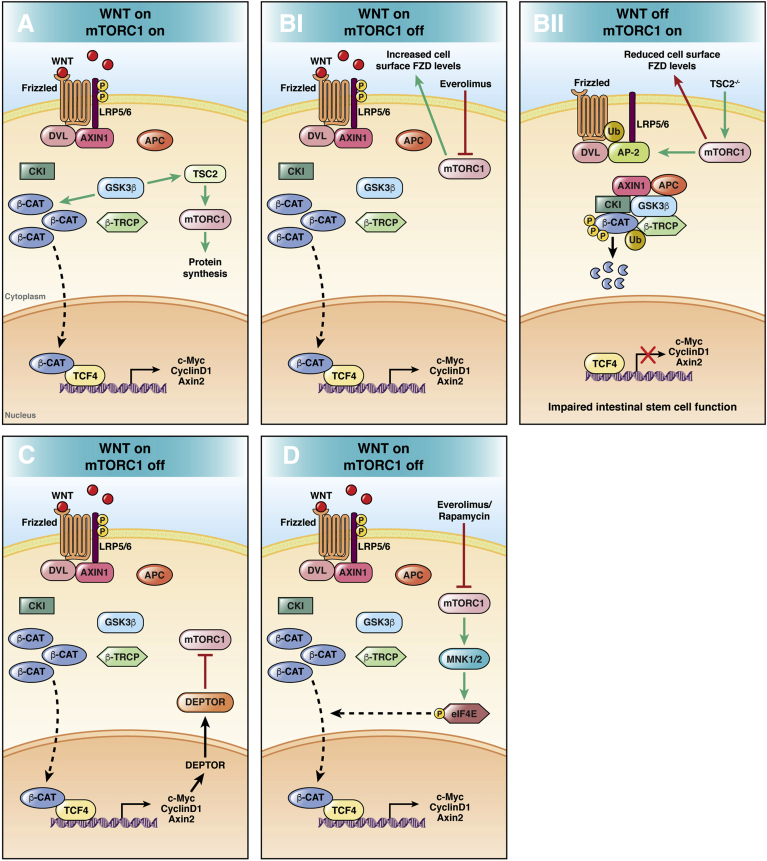
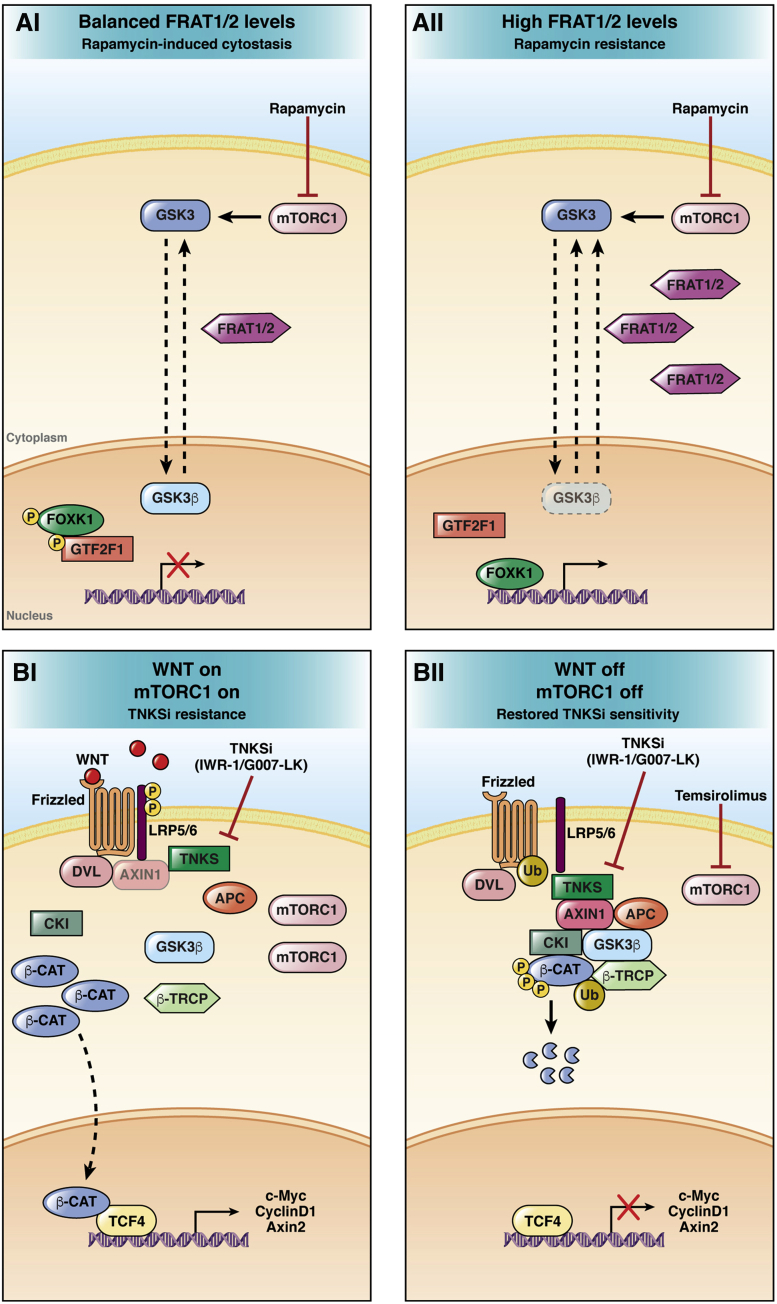
Wnt/β-catenin and phosphatidylinositol-3-kinase/protein kinase B/mammalian target of rapamycin complex 1 (PI3K/AKT/mTORC1) pathways both are critically involved in colorectal cancer (CRC) development, although they are implicated in the modulation of distinct oncogenic mechanisms. In homeostatic and pathologic conditions, these pathways show a fine regulation based mainly on feedback mechanisms, and are connected at multiple levels involving both upstream and downstream common effectors. The ability of the Wnt/β-catenin and PI3K/AKT/mTORC1 pathways to reciprocally control themselves represents one of the main resistance mechanisms to selective inhibitors in CRC, leading to the hypothesis that in specific settings, particularly in cancer driven by genetic alterations in Wnt/β-catenin signaling, the relationship between Wnt/β-catenin and PI3K/AKT/mTORC1 pathways could be so close that they should be considered as a unique therapeutic target. This review provides an update on the Wnt/β-catenin and PI3K/AKT/mTORC1 pathway interconnections in CRC, describing the main molecular players and the potential implications of combined inhibitors as an approach for CRC chemoprevention and treatment.
Overview
The claims and statistics of this paper haven’t been checked yet.
Run the check — free, no account needed. It reads the open-access text and checks the sources it cites.
Integrity signals
Registry
Cites
Statistics
Figures
Verification
Claims the paper makes
The claims and statistics of this paper haven’t been checked yet.
Run the check — free, no account needed. It reads the open-access text and checks the sources it cites.
Claims other papers make about this one
Each is checked against this paper’s own text: does it say what the citing paper says it does?
The source backs part of the claim, not all of it — or backs it for a different population, condition or comparison.
In the citing paper
“the ability of the Wnt/β‐catenin and PI3K/AKT/mTORC1 pathways to compensate for one another is one of the main mechanisms of chemoresistance [51]”
From Pyrvinium Pamoate Alone and With Gemcitabine Exhibits Anti‐Pancreatic Cancer Activity in 2D and 3D Cell Culture Models (2024) · cites this paper as [51]
Experimental — accuracy not yet measured
Self-check
Percentages, sums and reported differences re-computed from the paper’s own numbers.
The self-check needs the paper’s full text.
Citations
Cites
Siegel, R. L., Miller, K. D., & Jemal, A. (2020) · CA: A Cancer Journal for Clinicians · doi:10.3322/caac.21590 · Cited by 20,444
mTOR Signaling in Growth Control and Disease
Laplante, M., & Sabatini, D. M. (2012) · Cell · doi:10.1016/j.cell.2012.03.017 · Cited by 8,509
mTOR Signaling in Growth, Metabolism, and Disease
Saxton, R. A., & Sabatini, D. M. (2017) · Cell · doi:10.1016/j.cell.2017.02.004 · Cited by 7,555
Wnt/β-catenin signaling and disease
Clevers, H., & Nusse, R. (2012) · Cell · doi:10.1016/j.cell.2012.05.012 · Cited by 5,554
Inhibition of glycogen synthase kinase-3 by insulin mediated by protein kinase B
Cross, D. A. E., Alessi, D. R., Cohen, P., Andjelkovich, M., & Hemmings, B. A. (1995) · Nature · doi:10.1038/378785a0 · Cited by 5,244
Lessons from hereditary colorectal cancer
Kinzler, K. W., & Vogelstein, B. (1996) · Cell · doi:10.1016/s0092-8674(00)81333-1 · Cited by 4,919
Identification of c- MYC as a Target of the APC Pathway
He, T.-C., Sparks, A. B., Rago, C., Hermeking, H., Zawel, L., da Costa, L. T., Morin, P. J., Vogelstein, B., & Kinzler, K. W. (1998) · Science · doi:10.1126/science.281.5382.1509 · Cited by 4,566
β-Catenin regulates expression of cyclin D1 in colon carcinoma cells
Tetsu, O., & McCormick, F. (1999) · Nature · doi:10.1038/18884 · Cited by 3,601
High Frequency of Mutations of the PIK3CA Gene in Human Cancers
Samuels, Y., Wang, Z., Bardelli, A., Silliman, N., Ptak, J., Szabo, S., Yan, H., Gazdar, A. F., Powell, S. M., Riggins, G. J., et al. (2004) · Science · doi:10.1126/science.1096502 · Cited by 3,448
TSC2 is phosphorylated and inhibited by Akt and suppresses mTOR signalling
Inoki, K., Li, Y., Zhu, T., Wu, J., & Guan, K.-L. (2002) · Nature Cell Biology · doi:10.1038/ncb839 · Cited by 3,083
Cited by
Sorted by citations
Singh, V., Lee, G., Son, H., Koh, H., Kim, E. S., Unno, T., & Shin, J. (2023) · Frontiers in Microbiology · doi:10.3389/fmicb.2022.1103836 · Cited by 784
Signaling pathways involved in colorectal cancer: pathogenesis and targeted therapy
Li, Q., Geng, S., Luo, H., Wang, W., Mo, Y.-Q., Luo, Q., Wang, L., Song, G.-B., Sheng, J.-P., & Xu, B. (2024) · Signal Transduction and Targeted Therapy · doi:10.1038/s41392-024-01953-7 · Cited by 546
Chen, H., Gao, S., Liu, W., Wong, C.-C., Wu, J., Wu, J., Liu, D., Gou, H., Kang, W., Zhai, J., et al. (2020) · Gastroenterology · doi:10.1053/j.gastro.2020.11.013 · Cited by 308
PI3K/Akt/mTOR Signaling Pathway as a Target for Colorectal Cancer Treatment
Leiphrakpam, P., & Are, C. (2024) · International Journal of Molecular Sciences · doi:10.3390/ijms25063178 · Cited by 193
Crosstalk between miRNA and PI3K/AKT/mTOR signaling pathway in cancer
Akbarzadeh, M., Mihanfar, A., Akbarzadeh, S., Yousefi, B., & Majidinia, M. (2021) · Life Sciences · doi:10.1016/j.lfs.2021.119984 · Cited by 112
Metadata
- Authors
- Prossomariti, A., Piazzi, G., Alquati, C., & Ricciardiello, L.
- Affiliations
- IRCCS Azienda Ospedliero-Universitaria di Bologna Policlinico di Sant'Orsola (IT)
- Corresponding author
- Prossomariti, Anna
- Ricciardiello, Luigi
- Venue
- Cellular and Molecular Gastroenterology and Hepatology
- Publisher
- Elsevier BV
- Published
- 2020
- Volume
- 10
- Issue
- 3
- Pages
- 491-506
- ISSN
- 2352-345X (ISSN-L)
- PMC
- PMC7369353
- OpenAlex
- W3017979273
- Cited by
- 155
- References
- 167
- Citations by year
- 2026: 20 · 2025: 30 · 2024: 36 · 2023: 25 · 2022: 19 · 2021: 20 · 2020: 5
- FWCI
- 1.65
- Type
- journal article
- Language
- en
- Open access
- gold
- doi.org
- Licence
- Locations
- Cellular and Molecular Gastroenterology and Hepatology (publishedVersion, cc-by-nc-nd)
- PubMed Central (publishedVersion, cc-by-nc-nd)
- PubMed (publishedVersion)
- Archivio istituzionale della ricerca (Alma Mater Studiorum Università di Bologna) (submittedVersion, cc-by-nc-nd)
- DOAJ (DOAJ: Directory of Open Access Journals) (submittedVersion, cc-by-sa)
- Funders
- Associazione Italiana per la Ricerca sul Cancro
- Topics
- Life Sciences › Biochemistry, Genetics and Molecular Biology › Molecular Biology › PI3K/AKT/mTOR signaling in cancer
- Life Sciences › Biochemistry, Genetics and Molecular Biology › Molecular Biology › Wnt/β-catenin signaling in development and cancer
- Health Sciences › Medicine › Oncology › Colorectal Cancer Treatments and Studies
- Keywords
- Wnt/β-catenin signaling, PI3K/Akt/mTORC1 pathway, colorectal cancer, pathway crosstalk, intestinal tumorigenesis, drug resistance, chemoprevention, feedback regulation
- MeSH terms
- Mechanistic Target of Rapamycin Complex 1, Phosphoinositide-3 Kinase Inhibitors, Animals, Antineoplastic Combined Chemotherapy Protocols, Disease Models, Animal, Humans, Colorectal Neoplasms, Signal Transduction, Gene Expression Regulation, Neoplastic, Drug Resistance, Neoplasm, Phosphatidylinositol 3-Kinases, Cell Line, Tumor, Cell Proliferation, Proto-Oncogene Proteins c-akt, Wnt Proteins, beta Catenin
About these checks
Registry, retraction, Cites and statistics results are computed, not judged, with one exception: a printed reference that no index lists is read once by a model before it counts as a citation error. Claims are extracted by a model and kept only when their quote appears verbatim in the text; each cited source is then checked, with a model’s help, for whether it says what the claim relies on. Those verdicts can be wrong — read the claim’s quote and the cited source before relying on one.
Statistics and arithmetic are recomputed, not judged.
Confidence bands are shown only for fields calibrated on our annotated test set. None is calibrated yet, so no band is shown.
What counts as a claim ›How we measure confidence ›How we check this ›
Are you an author, or do you see a problem with this page? Request a review
