

Listening effort and fatigue in native and non-native primary school children
Open accessThe DOI matches its Crossref record; 72 of the 73 references it cites were found in a registry or an index; 3 of the 56 sources its claims cite were checked for support.
Abstract
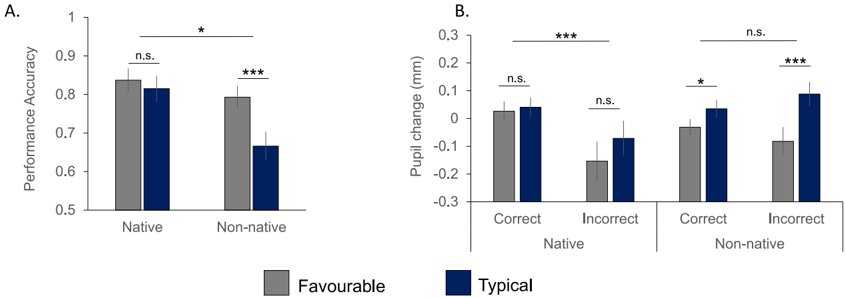
Background noise makes listening effortful and may lead to fatigue. This may compromise classroom learning, especially for children with a non-native background. In the current study, we used pupillometry to investigate listening effort and fatigue during listening comprehension under typical (0 dB signal-to-noise ratio [SNR]) and favorable (+10 dB SNR) listening conditions in 63 Swedish primary school children (7-9 years of age) performing a narrative speech-picture verification task. Our sample comprised both native (n = 25) and non-native (n = 38) speakers of Swedish. Results revealed greater pupil dilation, indicating more listening effort, in the typical listening condition compared with the favorable listening condition, and it was primarily the non-native speakers who contributed to this effect (and who also had lower performance accuracy than the native speakers). Furthermore, the native speakers had greater pupil dilation during successful trials, whereas the non-native speakers showed greatest pupil dilation during unsuccessful trials, especially in the typical listening condition. This set of results indicates that whereas native speakers can apply listening effort to good effect, non-native speakers may have reached their effort ceiling, resulting in poorer listening comprehension. Finally, we found that baseline pupil size decreased over trials, which potentially indicates more listening-related fatigue, and this effect was greater in the typical listening condition compared with the favorable listening condition. Collectively, these results provide novel insight into the underlying dynamics of listening effort, fatigue, and listening comprehension in typical classroom conditions compared with favorable classroom conditions, and they demonstrate for the first time how sensitive this interplay is to language experience.
Overview
CoChat Summary
TL;DR
In 63 Swedish primary school children (7–9 years; 25 native, 38 non-native Swedish speakers), listening at a typical classroom SNR (0 dB) increased pupil dilation and reduced comprehension relative to a favorable +10 dB SNR, with effects driven mainly by non-native speakers. Baseline pupil size declined more steeply over trials in the typical condition, a potential marker of listening-related fatigue, while subjective fatigue ratings did not differ by condition.
Key findings
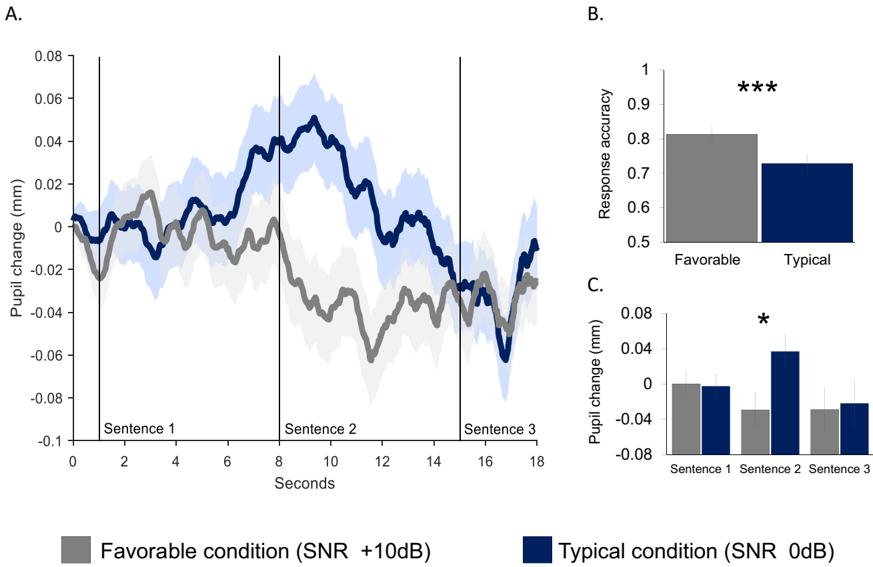
- Pupil dilation (listening effort) was greater in the typical (0 dB SNR) than favorable (+10 dB SNR) condition during the critical second sentence: b = 0.066, SE = 0.027, z = 2.43, p = .015; this effect was primarily contributed by non-native speakers.
- Response accuracy was lower in the typical than favorable condition: b = 0.483, SE = 0.112, z = 4.33, p < .001. Native speakers performed better than non-native speakers: b = 0.544, SE = 0.248, z = 2.20, p = .028; the listening condition × language group interaction was significant, p = .033, and post hoc contrasts showed only non-native speakers had significantly greater performance in the favorable versus typical condition.
- Native speakers had greater pupil dilation on trials subsequently answered correctly: b = 0.073, SE = 0.033, z = 2.19, p = .028; non-native speakers instead showed greatest pupil dilation on unsuccessful trials, especially in the typical condition, with a significant language group × response accuracy interaction, p = .025.
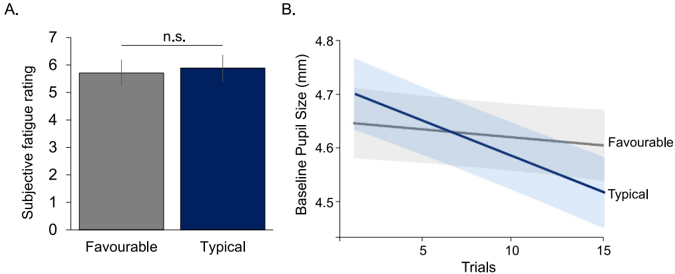
- Baseline pupil size decreased over trials: b = 0.007, SE = 0.002, z = 3.45, p < .001, and the decline was steeper in the typical than favorable condition: b = 0.009, SE = 0.004, z = 2.18, p = .03; subjective fatigue ratings did not differ significantly by listening condition.
Methods
- Participants were 63 children in Grades 2–3 from two Swedish primary schools: native Swedish speakers n = 25 (18 girls; mean age 8 years 10 months) and non-native Swedish speakers n = 38 (15 girls; mean age 8 years 11 months; mean exposure to Swedish school language 3 years 11 months). Groups did not differ significantly on backward digit span WMC, F(1, 61) = 2.01, p = .16, or quasi-universal nonword repetition, F(1, 62) = 0.45, p = .50.
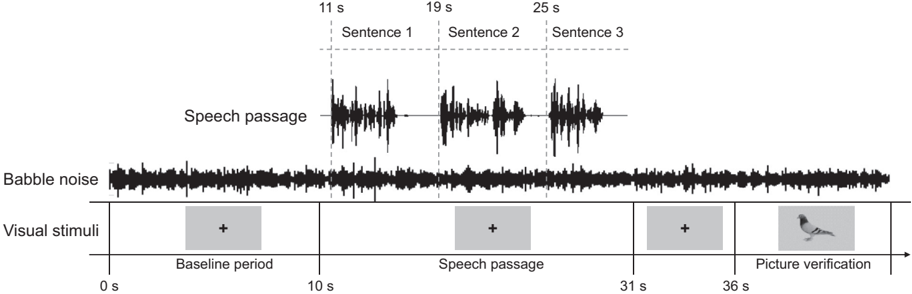
- Children performed a narrative speech-picture verification task with pupillometry under favorable (+10 dB SNR) and typical (0 dB SNR) conditions; 36 passages total, 30 analyzed (15 per condition), with multi-talker child babble at 65 dB SPL and speech at 75/65 dB SPL. Fatigue ratings were collected after each block.
- Data were analyzed with generalized linear mixed-effects models and linear mixed-effects models, with participants and speech passage items as random intercepts; model selection used backward selection and likelihood ratio tests with α = .05.
Limitations
- Paper-stated: inclusive recruitment meant Swedish language experience was incidental and the language groups were uneven; hand-picking groups by language experience could introduce confounds such as socioeconomic status. The background noise was L2 Swedish for non-native speakers and may have been less disruptive than L1 competing speech, making between-group differences more conservative.
- Paper-stated caveats for fatigue: no condition effect was found for self-reported fatigue, task performance did not decrease over successive trials, and the putative pupillary fatigue marker might instead reflect boredom or reduced focus; longer exposure than the ~10–14 min per listening condition may be needed for effects on performance or self-report.
- Evident from the text: testing occurred in a portable laboratory at the children’s schools rather than during actual classroom lessons; the sample was modest and the language groups were unequal; findings are limited to Swedish primary school children aged 7–9 years.
Model-written summary. Check it against the paper before relying on it.
Integrity signals
Registry
Cites
Statistics
Figures
Verification
Claims the paper makes
1 Valid · 0 Not valid · 37 Not checked · 66 Own results and interpretations
The cited sources support only part of this claim — read each source’s verdict below.
In the paper
“Generally speaking, listening effort increases with the magnitude of the obstacle such that more background noise (Van Engen & McLaughlin, 2018;Zekveld, Koelewijn, & Kramer, 2018) or poorer knowledge of the target language (Borghini & Hazan, 2018;Schmidtke et al., 2014) leads to greater listening effort”
§ Listening effort and fatigue in native and non-native primary school children > Introduction
What the sources say
- Supportedcites Van Engen & McLaughlin, 2018 matched to “Eyes and ears: Using eye tracking and pupillometry to understand challenges to speech recognition” (2018) source
The citation is attached to the 'more background noise -> greater listening effort' part of the sentence, and our copy states exactly that: Pupillometry > Signal degradation reports Zekveld et al. (2010), where peak dilation, peak latency and mean dilation 'systematically increased as the intelligibility of spoken sentences decreased, suggesting that reduced intelligibility imposes a greater cognitive load on listeners', and McGarrigle et al. (2017a), where self-reported effort ratings were significantly greater in the noisier (-8 dB SNR) than the easier (+15 dB SNR) condition. The Introduction (p. 1) likewise states that difficult listening conditions deplete the cognitive resources otherwise available for other tasks (poorer recall, poorer secondary-task performance with noise or hearing loss). One scope nuance: the same section notes Zekveld and Kramer (2014) found dilation falling at extremely difficult SNRs, so the paper describes the increase as systematic 'but only within a limited range of difficulty' — this bounds the monotonic framing but does not contradict the noise-to-effort link attributed here. (LLM, conf=0.85)
- Partly supportedcites Zekveld et al., 2018 matched to “The Pupil Dilation Response to Auditory Stimuli: Current State of Knowledge” (2018) sourceExperimental — accuracy not yet measured
The Discussion ('Note that some factors have been assessed much more extensively than others') states that increasing the degradation level will generally increase the pupil dilation response (the review's index of listening effort) 'as long as the demands on capacity do not exceed the available capacity', and the Results section on input-related demands confirms robustly larger pupil responses at lower intelligibility/lower SNR (i.e., more masking noise). However, the same source repeatedly qualifies the monotonic reading the citing sentence asserts: across a wide range of intelligibility/SNR the function is inverse-U-shaped, with relatively small responses at very low intelligibility because listeners may give up (Results, 'Pupil dilation responses to a wide range of intelligibility conditions'; Discussion). The unconditional claim that effort rises with the magnitude of the obstacle therefore overstates this review; the language-knowledge half of the sentence is credited to other works and is not this source's contribution. (LLM, conf=0.75)
- Supportedcites Borghini & Hazan, 2018 matched to “Listening Effort During Sentence Processing Is Increased for Non-native Listeners: A Pupillometry Study” (2018) source
For the part this citation carries (poorer knowledge of the target language -> greater listening effort), Borghini & Hazan (2018) state it directly: the Abstract and Discussion (p. null) report a significantly greater pupil response for non-native than native listeners at matched intelligibility, concluding 'for a given intelligibility level, a greater listening effort is required when listening in a second language'. The Discussion attributes this to increased difficulty at multiple levels including 'a generally lower L2 linguistic proficiency', noting these levels 'play an individual role in enhancing the listening effort required to understand a second language'. Note the evidence is a native vs non-native group contrast (plus the hedged 'might be a result of' for the proficiency component) rather than a continuous gradient of language knowledge, and the effort difference was shown mainly for speech in noise. (LLM, conf=0.82)
plainstates a cause- Asserted: passes — The authors put it forward as true.
- Checkable: passes — It can be checked against evidence.
- Load-bearing: passes — The paper’s conclusions depend on it.
- Based: passes — The paper gives a reason why it holds.
- Supported
A result the paper reports from its own data — it cites no other source for it, so there is none to check. The quote shows it is in the paper.
In the paper
“When considering the baseline pupillary measure of listening-related fatigue, adding language group and response performance as independent variables into our LMEM, the model was not improved”
§ Listening effort and fatigue in native and non-native primary school children > Language groups
plain- Asserted: passes — The authors put it forward as true.
- Checkable: passes — It can be checked against evidence.
- Load-bearing: unclear — It is unclear whether the paper’s conclusions depend on it.
- Based: passes — The paper gives a reason why it holds.
A result the paper reports from its own data — it cites no other source for it, so there is none to check. The quote shows it is in the paper.
In the paper
“response accuracy was significantly lower in the typical listening condition than in the favorable listening condition, b = 0.483, SE = 0.112, z = 4.33, p < .001.”
§ Listening effort and fatigue in native and non-native primary school children > Behavioral results
plainstates an association- Asserted: passes — The authors put it forward as true.
- Checkable: passes — It can be checked against evidence.
- Load-bearing: passes — The paper’s conclusions depend on it.
- Based: passes — The paper gives a reason why it holds.
A result the paper reports from its own data — it cites no other source for it, so there is none to check. The quote shows it is in the paper.
In the paper
“However, a difference in fatigue over conditions was not detected by subjective ratings.”
§ Listening effort and fatigue in native and non-native primary school children > Discussion
plain- Asserted: passes — The authors put it forward as true.
- Checkable: passes — It can be checked against evidence.
- Load-bearing: passes — The paper’s conclusions depend on it.
- Based: passes — The paper gives a reason why it holds.
A result the paper reports from its own data — it cites no other source for it, so there is none to check. The quote shows it is in the paper.
In the paper
“whereas the pupillary effect of listening condition was significant only for the non-native speakers.”
§ Listening effort and fatigue in native and non-native primary school children > Language groups
plain- Asserted: passes — The authors put it forward as true.
- Checkable: passes — It can be checked against evidence.
- Load-bearing: passes — The paper’s conclusions depend on it.
- Based: passes — The paper gives a reason why it holds.
59 more claims
Create a free account to see all 104 claims and to verify the 34 references still open.
- The quote only partly states this claim. 2
- It may state two separate claims as one. 27
- Probably not a substantial claim. 16
Claims other papers make about this one
Each is checked against this paper’s own text: does it say what the citing paper says it does?
In the citing paper
“The findings showed that monolinguals exhibited a slight but nonsignificant decrease in perceptual accuracy in the typical (i.e., more difficult listening condition) compared to the favorable listening condition. However, bilinguals’ accuracy in their L2 was significantly lower in the typical compared to the favorable listening condition.”
From The Involvement of Listening Effort in Explaining Bilingual Listening Under Adverse Listening Conditions (2023) · cites this paper as Brännström et al., 2021
In the citing paper
“Moreover, when comparing pupil size in the two noise levels, larger dilation was observed under the typical noise levels than the favorable condition, and the effect was especially pronounced in bilingual listeners.”
From The Involvement of Listening Effort in Explaining Bilingual Listening Under Adverse Listening Conditions (2023) · cites this paper as Brännström et al., 2021
In the citing paper
“For example, the current review shows that when a degradation led to higher interference with the signal, such as in the case of a degradation presented in a higher intensity (e.g., Borghini & Hazan, 2018; Brännström et al., 2021) or in the same language of the signal (e.g., Francis et al., 2018; Kilman et al., 2014), more effort was reported.”
From The Involvement of Listening Effort in Explaining Bilingual Listening Under Adverse Listening Conditions (2023) · cites this paper as Brännström et al., 2021
Statistics that don’t add up
Each reported p-value recomputed from its test statistic and degrees of freedom, each partial η² from its F, and each ratio, mean difference or B printed with a p checked against its own confidence interval.
Rated minor: it would not touch a result — a value no result rests on, a p-value that stays on the same side of the significance level, or a conflict that is clerical, resolved elsewhere in the paper, or outside its own findings.
In the paper
“z = 2.65, p = .009”
§ Listening effort and fatigue in native and non-native primary school children > Language groups
Reported p = .009 · recomputed p = .008
Statistics recomputed
Every reported test result, recomputed from its test statistic and degrees of freedom. A result shows as not adding up only once an independent check has confirmed it.
- Doesn’t add upz = 2.65reported p = .009 · recomputed p = .008
“z = 2.65, p = .009”
- ConsistentF(1, 61) = 2.01reported p = .16 · recomputed p = .161
“F(1, 61) = 2.01, p = .16”
- ConsistentF(1, 62) = 0.45reported p = .5 · recomputed p = .505
“F(1, 62) = 0.45, p = .50”
- Consistentz = 4.33reported p < .001 · recomputed p < .001
“z = 4.33, p < .001”
- Consistentz = 2.43reported p = .015 · recomputed p = .015
“z = 2.43, p = .015”
5 more recomputed tests
Create a free account to see every test the Stats check recomputed.
Self-check
Percentages, sums and reported differences re-computed from the paper’s own numbers.
Each contradiction between two passages listed here was confirmed by an independent check.
Rated minor: it would not touch a result — a value no result rests on, a p-value that stays on the same side of the significance level, or a conflict that is clerical, resolved elsewhere in the paper, or outside its own findings.
In the paper
§ Listening effort and fatigue in native and non-native primary school children > General cognitive and language capabilities
“F(1, 62) = 0.45, p = .50”
§ Listening effort and fatigue in native and non-native primary school children > Participants
“leaving a total of 63 participants.”
Citations
Cites
Fitting Linear Mixed-Effects Models Using lme4
Bates, D., Mächler, M., Bolker, B., & Walker, S. (2015) · Journal of Statistical Software · doi:10.18637/jss.v067.i01 · Cited by 86,835
PsychoPy2: Experiments in behavior made easy
Peirce, J., Gray, J. R., Simpson, S., MacAskill, M., Höchenberger, R., Sogo, H., Kastman, E., & Lindeløv, J. K. (2019) · Behavior Research Methods · doi:10.3758/s13428-018-01193-y · Cited by 5,166
Aston-Jones, G., & Cohen, J. D. (2005) · Annual Review of Neuroscience · doi:10.1146/annurev.neuro.28.061604.135709 · Cited by 4,472 · cited 3×
“Because previous research has demonstrated that reduced base-line pupil size represents low-arousal states and task disengagement (Aston-Jones & Cohen, 2005; Gilzenrat et al., 2010), and that there is a link between task disengagement and mental fatigue (Hopstaken et al., 2015), we interpret this…”
Task-evoked pupillary responses, processing load, and the structure of processing resources.
Beatty, J. (1982) · Psychological Bulletin · doi:10.1037/0033-2909.91.2.276 · Cited by 1,959 · cited 1×
“…Rönnberg, Holmer, & Rudner, 2021), it was established that variations of pupil size can be used as a reliable measure of cognitive effort (e.g., Beatty, 1982; Kahneman & Beatty, 1966), and more recent work has shown that pupil size increases in accordance with attentional demands in common…”
Pupil Diameter and Load on Memory
Kahneman, D., & Beatty, J. (1966) · Science · doi:10.1126/science.154.3756.1583 · Cited by 1,617 · cited 1×
“…Holmer, & Rudner, 2021), it was established that variations of pupil size can be used as a reliable measure of cognitive effort (e.g., Beatty, 1982; Kahneman & Beatty, 1966), and more recent work has shown that pupil size increases in accordance with attentional demands in common cognitive…”
Hearing Impairment and Cognitive Energy: The Framework for Understanding Effortful Listening (FUEL)
Pichora-Fuller, M. K., Kramer, S. E., Eckert, M. A., Edwards, B., Hornsby, B. W. Y., Humes, L. E., Lemke, U., Lunner, T., Matthen, M., Mackersie, C. L., et al. (2016) · Ear & Hearing · doi:10.1097/aud.0000000000000312 · Cited by 1,318 · cited 10×
“Our findings are consistent with the FUEL (Pichora-Fuller et al., 2016) and extend it to primary school children.”
InfluentialSelf-citationMental fatigue: Costs and benefits
Boksem, M. A. S., & Tops, M. (2008) · Brain Research Reviews · doi:10.1016/j.brainresrev.2008.07.001 · Cited by 1,099
Speech recognition in adverse conditions: A review.
Mattys, S. L., Davis, M. H., Bradlow, A. R., & Scott, S. K. (2012) · Language and Cognitive Processes · doi:10.1080/01690965.2012.705006 · Cited by 809 · cited 2×
“Obstacles to listening may include external factors such as background noise and internal factors such as language knowledge (Mattys, Davis, Bradlow, & Scott, 2012).”
Gilzenrat, M. S., Nieuwenhuis, S., Jepma, M., & Cohen, J. D. (2010) · Cognitive, Affective, & Behavioral Neuroscience · doi:10.3758/cabn.10.2.252 · Cited by 798
Metsala, J. L. (1999) · Journal of Educational Psychology · doi:10.1037//0022-0663.91.1.3 · Cited by 615
Research works printed but not linked: 3
- K. Jonas Brännström, M. Rudner, J. Carlie et al. Journal of Experimental Child Psychology 210 (2021) 105203
- Chiat, S. (2015). Nonword repetition. In S. Armon-Lotem, J. de Jong, & N. Meir (Eds.), Methods for assessing multilingual children: Disentangling bilingualism from language impairment (pp. 125-150). Bristol, England: Multilingual Matters.
- Sahlén, B., Hansson, K., Lyberg-Åhlander, V., & Brännström, J. (2018). Spoken language and language impairment in DHH children: Towards better communication fostering classroom environments for mainstreamed children. In M. Marchark & H. Knoors (Eds.), Evidence-based intervention in deaf learners (pp. 1-21). Oxford, UK: Oxford University Press.
Cited by
The effect of classroom environment on literacy development
Rance, G., Dowell, R. C., & Tomlin, D. (2023) · npj Science of Learning · doi:10.1038/s41539-023-00157-y · Cited by 61
The Effect of Classroom Acoustic Treatment on Listening, Learning, and Well-being: A Scoping Review
Mealings, K. T. (2023) · Acoustics Australia · doi:10.1007/s40857-023-00291-y · Cited by 49
Mealings, K. T. (2022) · Acoustics Australia · doi:10.1007/s40857-022-00284-3 · Cited by 32
Bsharat-Maalouf, D., Degani, T., & Karawani, H. (2023) · Trends in Hearing · doi:10.1177/23312165231205107 · Cited by 27
Adams, B., Thornton, S. K., Naylor, G., Spriggs, R. V., Wiggins, I. M., & Kitterick, P. T. (2023) · Frontiers in Pediatrics · doi:10.3389/fped.2023.1127578 · Cited by 23
Mealings, K. T., Miles, K., Parrila, R., Holt, R., Cox, F., Dillon, H., Sharma, M., Demuth, K., Leigh, G., McMahon, C. M., et al. (2023) · Frontiers in Education · doi:10.3389/feduc.2023.1185167 · Cited by 17
Speech recognition in noise task among children and young-adults: a pupillometry study
Trau-Margalit, A., Fostick, L., Harel-Arbeli, T., Gannot, R. N., & Taitelbaum‐Swead, R. (2023) · Frontiers in Psychology · doi:10.3389/fpsyg.2023.1188485 · Cited by 15
Electromyographic correlates of effortful listening in the vestigial auriculomotor system
Schroeer, A., Corona–Strauss, F. I., Hannemann, R., Hackley, S. A., & Strauß, D. J. (2025) · Frontiers in Neuroscience · doi:10.3389/fnins.2024.1462507 · Cited by 14
Spoorthi, G. N., Uppunda, A. K., Kalaiah, M. K., & Shastri, U. (2025) · European Archives of Oto-Rhino-Laryngology · doi:10.1007/s00405-025-09232-z · Cited by 11
Child-Centred Room Acoustic Parameters of Public Preschools in Sweden
Winroth, J., Ögren, M., Glebe, D., & Waye, K. P. (2023) · Buildings · doi:10.3390/buildings13112777 · Cited by 10
Xu, S., Zhang, H., Fan, J., Jiang, X., Zhang, M., Guan, J., Ding, H., & Zhang, Y. (2024) · Journal of Speech Language and Hearing Research · doi:10.1044/2024_jslhr-23-00553 · Cited by 9
Through the Pupils’ Lens: Multilingual Effort in First and Second Language Listening
Bsharat-Maalouf, D., Schmidtke, J., Degani, T., & Karawani, H. (2024) · Ear and Hearing · doi:10.1097/aud.0000000000001602 · Cited by 9
Carlie, J., Sahlén, B. S., Johansson, R., Andersson, K., Whitling, S., & Brännström, K. J. (2024) · Journal of Speech Language and Hearing Research · doi:10.1044/2023_jslhr-22-00637 · Cited by 9
Self-citationInfluence of Noise Level and Reverberation on Children’s Performance and Effort in Primary Schools
Pittana, I., Pavarin, C., Pavanello, I., Bella, A. D., Romagnoni, P., Scimemi, P., & Cappelletti, F. (2025) · Applied Sciences · doi:10.3390/app152413213 · Cited by 7
Gökay, N. Y., Baysan, C., & Yücel, E. (2024) · Cochlear Implants International · doi:10.1080/14670100.2024.2304468 · Cited by 6
Zhang, D., Mui, K. W., Masullo, M., & Wong, L. T. (2024) · Acoustics · doi:10.3390/acoustics6030037 · Cited by 6
Listening challenges in children: Comprehension and effort in noisy and voice-degraded conditions
Murgia, S. (2024) · The Psychology of learning and motivation/The psychology of learning and motivation · doi:10.1016/bs.plm.2024.07.004 · Cited by 6
A Methodological Review of Stimuli Used for Classroom Speech-in-Noise Tests
Mealings, K. T., Miles, K., & Buchholz, J. M. (2024) · Journal of Speech Language and Hearing Research · doi:10.1044/2024_jslhr-24-00261 · Cited by 6
Universal acoustic design for schools: An evidence based approach
GREENLAND, E., HARVIE-CLARK, J., James, A., & Shield, B. (2025) · Applied Acoustics · doi:10.1016/j.apacoust.2025.111055 · Cited by 5
How variability in language experience modulates multilingual listening effort
Bsharat-Maalouf, D., Degani, T., & Karawani, H. (2025) · Bilingualism Language and Cognition · doi:10.1017/s1366728925100254 · Cited by 5
Carlie, J., Sahlén, B. S., Andersson, K., Johansson, R., Whitling, S., & Brännström, K. J. (2024) · Journal of Experimental Child Psychology · doi:10.1016/j.jecp.2024.106088 · Cited by 4
Self-citationEmploying Podcast Technology in Developing English Pronunciation: A Quasi-Experimental Study
Alobeytha, F. L., Ghalia, N. H., Galia, A. A., Ministry of education- Jordan, Khaled, S. A. B., & Ministry of education- Jordan (2023) · International Journal of Social Science and Human Research · doi:10.47191/ijsshr/v6-i5-45 · Cited by 4
Mealings, K. T. (2026) · Speech Language and Hearing · doi:10.1080/2050571x.2026.2661025 · Cited by 3
Actualizing Affordances of Audiobooks for Elective Readings in a University Course
Jahn, V. B., & Lombaerts, K. (2022) · International Journal of Mobile and Blended Learning · doi:10.4018/ijmbl.304457 · Cited by 3
Bao, W., Alain, C., Thaut, M. H., & Molnar, M. T. (2025) · Bilingualism Language and Cognition · doi:10.1017/s1366728925100795 · Cited by 4
I Don't Understand What They Speak: Photovoice of Indonesian Higher Education Students
Sari, T. S., Naimah, M., Martalina, A. W., & Arjiani, L. I. (2021) · Journal of English Teaching and Learning Issues · doi:10.21043/jetli.v4i2.11946 · Cited by 2
Yoga as a Fatigue Intervention for Children Who Are Deaf and Hard of Hearing
Werfel, K. L., Mattingly, J., & Lund, E. (2025) · Perspectives of the ASHA Special Interest Groups · doi:10.1044/2025_persp-25-00008 · Cited by 1
How does otitis media with effusion history affect spatial auditory processing and listening effort?
Yosef, M. B., Trau-Margalit, A., Harel-Arbeli, T., & Taitelbaum‐Swead, R. (2025) · European Archives of Oto-Rhino-Laryngology · doi:10.1007/s00405-025-09570-y · Cited by 1
Betts, A. (2022) · ThinkIR: The University of Louisville's Institutional Repository (University of Louisville) · doi:10.18297/etd/3871
INCLUSIVE ACOUSTIC DESIGN FOR MAINSTREAM SCHOOLS: AN EVIDENCE BASED APPROACH
GREENLAND, E., JAMES, A., & HARVIE-CLARK, J. (2023) · doi:10.25144/16585
Brännström, K. J., Waechter, S., Nirme, J., Whitling, S., Åhlander, V. L., & Sahlén, B. S. (2024) · Acta logopaedica · doi:10.58986/al.2024.13972
Self-citationRecursos para amenizar o esforço auditivo em escolares: revisão sistemática
Alves, H. D. M. C. (2024) · Digital Library of Theses and Dissertations (Universidade de São Paulo) · doi:10.11606/t.25.2024.tde-31032025-115907
Comparison of Listening Fatigue in Children with and Without Hearing Impairment
Jamil, M., Ahmed, A., Ali, H. A., Khan, M. S., & Qasim, M. M. (2025) · Link Journal of Speech Language and Audiology · doi:10.61919/ljsla.vi.7
Behavioral and Neurophysiological Correlates of Auditory Attention in Monolinguals and Bilinguals
Bao, W. (2025) · TSpace (University of Toronto)
Benítez-Barrera, C. R., Behboudi, M. H., Chalamalasetty, P., Castro, S., Leung, E., & Maguire, M. J. (2026) · Language and Speech · doi:10.1177/00238309261458808 · Cited by 1
Aljasser, F. M., Wang, Y., & Vitevitch, M. S. (2026) · Applied Psycholinguistics · doi:10.1017/s0142716426100861
Murgia, S. (2024) · Illinois Digital Environment for Access to Learning and Scholarship (University of Illinois at Urbana-Champaign)
Gao, S., Chen, F., Lu, D., Siu, A. K. Y., & Ma, E. (2026) · The Journal of the Acoustical Society of America · doi:10.1121/10.0047459
Mealings, K., Miles, K., Parrila, R., Holt, R., Cox, F., Dillon, H., Sharma, M., Demuth, K., Leigh, G., McMahon, C., et al. (2023) · doi:10.3389/feduc.2023.1185167.s001
Metadata
- Authors
- Brännström, K. J., Rudner, M., Carlie, J., Sahlén, B., Gulz, A., Andersson, K., & Johansson, R.
- Affiliations
- Lund University (SE)
- Linköping University (SE)
- Corresponding author
- Johansson, Roger
- ORCID
- Venue
- Journal of Experimental Child Psychology
- Publisher
- Elsevier BV
- Published
- 2021-10
- Volume
- 210
- Pages
- 105203
- ISSN
- 0022-0965 (ISSN-L)
- OpenAlex
- W3167676566
- Semantic Scholar
- 06566fc889bf46ae1c58b3b4d658f5b028cddc90
- Cited by
- 39
- References
- 73
- Citations by year
- 2026: 4 · 2025: 10 · 2024: 11 · 2023: 10 · 2022: 3 · 2021: 1
- FWCI
- 5.12
- Type
- journal article
- Language
- en
- Open access
- hybrid
- doi.org
- Licence
- cc-by
- www.elsevier.com/tdm/userlicense/1.0/ (tdm)
- creativecommons.org/licenses/by/4.0/ (vor)
- Locations
- Journal of Experimental Child Psychology (publishedVersion, cc-by)
- PubMed (publishedVersion)
- DiVA (Linkoping University) (submittedVersion, other-oa)
- Lund University Publications (Lund University) (submittedVersion)
- Funders
- Swedish Research Council
- Topics
- Health Sciences › Health Professions › Speech and Hearing › Hearing Loss and Rehabilitation
- Physical Sciences › Physics and Astronomy › Acoustics and Ultrasonics › Noise Effects and Management
- Social Sciences › Psychology › Experimental and Cognitive Psychology › Phonetics and Phonology Research
- Keywords
- listening effort, listening fatigue, non-native speakers, native speakers, pupil dilation, pupillometry, listening comprehension, signal-to-noise ratio, classroom noise, elementary school students, language experience
- MeSH terms
- Auditory Perception, Child, Fatigue, Humans, Noise, Schools, Speech Perception
About these checks
Registry, retraction, Cites and statistics results are computed, not judged, with one exception: a printed reference that no index lists is read once by a model before it counts as a citation error. Claims are extracted by a model and kept only when their quote appears verbatim in the text; each cited source is then checked, with a model’s help, for whether it says what the claim relies on. Those verdicts can be wrong — read the claim’s quote and the cited source before relying on one.
The claim verdicts this report counts are experimental: their accuracy is not yet measured.
A language model drew the claims from the paper on 2026-11-19, under version 3 of the claim definition (model deepseek-v4.1-flash, prompt extract-v3).
A second model labelled each claim on 2026-11-19 (model jev-1.13-20260917, definition revision gold-guideline-v0.2).
Cited sources are checked with a language model’s help (qwen3.8-omni-flash).
Statistics and arithmetic are recomputed, not judged.
Confidence bands are shown only for fields calibrated on our annotated test set. None is calibrated yet, so no band is shown.
What counts as a claim ›How we measure confidence ›How we check this ›
Are you an author, or do you see a problem with this page? Request a review
Data sources
Bibliographic data: Semantic Scholar, OpenAlex, Crossref.
Contains information from the Semantic Scholar Academic Graph Datasets, made available under the ODC Attribution License (ODC-BY 1.0).
Semantic Scholar’s data is described in: Kinney, R., et al. (2023). The Semantic Scholar Open Data Platform. arXiv:2301.10140.
