

The DOI matches its Crossref record; 34 of the 34 references it cites were found in a registry or an index.
Multiscale entropy: A tool for understanding the complexity of postural control
Open accessAbstract
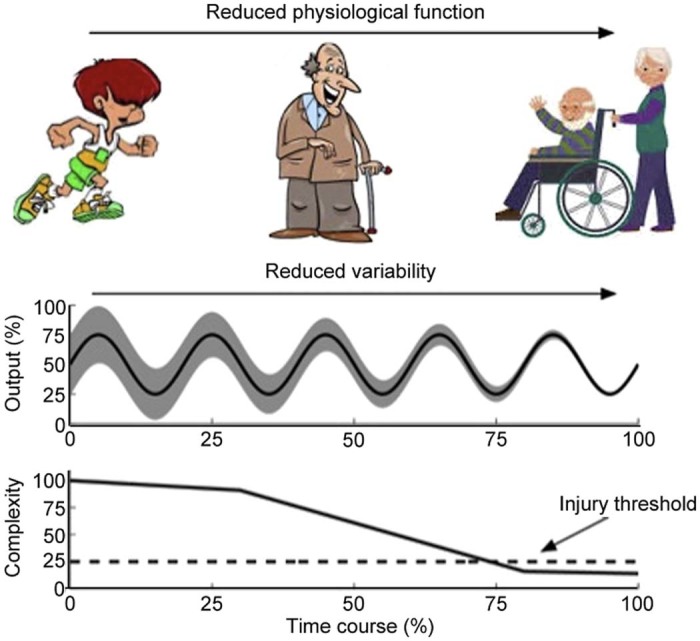
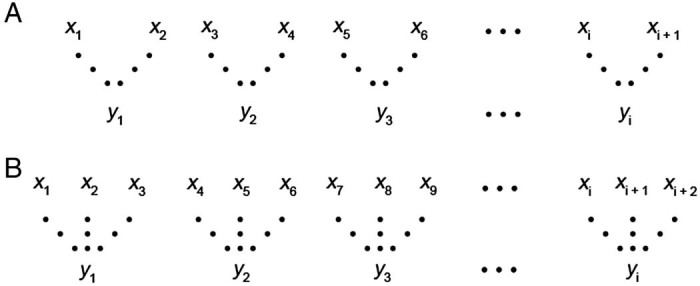
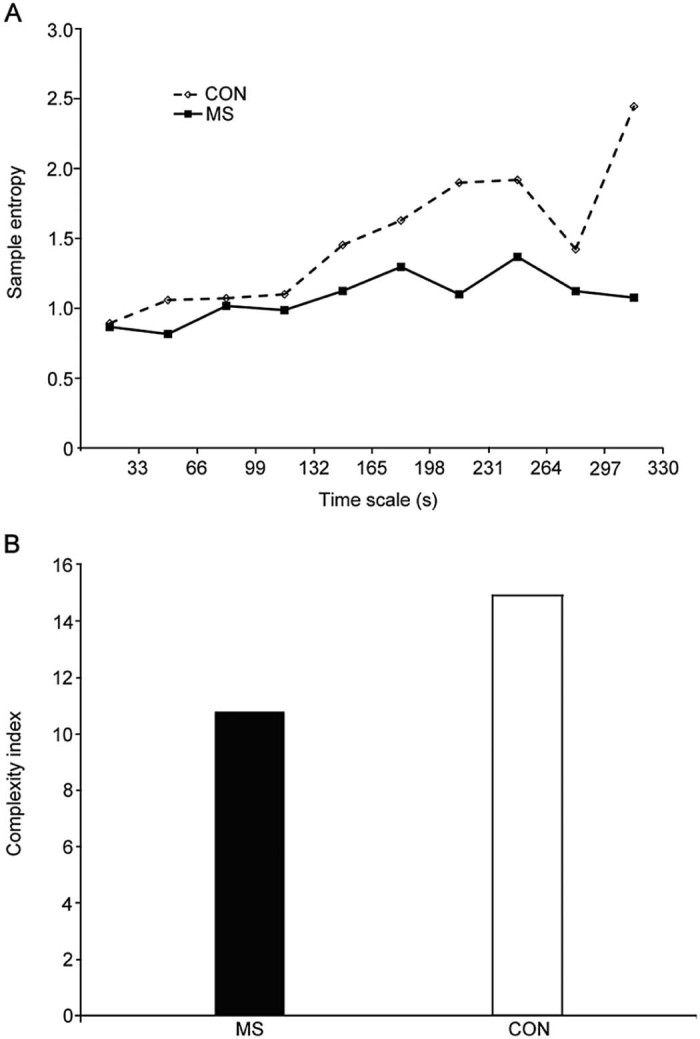
Clinical disorders often are characterized by a breakdown in dynamical processes that contribute to the control of upright standing. Disruption to a large number of physiological processes operating at different time scales can lead to alterations in postural center of pressure (CoP) fluctuations. Multiscale entropy (MSE) has been used to identify differences in fluctuations of postural CoP time series between groups with and without known physiological impairments at multiple time scales. The purpose of this paper is to: 1) review basic elements and current developments in entropy techniques used to assess physiological complexity; and 2) identify how MSE can provide insights into the complexity of physiological systems operating at multiple time scales that underlie the control of posture. We review and synthesize evidence from the literature providing support for MSE as a valuable tool to evaluate the breakdown in the physiological processes that accompany changes due to aging and disease in postural control. This evidence emerges from observed lower MSE values in individuals with multiple sclerosis, idiopathic scoliosis, and in older individuals with sensory impairments. Finally, we suggest some future applications of MSE that will allow for further insight into how physiological deficits impact the complexity of postural fluctuations; this information may improve the development and evaluation of new therapeutic interventions.
Overview
The claims and statistics of this paper haven’t been checked yet.
Run the check — free, no account needed. It reads the open-access text and checks the sources it cites.
Integrity signals
Registry
Cites
Statistics
Figures
Verification
Claims the paper makes
The claims and statistics of this paper haven’t been checked yet.
Run the check — free, no account needed. It reads the open-access text and checks the sources it cites.
Claims other papers make about this one
Each is checked against this paper’s own text: does it say what the citing paper says it does?
In the citing paper
“Compared with other entropy techniques (eg, sample entropy and approximate entropy), the advantage of MSE analysis is that the assessments of complexity at shorter and longer timescales can be analyzed separately [36].”
From Predicting depressive symptom severity through individuals’ nearby Bluetooth device count data collected by mobile phones: preliminary longitudinal study (2021) · cites this paper as [36]
Self-check
Percentages, sums and reported differences re-computed from the paper’s own numbers.
The self-check needs the paper’s full text.
Citations
Cites
A Mathematical Theory of Communication
Shannon, C. E. (1948) · The MIT Press eBooks · doi:10.1002/j.1538-7305.1948.tb00917.x · Cited by 50,387
Frailty in Older Adults: Evidence for a Phenotype
Fried, L. P., Tangen, C. M., Walston, J., Newman, A. B., Hirsch, C., Gottdiener, J., Seeman, T., Tracy, R., Kop, W. J., Burke, G., et al. (2001) · The Journals of Gerontology Series A: Biological Sciences and Medical Sciences · doi:10.1093/gerona/56.3.m146 · Cited by 24,907
Physiological time-series analysis using approximate entropy and sample entropy
Richman, J. S., & Moorman, J. R. (2000) · American Journal of Physiology-Heart and Circulatory Physiology · doi:10.1152/ajpheart.2000.278.6.h2039 · Cited by 7,880
Communication in the presence of noise
Shannon, C. E. (1949) · Proceedings of the IRE · doi:10.1109/jrproc.1949.232969 · Cited by 6,539
Approximate entropy as a measure of system complexity.
Pincus, S. M. (1991) · Proceedings of the National Academy of Sciences · doi:10.1073/pnas.88.6.2297 · Cited by 5,811
Ergodic theory of chaos and strange attractors
Eckmann, J., & Ruelle, D. P. (1985) · Reviews of Modern Physics · doi:10.1103/revmodphys.57.617 · Cited by 4,982
Communication In The Presence Of Noise
Shannon, C. E. (1998) · Proceedings of the IEEE · doi:10.1109/jproc.1998.659497 · Cited by 4,815
Systems biology: a brief overview
Kitano, H. (2002) · Science · doi:10.1126/science.1069492 · Cited by 4,265
The mechanism of stochastic resonance
Benzi, R., Sutera, A., & Vulpiani, A. (1981) · Journal of Physics A Mathematical and General · doi:10.1088/0305-4470/14/11/006 · Cited by 3,655
Attention and the control of posture and gait: a review of an emerging area of research
Woollacott, M., & Shumway-Cook, A. (2002) · Gait & Posture · doi:10.1016/s0966-6362(01)00156-4 · Cited by 2,690
Research works printed but not linked: 1
- McGregor, 2011, Control entropy of gait: does running fitness affect complexity of walking?, Clin Kines, 65, 9
Cited by
Sorted by citations
Lau, Z. J., Pham, T., Chen, S. A., & Makowski, D. (2022) · European Journal of Neuroscience · doi:10.1111/ejn.15800 · Cited by 250
On the use of approximate entropy and sample entropy with centre of pressure time-series
Montesinos, L., Castaldo, R., & Pecchia, L. (2018) · Journal of NeuroEngineering and Rehabilitation · doi:10.1186/s12984-018-0465-9 · Cited by 172
Nonlinear Measures to Evaluate Upright Postural Stability: A Systematic Review
Kędziorek, J., & Błażkiewicz, M. (2020) · Entropy · doi:10.3390/e22121357 · Cited by 135
Fall Risk Prediction in Multiple Sclerosis Using Postural Sway Measures: A Machine Learning Approach
Sun, R., Hsieh, K. L., & Sosnoff, J. J. (2019) · Scientific Reports · doi:10.1038/s41598-019-52697-2 · Cited by 93
Lee, C.-H., & Sun, T. (2018) · Journal of PHYSIOLOGICAL ANTHROPOLOGY · doi:10.1186/s40101-018-0187-5 · Cited by 82
Metadata
- Authors
- Busa, M. A., & van Emmerik, R. E. A.
- Affiliations
- University of Massachusetts Amherst (US)
- Corresponding author
- Busa, Michael A.
- ORCID
- Busa, Michael A.
- Venue
- Journal of Sport and Health Science
- Publisher
- Elsevier BV
- Published
- 2016-03
- Volume
- 5
- Issue
- 1
- Pages
- 44-51
- ISSN
- 2213-2961 (ISSN-L)
- 2095-2546
- PMC
- PMC6188573
- OpenAlex
- W2280857076
- Cited by
- 184
- References
- 34
- Citations by year
- 2026: 13 · 2025: 30 · 2024: 25 · 2023: 24 · 2022: 25 · 2021: 17 · 2020: 17 · 2019: 13 · 2018: 12 · 2017: 5 · 2016: 3
- FWCI
- 1.90
- Type
- journal article
- Language
- en
- Open access
- diamond
- doi.org
- Licence
- Locations
- Journal of sport and health science/Journal of Sport and Health Science (publishedVersion, cc-by-nc-nd)
- Europe PMC (PubMed Central) (publishedVersion, cc-by-nc-nd)
- PubMed Central (publishedVersion, cc-by-nc-nd)
- PubMed (publishedVersion)
- DOAJ (DOAJ: Directory of Open Access Journals) (submittedVersion, cc-by-sa)
- Topics
- Health Sciences › Health Professions › Physical Therapy, Sports Therapy and Rehabilitation › Balance, Gait, and Falls Prevention
- Health Sciences › Medicine › Cardiology and Cardiovascular Medicine › Heart Rate Variability and Autonomic Control
- Life Sciences › Neuroscience › Cognitive Neuroscience › Motor Control and Adaptation
- Keywords
- multiscale entropy, postural control, postural stability, physiological complexity, aging, multiple sclerosis, idiopathic scoliosis, sensory impairment, time-scale analysis, clinical disorders
About these checks
Registry, retraction, Cites and statistics results are computed, not judged, with one exception: a printed reference that no index lists is read once by a model before it counts as a citation error. Claims are extracted by a model and kept only when their quote appears verbatim in the text; each cited source is then checked, with a model’s help, for whether it says what the claim relies on. Those verdicts can be wrong — read the claim’s quote and the cited source before relying on one.
Statistics and arithmetic are recomputed, not judged.
Confidence bands are shown only for fields calibrated on our annotated test set. None is calibrated yet, so no band is shown.
What counts as a claim ›How we measure confidence ›How we check this ›
Are you an author, or do you see a problem with this page? Request a review
