

Understanding labour productivity in maternity wards
Open accessThe DOI matches its Crossref record; 81 of the 81 references it cites were found in a registry or an index; none of the 37 sources its claims cite is checked for support yet.
Abstract
This paper provides a causal estimate of labour productivity in maternity wards. We consider an Italian law that defines the staffing requirements of hospital maternity units according to the annual number of births. We exploit the discontinuities in the availability of medical staff caused by thresholds in the law to define both instrumental variables and a regression discontinuity framework that allows us to estimate the causal effect of different teams of professionals on the mode of delivery and on the health status of newborns and mothers at delivery. The analysis is based on detailed patient-level data on births in an Italian region. We find that maternity units with annual births above the thresholds are more likely to have a 'full team' of professionals at delivery. We find that having a full team has no effect on the mode of delivery (caesarean section vs vaginal birth). However, the presence of a full team has a significant impact on health outcomes. We find an improvement in both neonatal and maternal outcomes associated with a more intensive use of medical interventions, suggesting that larger hospitals are better than smaller units at managing deliveries with appropriate treatments to avoid complications. In addition, we do not find substantial heterogeneous effects across days of the week, time of day, or nationality of mothers.
Overview
CoChat Summary
TL;DR
Using Italian staffing thresholds that create discontinuities in maternity ward staffing, the paper estimates the causal effect of a “full team” (midwife, gynecologist, pediatrician/neonatologist) on delivery mode and maternal/newborn health in Piedmont, 2011–2013. It finds no effect on overall C-section versus vaginal delivery, but full teams improve several neonatal and maternal outcomes, mainly for vaginal deliveries, through more intensive medical management.
Key findings
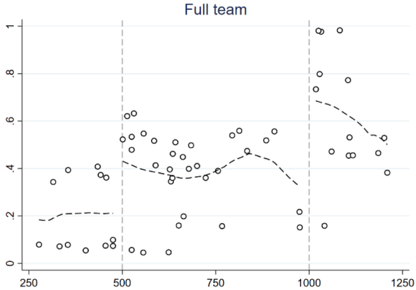
- Legal thresholds increase the probability of a full team: in 2SLS, being in a unit with 500–999 annual births raises full-team presence by 34.9 percentage points and >1000 births by 72.8 percentage points versus <500 births; in RDD, being above the thresholds raises full-team presence by 29.5 percentage points overall, 22.6 points at the 500 cut-off, and 18.0 points at the 1000 cut-off.
- Full team has no significant effect on C-section versus vaginal delivery overall, but it reduces emergency C-section by 5.9 percentage points in 2SLS; RDD shows negative emergency C-section effects above the 500 cut-off and positive assisted vaginal delivery effects.
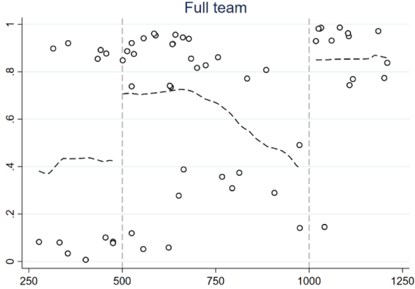
- Neonatal outcomes: full team increases “no need for resuscitation” by 2.3 percentage points (about one-fifth of a standard deviation), lowers one- and five-minute Apgar scores by 0.36 and 0.12 points, lowers perfect Apgar scores (≥9) by 8.2 and 4.5 percentage points, and increases the five-minute minus one-minute Apgar difference by 0.23 points; no significant effect on meconium. Effects are driven by vaginal/uncomplicated vaginal deliveries, with no significant effects in C-section subsamples.
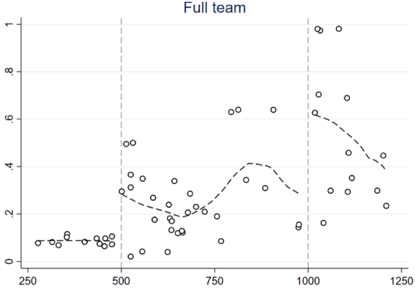
- Maternal outcomes: full team increases the probability of no second/third-degree lacerations by 9.2 percentage points and increases the likelihood of episiotomy by 17.4 percentage points (i.e., lowers “no episiotomy”); no effect on other complications/hospital stay. RDD confirms better outcomes for uncomplicated vaginal births, especially above the 1000 cut-off. Additional results indicate more “medicalization” of labor (e.g., less absence of oxytocin/prostaglandins/amniorrhexis, lower breastfeeding) and no substantial heterogeneity by day of week, time of day, or mother’s nationality.
Methods
- Design: quasi-experimental study exploiting Italian Ministry of Health decrees D.M. 24/04/2000 and D.M. 14/02/2001, which set staffing/equipment requirements by annual delivery volume groups (<500, 500–999, ≥1000 births). Volume-group dummies instrument for full team in 2SLS-IV, complemented by fuzzy RDD around the 500 and 1000 thresholds with ±250-birth bandwidths.
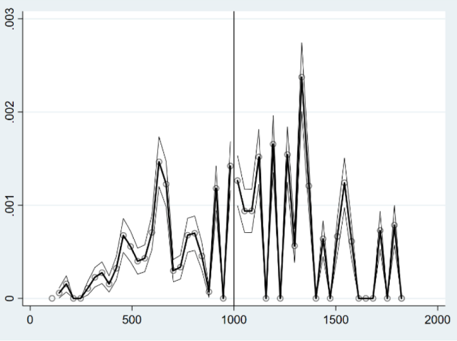
- Data: patient-level CeDAP microdata for the universe of births in Piedmont, Italy, 2011–2013. Initial sample: 104,559 births in 32 public hospitals; final sample: 55,840 after excluding non-Piedmont residents, second-level maternity units, and observations missing controls; RDD sample: 35,067. “Full team” is defined as at least a midwife, a gynecologist, and a pediatrician/neonatologist attending the birth.
- Analysis: productivity regressions for mode of delivery and newborn/maternal health outcomes, controlling for mother, delivery, and hospital characteristics, local health authority, month, and year fixed effects; standard errors clustered at hospital, shift, and weekday levels. Supporting tests include first-stage F-statistics, overidentification tests, McCrary density tests, and balancing tests around thresholds.
Limitations
- Stated: the authors cannot measure productivity variation within each team, only across team compositions; they lack direct data on equipment, delivery rooms, and beds, relying instead on indirect proxies; they do not observe postpartum health outcomes; and they are unlikely to fully capture all C-section-specific factors.
- Stated/evident: the analysis covers one Italian region (Piedmont), 2011–2013, and public hospitals, so external validity is limited; RDD subsamples have reduced precision; some maternal characteristics differ around the thresholds, though the authors control for them.
- Stated: the authors do not have permission to share the data.
Model-written summary. Check it against the paper before relying on it.
Integrity signals
Registry
Cites
Statistics
Figures
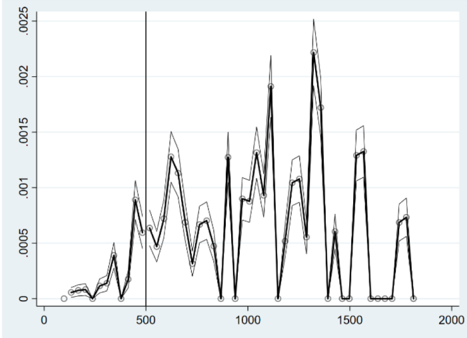
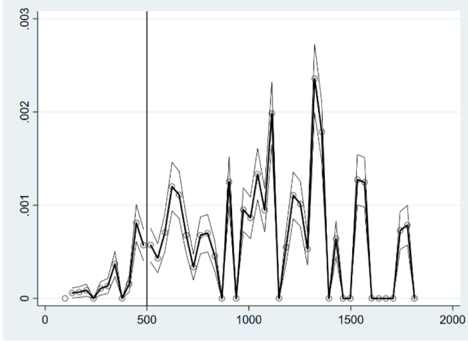
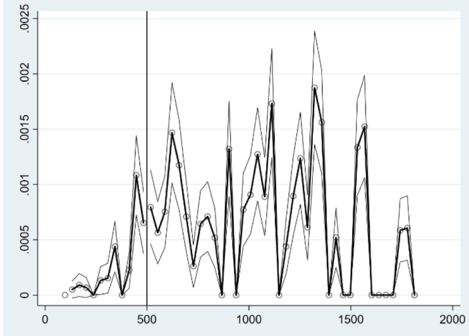
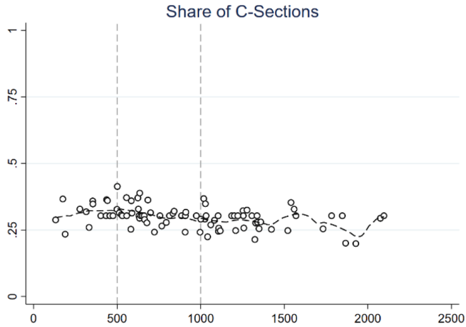
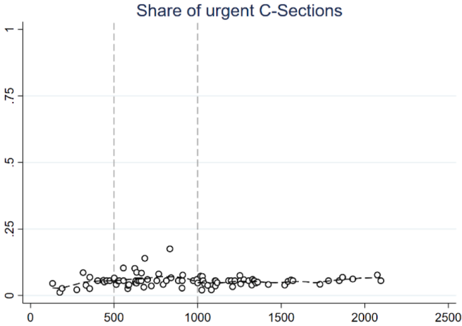
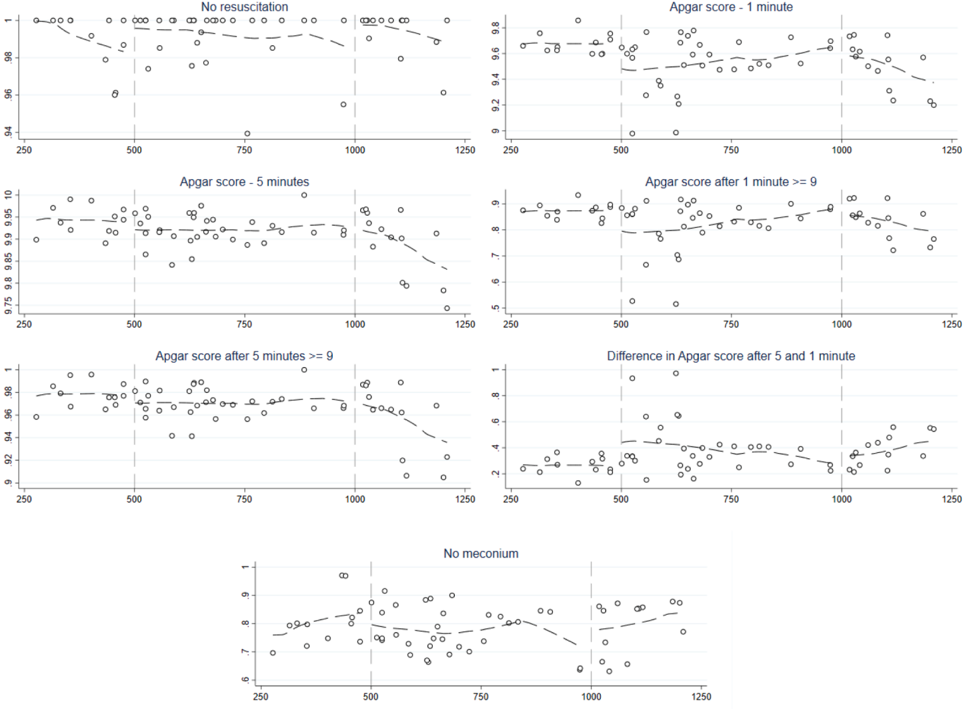
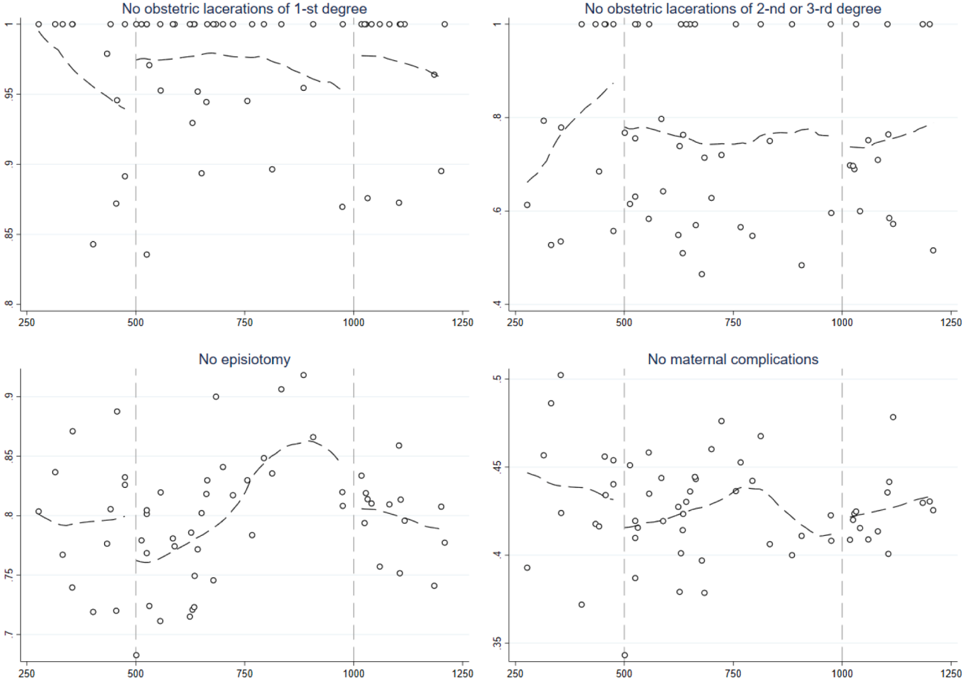
Verification
Claims the paper makes
0 Valid · 1 Not valid · 22 Not checked · 222 Own results and interpretations
A result the paper reports from its own data — it cites no other source for it, so there is none to check. The quote shows it is in the paper.
In the paper
“the likelihood of having no major obstetric lacerations increases by about nine percentage points (about one-quarter of a standard deviation) with a full team.”
§ Understanding labour productivity in maternity wards > 1. Introduction
plainstates a cause- Asserted: passes — The authors put it forward as true.
- Checkable: passes — It can be checked against evidence.
- Load-bearing: passes — The paper’s conclusions depend on it.
- Based: passes — The paper gives a reason why it holds.
- Rests on 2 assumptions not shown here.
A result the paper reports from its own data — it cites no other source for it, so there is none to check. The quote shows it is in the paper.
In the paper
“the probability of having a full team in the delivery room increases by about 23 percentage points for maternity units above the 500-births threshold and by about 18 percentage points for units above the 1000-births threshold compared to units just below the thresholds.”
§ Understanding labour productivity in maternity wards > 1. Introduction
plainstates a cause- Asserted: passes — The authors put it forward as true.
- Checkable: passes — It can be checked against evidence.
- Load-bearing: passes — The paper’s conclusions depend on it.
- Based: passes — The paper gives a reason why it holds.
- Rests on an assumption not shown here.
A result the paper reports from its own data — it cites no other source for it, so there is none to check. The quote shows it is in the paper.
In the paper
“A full team also decreases the probability of observing a perfect Apgar score (greater than nine) after birth.”
§ Understanding labour productivity in maternity wards > 1. Introduction
plainstates a cause- Asserted: passes — The authors put it forward as true.
- Checkable: passes — It can be checked against evidence.
- Load-bearing: unclear — It is unclear whether the paper’s conclusions depend on it.
- Based: passes — The paper gives a reason why it holds.
- Rests on 2 assumptions not shown here.
A result the paper reports from its own data — it cites no other source for it, so there is none to check. The quote shows it is in the paper.
In the paper
“Apgar scores are significantly lower with a full team: -0.36 points and -0.12 points for one-and five-minute Apgar scores, respectively.”
§ Understanding labour productivity in maternity wards > 1. Introduction
plainstates a cause- Asserted: passes — The authors put it forward as true.
- Checkable: passes — It can be checked against evidence.
- Load-bearing: unclear — It is unclear whether the paper’s conclusions depend on it.
- Based: passes — The paper gives a reason why it holds.
- Rests on 2 assumptions not shown here.
A result the paper reports from its own data — it cites no other source for it, so there is none to check. The quote shows it is in the paper.
In the paper
“the likelihood of having an episiotomy, a small surgical cut to facilitate childbirth and prevent complications or vaginal tears, increases by 17 percentage points with a full team”
§ Understanding labour productivity in maternity wards > 1. Introduction
plainstates a cause- Asserted: passes — The authors put it forward as true.
- Checkable: passes — It can be checked against evidence.
- Load-bearing: passes — The paper’s conclusions depend on it.
- Based: passes — The paper gives a reason why it holds.
- Rests on 2 assumptions not shown here.
135 more claims
Create a free account to see all 245 claims and to verify the 30 references still open.
- It may state two separate claims as one. 61
- Probably not a substantial claim. 26
- The quote only partly states this claim. 23
Self-check
Percentages, sums and reported differences re-computed from the paper’s own numbers.
Each contradiction between two passages listed here was confirmed by an independent check.
Rated minor: it would not touch a result — a value no result rests on, a p-value that stays on the same side of the significance level, or a conflict that is clerical, resolved elsewhere in the paper, or outside its own findings.
In the paper
§ Understanding labour productivity in maternity wards > 6. Conclusions
“We find no role for the full team in the choice of mode of delivery.”
§ Understanding labour productivity in maternity wards > 5.3. Delivery method
“We find that the presence of a full team is significant only in column 2: the presence of a full team reduces the probability of having an emergency C-section rather than a planned C-section or a vaginal delivery by about 5.9 percentage points, around one fourth of a standard deviation.”
Rated minor: it would not touch a result — a value no result rests on, a p-value that stays on the same side of the significance level, or a conflict that is clerical, resolved elsewhere in the paper, or outside its own findings.
In the paper
§ Understanding labour productivity in maternity wards > 3.2. Outcome variables
“We also define two dichotomous indicators for the probability of an Apgar score equal to or higher than 9 (a perfect score) for both the one and five-minute scores.”
§ Understanding labour productivity in maternity wards > 1. Introduction
“A full team also decreases the probability of observing a perfect Apgar score (greater than nine) after birth.”
Citations
Cites
WHO Recommendations: Intrapartum care for a positive childbirth experience
World Health Organization, & Bohren, M. (2018) · Minerva Access (University of Melbourne) · Cited by 3,675
Manipulation of the Running Variable in the Regression Discontinuity Design: A Density Test,
McCrary, J. (2008) · Journal of Econometrics · doi:10.1016/j.jeconom.2007.05.005 · Cited by 3,600
Using Maimonides' Rule to Estimate the Effect of Class Size on Scholastic Achievement
Angrist, J. D., & Lavy, V. (1999) · The Quarterly Journal of Economics · doi:10.1162/003355399556061 · Cited by 1,482
Almond, D. (2006) · Journal of Political Economy · doi:10.1086/507154 · Cited by 1,190
From the Cradle to the Labor Market? The Effect of Birth Weight on Adult Outcomes
Black, S. E., Devereux, P. J., & Salvanes, K. G. (2007) · The Quarterly Journal of Economics · doi:10.1162/qjec.122.1.409 · Cited by 1,142
Waste in the US Health Care System: Estimated Costs and Potential for Savings
Shrank, W. H., Rogstad, T. L., & Parekh, N. (2019) · JAMA · doi:10.1001/jama.2019.13978 · Cited by 1,046
Ageing of population and health care expenditure: a red herring?
Zweifel, P., Felder, S., & Meiers, M. (1999) · Health Economics · doi:10.1002/(sici)1099-1050(199909)8:6<485::aid-hec461>3.0.co;2-4 · Cited by 910
Aiken, L. H., Cimiotti, J. P., Sloane, D. M., Smith, H. L., Flynn, L., & Neff, D. F. (2011) · Medical Care · doi:10.1097/mlr.0b013e3182330b6e · Cited by 822
Fiscal Sustainability of Health Systems: Bridging Health and Finance Perspectives
OECD (2015) · OECD eBooks · doi:10.1787/9789264233386-en · Cited by 531
Health at a Glance: Europe 2018: State of Health in the EU Cycle
OECD, & Union, E. (2018) · Health at a Glance: Europe · doi:10.1787/health_glance_eur-2018-en · Cited by 524
Almond, D., Chay, K. Y., & Lee, D. S. (2005) · The Quarterly Journal of Economics · doi:10.1093/qje/120.3.1031 · Cited by 507
The Impact of Competition on Management Quality: Evidence from Public Hospitals
Bloom, N., Propper, C., Seiler, S., & Van Reenen, J. (2015) · The Review of Economic Studies · doi:10.1093/restud/rdu045 · Cited by 500
Productivity Spillovers in Health Care: Evidence from the Treatment of Heart Attacks
Chandra, A., & Staiger, D. O. (2007) · Journal of Political Economy · doi:10.1086/512249 · Cited by 366
The Effects of Poor Neonatal Health on Children's Cognitive Development
Figlio, D., Guryan, J., Karbownik, K., & Roth, J. (2014) · American Economic Review · doi:10.1257/aer.104.12.3921 · Cited by 313
Early Life Health Interventions and Academic Achievement
Bharadwaj, P., Løken, K. V., & Neilson, C. (2013) · American Economic Review · doi:10.1257/aer.103.5.1862 · Cited by 290
Physician fees and procedure intensity: the case of cesarean delivery
Gruber, J., Kim, J., & Mayzlin, D. (1999) · Journal of Health Economics · doi:10.1016/s0167-6296(99)00009-0 · Cited by 284
Oreopoulos, P., Stabile, M., Walld, R., & Roos, L. L. (2008) · Journal of Human Resources · doi:10.1353/jhr.2008.0003 · Cited by 279
First Do No Harm? Tort Reform and Birth Outcomes*
Currie, J., & MacLeod, W. B. (2008) · Quarterly Journal of Economics · doi:10.1162/qjec.2008.123.2.795 · Cited by 256
Estimating Marginal Returns to Medical Care: Evidence from At-Risk Newborns*
Almond, D., Doyle, Jr., Kowalski, A. E., & Williams, H. (2010) · Quarterly Journal of Economics · doi:10.1162/qjec.2010.125.2.591 · Cited by 223
Breastfeeding: a smart investment in people and in economies
Hansen, K. (2016) · The Lancet · doi:10.1016/s0140-6736(16)00012-x · Cited by 202
Lin, H. (2013) · Journal of Health Economics · doi:10.1016/j.jhealeco.2014.04.007 · Cited by 199
Interobserver variability of the 5-minute Apgar score
O’Donnell, C. P. F., Kamlin, C. O. F., Davis, P. G., Carlin, J. B., & Morley, C. J. (2006) · The Journal of Pediatrics · doi:10.1016/j.jpeds.2006.05.040 · Cited by 189
Nurse Staffing and NICU Infection Rates
Rogowski, J. A., Staiger, D., Patrick, T., Horbar, J., Kenny, M., & Lake, E. T. (2013) · JAMA Pediatrics · doi:10.1001/jamapediatrics.2013.18 · Cited by 187
Technology Diffusion and Productivity Growth in Health Care
Skinner, J., & Staiger, D. (2015) · Review of Economics and Statistics · doi:10.1162/rest_a_00535 · Cited by 185
Human Capital and Productivity in a Team Environment: Evidence from the Healthcare Sector
Bartel, A. P., Beaulieu, N. D., Phibbs, C. S., & Stone, P. W. (2014) · American Economic Journal Applied Economics · doi:10.1257/app.6.2.231 · Cited by 185
Can governments do it better? Merger mania and hospital outcomes in the English NHS
Gaynor, M., Laudicella, M., & Propper, C. (2012) · Journal of Health Economics · doi:10.1016/j.jhealeco.2012.03.006 · Cited by 182
Returns to physician human capital: Evidence from patients randomized to physician teams
Doyle, J. J., Ewer, S. M., & Wagner, T. H. (2010) · Journal of Health Economics · doi:10.1016/j.jhealeco.2010.08.004 · Cited by 146
The First Golden Minutes of the Extremely-Low-Gestational-Age Neonate: A Gentle Approach
Vento, M., Cheung, P., & Aguar, M. (2008) · Neonatology · doi:10.1159/000178770 · Cited by 137
Cook, A., Gaynor, M., Stephens, M., & Taylor, L. J. (2012) · Journal of Health Economics · doi:10.1016/j.jhealeco.2012.01.005 · Cited by 128
The volume-outcome effect, scale economies, and learning-by-doing
Gaynor, M., Seider, H., & Vogt, W. B. (2005) · American Economic Review · doi:10.1257/000282805774670329 · Cited by 127
Federalism and Decentralization in European Health and Social Care
Costa‐Font, J., & Greer, S. L. (2012) · Palgrave Macmillan UK eBooks · doi:10.1057/9781137291875 · Cited by 124
Do Strikes Kill? Evidence from New York State
B, J. G. A., & Kleiner, S. A. (2010) · American Economic Journal Economic Policy · doi:10.1257/pol.4.1.127 · Cited by 121
Teamwork and Moral Hazard: Evidence from the Emergency Department
Chan, D. C. (2016) · Journal of Political Economy · doi:10.1086/685910 · Cited by 116
Avdic, D. (2016) · Journal of Health Economics · doi:10.1016/j.jhealeco.2016.02.002 · Cited by 114
Leinweber, J., Fontein‐Kuipers, Y., Karlsdottir, S. I., Ekström‐Bergström, A., Nilsson, C., Stramrood, C., & Thomson, G. (2023) · Birth · doi:10.1111/birt.12666 · Cited by 113
An International Perspective on Policies for an Aging Society
B, J. G. A., & Wise, D. A. (2001) · National Bureau of Economic Research · doi:10.3386/w8103 · Cited by 110
Mesman, R., Westert, G. P., Berden, B. J. M. M., & Faber, M. J. (2015) · Health Policy · doi:10.1016/j.healthpol.2015.04.005 · Cited by 102
The Efficiency of Slacking off: Evidence From the Emergency Department
Chan, D. C. (2018) · Econometrica · doi:10.3982/ecta13565 · Cited by 96
Diagnosing expertise: human capital, decision making, and performance among physicians
Currie, J., & MacLeod, W. B. (2017) · Journal of Labor Economics · doi:10.1086/687848 · Cited by 91
OECD (2024) · OECD eBooks · doi:10.1787/880f3195-en · Cited by 88
Policies for an Ageing Society
Casey, B. H., Oxley, H., Whitehouse, E., Antolín, P., Duval, R., & Leibfritz, W. (2003) · OECD Economics Department working papers · doi:10.1787/737005512385 · Cited by 86
Patient outcomes when hospitals experience a surge in admissions
Evans, W. N., & Kim, B. (2005) · Journal of Health Economics · doi:10.1016/j.jhealeco.2005.10.003 · Cited by 85
Mums Go Online: Is the Internet Changing the Demand for Health Care?
Amaral‐Garcia, S., Nardotto, M., Propper, C., & Valletti, T. (2020) · The Review of Economics and Statistics · doi:10.1162/rest_a_01033 · Cited by 81
Haste or Waste? Peer Pressure and Productivity in the Emergency Department
Silver, D. W. (2020) · The Review of Economic Studies · doi:10.1093/restud/rdaa054 · Cited by 75
Identifying Sources of Inefficiency in Healthcare*
Chandra, A., & Staiger, D. O. (2020) · The Quarterly Journal of Economics · doi:10.1093/qje/qjz040 · Cited by 62
Provider Supply, Utilization, and Infant Health: Evidence from a Physician Distribution Policy
Carrillo, B., & Féres, J. G. (2019) · American Economic Journal Economic Policy · doi:10.1257/pol.20170619 · Cited by 57
Estimating returns to hospital volume: Evidence from advanced cancer surgery
Avdic, D., Lundborg, P., & Vikström, J. (2018) · Journal of Health Economics · doi:10.1016/j.jhealeco.2018.10.005 · Cited by 54
Nicholson, S., & Propper, C. (2011) · Handbook of health economics · doi:10.1016/b978-0-444-53592-4.00014-1 · Cited by 50
Matsudaira, J. D. (2014) · The Journal of Human Resources · doi:10.3368/jhr.49.1.32 · Cited by 49
Medical Labour Supply and the Production of Healthcare
Lee, T., Propper, C., & Stoye, G. (2019) · Fiscal Studies · doi:10.1111/1475-5890.12198 · Cited by 48
Forgia, A. L. (2023) · Management Science · doi:10.1287/mnsc.2022.4571 · Cited by 46
Saving Money or Just Saving Lives? Improving the Productivity of US Health Care Spending
D, K. B. A., Chandra, A., & Skinner, J. (2012) · Annual Review of Economics · doi:10.1146/annurev-economics-080511-110942 · Cited by 43
Productivity Dispersion in Medicine and Manufacturing
Chandra, A., Finkelstein, A. N., Sacarny, A., & Syverson, C. (2016) · American Economic Review · doi:10.1257/aer.p20161024 · Cited by 41
The Italian Servizio Sanitario Nazionale: A Renewing Tale of Lost Promises
Turati, G. (2013) · Palgrave Macmillan UK eBooks · doi:10.1057/9781137291875_3 · Cited by 39
Self-citationSpatial inequality in access to healthcare: evidence from an Italian Alpine region
Perucca, G., Piacenza, M., & Turati, G. (2019) · Regional Studies · doi:10.1080/00343404.2018.1462481 · Cited by 38
Self-citationProducing Health: Measuring Value Added of Nursing Homes
Einav, L., Finkelstein, A. N., & Mahoney, N. (2022) · National Bureau of Economic Research · doi:10.3386/w30228 · Cited by 35
The Productivity of Professions: Evidence from the Emergency Department
Chan, D., & Chen, Y. (2022) · doi:10.3386/w30608 · Cited by 34
Giacomo, M. D., Piacenza, M., Siciliani, L., & Turati, G. (2017) · Health Economics · doi:10.1002/hec.3541 · Cited by 32
Self-citationThe newborn delivery room of tomorrow: emerging and future technologies
Batey, N., Henry, C., Garg, S., Wagner, M., Malhotra, A., Valstar, M., Smith, T., Sharkey, D., the European Society for Paediatric Research (ESPR) Neonatal Resuscitation Section Writing Group, Niemuth, M., et al. (2024) · Pediatric Research · doi:10.1038/s41390-022-01988-y · Cited by 31
Beyond Birthweight: The Origins of Human CapitalPreprint
Conti, G., Hanson, M. A., Inskip, H. M., Crozier, S., Cooper, C. C., & Godfrey, K. M. (2020) · SSRN Electronic Journal · doi:10.2139/ssrn.3614244 · Cited by 22
Baby Boomlets and Baby Health: Hospital Crowdedness, Hospital Spending, and Infant Health
Marks, M. S., & Choi, M. K. (2018) · American Journal of Health Economics · doi:10.1162/ajhe_a_00129 · Cited by 19
The Returns to Nursing: Evidence from a Parental Leave Program
Friedrich, B., & Hackmann, M. B. (2017) · National Bureau of Economic Research · doi:10.3386/w23174 · Cited by 19
The effect of co-payments on the take-up of prenatal tests
Giacomo, M. D., Piacenza, M., Siciliani, L., & Turati, G. (2021) · Journal of Health Economics · doi:10.1016/j.jhealeco.2021.102553 · Cited by 19
Self-citationMaternity ward crowding, procedure use, and child health
Maibom, J., Sievertsen, H. H., Simonsen, M., & Wüst, M. (2020) · Journal of Health Economics · doi:10.1016/j.jhealeco.2020.102399 · Cited by 17
Justified skepticism about Apgar scoring in out-of-hospital birth settings
Grünebaum, A., McCullough, L. B., Brent, R. L., Arabin, B., Levene, M. I., & Chervenak, F. A. (2015) · Journal of Perinatal Medicine · doi:10.1515/jpm-2014-0003 · Cited by 15
Low staffing in the maternity ward: Keep calm and call the surgeon
Facchini, G. (2022) · Journal of Economic Behavior & Organization · doi:10.1016/j.jebo.2022.03.013 · Cited by 15
Piacenza, M., Turati, G., & Vannoni, D. (2010) · Economic Modelling · doi:10.1016/j.econmod.2009.10.006 · Cited by 13
Self-citationLow-risk isn’t no-risk: Perinatal treatments and the health of low-income newborns
Daysal, N. M., Trandafir, M., & van Ewijk, R. J. G. (2019) · Journal of Health Economics · doi:10.1016/j.jhealeco.2019.01.006 · Cited by 13
Wiegerinck, M. M. J., Eskes, M., van der Post, J. A. M., Mol, B. W., & Ravelli, A. C. J. (2020) · Acta Obstetricia et Gynecologica Scandinavica · doi:10.1111/aogs.13767 · Cited by 13
The Health Impacts of Hospital Delivery Practices
Card, D., Fenizia, A., & Silver, D. (2023) · American Economic Journal: Economic Policy · doi:10.1257/pol.20210034 · Cited by 13
Berta, P., Martini, G., Massimiliano Piacenza, B., & Turati, G. (2020) · Health Economics · doi:10.1002/hec.4110 · Cited by 12
Self-citationRachet-Jacquet, L., Gutacker, N., & Siciliani, L. (2021) · Journal of Economic Behavior & Organization · doi:10.1016/j.jebo.2021.08.014 · Cited by 11
How do hospitals respond to input regulation? Evidence from the California nurse staffing mandate
Raja, C. (2023) · Journal of Health Economics · doi:10.1016/j.jhealeco.2023.102826 · Cited by 9
Does Health-Care Consolidation Harm Patients? Evidence from Maternity Ward Closures
Avdic, D., Lundborg, P., & Vikström, J. (2024) · American Economic Journal: Economic Policy · doi:10.1257/pol.20200734 · Cited by 9
Fiscal sustainability of health systems – Why is it an issue, what can be done?
OECD (2015) · OECD eBooks · doi:10.1787/9789264233386-5-en · Cited by 6
The Productivity of Professions: Evidence from the Emergency Department
Chan, D., & Chen, Y. (2026) · American Economic Review · doi:10.1257/aer.20241007 · Cited by 1
(1993) · Europe PMC (PubMed Central)
The Costs of Low Birth Weight*
Almond, D., Chay, K. Y., & Lee, D. S. (2005) · Quarterly Journal of Economics · doi:10.1162/003355305774268228
Matsudaira, J. D. (2014) · Journal of Human Resources · doi:10.1353/jhr.2014.0003
The Productivity of Professions: Evidence from the Emergency Department
Chan, D., & Chen, Y. (2022) · SSRN Electronic Journal · doi:10.2139/ssrn.4262592
Haste or Waste? Peer Pressure and Productivity in the Emergency Department
Silver, D. (2020) · SSRN Electronic Journal · doi:10.2139/ssrn.3588769
Research works printed but not linked: 1
- ACOG -American College of Obstetricians and Gynecologists, 2017. Guidelines For Perinatal Care, 8th Edition.
Cited by
The Long and Winding Road: The Access to Administrative Data for Research in Italy
Leombruni, R., & Ardito, C. (2026) · Professional practice in governance and public organizations · doi:10.1007/978-3-031-99032-8_16 · Cited by 1
Data-Driven Learning in the EU: From Administrative Sources to Public Value
Berton, F., & Paruolo, P. (2026) · Professional practice in governance and public organizations · doi:10.1007/978-3-031-99032-8 · Cited by 1
Moscelli, G., Giuntella, O., & Ziebarth, N. R. (2025) · Labour Economics · doi:10.1016/j.labeco.2025.102801
Does practice make perfect? Panel evidence from hip fracture surgery in Italy
Paktinat, S., Ugolini, C., & Verzulli, R. (2026) · Health Policy · doi:10.1016/j.healthpol.2026.105703
Learning About Environmental Outcomes in Europe
Brutti, Z., Freo, M., & Serlenga, L. (2026) · Professional practice in governance and public organizations · doi:10.1007/978-3-031-99032-8_31
Metadata
- Authors
- Di Giacomo, M., Piacenza, M., Salmasi, L., & Turati, G.
- Affiliations
- Università Cattolica del Sacro Cuore (IT)
- Corresponding author
- Turati, Gilberto
- Venue
- Labour Economics
- Publisher
- Elsevier BV
- Published
- 2025-10
- Volume
- 96
- Pages
- 102760
- ISSN
- 0927-5371 (ISSN-L)
- OpenAlex
- W4412449269
- Semantic Scholar
- bb8f6887adbee9a374c41ed2f36aae10779647ae
- Cited by
- 5
- References
- 75
- Citations by year
- 2026: 4 · 2025: 1
- FWCI
- 3.71
- Type
- journal article
- Language
- en
- Open access
- hybrid
- doi.org
- Licence
- cc-by
- www.elsevier.com/tdm/userlicense/1.0/ (tdm)
- www.elsevier.com/legal/tdmrep-license (tdm)
- creativecommons.org/licenses/by/4.0/ (vor)
- Locations
- Labour Economics (publishedVersion, cc-by)
- Institutional Research Information System University of Turin (University of Turin) (submittedVersion, other-oa)
- PubliCatt (Università Cattolica del Sacro Cuore) (submittedVersion, other-oa)
- Funders
- Regione Piemonte
- Università Cattolica del Sacro Cuore
- Universita degli Studi di Bari Aldo Moro
- Università degli Studi di Genova
- Università Bocconi
- Università degli Studi di Padova
- Università Politecnica delle Marche
- University of Surrey
- Topics
- Health Sciences › Medicine › Obstetrics and Gynecology › Maternal and Perinatal Health Interventions
- Social Sciences › Economics, Econometrics and Finance › Economics and Econometrics › Healthcare Policy and Management
- Health Sciences › Medicine › Public Health, Environmental and Occupational Health › Healthcare Quality and Management
- Keywords
- labor productivity, maternity ward, hospital staffing, mode of delivery, cesarean section, neonatal outcomes, maternal outcomes, medical interventions, regression discontinuity design
About these checks
Registry, retraction, Cites and statistics results are computed, not judged, with one exception: a printed reference that no index lists is read once by a model before it counts as a citation error. Claims are extracted by a model and kept only when their quote appears verbatim in the text; each cited source is then checked, with a model’s help, for whether it says what the claim relies on. Those verdicts can be wrong — read the claim’s quote and the cited source before relying on one.
A language model drew the claims from the paper on 2026-11-17, under version 3 of the claim definition (model deepseek-v4.1-flash, prompt extract-v3).
A second model labelled each claim on 2026-11-17 (model jev-1.13-20260917, definition revision gold-guideline-v0.2).
Statistics and arithmetic are recomputed, not judged.
Confidence bands are shown only for fields calibrated on our annotated test set. None is calibrated yet, so no band is shown.
What counts as a claim ›How we measure confidence ›How we check this ›
Are you an author, or do you see a problem with this page? Request a review
Data sources
Bibliographic data: Semantic Scholar, OpenAlex, Crossref.
Contains information from the Semantic Scholar Academic Graph Datasets, made available under the ODC Attribution License (ODC-BY 1.0).
Semantic Scholar’s data is described in: Kinney, R., et al. (2023). The Semantic Scholar Open Data Platform. arXiv:2301.10140.
