

The DOI matches its Crossref record; 239 of the 244 references it cites were found in a registry or an index.
Nonalcoholic fatty liver disease (NAFLD) from pathogenesis to treatment concepts in humans
Open accessAbstract
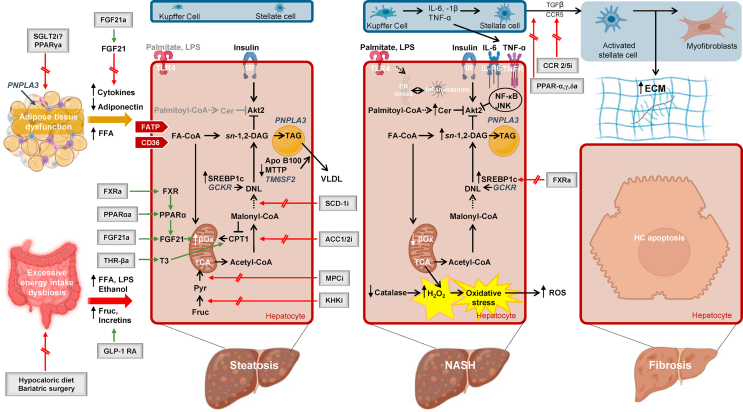
BACKGROUND: Nonalcoholic fatty liver disease (NAFLD) comprises hepatic alterations with increased lipid accumulation (steatosis) without or with inflammation (nonalcoholic steatohepatitis, NASH) and/or fibrosis in the absence of other causes of liver disease. NAFLD is developing as a burgeoning health challenge, mainly due to the worldwide obesity and diabetes epidemics. SCOPE OF REVIEW: This review summarizes the knowledge on the pathogenesis underlying NAFLD by focusing on studies in humans and on hypercaloric nutrition, including effects of saturated fat and fructose, as well as adipose tissue dysfunction, leading to hepatic lipotoxicity, abnormal mitochondrial function, and oxidative stress, and highlights intestinal dysbiosis. These mechanisms are discussed in the context of current treatments targeting metabolic pathways and the results of related clinical trials. MAJOR CONCLUSIONS: Recent studies have provided evidence that certain conditions, for example, the severe insulin-resistant diabetes (SIRD) subgroup (cluster) and the presence of an increasing number of gene variants, seem to predispose for excessive risk of NAFLD and its accelerated progression. Recent clinical trials have been frequently unsuccessful in halting or preventing NAFLD progression, perhaps partly due to including unselected cohorts in later stages of NAFLD. On the basis of this literature review, this study proposed screening in individuals with the highest genetic or acquired risk of disease progression, for example, the SIRD subgroup, and developing treatment concepts targeting the earliest pathophysiolgical alterations, namely, adipocyte dysfunction and insulin resistance.
Overview
The claims and statistics of this paper haven’t been checked yet.
Run the check — free, no account needed. It reads the open-access text and checks the sources it cites.
Integrity signals
Registry
Cites
Statistics
Figures
Verification
Claims the paper makes
The claims and statistics of this paper haven’t been checked yet.
Run the check — free, no account needed. It reads the open-access text and checks the sources it cites.
Claims other papers make about this one
Each is checked against this paper’s own text: does it say what the citing paper says it does?
The source backs part of the claim, not all of it — or backs it for a different population, condition or comparison.
In the citing paper
“As a consequence, adipose tissue insulin resistance develops, paralleled by altered adipokine (i.e., adiponectin, leptin) secretion and impaired mitochondrial function, further promoting adipose tissue inflammation [19,20].”
From Obesity and MASLD: Is weight loss the (only) key to treat metabolic liver disease? (2024) · cites this paper as [19]
Experimental — accuracy not yet measuredThe cited source says what the claim attributes to it.
In the citing paper
“Here, NEFA promote hepatic triglyceride storage and gluconeogenesis [26], when the capacity of the liver to oxidize these substrates or export them as very-low-density lipoproteins (VLDL) is depleted [19].”
From Obesity and MASLD: Is weight loss the (only) key to treat metabolic liver disease? (2024) · cites this paper as [19]
Self-check
Percentages, sums and reported differences re-computed from the paper’s own numbers.
The self-check needs the paper’s full text.
Citations
Cites
Dapagliflozin in Patients with Heart Failure and Reduced Ejection Fraction
McMurray, J. J. V., Solomon, S. D., Inzucchi, S. E., Køber, L., Kosiborod, M. N., Martinez, F. A., Ponikowski, P., Sabatine, M. S., Anand, I. S., Bělohlávek, J., et al. (2019) · New England Journal of Medicine · doi:10.1056/nejmoa1911303 · Cited by 7,140
Changes of Intestinal Functions in Liver Cirrhosis
Fukui, H., & Wiest, R. (2016) · Inflammatory Intestinal Diseases · doi:10.1159/000444436 · Cited by 6,820
EASL–EASD–EASO Clinical Practice Guidelines for the management of non-alcoholic fatty liver disease
(2016) · Journal of Hepatology · doi:10.1016/j.jhep.2015.11.004 · Cited by 4,836
Steatohepatitis: A tale of two “hits”?
Day, C. P., & James, O. F. W. (1998) · Gastroenterology · doi:10.1016/s0016-5085(98)70599-2 · Cited by 4,285
Donnelly, K. L., Smith, C. I., Schwarzenberg, S. J., Jessurun, J., Boldt, M. D., & Parks, E. J. (2005) · Journal of Clinical Investigation · doi:10.1172/jci23621 · Cited by 3,604
Genetic variation in PNPLA3 confers susceptibility to nonalcoholic fatty liver disease
Romeo, S., Kozlitina, J., Xing, C., Pertsemlidis, A., Cox, D., Pennacchio, L. A., Boerwinkle, E., Cohen, J. C., & Hobbs, H. H. (2008) · Nature Genetics · doi:10.1038/ng.257 · Cited by 3,416
Pioglitazone, Vitamin E, or Placebo for Nonalcoholic Steatohepatitis
Sanyal, A. J., Chalasani, N., Kowdley, K. V., McCullough, A., Diehl, A. M., Bass, N. M., Neuschwander-Tetri, B. A., Lavine, J. E., Tonascia, J., Unalp, A., et al. (2010) · New England Journal of Medicine · doi:10.1056/nejmoa0907929 · Cited by 3,327
Evolution of inflammation in nonalcoholic fatty liver disease: The multiple parallel hits hypothesis
Tilg, H., & Moschen, A. R. (2010) · Hepatology · doi:10.1002/hep.24001 · Cited by 2,548
Ahlqvist, E., Storm, P., Käräjämäki, A., Martinell, M., Dorkhan, M., Carlsson, A., Vikman, P., Prasad, R. B., Aly, D. M., Almgren, P., et al. (2018) · The Lancet Diabetes & Endocrinology · doi:10.1016/s2213-8587(18)30051-2 · Cited by 2,335
Neuschwander-Tetri, B. A., Loomba, R., Sanyal, A. J., Lavine, J. E., Van Natta, M. L., Abdelmalek, M. F., Chalasani, N., Dasarathy, S., Diehl, A. M., Hameed, B., et al. (2015) · The Lancet · doi:10.1016/s0140-6736(14)61933-4 · Cited by 2,237
Research works printed but not linked: 1
- Ratziu, 2018, One-year results of the global phase 2b randomized placebo-controlled arrest trial of aramchol, a stearoyl CoA desaturase inhibitor, in patients with NASH, Hepatology, 68
Cited by
Sorted by citations
Glucagon-like peptide-1 receptor: mechanisms and advances in therapy
Zheng, Z., Zong, Y., Ma, Y., Tian, Y., Pang, Y., Zhang, C., & Gao, J. (2024) · Signal Transduction and Targeted Therapy · doi:10.1038/s41392-024-01931-z · Cited by 1,036
Mitochondrial alterations in fatty liver diseases
Fromenty, B., & Roden, M. (2022) · Journal of Hepatology · doi:10.1016/j.jhep.2022.09.020 · Cited by 448
Self-citationInter-organ crosstalk during development and progression of type 2 diabetes mellitus
Xourafa, G., Korbmacher, M., & Roden, M. (2024) · Nature Reviews Endocrinology · doi:10.1038/s41574-023-00898-1 · Cited by 274
Self-citationInsulin resistance and insulin sensitizing agents
Mastrototaro, L., & Roden, M. (2021) · Metabolism · doi:10.1016/j.metabol.2021.154892 · Cited by 274
Self-citationHealth Promoting Properties of Bee Royal Jelly: Food of the Queens
Collazo, N., Carpena, M., Núñez-Estévez, B., Otero, P., Simal‐Gándara, J., & Prieto, M. A. (2021) · Nutrients · doi:10.3390/nu13020543 · Cited by 174
MicroRNAs in non-alcoholic fatty liver disease: Progress and perspectives
Hochreuter, M. Y., Dall, M., Treebak, J. T., & Barrès, R. (2022) · Molecular Metabolism · doi:10.1016/j.molmet.2022.101581 · Cited by 180
Obesity and MASLD: Is weight loss the (only) key to treat metabolic liver disease?
Huttasch, M., Roden, M., & Kahl, S. (2024) · Metabolism · doi:10.1016/j.metabol.2024.155937 · Cited by 169
Self-citationZeng, X., Varady, K. A., Wang, X., Targher, G., Byrne, C. D., Tayyem, R., Latella, G., Bergheim, I., Valenzuela, R., George, J., et al. (2024) · Metabolism · doi:10.1016/j.metabol.2024.156028 · Cited by 138
In Vitro Models for Non-Alcoholic Fatty Liver Disease: Emerging Platforms and Their Applications
Ramos, M. J., Bandiera, L., Menolascina, F., & Fallowfield, J. A. (2022) · iScience · doi:10.1016/j.isci.2021.103549 · Cited by 127
Tian, T., Zhang, J., Xie, W., Ni, Y., Fang, X., Liu, M., Peng, X., Wang, J., Dai, Y., & Zhou, Y. (2022) · Nutrients · doi:10.3390/nu14214505 · Cited by 129
Johnson, S. M., Bao, H., McMahon, C. E., Chen, Y., Burr, S. D., Anderson, A. M., Madeyski-Bengtson, K., Lindén, D., Han, X., & Liu, J. (2024) · Nature Communications · doi:10.1038/s41467-024-49224-x · Cited by 100
NAFLD and thyroid function: pathophysiological and therapeutic considerations
Hatziagelaki, E., Paschou, S. A., Schön, M., Psaltopoulou, T., & Roden, M. (2022) · Trends in Endocrinology & Metabolism · doi:10.1016/j.tem.2022.08.001 · Cited by 93
FGF19 and FGF21: In NASH we trust
Talukdar, S., & Kharitonenkov, A. (2020) · Molecular Metabolism · doi:10.1016/j.molmet.2020.101152 · Cited by 82
Bi, Y., Guo, X., Zhang, M., Zhu, K., Shi, C., Fan, B., Wu, Y., Yang, Z., & Ji, G. (2021) · Stem Cell Research & Therapy · doi:10.1186/s13287-021-02663-5 · Cited by 82
Yang, K., Chen, J., Zhang, T., Yuan, X., Ge, A., Wang, S., Xu, H., Zeng, L., & Ge, J. (2022) · Frontiers in Immunology · doi:10.3389/fimmu.2022.949746 · Cited by 85
Steatotic Liver Disease: Pathophysiology and Emerging Pharmacotherapies
Kokkorakis, M., Muzurović, E. M., Volčanšek, Š., Chakhtoura, M., Hill, M. A., Mikhailidis, D. P., & Mantzoros, C. S. (2024) · Pharmacological Reviews · doi:10.1124/pharmrev.123.001087 · Cited by 79
Endoplasmic Reticulum Stress Signaling and the Pathogenesis of Hepatocarcinoma
Wei, J., & Fang, D. (2021) · International Journal of Molecular Sciences · doi:10.3390/ijms22041799 · Cited by 68
Pafili, K., Kahl, S., Mastrototaro, L., Strassburger, K., Pesta, D., Herder, C., Pützer, J., Dewidar, B., Hendlinger, M., Granata, C., et al. (2022) · Journal of Hepatology · doi:10.1016/j.jhep.2022.08.010 · Cited by 67
Self-citationDing, R., Ma, Y., Li, T., Sun, M., Sun, Z., & Duan, J. (2023) · The Science of The Total Environment · doi:10.1016/j.scitotenv.2023.163144 · Cited by 69
Dewidar, B., Mastrototaro, L., Englisch, C., Ress, C., Granata, C., Rohbeck, E., Pesta, D. H., Heilmann, G., Wolkersdorfer, M. F., Esposito, I., et al. (2023) · EBioMedicine · doi:10.1016/j.ebiom.2023.104714 · Cited by 57
Self-citationHong, T., Zou, J., He, Y., Zhang, H., Liu, H., Mai, H., Yang, J., Cao, Z., Chen, X., Yao, J., et al. (2023) · The Science of The Total Environment · doi:10.1016/j.scitotenv.2023.164307 · Cited by 53
Ezhilarasan, D. (2024) · Metabolism · doi:10.1016/j.metabol.2024.155912 · Cited by 54
Nonalcoholic Fatty Liver Disease: An Emerging Modern-Day Risk Factor for Cardiovascular Disease
Hassen, G., Singh, A., Belete, G., Jain, N., la Hoz, I. D., Camacho-Leon, G., Dargie, N. K., Carrera, K. G., Alemu, T., Jhaveri, S., et al. (2022) · Cureus · doi:10.7759/cureus.25495 · Cited by 57
Nonalcoholic Fatty Liver Disease (NAFLD): Pathogenesis and Noninvasive Diagnosis
Dorairaj, V., Sulaiman, S. A., Abu, N., & Murad, N. A. A. (2021) · Biomedicines · doi:10.3390/biomedicines10010015 · Cited by 52
Xu, Z., Hu, W., Wang, B., Xu, T., Wang, J., & Wei, D. (2022) · Yonsei Medical Journal · doi:10.3349/ymj.2022.63.7.619 · Cited by 47
Khairnar, R., Islam, M. A., Fleishman, J. S., & Kumar, S. (2022) · Life Sciences · doi:10.1016/j.lfs.2022.121185 · Cited by 49
Cai, H., Li, Y., Wu, X., Yang, Y., Tedesco, A. C., Li, Z., & Bi, H. (2024) · Advanced Functional Materials · doi:10.1002/adfm.202406096 · Cited by 45
Ding, X., He, X., Tang, B., & Lan, T. (2024) · Chinese Medicine · doi:10.1186/s13020-024-00894-1 · Cited by 49
Matye, D. J., Wang, H., Luo, W., Sharp, R. R., Chen, C., Gu, L., Jones, K. L., Ding, W., Friedman, J. E., & Li, T. (2021) · Cellular and Molecular Gastroenterology and Hepatology · doi:10.1016/j.jcmgh.2021.04.013 · Cited by 44
Zhang, L., Dai, X., Wang, L., Cai, J., Shen, J., Shen, Y., Li, X., & Zhao, Y. M. (2022) · Frontiers in Nutrition · doi:10.3389/fnut.2022.961892 · Cited by 46
NIRANJAN, S., Phillips, B. E., & Giannoukakis, N. (2023) · Frontiers in Endocrinology · doi:10.3389/fendo.2023.1193373 · Cited by 44
Amiri, P., Arefhosseini, S., Bakhshimoghaddam, F., Gurvan, H. J., & Hosseini, S. A. (2022) · Frontiers in Nutrition · doi:10.3389/fnut.2022.1037696 · Cited by 42
Fan, S., Wang, W., Che, W., Xu, Y., Jin, C., Dong, L., & Xia, Q. (2025) · Metabolites · doi:10.3390/metabo15030201 · Cited by 43
Epigenetic regulation of inflammation in insulin resistance
Klimczak, S., & Śliwińska, A. (2022) · Seminars in Cell and Developmental Biology · doi:10.1016/j.semcdb.2022.09.004 · Cited by 47
Understanding NAFLD: From Case Identification to Interventions, Outcomes, and Future Perspectives
Clayton‐Chubb, D., Kemp, W. W., Majeed, A., Lubel, J. S., Hodge, A., & Roberts, S. K. (2023) · Nutrients · doi:10.3390/nu15030687 · Cited by 45
Zhou, Y., Wu, C., Wang, X., Li, P., Fan, N., Zhang, W., Liu, Z., Zhang, W., & Tang, B. (2021) · Analytical Chemistry · doi:10.1021/acs.analchem.1c01776 · Cited by 39
Excess Body Weight and Metabolic (Dysfunction)-Associated Fatty Liver Disease (MAFLD)
Roeb, E. (2021) · Visceral Medicine · doi:10.1159/000515445 · Cited by 37
Zhou, Y., Yang, X., Wei, X., Zhang, S., & Yan, M. (2024) · Coordination Chemistry Reviews · doi:10.1016/j.ccr.2024.215864 · Cited by 36
Huang, X., Liu, X., Li, X., Zhang, Y., Gao, J., Yang, Y., Jiang, Y., Gao, H., Sun, C., Xuan, L., et al. (2023) · Nature Communications · doi:10.1038/s41467-023-40327-5 · Cited by 35
Ali, H., Shahzil, M., Moond, V., Shahzad, M., Thandavaram, A., Sehar, A., Waseem, H., Siddiqui, T. A., Dahiya, D. S., Patel, P., et al. (2024) · Journal of Personalized Medicine · doi:10.3390/jpm14010061 · Cited by 40
Kwon, Y., Gottmann, P., Wang, S., Tissink, J. J., Motzler, K., Sekar, R., Albrecht, W., Cadenas, C., Hengstler, J. G., Schürmann, A., et al. (2024) · Journal of Hepatology · doi:10.1016/j.jhep.2024.06.040 · Cited by 36
Yin, W., Xu, H., Bai, Z., Wu, Y., Zhang, Y., Liu, R., Wang, Z., Zhang, B., Shen, J., Zhang, H., et al. (2025) · Nature Communications · doi:10.1038/s41467-025-55939-2 · Cited by 36
Chu, X., Li, L., Yan, W., & Ma, H. (2022) · Oxidative Medicine and Cellular Longevity · doi:10.1155/2022/5180242 · Cited by 33
Choi, Y., Lee, J., & Moon, K. W. (2023) · Ecotoxicology and Environmental Safety · doi:10.1016/j.ecoenv.2023.114508 · Cited by 33
Mechanisms and therapeutic implications of selective autophagy in nonalcoholic fatty liver disease
Jin, S., Li, Y., Xia, T., Liu, Y., Zhang, S., Hu, H., Chang, Q., & Yan, M. (2024) · Journal of Advanced Research · doi:10.1016/j.jare.2024.01.027 · Cited by 35
Serum Afamin a Novel Marker of Increased Hepatic Lipid Content
Kurdiová, T., Baláž, M., Kovaničová, Z., Zemková, E., Kužma, M., Belan, V., Payer, J., Gašperíková, D., Dieplinger, H., Ukropcová, B., et al. (2021) · Frontiers in Endocrinology · doi:10.3389/fendo.2021.670425 · Cited by 34
Mtfp1 ablation enhances mitochondrial respiration and protects against hepatic steatosis
Patitucci, C., Hernández‐Camacho, J. D., Vimont, E., Yde, S., Cokelaer, T., Chaze, T., Gianetto, Q. G., Matondo, M., Gazi, A. D., Nemazanyy, I., et al. (2023) · Nature Communications · doi:10.1038/s41467-023-44143-9 · Cited by 32
Non-alcoholic fatty liver disease through the female lifespan: the role of sex hormones
Pafili, K., Paschou, S. Α., Armeni, E., Polyzos, S. A., Goulis, D. G., & Lambrinoudaki, I. V. (2022) · Journal of Endocrinological Investigation · doi:10.1007/s40618-022-01766-x · Cited by 32
Self-citationZhang, L., Chen, J., Yang, X., Shen, C., Huang, J., Zhang, D., Liu, N., Liu, C., Zhong, Y., Chen, Y., et al. (2024) · Signal Transduction and Targeted Therapy · doi:10.1038/s41392-023-01727-7 · Cited by 30
Jia, W. P., Luo, J., Yang, F., Feng, X., Zeng, M., Dai, W., Pan, X., Yang, Y., Li, Y., Duan, Y., et al. (2024) · Gut Microbes · doi:10.1080/19490976.2024.2351620 · Cited by 34
Genetic Polymorphisms and Diversity in Nonalcoholic Fatty Liver Disease (NAFLD): A Mini Review
Sulaiman, S. A., Dorairaj, V., & Adrus, M. N. H. (2022) · Biomedicines · doi:10.3390/biomedicines11010106 · Cited by 30
Elucidating cuproptosis in metabolic dysfunction-associated steatotic liver disease
Li, Y., Qi, P., Song, S., Wang, Y., Wang, H., Cao, P., Liu, Y., & Wang, Y. (2024) · Biomedicine & Pharmacotherapy · doi:10.1016/j.biopha.2024.116585 · Cited by 28
Begriche, K., Penhoat, C., Bernabeu-Gentey, P., Massart, J., & Fromenty, B. (2023) · Livers · doi:10.3390/livers3010003 · Cited by 32
Lai, Y., He, Z., Liu, Y., Yin, X., Fan, X., Rao, Z., Fu, H., Gu, L., & Xia, T. (2023) · Frontiers in Public Health · doi:10.3389/fpubh.2023.1231240 · Cited by 27
Hydrogen Sulfide and Liver Health: Insights into Liver Diseases
Nguyen, T. T. P., Nguyen, P. L., Park, S., Jung, C. H., & Jeon, T. (2023) · Antioxidants and Redox Signaling · doi:10.1089/ars.2023.0404 · Cited by 27
Giannakogeorgou, A., & Roden, M. (2024) · Alimentary Pharmacology & Therapeutics · doi:10.1111/apt.17848 · Cited by 30
Self-citationNonalcoholic Fatty Liver Disease and Staging of Hepatic Fibrosis
Engin, A. (2024) · Advances in experimental medicine and biology · doi:10.1007/978-3-031-63657-8_18 · Cited by 28
Chi, Y.-J., Bai, Z.-Y., Feng, G., Lai, X., & Song, Y. (2024) · Cell Communication and Signaling · doi:10.1186/s12964-024-01829-x · Cited by 27
Zhang, Y., Fu, Q., Wu, T., Liu, K., Xiao, Y., Liao, Q., Qi, X., Li, Y., & Zhou, L. (2022) · Free Radical Biology and Medicine · doi:10.1016/j.freeradbiomed.2022.12.093 · Cited by 26
James, A., Wang, K., Chen, Y., & Wang, Y. (2024) · Food Bioscience · doi:10.1016/j.fbio.2024.104218 · Cited by 27
PIM1 alleviated liver oxidative stress and NAFLD by regulating the NRF2/HO-1/NQO1 pathway
Yang, K., Yu, X., Guo, Z., Fang, Z., Zhang, H., Zhang, W., Liu, C., Ji, Y., Dong, Z., Gu, Q., et al. (2024) · Life Sciences · doi:10.1016/j.lfs.2024.122714 · Cited by 24
Wang, W. J., Liu, X., Wei, P., Ye, F., Chen, Y., Shi, L., Zhang, X., Li, ., Lin, S., & Yang, X. (2022) · Frontiers in Medicine · doi:10.3389/fmed.2022.862278 · Cited by 24
Li, T., Zhao, J., Cao, H., Han, X., Lu, Y. Y., Jiang, F., Li, X., Sun, J., Zhou, S., Sun, Z., et al. (2024) · American Journal of Clinical Nutrition · doi:10.1016/j.ajcnut.2024.07.015 · Cited by 22
Jin, G., Yao, X., Liu, D., Zhang, J., Zhang, X., Yang, Y., Bi, Y., Zhang, H., Dong, G., Tang, H., et al. (2023) · Immunity Inflammation and Disease · doi:10.1002/iid3.1114 · Cited by 23
The Role of Epigenetic Control of Mitochondrial (Dys)Function in MASLD Onset and Progression
Caputo, V., Tarantino, G., Santini, S. J., Fracassi, G., & Balsano, C. (2023) · Nutrients · doi:10.3390/nu15224757 · Cited by 22
Zhang, X., Zhi, Y., Zan, X., Fan, K., Chen, K., Zhao, S., Dai, X., Li, L., Yang, Y., Hu, K., et al. (2023) · Biochimica et Biophysica Acta (BBA) - Molecular Basis of Disease · doi:10.1016/j.bbadis.2023.166656 · Cited by 22
Tehrani, S. S., Goodarzi, G., Panahi, G., Zamani‐Garmsiri, F., & Meshkani, R. (2023) · Life Sciences · doi:10.1016/j.lfs.2023.121706 · Cited by 22
Lee, J. Y., An, M., Heo, H., Park, J.-Y., Lee, J., & Kang, C.-H. (2023) · Nutrients · doi:10.3390/nu15082005 · Cited by 22
Yuzbashian, E., Fernando, D. N., Pakseresht, M., Eurich, D. T., & Chan, C. B. (2023) · Nutrition Metabolism and Cardiovascular Diseases · doi:10.1016/j.numecd.2023.04.018 · Cited by 24
The emerging significance of mitochondrial targeted strategies in NAFLD treatment
Zhang, T., Nie, Y., & Wang, J. (2023) · Life Sciences · doi:10.1016/j.lfs.2023.121943 · Cited by 21
Li, Y., & Liu, Y. (2024) · Frontiers in Nutrition · doi:10.3389/fnut.2024.1361567 · Cited by 21
Amorim, R., Soares, P., Chavarria, D., Benfeito, S., Cagide, F., Teixeira, J., Oliveira, P. J., & Borges, F. (2024) · European Journal of Medicinal Chemistry · doi:10.1016/j.ejmech.2024.116723 · Cited by 21
LeFort, K. R., Rungratanawanich, W., & Song, B. (2023) · Antioxidants · doi:10.3390/antiox13010043 · Cited by 21
Armstrong, M. J., Okanoue, T., Palle, M. S., Sejling, A., Tawfik, M., & Roden, M. (2024) · Diabetes Obesity and Metabolism · doi:10.1111/dom.16065 · Cited by 20
Self-citationJiang, Y., Sui, D., Li, M., Xu, H., Yu, X., Liu, J., & Yu, Q. (2021) · Evidence-based Complementary and Alternative Medicine · doi:10.1155/2021/9003603 · Cited by 19
Li, C., Feng, Y., Li, J., Lian, R., Qin, L., & Wang, C. (2022) · Journal of the Science of Food and Agriculture · doi:10.1002/jsfa.12239 · Cited by 19
Non-alcoholic fatty liver disease: Dietary and nutraceutical approaches
Cogorno, L., Formisano, E., Vignati, A., Prigione, A., Tramacere, A., Borgarelli, C., Sukkar, S. G., & Pisciotta, L. (2023) · Liver Research · doi:10.1016/j.livres.2023.08.005 · Cited by 19
Zhao, W.-W., Xiao, M., Wu, X., Li, X., Li, X.-X., Zhao, T., Yu, L., & Chen, X.-Q. (2021) · Frontiers in Pharmacology · doi:10.3389/fphar.2021.771976 · Cited by 18
Excess cardiovascular mortality in men with non-alcoholic fatty liver disease: A cause for concern!
Batta, A., & Hatwal, J. (2024) · World Journal of Cardiology · doi:10.4330/wjc.v16.i7.380 · Cited by 19
Liu, X., Jiang, Y., Ye, J., & Wang, X. (2022) · Frontiers in Immunology · doi:10.3389/fimmu.2022.999412 · Cited by 18
Cao, Y., Fang, X., Sun, M., Zhang, Y., Shan, M., Lan, X., Zhu, D., & Luo, H. (2023) · Phytotherapy Research · doi:10.1002/ptr.7932 · Cited by 17
Metabolic disorders affecting the liver and heart: Therapeutic efficacy of miRNA-based therapies?
Sala, L. L., Carlini, V., Conte, C., Macas-Granizo, M. B., Afzalpour, E., Martín-Delgado, J., D’Anzeo, M., Pedretti, R. F. E., Naselli, A., Pontiroli, A. E., et al. (2024) · Pharmacological Research · doi:10.1016/j.phrs.2024.107083 · Cited by 18
Lipid Hormones at the Intersection of Metabolic Imbalances and Endocrine Disorders
Dobre, M.-Z., Vîrgolici, B., & Cioarca-Nedelcu, R. (2025) · Current Issues in Molecular Biology · doi:10.3390/cimb47070565 · Cited by 17
Giannakogeorgou, A., Roden, M., & Pafili, K. (2025) · HORMONES · doi:10.1007/s42000-025-00701-y · Cited by 17
Self-citationThompson, D., Mahmood, S., Morrice, N., Kamli-Salino, S., Dekeryte, R., Hoffmann, P. A., Doherty, M. K., Whitfield, P. D., Delibegović, M., & Mody, N. (2022) · Scientific Reports · doi:10.1038/s41598-023-30759-w · Cited by 15
PRDX1 Cys52Ser variant alleviates nonalcoholic steatohepatitis by reducing inflammation in mice
Bai, Z., Yin, W., Liu, R., Tang, M., Shi, X., Luo, C., & Xie, X. (2023) · Molecular Metabolism · doi:10.1016/j.molmet.2023.101789 · Cited by 16
Vesković, M. N., Pejović, M., Šutulović, N., Hrnčić, D., Rašić-Marković, A., Stanojlović, O. P., & Mladenović, D. R. (2024) · International Journal of Molecular Sciences · doi:10.3390/ijms25137405 · Cited by 19
Wang, H., Liu, X., Wang, C., Yu, S., Yang, X., Cao, X., Luo, M., Liu, S., & Zhang, C. (2025) · Frontiers in Pharmacology · doi:10.3389/fphar.2025.1611400 · Cited by 16
Zhang, C., Liu, S., & Yang, M. J. (2022) · Gastroenterology Insights · doi:10.3390/gastroent13020016 · Cited by 16
Zhang, Y., Chen, Q., Fu, X., Zhu, S., Huang, Q., & Li, C. (2023) · Journal of Agricultural and Food Chemistry · doi:10.1021/acs.jafc.3c04692 · Cited by 15
González-Aldaco, K., Torres-Reyes, L. A., Ojeda‐Granados, C., Leal-Mercado, L., Román, S., & Panduro, A. (2024) · Clinics and Practice · doi:10.3390/clinpract14060200 · Cited by 15
Liu, H., Huang, S., Xu, M., Zhao, D., Wang, X., Zhang, L., Chen, D., Du, J., Yu, R., Li, H., et al. (2023) · Open Medicine · doi:10.1515/med-2023-0670 · Cited by 15
Li, H., Li, Z., Chen, L., Peng, X., Wang, D., Sun, Q., Chen, Y., Zhang, A., Liu, Q., & Tang, H. (2025) · Journal of Hazardous Materials · doi:10.1016/j.jhazmat.2025.139852 · Cited by 14
Genetic Predictors of Comorbid Course of COVID-19 and MAFLD: A Comprehensive Analysis
Buchynskyi, M., Oksenych, V., Kamyshna, I. I., Vari, S. G., & Kamyshnyi, O. (2023) · Viruses · doi:10.3390/v15081724 · Cited by 12
Cai, Y., Yuan, L., Wang, K., Liu, Q., Xing, H., Zhong, P., Lin, J., Liang, Y., Chen, G., Li, W., et al. (2024) · Journal of Functional Foods · doi:10.1016/j.jff.2024.106041 · Cited by 15
Wang, C., Yang, F., Zeng, W., Chen, X., Qiu, Z., Wang, Q., Meng, Y., Zheng, G., & Hu, J. (2024) · Journal of Food Science · doi:10.1111/1750-3841.17025 · Cited by 13
Jaffar, H. M., Ain, H. B. U., Tufail, T., Hanif, A., & Malik, T. (2024) · Food Science & Nutrition · doi:10.1002/fsn3.4348 · Cited by 14
Bril, F., Berg, G. A., Barchuk, M., & Nogueira, J. P. (2025) · Journal of Lipid and Atherosclerosis · doi:10.12997/jla.2025.14.1.5 · Cited by 15
Mercurio, G., Giacco, A., Scopigno, N., Vigliotti, M., Goglia, F., Cioffi, F., & Silvestri, E. (2025) · Nutrients · doi:10.3390/nu17071214 · Cited by 16
Zaharia, O., Kupriyanova, Y., Karusheva, Y., Markgraf, D. F., Kantartzis, K., Birkenfeld, A. L., Trenell, M. I., Sahasranaman, A., Cheyette, C., Kössler, T., et al. (2021) · European Journal of Nutrition · doi:10.1007/s00394-021-02521-3 · Cited by 14
Self-citation
Metadata
- Authors
- Pafili, K., & Roden, M.
- Affiliations
- Deutsches Diabetes-Zentrum e.V. (DE)
- Corresponding author
- Roden, Michael
- Venue
- Molecular Metabolism
- Publisher
- Elsevier BV
- Published
- 2021-08
- Volume
- 50
- Pages
- 101122
- ISSN
- 2212-8778 (ISSN-L)
- PMC
- PMC8324683
- OpenAlex
- W3104053913
- Cited by
- 330
- References
- 244
- Citations by year
- 2026: 47 · 2025: 63 · 2024: 85 · 2023: 73 · 2022: 40 · 2021: 19
- FWCI
- 4.89
- Type
- journal article
- Language
- en
- Open access
- gold
- doi.org
- Licence
- Locations
- Molecular Metabolism (publishedVersion, cc-by-nc-nd)
- PubMed Central (publishedVersion, cc-by-nc-nd)
- PubMed (publishedVersion)
- DOAJ (DOAJ: Directory of Open Access Journals) (submittedVersion, cc-by-sa)
- Funders
- Ministry of Innovation, Science, Research and Technology of the State of North Rhine-Westphalia
- Deutsche Forschungsgemeinschaft (CRC 1116/2)
- Bundesministerium für Bildung und Forschung
- Bundesministerium für Gesundheit
- Topics
- Health Sciences › Medicine › Hepatology › Liver Disease Diagnosis and Treatment
- Health Sciences › Medicine › Endocrinology, Diabetes and Metabolism › Diet, Metabolism, and Disease
- Health Sciences › Medicine › Pathology and Forensic Medicine › Alcohol Consumption and Health Effects
- Keywords
- non-alcoholic fatty liver disease, nonalcoholic steatohepatitis, hepatic steatosis, liver fibrosis, saturated fat, fructose, adipose tissue dysfunction, hepatic lipotoxicity, mitochondrial dysfunction, oxidative stress, gut dysbiosis, severe insulin-resistant diabetes, genetic risk variants, NAFLD progression, NAFLD screening, insulin resistance, NAFLD treatment
- MeSH terms
- Diabetes Mellitus, Type 2, Fatty Acids, Humans, Insulin Resistance, Liver, Mitochondria, Obesity, Genetic Variation, Adipocytes, Oxidative Stress, Disease Progression, Genetic Predisposition to Disease, Polymorphism, Single Nucleotide, Lipid Metabolism, Non-alcoholic Fatty Liver Disease
About these checks
Registry, retraction, Cites and statistics results are computed, not judged, with one exception: a printed reference that no index lists is read once by a model before it counts as a citation error. Claims are extracted by a model and kept only when their quote appears verbatim in the text; each cited source is then checked, with a model’s help, for whether it says what the claim relies on. Those verdicts can be wrong — read the claim’s quote and the cited source before relying on one.
Statistics and arithmetic are recomputed, not judged.
Confidence bands are shown only for fields calibrated on our annotated test set. None is calibrated yet, so no band is shown.
What counts as a claim ›How we measure confidence ›How we check this ›
Are you an author, or do you see a problem with this page? Request a review
