

The DOI matches its Crossref record; 418 of the 418 references it cites were found in a registry or an index.
Chronic inflammation and the hallmarks of aging
Open accessAbstract
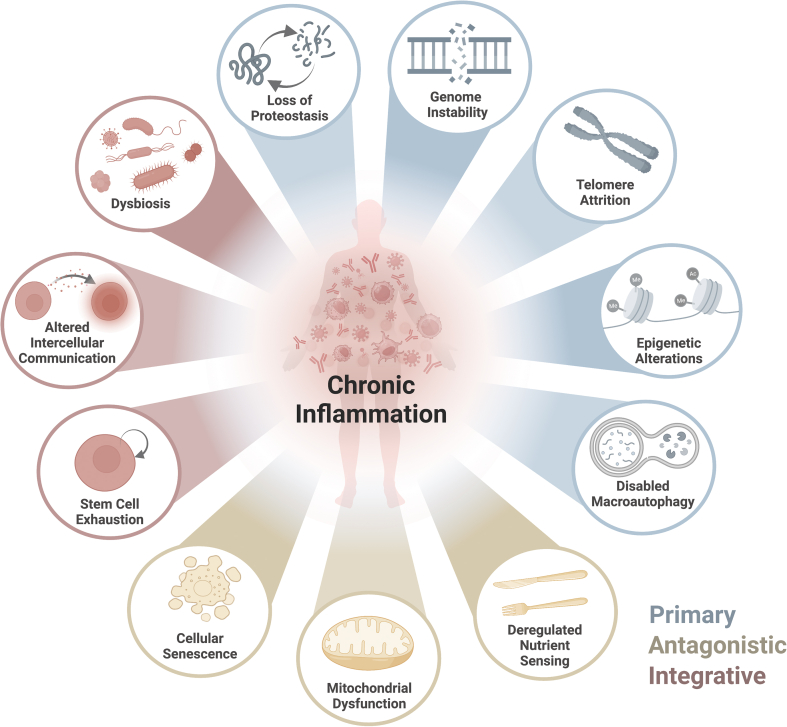
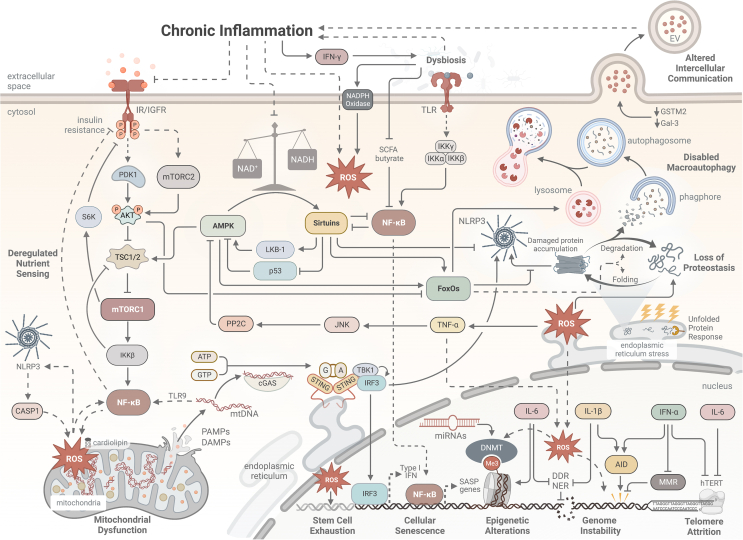
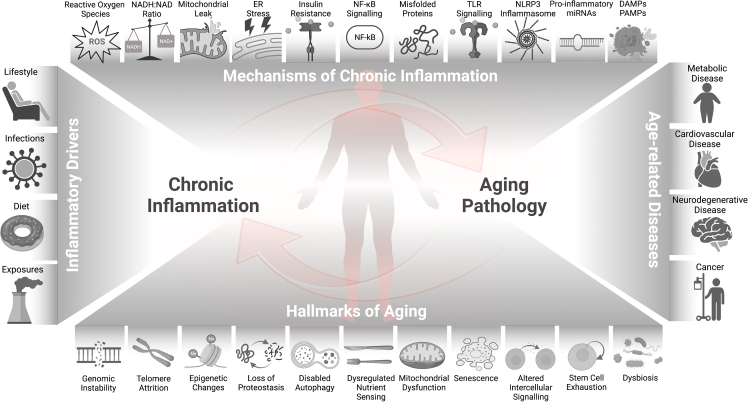
BACKGROUND: Recently, the hallmarks of aging were updated to include dysbiosis, disabled macroautophagy, and chronic inflammation. In particular, the low-grade chronic inflammation during aging, without overt infection, is defined as "inflammaging," which is associated with increased morbidity and mortality in the aging population. Emerging evidence suggests a bidirectional and cyclical relationship between chronic inflammation and the development of age-related conditions, such as cardiovascular diseases, neurodegeneration, cancer, and frailty. How the crosstalk between chronic inflammation and other hallmarks of aging underlies biological mechanisms of aging and age-related disease is thus of particular interest to the current geroscience research. SCOPE OF REVIEW: This review integrates the cellular and molecular mechanisms of age-associated chronic inflammation with the other eleven hallmarks of aging. Extra discussion is dedicated to the hallmark of "altered nutrient sensing," given the scope of Molecular Metabolism. The deregulation of hallmark processes during aging disrupts the delicate balance between pro-inflammatory and anti-inflammatory signaling, leading to a persistent inflammatory state. The resultant chronic inflammation, in turn, further aggravates the dysfunction of each hallmark, thereby driving the progression of aging and age-related diseases. MAIN CONCLUSIONS: The crosstalk between chronic inflammation and other hallmarks of aging results in a vicious cycle that exacerbates the decline in cellular functions and promotes aging. Understanding this complex interplay will provide new insights into the mechanisms of aging and the development of potential anti-aging interventions. Given their interconnectedness and ability to accentuate the primary elements of aging, drivers of chronic inflammation may be an ideal target with high translational potential to address the pathological conditions associated with aging.
Overview
The claims and statistics of this paper haven’t been checked yet.
Run the check — free, no account needed. It reads the open-access text and checks the sources it cites.
Integrity signals
Registry
Cites
Statistics
Figures
Verification
Claims the paper makes
The claims and statistics of this paper haven’t been checked yet.
Run the check — free, no account needed. It reads the open-access text and checks the sources it cites.
Claims other papers make about this one
Each is checked against this paper’s own text: does it say what the citing paper says it does?
The source backs part of the claim, not all of it — or backs it for a different population, condition or comparison.
In the citing paper
“Chronic low-grade inflammation is a central driver of non-communicable diseases such as atherosclerosis, type 2 diabetes, neurodegeneration, autoimmune conditions, cancer, and ageing [48,49].”
From Microalgae Bioactives for Functional Food Innovation and Health Promotion (2025) · cites this paper as [48]
Experimental — accuracy not yet measured
Self-check
Percentages, sums and reported differences re-computed from the paper’s own numbers.
The self-check needs the paper’s full text.
Citations
Cites
1 retracted
CHUNG, S. S., Wu, Y., Okobi, Q., Adekoya, D., Atefi, M. S., Clarke, O., Dutta, P., & Vadgama, J. V. (2017) · Mediators of Inflammation · doi:10.1155/2017/5958429 · Cited by 108
RetractedLópez-Otín, C., Blasco, M. A., Partridge, L., Serrano, M., & Kroemer, G. (2013) · Cell · doi:10.1016/j.cell.2013.05.039 · Cited by 14,982
The biology , function , and biomedical applications of exosomes
Kalluri, R., & LeBleu, V. S. (2020) · Science · doi:10.1126/science.aau6977 · Cited by 10,770
Hallmarks of Cancer: New Dimensions
Hanahan, D. (2022) · Cancer Discovery · doi:10.1158/2159-8290.cd-21-1059 · Cited by 9,887
mTOR Signaling in Growth Control and Disease
Laplante, M., & Sabatini, D. M. (2012) · Cell · doi:10.1016/j.cell.2012.03.017 · Cited by 8,509
Shedding light on the cell biology of extracellular vesicles
van Niel, G., D'Angelo, G., & Raposo, G. (2018) · Nature Reviews Molecular Cell Biology · doi:10.1038/nrm.2017.125 · Cited by 8,369
Hallmarks of aging: An expanding universe
López-Otín, C., Blasco, M. A., Partridge, L., Serrano, M., & Kroemer, G. (2023) · Cell · doi:10.1016/j.cell.2022.11.001 · Cited by 6,549
The limited in vitro lifetime of human diploid cell strains
Hayflick, L. (1965) · Experimental Cell Research · doi:10.1016/0014-4827(65)90211-9 · Cited by 5,876
Instability and decay of the primary structure of DNA
Lindahl, T. (1993) · Nature · doi:10.1038/362709a0 · Cited by 5,679
Chronic inflammation in the etiology of disease across the life span
Furman, D., Campisi, J., Verdin, E., Carrera-Bastos, P., Targ, S., Franceschi, C., Ferrucci, L., Gilroy, D. W., Fasano, A., Miller, G. W., et al. (2019) · Nature Medicine · doi:10.1038/s41591-019-0675-0 · Cited by 4,915
Self-citation
Research works printed but not linked: 1
- Schmauck-Medina, 2022, 14, 6829
Cited by
Sorted by citations
Theodorakis, N., Feretzakis, G., Tzelves, L., Paxinou, E., Hitas, C., Vamvakou, G., Verykios, V. S., & Nikolaou, M. (2024) · Journal of Personalized Medicine · doi:10.3390/jpm14090931 · Cited by 51
Microalgae Bioactives for Functional Food Innovation and Health Promotion
Guil-Guerrero, J. L., & Prates, J. A. M. (2025) · Foods · doi:10.3390/foods14122122 · Cited by 47
“Chronic low-grade inflammation is a central driver of non-communicable diseases such as atherosclerosis, type 2 diabetes, neurodegeneration, autoimmune conditions, cancer, and ageing [48,49].”
Metadata
- Authors
- Baechle, J. J., Chen, N., Makhijani, P., Winer, S., Furman, D., & Winer, D. A.
- Affiliations
- Buck Institute for Research on Aging (US)
- University Health Network (CA)
- University of Toronto (CA)
- University of Southern California (US)
- Corresponding author
- Furman, David
- Winer, Daniel A.
- Venue
- Molecular Metabolism
- Publisher
- Elsevier BV
- Published
- 2023-08
- Volume
- 74
- Pages
- 101755
- ISSN
- 2212-8778 (ISSN-L)
- PMC
- PMC10359950
- OpenAlex
- W4380854034
- Cited by
- 471
- References
- 418
- Citations by year
- 2026: 193 · 2025: 157 · 2024: 107 · 2023: 13
- FWCI
- 5.54
- Type
- journal article
- Language
- en
- Open access
- gold
- doi.org
- Licence
- Locations
- Molecular Metabolism (publishedVersion, cc-by-nc-nd)
- PubMed Central (publishedVersion, cc-by-nc-nd)
- PubMed (publishedVersion)
- DOAJ (DOAJ: Directory of Open Access Journals) (submittedVersion, cc-by-sa)
- Funders
- National Institutes of Health (5T32AG000266-23, P01AI153559, R01DK128435, U54AG075932)
- Canadian Institutes of Health Research (PJT186165)
- Topics
- Life Sciences › Biochemistry, Genetics and Molecular Biology › Aging › Genetics, Aging, and Longevity in Model Organisms
- Life Sciences › Biochemistry, Genetics and Molecular Biology › Cell Biology › Telomeres, Telomerase, and Senescence
- Life Sciences › Biochemistry, Genetics and Molecular Biology › Clinical Biochemistry › Advanced Glycation End Products research
- Keywords
- inflammaging, hallmarks of aging, chronic inflammation, dysbiosis, age-related diseases, frailty, neurodegeneration, cardiovascular disease, cancer, anti-aging interventions, geroscience
- MeSH terms
- Aged, Anti-Inflammatory Agents, Cardiovascular Diseases, Humans, Inflammation
About these checks
Registry, retraction, Cites and statistics results are computed, not judged, with one exception: a printed reference that no index lists is read once by a model before it counts as a citation error. Claims are extracted by a model and kept only when their quote appears verbatim in the text; each cited source is then checked, with a model’s help, for whether it says what the claim relies on. Those verdicts can be wrong — read the claim’s quote and the cited source before relying on one.
Statistics and arithmetic are recomputed, not judged.
Confidence bands are shown only for fields calibrated on our annotated test set. None is calibrated yet, so no band is shown.
What counts as a claim ›How we measure confidence ›How we check this ›
Are you an author, or do you see a problem with this page? Request a review
