

The DOI matches its Crossref record; 62 of the 64 references it cites were found in a registry or an index.
Accurate multimodal probabilistic prediction of conversion to Alzheimer’s disease in patients with mild cognitive impairment
Open accessAbstract
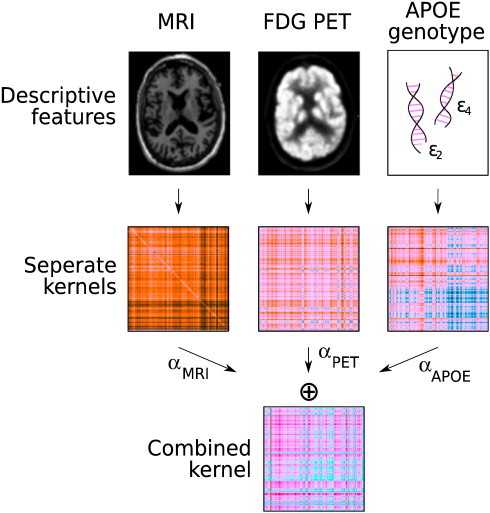
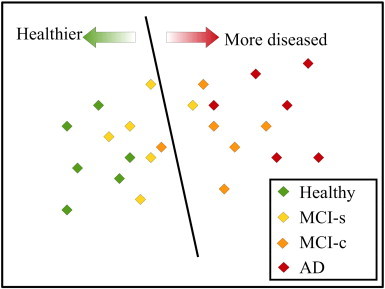
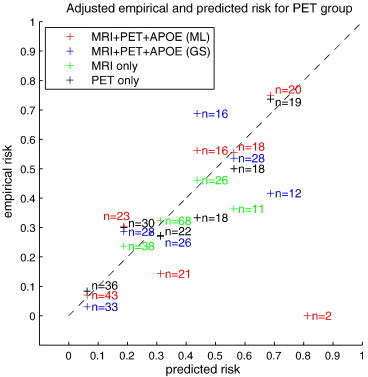
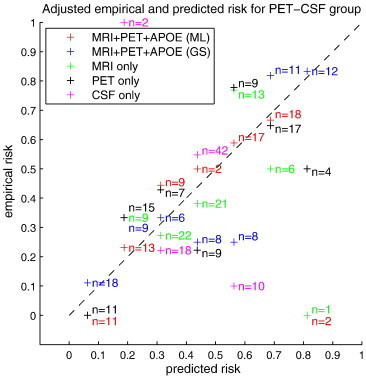
Accurately identifying the patients that have mild cognitive impairment (MCI) who will go on to develop Alzheimer's disease (AD) will become essential as new treatments will require identification of AD patients at earlier stages in the disease process. Most previous work in this area has centred around the same automated techniques used to diagnose AD patients from healthy controls, by coupling high dimensional brain image data or other relevant biomarker data to modern machine learning techniques. Such studies can now distinguish between AD patients and controls as accurately as an experienced clinician. Models trained on patients with AD and control subjects can also distinguish between MCI patients that will convert to AD within a given timeframe (MCI-c) and those that remain stable (MCI-s), although differences between these groups are smaller and thus, the corresponding accuracy is lower. The most common type of classifier used in these studies is the support vector machine, which gives categorical class decisions. In this paper, we introduce Gaussian process (GP) classification to the problem. This fully Bayesian method produces naturally probabilistic predictions, which we show correlate well with the actual chances of converting to AD within 3 years in a population of 96 MCI-s and 47 MCI-c subjects. Furthermore, we show that GPs can integrate multimodal data (in this study volumetric MRI, FDG-PET, cerebrospinal fluid, and APOE genotype with the classification process through the use of a mixed kernel). The GP approach aids combination of different data sources by learning parameters automatically from training data via type-II maximum likelihood, which we compare to a more conventional method based on cross validation and an SVM classifier. When the resulting probabilities from the GP are dichotomised to produce a binary classification, the results for predicting MCI conversion based on the combination of all three types of data show a balanced accuracy of 74%. This is a substantially higher accuracy than could be obtained using any individual modality or using a multikernel SVM, and is competitive with the highest accuracy yet achieved for predicting conversion within three years on the widely used ADNI dataset.
Overview
The claims and statistics of this paper haven’t been checked yet.
Run the check — free, no account needed. It reads the open-access text and checks the sources it cites.
Integrity signals
Registry
Cites
Statistics
Figures
Verification
Claims the paper makes
The claims and statistics of this paper haven’t been checked yet.
Run the check — free, no account needed. It reads the open-access text and checks the sources it cites.
Claims other papers make about this one
Each is checked against this paper’s own text: does it say what the citing paper says it does?
In the citing paper
“Although ML analysis of multi-omics is still in its embryonic stage, it has already been explored for a wide range of applications, as reported in recent reviews on brain diseases (Garali et al., 2018;Young et al., 2013), diabetes (Kavakiotis et al., 2017), cancers (Borad and LoRusso, 2017;Chaudhary et al., 2017;Wong et al., 2016) cardiovascular disease (Weng et al., 2017), medical imaging (Ericks”
From Using machine learning approaches for multi-omics data analysis: A review (2021) · cites this paper as Young et al., 2013
Self-check
Percentages, sums and reported differences re-computed from the paper’s own numbers.
The self-check needs the paper’s full text.
Citations
Cites
Book Review: Pattern Recognition and Machine Learning
Nasrabadi, N. M. (2007) · Journal of Electronic Imaging · doi:10.1117/1.2819119 · Cited by 22,066
Gaussian Processes for Machine Learning
Rasmussen, C. E., & Williams, C. K. I. (2005) · doi:10.7551/mitpress/3206.001.0001 · Cited by 11,705
Corder, E. H., Saunders, A. M., Strittmatter, W. J., Schmechel, D. E., Gaskell, P. C., Small, G. W., Roses, A. D., Haines, J. L., & Pericak-Vance, M. A. (1993) · Science · doi:10.1126/science.8346443 · Cited by 9,429
Mild Cognitive Impairment: Clinical Characterization and Outcome
Petersen, R. C., Smith, G. E., Waring, S. C., Ivnik, R. J., Tangalos, E. G., & Kokmen, E. (1999) · Archives of Neurology · doi:10.1001/archneur.56.3.303 · Cited by 8,980
Voxel-Based Morphometry—The Methods
Ashburner, J., & Friston, K. J. (2000) · NeuroImage · doi:10.1006/nimg.2000.0582 · Cited by 8,676
Global prevalence of dementia: a Delphi consensus study
Ferri, C. P., Prince, M. J., Brayne, C., Brodaty, H., Fratiglioni, L., Ganguli, M., Hall, K. S., Hasegawa, K., Hendrie, H. C., Huang, Y., et al. (2005) · The Lancet · doi:10.1016/s0140-6736(05)67889-0 · Cited by 5,336
Note on the Sampling Error of the Difference Between Correlated Proportions or Percentages
McNemar, Q. (1947) · Psychometrika · doi:10.1007/bf02295996 · Cited by 4,754
Pattern recognition and machine learning
(2007) · Choice Reviews Online · doi:10.5860/choice.44-5091 · Cited by 2,783
Circular analysis in systems neuroscience: the dangers of double dipping
Kriegeskorte, N., Simmons, W. K., Bellgowan, P. S. F., & Baker, C. I. (2009) · Nature Neuroscience · doi:10.1038/nn.2303 · Cited by 2,696
Staging of alzheimer's disease-related neurofibrillary changes
Braak, H., & Braak, E. (1995) · Neurobiology of Aging · doi:10.1016/0197-4580(95)00021-6 · Cited by 2,357
Cited by
Sorted by citations
Items 201–248 of 248
Imaging biomarkers in Alzheimer's disease
Sudre, C. H., Cardoso, M. J., Marc Modat, A., & Sebastien Ourselin, A. (2019) · Elsevier eBooks · doi:10.1016/b978-0-12-816176-0.00020-x · Cited by 3
Two Routes to Alzheimer’s Disease Based on Differential Structural Changes in Key Brain Regions
Hollenbenders, Y., Initiative, A. D. N., Pobiruchin, M., & Reichenbach, A. (2023) · Journal of Alzheimer s Disease · doi:10.3233/jad-221061 · Cited by 3
Defrancesco, M., Marksteiner, J., Lenhart, L., Klingler, P. J., Steiger, R., Gizewski, E. R., Goebel, G., Deisenhammer, E., & Scherfler, C. (2024) · Progress in Neuro-Psychopharmacology and Biological Psychiatry · doi:10.1016/j.pnpbp.2024.111157 · Cited by 3
Khatami, S. G., Salimi, Y., Hofmann‐Apitius, M., Oxtoby, N. P., Birkenbihl, C., Initiative, A. D. N., Initiative, T. J. A. D. N., & the Alzheimer’s Disease Repository Without Borders Investigators (2022) · Alzheimer s Research & Therapy · doi:10.1186/s13195-022-01001-y · Cited by 3
Young, J., Marc Modat, A., Cardoso, M. J., Ashburner, J., & Sebastien Ourselin, A. (2016) · Lecture notes in computer science · doi:10.1007/978-3-319-45174-9_13 · Cited by 3
Kang, J. M., Lee, J., Kim, Y. K., Sohn, B. K., Byun, M. S., Choi, J., Son, S. K., Im, H. J., Ryu, Y. H., Ryu, Y. H., et al. (2018) · Molecular Diagnosis & Therapy · doi:10.1007/s40291-018-0334-z · Cited by 3
MOT: a Multi-Omics Transformer for Multiclass Classification Tumour Types PredictionsPreprint
Osseni, M. A., Tossou, P., Laviolette, F., & Corbeil, J. (2022) · Research Square · doi:10.21203/rs.3.rs-1348696/v1 · Cited by 4
Ning, K., Bouchard-Cannon, P., Yu, J., Shenoi, S., Wang, L., Initiative, A. D. N., & Sarkar, J. (2022) · bioRxiv (Cold Spring Harbor Laboratory) · doi:10.1101/2022.03.17.484832 · Cited by 3
Zamani, J., & Jafadideh, A. T. (2024) · Research Square · doi:10.21203/rs.3.rs-4549428/v1 · Cited by 3
A survey of multimodal fusion for Alzheimer’s disease prediction: A new taxonomy and trends
Guan, Y., Wang, W., Chen, J., Yang, P., Xu, J., & Qi, J. (2025) · Information Fusion · doi:10.1016/j.inffus.2025.104098 · Cited by 3
Improving MRI Brain Image Classification with Anatomical Regional Kernels
Young, J., Mendelson, A., Cardoso, M. J., Marc Modat, A., Ashburner, J., & Sebastien Ourselin, A. (2015) · Lecture notes in computer science · doi:10.1007/978-3-319-27929-9_5 · Cited by 2
Extraction of Features from Patch Based Graphs for the Prediction of Disease Progression in AD
Tong, T., & Gao, Q. (2015) · Lecture notes in computer science · doi:10.1007/978-3-319-22186-1_50 · Cited by 2
Yamada, A., Teramoto, A., Hoshi, M., Toyama, H., Imaizumi, K., Saito, K., & Fujita, H. (2020) · Applied Sciences · doi:10.3390/app10124225 · Cited by 2
Non-Parametric Mixture Modelling and its Application to Disease Progression ModellingPreprint
Firth, N. C., Oxtoby, N. P., Primativo, S., Brotherhood, E., Young, A. L., Yong, K. X. X., Crutch, S. J., & Alexander, D. C. (2018) · bioRxiv (Cold Spring Harbor Laboratory) · doi:10.1101/297978 · Cited by 2
Liu, Z., Maiti, T., & Bender, A. R. (2020) · arXiv (Cornell University) · doi:10.48550/arxiv.2012.00538 · Cited by 2
Zhang, C., Bao, Q., Zhang, F., Li, P., & Chen, L. (2023) · Intelligent Data Analysis · doi:10.3233/ida-230220 · Cited by 1
MSSAFN: A multiscale structure-aware spatial fusion network for Alzheimer’s disease classification
Huang, Y., Duan, B., Li, Z., & Zhang, Q. (2025) · Biomedical Signal Processing and Control · doi:10.1016/j.bspc.2025.108889 · Cited by 1
Functional Neuroimaging in Clinical Neurology: A Comprehensive Review of Commonly Used Modalities
Salardini, A. (2025) · Seminars in Neurology · doi:10.1055/a-2773-5481 · Cited by 1
Predicting Cognitive Decline: A Hybrid CNN-GRU Model for the Prognosis of MCI-to-AD Conversion
Maga Vigna, C., & Bhavani, G. (2025) · International Conference on Computational Intelligence and Communication Networks (CICN) · doi:10.1109/cicn67655.2025.11367889 · Cited by 1
Cosar, M. (2026) · PeerJ Computer Science · doi:10.7717/peerj-cs.3580 · Cited by 1
Prediction of clinical scores from neuroimaging data with censored likelihood gaussian processes
Rao, A. W., Monteiro, J. M., & Mourão-Miranda, J. (2016) · International Workshop on Pattern Recognition in NeuroImaging · doi:10.1109/prni.2016.7552358 · Cited by 1
Diagnosing Alzheimer’s Disease Using Deep Learning Techniques
Mitra, A., Khaitan, S., Abidi, A. I., & Chakraborty, S. (2021) · Springer eBooks · doi:10.1007/978-3-030-82079-4_5 · Cited by 2
Supervised machine learning in psychiatry
Grassi, M. (2022) · doi:10.26481/dis.20220919mg · Cited by 1
MOT: a Multi-Omics Transformer for multiclass classification tumour types predictionsPreprint
Osseni, M. A., Tossou, P., Laviolette, F., & Corbeil, J. (2022) · Research Square · doi:10.21203/rs.3.rs-1348696/v2 · Cited by 1
Li, R., Perneczky, R., Drzezga, A. E., & Krämer, S. (2015) · arXiv (Cornell University) · doi:10.48550/arxiv.1512.03955
Mikita, N. K. (2016) · Research Portal (King's College London)
Ayhan, M. S., Raghavan, V. V., & Initiative, A. D. N. (2017) · arXiv (Cornell University) · doi:10.48550/arxiv.1706.00856
Visual Versus Semi-Quantitative Analysis of 18 F-FDG-PET in Amnestic MCI: An
Morbelli, S. D., Brugnolo, A., Bossert, I., Buschiazzo, A., Frisoni, G. B., Galluzzi, S., Ossenkoppele, R., Perneczky, R., Didic, M., Guedj, É., et al. (2014)
Diagnostic consistency of cases from ADNI cohort metadata: methodological considerations
Zywiec, A., & Kirkby, R. D. (2018) · Neurobiology of Aging · doi:10.1016/j.neurobiolaging.2018.05.030
Bhattacharya, S., Liu, Z., & Maiti, T. (2020) · arXiv (Cornell University) · doi:10.48550/arxiv.2011.09592 · Cited by 3
Rajendiran, M., Kumar, K. P. S., Kumar, R. N., & Nair, S. (2021) · Materials Today Proceedings · doi:10.1016/j.matpr.2021.01.221
RetractedOn the inhomogeneous magnetised electron gas
Kettenis, M. (2001) · UvA-DARE (University of Amsterdam)
Methods of analysis of multimodal data to increase the accuracy of classification
Boyko, N. I., & Muzyka, M. (2022) · Applied Aspects of Information Technology · doi:10.15276/aait.05.2022.11 · Cited by 1
A Model for Clustering and Predicting Customer Behavior in a Structured Data Set
Boyko, N. I. (2023) · Journal of Economics Finance and Management Studies · doi:10.47191/jefms/v6-i3-06
Adversarial Transfer Learning for Alzheimer's Disease Diagnosis Using Structural MRI
Xu, X., Cao, G., Song, T., & Kang, G. (2023) · International Conference on Biomedical and Bioinformatics Engineering (ICBBE) · doi:10.1145/3637732.3637775
Kaur, H., Kumar, A., & Attri, V. K. (2025) · Lecture notes in electrical engineering · doi:10.1007/978-981-97-9045-6_37
Brain Region-Centered MultiModal Hypergraph Fusion for MCI Conversion Prediction
Dong, Z., Liu, H., Ge, X., Zhang, H., Li, Z., Chen, Y., & Li, W. (2026) · IEEE Journal of Biomedical and Health Informatics · doi:10.1109/jbhi.2026.3715131
Tensor-based multigraph fusion for Alzheimer’s disease diagnosis
Zhu, Y., Li, D., Wang, S., Xu, L., & Xi, C. (2025) · Applied Soft Computing · doi:10.1016/j.asoc.2025.114394
Golriz Khatami, S., Salimi, Y., Hofmann‐Apitius, M., Oxtoby, N. P., & Birkenbihl, C. (2022) · Figshare · doi:10.6084/m9.figshare.19624375
Zheng, E. Z., Gu, Y., Jin, R. R., Lee, T. M. C., & Initiative, A. D. N. (2026) · GeroScience · doi:10.1007/s11357-026-02155-5
Ly, P., Milongo, J., Xie, Y., Tian, X., He, J. (., & Zhao, C. (2026) · ACM Southeast Regional Conference (ACMSE) · doi:10.1145/3746467.3801526
Alzheimer’s Disease Progression Prediction with Machine Learning
Jana, R. K., Roy, A., Banerjee, D., Chakraborty, D., Nag, I., & Qin, H. (2026) · Studies in Rhythm Engineering · doi:10.1007/978-981-95-8938-8_10
Quantifying generalization error in machine learning prediction of cognitive decline
Hüppi, R. M., Langer, N., & Vieira, B. H. (2026) · The Journal of Prevention of Alzheimer s Disease · doi:10.1016/j.tjpad.2026.100646
Mdluli, N. T., Chang, Y., Wu, C.-H., & Cheng, W.-J. (2026) · doi:10.2196/preprints.108578
Menezes, J., Barbosa, M. I. A., & Rodrigues, P. M. (2026) · Sensors · doi:10.3390/s26175489
Baker, D., Goh, N., Kadambi, P., Belnavis, A., Steinhauer, H., Akpan, I., Watkins, K., Mallick, D., Tallino, S., Mukherjee, S., et al. (2026) · IEEE International Conference on Information Reuse and Integration (IRI) · doi:10.1109/iri69576.2026.00050
Alawneh, A. (2026) · Journal of Information & Knowledge Management · doi:10.1142/s021964922650067x
Looking for neuroimaging biomarkers in Huntington Disease
Carrasco, D. P. (2015) · RECERCAT (Consorci de Serveis Universitaris de Catalunya)
Metadata
- Authors
- Young, J., Modat, M., Cardoso, M. J., Mendelson, A., Cash, D., & Ourselin, S.
- Affiliations
- University College London (GB)
- Corresponding author
- Young, Jonathan
- Venue
- NeuroImage Clinical
- Publisher
- Elsevier BV
- Published
- 2013
- Volume
- 2
- Pages
- 735-745
- ISSN
- 2213-1582 (ISSN-L)
- PMC
- PMC3777690
- OpenAlex
- W1978763244
- Cited by
- 249
- References
- 64
- Citations by year
- 2026: 12 · 2025: 10 · 2024: 11 · 2023: 11 · 2022: 19 · 2021: 24 · 2020: 25 · 2019: 28 · 2018: 32 · 2017: 22 · 2016: 15 · 2015: 31 · 2014: 7 · 2013: 1
- FWCI
- 12.52
- Type
- journal article
- Language
- en
- Open access
- gold
- doi.org
- Licence
- Locations
- NeuroImage Clinical (publishedVersion, cc-by-nc-nd)
- Europe PMC (PubMed Central) (publishedVersion, cc-by-nc-nd)
- PubMed Central (publishedVersion, cc-by-nc-nd)
- PubMed (publishedVersion)
- UCL Discovery (University College London) (submittedVersion)
- Funders
- Engineering and Physical Sciences Research Council (EP/H046410/1)
- Topics
- Health Sciences › Medicine › Psychiatry and Mental health › Dementia and Cognitive Impairment Research
- Health Sciences › Health Professions › Health Information Management › Artificial Intelligence in Healthcare
- Life Sciences › Neuroscience › Cellular and Molecular Neuroscience › Alzheimer's disease research and treatments
- Keywords
- Alzheimer's disease, mild cognitive impairment, conversion prediction, Gaussian process classification, probabilistic forecasting, multimodal data integration, mixed kernel, volumetric MRI, FDG-PET, cerebrospinal fluid biomarkers, APOE genotype, support vector machine comparison, ADNI
About these checks
Registry, retraction, Cites and statistics results are computed, not judged, with one exception: a printed reference that no index lists is read once by a model before it counts as a citation error. Claims are extracted by a model and kept only when their quote appears verbatim in the text; each cited source is then checked, with a model’s help, for whether it says what the claim relies on. Those verdicts can be wrong — read the claim’s quote and the cited source before relying on one.
Statistics and arithmetic are recomputed, not judged.
Confidence bands are shown only for fields calibrated on our annotated test set. None is calibrated yet, so no band is shown.
What counts as a claim ›How we measure confidence ›How we check this ›
Are you an author, or do you see a problem with this page? Request a review
