

Amygdala hyperreactivity to faces conditioned with a social-evaluative meaning– a multiplex, multigenerational fMRI study on social anxiety endophenotypes
The DOI matches its Crossref record; 33 of the 33 references it cites were found in a registry or an index.
Abstract
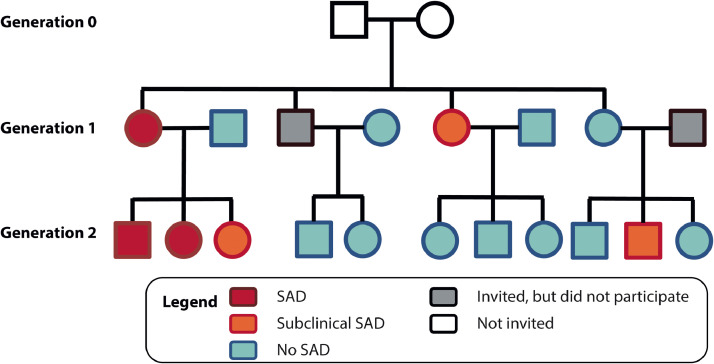
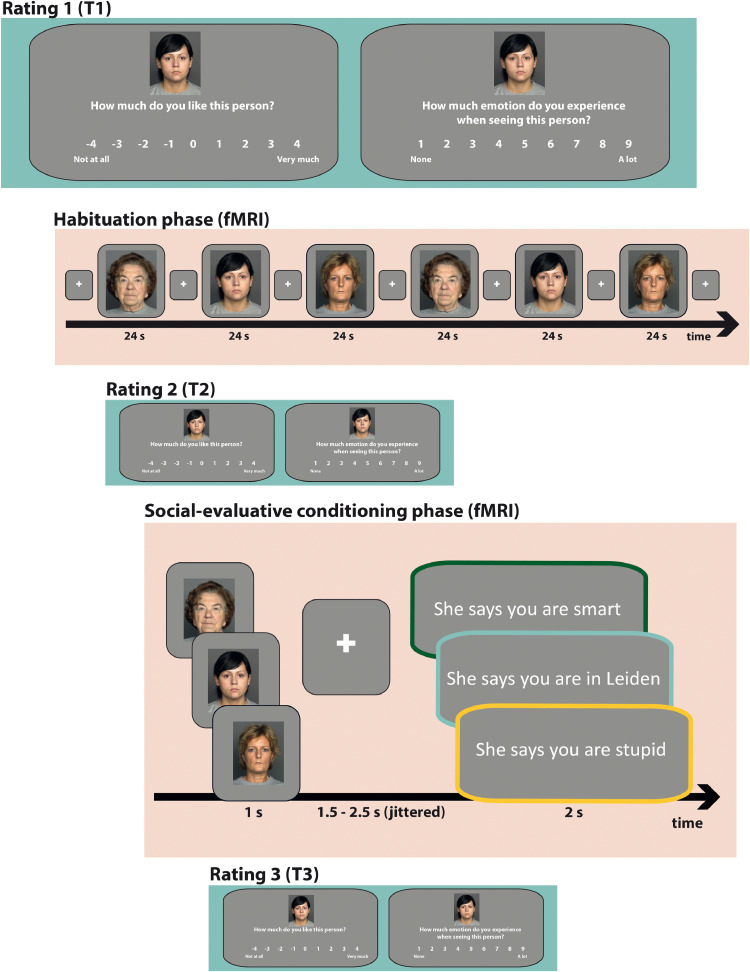
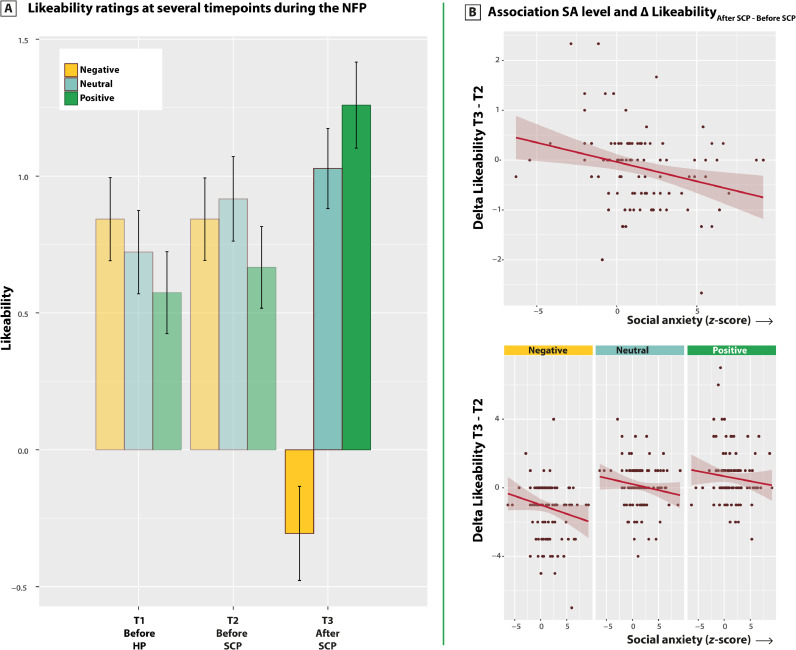
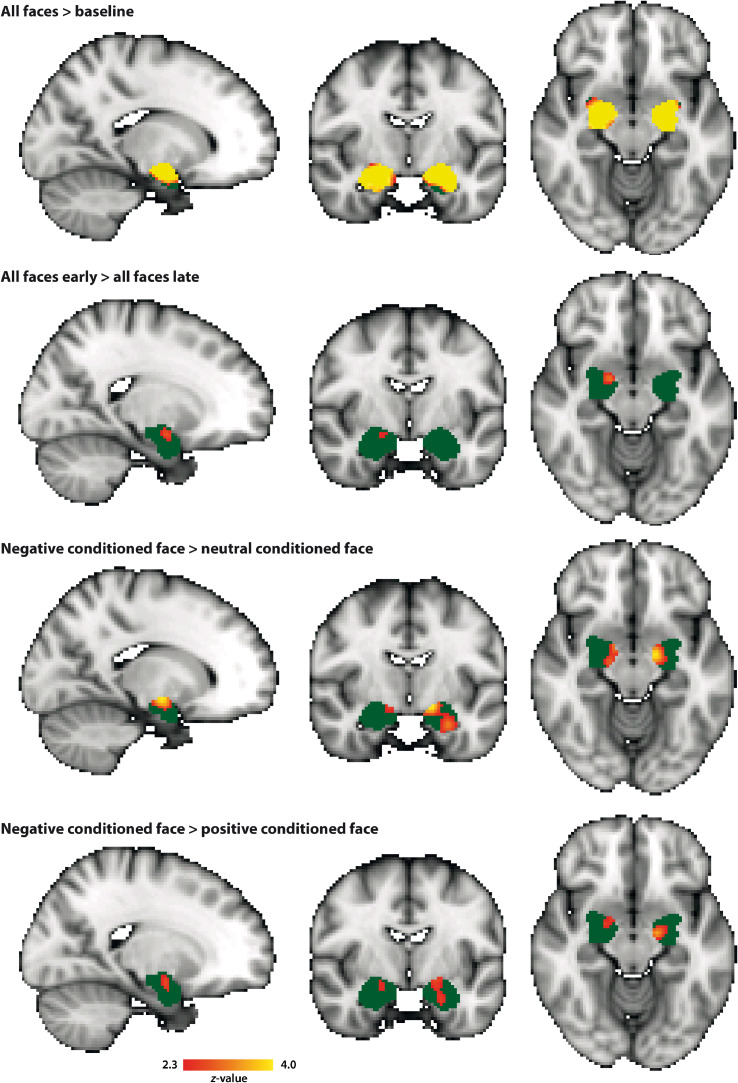
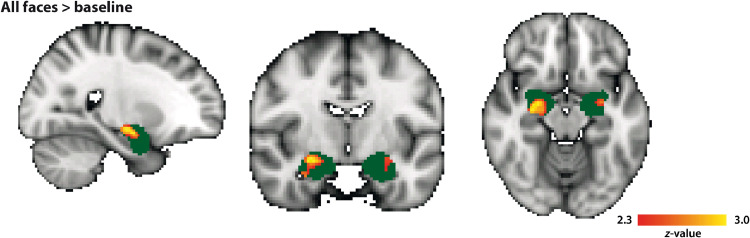
Social anxiety disorder (SAD) runs in families, but the neurobiological pathways underlying the genetic susceptibility towards SAD are largely unknown. Here, we employed an endophenotype approach, and tested the hypothesis that amygdala hyperreactivity to faces conditioned with a social-evaluative meaning is a candidate SAD endophenotype. We used data from the multiplex, multigenerational Leiden Family Lab study on Social Anxiety Disorder (eight families, n = 105) and investigated amygdala activation during a social-evaluative conditioning paradigm with high ecological validity in the context of SAD. Three neutral faces were repeatedly presented in combination with socially negative, positive or neutral sentences. We focused on two endophenotype criteria: co-segregation of the candidate endophenotype with the disorder within families, and heritability. Analyses of the fMRI data were restricted to the amygdala as a region of interest, and association analyses revealed that bilateral amygdala hyperreactivity in response to the conditioned faces co-segregated with social anxiety (SA; continuous measure) within the families; we found, however, no relationship between SA and brain activation in response to more specific fMRI contrasts. Furthermore, brain activation in a small subset of voxels within these amygdala clusters was at least moderately heritable. Taken together, these findings show that amygdala engagement in response to conditioned faces with a social-evaluative meaning qualifies as a neurobiological candidate endophenotype of social anxiety. Thereby, these data shed light on the genetic vulnerability to develop SAD.
Overview
The claims and statistics of this paper haven’t been checked yet.
Free: it reads the open-access text and checks the first 5 claims that cite a source we can check. Create a free account to check every claim.
Integrity signals
Registry
Cites
Statistics
Figures
Verification
Claims the paper makes
The claims and statistics of this paper haven’t been checked yet.
Free: it reads the open-access text and checks the first 5 claims that cite a source we can check. Create a free account to check every claim.
Claims other papers make about this one
Each is checked against this paper’s own text: does it say what the citing paper says it does?
In the citing paper
“fMRI paradigms involving social conditioning have demonstrated exaggerated amygdala responses to socially salient cues, suggesting a neurobiological substrate underlying heightened threat sensitivity in social anxiety”
From Epidemiology, genetics, neuroimaging, clinical features, and treatment between overall and performance-only social anxiety disorder: a narrative review (2026) · cites this paper as Bas-Hoogendam et al. 2020
Self-check
Percentages, sums and reported differences re-computed from the paper’s own numbers.
The self-check needs the paper’s full text.
Citations
Cites
The Neurocircuitry of Fear, Stress, and Anxiety Disorders
Shin, L. M., & Liberzon, I. (2010) · Neuropsychopharmacology · doi:10.1038/npp.2009.83 · Cited by 2,083
From circuits to behaviour in the amygdala
Janak, P. H., & Tye, K. M. (2015) · Nature · doi:10.1038/nature14188 · Cited by 2,011
Sheehan, D. V., Sheehan, K. H., Shytle, R. D., Janavs, J., Bannon, Y., Rogers, J. E., Milo, K. M., Stock, S. L., & Wilkinson, B. (2010) · The Journal of Clinical Psychiatry · doi:10.4088/jcp.09m05305whi · Cited by 1,730
Social Anxiety among Adolescents: Linkages with Peer Relations and Friendships
La Greca, A. M., & Lopez, N. (1998) · Journal of Abnormal Child Psychology · doi:10.1023/a:1022684520514 · Cited by 1,656
Amunts, K., Kedo, O., Kindler, M., Pieperhoff, P., Mohlberg, H., Shah, N. J., Habel, U., Schneider, F., & Zilles, K. (2005) · Anatomy and Embryology · doi:10.1007/s00429-005-0025-5 · Cited by 1,264
Stein, M. B., & Stein, D. J. (2008) · The Lancet · doi:10.1016/s0140-6736(08)60488-2 · Cited by 1,137
The primate amygdala represents the positive and negative value of visual stimuli during learning
Paton, J. J., Belova, M. A., Morrison, S. E., & Salzman, C. D. (2006) · Nature · doi:10.1038/nature04490 · Cited by 917
FRESCO, D. M., COLES, M. E., HEIMBERG, R. G., LIEBOWITZ, M. R., HAMI, S., STEIN, M. B., & GOETZ, D. (2001) · Psychological Medicine · doi:10.1017/s0033291701004056 · Cited by 874
Functional connectivity of the human amygdala using resting state fMRI
Roy, A. K., Shehzad, Z., Margulies, D. S., Kelly, A. M. C., Uddin, L. Q., Gotimer, K., Biswal, B. B., Castellanos, F. X., & Milham, M. P. (2009) · NeuroImage · doi:10.1016/j.neuroimage.2008.11.030 · Cited by 749
Olsson, A., & Phelps, E. A. (2007) · Nature Neuroscience · doi:10.1038/nn1968 · Cited by 622
Research works printed but not linked: 77
- Ahrens L.M. Mühlberger A. Pauli P. Wieser M.J. Impaired visuocortical discrimination learning of socially conditioned stimuli in social anxiety Soc. Cogn. Affect. Neurosci. 10 2015 929 937 25338634 PMC4483562 · DOI · Paper page
- Åhs F. Gingnell M. Furmark T. Fredrikson M. Within-session effect of repeated stress exposure on extinction circuitry function in social anxiety disorder Psychiatry Res. Neuroimaging 261 2017 85 90 28167379 · DOI
- American Psychiatric Association Diagnostic and Statistical Manual of Mental Disorders Fifth Edition 2013 (DSM-5)
- Ball T.M. Knapp S.E. Paulus M.P. Stein M.B. Brain activation during fear extinction predicts exposure success Depress. Anxiety 34 2017 257 266 27921340 · DOI · Paper page
- Bas-Hoogendam J.M. Commentary: gray matter structural alterations in social anxiety disorder: a voxel-based meta-analysis Front. Psychiatry 2019 PMC6349716 30723425 · DOI
- Bas-Hoogendam J.M. Andela C.D. van der Werff S.J.A. Pannekoek J.N. van Steenbergen H. Meijer O.C. van Buchem M.A. Rombouts S.A.R.B. van der Mast R.C. Biermasz N.R. van der Wee N.J.A. Pereira A.M. Altered neural processing of emotional faces in remitted Cushing's disease Psychoneuroendocrinology 59 2015 134 146 26092780 · DOI · Paper page
- Bas-Hoogendam J.M. Blackford J.U. Brühl A.B. Blair K.S. van der Wee N.J.A. Westenberg P.M. Neurobiological candidate endophenotypes of social anxiety disorder Neurosci. Biobehav. Rev. 71 2016 362 378 27593443 · DOI · Paper page
- Bas-Hoogendam J.M. Harrewijn A. Tissier R.L.M. van der Molen M.J.W. van Steenbergen H. van Vliet I.M. Reichart C.G. Houwing-Duistermaat J.J. Slagboom P.E. van der Wee N.J.A. Westenberg P.M. The Leiden family lab study on social anxiety disorder: a multiplex, multigenerational family study on neurocognitive endophenotypes Int. J. Methods Psychiatr. Res. 27 2018 e1616 29700902 PMC6001802 · DOI
- Bas-Hoogendam J.M. Harrewijn A. van der Molen M.J.W. van Steenbergen H. van Vliet I. Houwing-Duistermaat J. van der Wee N. Westenberg P.M. Preregistration: methods: study design and sample. Part of “profiling endophenotypes in social anxiety disorder: a neurocognitive approach” [WWW Document] Database Open Sci. Framew. 2014
- Bas-Hoogendam J.M. Harrewijn A. van der Molen M.J.W. van Steenbergen H. van Vliet I. Houwing-Duistermaat J. van der Wee N.J.A. Westenberg P.M. Preregistration: general background and key question of project, part of “profiling endophenotypes in social anxiety disorder: a neurocognitive approach” [WWW Document] Database Open Sci. Framew. 2014
- Bas-Hoogendam J.M. van Steenbergen H. Blackford J.U. Tissier R.L.M. van der Wee N.J.A. Westenberg P.M. Impaired neural habituation to neutral faces in families genetically enriched for social anxiety disorder Depress. Anxiety 36 2019 1143 1153 31600020 PMC6916167 · DOI
- Bas-Hoogendam J.M. van Steenbergen H. Kreuk T. van der Wee N.J.A. Westenberg P.M. How embarrassing! The behavioral and neural correlates of processing social norm violations PLoS One 12 2017 e0176326 PMC5404760 28441460 · DOI · Paper page
- Bas-Hoogendam J.M. van Steenbergen H. Pannekoek J.N. Fouche J.-P. Lochner C. Hattingh C.J. Cremers H.R. Furmark T. Månsson K.N.T. Frick A. Engman J. Boraxbekk C.-J. Carlbring P. Andersson G. Fredrikson M. Straube T. Peterburs J. Klumpp H. Luan Phan K. Roelofs K. Veltman D.J. van Tol M.-J. Stein D.J. van der Wee N.J.A. Voxel-based morphometry multi-center mega-analysis of brain structure in social anxiety disorder NeuroImage Clin. 16 2017 678 688 30140607 PMC6103329 · DOI · Paper page
- Bas-Hoogendam J.M. van Steenbergen H. Tissier R.L.M. Houwing-Duistermaat J.J. Westenberg P.M. van der Wee N.J.A. Subcortical brain volumes, cortical thickness and cortical surface area in families genetically enriched for social anxiety disorder - a multiplex multigenerational neuroimaging study EBioMedicine 2018 410 428 PMC6197574 30266294 · DOI · Paper page
- Bas-Hoogendam J.M. van Steenbergen H. Tissier R.L.M. van der Wee N.J.A. Westenberg P.M. Altered neurobiological processing of unintentional social norm violations: a multiplex, multigenerational fMRI study on social anxiety endophenotypes Biol. Psychiatry Cogn. Neurosci. Neuroimaging 2019 in press 31031203
- Beauchaine T.P. Constantino J.N. Redefining the endophenotype concept to accommodate transdiagnostic vulnerabilities and etiological complexity Biomark. Med. 11 2017 769 780 28891303 PMC5771461 · DOI · Paper page
- Bell C. Bourke C. Colhoun H. Carter F. Frampton C. Porter R. The misclassification of facial expressions in generalised social phobia J. Anxiety Disord. 25 2011 278 283 21041060 · DOI
- Belleau E.L. Pedersen W.S. Miskovich T.A. Helmstetter F.J. Larson C.L. Cortico-limbic connectivity changes following fear extinction and relationships with trait anxiety Soc. Cogn. Affect. Neurosci. 2018 nsy073–nsy073 PMC6204483 30137604 · DOI
- Blair K.S. Otero M. Teng C. Geraci M. Lewis E. Hollon N. Blair R.J.R. Ernst M. Grillon C. Pine D.S. Learning from other people’s fear: amygdala-based social reference learning in social anxiety disorder Psychol. Med. 46 2016 2943 2953 27476529 PMC5063696 · DOI
- WTCCC2 Blakey R. Ranlund S. Zartaloudi E. Cahn W. Calafato S. Colizzi M. Crespo-Facorro B. Daniel C. Díez-Revuelta Á. Di Forti M. Iyegbe C. Jablensky A. Jones R. Hall M.-H. Kahn R. Kalaydjieva L. Kravariti E. Lin K. McDonald C. McIntosh A.M. Picchioni M. Powell J. Presman A. Rujescu D. Schulze K. Shaikh M. Thygesen J.H. Toulopoulou T. Van Haren N. Van Os J. Walshe M. Murray R.M. Bramon E. Murray R.M. Bramon E. Associations between psychosis endophenotypes across brain functional, structural, and cognitive domains Psychol. Med. 48 2018 1325 1340 29094675 PMC6516747 · DOI
- Brühl A.B. Rufer M. Delsignore A. Kaffenberger T. Jäncke L. Herwig U. Neural correlates of altered general emotion processing in social anxiety disorder Brain Res 1378 2011 72 83 21215728 · DOI
- Bzdok D. Laird A.R. Zilles K. Fox P.T. Eickhoff S.B. An investigation of the structural, connectional, and functional subspecialization in the human amygdala Hum. Brain Mapp. 34 2013 3247 3266 22806915 PMC4801486 · DOI · Paper page
- Casey B.J. Ruberry E.J. Libby V. Glatt C.E. Hare T. Soliman F. Duhoux S. Frielingsdorf H. Tottenham N. Transitional and translational studies of risk for anxiety Depress. Anxiety 28 2011 18 28 21225849 PMC3070413 · DOI · Paper page
- Dams J. König H.-H. Bleibler F. Hoyer J. Wiltink J. Beutel M.E. Salzer S. Herpertz S. Willutzki U. Strauß B. Leibing E. Leichsenring F. Konnopka A. Excess costs of social anxiety disorder in Germany J. Affect. Disord. 213 2017 23 29 28188993 · DOI
- Davis F.C. Johnstone T. Mazzulla E.C. Oler J.A. Whalen P.J. Regional response differences across the human amygdaloid complex during social conditioning Cereb. Cortex 20 2010 612 621 19556348 PMC2820700 · DOI · Paper page
- den Braber A. Bohlken M.M. Brouwer R.M. van ’t Ent D. Kanai R. Kahn R.S. de Geus E.J.C. Hulshoff Pol H.E. Boomsma D.I. Heritability of subcortical brain measures: A perspective for future genome-wide association studies Neuroimage 83C 2013 98 102 23770413 · DOI
- Dick D.M. Mapping risk from genes to behavior: the enduring and evolving influence of Irving Gottesman's endophenotype concept Twin Res. Hum. Genet. 21 2018 306 309 30027865 · DOI
- Ebner N.C. Riediger M. Lindenberger U. FACES–a database of facial expressions in young, middle-aged, and older women and men: development and validation Behav. Res. Methods 42 2010 351 362 20160315 · DOI · Paper page
- Erhardt A. Spoormaker V.I. Translational approaches to anxiety: focus on genetics, fear extinction and brain imaging Curr. Psychiatry Rep. 15 2013 417 24234873 · DOI
- Etkin A. Wager T.D. Functional neuroimaging of anxiety: a meta-analysis of emotional processing in PTSD, social anxiety disorder, and specific phobia Am. J. Psychiatry 164 2007 1476 1488 17898336 PMC3318959 · DOI · Paper page
- Everaert J. Bronstein M.V Cannon T.D. Joormann J. Looking through tinted glasses: depression and social anxiety are related to both interpretation biases and inflexible negative interpretations Clin. Psychol. Sci. 6 2018 517 528 · DOI · Paper page
- Fehm L. Pelissolo A. Furmark T. Wittchen H.-U. Size and burden of social phobia in Europe Eur. Neuropsychopharmacol. 15 2005 453 462 15921898 · DOI · Paper page
- Ferri J. Bress J.N. Eaton N.R. Proudfit G.H. The impact of puberty and social anxiety on amygdala activation to faces in adolescence Dev. Neurosci. 36 2014 239 249 25034314 PMC4152317 · DOI · Paper page
- Fox A.S. Oler J.A. Tromp D.P.M. Fudge J.L. Kalin N.H. Extending the amygdala in theories of threat processing Trends Neurosci. 38 2015 319 329 25851307 PMC4417372 · DOI · Paper page
- Furmark T. Henningsson S. Appel L. Ahs F. Linnman C. Pissiota A. Faria V. Oreland L. Bani M. Pich E.M. Eriksson E. Fredrikson M. Genotype over-diagnosis in amygdala responsiveness: affective processing in social anxiety disorder J. psychiatry Neurosci. 34 2009 30 40 19125211 PMC2612081 · DOI · Paper page
- Garner M. Möhler H. Stein D.J. Mueggler T. Baldwin D.S. Research in anxiety disorders: from the bench to the bedside Eur. Neuropsychopharmacol. 19 2009 381 390 19327970 · DOI
- Gentili C. Cristea I.A. Angstadt M. Klumpp H. Tozzi L. Phan K.L. Pietrini P. Beyond emotions: a meta-analysis of neural response within face processing system in social anxiety Exp. Biol. Med. 241 2016 225 237 PMC4935439 26341469 · DOI · Paper page
- Glahn D.C. Thompson P.M. Blangero J. Neuroimaging endophenotypes: strategies for finding genes influencing brain structure and function Hum. Brain Mapp. 28 2007 488 501 17440953 PMC6871286 · DOI · Paper page
- Glahn D.C. Williams J.T. McKay D.R. Knowles E.E. Sprooten E. Mathias S.R. Curran J.E. Kent J.W. Carless M.A. Göring H.H.H. Dyer T.D. Woolsey M.D. Winkler A.M. Olvera R.L. Kochunov P. Fox P.T. Duggirala R. Almasy L. Blangero J. Discovering schizophrenia endophenotypes in randomly ascertained pedigrees Biol. Psychiatry 77 2014 75 83 25168609 PMC4261014 · DOI
- Haller S.P.W. Cohen Kadosh K. Scerif G. Lau J.Y.F. Social anxiety disorder in adolescence: how developmental cognitive neuroscience findings may shape understanding and interventions for psychopathology Dev. Cogn. Neurosci. 13 2015 11 20 25818181 PMC6989773 · DOI · Paper page
- Haller S.P.W. Raeder S.M. Scerif G. Cohen Kadosh K. Lau J.Y.F. Measuring online interpretations and attributions of social situations: links with adolescent social anxiety J. Behav. Ther. Exp. Psychiatry 50 2016 250 256 26476463 · DOI
- Hariri A.R. Whalen P.J. The amygdala: inside and out F1000 Biol. Rep. 3 2011 2 10.3410/B3-2 21399763 PMC3042316 · DOI · Paper page
- Harrewijn A. van der Molen M.J.W. van Vliet I.M. Tissier R.L Westenberg P.M. Behavioral and EEG responses to social evaluation: a two-generation family study on social anxiety NeuroImage Clin. 17 2018 549 562 29527481 PMC5842666 · DOI
- Hirsch C.R. Clark D.M. Information-processing bias in social phobia Clin. Psychol. Rev. 24 2004 799 825 15501557 · DOI · Paper page
- Jenkinson M. Beckmann C.F. Behrens T.E.J. Woolrich M.W. Smith S.M. FSL Neuroimage 62 2012 782 790 21979382 · DOI · Paper page
- Kerestes R. Chase H.W. Phillips M.L. Ladouceur C.D. Eickhoff S.B. Multimodal evaluation of the amygdala's functional connectivity Neuroimage 148 2017 219 229 28089676 PMC5416470 · DOI · Paper page
- Kneer K. Reinhard J. Ziegler C. Slyschak A. Schiele M. Vietz M. Peters K. Meisenzahl E.M. Pauli P. Reif A. Deckert J. Romanos M. Domschke K. Neufang S. Serotonergic influence on depressive symptoms and trait anxiety is mediated by negative life events and frontal activation in children and adolescents Eur. Child Adolesc. Psychiatry 2019 31422473
- Kovacs M. The children's depression inventory (CDI) Psychopharmacol. Bull. 21 1985 995 998 4089116
- Kraus J. Frick A. Fischer H. Howner K. Fredrikson M. Furmark T. Amygdala reactivity and connectivity during social and non-social aversive stimulation in social anxiety disorder Psychiatry Res. Neuroimaging 280 2018 56 61 30165271 · DOI
- Marin M.-F. Zsido R.G. Song H. Lasko N.B. Killgore W.D.S. Rauch S.L. Simon N.M. Milad M.R. Skin Conductance responses and neural activations during fear conditioning and extinction recall across anxiety disorders JAMA Psychiatry 74 2017 622 28403387 PMC5539837 · DOI · Paper page
- Melfsen S. Florin I. Do socially anxious children show deficits in classifying facial expressions of emotions? J. Nonverbal Behav. 26 2002 109 126 · DOI
- Miers A.C. Blöte A.W. de Rooij M. Bokhorst C.L. Westenberg P.M. Trajectories of social anxiety during adolescence and relations with cognition, social competence, and temperament J. Abnorm. Child Psychol. 41 2013 97 110 22723078 PMC3540366 · DOI · Paper page
- Pannekoek J.N. Veer I.M. van Tol M.-J. van der Werff S.J.A. Demenescu L.R. Aleman A. Veltman D.J. Zitman F.G. Rombouts S.A.R.B. van der Wee N.J.A. Resting-state functional connectivity abnormalities in limbic and salience networks in social anxiety disorder without comorbidity Eur. Neuropsychopharmacol. 23 2013 186 195 22749355 · DOI · Paper page
- Pejic T. Hermann A. Vaitl D. Stark R. Social anxiety modulates amygdala activation during social conditioning Soc. Cogn. Affect. Neurosci. 8 2013 267 276 22198970 PMC3594720 · DOI · Paper page
- Peschard V. Philippot P. Overestimation of threat from neutral faces and voices in social anxiety J. Behav. Ther. Exp. Psychiatry 2017 28708974 · DOI
- Piray P. Ly V. Roelofs K. Cools R. Toni I. Emotionally aversive cues suppress neural systems underlying optimal learning in socially anxious individuals J. Neurosci. 2018 1318 1394 PMC6381249 30559152
- Pissiota A. Frans Ö. Michelgård Å. Appel L. Långström B. Flaten M.A. Fredrikson M. Amygdala and anterior cingulate cortex activation during affective startle modulation: a PET study of fear Eur. J. Neurosci. 18 2003 1325 1331 12956731 · DOI · Paper page
- Pittig A. Treanor M. LeBeau R.T. Craske M.G. The role of associative fear and avoidance learning in anxiety disorders: gaps and directions for future research Neurosci. Biobehav. Rev. 88 2018 117 140 29550209 · DOI · Paper page
- Pittig A. van den Berg L. Vervliet B. The key role of extinction learning in anxiety disorders: Behavioral strategies to enhance exposure-based treatments Curr. Opin. Psychiatry 2016 26575298 · DOI · Paper page
- Reichenberger J. Blechert J. Malaise with praise: a narrative review of 10 years of research on the concept of fear of positive evaluation in social anxiety Depress. Anxiety 2018 PMC6519229 30144225 · DOI · Paper page
- Rhodes M.G. Anastasi J.S. The own-age bias in face recognition: a meta-analytic and theoretical review Psychol. Bull. 2012 22061689 · DOI · Paper page
- Roy A.K. Benson B.E. Degnan K.A. Perez-Edgar K. Pine D.S. Fox N.A. Ernst M. Alterations in amygdala functional connectivity reflect early temperament Biol. Psychol. 103 2014 248 254 25261727 PMC4356650 · DOI · Paper page
- Satizabal C.L. Adams H.H.H. Hibar D.P. White C.C. Knol M.J. Stein J.L. Scholz M. Sargurupremraj M. Jahanshad N. Roshchupkin G.V. Smith A.V. Bis J.C. Jian X. Luciano M. Hofer E. Teumer A. van der Lee S.J. Yang J. Yanek L.R. Lee T.V. Li S. Hu Y. Koh J.Y. Eicher J.D. Desrivières S. Arias-Vasquez A. Chauhan G. Athanasiu L. Rentería M.E. Kim S. Hoehn D. Armstrong N.J. Chen Q. Holmes A.J. den Braber A. Kloszewska I. Andersson M. Espeseth T. Grimm O. Abramovic L. Alhusaini S. Milaneschi Y. Papmeyer M. Axelsson T. Ehrlich S. Roiz-Santiañez R. Kraemer B. Håberg A.K. Jones H.J. Pike G.B. Stein D.J. Stevens A. Bralten J. Vernooij M.W. Harris T.B. Filippi I. Witte A.V. Guadalupe T. Wittfeld K. Mosley T.H. Becker J.T. Doan N.T. Hagenaars S.P. Saba Y. Cuellar-Partida G. Amin N. Hilal S. Nho K. Mirza-Schreiber N. Arfanakis K. Becker D.M. Ames D. Goldman A.L. Lee P.H. Boomsma D.I. Lovestone S. Giddaluru S. Le Hellard S. Mattheisen M. Bohlken M.M. Kasperaviciute D. Schmaal L. Lawrie S.M. Agartz I. Walton E. Tordesillas-Gutierrez D. Davies G.E. Shin J. Ipser J.C. Vinke L.N. Hoogman M. Jia T. Burkhardt R. Klein M. Crivello F. Janowitz D. Carmichael O. Haukvik U.K. Aribisala B.S. Schmidt H. Strike L.T. Cheng C.-Y. Risacher S.L. Pütz B. Fleischman D.A. Assareh A.A. Mattay V.S. Buckner R.L. Mecocci P. Dale A.M. Cichon S. Boks M.P. Matarin M. Penninx B.W.J.H. Calhoun V.D. Chakravarty M.M. Marquand A.F. Macare C. Kharabian Masouleh S. Oosterlaan J. Amouyel P. Hegenscheid K. Rotter J.I. Schork A.J. Liewald D.C.M. de Zubicaray G.I. Wong T.Y. Shen L. Sämann P.G. Brodaty H. Roffman J.L. de Geus E.J.C. Tsolaki M. Erk S. van Eijk K.R. Cavalleri G.L. van der Wee N.J.A. McIntosh A.M. Gollub R.L. Bulayeva K.B. Bernard M. Richards J.S. Himali J.J. Loeffler M. Rommelse N. Hoffmann W. Westlye L.T. Valdés Hernández M.C. Hansell N.K. van Erp T.G.M. Wolf C. Kwok J.B.J. Vellas B. Heinz A. Olde Loohuis L.M. Delanty N. Ho B.-C. Ching C.R.K. Shumskaya E. Singh B. Hofman A. van der Meer D. Homuth G. Psaty B.M. Bastin M.E. Montgomery G.W. Foroud T.M. Reppermund S. Hottenga J.-J. Simmons A. Meyer-Lindenberg A. Cahn W. Whelan C.D. van Donkelaar M.M.J. Yang Q. Hosten N. Green R.C. Thalamuthu A. Mohnke S. Hulshoff Pol H.E. Lin H. Jack C.R. Schofield P.R. Mühleisen T.W. Maillard P. Potkin S.G. Wen W. Fletcher E. Toga A.W. Gruber O. Huentelman M. Davey Smith G. Launer L.J. Nyberg L. Jönsson E.G. Crespo-Facorro B. Koen N. Greve D.N. Uitterlinden A.G. Weinberger D.R. Steen V.M. Fedko I.O. Groenewold N.A. Niessen W.J. Toro R. Tzourio C. Longstreth W.T. Ikram M.K. Smoller J.W. van Tol M.-J. Sussmann J.E. Paus T. Lemaître H. Schroeter M.L. Mazoyer B. Andreassen O.A. Holsboer F. Depondt C. Veltman D.J. Turner J.A. Pausova Z. Schumann G. van Rooij D. Djurovic S. Deary I.J. McMahon K.L. Müller-Myhsok B. Brouwer R.M. Soininen H. Pandolfo M. Wassink T.H. Cheung J.W. Wolfers T. Martinot J.-L. Zwiers M.P. Nauck M. Melle I. Martin N.G. Kanai R. Westman E. Kahn R.S. Sisodiya S.M. White T. Saremi A. van Bokhoven H. Brunner H.G. Völzke H. Wright M.J. van ‘t Ent D. Nöthen M.M. Ophoff R.A. Buitelaar J.K. Fernández G. Sachdev P.S. Rietschel M. van Haren N.E.M. Fisher S.E. Beiser A.S. Francks C. Saykin A.J. Mather K.A. Romanczuk-Seiferth N. Hartman C.A. DeStefano A.L. Heslenfeld D.J. Weiner M.W. Walter H. Hoekstra P.J. Nyquist P.A. Franke B. Bennett D.A. Grabe H.J. Johnson A.D. Chen C. van Duijn C.M. Lopez O.L. Fornage M. Wardlaw J.M. Schmidt R. DeCarli C. De Jager P.L. Villringer A. Debette S. Gudnason V. Medland S.E. Shulman J.M. Thompson P.M. Seshadri S. Ikram M.A. Genetic architecture of subcortical brain structures in 38,851 individuals Nat. Genet. 51 2019 1624 1636 31636452 PMC7055269 · DOI · Paper page
- Scaini S. Belotti R. Ogliari A. Genetic and environmental contributions to social anxiety across different ages: a meta-analytic approach to twin data J. Anxiety Disord. 28 2014 650 656 25118017 · DOI · Paper page
- Sheehan D.V. Lecrubier Y. Sheehan K.H. Amorim P. Janavs J. Weiller E. Hergueta T. Baker R. Dunbar G.C. The Mini-International Neuropsychiatric Interview (M.I.N.I.): the development and validation of a structured diagnostic psychiatric interview for DSM-IV and ICD-10 J. Clin. Psychiatry 59 Suppl 2 1998 22 33 9881538
- Stein M.B. Goldin P.R. Sareen J. Zorrilla L.T.E. Brown G.G. Increased amygdala activation to angry and contemptuous faces in generalized social phobia Arch. Gen. Psychiatry 59 2002 1027 1034 12418936 · DOI · Paper page
- Sutcliffe G. Harneit A. Tost H. Meyer-Lindenberg A. Neuroimaging intermediate phenotypes of executive control dysfunction in schizophrenia Biol. Psychiatry Cogn. Neurosci. Neuroimaging 2016 29560881
- Swagerman S. Brouwer R. de Geus E. Pol H.H. Boomsma D. Development and heritability of subcortical brain volumes at age 9 and 12 Genes. Brain. Behav. 2014 25311829 · DOI · Paper page
- Taylor S. Endophenotypes of obsessive–compulsive disorder: Current status and future directions J. Obsessive. Compuls. Relat. Disord. 1 2012 258 262 · DOI
- Tinoco-González D. Fullana M.A. Torrents-Rodas D. Bonillo A. Vervliet B. Pailhez G. Farré M. Andión O. Perez V. Torrubia R. Conditioned subjective responses to socially relevant stimuli in social anxiety disorder and subclinical social anxiety Clin. Psychol. Psychother. 22 2015 221 231 24464952 · DOI
- Tissier R. Tsonaka R. Mooijaart S.P. Slagboom E. Houwing-Duistermaat J.J. Secondary phenotype analysis in ascertained family designs: application to the Leiden longevity study Stat. Med. 36 2017 2288 2301 28303589 PMC5485037 · DOI
- Toth I. Neumann I.D. Slattery D.A. Social fear conditioning: a novel and specific animal model to study social anxiety disorder Neuropsychopharmacology 37 2012 1433 1443 22237310 PMC3327848 · DOI
- Van Damme I. Mood and the DRM paradigm: an investigation of the effects of valence and arousal on false memory Q. J. Exp. Psychol. 66 2013 1060 1081 23057583 · DOI
- Wang X. Cheng B. Luo Q. Qiu L. Wang S. Gray matter structural alterations in social anxiety disorder: a voxel-based meta-analysis Front. Psychiatry 2018 PMC6160565 30298028
- Woolrich M.W. Ripley B.D. Brady M. Smith S.M. Temporal autocorrelation in univariate linear modeling of FMRI data Neuroimage 14 2001 1370 1386 11707093 · DOI · Paper page
- Worsley K.J. Statistical analysis of activation images Jezzard P. Matthews P.M. Smith S.M. Functional MRI: An Introduction to Methods 2001 Oxford University Press 1 23
- Wright D.B. Sladden B. An own gender bias and the importance of hair in face recognition Acta Psychol. (Amst). 114 2003 101 114 12927345 · DOI · Paper page
Cited by
Okamura, L., Ueji, Y., Izumi, T., Fujikane, D., Ukisu, T., Murakami, H., Shioiri, T., & Ohi, K. (2026) · Dialogues in clinical neuroscience · doi:10.1080/19585969.2026.2661986
Metadata
- Authors
- Bas-Hoogendam, J. M., van Steenbergen, H., van der Wee, N. J. A., & Westenberg, P. M.
- Venue
- NeuroImage: Clinical
- Publisher
- Elsevier BV
- Published
- 2020
- Volume
- 26
- Pages
- 102247
- ISSN
- 2213-1582
- PMC
- PMC7125356
- Cited by
- 31
- References
- 33
- Language
- en
- Licence
- www.elsevier.com/tdm/userlicense/1.0/ (tdm)
- www.elsevier.com/legal/tdmrep-license (tdm)
- creativecommons.org/licenses/by-nc-nd/4.0/ (vor, 73 d)
- Funders
- Universiteit Leiden
About these checks
Registry, retraction, Cites and statistics results are computed, not judged, with one exception: a printed reference that no index lists is read once by a model before it counts as a citation error. Claims are extracted by a model and kept only when their quote appears verbatim in the text; each cited source is then checked, with a model’s help, for whether it says what the claim relies on. Those verdicts can be wrong — read the claim’s quote and the cited source before relying on one.
Statistics and arithmetic are recomputed, not judged.
Confidence bands are shown only for fields calibrated on our annotated test set. None is calibrated yet, so no band is shown.
What counts as a claim ›How we measure confidence ›How we check this ›
Are you an author, or do you see a problem with this page? Request a review
Data sources
Bibliographic data: Semantic Scholar, OpenAlex, Crossref.
Contains information from the Semantic Scholar Academic Graph Datasets, made available under the ODC Attribution License (ODC-BY 1.0).
Semantic Scholar’s data is described in: Kinney, R., et al. (2023). The Semantic Scholar Open Data Platform. arXiv:2301.10140.
