

The DOI matches its Crossref record; 61 of the 61 references it cites were found in a registry or an index; none of the 45 sources its claims cite is checked for support yet.
Fueling for and recovering from resistance training: The periworkout nutrition practices of competitive powerlifters
Open accessAbstract
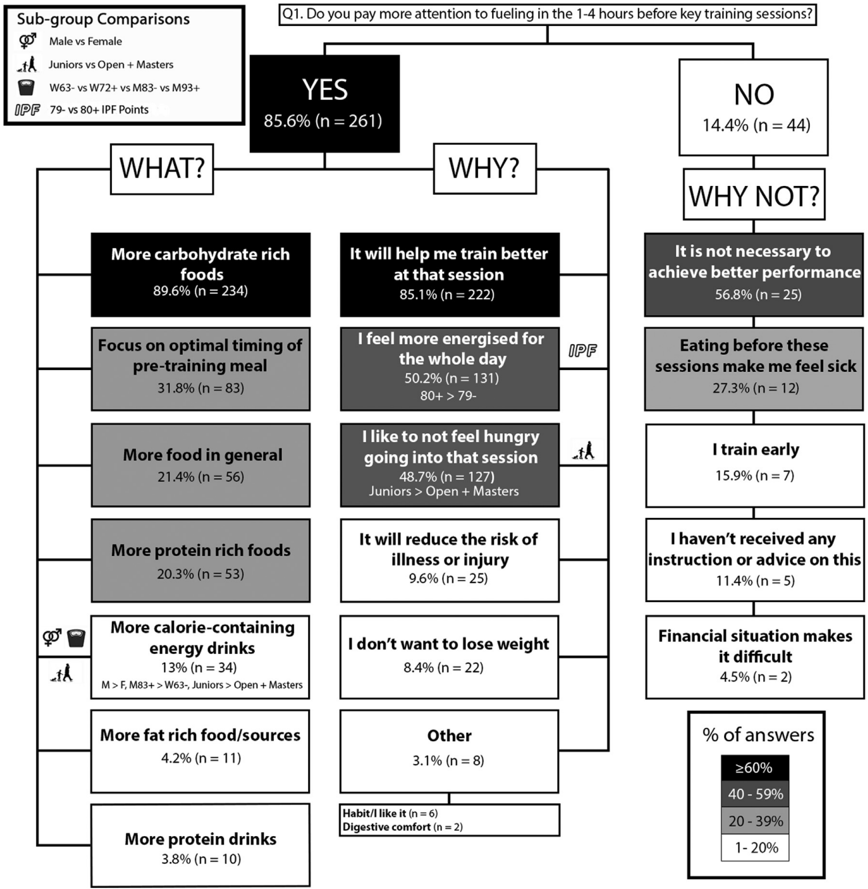
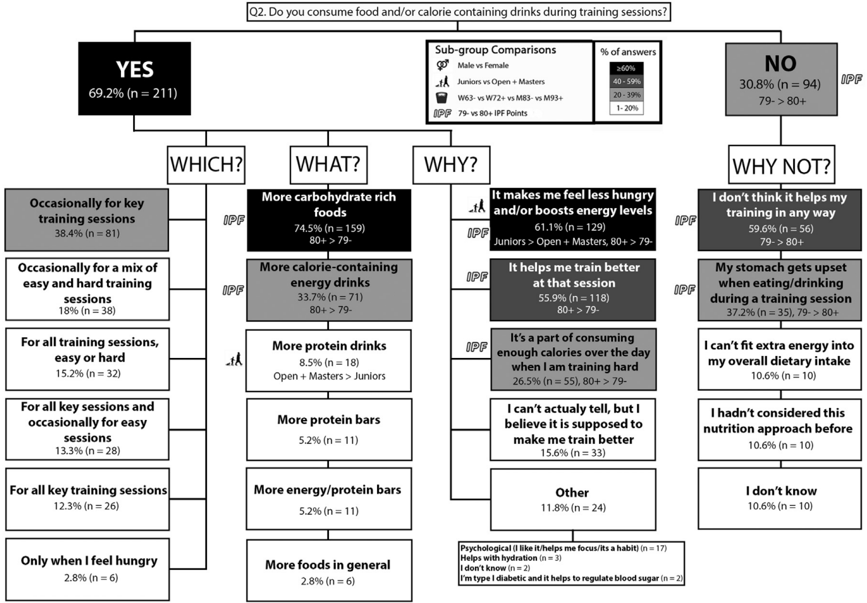
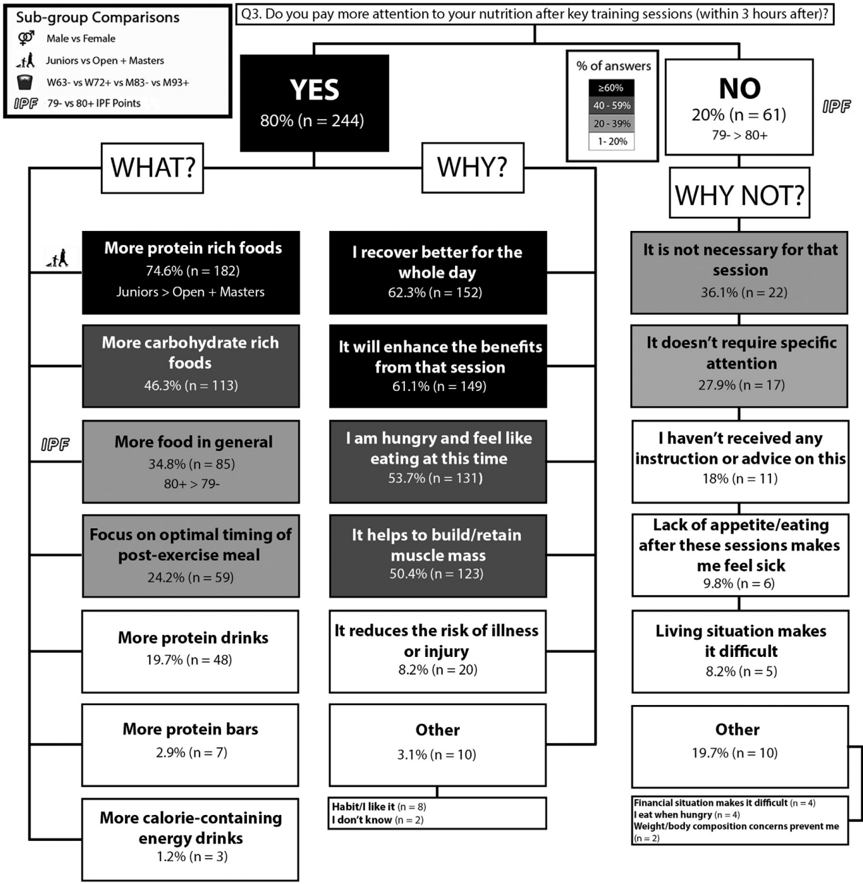
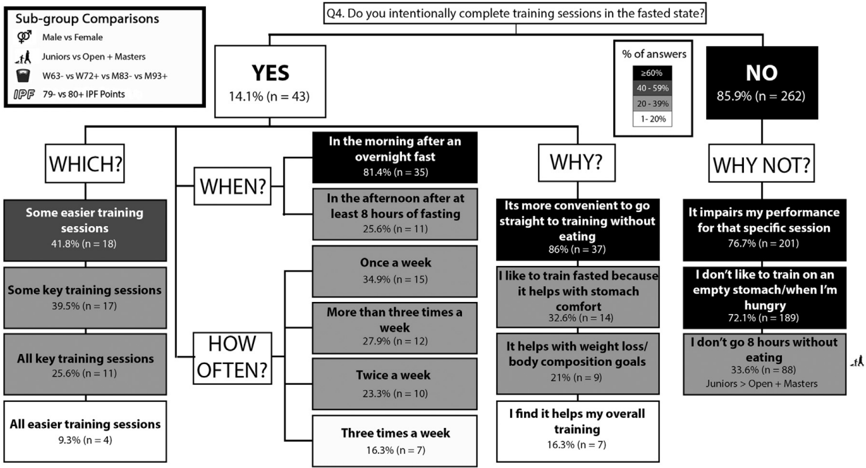
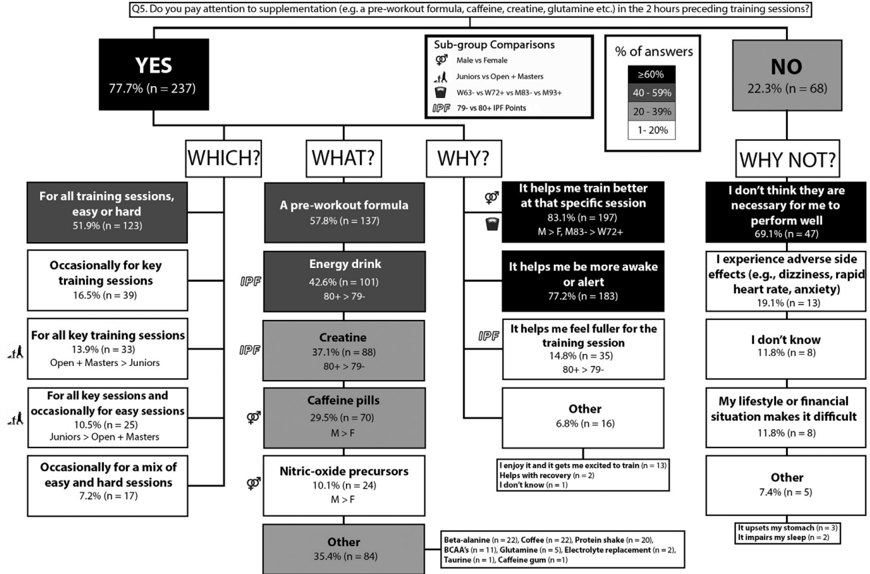
PURPOSE: Nutrient timing is a concept that emphasizes the intentional ingestion of whole or fortified foods, and dietary supplements, to adequately fuel for, and recover from, acute and chronic exercise. The nutrition strategies used by powerlifters around training sessions have not, to our knowledge, been previously investigated. This study explored the self-reported periworkout (before, during, and after) nutrition practices of competitive powerlifters, including what, why, and information source that informed practice, with comparison to current sport nutrition guidelines. METHODS: Actively competing male (n = 240) and female (n = 65) powerlifters completed a cross-sectional online survey of self-reported periworkout nutrition practices in the pre-, intra-, and postexercise periods, fasted training, and supplementation. Data are presented as the number (n) and percentage (%) of all powerlifters practicing a given strategy followed by a % of responses reporting various practices or beliefs within this strategy. Categorical subgroups (sex, age, and weight class; and competitive caliber) were analyzed with a chi-square test or Fisher's exact test and denoted where significant (P ≤ 0.05). RESULTS: Most powerlifters reported paying specific attention to nutrition practices in the pre-exercise period (n = 261; 85.6%) by ingesting more carbohydrate (CHO) rich foods (n = 234; 89.6%) for the purpose of assisting in training performance (n = 222; 85.1%). Most powerlifters reported intraexercise nutrition strategies (n = 211; 69.2%), of which most included ingesting more CHO rich foods (n = 159; 74.5%) for the purpose of feeling less hungry and/or boosting energy levels during training (n = 129; 61.1%). Most powerlifters reported paying attention to postexercise nutrition (n = 244; 80%), by ingesting more protein rich foods (n = 182; 74.6%) for the purpose of recovering better for the whole day (n = 152; 62.3%) and enhancing the benefits of training (n = 149; 61.1%). Most powerlifters did not complete training sessions in the fasted state (n = 262; 85.9%). Most powerlifters reported paying attention to supplementation before training (n = 237; 77.7%), of which preworkout formulas (n = 137; 57.8%), energy drinks (n = 101; 42.6%), creatine (n = 88; 37.1%), and caffeine pills (n = 70; 29.5%) were most reported. Supplementation was used to assist in training performance (n = 197; 83.1%) and increase wakefulness/alertness (n = 183; 77.2%). Males reported more often than females that they informed multiple elements of their nutrition practices with the information they read or watched somewhere (P = 0.002-0.012). CONCLUSION: The periworkout nutrition practices used by competitive powerlifters followed current sport nutrition guidelines, by using CHO sources to fuel for training and ensuring the provision of protein postexercise. Competitive powerlifters may wish to exert caution with supplementation, as there is a risk of harm or inadvertent doping.
Overview
CoChat Summary
TL;DR
In a cross-sectional survey of 305 competitive powerlifters, most reported periworkout nutrition practices consistent with current sport nutrition guidelines, emphasizing carbohydrate before/during training and protein after training. Supplementation before training was common, most often caffeine-containing products and creatine, with authors cautioning about contamination and inadvertent doping risk.
Key findings
- Pre- and intraexercise: 85.6% (n = 261) paid attention to fueling 1–4 h before key sessions; 89.6% (n = 234) ate more CHO-rich foods, and 85.1% (n = 222) did so to assist training performance. 69.2% (n = 211) used intraexercise nutrition; 74.5% (n = 159) chose CHO-rich foods, and 61.1% (n = 112) reported the purpose as feeling less hungry and/or boosting energy.
- Postexercise and fasting: 80% (n = 244) paid attention to postexercise nutrition; 74.6% (n = 182) chose protein-rich foods, with 62.3% (n = 152) reporting “recovering better for the whole day” and 61.1% (n = 149) “enhancing the benefits of training.” 85.9% (n = 262) did not complete training fasted; among the 14.1% (n = 43) who did, 81.4% (n = 35) trained after an overnight fast and 86% (n = 36) cited convenience.
- Supplementation: 77.7% (n = 237) paid attention to supplementation in the 2 h before training; preworkout formulas (57.8%, n = 137), energy drinks (42.6%, n = 101), creatine (37.1%, n = 88), and caffeine pills (29.5%, n = 70) were most reported. Reasons included assisting training performance (83.1%, n = 197) and increasing wakefulness/alertness (77.2%, n = 183). Males more often than females informed multiple nutrition practices from reading/watching something (P = 0.002–0.012).
Methods
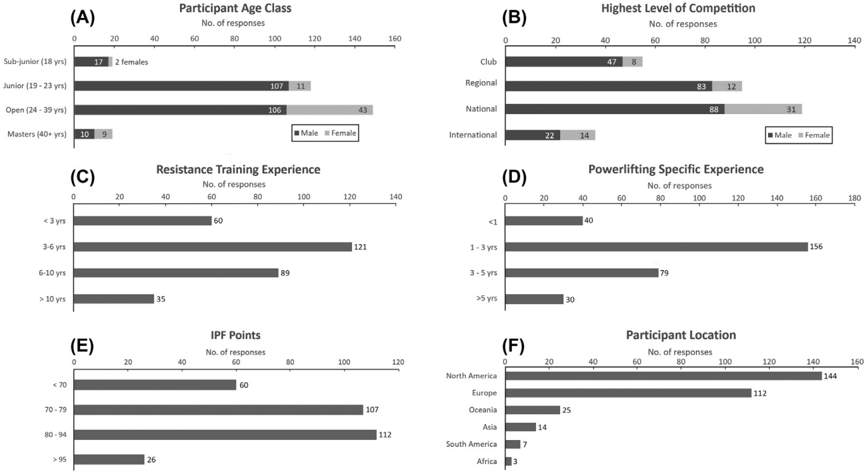
- Anonymous international cross-sectional online survey (Qualtrics) distributed via social media from November 2020 to February 2021. Inclusion criteria were age ≥18 y and competing in a drug-free sanctioned powerlifting competition within the previous 18 months; 305 actively competing powerlifters (240 male, 65 female) were analyzed, with only fully completed questionnaires included.
- The questionnaire had ten sections; the last five covered pre-exercise nutrition, postexercise nutrition, fasted training, intraexercise nutrition, and supplementation practices. Definitions were provided for concepts such as hard/easier/key training sessions, fueling, and fasting.
- Descriptive data were presented as n and %; categorical subgroups were analyzed with chi-square or Fisher’s exact test and Cramer’s V, with significance set at P < 0.05. Weight-class follow-up used Holm-Bonferroni correction where significant; analyses used SPSS v27 and R v4.2.2, and data/code are available on OSF.
Limitations
- Stated in the paper: self-reported nutrition practices may be subject to recall errors and participant bias; reliability could not be assessed because the survey was anonymous. Not all questionnaire terms were defined (e.g., supplementation, fasting), and quantities for food categories were not defined.
- Stated in the paper: participants had to be ≥18 y, excluding subjunior powerlifters aged 14–17 y; most respondents (84%) resided in North America and Europe, limiting generalizability; the sample was convenience-based and analyses were descriptive/exploratory rather than confirmatory. Only 21% (n = 65) were female, so sex and weight-class subgroup analyses may be spurious or of limited practical significance.
- Evident from the design: the cross-sectional survey cannot establish causality or track changes over time, and the convenience/social-media recruitment limits generalizability beyond the sampled respondents.
Model-written summary. Check it against the paper before relying on it.
Integrity signals
Registry
Cites
Statistics
Figures
Verification
Claims the paper makes
0 Valid · 0 Not valid · 33 Not checked · 102 Own results and interpretations
A result the paper reports from its own data — it cites no other source for it, so there is none to check. The quote shows it is in the paper.
In the paper
“Of the participants (14.1%, n = 43) that completed at least some training sessions in the fasted state, fasted training most often occurred the morning after an overnight fast (81.4%, n = 35) and because it was more convenient to go straight to training than eat first (86%, n = 36).”
§ Applied nutritional investigation Fueling for and recovering from resistance training: The periworkout nutrition practices of competitive powerlifters > Question 4. Fasted training
plainn = 35- Asserted: passes — The authors put it forward as true.
- Checkable: passes — It can be checked against evidence.
- Load-bearing: unclear — It is unclear whether the paper’s conclusions depend on it.
- Based: passes — The paper gives a reason why it holds.
A result the paper reports from its own data — it cites no other source for it, so there is none to check. The quote shows it is in the paper.
In the paper
“80+ IPF more often than 79-IPF reported that supplementation helped them feel fuller for the training session (P < 0.001; w c = 0.210).”
§ Applied nutritional investigation Fueling for and recovering from resistance training: The periworkout nutrition practices of competitive powerlifters > Question 5. Supplementation
plainstates an association- Asserted: passes — The authors put it forward as true.
- Checkable: passes — It can be checked against evidence.
- Load-bearing: unclear — It is unclear whether the paper’s conclusions depend on it.
- Based: passes — The paper gives a reason why it holds.
A result the paper reports from its own data — it cites no other source for it, so there is none to check. The quote shows it is in the paper.
In the paper
“Regarding supplementation type, 80+ IPF more often than 79-IPF reported supplementing with an energy drink (P = 0.042; w c = 0.116) or creatine (P = 0.038; w c = 0.119).”
§ Applied nutritional investigation Fueling for and recovering from resistance training: The periworkout nutrition practices of competitive powerlifters > Question 5. Supplementation
plainstates an association- Asserted: passes — The authors put it forward as true.
- Checkable: passes — It can be checked against evidence.
- Load-bearing: unclear — It is unclear whether the paper’s conclusions depend on it.
- Based: passes — The paper gives a reason why it holds.
A result the paper reports from its own data — it cites no other source for it, so there is none to check. The quote shows it is in the paper.
In the paper
“Males more often than females reported a focus on supplementation with information from reading or watching something (P = 0.002; w c = 0.178) and/or from their training partner (P = 0.016; w c = 0.138).”
§ Applied nutritional investigation Fueling for and recovering from resistance training: The periworkout nutrition practices of competitive powerlifters > Question 5. Supplementation
plainstates an association- Asserted: passes — The authors put it forward as true.
- Checkable: passes — It can be checked against evidence.
- Load-bearing: unclear — It is unclear whether the paper’s conclusions depend on it.
- Based: passes — The paper gives a reason why it holds.
A result the paper reports from its own data — it cites no other source for it, so there is none to check. The quote shows it is in the paper.
In the paper
“which was more often reported by males than females (P = 0.009; w c = 0.150) and M83than W72-(P = 0.036; w c = 0.241).”
§ Applied nutritional investigation Fueling for and recovering from resistance training: The periworkout nutrition practices of competitive powerlifters > Question 5. Supplementation
plainstates an associationn = 197- Asserted: passes — The authors put it forward as true.
- Checkable: passes — It can be checked against evidence.
- Load-bearing: unclear — It is unclear whether the paper’s conclusions depend on it.
- Based: passes — The paper gives a reason why it holds.
88 more claims
Create a free account to see all 135 claims and to verify the 40 references still open.
- It may state two separate claims as one. 23
- Probably not a substantial claim. 31
- The quote only partly states this claim. 1
Self-check
Percentages, sums and reported differences re-computed from the paper’s own numbers.
Each contradiction between two passages listed here was confirmed by an independent check.
Rated minor: it would not touch a result — a value no result rests on, a p-value that stays on the same side of the significance level, or a conflict that is clerical, resolved elsewhere in the paper, or outside its own findings.
In the paper
“a minority reported sport nutritionist (n = 39, 16.2%) or dietician (n = 17, 7.2%) guidance in their decision making”
§ Applied nutritional investigation Fueling for and recovering from resistance training: The periworkout nutrition practices of competitive powerlifters > Supplementation
Reported 16.2 · recomputed 16.455696
Rated minor: it would not touch a result — a value no result rests on, a p-value that stays on the same side of the significance level, or a conflict that is clerical, resolved elsewhere in the paper, or outside its own findings.
In the paper
§ Applied nutritional investigation Fueling for and recovering from resistance training: The periworkout nutrition practices of competitive powerlifters > Supplementation
“However, lower doses of caffeine (1À2 g/kg body mass or 1À2 cups of coffee) similarly confer a small ergogenic effect on resistance training performance as higher doses [48].”
§ Applied nutritional investigation Fueling for and recovering from resistance training: The periworkout nutrition practices of competitive powerlifters > Supplementation
“Current recommendations are to ingest a caffeine dose of 3 to 6 mg/kg body mass caffeine »60 mins before exercise [19,20].”
Rated minor: it would not touch a result — a value no result rests on, a p-value that stays on the same side of the significance level, or a conflict that is clerical, resolved elsewhere in the paper, or outside its own findings.
In the paper
§ Applied nutritional investigation Fueling for and recovering from resistance training: The periworkout nutrition practices of competitive powerlifters > Survey content
“Fasting was defined as the completion of a training session without eating food or calorie containing drinks in the 8 h prior.”
§ Applied nutritional investigation Fueling for and recovering from resistance training: The periworkout nutrition practices of competitive powerlifters > Limitations
“we did not define all terms used in the questionnaire for the participants (e.g., supplementation or fasting)”
Rated minor: it would not touch a result — a value no result rests on, a p-value that stays on the same side of the significance level, or a conflict that is clerical, resolved elsewhere in the paper, or outside its own findings.
In the paper
“Of the participants (14.1%, n = 43) that completed at least some training sessions in the fasted state, fasted training most often occurred the morning after an overnight fast (81.4%, n = 35) and because it was more convenient to go straight to training than eat first (86%, n = 36).”
§ Applied nutritional investigation Fueling for and recovering from resistance training: The periworkout nutrition practices of competitive powerlifters > Question 4. Fasted training
Reported 86 · recomputed 83.72093
Rated minor: it would not touch a result — a value no result rests on, a p-value that stays on the same side of the significance level, or a conflict that is clerical, resolved elsewhere in the paper, or outside its own findings.
In the paper
§ Applied nutritional investigation Fueling for and recovering from resistance training: The periworkout nutrition practices of competitive powerlifters > Abstract
“for the purpose of feeling less hungry and/or boosting energy levels during training (n = 129; 61.1%).”
§ Applied nutritional investigation Fueling for and recovering from resistance training: The periworkout nutrition practices of competitive powerlifters > Question 2. Intraexercise nutrition
“Regarding the purpose of intrasession nutrition, 61.1% (n = 112) answered that it made them feel less hungry or boosted energy levels”
Citations
Cites
Designing and Conducting Survey Research: A Comprehensive Guide
Rea, L. M., & Parker, R. (1992) · Cited by 1,761
Skeletal muscle energy metabolism during exercise
Hargreaves, M., & Spriet, L. L. (2020) · Nature Metabolism · doi:10.1038/s42255-020-0251-4 · Cited by 1,408
Thomas, D. T., Erdman, K. A., & Burke, L. M. (2016) · Journal of the Academy of Nutrition and Dietetics · doi:10.1016/j.jand.2015.12.006 · Cited by 1,359
Morton, R. W., Murphy, K. T., McKellar, S. R., Schoenfeld, B. J., Henselmans, M., Helms, E., Aragon, A. A., Devries, M. C., Banfield, L., Krieger, J. W., et al. (2018) · British Journal of Sports Medicine · doi:10.1136/bjsports-2017-097608 · Cited by 1,269
Self-citationKreider, R. B., Kalman, D. S., Antonio, J., Ziegenfuss, T. N., Wildman, R., Collins, R., Candow, D. G., Kleiner, S. M., Almada, A. L., & Lopez, H. L. (2017) · Journal of the International Society of Sports Nutrition · doi:10.1186/s12970-017-0173-z · Cited by 1,057
The effects of increasing exercise intensity on muscle fuel utilisation in humans
van Loon, L. J. C., Greenhaff, P. L., Constantin‐Teodosiu, D., Saris, W. H. M., & Wagenmakers, A. J. M. (2001) · The Journal of Physiology · doi:10.1111/j.1469-7793.2001.00295.x · Cited by 897
Developing Maximal Neuromuscular Power: Part 1 – Biological Basis of Maximal Power Production
Cormie, P., McGuigan, M. R., & Newton, R. U. (2011) · Sports Medicine · doi:10.2165/11537690-000000000-00000 · Cited by 774
International Society of Sports Nutrition Position Stand: Caffeine and Exercise Performance
Guest, N. S., VanDusseldorp, T. A., Nelson, M. T., Grgic, J., Schoenfeld, B. J., Jenkins, N. D. M., Arent, S. M., Antonio, J., Stout, J. R., Trexler, E. T., et al. (2021) · Journal of the International Society of Sports Nutrition · doi:10.1186/s12970-020-00383-4 · Cited by 665
Wilkinson, S. B., Phillips, S. M., Atherton, P. J., Patel, R., Yarasheski, K. E., Tarnopolsky, M. A., & Rennie, M. J. (2008) · The Journal of Physiology · doi:10.1113/jphysiol.2008.153916 · Cited by 628
International society of sports nutrition position stand: nutrient timing
Kerksick, C. M., Arent, S., Schoenfeld, B. J., Stout, J. R., Campbell, B., Wilborn, C. D., Taylor, L., Kalman, D., Smith-Ryan, A. E., Kreider, R. B., et al. (2017) · Journal of the International Society of Sports Nutrition · doi:10.1186/s12970-017-0189-4 · Cited by 622
Cited by
Bird, S. P., Nienhuis, M. B., Biagioli, B., Pauw, K. D., & MEEUSEN, R. R. (2024) · Nutrients · doi:10.3390/nu16121886 · Cited by 27
Nutritional Strategies for Enhancing Performance and Training Adaptation in Weightlifters
Hwang, D.-J., & Yang, H.-J. (2024) · International Journal of Molecular Sciences · doi:10.3390/ijms26010240 · Cited by 19
Silverthorne, K., Morrison, M. A., Cowley, N., Munteanu, G., Creaby, M. W., Timmins, R. G., Chiang, C.-Y., & Weakley, J. J. S. (2025) · Sports Medicine · doi:10.1007/s40279-025-02305-3 · Cited by 10
Amdi, C. H., Spence, A., Helms, E. R., & McGuigan, M. R. (2025) · The Journal of Strength and Conditioning Research · doi:10.1519/jsc.0000000000005261 · Cited by 5
Self-citationMatsumura, T., Nonoyama, S., & Hashimoto, T. (2026) · PharmaNutrition · doi:10.1016/j.phanu.2026.100476 · Cited by 2
Metadata
- Authors
- King, A., Kwan, K., Jukic, I., Zinn, C., & Helms, E.
- Affiliations
- Auckland University of Technology (NZ)
- Corresponding author
- King, Andrew
- Venue
- Nutrition
- Publisher
- Elsevier BV
- Published
- 2024-06
- Volume
- 122
- Pages
- 112389
- ISSN
- 0899-9007 (ISSN-L)
- OpenAlex
- W4391617268
- Cited by
- 10
- References
- 61
- Citations by year
- 2026: 4 · 2025: 3 · 2024: 3
- FWCI
- 2.28
- Type
- journal article
- Language
- en
- Open access
- hybrid
- doi.org
- Licence
- cc-by
- www.elsevier.com/tdm/userlicense/1.0/ (tdm)
- www.elsevier.com/legal/tdmrep-license (tdm)
- creativecommons.org/licenses/by/4.0/ (vor)
- Locations
- Nutrition (publishedVersion, cc-by)
- PubMed (publishedVersion)
- Tuwhera (Auckland University of Technology) (submittedVersion, cc-by)
- Topics
- Health Sciences › Nursing › Nutrition and Dietetics › Muscle metabolism and nutrition
- Health Sciences › Medicine › Orthopedics and Sports Medicine › Sports Performance and Training
- Health Sciences › Nursing › Nutrition and Dietetics › Nutrition, Health and Food Behavior
- Keywords
- powerlifters, nutrient timing, pre-exercise nutrition, post-exercise nutrition, carbohydrate intake, protein intake, dietary supplements, nutrition information sources, competitive athletes, sex differences, weight class, training recovery, training performance
- MeSH terms
- Cross-Sectional Studies, Female, Humans, Male, Nutritional Status, Exercise, Dietary Supplements, Resistance Training
About these checks
Registry, retraction, Cites and statistics results are computed, not judged, with one exception: a printed reference that no index lists is read once by a model before it counts as a citation error. Claims are extracted by a model and kept only when their quote appears verbatim in the text; each cited source is then checked, with a model’s help, for whether it says what the claim relies on. Those verdicts can be wrong — read the claim’s quote and the cited source before relying on one.
A language model drew the claims from the paper on 2026-11-14, under version 3 of the claim definition (model deepseek-v4.1-flash, prompt extract-v3).
A second model labelled each claim on 2026-11-14 (model jev-1.13-20260917, definition revision gold-guideline-v0.2).
Statistics and arithmetic are recomputed, not judged.
Confidence bands are shown only for fields calibrated on our annotated test set. None is calibrated yet, so no band is shown.
What counts as a claim ›How we measure confidence ›How we check this ›
Are you an author, or do you see a problem with this page? Request a review
Data sources
Bibliographic data: Semantic Scholar, OpenAlex, Crossref.
Contains information from the Semantic Scholar Academic Graph Datasets, made available under the ODC Attribution License (ODC-BY 1.0).
Semantic Scholar’s data is described in: Kinney, R., et al. (2023). The Semantic Scholar Open Data Platform. arXiv:2301.10140.
