

Double-stranded RNA reduction by chaotropic agents during in vitro transcription of messenger RNA
The DOI matches its Crossref record; 18 of the 18 references it cites were found in a registry or an index.
Abstract
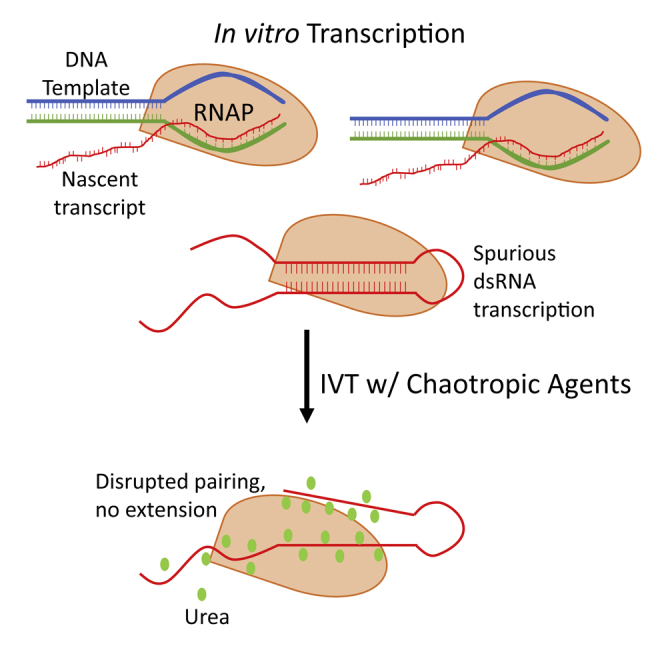
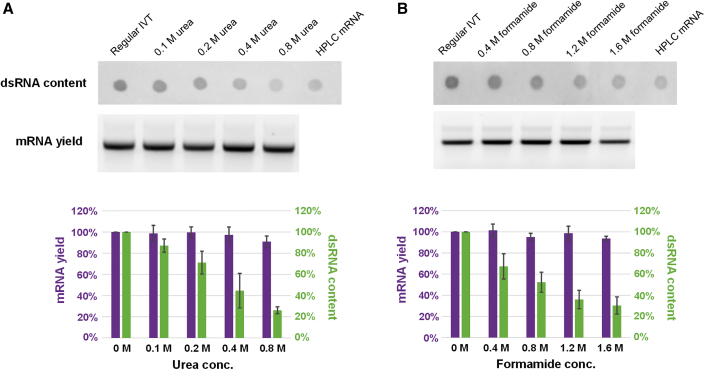
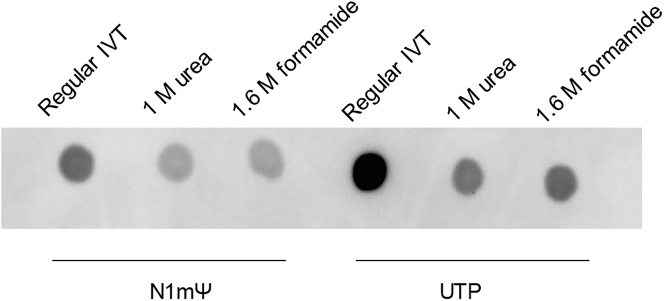
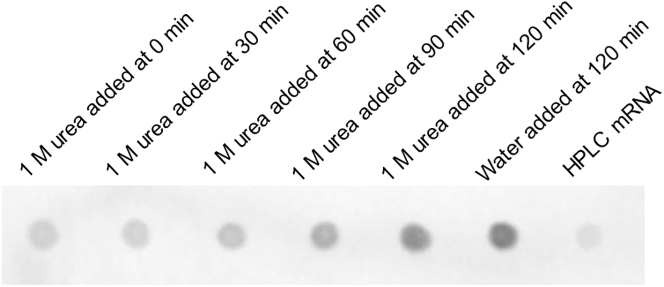
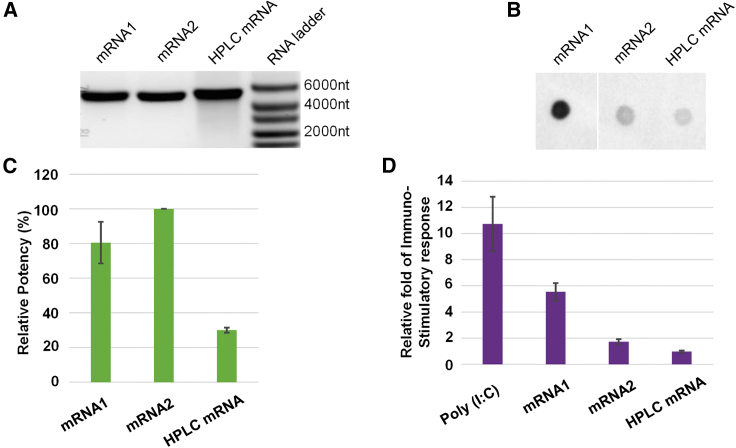
transcription (IVT), and it is challenging to reduce dsRNA byproduct from mRNA due to their similar sizes and intrinsic characteristics. Removal of dsRNA relies heavily on post-IVT chromatography purifications, such as reverse-phase high-pressure liquid chromatography, which increase manufacturing costs, reduce yield, and often decrease integrity, especially for long mRNA. Thus, it would be ideal to reduce and control the level of dsRNA during IVT. We herein present a simple, scalable, and controllable method to reduce the formation of dsRNA byproducts during IVT. Selected chaotropic agents at optimized concentrations are included during IVT to create a mild denaturing environment to prevent the undesired intermolecular or intramolecular base-pairing that is thought to promote RNA-templated dsRNA formation by RNA polymerase. Compared with regular IVT, our improved method produces mRNA with significantly less dsRNA, much lower immuno-stimulation, and more efficient protein expression. Therefore, this method potentially eliminates dsRNA removal purification steps and does not require reduced magnesium concentration, elevated temperature, or custom reagents, enabling a straightforward, high-yield, and cost-effective scale-up approach for mRNA manufacturing.
Overview
The claims and statistics of this paper haven’t been checked yet.
Free: it reads the open-access text and checks the first 5 claims that cite a source we can check. Create a free account to check every claim.
Integrity signals
Registry
Cites
Statistics
Figures
Verification
Claims the paper makes
The claims and statistics of this paper haven’t been checked yet.
Free: it reads the open-access text and checks the first 5 claims that cite a source we can check. Create a free account to check every claim.
Claims other papers make about this one
Each is checked against this paper’s own text: does it say what the citing paper says it does?
In the citing paper
“However, it is important to note that T7 RNAP has cryptic RNA-templated transcription capabilities, resulting in the formation of different types of dsRNA byproducts, including long antisense–sense dsRNA,7,8 3′-heterogeneity, and 3′-loopback dsRNA.9”
From Exploring the Impact of In Vitro-Transcribed mRNA Impurities on Cellular Responses (2024) · cites this paper as [7]
Self-check
Percentages, sums and reported differences re-computed from the paper’s own numbers.
The self-check needs the paper’s full text.
Citations
Cites
mRNA vaccines — a new era in vaccinology
Pardi, N., Hogan, M. J., Porter, F. W., & Weissman, D. (2018) · Nature Reviews Drug Discovery · doi:10.1038/nrd.2017.243 · Cited by 4,667
Karikó, K., Buckstein, M., Ni, H., & Weissman, D. (2005) · Immunity · doi:10.1016/j.immuni.2005.06.008 · Cited by 2,728
Oligoribonucleotide synthesis using T7 RNA polymerase and synthetic DNA templates
Milligan, J. F., Groebe, D. R., Witherell, G. W., & Uhlenbeck, O. C. (1987) · Nucleic Acids Research · doi:10.1093/nar/15.21.8783 · Cited by 2,136
Karikó, K., Muramatsu, H., Welsh, F. A., Ludwig, J., Kato, H., Akira, S., & Weissman, D. (2008) · Molecular Therapy · doi:10.1038/mt.2008.200 · Cited by 1,930
Karikó, K., Muramatsu, H., Ludwig, J., & Weissman, D. (2011) · Nucleic Acids Research · doi:10.1093/nar/gkr695 · Cited by 898 · cited 1×
“It was not unusual to observe that mRNA samples with reduced dsRNA byproducts triggered less immunostimulatory response and more protein expression based on previous reports.(9,12) A possible explanation could be that dsRNA induced protein kinase R (PKR) activation, inhibiting translation of the mRNA by phosphorylatin…”
Incorporation of pseudouridine into mRNA enhances translation by diminishing PKR activation
Anderson, B. R., Muramatsu, H., Nallagatla, S. R., Bevilacqua, P. C., Sansing, L. H., Weissman, D., & Karikó, K. (2010) · Nucleic Acids Research · doi:10.1093/nar/gkq347 · Cited by 682
A facile method for the removal of dsRNA contaminant from in vitro-transcribed mRNA
Baiersdörfer, M., Boros, G., Muramatsu, H., Mahiny, A., Vlatkovic, I., Sahin, U., & Karikó, K. (2019) · Molecular Therapy — Nucleic Acids · doi:10.1016/j.omtn.2019.02.018 · Cited by 569
Impact of mRNA chemistry and manufacturing process on innate immune activation
Nelson, J., Sorensen, E. W., Mintri, S., Rabideau, A. E., Zheng, W., Besin, G., Khatwani, N., Su, S. V., Miracco, E. J., Issa, W. J., et al. (2020) · Science Advances · doi:10.1126/sciadv.aaz6893 · Cited by 354
Processivity in early stages of transcription by T7 RNA polymerase
Martin, C. T., Muller, D. K., & Coleman, J. E. (1988) · Biochemistry · doi:10.1021/bi00411a012 · Cited by 264
Vaidyanathan, S., Azizian, K. T., Haque, A. K. M. A., Henderson, J. M., Hendel, A., Shore, S., Antony, J. S., Hogrefe, R. I., Kormann, M. S. D., Porteus, M. H., et al. (2018) · Molecular Therapy Nucleic Acids · doi:10.1016/j.omtn.2018.06.010 · Cited by 262
Research works printed but not linked: 9
- Fortner A. Schumacher D. First COVID-19 vaccines receiving the US FDA and EMA emergency use authorization Discoveries 9 2021 e122 33969180 PMC8101362 · DOI
- Jhaveri R. The COVID-19 mRNA vaccines and the pandemic: do they represent the beginning of the end or the end of the beginning? Clin. Ther. 43 2021 549 556 33579547 PMC7825996 · DOI
- Kalmakoff J. Payne C.C. A simple method for the separation of single-stranded and double-stranded RNA on hydroxyapatite Anal. Biochem. 55 1973 26 33 4584872 · doi:10.1016/0003-2697(73)90287-x
- Kanwal F. Chen T. Zhang Y. Zhang Y. Simair A. Rujie C. Sadaf Zaidi N.U.S. Guo X. Wei X. Siegel G. Lu C. Large-scale in vitro transcription, RNA purification and chemical probing analysis Cell. Physiol. Biochem. 48 2018 1915 1927 30092596 · DOI
- Gholamalipour Y. Johnson W.C. Martin C.T. Efficient inhibition of RNA self-primed extension by addition of competing 3’-capture DNA-improved RNA synthesis by T7 RNA polymerase Nucleic Acids Res. 47 2019 e118 31392994 PMC6821179 · DOI
- Cavac E. Ramírez-Tapia L.E. Martin C.T. High-salt transcription of DNA cotethered with T7 RNA polymerase to beads generates increased yields of highly pure RNA J. Biol. Chem. 297 2021 100999 34303704 PMC8368030 · DOI
- Moqtaderi Z. Geisberg J.V. Struhl K. Secondary structures involving the poly(A) tail and other 3’ sequences are major determinants of mRNA isoform stability in yeast Microb. Cell 1 2014 137 139 25279376 PMC4178928 · DOI
- Huang J. Brieba L.G. Sousa R. Misincorporation by wild-type and mutant T7 RNA polymerases: identification of interactions that reduce misincorporation rates by stabilizing the catalytically incompetent open conformation Biochemistry 39 2000 11571 11580 10995224 · DOI
- Balachandran S. Roberts P.C. Brown L.E. Truong H. Pattnaik A.K. Archer D.R. Barber G.N. Essential role for the dsRNA-dependent protein kinase PKR in innate immunity to viral infection Immunity 13 2000 129 141 10933401 · DOI · Paper page
Cited by
Exploring the Impact of In Vitro-Transcribed mRNA Impurities on Cellular Responses
Camperi, J., Roper, B., Freund, E., Leylek, R., Nissenbaum, A., Galan, C., Caothien, R., Hu, Z., Ko, P., Lee, A., et al. (2024) · Analytical Chemistry · doi:10.1021/acs.analchem.4c04162 · Cited by 22
Metadata
- Authors
- Piao, X., Yadav, V., Wang, E., Chang, W., Tau, L., Lindenmuth, B. E., & Wang, S. X.
- Venue
- Molecular Therapy - Nucleic Acids
- Publisher
- Elsevier BV
- Published
- 2022-09
- Volume
- 29
- Pages
- 618-624
- ISSN
- 2162-2531
- PMC
- PMC9421179
- Cited by
- 79
- References
- 18
- Language
- en
- Licence
- www.elsevier.com/tdm/userlicense/1.0/ (tdm)
- www.elsevier.com/legal/tdmrep-license (tdm)
- creativecommons.org/licenses/by-nc-nd/4.0/ (vor)
- Funders
- Ultragenyx Pharmaceutical
About these checks
Registry, retraction, Cites and statistics results are computed, not judged, with one exception: a printed reference that no index lists is read once by a model before it counts as a citation error. Claims are extracted by a model and kept only when their quote appears verbatim in the text; each cited source is then checked, with a model’s help, for whether it says what the claim relies on. Those verdicts can be wrong — read the claim’s quote and the cited source before relying on one.
Statistics and arithmetic are recomputed, not judged.
Confidence bands are shown only for fields calibrated on our annotated test set. None is calibrated yet, so no band is shown.
What counts as a claim ›How we measure confidence ›How we check this ›
Are you an author, or do you see a problem with this page? Request a review
Data sources
Bibliographic data: Semantic Scholar, OpenAlex, Crossref.
Contains information from the Semantic Scholar Academic Graph Datasets, made available under the ODC Attribution License (ODC-BY 1.0).
Semantic Scholar’s data is described in: Kinney, R., et al. (2023). The Semantic Scholar Open Data Platform. arXiv:2301.10140.
