

The brighter side of materialism: Managing impressions on social media for higher social capital
Open accessThe DOI matches its Crossref record; 90 of the 90 references it cites were found in a registry or an index; none of the 55 sources its claims cite is checked for support yet.
Abstract
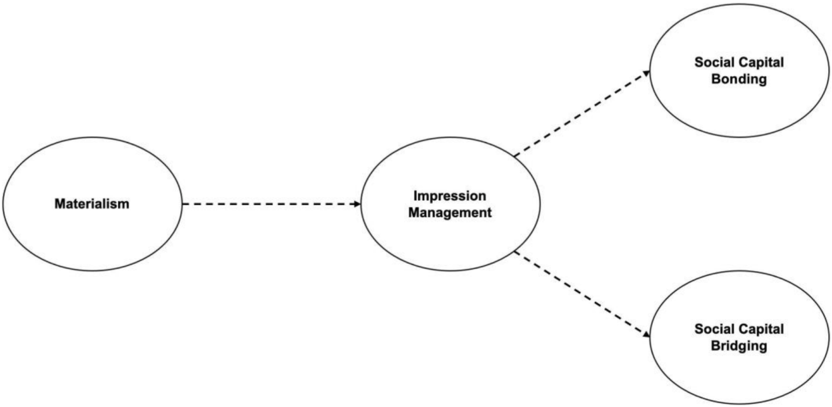
Individuals adjust their behavior on social media to varying extent, and commonly in their idealized way. Most studies have focused on the problems associated with materialism and social media use, yet their potential positive contributions remain less clear. In fact, impression management holds potential for both negative and positive: it has been linked with materialistic attitudes, but also increased amounts of self-reported social capital. This study examines how young people's materialistic values connect with status-seeking impression management on social media, and subsequently to social capital, within the same model. Eight hundred Finnish participants aged 15–19 participated in our structured phone survey. We applied structural equation modeling to examine the connections between materialism, impression management, and online social capital. Our findings show that materialism is positively related to impression management, while impression management is positively associated with online social capital. Additionally, we found positive indirect effects between materialism and both bridging and bonding social capital through impression management. In sum, more materialistic young people who engaged in higher impression management had higher amounts of social capital.
Overview
CoChat Summary
TL;DR
In a survey of 800 Finnish 15–19-year-olds, materialism was positively associated with status-seeking impression management on social media, which in turn was positively associated with online bridging and bonding social capital. The study reports positive indirect effects from materialism to both forms of social capital via impression management.
Key findings
- Materialism was positively related to status-seeking impression management (ß = 0.58, p < .001).
- Impression management was positively related to online social capital: bridging (ß = 0.41, p < .001) and bonding (ß = 0.14, p = .003); bridging and bonding social capital were also positively related (ß = 0.52, p < .001).
- Indirect positive effects were found from materialism to bonding social capital (ß = 0.08, p = .003) and to bridging social capital (ß = 0.24, p < .001), both mediated by impression management.
- Covariates (gender, age, personal financial situation) did not significantly alter the coefficients; in the robust model, indirect effects remained similar (bonding ß = 0.09, p = .003; bridging ß = 0.25, p < .001).
Methods
- Structured telephone survey of 800 Finnish participants aged 15–19, randomly selected from the Finnish Population Register and adjusted to be nationally representative by age, gender, and area of residence; data collected December 2019–January 2020.
- Measures used Likert scales (1–5): materialism via a shortened 6-item Richins scale; online social capital adapted from Williams (2006) and Abbas and Mesch (2018) with bridging and bonding forms; status-seeking impression management via a newly created scale.
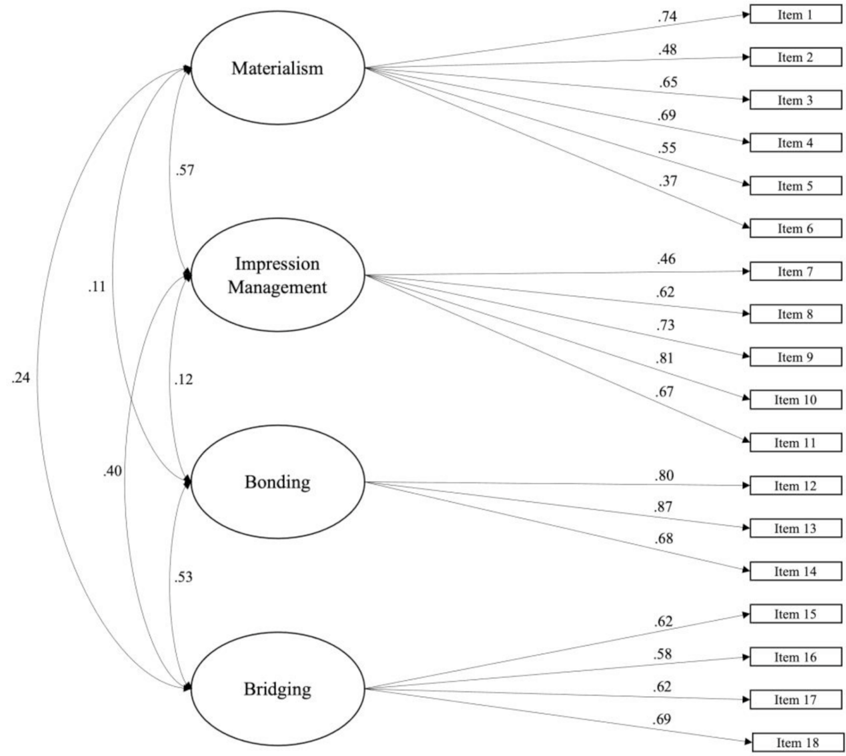
- Analysis used covariance-based structural equation modeling (CB-SEM) with confirmatory factor analysis in Mplus 8.4, WLSMV estimator, standardized coefficients, and covariates; reported SEM fit: RMSEA = 0.050, CFI = 0.955, TLI = 0.946, SRMR = 0.048.
Limitations
- Paper-stated: the model could not explain precise mechanisms because of the absence of valid statistical tests; cross-sectional data prevented evaluating causality; gender differences could not be tested due to lack of metric invariance; the Finnish-only sample limits cultural generalizability.
- Paper-stated: survey responses may be affected by respondents’ feelings and emotions, and value-laden statements about materialism or impression management may have produced socially desirable answers; statistical models are simplified approximations of real-life behavior.
- Evident from text: the study relies on self-reported measures from a single-country, cross-sectional sample, so causal direction and generalization beyond Finnish 15–19-year-olds are constrained, consistent with the paper’s own stated limitations.
Model-written summary. Check it against the paper before relying on it.
Integrity signals
Registry
Cites
Statistics
Figures
Verification
Claims the paper makes
0 Valid · 0 Not valid · 44 Not checked · 34 Own results and interpretations
A result the paper reports from its own data — it cites no other source for it, so there is none to check. The quote shows it is in the paper.
In the paper
“the effect of impression management on bridging was (ß = 0.41, p < .001)”
- Also stated in: § Abstract · plain
“impression management is positively associated with online social capital”
§ The brighter side of materialism: Managing impressions on social media for higher social capital > 7. Results
plainstates an association- Asserted: passes — The authors put it forward as true.
- Checkable: passes — It can be checked against evidence.
- Load-bearing: passes — The paper’s conclusions depend on it.
- Based: passes — The paper gives a reason why it holds.
- Also stated in: § Abstract · plain
A result the paper states — it cites no source for it, so there is none to check. The quote shows it is in the paper.
In the paper
“Interestingly, the increase in social capital happened even if the motives for impression management were unintended.”
§ The brighter side of materialism: Managing impressions on social media for higher social capital > 8.1. Theoretical implications
plainstates a cause- Asserted: passes — The authors put it forward as true.
- Checkable: passes — It can be checked against evidence.
- Load-bearing: passes — The paper’s conclusions depend on it.
- Based: passes — The paper gives a reason why it holds.
A result the paper reports from its own data — it cites no other source for it, so there is none to check. The quote shows it is in the paper.
In the paper
“Our findings add to our presumption that materialistic values can be positively related to higher impression management on social media and thereby result in higher online social capital.”
- Also stated in: § 8. Discussion · plain
“Our results, in turn, present the brighter side of materialism among young people by showing the indirect positive connection between materialism and bonding and bridging social capital via impression management on social media.”
- Also stated in: § 8. Discussion · plain
“since materialistic values were related to higher social capital through status-seeking impression management in this study”
§ The brighter side of materialism: Managing impressions on social media for higher social capital > 8. Discussion
plainstates an association- Asserted: passes — The authors put it forward as true.
- Checkable: passes — It can be checked against evidence.
- Load-bearing: passes — The paper’s conclusions depend on it.
- Based: passes — The paper gives a reason why it holds.
- Also stated in: § 8. Discussion · plain
A result the paper reports from its own data — it cites no other source for it, so there is none to check. The quote shows it is in the paper.
In the paper
“we found a significant and positive connection between bridging and bonding social capital (ß = 0.52, p < .001).”
§ The brighter side of materialism: Managing impressions on social media for higher social capital > 7. Results
plainstates an association- Asserted: passes — The authors put it forward as true.
- Checkable: passes — It can be checked against evidence.
- Load-bearing: unclear — It is unclear whether the paper’s conclusions depend on it.
- Based: passes — The paper gives a reason why it holds.
A result the paper reports from its own data — it cites no other source for it, so there is none to check. The quote shows it is in the paper.
In the paper
“on bonding (ß = 0.14, p = .003)”
§ The brighter side of materialism: Managing impressions on social media for higher social capital > 7. Results
plainstates an association- Asserted: passes — The authors put it forward as true.
- Checkable: passes — It can be checked against evidence.
- Load-bearing: passes — The paper’s conclusions depend on it.
- Based: passes — The paper gives a reason why it holds.
32 more claims
Create a free account to see all 78 claims and to verify the 45 references still open.
- It may state two separate claims as one. 15
- The quote only partly states this claim. 2
- Probably not a substantial claim. 32
Self-check
Percentages, sums and reported differences re-computed from the paper’s own numbers.
Each contradiction between two passages listed here was confirmed by an independent check.
Rated minor: it would not touch a result — a value no result rests on, a p-value that stays on the same side of the significance level, or a conflict that is clerical, resolved elsewhere in the paper, or outside its own findings.
In the paper
§ The brighter side of materialism: Managing impressions on social media for higher social capital > 7. Results
“Also, a test model (SEM) showed good model-fit: (cut-off criteria in parenthesis (Hu & Bentler, 1999;Yu & Muthén, 2002) x 2 = 386, 709, df = 129, p< .001(>0.05),RMSEA = 0.050 (<0.06),CFI = 0.955 (>0.95), TLI = 0.946 (>0.95), SRMR = 0.048 (<0.08), which suggests that the tested model is acceptable.”
§ The brighter side of materialism: Managing impressions on social media for higher social capital > 6.3. Data analysis
“Moreover, we estimated our model fit in comparison to widely accepted cut-off criteria suggested by Hu and Bentler (1999): 0.95 for the TLI and CFI, 0.08 for SRMR, and 0.06 for RMSEA.”
Rated minor: it would not touch a result — a value no result rests on, a p-value that stays on the same side of the significance level, or a conflict that is clerical, resolved elsewhere in the paper, or outside its own findings.
In the paper
§ The brighter side of materialism: Managing impressions on social media for higher social capital > 7. Results
“Our measurement model (Fig. 2) showed a good fit: (accepted cut-off criteria in parenthesis) (Hu & Bentler, 1999;Yu & Muthén, 2002) x 2 = 405,423 df = 127, p < .001(>0.05), RMSEA = 0.052 (<0.06),CFI = 0.951 (>0.95), TLI = 0.941 (>0.95), SRMR = 0.047 (<0.08).”
§ The brighter side of materialism: Managing impressions on social media for higher social capital > 6.3. Data analysis
“Moreover, we estimated our model fit in comparison to widely accepted cut-off criteria suggested by Hu and Bentler (1999): 0.95 for the TLI and CFI, 0.08 for SRMR, and 0.06 for RMSEA.”
Citations
Cites
Hu, L., & Bentler, P. M. (1999) · Structural Equation Modeling A Multidisciplinary Journal · doi:10.1080/10705519909540118 · Cited by 108,788
Model selection and multimodel inference: a practical information-theoretic approach.
Guthery, F. S., Burnham, K. P., & Anderson, D. R. (2003) · The Journal of Wildlife Management · doi:10.2307/3802723 · Cited by 41,495
Social Capital in the Creation of Human Capital
Coleman, J. S. (1988) · American Journal of Sociology · doi:10.1086/228943 · Cited by 26,975
Putnam, R. (2000) · doi:10.1145/358916.361990 · Cited by 17,114
Ellison, N. B., Steinfield, C., & Lampe, C. (2007) · Journal of Computer-Mediated Communication · doi:10.1111/j.1083-6101.2007.00367.x · Cited by 9,939
Schermelleh-Engel, K., Moosbrugger, H., & Müller, H. (2003) · Department of Psychology - University of Koblenz-Landau · doi:10.23668/psycharchives.12784 · Cited by 8,975
(2011) · Cited by 5,290
Bowling Alone: The Collapse and Revival of American Community
Keddy, J. (2001) · Spiritus: A Journal of Christian Spirituality · doi:10.1353/scs.2001.0014 · Cited by 3,764
A Consumer Values Orientation for Materialism and Its Measurement: Scale Development and Validation
Richins, M. L., & Dawson, S. (1992) · Journal of Consumer Research · doi:10.1086/209304 · Cited by 3,372
Impression management: A literature review and two-component model.
Leary, M. R., & Kowalski, R. M. (1990) · Psychological Bulletin · doi:10.1037/0033-2909.107.1.34 · Cited by 3,334
Research works printed but not linked: 3
- Baumeister, R. F., & Bushman, B. J. (2015). Social psychology and human nature (Brief version) (4th ed.). Boston: Cengage Learning.
- Jones, E.E., .& Pittman, S.T. (.1982). Toward a general theory of strategic self-presentation. In J. Suls (Ed.), Psychology perspectives on the self (Vol. 1, pp. 231-262).
- Luoma-aho, V. (2016). Social capital theory. In C. Carrol (Ed.), The Sage Encyclopedia of Corporate Reputation (pp. 759-762). Sage Publications, Thousand Oaks.
Cited by
Personal values and travel social media use among Generation Z
Chang, T., Kong, W. H., & Bahl, A. (2023) · Consumer Behavior in Tourism and Hospitality · doi:10.1108/cbth-11-2021-0263 · Cited by 32
Sukmayadi, V., Darmawangsa, D., Ayub, S. H., & Fadhila, S. A. (2024) · The Qualitative Report · doi:10.46743/2160-3715/2024.5992 · Cited by 24
Social Capital's Impact on Indonesia's Urban and Rural Areas
Prastyo, R. E., Wisadirana, D., Rozuli, A. I., & Hakim, M. L. (2024) · Journal of Law and Sustainable Development · doi:10.55908/sdgs.v12i1.2714 · Cited by 17
PENGELOLAAN KESAN DARING DALAM MERAUP “CUAN”: STUDI FENOMENOLOGI PADA INFLUENCER TIKTOK DI INDONESIA
Fadhila, S. A., Sukmayadi, V., & Affandi, A. F. M. (2023) · Ekspresi dan Persepsi Jurnal Ilmu Komunikasi · doi:10.33822/jep.v6i3.5889 · Cited by 15
Effects of Materialist Values and Work Centrality on Organizational Citizenship Behaviors
Tan, B. U. (2023) · SAGE Open · doi:10.1177/21582440231214466 · Cited by 13
Ai, W., Wang, Y. A., Cunningham, W. A., & Lai, M. (2025) · Scientific Reports · doi:10.1038/s41598-025-24899-4 · Cited by 11
Korzyński, P., Protsiuk, O., & Turnley, W. H. (2025) · European Management Journal · doi:10.1016/j.emj.2025.02.003 · Cited by 11
Tuna, M. F., Bayır, T., & Çam, S. (2025) · Discover Psychology · doi:10.1007/s44202-025-00533-2 · Cited by 10
Wang, F., & Wang, X. (2025) · Frontiers in Psychology · doi:10.3389/fpsyg.2025.1627455 · Cited by 8
Navigating impressions: the impact of luxury social media posts
Lee, J. S., & Cho, H. Y. (2024) · Journal of Fashion Marketing and Management · doi:10.1108/jfmm-12-2023-0352 · Cited by 7
Online Impression Management on Linkedin: Phenomenological Study Among Indonesian Fresh Graduates
Fadhila, S. A., Sukmayadi, V., & Affandi, A. F. M. (2024) · Revista de Gestão Social e Ambiental · doi:10.24857/rgsa.v18n7-064 · Cited by 7
Technology acceptance and self-enhancement in social media
Balamoorthy, S., & Chandra, B. (2024) · Multimedia Tools and Applications · doi:10.1007/s11042-024-18424-4 · Cited by 6
Yuan, R., Chen, R., Huang, B., & Du, A. M. (2024) · Journal of Organizational Effectiveness People and Performance · doi:10.1108/joepp-04-2024-0165 · Cited by 4
Guo, Y., Senathirajah, A. R. B. S., Haque, R., Isa, A. M. M., Ramasamy, G., Lertatthakornkit, T., & Krishnasamy, H. N. (2024) · Journal of Infrastructure Policy and Development · doi:10.24294/jipd5243 · Cited by 4
The bright and dark sides of social media and its countermeasures
Ali, M., Semma, A. B., Suwardi, S., Ahmadiansah, R., & Hermawan, A. (2024) · AIP conference proceedings · doi:10.1063/5.0212272 · Cited by 2
“Spillover” or “specificity”? The effect of upward social comparison on intertemporal decision
Pan, C., & Xing, X. (2025) · Current Psychology · doi:10.1007/s12144-025-07380-3 · Cited by 2
The desire for less: An inquiry on trait mindfulness, passage of time, and materialistic value
Yusainy, C., Effendi, M. G., Setiawati, Y., Silvana, N., Barlaman, M. H. A., Timothy, J. A., & Wicaksono, W. (2024) · Current Psychology · doi:10.1007/s12144-024-06338-1 · Cited by 2
Nuorten sosiaalisen median käyttö ja sosiaalinen pääoma
Suomalainen, K. (2023) · Jyväskylä University Digital Archive (University of Jyväskylä) · Cited by 2
Nuorten sosiaalisen pääoman kehittymiseen vaikuttavat tekijät
Teperi, T. (2023) · Jyväskylä University Digital Archive (University of Jyväskylä) · Cited by 2
Psychological effects of Social Media on Real Life
Semma, A. B. (2022) · IJIP Indonesian Journal of Islamic Psychology · doi:10.18326/ijip.v4i2.154 · Cited by 1
Bok, S., Shum, J., & Lee, M. (2024) · Cogent Psychology · doi:10.1080/23311908.2024.2359827 · Cited by 1
Balamoorthy, S., & Chandra, B. (2022) · Journal of Marketing Communications · doi:10.1080/13527266.2022.2093943 · Cited by 1
Changning, R., Ghazali, A. H. A., & Kamarudin, S. (2024) · Studies in Media and Communication · doi:10.11114/smc.v13i1.7186 · Cited by 1
Omistamisen kulttuurit: Tavaroiden taakasta sijoittamisen vapauteen
Hirsto, H., Kuusela, H., Porttikivi, M., & Venäläinen, J. (2026) · Suomalaisen Kirjallisuuden Seura eBooks · doi:10.21435/skst.1507 · Cited by 1
Laukkanen, H. (2026) · Tampere University Institutional Repository (Tampere University) · Cited by 1
Bok, S., Shum, J., & Lee, M. (2026) · Cogent Business & Management · doi:10.1080/23311975.2026.2635181 · Cited by 1
Konsumsi Parfum Mewah oleh Konsumen Indonesia dalam Perspektif Masstige Brand
Departement of Business Administration, U. H. T., & Hambalah, F. (2023) · PERWIRA - Jurnal Pendidikan Kewirausahaan Indonesia · doi:10.21632/perwira.6.2.73-81 · Cited by 1
"Passion Became My Purpose": Performances of Self by "Paedophile Hunters" Online
Hussey, E. (2024) · Queensland University of Technology · doi:10.5204/thesis.eprints.251489
Exploring the underlying dimensions of tipping behavior in a new generation
Winton, B. G., Bradley, G. T., Barhate, B., & Zantow, K. (2026) · Journal of Hospitality and Tourism Insights · doi:10.1108/jhti-10-2025-1156
Tan, P. K. X., Khan, M. I., & Saleh, A. (2026) · Young Consumers Insight and Ideas for Responsible Marketers · doi:10.1108/yc-05-2026-3220
Sosiaalinen media, vaikuttajat ja koettu vastuu
Pietikäinen, K. (2023) · UTUPub (University of Turku)
Tenkanen, O. (2023) · Jyväskylä University Digital Archive (University of Jyväskylä)
The Concept of Tazkiyat al-Nafs in Sufism as a Solution to the Moral Crisis in the Digital Age
Arini, E. S. (2026) · Abrahamic Religions Jurnal Studi Agama-Agama · doi:10.22373/arj.v6i2.34983
The Paradigm of Internet News Headlines: A Transformational Approach
Kosyakova, Y. S. (2023) · Lecture notes in networks and systems · doi:10.1007/978-3-031-21432-5_74
Martins, J. A. S. (2023) · LA Referencia (Red Federada de Repositorios Institucionales de Publicaciones Científicas)
Pedro, R. B. G. (2024) · Portuguese National Funding Agency for Science, Research and Technology (RCAAP Project by FCT)
Anatomy of Higher Education Fundraising in Canada
Leibel, C. (2024) · YorkSpace (York University)
Silva, P. L. D. (2023) · Repositório do ISCTE-IUL
Zhang, X. (2023) · Advances in Economics Management and Political Sciences · doi:10.54254/2754-1169/35/20231740
Anonimnost kao filter samoprezentacije na društvenim mrežama
Đumić, T., & Veljković, B. (2025) · Media culture and public relations · doi:10.63191/mcpr.15.1.4
Sajovic, M. (2023) · Repository of the University of Ljubljana (University of Ljubljana)
The Role of Social Media in the Creation of Young People’s Consumer Identities
Wilska, T.-A., Holkkola, M., & Tuominen, J. (2023) · Sage Open · doi:10.1177/21582440231177030 · Cited by 58
Self-citation
Metadata
- Authors
- Tuominen, J., Rantala, E., Reinikainen, H., Luoma-aho, V., & Wilska, T.-A.
- Affiliations
- University of Jyväskylä (FI)
- Corresponding author
- Tuominen, Jesse
- Venue
- Poetics
- Publisher
- Elsevier BV
- Published
- 2022-06
- Volume
- 92
- Pages
- 101651
- ISSN
- 0304-422X (ISSN-L)
- OpenAlex
- W4210821182
- Cited by
- 42
- References
- 89
- Citations by year
- 2026: 6 · 2025: 6 · 2024: 14 · 2023: 14 · 2022: 2
- FWCI
- 7.42
- Type
- journal article
- Language
- en
- Open access
- hybrid
- doi.org
- Licence
- cc-by
- www.elsevier.com/tdm/userlicense/1.0/ (tdm)
- www.elsevier.com/legal/tdmrep-license (tdm)
- creativecommons.org/licenses/by/4.0/ (vor)
- Locations
- Poetics (publishedVersion, cc-by)
- Jyväskylä University Digital Archive (University of Jyväskylä) (publishedVersion, cc-by)
- Funders
- Academy of Finland (320370)
- Strategic Research Council (327237)
- Topics
- Social Sciences › Sociology and Political Science › Impact of Technology on Adolescents
- Social Sciences › Business, Management and Accounting › Marketing › Consumer Behavior in Brand Consumption and Identification
- Social Sciences › Sociology and Political Science › Social Power and Status Dynamics
- Keywords
- materialism, impression management, social media, social capital, status seeking, youth, bridging social capital, bonding social capital, self-presentation
About these checks
Registry, retraction, Cites and statistics results are computed, not judged, with one exception: a printed reference that no index lists is read once by a model before it counts as a citation error. Claims are extracted by a model and kept only when their quote appears verbatim in the text; each cited source is then checked, with a model’s help, for whether it says what the claim relies on. Those verdicts can be wrong — read the claim’s quote and the cited source before relying on one.
A language model drew the claims from the paper on 2026-11-23, under version 3 of the claim definition (model deepseek-v4.1-flash, prompt extract-v3).
A second model labelled each claim on 2026-11-23 (model jev-1.13-20260917, definition revision gold-guideline-v0.2).
Statistics and arithmetic are recomputed, not judged.
Confidence bands are shown only for fields calibrated on our annotated test set. None is calibrated yet, so no band is shown.
What counts as a claim ›How we measure confidence ›How we check this ›
Are you an author, or do you see a problem with this page? Request a review
Data sources
Bibliographic data: Semantic Scholar, OpenAlex, Crossref.
Contains information from the Semantic Scholar Academic Graph Datasets, made available under the ODC Attribution License (ODC-BY 1.0).
Semantic Scholar’s data is described in: Kinney, R., et al. (2023). The Semantic Scholar Open Data Platform. arXiv:2301.10140.
