

The brighter side of materialism: Managing impressions on social media for higher social capital
Open accessThe DOI matches its Crossref record; 90 of the 90 references it cites were found in a registry or an index; none of the 55 sources its claims cite is checked for support yet.
Abstract
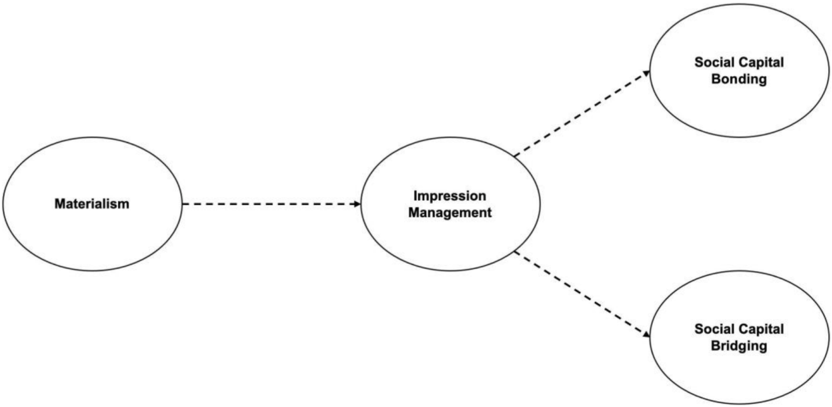
Individuals adjust their behavior on social media to varying extent, and commonly in their idealized way. Most studies have focused on the problems associated with materialism and social media use, yet their potential positive contributions remain less clear. In fact, impression management holds potential for both negative and positive: it has been linked with materialistic attitudes, but also increased amounts of self-reported social capital. This study examines how young people's materialistic values connect with status-seeking impression management on social media, and subsequently to social capital, within the same model. Eight hundred Finnish participants aged 15–19 participated in our structured phone survey. We applied structural equation modeling to examine the connections between materialism, impression management, and online social capital. Our findings show that materialism is positively related to impression management, while impression management is positively associated with online social capital. Additionally, we found positive indirect effects between materialism and both bridging and bonding social capital through impression management. In sum, more materialistic young people who engaged in higher impression management had higher amounts of social capital.
Overview
CoChat Summary
TL;DR
In a survey of 800 Finnish 15–19-year-olds, materialism was positively associated with status-seeking impression management on social media, which in turn was positively associated with online bridging and bonding social capital. The study reports positive indirect effects from materialism to both forms of social capital via impression management.
Key findings
- Materialism was positively related to status-seeking impression management (ß = 0.58, p < .001).
- Impression management was positively related to online social capital: bridging (ß = 0.41, p < .001) and bonding (ß = 0.14, p = .003); bridging and bonding social capital were also positively related (ß = 0.52, p < .001).
- Indirect positive effects were found from materialism to bonding social capital (ß = 0.08, p = .003) and to bridging social capital (ß = 0.24, p < .001), both mediated by impression management.
- Covariates (gender, age, personal financial situation) did not significantly alter the coefficients; in the robust model, indirect effects remained similar (bonding ß = 0.09, p = .003; bridging ß = 0.25, p < .001).
Methods
- Structured telephone survey of 800 Finnish participants aged 15–19, randomly selected from the Finnish Population Register and adjusted to be nationally representative by age, gender, and area of residence; data collected December 2019–January 2020.
- Measures used Likert scales (1–5): materialism via a shortened 6-item Richins scale; online social capital adapted from Williams (2006) and Abbas and Mesch (2018) with bridging and bonding forms; status-seeking impression management via a newly created scale.
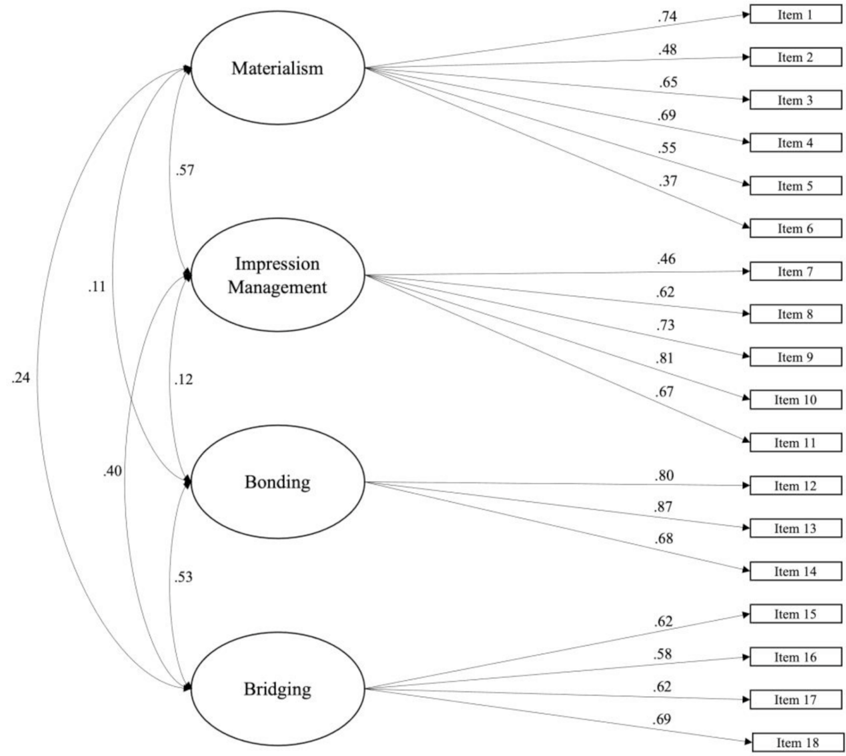
- Analysis used covariance-based structural equation modeling (CB-SEM) with confirmatory factor analysis in Mplus 8.4, WLSMV estimator, standardized coefficients, and covariates; reported SEM fit: RMSEA = 0.050, CFI = 0.955, TLI = 0.946, SRMR = 0.048.
Limitations
- Paper-stated: the model could not explain precise mechanisms because of the absence of valid statistical tests; cross-sectional data prevented evaluating causality; gender differences could not be tested due to lack of metric invariance; the Finnish-only sample limits cultural generalizability.
- Paper-stated: survey responses may be affected by respondents’ feelings and emotions, and value-laden statements about materialism or impression management may have produced socially desirable answers; statistical models are simplified approximations of real-life behavior.
- Evident from text: the study relies on self-reported measures from a single-country, cross-sectional sample, so causal direction and generalization beyond Finnish 15–19-year-olds are constrained, consistent with the paper’s own stated limitations.
Model-written summary. Check it against the paper before relying on it.
Integrity signals
Registry
Cites
Statistics
Figures

Verification
Claims the paper makes
0 Valid · 0 Not valid · 44 Not checked · 34 Own results and interpretations
A result the paper reports from its own data — it cites no other source for it, so there is none to check. The quote shows it is in the paper.
In the paper
“the effect of impression management on bridging was (ß = 0.41, p < .001)”
- Also stated in: § Abstract · plain
“impression management is positively associated with online social capital”
§ The brighter side of materialism: Managing impressions on social media for higher social capital > 7. Results
plainstates an association- Asserted: passes — The authors put it forward as true.
- Checkable: passes — It can be checked against evidence.
- Load-bearing: passes — The paper’s conclusions depend on it.
- Based: passes — The paper gives a reason why it holds.
- Also stated in: § Abstract · plain
A result the paper states — it cites no source for it, so there is none to check. The quote shows it is in the paper.
In the paper
“Interestingly, the increase in social capital happened even if the motives for impression management were unintended.”
§ The brighter side of materialism: Managing impressions on social media for higher social capital > 8.1. Theoretical implications
plainstates a cause- Asserted: passes — The authors put it forward as true.
- Checkable: passes — It can be checked against evidence.
- Load-bearing: passes — The paper’s conclusions depend on it.
- Based: passes — The paper gives a reason why it holds.
A result the paper reports from its own data — it cites no other source for it, so there is none to check. The quote shows it is in the paper.
In the paper
“Our findings add to our presumption that materialistic values can be positively related to higher impression management on social media and thereby result in higher online social capital.”
- Also stated in: § 8. Discussion · plain
“Our results, in turn, present the brighter side of materialism among young people by showing the indirect positive connection between materialism and bonding and bridging social capital via impression management on social media.”
- Also stated in: § 8. Discussion · plain
“since materialistic values were related to higher social capital through status-seeking impression management in this study”
§ The brighter side of materialism: Managing impressions on social media for higher social capital > 8. Discussion
plainstates an association- Asserted: passes — The authors put it forward as true.
- Checkable: passes — It can be checked against evidence.
- Load-bearing: passes — The paper’s conclusions depend on it.
- Based: passes — The paper gives a reason why it holds.
- Also stated in: § 8. Discussion · plain
A result the paper reports from its own data — it cites no other source for it, so there is none to check. The quote shows it is in the paper.
In the paper
“we found a significant and positive connection between bridging and bonding social capital (ß = 0.52, p < .001).”
§ The brighter side of materialism: Managing impressions on social media for higher social capital > 7. Results
plainstates an association- Asserted: passes — The authors put it forward as true.
- Checkable: passes — It can be checked against evidence.
- Load-bearing: unclear — It is unclear whether the paper’s conclusions depend on it.
- Based: passes — The paper gives a reason why it holds.
A result the paper reports from its own data — it cites no other source for it, so there is none to check. The quote shows it is in the paper.
In the paper
“on bonding (ß = 0.14, p = .003)”
§ The brighter side of materialism: Managing impressions on social media for higher social capital > 7. Results
plainstates an association- Asserted: passes — The authors put it forward as true.
- Checkable: passes — It can be checked against evidence.
- Load-bearing: passes — The paper’s conclusions depend on it.
- Based: passes — The paper gives a reason why it holds.
32 more claims
Create a free account to see all 78 claims and to verify the 46 references still open.
- It may state two separate claims as one. 15
- The quote only partly states this claim. 2
- Probably not a substantial claim. 32
Self-check
Percentages, sums and reported differences re-computed from the paper’s own numbers.
Each contradiction between two passages listed here was confirmed by an independent check.
Rated minor: it would not touch a result — a value no result rests on, a p-value that stays on the same side of the significance level, or a conflict that is clerical, resolved elsewhere in the paper, or outside its own findings.
In the paper
§ The brighter side of materialism: Managing impressions on social media for higher social capital > 7. Results
“Also, a test model (SEM) showed good model-fit: (cut-off criteria in parenthesis (Hu & Bentler, 1999;Yu & Muthén, 2002) x 2 = 386, 709, df = 129, p< .001(>0.05),RMSEA = 0.050 (<0.06),CFI = 0.955 (>0.95), TLI = 0.946 (>0.95), SRMR = 0.048 (<0.08), which suggests that the tested model is acceptable.”
§ The brighter side of materialism: Managing impressions on social media for higher social capital > 6.3. Data analysis
“Moreover, we estimated our model fit in comparison to widely accepted cut-off criteria suggested by Hu and Bentler (1999): 0.95 for the TLI and CFI, 0.08 for SRMR, and 0.06 for RMSEA.”
Rated minor: it would not touch a result — a value no result rests on, a p-value that stays on the same side of the significance level, or a conflict that is clerical, resolved elsewhere in the paper, or outside its own findings.
In the paper
§ The brighter side of materialism: Managing impressions on social media for higher social capital > 7. Results
“Our measurement model (Fig. 2) showed a good fit: (accepted cut-off criteria in parenthesis) (Hu & Bentler, 1999;Yu & Muthén, 2002) x 2 = 405,423 df = 127, p < .001(>0.05), RMSEA = 0.052 (<0.06),CFI = 0.951 (>0.95), TLI = 0.941 (>0.95), SRMR = 0.047 (<0.08).”
§ The brighter side of materialism: Managing impressions on social media for higher social capital > 6.3. Data analysis
“Moreover, we estimated our model fit in comparison to widely accepted cut-off criteria suggested by Hu and Bentler (1999): 0.95 for the TLI and CFI, 0.08 for SRMR, and 0.06 for RMSEA.”
Citations
Cites
Hu, L., & Bentler, P. M. (1999) · Structural Equation Modeling A Multidisciplinary Journal · doi:10.1080/10705519909540118 · Cited by 108,788
Model selection and multimodel inference: a practical information-theoretic approach.
Guthery, F. S., Burnham, K. P., & Anderson, D. R. (2003) · The Journal of Wildlife Management · doi:10.2307/3802723 · Cited by 41,495
Social Capital in the Creation of Human Capital
Coleman, J. S. (1988) · American Journal of Sociology · doi:10.1086/228943 · Cited by 26,975
Putnam, R. (2000) · doi:10.1145/358916.361990 · Cited by 17,114
Ellison, N. B., Steinfield, C., & Lampe, C. (2007) · Journal of Computer-Mediated Communication · doi:10.1111/j.1083-6101.2007.00367.x · Cited by 9,939
Schermelleh-Engel, K., Moosbrugger, H., & Müller, H. (2003) · Department of Psychology - University of Koblenz-Landau · doi:10.23668/psycharchives.12784 · Cited by 8,975
(2011) · Cited by 5,290
Bowling Alone: The Collapse and Revival of American Community
Keddy, J. (2001) · Spiritus: A Journal of Christian Spirituality · doi:10.1353/scs.2001.0014 · Cited by 3,764
A Consumer Values Orientation for Materialism and Its Measurement: Scale Development and Validation
Richins, M. L., & Dawson, S. (1992) · Journal of Consumer Research · doi:10.1086/209304 · Cited by 3,372
Impression management: A literature review and two-component model.
Leary, M. R., & Kowalski, R. M. (1990) · Psychological Bulletin · doi:10.1037/0033-2909.107.1.34 · Cited by 3,334
Human Nature and the Social Order
GINSBERG, M. (1941) · Nature · doi:10.1038/148351a0 · Cited by 3,149
The social context of well–being
Helliwell, J. F., & Putnam, R. D. (2004) · Philosophical Transactions of the Royal Society of London. Series B: Biological Sciences · doi:10.1098/rstb.2004.1522 · Cited by 2,354
A dark side of the American dream: Correlates of financial success as a central life aspiration
Kasser, T., & Ryan, R. M. (1993) · Journal of Personality and Social Psychology · doi:10.1037/0022-3514.65.2.410 · Cited by 2,298
Gardner, M., & Steinberg, L. (2005) · Developmental Psychology · doi:10.1037/0012-1649.41.4.625 · Cited by 2,218
A structural equation test of the value-attitude-behavior hierarchy.
Homer, P. M., & Kahle, L. R. (1988) · Journal of Personality and Social Psychology · doi:10.1037/0022-3514.54.4.638 · Cited by 1,883
Managing impressions online: Self-presentation processes in the online dating environment
Ellison, N., Heino, R., & Gibbs, J. (2006) · Journal of Computer-Mediated Communication · doi:10.1111/j.1083-6101.2006.00020.x · Cited by 1,616
The Material Values Scale: Measurement Properties and Development of a Short Form
Richins, M. L. (2004) · Journal of Consumer Research · doi:10.1086/383436 · Cited by 1,424
Angeles, L. (2002) · Cited by 1,420
On and Off the 'Net: Scales for Social Capital in an Online Era
Williams, D. (2006) · Journal of Computer-Mediated Communication · doi:10.1111/j.1083-6101.2006.00029.x · Cited by 1,341
A self-presentational view of social phenomena.
Baumeister, R. F. (1982) · Psychological Bulletin · doi:10.1037/0033-2909.91.1.3 · Cited by 1,191
The relationship between materialism and personal well-being: A meta-analysis
Dittmar, H., Bond, R., Hurst, M., & Kasser, T. (2014) · Journal of Personality and Social Psychology · doi:10.1037/a0037409 · Cited by 890
Krämer (2008) · doi:10.1027/1864-1105.20.3.106 · Cited by 883
Global self-esteem across the life span.
Robins, R. W., Trzesniewski, K. H., Tracy, J. L., Gosling, S. D., & Potter, J. (2002) · Psychology and Aging · doi:10.1037/0882-7974.17.3.423 · Cited by 836
Self-monitoring: Appraisal and reappraisal.
Gangestad, S. W., & Snyder, M. (2000) · Psychological Bulletin · doi:10.1037//0033-2909.126.4.530 · Cited by 787
Villalonga-Olives, E., & Kawachi, I. (2017) · Social Science & Medicine · doi:10.1016/j.socscimed.2017.10.020 · Cited by 542
Bolino, M. C., & Turnley, W. H. (1999) · Organizational Research Methods · doi:10.1177/109442819922005 · Cited by 534
Turnley, W. H., & Bolino, M. C. (2001) · Journal of Applied Psychology · doi:10.1037//0021-9010.86.2.351 · Cited by 448
Hurst, M., Dittmar, H., Bond, R., & Kasser, T. (2013) · Journal of Environmental Psychology · doi:10.1016/j.jenvp.2013.09.003 · Cited by 416
Robustness checks and robustness tests in applied economics
Lu, X., & White, H. (2014) · Journal of Econometrics · doi:10.1016/j.jeconom.2013.08.016 · Cited by 412
The Role of Status Seeking in Online Communities: Giving the Gift of Experience
Lampel, J., & Bhalla, A. (2007) · Journal of Computer-Mediated Communication · doi:10.1111/j.1083-6101.2007.00332.x · Cited by 408
The Presentation of Self in Virtual Life: Characteristics of Personal Home Pages
Papacharissi, Z. (2002) · Journalism & Mass Communication Quarterly · doi:10.1177/107769900207900307 · Cited by 350
Social Capital and Information Technology
(2004) · The MIT Press eBooks · doi:10.7551/mitpress/6289.001.0001 · Cited by 346
Examining the New Influencers: A Self-Presentation Study of A-List Blogs
Trammell, K. D., & Keshelashvili, A. (2005) · Journalism & Mass Communication Quarterly · doi:10.1177/107769900508200413 · Cited by 335
Looks and Lies: The Role of Physical Attractiveness in Online Dating Self-Presentation and Deception
Toma, C. L., & Hancock, J. T. (2010) · Communication Research · doi:10.1177/0093650209356437 · Cited by 331
Profile as promise: A framework for conceptualizing veracity in online dating self-presentations
Ellison, N. B., Hancock, J. T., & Toma, C. L. (2012) · New Media & Society · doi:10.1177/1461444811410395 · Cited by 326
Gender and Impression Management: Playing the Promotion Game
Singh, V., Kumra, S., & Vinnicombe, S. (2002) · Journal of Business Ethics · doi:10.1023/a:1014782118902 · Cited by 308
Twenge, J. M., & Kasser, T. (2013) · Personality and Social Psychology Bulletin · doi:10.1177/0146167213484586 · Cited by 273
Holland, J., Reynolds, T., & Weller, S. (2007) · Journal of Youth Studies · doi:10.1080/13676260600881474 · Cited by 244
The effects of impression management on the performance appraisal process
Wayne, S. J., & Kacmar, K. M. (1991) · Organizational Behavior and Human Decision Processes · doi:10.1016/0749-5978(91)90006-f · Cited by 229
What are you doing on Tinder? Impression management on a matchmaking mobile app
Ward, J. (2017) · Information, Communication & Society · doi:10.1080/1369118x.2016.1252412 · Cited by 221
Development of a self-presentation tactics scale
Lee, S.-J., Quigley, B. M., Nesler, M. S., Corbett, A. B., & Tedeschi, J. T. (1999) · Personality and Individual Differences · doi:10.1016/s0191-8869(98)00178-0 · Cited by 215
McPherson, K. E., Kerr, S., McGee, E., Morgan, A., Cheater, F. M., McLean, J., & Egan, J. (2014) · BMC Psychology · doi:10.1186/2050-7283-2-7 · Cited by 214
A meta-analysis of social networking online and social capital
Liu, D., Ainsworth, S. E., & Baumeister, R. F. (2016) · Review of General Psychology · doi:10.1037/gpr0000091 · Cited by 205
Can you tell who I am? Neuroticism, extraversion, and online self-presentation among young adults
Michikyan, M., Subrahmanyam, K., & Dennis, J. (2014) · Computers in Human Behavior · doi:10.1016/j.chb.2014.01.010 · Cited by 193
Materialism, Status Consumption, and Consumer Independence
Goldsmith, R. E., & Clark, R. A. (2012) · The Journal of Social Psychology · doi:10.1080/00224545.2011.555434 · Cited by 188
Marengo, D., Montag, C., Sindermann, C., Elhai, J. D., & Settanni, M. (2021) · Telematics and Informatics · doi:10.1016/j.tele.2020.101523 · Cited by 174
Self-uncertainty, social identity prominence and group identification
Grant, F., & Hogg, M. A. (2011) · Journal of Experimental Social Psychology · doi:10.1016/j.jesp.2011.11.006 · Cited by 168
Poverty and Materialism: A Look at Impoverished versus Affluent Children
Chaplin, L. N., Hill, R. P., & John, D. R. (2014) · Journal of Public Policy & Marketing · doi:10.1509/jppm.13.050 · Cited by 165
Oksanen, T., Kouvonen, A., Vahtera, J., Virtanen, M., & Kivimäki, M. (2010) · Journal of Epidemiology and Community Health · doi:10.1136/jech.2008.086074 · Cited by 164
Forming digital self and parasocial relationships on YouTube
Chen, C.-P. (2016) · Journal of Consumer Culture · doi:10.1177/1469540514521081 · Cited by 160
Kamal, S., Chu, S.-C., & Pedram, M. (2013) · Journal of Interactive Advertising · doi:10.1080/15252019.2013.768052 · Cited by 158
The etiology of the frugal consumer
Goldsmith, R. E., Flynn, L. R., & Clark, R. A. (2014) · Journal of Retailing and Consumer Services · doi:10.1016/j.jretconser.2013.11.005 · Cited by 154
Hart, W., Adams, J., Burton, K. A., & Tortoriello, G. K. (2017) · Personality and Individual Differences · doi:10.1016/j.paid.2016.06.062 · Cited by 143
Owens, T. J. (2006) · Springer eBooks · doi:10.1007/0-387-36921-x_9 · Cited by 126
Materialism and Affect: The Role of Self-Presentational Concerns
Christopher, A. N., & Schlenker, B. R. (2004) · Journal of Social and Clinical Psychology · doi:10.1521/jscp.23.2.260.31022 · Cited by 118
Heaney, J.-G., Goldsmith, R. E., & Jusoh, W. J. W. (2005) · Journal of International Consumer Marketing · doi:10.1300/j046v17n04_05 · Cited by 116
Are value–behavior relations stronger than previously thought? It depends on value importance
Lee, J. A., Bardi, A., Gerrans, P., Sneddon, J., van Herk, H., Evers, U., & Schwartz, S. H. (2021) · European Journal of Personality · doi:10.1177/08902070211002965 · Cited by 115
Materialism across the life span: An age-period-cohort analysis.
Jaspers, E. D. T., & Pieters, R. G. M. (2016) · Journal of Personality and Social Psychology · doi:10.1037/pspp0000092 · Cited by 115
Influence of materialism, gender and nationality on consumer brand perceptions
Kamineni, R. (2005) · Journal of Targeting Measurement and Analysis for Marketing · doi:10.1057/palgrave.jt.5740167 · Cited by 99
Metzler, A., & Scheithauer, H. (2017) · Frontiers in Psychology · doi:10.3389/fpsyg.2017.01981 · Cited by 75
Bae, S. (2018) · Children and Youth Services Review · doi:10.1016/j.childyouth.2018.11.032 · Cited by 75
Deceptive Impression Management: Does Deception Pay in Established Workplace Relationships?
Carlson, J. R., Carlson, D. S., & Ferguson, M. J. (2010) · Journal of Business Ethics · doi:10.1007/s10551-010-0693-9 · Cited by 71
Abbas, R., & Mesch, G. (2018) · Information, Communication & Society · doi:10.1080/1369118x.2016.1261168 · Cited by 68
Thoumrungroje, A. (2018) · Journal of International Consumer Marketing · doi:10.1080/08961530.2018.1462130 · Cited by 67
Interpersonal influence and adolescent materialism and compulsive buying
Roberts, J. A., Manolis, C., & (Jeff) Tanner, J. F. (2008) · Social Influence · doi:10.1080/15534510802185687 · Cited by 67
Social Capital and Information Technology: Current Debates and Research
Huysman, M., & Wulf, V. (2004) · The MIT Press eBooks · doi:10.7551/mitpress/6289.003.0002 · Cited by 61
Traits, Predictors, and Consequences of Facebook Self-Presentation
Sun, T., & Wu, G. (2012) · Social Science Computer Review · doi:10.1177/0894439311425978 · Cited by 58
Xie, J., Huang, Q., Wang, H., & Shen, M. (2019) · Personality and Individual Differences · doi:10.1016/j.paid.2019.06.025 · Cited by 49
Gioaba, I., & Krings, F. (2017) · Frontiers in Psychology · doi:10.3389/fpsyg.2017.00770 · Cited by 49
Blomqvist, K., & Cook, K. S. (2018) · The Routledge Companion to Trust · doi:10.4324/9781315745572-4 · Cited by 44
Holmberg, C., Berg, C., Hillman, T., Lissner, L., & Chaplin, J. E. (2018) · Digital Health · doi:10.1177/2055207618807603 · Cited by 43
Han, S., Kim, H., Lee, E.-S., & Lee, H. (2012) · Journal of Happiness Studies · doi:10.1007/s10902-012-9375-x · Cited by 43
A Model of Competitive Impression Management: Edison versus Westinghouse in the War of the Currents
Cole, B. M., & Chandler, D. (2019) · Administrative Science Quarterly · doi:10.1177/0001839218821439 · Cited by 41
Impression Management, Psychology of
Leary, M. R. (2001) · Elsevier eBooks · doi:10.1016/b0-08-043076-7/01727-7 · Cited by 36
Social media and social capital: Introduction to the special issue
Utz, S., & Muscanell, N. (2015) · Societies · doi:10.3390/soc5020420 · Cited by 35
Materialism, affective states, and life satisfaction: case of Croatia
Lipovčan, L. K., Prizmić‐Larsen, Z., & Brkljačić, T. (2015) · SpringerPlus · doi:10.1186/s40064-015-1494-5 · Cited by 34
Self-presentation Tactics in Social Media
Huang, H. (2014) · Advances in Social Science, Education and Humanities Research/Advances in social science, education and humanities research · doi:10.2991/icss-14.2014.76 · Cited by 32
Chatterjee, A., & Hunt, J. M. (1996) · Psychological Reports · doi:10.2466/pr0.1996.79.2.523 · Cited by 23
Materialism and self-presentational styles
Christopher, A. N., Morgan, R. D., Marek, P., Keller, M., & Drummond, K. (2005) · Personality and Individual Differences · doi:10.1016/j.paid.2004.03.015 · Cited by 22
Wang, L., Gu, D., Jiang, J., & Sun, Y. (2019) · Frontiers in Psychology · doi:10.3389/fpsyg.2019.00790 · Cited by 17
Modeling the hidden mediating relationships between SNS privacy and SNS impression construction
Gadgil, G., Prybutok, G. T., Peak, D. A., & Prybutok, V. R. (2021) · Computers in Human Behavior · doi:10.1016/j.chb.2021.106941 · Cited by 17
Impression Management and Self-Presentation Online
Fullwood, C. (2018) · doi:10.1093/oxfordhb/9780198812746.013.5 · Cited by 17
Explaining the link between materialism and life satisfaction: A life course study in Turkey
Balıkçıoğlu, B., & Arslan, Z. (2020) · Journal of Global Scholars of Marketing Science · doi:10.1080/21639159.2019.1613911 · Cited by 10
Are Value-Behavior Relations Stronger than Previously Thought? It depends on value importancePreprint
Lee, J. A., Bardi, A., Gerrans, P., Sneddon, J., van Herk, H., Evers, U., & Schwartz, S. H. (2021) · PsyArXiv (OSF Preprints) · doi:10.31234/osf.io/hyn2e · Cited by 8
(1959)
(1991)
(2002) · Thammasat University Digital Collections
(2013) · Research on humanities and social sciences
(2000) · Works - Scholarship, Research, & Creative Expression (Swarthmore College)
Research works printed but not linked: 3
- Baumeister, R. F., & Bushman, B. J. (2015). Social psychology and human nature (Brief version) (4th ed.). Boston: Cengage Learning.
- Jones, E.E., .& Pittman, S.T. (.1982). Toward a general theory of strategic self-presentation. In J. Suls (Ed.), Psychology perspectives on the self (Vol. 1, pp. 231-262).
- Luoma-aho, V. (2016). Social capital theory. In C. Carrol (Ed.), The Sage Encyclopedia of Corporate Reputation (pp. 759-762). Sage Publications, Thousand Oaks.
Cited by
Personal values and travel social media use among Generation Z
Chang, T., Kong, W. H., & Bahl, A. (2023) · Consumer Behavior in Tourism and Hospitality · doi:10.1108/cbth-11-2021-0263 · Cited by 32
Sukmayadi, V., Darmawangsa, D., Ayub, S. H., & Fadhila, S. A. (2024) · The Qualitative Report · doi:10.46743/2160-3715/2024.5992 · Cited by 24
Social Capital's Impact on Indonesia's Urban and Rural Areas
Prastyo, R. E., Wisadirana, D., Rozuli, A. I., & Hakim, M. L. (2024) · Journal of Law and Sustainable Development · doi:10.55908/sdgs.v12i1.2714 · Cited by 17
PENGELOLAAN KESAN DARING DALAM MERAUP “CUAN”: STUDI FENOMENOLOGI PADA INFLUENCER TIKTOK DI INDONESIA
Fadhila, S. A., Sukmayadi, V., & Affandi, A. F. M. (2023) · Ekspresi dan Persepsi Jurnal Ilmu Komunikasi · doi:10.33822/jep.v6i3.5889 · Cited by 15
Effects of Materialist Values and Work Centrality on Organizational Citizenship Behaviors
Tan, B. U. (2023) · SAGE Open · doi:10.1177/21582440231214466 · Cited by 13
Metadata
- Authors
- Tuominen, J., Rantala, E., Reinikainen, H., Luoma-aho, V., & Wilska, T.-A.
- Affiliations
- University of Jyväskylä (FI)
- Corresponding author
- Tuominen, Jesse
- Venue
- Poetics
- Publisher
- Elsevier BV
- Published
- 2022-06
- Volume
- 92
- Pages
- 101651
- ISSN
- 0304-422X (ISSN-L)
- OpenAlex
- W4210821182
- Cited by
- 42
- References
- 89
- Citations by year
- 2026: 6 · 2025: 6 · 2024: 14 · 2023: 14 · 2022: 2
- FWCI
- 7.42
- Type
- journal article
- Language
- en
- Open access
- hybrid
- doi.org
- Licence
- cc-by
- www.elsevier.com/tdm/userlicense/1.0/ (tdm)
- www.elsevier.com/legal/tdmrep-license (tdm)
- creativecommons.org/licenses/by/4.0/ (vor)
- Locations
- Poetics (publishedVersion, cc-by)
- Jyväskylä University Digital Archive (University of Jyväskylä) (publishedVersion, cc-by)
- Funders
- Academy of Finland (320370)
- Strategic Research Council (327237)
- Topics
- Social Sciences › Sociology and Political Science › Impact of Technology on Adolescents
- Social Sciences › Business, Management and Accounting › Marketing › Consumer Behavior in Brand Consumption and Identification
- Social Sciences › Sociology and Political Science › Social Power and Status Dynamics
- Keywords
- materialism, impression management, social media, social capital, status seeking, youth, bridging social capital, bonding social capital, self-presentation
About these checks
Registry, retraction, Cites and statistics results are computed, not judged, with one exception: a printed reference that no index lists is read once by a model before it counts as a citation error. Claims are extracted by a model and kept only when their quote appears verbatim in the text; each cited source is then checked, with a model’s help, for whether it says what the claim relies on. Those verdicts can be wrong — read the claim’s quote and the cited source before relying on one.
A language model drew the claims from the paper on 2026-11-23, under version 3 of the claim definition (model deepseek-v4.1-flash, prompt extract-v3).
A second model labelled each claim on 2026-11-23 (model jev-1.13-20260917, definition revision gold-guideline-v0.2).
Statistics and arithmetic are recomputed, not judged.
Confidence bands are shown only for fields calibrated on our annotated test set. None is calibrated yet, so no band is shown.
What counts as a claim ›How we measure confidence ›How we check this ›
Are you an author, or do you see a problem with this page? Request a review
Data sources
Bibliographic data: Semantic Scholar, OpenAlex, Crossref.
Contains information from the Semantic Scholar Academic Graph Datasets, made available under the ODC Attribution License (ODC-BY 1.0).
Semantic Scholar’s data is described in: Kinney, R., et al. (2023). The Semantic Scholar Open Data Platform. arXiv:2301.10140.
