

Inducing narrative tension in the viewer through suspense, surprise, and curiosity
Open accessThe DOI matches its Crossref record; 67 of the 69 references it cites were found in a registry or an index; 1 of the 40 sources its claims cite were checked for support.
Abstract
Research into narrative tension is of interest in terms of the progress of knowledge of the processes and mechanisms by which stories are received and enjoyed. We have created four versions of an audiovisual story with three different structures of fiction (suspense, surprise, curiosity) and one of non-fiction. We have investigated the effects of the narrative tension of these stories with four groups of subjects (N=94). The results show that the organization of the stories, depending on their structures of suspense, surprise, or curiosity, induces narrative tension, while the non-fictional story, induces cognitive and affective effects of another kind. Narrative tension appears during narrative progression. It is manifested by cognitive-affective responses that include anticipations, diagnoses, retrospections, and emotions. In narrative tension, curiosity plays a triggering and organizing role in suspense and surprise. The emotions and cognitions that result from narrative tension during plot construction underpin the experience of enjoyment. The Multidimensional Narrative Tension Theory of Enjoyment that emerges from this research allows establishing connections between narrative theory concerned with narrative progression and plot, the psychology of interest, and the psychology of media enjoyment.
Overview
CoChat Summary
TL;DR
The study created four audiovisual versions of one story—suspense, surprise, curiosity, and non-fiction—and tested them with 94 university students. It finds that suspense, surprise, and curiosity structures induce distinct cognitive-affective narrative tension, while non-fiction does not; curiosity organizes suspense/surprise and local tension relates to enjoyment.
Key findings
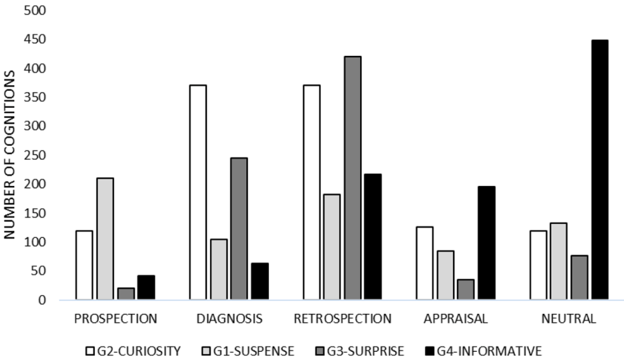
- H1 was confirmed: each fictional discourse structure induced specific cognitive tension—anticipations/uncertainty predominated in Suspense, uncertainty/questioning/incomprehension in Curiosity, and schema reworkings/verbal surprise in Surprise. Non-fiction, without withheld information, produced mainly emotional appraisals and neutral cognitions.
- Across 3,693 thoughts, the distribution was prospection 11%, local appraisal 12%, neutral 22%, diagnosis 22%, and retrospection 33%; the diagnostic function (characteristic of curiosity) was reported as the most abundant at 52% of total cognitions. Fictional groups averaged 227.2 prospective/diagnostic/retrospective cognitions per group versus 107.4 in non-fiction; appraisal/neutral cognitions averaged 127.5 versus 429.3. 89.6% of fictional-group cognitions referred to the character and action, versus 27.8% in non-fiction.
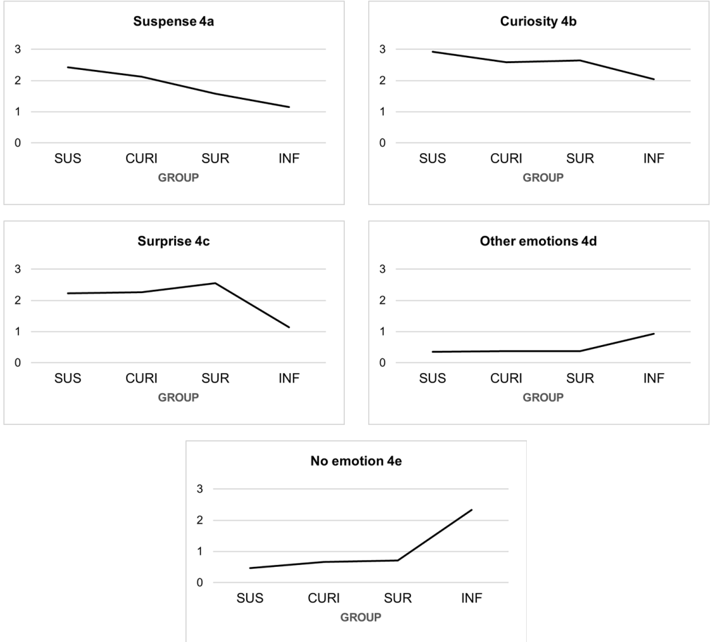
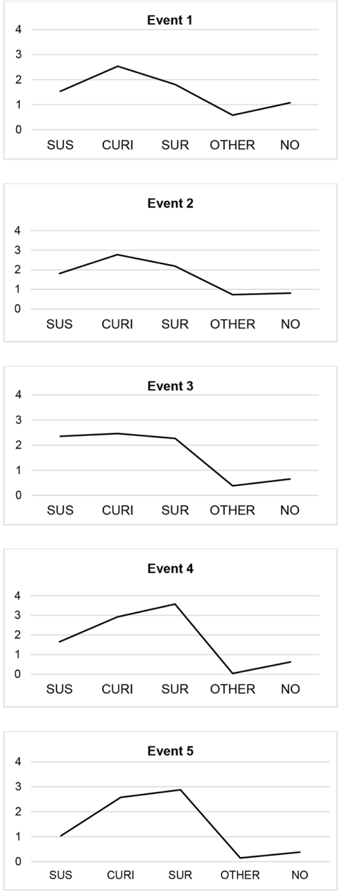
- Emotions: five categories appeared; suspense, surprise, and curiosity were highest in their respective groups. ANOVA was significant for suspense F(3,90)=6.492, p=.001; surprise F(3,90)=9.090, p=.000; and non-emotion F(3,90)=12.276, p=.000. Post-hoc INF vs SUS/CURI/SUR mean differences were 9.29/8.33/8.10, all p=.000. Surprise peaked at events 4 and 5.
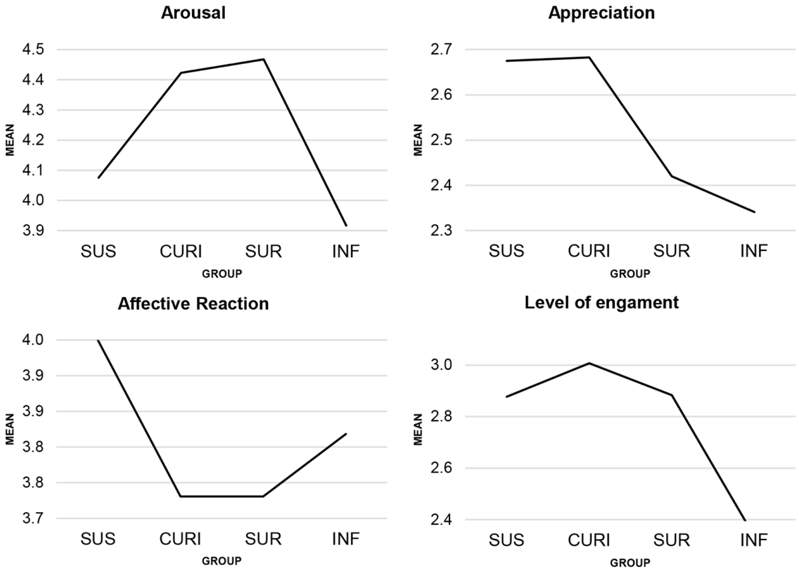
- Global enjoyment: Engagement differed significantly F(3,90)=10.125, p=.000 (INF vs SUS −.54, p=.003; INF vs CURI −.67, p=.000; INF vs SUR −.55, p=.001); Arousal, Appreciation, and Affective Reaction did not differ significantly. Regression showed Suspense and Surprise local emotions related to Arousal; Suspense, Curiosity, and Surprise to Appreciation; and Suspense and Surprise to Engagement, as the paper states.
Methods
- Four versions of the audiovisual story *El Avecinero* were created: suspense, curiosity, surprise, and non-fiction. Ninety-four university communication students (age M=21.38, SD=4.15) were assigned to four independent groups: SUS, CURI, SUR, INF.
- After viewing, participants rated overall Arousal (AROU) and Affective Response (AFRE); local cognitions and emotions were measured at five plot points using thought-listing (COGP) and emotion intensity ratings from 1 to 5 (EMOP); then Appreciation (APR) and Engagement (ENG) were measured. Three independent judges coded thoughts, with Fleiss kappa k=.784 and k=.825; data were processed in SPSS-25 using ANOVA, Scheffe post-hoc tests, and regression.
Limitations
- The paper states no limitations.
- Evident from the text: the sample is 94 university communication students, which limits generalizability.
- Evident from the text: findings rest on four versions of a single short film, *El Avecinero*, so results are stimulus-specific.
Model-written summary. Check it against the paper before relying on it.
Integrity signals
Registry
Cites
Statistics
Figures


Verification
Claims the paper makes
1 Valid · 2 Not valid · 24 Not checked · 100 Own results and interpretations
The cited sources support only part of this claim — read each source’s verdict below.
In the paper
“The results of different research showed that suspense can be evoked even when readers know how the story will end (Gerrig, 1989;Hoeken & vanVilet, Hoeken & vanVliet, 2000;Lehne & Koelsch, 2015;Delatorre et al., 2018).”
§ Inducing narrative tension in the viewer through suspense, surprise, and curiosity > Knowledge and emotion in narrative tension
What the sources say
- Not checked yetcites Gerrig, 1989 matched to “Suspense in the Absence of Uncertainty” (1989) source
Checked before — its earlier verdict is held back until a new check runs.
- Not matchedcites Hoeken & vanVliet, 2000
An author–year citation the paper’s reference list doesn’t settle. We don’t search these by name.
- Partly supportedcites Lehne & Koelsch, 2015 matched to “Toward a general psychological model of tension and suspense” (2015) sourceExperimental — accuracy not yet measured
In 'The Paradox of Suspense' our copy does carry the idea the claim attributes: 'the narrative plots of novels or movies can be experienced as suspenseful even in the absence of uncertainty after several readings or viewings,' alongside genre-based outcome prediction. But it is explicitly credited to others ('at least according to some authors (see Gerrig, 1989; Carroll, 1996b)') and framed as a debated position, not as this paper's empirical result — the citing sentence's 'the results of different research showed' therefore overstates it, since the paper is a domain-independent theoretical review with no experiment (Abstract; Future Directions: the role of uncertainty 'remains to be resolved by investigating how tension experiences change over repeated exposures'). The authors also qualify the point in the opposite direction: 'we think that in most cases the reduction of uncertainty, ceteris paribus, leads to a considerable decrease of tension or suspense' (The Paradox of Suspense), offering only partial rescues such as temporal uncertainty and felt vs. perceived suspense. (LLM, conf=0.80)
plainstates a cause- Asserted: passes — The authors put it forward as true.
- Checkable: passes — It can be checked against evidence.
- Load-bearing: passes — The paper’s conclusions depend on it.
- Based: passes — The paper gives a reason why it holds.
- Not checked yet
A result the paper reports from its own data — it cites no other source for it, so there is none to check. The quote shows it is in the paper.
In the paper
“The results show that the organization of the stories, depending on their structures of suspense, surprise, or curiosity, induces narrative tension”
§ Inducing narrative tension in the viewer through suspense, surprise, and curiosity > Abstract
plainstates a causen = 94- Asserted: passes — The authors put it forward as true.
- Checkable: passes — It can be checked against evidence.
- Load-bearing: passes — The paper’s conclusions depend on it.
- Based: passes — The paper gives a reason why it holds.
A result the paper reports from its own data — it cites no other source for it, so there is none to check. The quote shows it is in the paper.
In the paper
“while the nonfictional story, induces cognitive and affective effects of another kind”
§ Inducing narrative tension in the viewer through suspense, surprise, and curiosity > Abstract
plainstates a causen = 94- Asserted: passes — The authors put it forward as true.
- Checkable: passes — It can be checked against evidence.
- Load-bearing: passes — The paper’s conclusions depend on it.
- Based: passes — The paper gives a reason why it holds.
A result the paper states — it cites no source for it, so there is none to check. The quote shows it is in the paper.
In the paper
“Narrative tension appears during narrative progression.”
§ Inducing narrative tension in the viewer through suspense, surprise, and curiosity > Abstract
hedgedstates an associationn = 94- Asserted: passes — The authors put it forward as true.
- Checkable: passes — It can be checked against evidence.
- Load-bearing: passes — The paper’s conclusions depend on it.
- Based: passes — The paper gives a reason why it holds.
A result the paper states — it cites no source for it, so there is none to check. The quote shows it is in the paper.
In the paper
“In the analysis of the cognitive responses to the five points of narrative progression new types of cognitions appear.”
§ Inducing narrative tension in the viewer through suspense, surprise, and curiosity > Narrative Tension
plain- Asserted: passes — The authors put it forward as true.
- Checkable: passes — It can be checked against evidence.
- Load-bearing: passes — The paper’s conclusions depend on it.
- Based: passes — The paper gives a reason why it holds.
- Rests on 2 assumptions not shown here.
27 more claims
Create a free account to see all 127 claims and to verify the 23 references still open.
- Probably not a substantial claim. 48
- It may state two separate claims as one. 65
- The quote only partly states this claim. 3
Self-check
Percentages, sums and reported differences re-computed from the paper’s own numbers.
Each contradiction between two passages listed here was confirmed by an independent check.
Rated major: it would touch a result — a value a result rests on, reported and recomputed p-values on opposite sides of the significance level, two passages that conflict with no sign which is right, or a cited work retracted before this paper was published.
In the paper
§ Inducing narrative tension in the viewer through suspense, surprise, and curiosity > Relation between local emotions and global enjoyment
“However, there is no relationship of this kind for the tension categories of Curiosity, Other Emotions and No Emotion.”
§ Inducing narrative tension in the viewer through suspense, surprise, and curiosity > Theory of the multidimensional narrative tension of enjoyment
“| Other emotions | | | -0,067 | 0,027 | -0,255 | -2,526 | 0,013 |”
Rated major: it would touch a result — a value a result rests on, reported and recomputed p-values on opposite sides of the significance level, two passages that conflict with no sign which is right, or a cited work retracted before this paper was published.
In the paper
§ Inducing narrative tension in the viewer through suspense, surprise, and curiosity > Relation between local emotions and global enjoyment
“Third, there is a relation between the tension categories of Suspense and Surprise and the Engagement variable, but not for the other three categories.”
§ Inducing narrative tension in the viewer through suspense, surprise, and curiosity > Theory of the multidimensional narrative tension of enjoyment
“| Curiosity | | | 0,023 | 0,010 | 0,226 | 2,211 | 0,030 |”
Rated major: it would touch a result — a value a result rests on, reported and recomputed p-values on opposite sides of the significance level, two passages that conflict with no sign which is right, or a cited work retracted before this paper was published.
In the paper
§ Inducing narrative tension in the viewer through suspense, surprise, and curiosity > The relationship between narrative tension and enjoyment
“In contrast, curiosity, which has a strong presence in tension relations, paradoxically does not present this relationship.”
§ Inducing narrative tension in the viewer through suspense, surprise, and curiosity > Relation between local emotions and global enjoyment
“Second, there is a relationship between the affective narrative tension of Suspense, Curiosity and Surprise with the level of global Appreciation.”
Rated major: it would touch a result — a value a result rests on, reported and recomputed p-values on opposite sides of the significance level, two passages that conflict with no sign which is right, or a cited work retracted before this paper was published.
In the paper
§ Inducing narrative tension in the viewer through suspense, surprise, and curiosity > Relation between local emotions and global enjoyment
“However, there is no relationship of this kind for the tension categories of Curiosity, Other Emotions and No Emotion.”
§ Inducing narrative tension in the viewer through suspense, surprise, and curiosity > Theory of the multidimensional narrative tension of enjoyment
“| Curiosity | | | -0,051 | 0,023 | -0,225 | -2,220 | 0,029 |”
Rated minor: it would not touch a result — a value no result rests on, a p-value that stays on the same side of the significance level, or a conflict that is clerical, resolved elsewhere in the paper, or outside its own findings.
In the paper
“| constant | .255 | 6,379 (1, 92) | 4,391 | 0,134 | | 32,816 | 0,000 | | Other emotions | | | -0,067 | 0,027 | -0,255 | -2,526 | 0,013 |”
§ Inducing narrative tension in the viewer through suspense, surprise, and curiosity > Theory of the multidimensional narrative tension of enjoyment
Reported 0.255 · recomputed 0.065025
5 more findings
Create a free account to see every finding of this check.
Citations
Cites
Cognitive, social, and physiological determinants of emotional state.
Schachter, S., & Singer, J. (1962) · Psychological Review · doi:10.1037/h0046234 · Cited by 6,223
Conflict, arousal, and curiosity.
Berlyne, D. E. (1960) · McGraw-Hill Book Company · doi:10.1037/11164-000 · Cited by 5,995
The psychology of curiosity: A review and reinterpretation.
Loewenstein, G. (1994) · Psychological Bulletin · doi:10.1037/0033-2909.116.1.75 · Cited by 2,738
Reading for the plot : design and intention in narrative
Brooks, P. (1984) · Cited by 2,550
Bergum, B. O., Long, J., & Baddeley, A. (1982) · The American Journal of Psychology · doi:10.2307/1422199 · Cited by 2,226
Narratology: introduction to the theory of narrative
(1998) · Choice Reviews Online · doi:10.5860/choice.35-6054 · Cited by 2,181
Advertising Value and Advertising on the Web
Ducoffe, R. H. (1996) · Journal of Advertising Research · doi:10.1080/00218499.1996.12466626 · Cited by 1,896
Essays on the Verbal and Visual Arts
Robins, R. H., & Helm, J. (1968) · Man · doi:10.2307/2798565 · Cited by 1,657
Measuring Narrative Engagement
Busselle, R., & Bilandzic, H. (2009) · Media Psychology · doi:10.1080/15213260903287259 · Cited by 1,088
Keen, S. (2007) · Oxford University Press eBooks · doi:10.1093/acprof:oso/9780195175769.001.0001 · Cited by 1,085
Research works printed but not linked: 6
- Cacioppo, J. X, & Petty, R. E. (1981). Social psychological procedures for cognitive response assessment: The thought-listing technique. In X. V. Merluzzi, C. R. Glass, & M. Genest (Eds.), Cognitive assessment (pp. 309-342). Guilford Press.
- Fill, A. (2003). Linguistic Devices for the creation of suspense. In B. Kettemann (Ed.), Expanding circles, transcending disciplines, and multimodal texts (pp. 263-276).
- Herman, D. (Ed.). (2003). Narrative Theory and the Cognitive Sciences. Center for the Study of Language and Information.
- Ionescu, A. (2019). Postclassical Narratology: Twenty Years Later. A Journal of Literary Studies and Linguistics, 11, 5-34. https://www.researchgate.net/publication/ 338357670_Postclassical_Narratology_Twenty_Years_Later.
- In P. A. O'Keefe, & J. M. Harackievicz (Eds.), The science of Interest. Springer. https://doi.org/10.1007/978-3-319-55509-6. · DOI · Paper page
- Tomashevsky, B. (1965). Thematics. In L. T. Lemon, & M. J. Reis (Eds.), Russian Formalist Criticism (pp. 61-98). University of Nebraska Press (Original work published 1925).
Cited by
A quantitative study of non-linearity in storytelling
Piper, A., & Toubia, O. (2023) · Poetics · doi:10.1016/j.poetic.2023.101793 · Cited by 27
Long-term, multi-event surprise correlates with enhanced autobiographical memory
Antony, J. W., Dam, J. V., Massey, J., Barnett, A. J., & Bennion, K. A. (2023) · Nature Human Behaviour · doi:10.1038/s41562-023-01631-8 · Cited by 16
Martins, S., & Vairinhos, M. (2023) · Virtual Worlds · doi:10.3390/virtualworlds2040018 · Cited by 13
Pan, Y., Lai, I. K. W., & Wong, J. W. C. (2025) · Asia Pacific Journal of Tourism Research · doi:10.1080/10941665.2025.2457508 · Cited by 12
Charting the rise of imaginary worlds in history
Dubourg, E., Safa, R., Thouzeau, V., & Baumard, N. (2025) · Humanities and Social Sciences Communications · doi:10.1057/s41599-025-04877-x · Cited by 11
A Theoretical Framework for Evaluating Narrative Surprise in Large Language Models
Bissell, A., Paulin, E., & Piper, A. (2025) · Workshop on Narrative Understanding (WNU) · doi:10.18653/v1/2025.wnu-1.7 · Cited by 8
Kept in the Loop: Narrative Play and Epistemic Emotions
Willemsen, S. (2025) · Poetics Today · doi:10.1215/03335372-11557561 · Cited by 5
Edutainment in the Context of Science Communication in Virtual Reality
DSouza, P., Galeote, D. F., Legaki, N.-Z., & Hamari, J. (2024) · Annual Symposium on Computer-Human Interaction in Play · doi:10.1145/3665463.3678827 · Cited by 3
Dewanto, D. P. N., & Suprajitno, S. (2024) · K ta Kita · doi:10.9744/katakita.12.3.291-298 · Cited by 3
Meta-Evaluation Methodology and Benchmark for Automatic Story Generation
Chhun, C. (2024) · theses.fr (ABES) · doi:10.70675/ec296eb8z87a1z4fdbzbbbdz12bb27449b8f · Cited by 2
Wahyudin, A., & Supratman, L. P. (2026) · Frontiers in Communication · doi:10.3389/fcomm.2026.1816356 · Cited by 2
Liang, S. (2026) · Journal of Voice · doi:10.1016/j.jvoice.2026.03.022 · Cited by 2
Five Properties of Specific Curiosity You Didn't Know Curious Machines Should HavePreprint
Ady, N. M., Shariff, R., Günther, J., & Pilarski, P. M. (2022) · arXiv (Cornell University) · doi:10.48550/arxiv.2212.00187 · Cited by 2
Strategies for enhancing students’ reading interest: A textbook study
Николаевич, Т. П. (2025) · RESEARCH RESULT Theoretical and Applied Linguistics · doi:10.18413/2313-8912-2025-11-1-0-5 · Cited by 2
COMPOSITION AND PLOT ORGANIZATION OF COSSACK FANTASY: THE GENRE ASPECT
Pydiura, O. (2024) · Mìžnarodnij fìlologìčnij časopis · doi:10.31548/philolog15(1).2024.010 · Cited by 2
Dönicke, T. (2024) · eDiss (Georg-August-Universität Göttingen) · doi:10.53846/goediss-10494 · Cited by 1
The Architecture of Fictionality: A Computational Analysis of Narrative Divides
Peksoy, E. (2025) · SÖYLEM Filoloji Dergisi · doi:10.29110/soylemdergi.1776640 · Cited by 1
La mutación del sistema publicitario hacia estrategias persuasivas indirectas en la era digital
Berros, J. B. (2023) · adComunica revista científica de estrategias tendencias e innovación en comunicación · doi:10.6035/adcomunica.7244 · Cited by 1
(2025) · Beykent University Repository
The Effects of Story Discourse Structure and Self-Relevance on Narrative Transportation
Janes, K. (2023) · OakTrust (Texas A&M University Libraries)
Ghost in the Machine: Exploring Designed Fear in HRI
Connor, B., Valentine, W., Hsu, L.-J., Kamino, W., Šabanović, S., Crandall, D., & Khoo, W. Y. H. (2026) · ACM/IEEE International Conference on Human-Robot Interaction (HRI) · doi:10.1145/3776734.3794385
Putri, A. M. T., & Ernawati, A. (2026) · IDEAS Journal on English Language Teaching and Learning Linguistics and Literature
Shaping and Revealing the Suspense of Fate in “The Fall of the House of Usher” and “The Signalman”
Wen, M. (2024) · Interdisciplinary Humanities and Communication Studies · doi:10.61173/nmx5x261
MODERN LITERATURE OF KAZAKHSTAN BASED ON THE EXAMPLE OF THE CREATIVITY OF BAKHYTZHAN KANAPYANOV
Mashakova, A. (2025) · Keruen · doi:10.53871/2078-8134.2025.3-10
Julio Cortázar’s 62 / Modelo para armar: a literature outside of the margins
Harnache, A. F. (2024) · Digital Access to Libraries
Байтұрсынұлы, К. Р. У. И. А., Валериевна, З. Я., Nefedova, L. A., & Университет, Ч. Г. (2025) · doi:10.48371/phils.2025.4.79.036
New Narratives and Communication Strategies in Tourism, Culture, and Creative Industries
Volo, S., Grillini, G., & Panozzo, F. (2026) · FrancoAngeli srl eBooks · doi:10.3280/oa-1627
Glaucus’s Journey. The Literary Vision of Venice (1980-2025)
Cinquegrani, A. (2026) · ARCA (Università Ca' Foscari Venezia)
Calculating Narrative Tension for Ad Placement in Online Narrative Fiction
Mehta, V., Shirali-Shahreza, S., & Penn, G. (2026) · International World Wide Web Conference (WWW) · doi:10.1145/3774905.3794689
Narrative in Sophocles:A cognitive-narratological approach
Bos, L. A. S. (2026) · UvA-DARE (University of Amsterdam)
Rizki, P. A., Adiansyah, S., & Rokhmawan, T. (2026) · DEIKTIS Jurnal Pendidikan Bahasa dan Sastra · doi:10.53769/deiktis.v6i3.4253
Safitri, N., Suhendi, A., & Asriani, A. (2026) · JOURNAL OF LANGUAGE · doi:10.30743/jol.v8i2.14431
Metadata
- Authors
- Bermejo-Berros, J., Lopez-Diez, J., & Gil Martínez, M. A.
- Venue
- Poetics
- Publisher
- Elsevier BV
- Published
- 2022-08
- Volume
- 93
- Pages
- 101664
- ISSN
- 0304-422X (ISSN-L)
- OpenAlex
- W4220700322
- Cited by
- 32
- References
- 69
- Citations by year
- 2026: 10 · 2025: 9 · 2024: 7 · 2023: 5 · 2022: 1
- FWCI
- 33.39
- Type
- journal article
- Language
- en
- Open access
- hybrid
- doi.org
- Licence
- cc-by-nc-nd
- www.elsevier.com/tdm/userlicense/1.0/ (tdm)
- www.elsevier.com/legal/tdmrep-license (tdm)
- creativecommons.org/licenses/by-nc-nd/4.0/ (vor)
- Locations
- Poetics (publishedVersion, cc-by-nc-nd)
- UVaDOC UVaDOC University of Valladolid Documentary Repository (University of Valladolid) (submittedVersion, cc-by-nc-nd)
- Topics
- Social Sciences › Arts and Humanities › Literature and Literary Theory › Narrative Theory and Analysis
- Social Sciences › Communication › Media Influence and Health
- Life Sciences › Neuroscience › Cognitive Neuroscience › Aesthetic Perception and Analysis
- Keywords
- narrative tension, suspense, surprise, curiosity, narrative structure, audiovisual narrative, narrative progression, plot, narrative emotion, anticipation
About these checks
Registry, retraction, Cites and statistics results are computed, not judged, with one exception: a printed reference that no index lists is read once by a model before it counts as a citation error. Claims are extracted by a model and kept only when their quote appears verbatim in the text; each cited source is then checked, with a model’s help, for whether it says what the claim relies on. Those verdicts can be wrong — read the claim’s quote and the cited source before relying on one.
The claim verdicts this report counts are experimental: their accuracy is not yet measured.
A language model drew the claims from the paper on 2026-11-21, under version 3 of the claim definition (model deepseek-v4.1-flash, prompt extract-v3).
A second model labelled each claim on 2026-11-21 (model jev-1.13-20260917, definition revision gold-guideline-v0.2).
Cited sources are checked with a language model’s help (qwen3.8-omni-flash).
Statistics and arithmetic are recomputed, not judged.
Confidence bands are shown only for fields calibrated on our annotated test set. None is calibrated yet, so no band is shown.
What counts as a claim ›How we measure confidence ›How we check this ›
Are you an author, or do you see a problem with this page? Request a review
Data sources
Bibliographic data: Semantic Scholar, OpenAlex, Crossref.
Contains information from the Semantic Scholar Academic Graph Datasets, made available under the ODC Attribution License (ODC-BY 1.0).
Semantic Scholar’s data is described in: Kinney, R., et al. (2023). The Semantic Scholar Open Data Platform. arXiv:2301.10140.
