

Inducing narrative tension in the viewer through suspense, surprise, and curiosity
Open accessThe DOI matches its Crossref record; 67 of the 69 references it cites were found in a registry or an index; 1 of the 40 sources its claims cite were checked for support.
Abstract
Research into narrative tension is of interest in terms of the progress of knowledge of the processes and mechanisms by which stories are received and enjoyed. We have created four versions of an audiovisual story with three different structures of fiction (suspense, surprise, curiosity) and one of non-fiction. We have investigated the effects of the narrative tension of these stories with four groups of subjects (N=94). The results show that the organization of the stories, depending on their structures of suspense, surprise, or curiosity, induces narrative tension, while the non-fictional story, induces cognitive and affective effects of another kind. Narrative tension appears during narrative progression. It is manifested by cognitive-affective responses that include anticipations, diagnoses, retrospections, and emotions. In narrative tension, curiosity plays a triggering and organizing role in suspense and surprise. The emotions and cognitions that result from narrative tension during plot construction underpin the experience of enjoyment. The Multidimensional Narrative Tension Theory of Enjoyment that emerges from this research allows establishing connections between narrative theory concerned with narrative progression and plot, the psychology of interest, and the psychology of media enjoyment.
Overview
CoChat Summary
TL;DR
The study created four audiovisual versions of one story—suspense, surprise, curiosity, and non-fiction—and tested them with 94 university students. It finds that suspense, surprise, and curiosity structures induce distinct cognitive-affective narrative tension, while non-fiction does not; curiosity organizes suspense/surprise and local tension relates to enjoyment.
Key findings
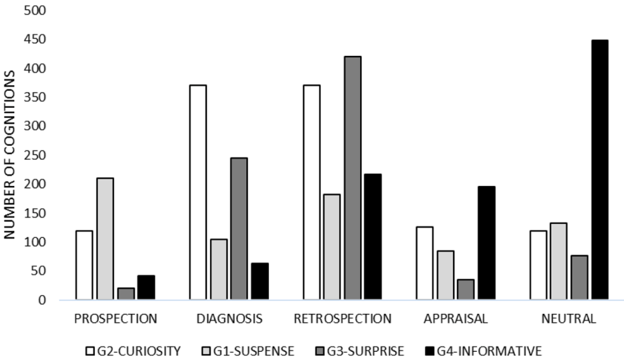
- H1 was confirmed: each fictional discourse structure induced specific cognitive tension—anticipations/uncertainty predominated in Suspense, uncertainty/questioning/incomprehension in Curiosity, and schema reworkings/verbal surprise in Surprise. Non-fiction, without withheld information, produced mainly emotional appraisals and neutral cognitions.
- Across 3,693 thoughts, the distribution was prospection 11%, local appraisal 12%, neutral 22%, diagnosis 22%, and retrospection 33%; the diagnostic function (characteristic of curiosity) was reported as the most abundant at 52% of total cognitions. Fictional groups averaged 227.2 prospective/diagnostic/retrospective cognitions per group versus 107.4 in non-fiction; appraisal/neutral cognitions averaged 127.5 versus 429.3. 89.6% of fictional-group cognitions referred to the character and action, versus 27.8% in non-fiction.
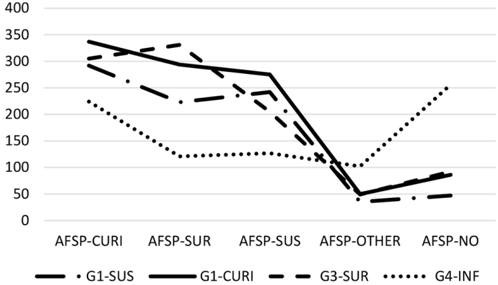
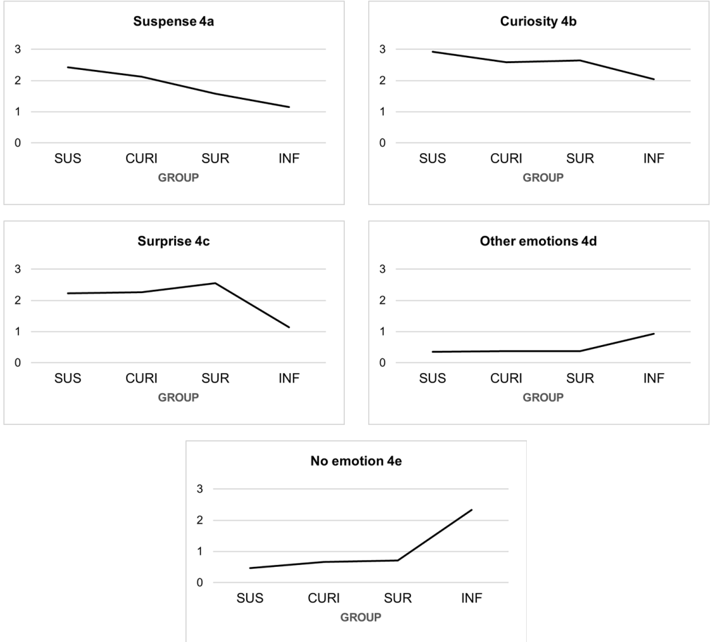
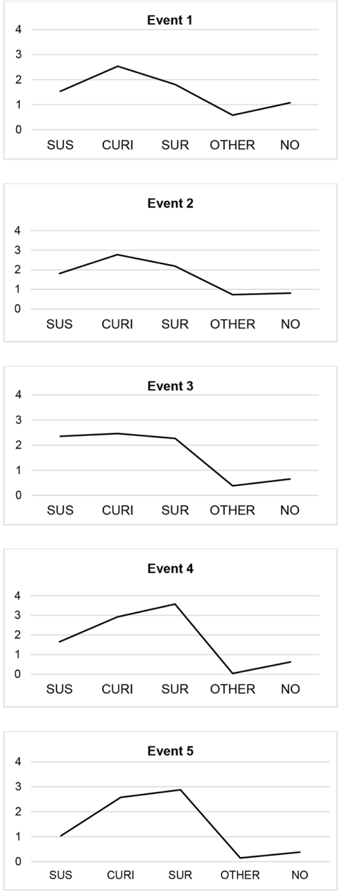
- Emotions: five categories appeared; suspense, surprise, and curiosity were highest in their respective groups. ANOVA was significant for suspense F(3,90)=6.492, p=.001; surprise F(3,90)=9.090, p=.000; and non-emotion F(3,90)=12.276, p=.000. Post-hoc INF vs SUS/CURI/SUR mean differences were 9.29/8.33/8.10, all p=.000. Surprise peaked at events 4 and 5.
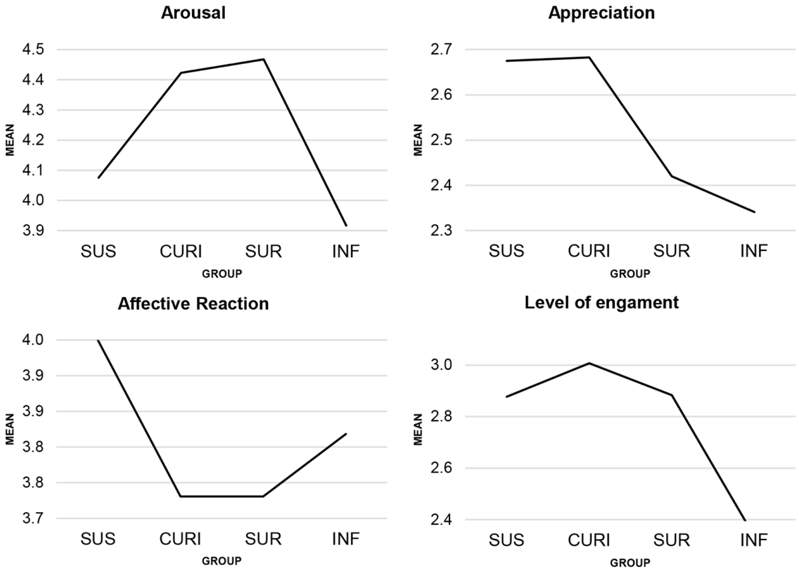
- Global enjoyment: Engagement differed significantly F(3,90)=10.125, p=.000 (INF vs SUS −.54, p=.003; INF vs CURI −.67, p=.000; INF vs SUR −.55, p=.001); Arousal, Appreciation, and Affective Reaction did not differ significantly. Regression showed Suspense and Surprise local emotions related to Arousal; Suspense, Curiosity, and Surprise to Appreciation; and Suspense and Surprise to Engagement, as the paper states.
Methods
- Four versions of the audiovisual story *El Avecinero* were created: suspense, curiosity, surprise, and non-fiction. Ninety-four university communication students (age M=21.38, SD=4.15) were assigned to four independent groups: SUS, CURI, SUR, INF.
- After viewing, participants rated overall Arousal (AROU) and Affective Response (AFRE); local cognitions and emotions were measured at five plot points using thought-listing (COGP) and emotion intensity ratings from 1 to 5 (EMOP); then Appreciation (APR) and Engagement (ENG) were measured. Three independent judges coded thoughts, with Fleiss kappa k=.784 and k=.825; data were processed in SPSS-25 using ANOVA, Scheffe post-hoc tests, and regression.
Limitations
- The paper states no limitations.
- Evident from the text: the sample is 94 university communication students, which limits generalizability.
- Evident from the text: findings rest on four versions of a single short film, *El Avecinero*, so results are stimulus-specific.
Model-written summary. Check it against the paper before relying on it.
Integrity signals
Registry
Cites
Statistics
Figures



Verification
Claims the paper makes
1 Valid · 2 Not valid · 24 Not checked · 100 Own results and interpretations
The cited sources support only part of this claim — read each source’s verdict below.
In the paper
“The results of different research showed that suspense can be evoked even when readers know how the story will end (Gerrig, 1989;Hoeken & vanVilet, Hoeken & vanVliet, 2000;Lehne & Koelsch, 2015;Delatorre et al., 2018).”
§ Inducing narrative tension in the viewer through suspense, surprise, and curiosity > Knowledge and emotion in narrative tension
What the sources say
- Not checked yetcites Gerrig, 1989 matched to “Suspense in the Absence of Uncertainty” (1989) source
Checked before — its earlier verdict is held back until a new check runs.
- Not matchedcites Hoeken & vanVliet, 2000
An author–year citation the paper’s reference list doesn’t settle. We don’t search these by name.
- Partly supportedcites Lehne & Koelsch, 2015 matched to “Toward a general psychological model of tension and suspense” (2015) sourceExperimental — accuracy not yet measured
In 'The Paradox of Suspense' our copy does carry the idea the claim attributes: 'the narrative plots of novels or movies can be experienced as suspenseful even in the absence of uncertainty after several readings or viewings,' alongside genre-based outcome prediction. But it is explicitly credited to others ('at least according to some authors (see Gerrig, 1989; Carroll, 1996b)') and framed as a debated position, not as this paper's empirical result — the citing sentence's 'the results of different research showed' therefore overstates it, since the paper is a domain-independent theoretical review with no experiment (Abstract; Future Directions: the role of uncertainty 'remains to be resolved by investigating how tension experiences change over repeated exposures'). The authors also qualify the point in the opposite direction: 'we think that in most cases the reduction of uncertainty, ceteris paribus, leads to a considerable decrease of tension or suspense' (The Paradox of Suspense), offering only partial rescues such as temporal uncertainty and felt vs. perceived suspense. (LLM, conf=0.80)
plainstates a cause- Asserted: passes — The authors put it forward as true.
- Checkable: passes — It can be checked against evidence.
- Load-bearing: passes — The paper’s conclusions depend on it.
- Based: passes — The paper gives a reason why it holds.
- Not checked yet
A result the paper reports from its own data — it cites no other source for it, so there is none to check. The quote shows it is in the paper.
In the paper
“The results show that the organization of the stories, depending on their structures of suspense, surprise, or curiosity, induces narrative tension”
§ Inducing narrative tension in the viewer through suspense, surprise, and curiosity > Abstract
plainstates a causen = 94- Asserted: passes — The authors put it forward as true.
- Checkable: passes — It can be checked against evidence.
- Load-bearing: passes — The paper’s conclusions depend on it.
- Based: passes — The paper gives a reason why it holds.
A result the paper reports from its own data — it cites no other source for it, so there is none to check. The quote shows it is in the paper.
In the paper
“while the nonfictional story, induces cognitive and affective effects of another kind”
§ Inducing narrative tension in the viewer through suspense, surprise, and curiosity > Abstract
plainstates a causen = 94- Asserted: passes — The authors put it forward as true.
- Checkable: passes — It can be checked against evidence.
- Load-bearing: passes — The paper’s conclusions depend on it.
- Based: passes — The paper gives a reason why it holds.
A result the paper states — it cites no source for it, so there is none to check. The quote shows it is in the paper.
In the paper
“Narrative tension appears during narrative progression.”
§ Inducing narrative tension in the viewer through suspense, surprise, and curiosity > Abstract
hedgedstates an associationn = 94- Asserted: passes — The authors put it forward as true.
- Checkable: passes — It can be checked against evidence.
- Load-bearing: passes — The paper’s conclusions depend on it.
- Based: passes — The paper gives a reason why it holds.
A result the paper states — it cites no source for it, so there is none to check. The quote shows it is in the paper.
In the paper
“In the analysis of the cognitive responses to the five points of narrative progression new types of cognitions appear.”
§ Inducing narrative tension in the viewer through suspense, surprise, and curiosity > Narrative Tension
plain- Asserted: passes — The authors put it forward as true.
- Checkable: passes — It can be checked against evidence.
- Load-bearing: passes — The paper’s conclusions depend on it.
- Based: passes — The paper gives a reason why it holds.
- Rests on 2 assumptions not shown here.
27 more claims
Create a free account to see all 127 claims and to verify the 23 references still open.
- Probably not a substantial claim. 48
- It may state two separate claims as one. 65
- The quote only partly states this claim. 3
Self-check
Percentages, sums and reported differences re-computed from the paper’s own numbers.
Each contradiction between two passages listed here was confirmed by an independent check.
Rated major: it would touch a result — a value a result rests on, reported and recomputed p-values on opposite sides of the significance level, two passages that conflict with no sign which is right, or a cited work retracted before this paper was published.
In the paper
§ Inducing narrative tension in the viewer through suspense, surprise, and curiosity > Relation between local emotions and global enjoyment
“However, there is no relationship of this kind for the tension categories of Curiosity, Other Emotions and No Emotion.”
§ Inducing narrative tension in the viewer through suspense, surprise, and curiosity > Theory of the multidimensional narrative tension of enjoyment
“| Other emotions | | | -0,067 | 0,027 | -0,255 | -2,526 | 0,013 |”
Rated major: it would touch a result — a value a result rests on, reported and recomputed p-values on opposite sides of the significance level, two passages that conflict with no sign which is right, or a cited work retracted before this paper was published.
In the paper
§ Inducing narrative tension in the viewer through suspense, surprise, and curiosity > Relation between local emotions and global enjoyment
“Third, there is a relation between the tension categories of Suspense and Surprise and the Engagement variable, but not for the other three categories.”
§ Inducing narrative tension in the viewer through suspense, surprise, and curiosity > Theory of the multidimensional narrative tension of enjoyment
“| Curiosity | | | 0,023 | 0,010 | 0,226 | 2,211 | 0,030 |”
Rated major: it would touch a result — a value a result rests on, reported and recomputed p-values on opposite sides of the significance level, two passages that conflict with no sign which is right, or a cited work retracted before this paper was published.
In the paper
§ Inducing narrative tension in the viewer through suspense, surprise, and curiosity > The relationship between narrative tension and enjoyment
“In contrast, curiosity, which has a strong presence in tension relations, paradoxically does not present this relationship.”
§ Inducing narrative tension in the viewer through suspense, surprise, and curiosity > Relation between local emotions and global enjoyment
“Second, there is a relationship between the affective narrative tension of Suspense, Curiosity and Surprise with the level of global Appreciation.”
Rated major: it would touch a result — a value a result rests on, reported and recomputed p-values on opposite sides of the significance level, two passages that conflict with no sign which is right, or a cited work retracted before this paper was published.
In the paper
§ Inducing narrative tension in the viewer through suspense, surprise, and curiosity > Relation between local emotions and global enjoyment
“However, there is no relationship of this kind for the tension categories of Curiosity, Other Emotions and No Emotion.”
§ Inducing narrative tension in the viewer through suspense, surprise, and curiosity > Theory of the multidimensional narrative tension of enjoyment
“| Curiosity | | | -0,051 | 0,023 | -0,225 | -2,220 | 0,029 |”
Rated minor: it would not touch a result — a value no result rests on, a p-value that stays on the same side of the significance level, or a conflict that is clerical, resolved elsewhere in the paper, or outside its own findings.
In the paper
“| constant | .255 | 6,379 (1, 92) | 4,391 | 0,134 | | 32,816 | 0,000 | | Other emotions | | | -0,067 | 0,027 | -0,255 | -2,526 | 0,013 |”
§ Inducing narrative tension in the viewer through suspense, surprise, and curiosity > Theory of the multidimensional narrative tension of enjoyment
Reported 0.255 · recomputed 0.065025
5 more findings
Create a free account to see every finding of this check.
Citations
Cites
Cognitive, social, and physiological determinants of emotional state.
Schachter, S., & Singer, J. (1962) · Psychological Review · doi:10.1037/h0046234 · Cited by 6,223
Conflict, arousal, and curiosity.
Berlyne, D. E. (1960) · McGraw-Hill Book Company · doi:10.1037/11164-000 · Cited by 5,995
The psychology of curiosity: A review and reinterpretation.
Loewenstein, G. (1994) · Psychological Bulletin · doi:10.1037/0033-2909.116.1.75 · Cited by 2,738
Reading for the plot : design and intention in narrative
Brooks, P. (1984) · Cited by 2,550
Bergum, B. O., Long, J., & Baddeley, A. (1982) · The American Journal of Psychology · doi:10.2307/1422199 · Cited by 2,226
Narratology: introduction to the theory of narrative
(1998) · Choice Reviews Online · doi:10.5860/choice.35-6054 · Cited by 2,181
Advertising Value and Advertising on the Web
Ducoffe, R. H. (1996) · Journal of Advertising Research · doi:10.1080/00218499.1996.12466626 · Cited by 1,896
Essays on the Verbal and Visual Arts
Robins, R. H., & Helm, J. (1968) · Man · doi:10.2307/2798565 · Cited by 1,657
Measuring Narrative Engagement
Busselle, R., & Bilandzic, H. (2009) · Media Psychology · doi:10.1080/15213260903287259 · Cited by 1,088
Keen, S. (2007) · Oxford University Press eBooks · doi:10.1093/acprof:oso/9780195175769.001.0001 · Cited by 1,085
Cognitive Learning, Cognitive Response to Persuasion, and Attitude Change
GREENWALD, A. G. (1968) · Psychological Foundations of Attitudes · doi:10.1016/b978-1-4832-3071-9.50012-x · Cited by 993
TOWARDS A ‘NATURAL’ NARRATOLOGY
Fludernik, M. (1996) · jlse · doi:10.1515/jlse.1996.25.2.97 · Cited by 857
Psychological Foundations of Attitudes
(1968) · Elsevier eBooks · doi:10.1016/c2013-0-12318-5 · Cited by 833
How consumers assess the value of advertising
Ducoffe, R. H. (1995) · Journal of Current Issues & Research in Advertising · doi:10.1080/10641734.1995.10505022 · Cited by 774
Routledge encyclopedia of narrative theory
(2005) · Choice Reviews Online · doi:10.5860/choice.43-0024 · Cited by 767
Exploring the Psychology of Interest
Silvia, P. J. (2006) · doi:10.1093/acprof:oso/9780195158557.001.0001 · Cited by 715
The International Encyclopedia of Media Effects
(2017) · Wiley eBooks · doi:10.1002/9781118783764 · Cited by 536
Expositional Modes and Temporal Ordering in Fiction
Moor, A., & Sternberg, M. (1979) · Comparative Literature · doi:10.2307/1770307 · Cited by 431
Analyse sémiotique du discours : de l'énoncé à l'énonciation
Courtés, J. (1991) · Hachette eBooks · Cited by 404
Stories are to entertain: A structural-affect theory of stories
Brewer, W. F., & Lichtenstein, E. H. (1982) · Journal of Pragmatics · doi:10.1016/0378-2166(82)90021-2 · Cited by 399
Coincidence and Counterfactuality: Plotting Time and Space in Narrative Fiction
Dannenberg, H. P. (2008) · UNP - Nebraska eBooks · doi:10.2307/j.ctt1dgn486 · Cited by 365
Principles of Physiological Psychology.
(1905) · JAMA: The Journal of the American Medical Association · doi:10.1001/jama.1905.02500440060019 · Cited by 362
Reading people, reading plots: character, progression, and the interpretation of narrative
Phelan, J. B. (1989) · Choice Reviews Online · doi:10.5860/choice.27-0782 · Cited by 324
Experiencing fiction: judgments, progressions, and the rhetorical theory of narrative
Phelan, J. B. (2008) · Choice Reviews Online · doi:10.5860/choice.45-5433 · Cited by 291
Fontanille, J., & Zilberberg, C. (1998) · HAL · Cited by 279
Confusion and interest: The role of knowledge emotions in aesthetic experience.
Silvia, P. J. (2010) · Psychology of Aesthetics, Creativity, and the Arts · doi:10.1037/a0017081 · Cited by 270
Toward a general psychological model of tension and suspense
Lehne, M., & Koelsch, S. (2015) · Frontiers in Psychology · doi:10.3389/fpsyg.2015.00079 · Cited by 222
The International Encyclopedia of Media Psychology
(2020) · Wiley eBooks · doi:10.1002/9781119011071 · Cited by 221
Zilberberg, C. (2006) · Cited by 217
Narrative Theory: A Critical Introduction
Puckett, K. (2016) · Cambridge University Press eBooks · doi:10.1017/cbo9781139522502 · Cited by 207
Hoeken, H., & van Vliet, M. (2000) · Poetics · doi:10.1016/s0304-422x(99)00021-2 · Cited by 192
Narrative Progression in the Short Story: A corpus stylistic approach
Toolan, M. (2008) · Linguistic approaches to literature · doi:10.1075/lal.6 · Cited by 146
Herman, D. (2014) · De Gruyter eBooks · doi:10.1515/9783110316469.46 · Cited by 135
Suspense : conceptualizations, theoretical analyses, and empirical explorations
(1996) · MADOC (University of Mannheim) · Cited by 135
Postclassical narratology: approaches and analyses
Alber, J., & Fludernik, M. (2011) · Choice Reviews Online · doi:10.5860/choice.48-4315 · Cited by 124
New displays and new emotions: A commentary on Rozin and Cohen (2003).
Keltner, D., & Shiota, M. N. (2003) · Emotion · doi:10.1037/1528-3542.3.1.86 · Cited by 115
A companion to narrative theory
Phelan, J. B. (2006) · Cited by 95
Suspense in the Absence of Uncertainty
Gerrig, R. J. (1989) · Journal of Memory and Language · doi:10.1016/0749-596x(89)90001-6 · Cited by 63
Silvia, P. J. (2017) · Springer eBooks · doi:10.1007/978-3-319-55509-6_5 · Cited by 51
Style and Rhetoric of Short Narrative Fiction: Covert Progressions Behind Overt Plots
Shen, D. (2013) · Cited by 43
Narrative Sequence in Contemporary Narratology
Baroni, R., & Revaz, F. (2015) · Cited by 37
The Cambridge Companion to Narrative Theory
(2018) · Cambridge University Press eBooks · doi:10.1017/9781108639149 · Cited by 36
Confronting a Paradox: A New Perspective of the Impact of Uncertainty in Suspense
Delatorre, P., León, C., Salguero, A., Palomo‐Duarte, M., & Gervás, P. (2018) · Frontiers in Psychology · doi:10.3389/fpsyg.2018.01392 · Cited by 33
(2017) · doi:10.1007/978-3-319-55509-6 · Cited by 26
Fictional reliefs and reality checks
Vaage, M. B. (2013) · Screen · doi:10.1093/screen/hjt004 · Cited by 25
Emerging Vectors of Narratology
Hansen, P. K., Pier, J., Roussin, P., & Schmid, W. (2017) · De Gruyter eBooks · doi:10.1515/9783110555158 · Cited by 23
Tensions et résolutions : musicalité de l’intrigue ou intrigue musicale ?
Baroni, R. (2011) · Cahiers de Narratologie · doi:10.4000/narratologie.6461 · Cited by 20
The Narrative Sequence: History of a Concept and a Research Area
Adam, J. (2011) · Cited by 20
Preschool children transfer real-world moral reasoning into pretense
Fast, A. A., & Van Reet, J. (2018) · Cognitive Development · doi:10.1016/j.cogdev.2017.11.003 · Cited by 11
Baroni, R. (2007) · Variations · doi:10.3726/85603_235 · Cited by 10
A good, a bad, and an evil character: Who renders a novel most enjoyable?
Salgaro, M., Wagner, V., & Menninghaus, W. (2021) · Poetics · doi:10.1016/j.poetic.2021.101550 · Cited by 9
Entertainment Effects: Enjoyment
Eden, A. (2017) · Wiley eBooks · doi:10.1002/9781118783764.wbieme0163 · Cited by 9
A Companion to Narrative Theory
(2005) · Blackwell Publishing Ltd eBooks · doi:10.1111/b.9781405114769.2005.00021.x · Cited by 9
Emplotment, Plot and Explotment:
Morgan, J. M. (2013) · Biblical Interpretation · doi:10.1163/15685152-1041a0004 · Cited by 5
Cognitive Assessment: Think‐Aloud and Thought‐Listing Technique
Woelke, J., & Pelzer, E. (2020) · Wiley eBooks · doi:10.1002/9781119011071.iemp0048 · Cited by 4
Content Effects: Entertainment
Bartsch, A. (2017) · Wiley eBooks · doi:10.1002/9781118783764.wbieme0128 · Cited by 4
The rhythms of narrative tension and its cultural satisfaction: Frank Miller’s 300
Bormann, D. C. (2018) · English Text Construction · doi:10.1075/etc.00008.can · Cited by 3
Rhetorical Theory of Narrative and Contemporary Narrative Poetics: A Conversation with James Phelan
Shang, B., & Phelan, J. B. (2019) · Frontiers of Narrative Studies · doi:10.1515/fns-2019-0001 · Cited by 3
In Pursuit of Narrative Dynamics
Shang, B. (2012) · Peter Lang CH eBooks · doi:10.3726/978-3-0351-0330-4 · Cited by 2
Plots in Life and Fiction: A Cognitive Reconceptualization
Baroni, R. (2015) · IRIS · Cited by 2
Baroni, R. (2010) · IRIS · Cited by 2
Narrative tension within the framework of cognitive modeling
(2018) · Cognition, Communication, Discourse · doi:10.26565/2218-2926-2018-16-04
(1980) · Illinois Digital Environment for Access to Learning and Scholarship (University of Illinois at Urbana-Champaign)
(1999)
(1973) · Seuil eBooks
(1971) · Seuil eBooks
(1986) · Éditions de Minuit eBooks
(2017) · SERVAL (Université de Lausanne)
Research works printed but not linked: 6
- Cacioppo, J. X, & Petty, R. E. (1981). Social psychological procedures for cognitive response assessment: The thought-listing technique. In X. V. Merluzzi, C. R. Glass, & M. Genest (Eds.), Cognitive assessment (pp. 309-342). Guilford Press.
- Fill, A. (2003). Linguistic Devices for the creation of suspense. In B. Kettemann (Ed.), Expanding circles, transcending disciplines, and multimodal texts (pp. 263-276).
- Herman, D. (Ed.). (2003). Narrative Theory and the Cognitive Sciences. Center for the Study of Language and Information.
- Ionescu, A. (2019). Postclassical Narratology: Twenty Years Later. A Journal of Literary Studies and Linguistics, 11, 5-34. https://www.researchgate.net/publication/ 338357670_Postclassical_Narratology_Twenty_Years_Later.
- In P. A. O'Keefe, & J. M. Harackievicz (Eds.), The science of Interest. Springer. https://doi.org/10.1007/978-3-319-55509-6. · DOI · Paper page
- Tomashevsky, B. (1965). Thematics. In L. T. Lemon, & M. J. Reis (Eds.), Russian Formalist Criticism (pp. 61-98). University of Nebraska Press (Original work published 1925).
Cited by
A quantitative study of non-linearity in storytelling
Piper, A., & Toubia, O. (2023) · Poetics · doi:10.1016/j.poetic.2023.101793 · Cited by 27
Long-term, multi-event surprise correlates with enhanced autobiographical memory
Antony, J. W., Dam, J. V., Massey, J., Barnett, A. J., & Bennion, K. A. (2023) · Nature Human Behaviour · doi:10.1038/s41562-023-01631-8 · Cited by 16
Martins, S., & Vairinhos, M. (2023) · Virtual Worlds · doi:10.3390/virtualworlds2040018 · Cited by 13
Pan, Y., Lai, I. K. W., & Wong, J. W. C. (2025) · Asia Pacific Journal of Tourism Research · doi:10.1080/10941665.2025.2457508 · Cited by 12
Charting the rise of imaginary worlds in history
Dubourg, E., Safa, R., Thouzeau, V., & Baumard, N. (2025) · Humanities and Social Sciences Communications · doi:10.1057/s41599-025-04877-x · Cited by 11
Metadata
- Authors
- Bermejo-Berros, J., Lopez-Diez, J., & Gil Martínez, M. A.
- Venue
- Poetics
- Publisher
- Elsevier BV
- Published
- 2022-08
- Volume
- 93
- Pages
- 101664
- ISSN
- 0304-422X (ISSN-L)
- OpenAlex
- W4220700322
- Cited by
- 32
- References
- 69
- Citations by year
- 2026: 10 · 2025: 9 · 2024: 7 · 2023: 5 · 2022: 1
- FWCI
- 33.39
- Type
- journal article
- Language
- en
- Open access
- hybrid
- doi.org
- Licence
- cc-by-nc-nd
- www.elsevier.com/tdm/userlicense/1.0/ (tdm)
- www.elsevier.com/legal/tdmrep-license (tdm)
- creativecommons.org/licenses/by-nc-nd/4.0/ (vor)
- Locations
- Poetics (publishedVersion, cc-by-nc-nd)
- UVaDOC UVaDOC University of Valladolid Documentary Repository (University of Valladolid) (submittedVersion, cc-by-nc-nd)
- Topics
- Social Sciences › Arts and Humanities › Literature and Literary Theory › Narrative Theory and Analysis
- Social Sciences › Communication › Media Influence and Health
- Life Sciences › Neuroscience › Cognitive Neuroscience › Aesthetic Perception and Analysis
- Keywords
- narrative tension, suspense, surprise, curiosity, narrative structure, audiovisual narrative, narrative progression, plot, narrative emotion, anticipation
About these checks
Registry, retraction, Cites and statistics results are computed, not judged, with one exception: a printed reference that no index lists is read once by a model before it counts as a citation error. Claims are extracted by a model and kept only when their quote appears verbatim in the text; each cited source is then checked, with a model’s help, for whether it says what the claim relies on. Those verdicts can be wrong — read the claim’s quote and the cited source before relying on one.
The claim verdicts this report counts are experimental: their accuracy is not yet measured.
A language model drew the claims from the paper on 2026-11-21, under version 3 of the claim definition (model deepseek-v4.1-flash, prompt extract-v3).
A second model labelled each claim on 2026-11-21 (model jev-1.13-20260917, definition revision gold-guideline-v0.2).
Cited sources are checked with a language model’s help (qwen3.8-omni-flash).
Statistics and arithmetic are recomputed, not judged.
Confidence bands are shown only for fields calibrated on our annotated test set. None is calibrated yet, so no band is shown.
What counts as a claim ›How we measure confidence ›How we check this ›
Are you an author, or do you see a problem with this page? Request a review
Data sources
Bibliographic data: Semantic Scholar, OpenAlex, Crossref.
Contains information from the Semantic Scholar Academic Graph Datasets, made available under the ODC Attribution License (ODC-BY 1.0).
Semantic Scholar’s data is described in: Kinney, R., et al. (2023). The Semantic Scholar Open Data Platform. arXiv:2301.10140.
