

The DOI matches its Crossref record; 62 of the 64 references it cites were found in a registry or an index.
Nitrosopersulfide (SSNO−) accounts for sustained NO bioactivity of S-nitrosothiols following reaction with sulfide
Open accessAbstract
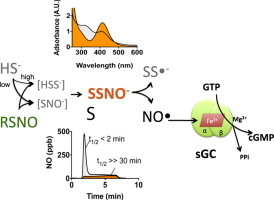
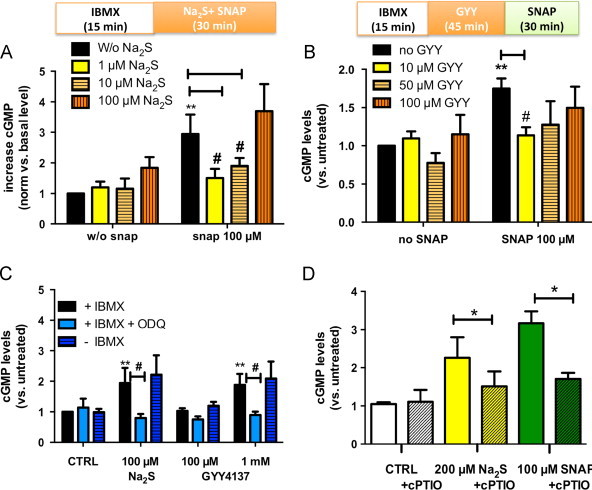
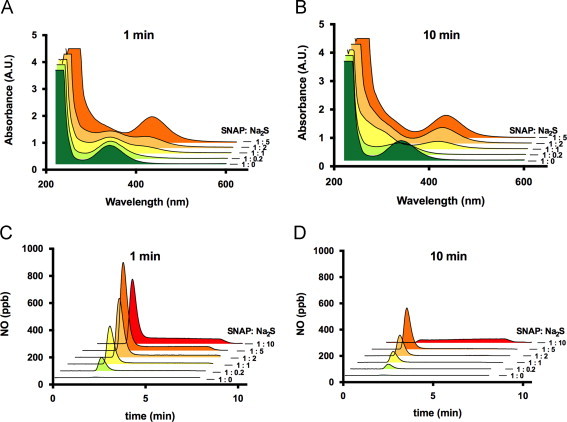
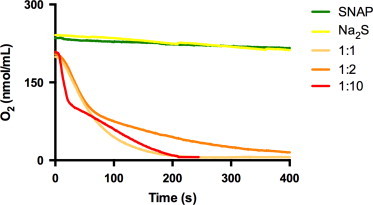
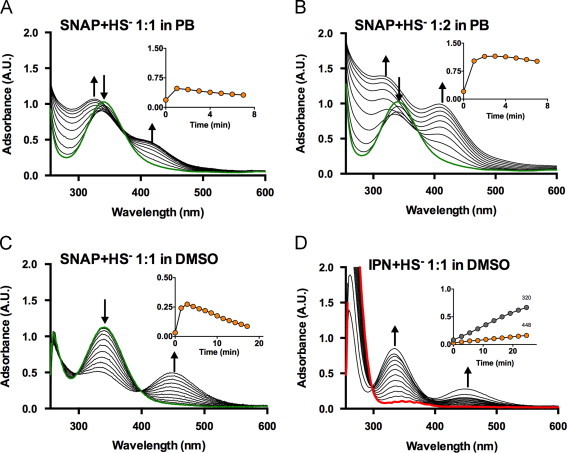
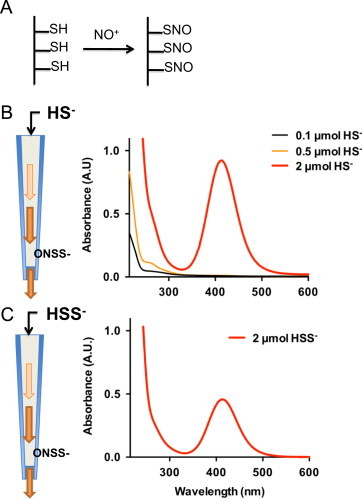
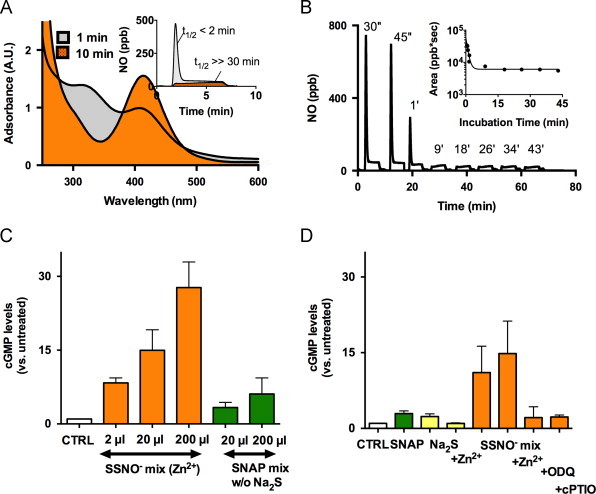
Sulfide salts are known to promote the release of nitric oxide (NO) from S-nitrosothiols and potentiate their vasorelaxant activity, but much of the cross-talk between hydrogen sulfide and NO is believed to occur via functional interactions of cell regulatory elements such as phosphodiesterases. Using RFL-6 cells as an NO reporter system we sought to investigate whether sulfide can also modulate nitrosothiol-mediated soluble guanylyl cyclase (sGC) activation following direct chemical interaction. We find a U-shaped dose response relationship where low sulfide concentrations attenuate sGC stimulation by S-nitrosopenicillamine (SNAP) and cyclic GMP levels are restored at equimolar ratios. Similar results are observed when intracellular sulfide levels are raised by pre-incubation with the sulfide donor, GYY4137. The outcome of direct sulfide/nitrosothiol interactions also critically depends on molar reactant ratios and is accompanied by oxygen consumption. With sulfide in excess, a 'yellow compound' accumulates that is indistinguishable from the product of solid-phase transnitrosation of either hydrosulfide or hydrodisulfide and assigned to be nitrosopersulfide (perthionitrite, SSNO(-); λ max 412 nm in aqueous buffers, pH 7.4; 448 nm in DMF). Time-resolved chemiluminescence and UV-visible spectroscopy analyses suggest that its generation is preceded by formation of the short-lived NO-donor, thionitrite (SNO(-)). In contrast to the latter, SSNO(-) is rather stable at physiological pH and generates both NO and polysulfides on decomposition, resulting in sustained potentiation of SNAP-induced sGC stimulation. Thus, sulfide reacts with nitrosothiols to form multiple bioactive products; SSNO(-) rather than SNO(-) may account for some of the longer-lived effects of nitrosothiols and contribute to sulfide and NO signaling.
Overview
The claims and statistics of this paper haven’t been checked yet.
Run the check — free, no account needed. It reads the open-access text and checks the sources it cites.
Integrity signals
Registry
Cites
Statistics
Figures
Verification
Claims the paper makes
The claims and statistics of this paper haven’t been checked yet.
Run the check — free, no account needed. It reads the open-access text and checks the sources it cites.
Claims other papers make about this one
Each is checked against this paper’s own text: does it say what the citing paper says it does?
The source backs part of the claim, not all of it — or backs it for a different population, condition or comparison.
In the citing paper
“however, contrary to polysulfides and other nitrosothiols, it is stable in the presence of millimolar concentrations of reduced thiols, including cysteine and glutathione (even dithiotheritol, DTT) [19].”
From On the chemical biology of the nitrite/sulfide interaction (2015) · cites this paper as [19]
Experimental — accuracy not yet measuredIn the citing paper
“The resulting nitroso compound, nitrosopersulfide (perthionitrite; SSNO -) appears, from our recent work [19] and that of Seel et al. [58,59], to be considerably more stable than HSNO -even in the presence of high concentrations of thiols -and, therefore, a potentially better signaling molecule.”
From On the chemical biology of the nitrite/sulfide interaction (2015) · cites this paper as [19]
In the citing paper
“Indeed, we found that SSNO -was able to release NO and induce sGC-dependent cGMP production in cells [19], but its detection in cells/tissues necessitates development of specific and sufficiently sensitive analytical methods, a task that has not yet been accomplished.”
From On the chemical biology of the nitrite/sulfide interaction (2015) · cites this paper as [19]
In the citing paper
“Based on Seel's earlier findings [58,68,69] we assign this product to be nitrosopersulfide, SSNO - [19].”
From On the chemical biology of the nitrite/sulfide interaction (2015) · cites this paper as [19]
In the citing paper
“Taken together, nitrite reacts with S8 and, seemingly less efficiently, with polysulfides in non-aqueous polar solvents leading to the formation of similar products as observed previously in the reaction of NO with sulfide [69], and nitrosothiols with thiols [70], and with sulfide [19,71] including SSNO -.”
From On the chemical biology of the nitrite/sulfide interaction (2015) · cites this paper as [19]
In the citing paper
“the latter have been shown to rapidly react with sulfide in vitro, leading to formation of S/N-hybrid species including thionitrite (SNO -) and nitrosopersulfide (SSNO -).”
From On the chemical biology of the nitrite/sulfide interaction (2015) · cites this paper as [19]
In the citing paper
“Evidence of pharmacological activity of SSNO -leading to sGC activation with concomitant cGMP formation in cells was presented by us recently [19].”
From On the chemical biology of the nitrite/sulfide interaction (2015) · cites this paper as [19]
In the citing paper
“Contrary to nitrosothiols, SSNO -like polysulfides is unstable under strong acidic conditions, leading to rapid decomposition and excision of S8 [19].”
From On the chemical biology of the nitrite/sulfide interaction (2015) · cites this paper as [19]
In the citing paper
“SSNO -is a colored species containing a sulfane sulfur and a nitrosonium (NO + ) moiety attached to opposite ends of a sulfur atom.”
From On the chemical biology of the nitrite/sulfide interaction (2015) · cites this paper as [19]
In the citing paper
“It formally belongs to the group of polysulfides (Sx 2-);”
From On the chemical biology of the nitrite/sulfide interaction (2015) · cites this paper as [19]
In the citing paper
“If sulfide is in excess over the nitrosothiol (which are found in tissues typically at nM concentrations), SSNO -is likely to accumulate and may more easily transport and release NO than GSNO or S-nitrosoalbumin [19].”
From On the chemical biology of the nitrite/sulfide interaction (2015) · cites this paper as [19]
In the citing paper
“SSNO -should be sufficiently stable in the reducing environment of the cell; at the same time, it is a better NO releaser than the parent nitrosothiol [19].”
From On the chemical biology of the nitrite/sulfide interaction (2015) · cites this paper as [19]
Self-check
Percentages, sums and reported differences re-computed from the paper’s own numbers.
The self-check needs the paper’s full text.
Citations
Cites
H 2 S as a Physiologic Vasorelaxant: Hypertension in Mice with Deletion of Cystathionine γ-Lyase
Yang, G., Wu, L., Jiang, B., Yang, W., Qi, J., Cao, K., Meng, Q., Mustafa, A. K., Mu, W., Zhang, S., et al. (2008) · Science · doi:10.1126/science.1162667 · Cited by 2,310
Physiological Implications of Hydrogen Sulfide: A Whiff Exploration That Blossomed
Wang, R. (2012) · Physiological Reviews · doi:10.1152/physrev.00017.2011 · Cited by 1,962
Two's company, three's a crowd: can H 2 S be the third endogenous gaseous transmitter?
Wang, R. T. (2002) · The FASEB Journal · doi:10.1096/fj.02-0211hyp · Cited by 1,808
Hydrogen Sulfide and Cell Signaling
Li, L., Rose, P. E., & Moore, P. K. (2011) · The Annual Review of Pharmacology and Toxicology · doi:10.1146/annurev-pharmtox-010510-100505 · Cited by 1,289
H 2 S: A Universal Defense Against Antibiotics in Bacteria
Shatalin, K. Y., Shatalina, E., Mironov, A. S., & Nudler, E. (2011) · Science · doi:10.1126/science.1209855 · Cited by 769
Methods in Nitric Oxide Research
Young, J. (1997) · Physiological Measurement · doi:10.1088/0967-3334/18/1/008 · Cited by 749
Hydrogen Sulfide Mediates Cardioprotection Through Nrf2 Signaling
Calvert, J. W., Jha, S. K., Gundewar, S., Elrod, J. W., Ramachandran, A., Pattillo, C. B., Kevil, C. G., & Lefer, D. J. (2009) · Circulation Research · doi:10.1161/circresaha.109.199919 · Cited by 720
Coletta, C., Papapetropoulos, A., Erdelyi, K., Olah, G., Módis, K., Panopoulos, P., Asimakopoulou, A., Gerö, D., Sharina, I., Martin, E., et al. (2012) · Proceedings of the National Academy of Sciences · doi:10.1073/pnas.1202916109 · Cited by 677
The chemistry of the hydrogen sulfide and iron sulfide systems in natural waters
MORSE, J., MILLERO, F., CORNWELL, J., & RICKARD, D. (1987) · Earth-Science Reviews · doi:10.1016/0012-8252(87)90046-8 · Cited by 660
The Chemistry of S-Nitrosothiols
Williams, D. L. H. (1999) · Accounts of Chemical Research · doi:10.1021/ar9800439 · Cited by 499
Research works printed but not linked: 1
- Seel, 1985, PNP-Perthionitrit und PNP-Monothionitrit. Zeitschrift für Naturforschung, Teil b, Anorg. Chemie, Org. Chem., 40, 1607
Cited by
Sorted by citations
Chemical Biology of H 2 S Signaling through Persulfidation
Filipović, M. R., Živanović, J., Álvarez, B., & Banerjee, R. V. (2017) · Chemical Reviews · doi:10.1021/acs.chemrev.7b00205 · Cited by 1,059
Cortese-Krott, M. M., Koning, A. M., Kuhnle, G., Nagy, P., Bianco, C. L., Pasch, A., Wink, D. A., Fukuto, J. M., Jackson, A. A., van Goor, H., et al. (2017) · Antioxidants and Redox Signaling · doi:10.1089/ars.2017.7083 · Cited by 371
Dóka, É., Pader, I., Bíró, A., Johansson, K., Cheng, Q., Ballagó, K., Prigge, J. R., Pastor‐Flores, D., Dick, T. P., Schmidt, E. E., et al. (2016) · Science Advances · doi:10.1126/sciadv.1500968 · Cited by 330
Cortese-Krott, M. M., Kuhnle, G., Dyson, A., Fernandez, B. O., Grman, M., DuMond, J. F., Barrow, M. P., McLeod, G. S., Nakagawa, H., Ondriaš, K., et al. (2015) · Proceedings of the National Academy of Sciences · doi:10.1073/pnas.1509277112 · Cited by 294
Heme Oxygenases in Cardiovascular Health and Disease
Ayer, A., Zarjou, A., Agarwal, A., & Stocker, R. (2016) · Physiological Reviews · doi:10.1152/physrev.00003.2016 · Cited by 248
Metadata
- Authors
- Cortese-Krott, M. M., Fernandez, B. O., Santos, J. L. T., Mergia, E., Grman, M., Nagy, P., Kelm, M., Butler, A., & Feelisch, M.
- Affiliations
- Heinrich Heine University Düsseldorf (DE)
- Southampton General Hospital (GB)
- Ruhr University Bochum (DE)
- Slovak Academy of Sciences (SK)
- National Institute of Oncology (HU)
- University of St Andrews (GB)
- Corresponding author
- Feelisch, Martin
- ORCID
- Venue
- Redox Biology
- Publisher
- Elsevier BV
- Published
- 2014
- Volume
- 2
- Pages
- 234-244
- ISSN
- 2213-2317 (ISSN-L)
- PMC
- PMC3909780
- OpenAlex
- W2037151440
- Cited by
- 153
- References
- 64
- Citations by year
- 2026: 6 · 2025: 11 · 2024: 6 · 2023: 7 · 2022: 7 · 2021: 5 · 2020: 17 · 2019: 11 · 2018: 12 · 2017: 22 · 2016: 20 · 2015: 14 · 2014: 14
- FWCI
- 10.37
- Type
- journal article
- Language
- en
- Open access
- gold
- doi.org
- Licence
- Locations
- Redox Biology (publishedVersion, cc-by)
- Europe PMC (PubMed Central) (publishedVersion, cc-by)
- PubMed Central (publishedVersion, cc-by)
- PubMed (publishedVersion)
- ePrints Soton (University of Southampton) (acceptedVersion)
- University of Debrecen Electronic Archive (University of Debrecen) (submittedVersion, other-oa)
- DOAJ (DOAJ: Directory of Open Access Journals) (submittedVersion, cc-by-sa)
- St Andrews Research Repository (St Andrews Research Repository) (submittedVersion, cc-by)
- Funders
- European Network on Gasotransmitters
- FP7 Marie Curie International Reintegration program (PIRG08-GA-2010-277006, to PN)
- Topics
- Life Sciences › Biochemistry, Genetics and Molecular Biology › Biochemistry › Sulfur Compounds in Biology
- Health Sciences › Medicine › Physiology (medical) › Nitric Oxide and Endothelin Effects
- Life Sciences › Biochemistry, Genetics and Molecular Biology › Molecular Biology › Redox biology and oxidative stress
- Keywords
- S-nitrosothiols, sulfide, nitric oxide, hydrogen sulfide signaling, transnitrosation, thionitrites, GYY4137, cyclic GMP, polysulfides, oxygen consumption
- MeSH terms
- Soluble Guanylyl Cyclase, Animals, Cell Line, Cyclic GMP, Guanylate Cyclase, Morpholines, Nitric Oxide, Nitroso Compounds, Organothiophosphorus Compounds, Oxygen Consumption, Sulfides, Receptors, Cytoplasmic and Nuclear, Nitric Oxide Donors, S-Nitrosothiols, Rats
About these checks
Registry, retraction, Cites and statistics results are computed, not judged, with one exception: a printed reference that no index lists is read once by a model before it counts as a citation error. Claims are extracted by a model and kept only when their quote appears verbatim in the text; each cited source is then checked, with a model’s help, for whether it says what the claim relies on. Those verdicts can be wrong — read the claim’s quote and the cited source before relying on one.
Statistics and arithmetic are recomputed, not judged.
Confidence bands are shown only for fields calibrated on our annotated test set. None is calibrated yet, so no band is shown.
What counts as a claim ›How we measure confidence ›How we check this ›
Are you an author, or do you see a problem with this page? Request a review
