

The DOI matches its Crossref record; 51 of the 51 references it cites were found in a registry or an index; 3 of the 36 sources its claims cite were checked for support.
Skills or degree? The rise of skill-based hiring for AI and green jobs
Open accessAbstract
Emerging professions in fields like Artificial Intelligence (AI) and sustainability (green jobs) are experiencing labour shortages as industry demand outpaces labour supply. In this context, our study aims to understand whether employers have begun focusing more on individual skills rather than formal qualifications in their recruitment processes. We analysed a large time-series dataset of approximately eleven million online job vacancies in the UK from 2018 to mid-2024, drawing on diverse literature on technological change and labour market signalling. Our findings provide evidence that employers have initiated “skill-based hiring” for AI roles, adopting more flexible hiring practices to expand the available talent pool. From 2018 to 2023, demand for AI roles grew by 21 % as a proportion of all postings (and accelerated into 2024). Simultaneously, mentions of university education requirements for AI roles declined by 15 %. Our regression analysis shows that university degrees have a significantly lower wage premium for both AI and green roles. In contrast, AI skills command a wage premium of 23 %, exceeding the value of degrees up until the PhD-level (33 %). In occupations with high demand for AI skills, the premium for skills is high, and the reward for degrees is relatively low. We recommend leveraging alternative skill-building formats such as apprenticeships , on-the-job training, MOOCs , vocational education and training, micro-certificates, and online bootcamps to fully utilise human capital and address talent shortages.
Overview
AI snapshot
Written from the paper’s full text.
TL;DR
Using ~11 million UK online job vacancies (2018–mid-2024), the paper finds employers increasingly use skill-based hiring for AI roles, with AI skills carrying a 23% wage premium and degree requirements declining 15%, while green roles show rising demand but weaker skill premia. It concludes AI hiring is shifting from degrees to skills, but green hiring has not yet shown the same shift.
Key findings
- AI postings grew by 21% as a proportion of all postings from 2018–2023 and accelerated into 2024; green postings grew by 67%. Mentions of university education requirements for AI roles declined by 15% from 2018–2023.
- AI skills command a wage premium of 23%, second only to a PhD (33%) and higher than a master’s degree (13%); green skills do not exhibit a significant wage premium. For AI roles, the education premium nearly disappeared—only a slight master’s premium and no significant PhD premium—while for green roles the educational gradient flattened.
- AI roles are more skill-intensive: average 15–16 skills per posting, versus about 10 for green roles and about 5 for the broader labour market. AI roles average around £50k, green roles trend toward £40k, and average postings remain slightly below £30k.
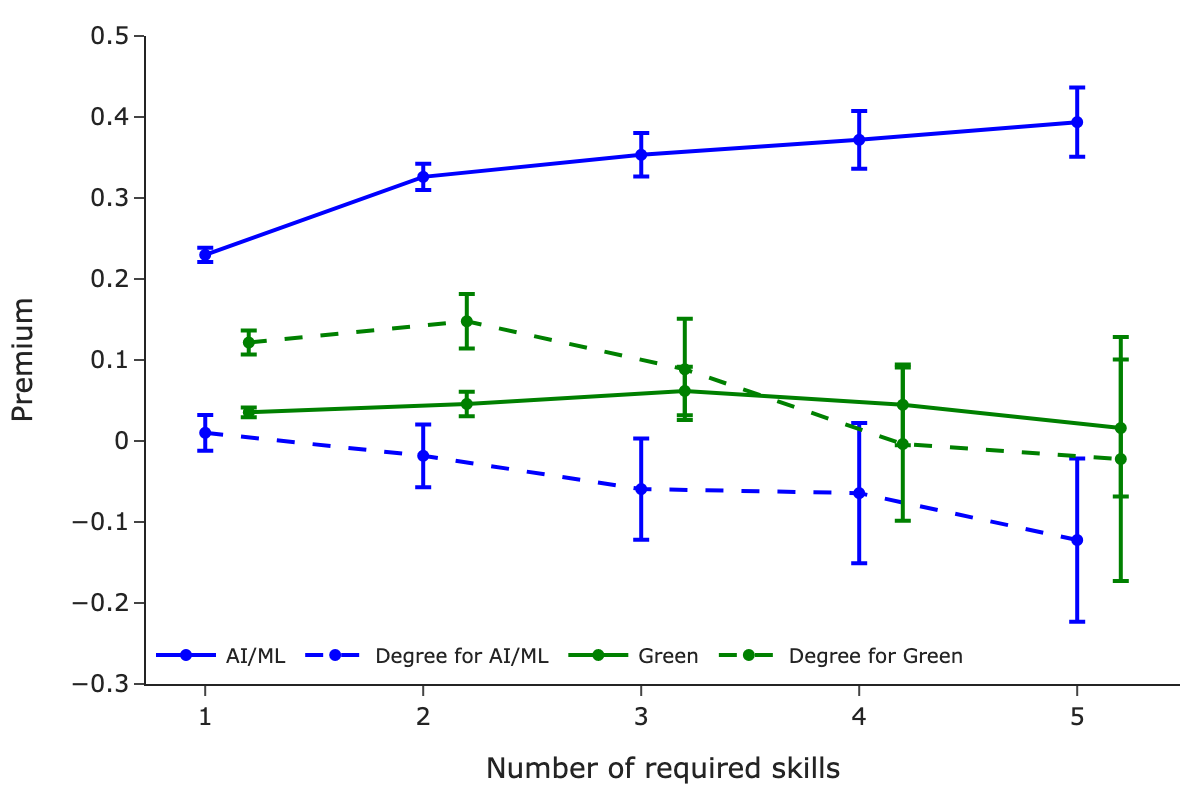
- For AI skills, wage premiums increase with demand and degree premiums decrease with demand; for green skills, the relationship between demand and premium is flat.
Methods
- Dataset: Lightcast/Burning Glass online job vacancy database covering ~11 million UK vacancies from January 2018 to June 2024, with around 80 million associated skills; advertised salary information is available for about 39% of the sample.
- Classification: a bottom-up, skill-based approach labels a vacancy as AI-related if it contains at least one AI skill from Lightcast’s AI/ML subcategory (157 skills) and green if it contains at least one green skill from a 2019 list (259 still in the taxonomy).
- Analysis: descriptive time series plus OLS regressions of log advertised wage on AI/green skill dummies, education dummies, experience, and fixed effects for years, 12 regions, 16 industries, and 9 occupational groups; additional occupation-by-year regressions relate skill and degree premiums to demand.
Limitations
- Stated in the paper: online job vacancy data cannot fully reveal candidate selection; employers may consider criteria beyond postings; online vacancies miss other talent channels such as contractors or in-house development; OJVs are biased toward certain occupations, sectors, and industries; only advertised salaries are observed, not actual negotiated pay; London and business administration/support services are overrepresented, while motor trades, wholesale/retail, and elementary occupations are underrepresented.
- Stated in the paper: salary information is available for only about 39% of the sample, though AI (31%) and green (37%) postings are as likely as other vacancies to contain wage information.
- Evident from the text: the AI/green classification uses a threshold of at least one skill, which is broad; the green skill list was compiled in 2019 and may miss newer green skills; the regression results are associational and do not establish causality.
Model-written summary. Check it against the paper before relying on it.
Integrity signals
Registry
Cites
Statistics
Figures
Verification
Claims the paper makes
105 Own result · 28 Own interpretation · 21 Sources not found · 12 Own method · 9 No basis given · 2 Partly supported · 2 Not checked yet · 1 Couldn’t confirm · accuracy not yet measured
The cited sources that could be checked couldn’t confirm or dispute this claim.
In the paper
“Several formal education degrees related to the domain of AI and green roles have been established only very recently in leading higher education institutions around the world (Chen et al., 2020;Muñoz-Rodríguez et al., 2020).”
§ Skills or Degree? The Rise of Skill-Based Hiring for AI and Green Jobs* > Does education still matter for green and AI roles?
What the sources say
- Not checked — no full text of the sourcecites Chen et al., 2020 source
- Could not verifycites Muñoz-Rodríguez et al., 2020 sourceExperimental — accuracy not yet measured
The Introduction discusses incorporating sustainability into existing degree curricula, and the Conclusions examine sustainability competencies in four education degrees at the University of Salamanca. Neither section addresses recently established degrees in AI or green roles at institutions around the world (searched for new degrees and their establishment). (LLM, conf=0.75)
plain- Asserted: passes — The authors put it forward as true.
- Checkable: passes — It can be checked against evidence.
- Load-bearing: unclear — It is unclear whether the paper’s conclusions depend on it.
- Based: passes — The paper gives a reason why it holds.
The cited sources support only part of this claim — read each source’s verdict below.
In the paper
“Similarly, it has been found that in times where the number of vacancies is scarce compared to the pool of qualified candidates, employers are likely to add qualification requirements as the supply of educated candidates exceeds demand (Brown andSouto-Otero, 2020, Golding &Katz, 2008).”
§ Skills or Degree? The Rise of Skill-Based Hiring for AI and Green Jobs* > Does education still matter for green and AI roles?
What the sources say
- Partly supportedcites Brown and Souto-Otero, 2020 sourceExperimental — accuracy not yet measured
Section 5 says that when employers face many candidates who could do the job, they may adjust entry hurdles according to labour-market conditions. It does not say that scarce vacancies specifically lead employers to add qualification requirements; section 4.1 instead finds that only 18% of the job adverts studied specify a qualification requirement. (LLM, conf=0.83)
- Not matchedcites Golding & Katz, 2008
Couldn’t be matched to a paper in Crossref, so it can’t be checked.
hedgedconditional- Asserted: passes — The authors put it forward as true.
- Checkable: passes — It can be checked against evidence.
- Load-bearing: unclear — It is unclear whether the paper’s conclusions depend on it.
- Based: passes — The paper gives a reason why it holds.
- Partly supported
The paper states this without a source or data behind it here, so there is nothing to check it against. The quote shows it is in the paper.
In the paper
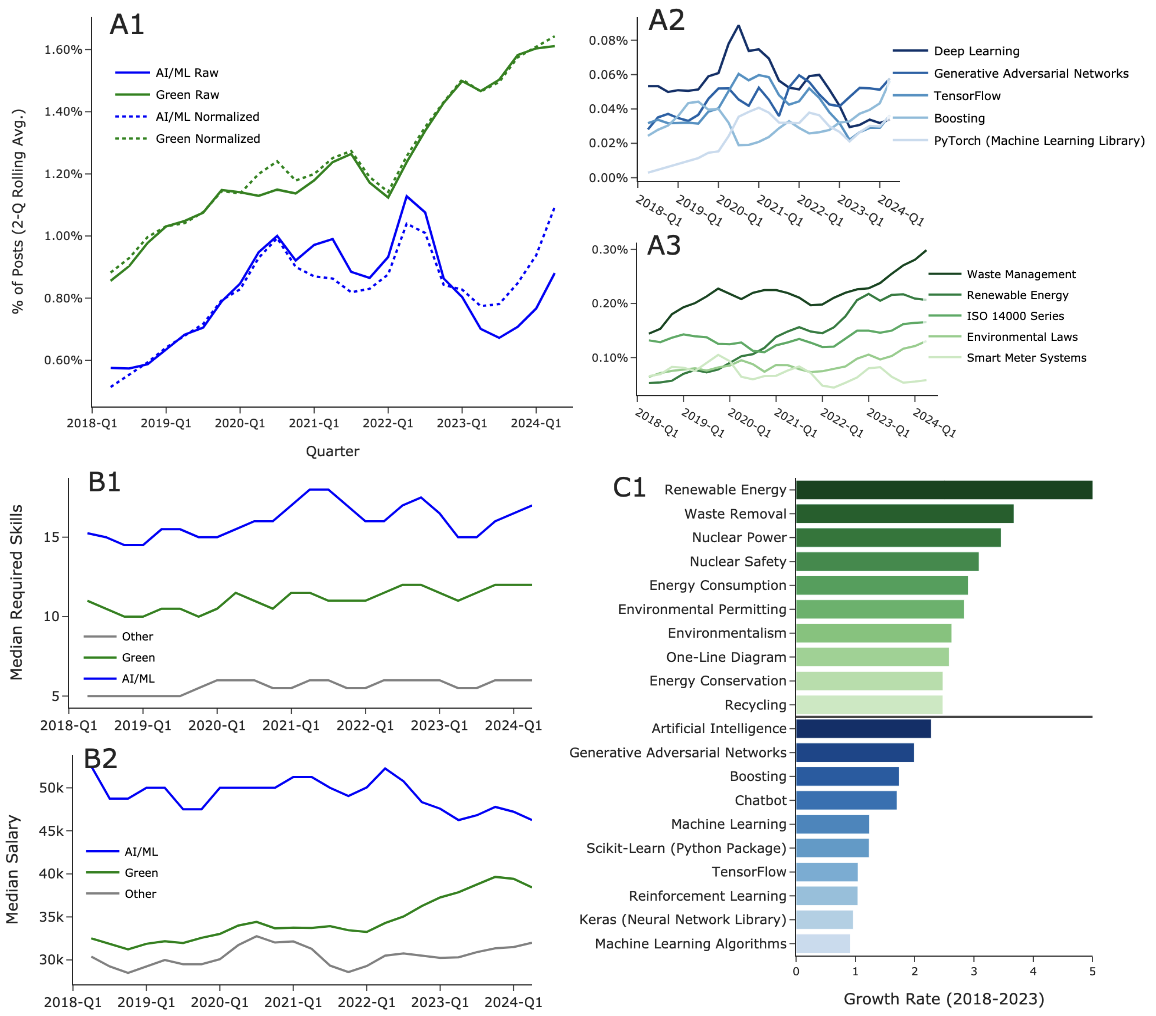
“However, there is a slight decline in AI salaries during the period from early 2022 to mid-2023, which corresponds with a reduction in demand due to tech sector layoffs.”
§ Skills or Degree? The Rise of Skill-Based Hiring for AI and Green Jobs* > Green and AI roles are on the rise
plain- Asserted: passes — The authors put it forward as true.
- Checkable: passes — It can be checked against evidence.
- Load-bearing: unclear — It is unclear whether the paper’s conclusions depend on it.
- Based: passes — The paper gives a reason why it holds.
A result the paper reports from its own data — it cites no other source for it, so there is none to check. The quote shows it is in the paper.
In the paper
“After 2023, we can see a rapid acceleration in the demand for AI skills, in particular.”
§ Skills or Degree? The Rise of Skill-Based Hiring for AI and Green Jobs* > Green and AI roles are on the rise
plain- Asserted: passes — The authors put it forward as true.
- Checkable: passes — It can be checked against evidence.
- Load-bearing: unclear — It is unclear whether the paper’s conclusions depend on it.
- Based: passes — The paper gives a reason why it holds.
A result the paper reports from its own data — it cites no other source for it, so there is none to check. The quote shows it is in the paper.
In the paper
“In the domain of green skills, Panel C1 shows the strongest growth in areas like waste management and renewable energy technologies.”
§ Skills or Degree? The Rise of Skill-Based Hiring for AI and Green Jobs* > Green and AI roles are on the rise
plain- Asserted: passes — The authors put it forward as true.
- Checkable: passes — It can be checked against evidence.
- Load-bearing: unclear — It is unclear whether the paper’s conclusions depend on it.
- Based: passes — The paper gives a reason why it holds.
A result the paper reports from its own data — it cites no other source for it, so there is none to check. The quote shows it is in the paper.
In the paper
“Panel A3 also shows there is consistent and increasing demand for Environmental Law and ISO 14000 series skills, the latter of which pertains to environmental management standards aimed at minimising negative impacts on the environment and promoting sustainability practices in industries.”
§ Skills or Degree? The Rise of Skill-Based Hiring for AI and Green Jobs* > Green and AI roles are on the rise
plaincorrelational- Asserted: passes — The authors put it forward as true.
- Checkable: passes — It can be checked against evidence.
- Load-bearing: unclear — It is unclear whether the paper’s conclusions depend on it.
- Based: passes — The paper gives a reason why it holds.
A result the paper reports from its own data — it cites no other source for it, so there is none to check. The quote shows it is in the paper.
In the paper
“Panel C1 further emphasises that the growth in individual green skills generally outpaces that of AI skills over this time period.”
§ Skills or Degree? The Rise of Skill-Based Hiring for AI and Green Jobs* > Green and AI roles are on the rise
plaincorrelational- Asserted: passes — The authors put it forward as true.
- Checkable: passes — It can be checked against evidence.
- Load-bearing: unclear — It is unclear whether the paper’s conclusions depend on it.
- Based: passes — The paper gives a reason why it holds.
A result the paper reports from its own data — it cites no other source for it, so there is none to check. The quote shows it is in the paper.
In the paper
“The data shows that the number of job postings requiring at least one green skill has grown by 67% and increased by 21% AI skills between 2018 and 2023 1 .”
§ Skills or Degree? The Rise of Skill-Based Hiring for AI and Green Jobs* > Green and AI roles are on the rise
plain- Asserted: passes — The authors put it forward as true.
- Checkable: passes — It can be checked against evidence.
- Load-bearing: passes — The paper’s conclusions depend on it.
- Based: passes — The paper gives a reason why it holds.
A result the paper reports from its own data — it cites no other source for it, so there is none to check. The quote shows it is in the paper.
In the paper
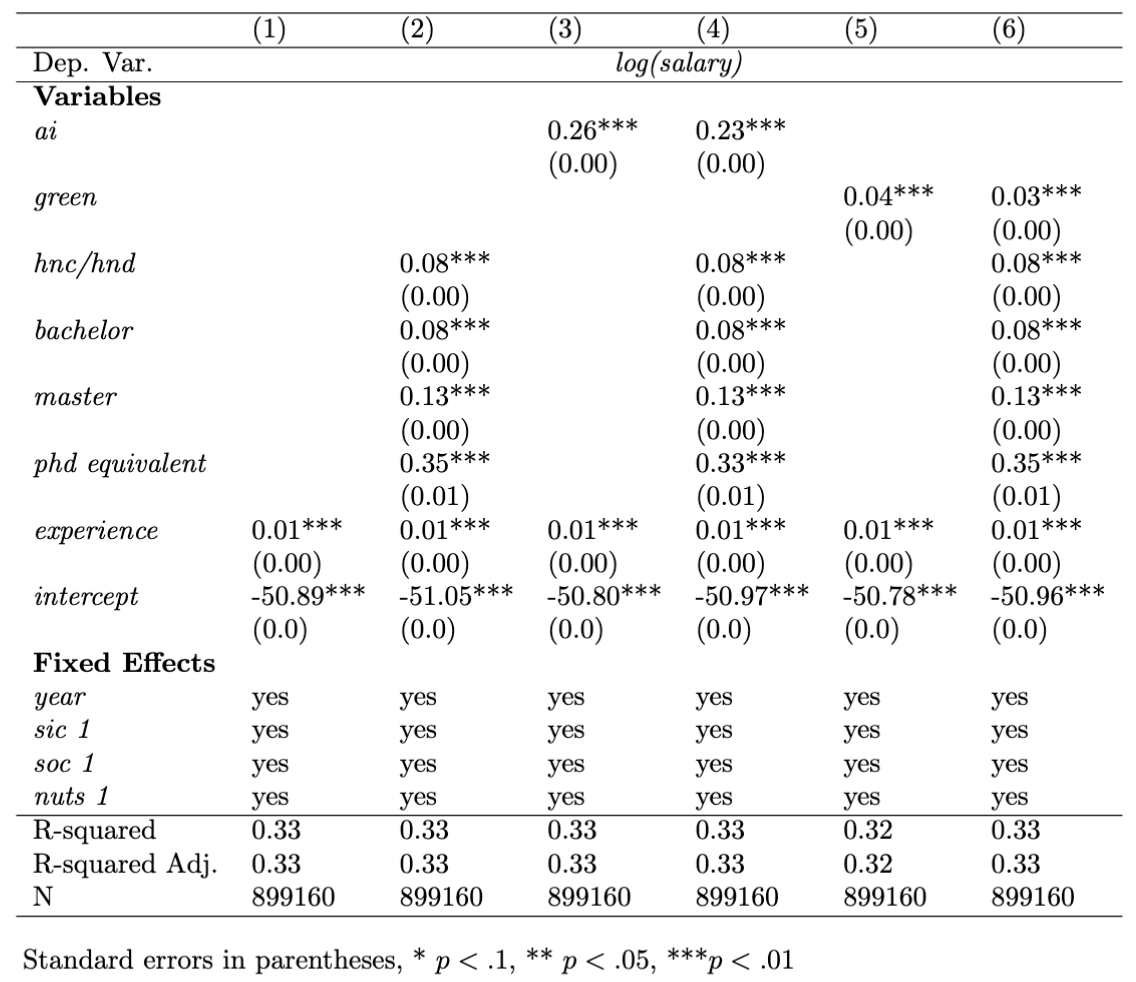
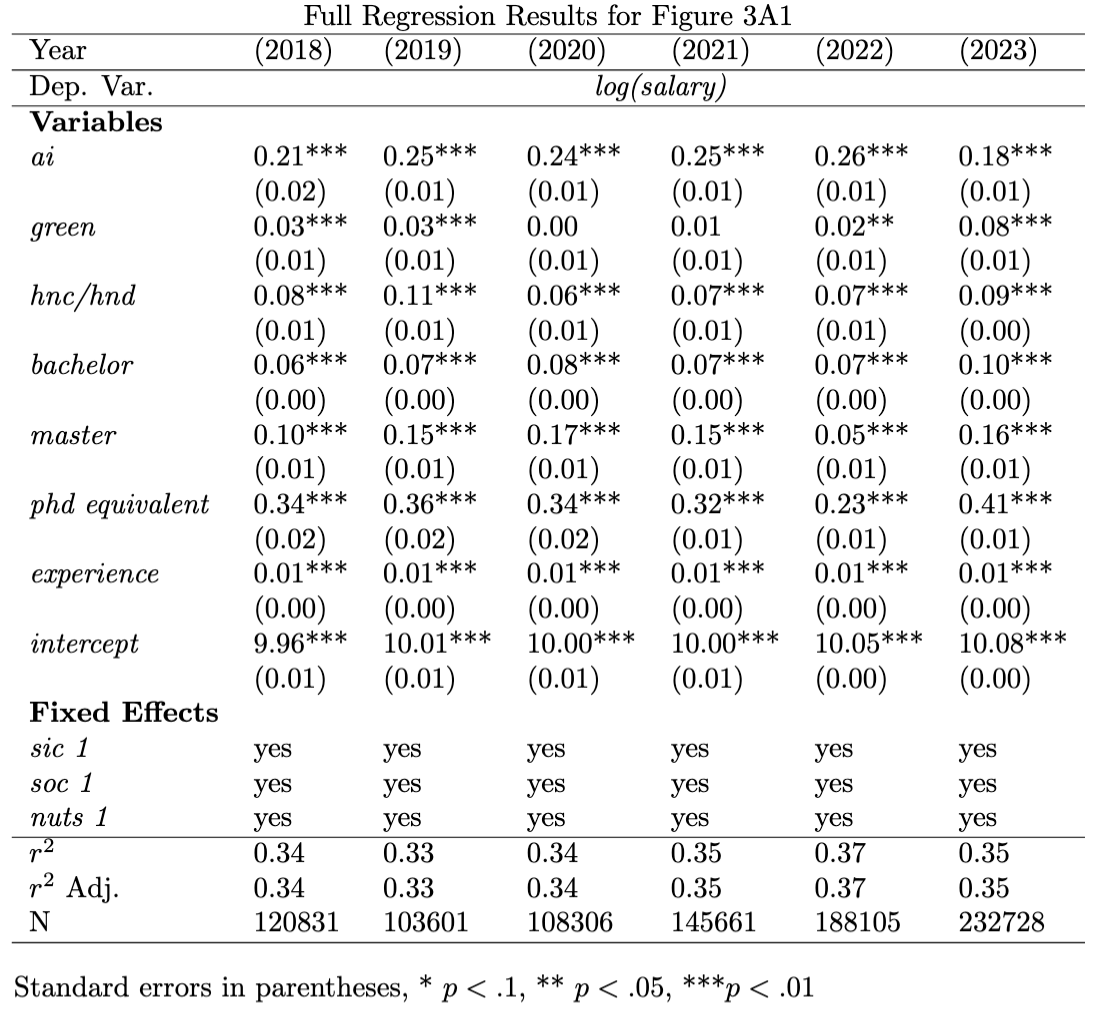
“In contrast, AI skills command a wage premium of 23%, exceeding the value of degrees up until the PhD-level (33%).”
§ Skills or Degree? The Rise of Skill-Based Hiring for AI and Green Jobs* > Abstract
plaincorrelational- Asserted: passes — The authors put it forward as true.
- Checkable: passes — It can be checked against evidence.
- Load-bearing: passes — The paper’s conclusions depend on it.
- Based: passes — The paper gives a reason why it holds.
The paper states this without a source or data behind it here, so there is nothing to check it against. The quote shows it is in the paper.
In the paper
“While green roles have constantly increased in relative demand, we see a significant drop in the demand for roles requiring AI skills in 2022, in our interpretation stemming from a period of tech layoffs in the UK during that year.”
§ Skills or Degree? The Rise of Skill-Based Hiring for AI and Green Jobs* > Green and AI roles are on the rise
hedged- Asserted: passes — The authors put it forward as true.
- Checkable: passes — It can be checked against evidence.
- Load-bearing: unclear — It is unclear whether the paper’s conclusions depend on it.
- Based: passes — The paper gives a reason why it holds.
- Probably not a substantial claim. 21
- It may state two separate claims as one. 62
The cited sources support only part of this claim — read each source’s verdict below.
In the paper
“Many of these studies have found that as technology becomes pervasive across industries, developed economies are increasingly requesting more highly skilled workers, while reducing the number of low skilled and routine jobs (Autor, 2014, Goos et al., 2014).”
§ Skills or Degree? The Rise of Skill-Based Hiring for AI and Green Jobs* > Does education still matter for green and AI roles?
What the sources say
- Not matchedcites Autor, 2014
Couldn’t be matched to a paper in Crossref, so it can’t be checked.
- Partly supportedcites Goos et al., 2014 sourceExperimental — accuracy not yet measured
The Conclusions report rising employment shares for high-paid professionals and managers and falling shares for routine office workers in Western Europe during 1993–2010. But they also report rising shares for low-paid personal service workers, so the claim that low-skilled jobs generally declined is not supported; the paper reports employment shares, not absolute job numbers. (LLM, conf=0.88)
boosteddirect- Asserted: passes — The authors put it forward as true.
- Checkable: passes — It can be checked against evidence.
- Load-bearing: fails — The paper’s conclusions may not depend on it.
- Based: passes — The paper gives a reason why it holds.
Probably not a substantial claim. The paper’s conclusions may not depend on it. It may state two separate claims as one.
- Not matched
A result the paper reports from its own data — it cites no other source for it, so there is none to check. The quote shows it is in the paper.
In the paper
“While the average salary for job postings remains slightly below £30k, green roles tend to offer higher salaries, with an upward trend reaching towards £40k by the end of the time series.”
§ Skills or Degree? The Rise of Skill-Based Hiring for AI and Green Jobs* > Green and AI roles are on the rise
plaincorrelational- Asserted: passes — The authors put it forward as true.
- Checkable: passes — It can be checked against evidence.
- Load-bearing: unclear — It is unclear whether the paper’s conclusions depend on it.
- Based: passes — The paper gives a reason why it holds.
It may state two separate claims as one.
A result the paper reports from its own data — it cites no other source for it, so there is none to check. The quote shows it is in the paper.
In the paper
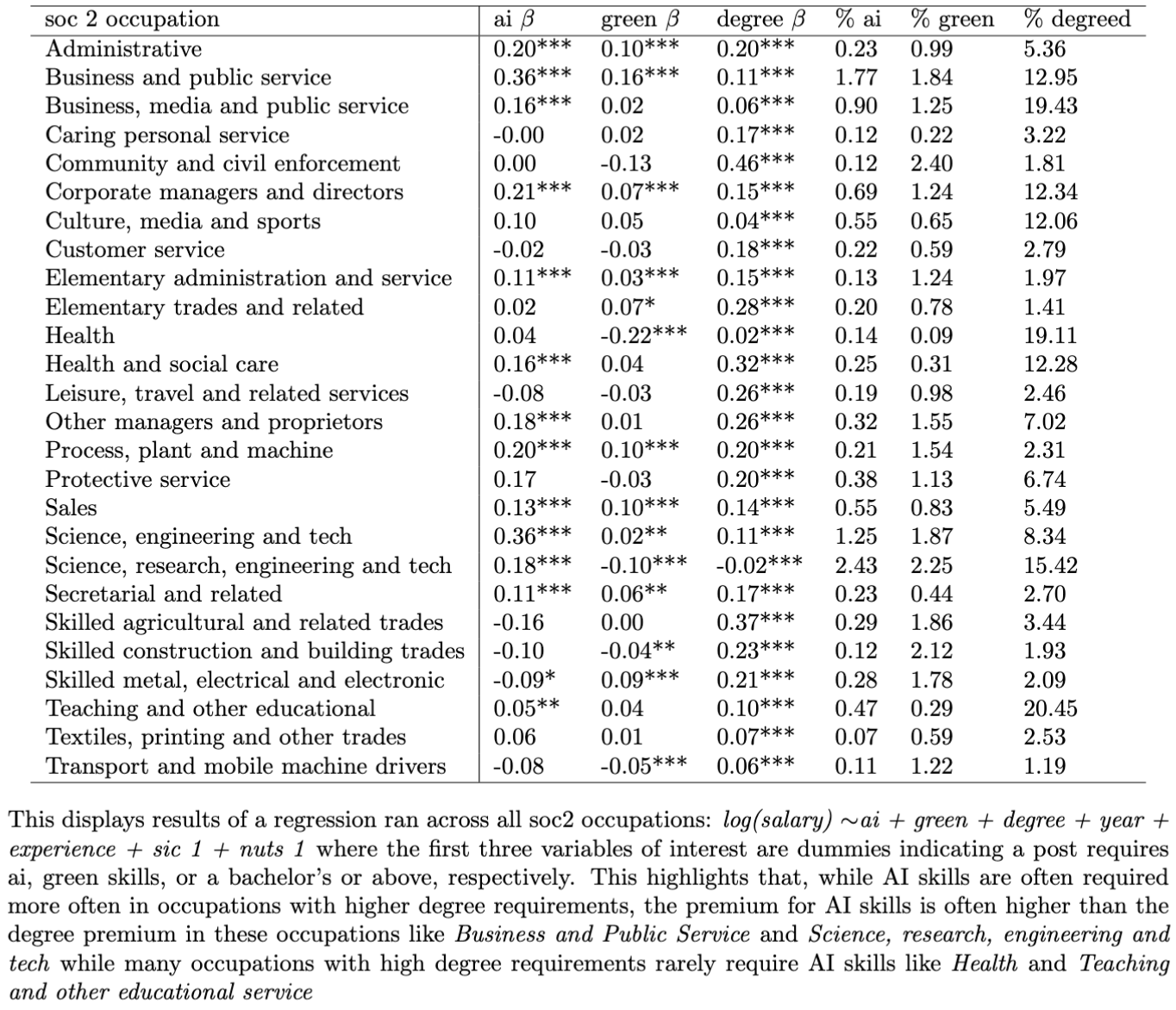
“In occupations with high demand for AI skills, the premium for skills is high, and the reward for degrees is relatively low.”
- Also stated in: § Introduction · plain
“For the case of AI roles, we reveal that premia on skills are most pronounced for occupations with above-average demand for AI talent.”
§ Skills or Degree? The Rise of Skill-Based Hiring for AI and Green Jobs* > Abstract
plaincorrelational- Asserted: passes — The authors put it forward as true.
- Checkable: passes — It can be checked against evidence.
- Load-bearing: passes — The paper’s conclusions depend on it.
- Based: passes — The paper gives a reason why it holds.
It may state two separate claims as one.
- Also stated in: § Introduction · plain
A result the paper reports from its own data — it cites no other source for it, so there is none to check. The quote shows it is in the paper.
In the paper
“In contrast, AI skills command a wage premium of 23%, exceeding the value of degrees up until the PhD-level (33%).”
§ Skills or Degree? The Rise of Skill-Based Hiring for AI and Green Jobs* > Abstract
plaincorrelational- Asserted: passes — The authors put it forward as true.
- Checkable: passes — It can be checked against evidence.
- Load-bearing: passes — The paper’s conclusions depend on it.
- Based: passes — The paper gives a reason why it holds.
It may state two separate claims as one.
A result the paper reports from its own data — it cites no other source for it, so there is none to check. The quote shows it is in the paper.
In the paper
“Skills related to generative adversarial networks (GANs), which form the backbone of advanced AI models such as ChatGPT, have shown relatively stable growth.”
§ Skills or Degree? The Rise of Skill-Based Hiring for AI and Green Jobs* > Green and AI roles are on the rise
plain- Asserted: passes — The authors put it forward as true.
- Checkable: passes — It can be checked against evidence.
- Load-bearing: fails — The paper’s conclusions may not depend on it.
- Based: passes — The paper gives a reason why it holds.
Probably not a substantial claim. The paper’s conclusions may not depend on it.
A result the paper reports from its own data — it cites no other source for it, so there is none to check. The quote shows it is in the paper.
In the paper
“After the 2022 layoff period, we observe a rapid rebound and steady increase in the demand for AI roles across the labour market.”
§ Skills or Degree? The Rise of Skill-Based Hiring for AI and Green Jobs* > Green and AI roles are on the rise
plain- Asserted: passes — The authors put it forward as true.
- Checkable: passes — It can be checked against evidence.
- Load-bearing: unclear — It is unclear whether the paper’s conclusions depend on it.
- Based: passes — The paper gives a reason why it holds.
It may state two separate claims as one.
A result the paper reports from its own data — it cites no other source for it, so there is none to check. The quote shows it is in the paper.
In the paper
“This correction reveals a less dramatic but still significant short-term drop off in the demand for AI roles.”
§ Skills or Degree? The Rise of Skill-Based Hiring for AI and Green Jobs* > Green and AI roles are on the rise
plain- Asserted: passes — The authors put it forward as true.
- Checkable: passes — It can be checked against evidence.
- Load-bearing: unclear — It is unclear whether the paper’s conclusions depend on it.
- Based: passes — The paper gives a reason why it holds.
It may state two separate claims as one.
The paper states this without a source or data behind it here, so there is nothing to check it against. The quote shows it is in the paper.
In the paper
“In line with that, while green vacancies still offer competitive remunerations, they have a less striking wage premium compared with other job postings.”
§ Skills or Degree? The Rise of Skill-Based Hiring for AI and Green Jobs* > Conclusion and Policy Recommendations
plain- Asserted: passes — The authors put it forward as true.
- Checkable: passes — It can be checked against evidence.
- Load-bearing: passes — The paper’s conclusions depend on it.
- Based: passes — The paper gives a reason why it holds.
It may state two separate claims as one.
The paper states this without a source or data behind it here, so there is nothing to check it against. The quote shows it is in the paper.
In the paper
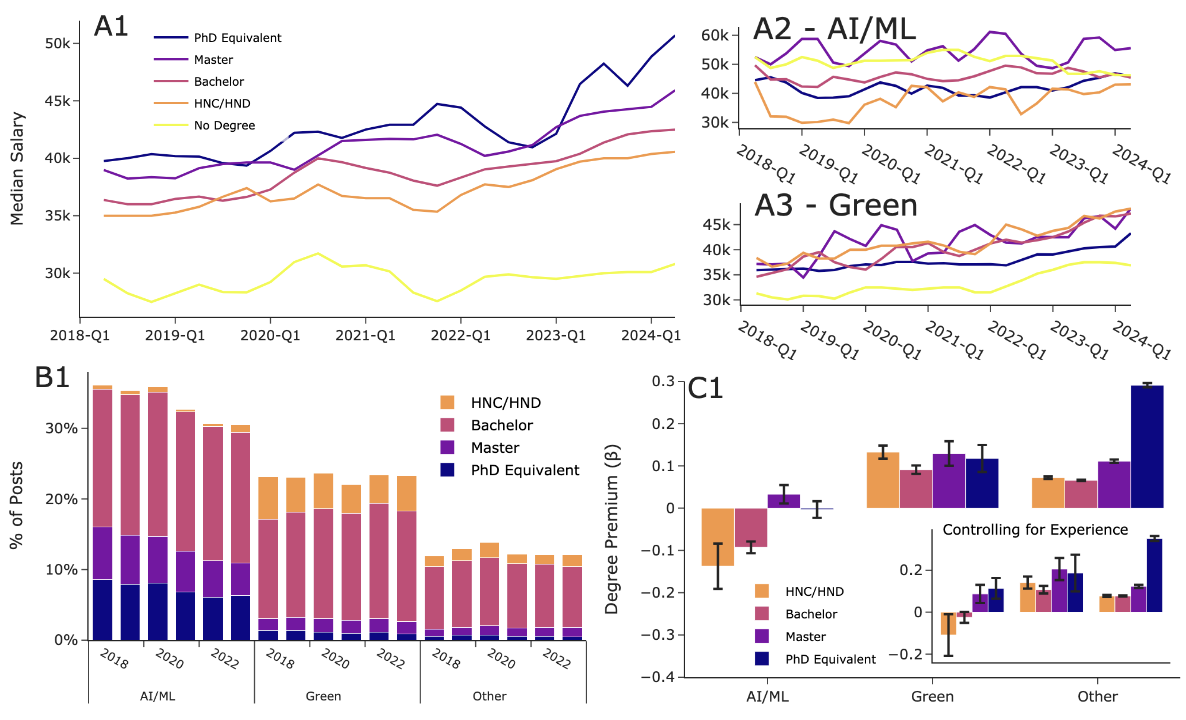
“Higher education correlates with higher wages, but there is also a noticeable increase in salaries for roles with no degree requirement, suggesting that growing demand in the green sector has pushed up wages across the board, even for less qualified roles.”
§ Skills or Degree? The Rise of Skill-Based Hiring for AI and Green Jobs* > Does education still matter for green and AI roles?
hedgedcorrelational- Asserted: passes — The authors put it forward as true.
- Checkable: passes — It can be checked against evidence.
- Load-bearing: passes — The paper’s conclusions depend on it.
- Based: passes — The paper gives a reason why it holds.
It may state two separate claims as one.
A result the paper reports from its own data — it cites no other source for it, so there is none to check. The quote shows it is in the paper.
In the paper
“Panel A1 illustrates the wage premium associated with higher education across all roles, with PhD holders earning the highest salaries, reaching around £50k by the end of the time series, while job postings without degree requirements offer significantly lower wages around £25k.”
§ Skills or Degree? The Rise of Skill-Based Hiring for AI and Green Jobs* > Conclusion and Policy Recommendations
plaincorrelational- Asserted: passes — The authors put it forward as true.
- Checkable: passes — It can be checked against evidence.
- Load-bearing: passes — The paper’s conclusions depend on it.
- Based: passes — The paper gives a reason why it holds.
It may state two separate claims as one.
A result the paper reports from its own data — it cites no other source for it, so there is none to check. The quote shows it is in the paper.
In the paper
“Over the past four years, job postings requiring at least one AI skill have increased by nearly 21% and increased by 67% for green skills.”
§ Skills or Degree? The Rise of Skill-Based Hiring for AI and Green Jobs* > Summary: Skill-based hiring for AI roles, mixed results for green jobs
plaindirect- Asserted: passes — The authors put it forward as true.
- Checkable: passes — It can be checked against evidence.
- Load-bearing: passes — The paper’s conclusions depend on it.
- Based: passes — The paper gives a reason why it holds.
It may state two separate claims as one.
A result the paper reports from its own data — it cites no other source for it, so there is none to check. The quote shows it is in the paper.
In the paper
“For one, we clearly observe that both AI and green skills have become more demanded in our observation period.”
§ Skills or Degree? The Rise of Skill-Based Hiring for AI and Green Jobs* > Does education still matter for green and AI roles?
boostedcorrelational- Asserted: passes — The authors put it forward as true.
- Checkable: passes — It can be checked against evidence.
- Load-bearing: passes — The paper’s conclusions depend on it.
- Based: passes — The paper gives a reason why it holds.
It may state two separate claims as one.
A result the paper reports from its own data — it cites no other source for it, so there is none to check. The quote shows it is in the paper.
In the paper
“We also find that controlling for experience reveals an educational gradient for AI/ML roles, though the premiums for HNC/HND roles are still negative, indicating that experience is a dominant factor in determining wages for AI/ML roles.”
§ Skills or Degree? The Rise of Skill-Based Hiring for AI and Green Jobs* > Additional information
hedgedcorrelational- Asserted: passes — The authors put it forward as true.
- Checkable: passes — It can be checked against evidence.
- Load-bearing: passes — The paper’s conclusions depend on it.
- Based: passes — The paper gives a reason why it holds.
It may state two separate claims as one.
A result the paper reports from its own data — it cites no other source for it, so there is none to check. The quote shows it is in the paper.
In the paper
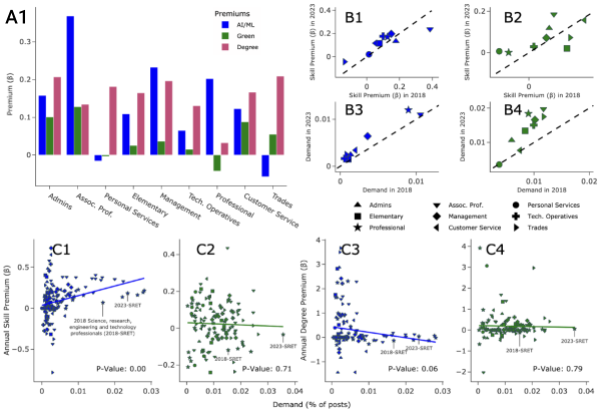
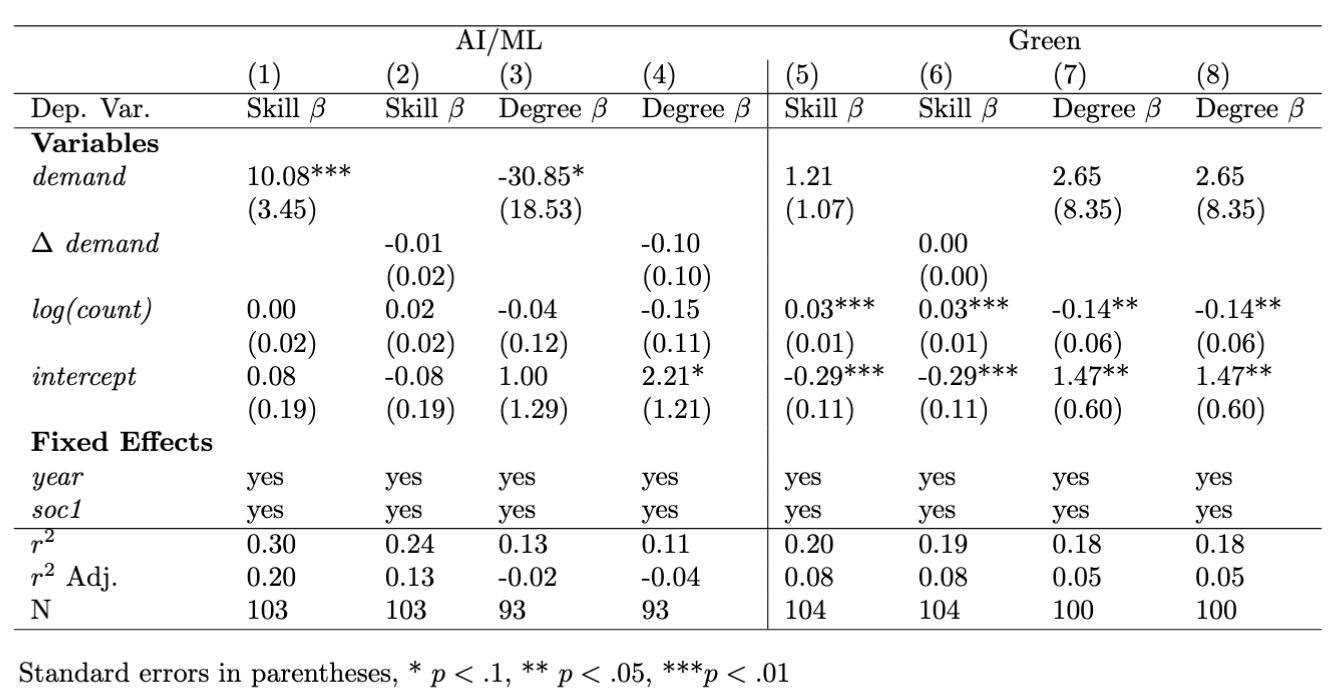
“For example, the AI skill premium is significantly higher than the offered reward for degrees in occupations related to Associate Professionals and management jobs, while in Trades and Professional Services degrees still offer a higher reward.”
§ Skills or Degree? The Rise of Skill-Based Hiring for AI and Green Jobs* > Does higher demand lead to skill-based hiring?
plaincorrelational- Asserted: passes — The authors put it forward as true.
- Checkable: passes — It can be checked against evidence.
- Load-bearing: passes — The paper’s conclusions depend on it.
- Based: passes — The paper gives a reason why it holds.
It may state two separate claims as one.
A result the paper reports from its own data — it cites no other source for it, so there is none to check. The quote shows it is in the paper.
In the paper
“Here, we see that for AI roles, the AI premium clearly increases the more skill intensive a role becomes, while the return on formal degrees diminishes.”
§ Skills or Degree? The Rise of Skill-Based Hiring for AI and Green Jobs* > Is the degree premium lower for AI and green roles?
boosteddirect- Asserted: passes — The authors put it forward as true.
- Checkable: passes — It can be checked against evidence.
- Load-bearing: passes — The paper’s conclusions depend on it.
- Based: passes — The paper gives a reason why it holds.
It may state two separate claims as one.
A result the paper reports from its own data — it cites no other source for it, so there is none to check. The quote shows it is in the paper.
In the paper
“Panel B1 highlights the higher educational requirements for AI and green roles, with 23% of green roles and 33% of AI roles demanding formal education, compared to just 12% of all other roles.”
§ Skills or Degree? The Rise of Skill-Based Hiring for AI and Green Jobs* > Does education still matter for green and AI roles?
plaincorrelational- Asserted: passes — The authors put it forward as true.
- Checkable: passes — It can be checked against evidence.
- Load-bearing: passes — The paper’s conclusions depend on it.
- Based: passes — The paper gives a reason why it holds.
It may state two separate claims as one.
A result the paper reports from its own data — it cites no other source for it, so there is none to check. The quote shows it is in the paper.
In the paper
“For the case of AI skills, we observe a clear positive relationship between skill demand and skill premium and a negative correlation between demand and degree premium.”
§ Skills or Degree? The Rise of Skill-Based Hiring for AI and Green Jobs* > Does higher demand lead to skill-based hiring?
boostedcorrelational- Asserted: passes — The authors put it forward as true.
- Checkable: passes — It can be checked against evidence.
- Load-bearing: passes — The paper’s conclusions depend on it.
- Based: passes — The paper gives a reason why it holds.
It may state two separate claims as one.
A result the paper reports from its own data — it cites no other source for it, so there is none to check. The quote shows it is in the paper.
In the paper
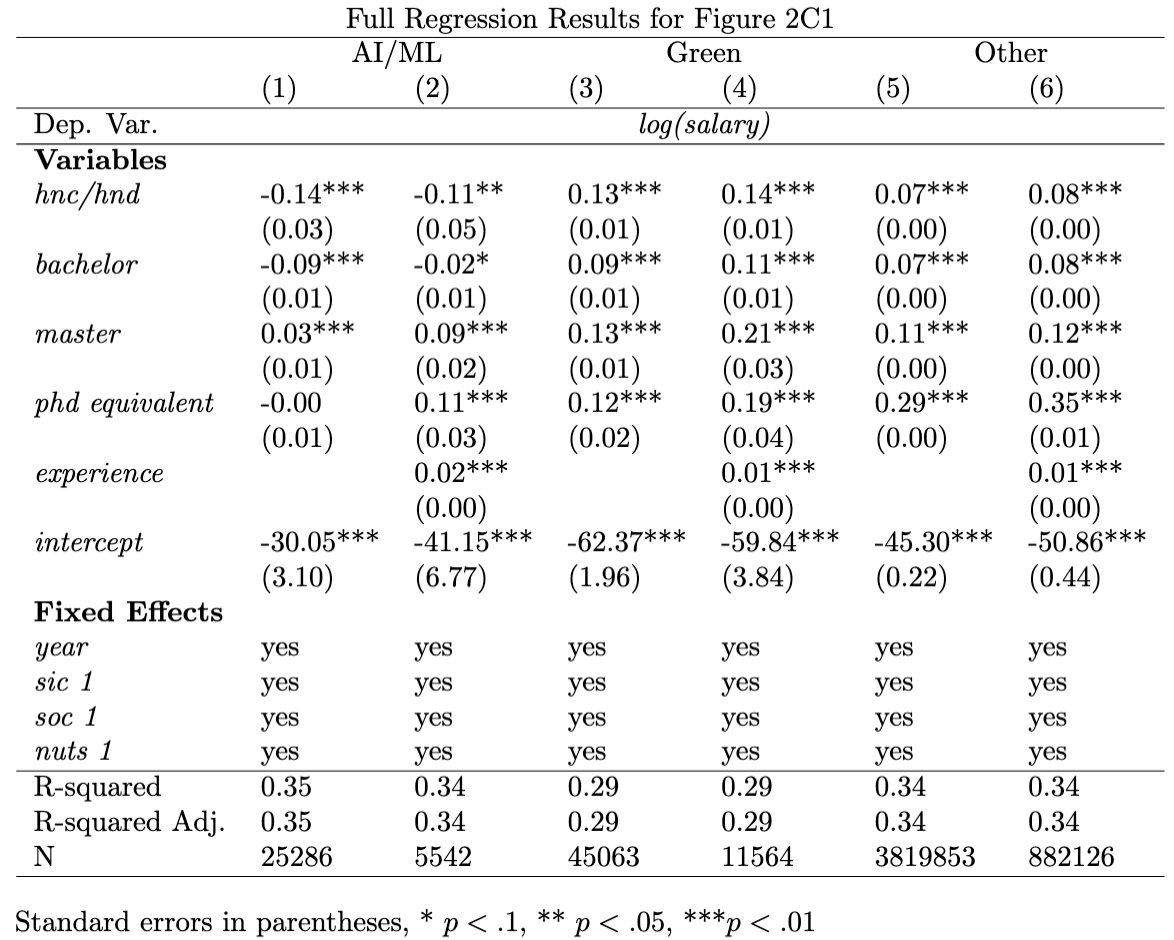
“For job offers outside of AI and green roles, Panel C1 illustrates a clear so-called educational gradient (rising premium the higher the degree).The regression results show a significant wage premium for those with technical or bachelor's degrees, an even higher premium for master's degrees, and a substantially greater premium for PhD holders-three times higher than for those with master's degrees”
§ Skills or Degree? The Rise of Skill-Based Hiring for AI and Green Jobs* > Is the degree premium lower for AI and green roles?
boostedcorrelational- Asserted: passes — The authors put it forward as true.
- Checkable: passes — It can be checked against evidence.
- Load-bearing: passes — The paper’s conclusions depend on it.
- Based: passes — The paper gives a reason why it holds.
It may state two separate claims as one.
A result the paper reports from its own data — it cites no other source for it, so there is none to check. The quote shows it is in the paper.
In the paper
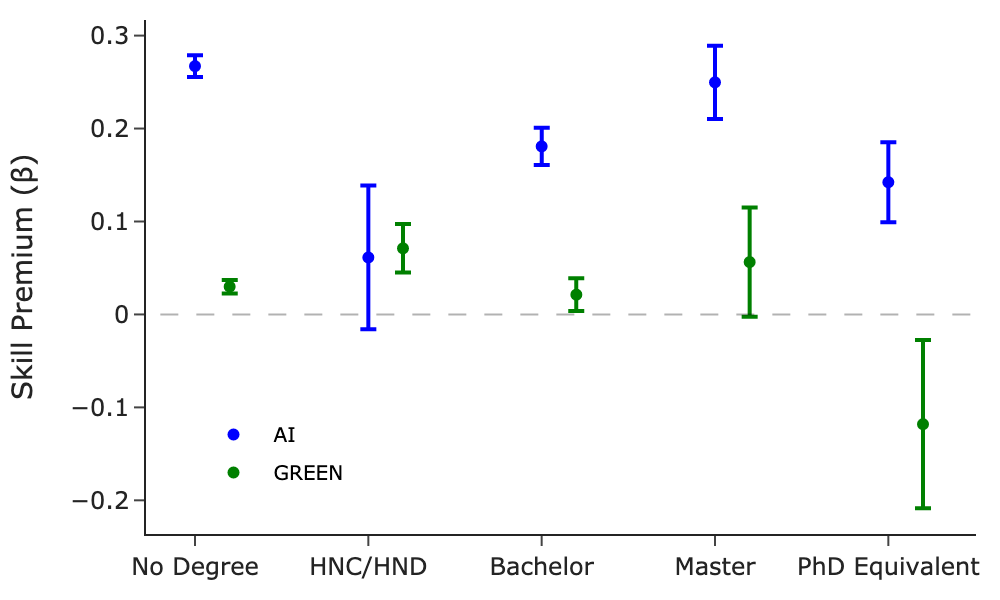
“However, for green roles, the educational gradient appears to have flattened.While roles requiring formal degrees still offer higher wages, the difference between educational levels-such as technical, bachelor's, and master's degrees-is not as pronounced.”
§ Skills or Degree? The Rise of Skill-Based Hiring for AI and Green Jobs* > Is the degree premium lower for AI and green roles?
hedgedcorrelational- Asserted: passes — The authors put it forward as true.
- Checkable: passes — It can be checked against evidence.
- Load-bearing: passes — The paper’s conclusions depend on it.
- Based: passes — The paper gives a reason why it holds.
It may state two separate claims as one.
A result the paper reports from its own data — it cites no other source for it, so there is none to check. The quote shows it is in the paper.
In the paper
“Additionally, green roles show a higher demand for technical qualifications (HNC, HND), reflecting the sector's technical nature, while AI roles demand a higher share of master's and PhD degrees.”
§ Skills or Degree? The Rise of Skill-Based Hiring for AI and Green Jobs* > Does education still matter for green and AI roles?
plaincorrelational- Asserted: passes — The authors put it forward as true.
- Checkable: passes — It can be checked against evidence.
- Load-bearing: passes — The paper’s conclusions depend on it.
- Based: passes — The paper gives a reason why it holds.
It may state two separate claims as one.
A result the paper reports from its own data — it cites no other source for it, so there is none to check. The quote shows it is in the paper.
In the paper
“Secondly, regarding monetary rewards, our analysis revealed that OJVs asking for a formal degree offer wages higher than postings without higher education requirements -8% higher for a bachelors, 13% for a masters and 35% for a PhD degree.”
§ Skills or Degree? The Rise of Skill-Based Hiring for AI and Green Jobs* > Summary: Skill-based hiring for AI roles, mixed results for green jobs
plaincorrelational- Asserted: passes — The authors put it forward as true.
- Checkable: passes — It can be checked against evidence.
- Load-bearing: passes — The paper’s conclusions depend on it.
- Based: passes — The paper gives a reason why it holds.
It may state two separate claims as one.
The paper states this without a source or data behind it here, so there is nothing to check it against. The quote shows it is in the paper.
In the paper
“The premium for Green skills is less clear for Bachelor's and Master's degrees and becomes negative for PhDs.”
§ Skills or Degree? The Rise of Skill-Based Hiring for AI and Green Jobs* > Conclusion and Policy Recommendations
plaincorrelational- Asserted: passes — The authors put it forward as true.
- Checkable: passes — It can be checked against evidence.
- Load-bearing: passes — The paper’s conclusions depend on it.
- Based: passes — The paper gives a reason why it holds.
It may state two separate claims as one.
A result the paper reports from its own data — it cites no other source for it, so there is none to check. The quote shows it is in the paper.
In the paper
“Job postings that do not require a degree hover around £25k, whereas positions requiring technical qualifications (HNC, HND), bachelor's, master's, or PhD degrees all offer salaries above £35k, with PhD roles nearing £50k towards the end of the time series.”
§ Skills or Degree? The Rise of Skill-Based Hiring for AI and Green Jobs* > Does education still matter for green and AI roles?
plaincorrelational- Asserted: passes — The authors put it forward as true.
- Checkable: passes — It can be checked against evidence.
- Load-bearing: passes — The paper’s conclusions depend on it.
- Based: passes — The paper gives a reason why it holds.
It may state two separate claims as one.
A result the paper reports from its own data — it cites no other source for it, so there is none to check. The quote shows it is in the paper.
In the paper
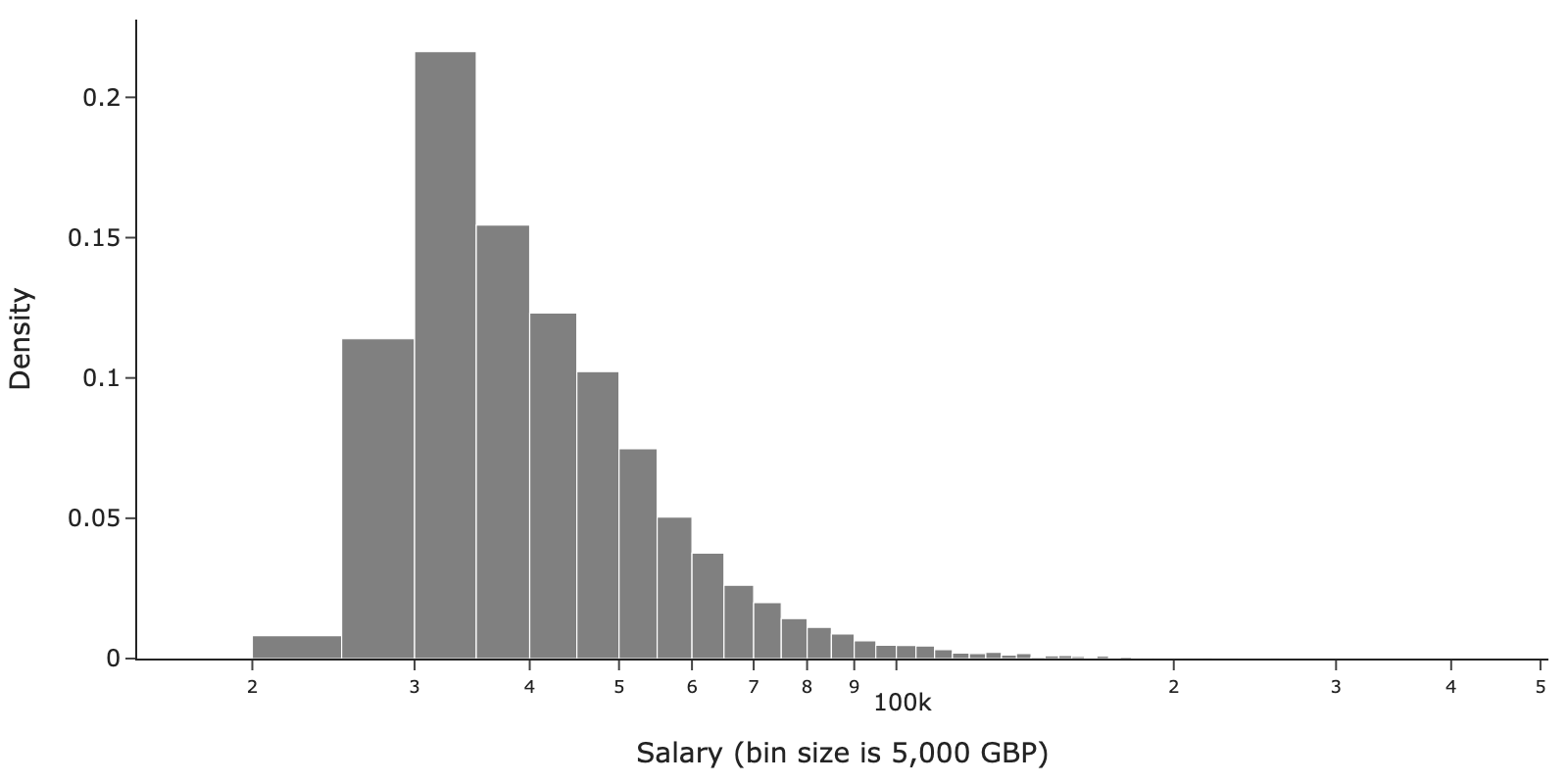
“Roughly 38.6 percent (4,187,603) of all job postings in our analysis contain wage information.”
§ Skills or Degree? The Rise of Skill-Based Hiring for AI and Green Jobs* > Conclusion and Policy Recommendations
plain- Asserted: passes — The authors put it forward as true.
- Checkable: passes — It can be checked against evidence.
- Load-bearing: fails — The paper’s conclusions may not depend on it.
- Based: passes — The paper gives a reason why it holds.
Probably not a substantial claim. The paper’s conclusions may not depend on it.
A result the paper reports from its own data — it cites no other source for it, so there is none to check. The quote shows it is in the paper.
In the paper
“For both AI and green skills, our model shows that wage premium for a respective skill increases with the demand for it.”
§ Skills or Degree? The Rise of Skill-Based Hiring for AI and Green Jobs* > Does higher demand lead to skill-based hiring?
plaindirect- Asserted: passes — The authors put it forward as true.
- Checkable: passes — It can be checked against evidence.
- Load-bearing: passes — The paper’s conclusions depend on it.
- Based: passes — The paper gives a reason why it holds.
It may state two separate claims as one.
A result the paper reports from its own data — it cites no other source for it, so there is none to check. The quote shows it is in the paper.
In the paper
“Wages are log-normal distributed and slightly right-skewed.”
§ Skills or Degree? The Rise of Skill-Based Hiring for AI and Green Jobs* > Conclusion and Policy Recommendations
plain- Asserted: passes — The authors put it forward as true.
- Checkable: passes — It can be checked against evidence.
- Load-bearing: passes — The paper’s conclusions depend on it.
- Based: passes — The paper gives a reason why it holds.
It may state two separate claims as one.
A result the paper reports from its own data — it cites no other source for it, so there is none to check. The quote shows it is in the paper.
In the paper
“In contrast to the premium of higher formal education across all postings (Figure 2-A1), we see that AI roles offer wages on a stable level and significantly higher than any role mentioning formal education can offer on average.”
§ Skills or Degree? The Rise of Skill-Based Hiring for AI and Green Jobs* > What is the premium of AI and green skills?
plaincorrelational- Asserted: passes — The authors put it forward as true.
- Checkable: passes — It can be checked against evidence.
- Load-bearing: passes — The paper’s conclusions depend on it.
- Based: passes — The paper gives a reason why it holds.
It may state two separate claims as one.
A result the paper reports from its own data — it cites no other source for it, so there is none to check. The quote shows it is in the paper.
In the paper
“However, this gradient is flattened for green roles and nearly absent for AI roles, indicating a shift in reward structures in these sectors.”
§ Skills or Degree? The Rise of Skill-Based Hiring for AI and Green Jobs* > Does education still matter for green and AI roles?
hedged- Asserted: passes — The authors put it forward as true.
- Checkable: passes — It can be checked against evidence.
- Load-bearing: passes — The paper’s conclusions depend on it.
- Based: passes — The paper gives a reason why it holds.
It may state two separate claims as one.
The paper states this without a source or data behind it here, so there is nothing to check it against. The quote shows it is in the paper.
In the paper
“Moreover, AI-related occupations typically require higher levels of education and a larger number of skills, reflecting the complex nature of these roles.”
§ Skills or Degree? The Rise of Skill-Based Hiring for AI and Green Jobs* > Conclusion and Policy Recommendations
plaincorrelational- Asserted: passes — The authors put it forward as true.
- Checkable: passes — It can be checked against evidence.
- Load-bearing: passes — The paper’s conclusions depend on it.
- Based: passes — The paper gives a reason why it holds.
It may state two separate claims as one.
A result the paper reports from its own data — it cites no other source for it, so there is none to check. The quote shows it is in the paper.
In the paper
“The regression shows that the wage premium for formal education has nearly disappeared.There is only a slight premium for master's degrees compared to no education, and no significant premium at all for PhDs.”
§ Skills or Degree? The Rise of Skill-Based Hiring for AI and Green Jobs* > Is the degree premium lower for AI and green roles?
plain- Asserted: passes — The authors put it forward as true.
- Checkable: passes — It can be checked against evidence.
- Load-bearing: passes — The paper’s conclusions depend on it.
- Based: passes — The paper gives a reason why it holds.
It may state two separate claims as one.
A result the paper reports from its own data — it cites no other source for it, so there is none to check. The quote shows it is in the paper.
In the paper
“For green roles, the return on skills is relatively stable and the economic reward offered for formal degrees decreases slightly.”
§ Skills or Degree? The Rise of Skill-Based Hiring for AI and Green Jobs* > Is the degree premium lower for AI and green roles?
plaindirect- Asserted: passes — The authors put it forward as true.
- Checkable: passes — It can be checked against evidence.
- Load-bearing: passes — The paper’s conclusions depend on it.
- Based: passes — The paper gives a reason why it holds.
It may state two separate claims as one.
A result the paper reports from its own data — it cites no other source for it, so there is none to check. The quote shows it is in the paper.
In the paper
“When controlling for experience, as seen in the subplot of the figure, the educational gradient reappears slightly but remains much weaker for AI and green roles compared to other sectors.”
§ Skills or Degree? The Rise of Skill-Based Hiring for AI and Green Jobs* > Is the degree premium lower for AI and green roles?
plaincorrelational- Asserted: passes — The authors put it forward as true.
- Checkable: passes — It can be checked against evidence.
- Load-bearing: passes — The paper’s conclusions depend on it.
- Based: passes — The paper gives a reason why it holds.
It may state two separate claims as one.
A result the paper reports from its own data — it cites no other source for it, so there is none to check. The quote shows it is in the paper.
In the paper
“The strongest growth in skills is observed in renewable energy, waste removal, nuclear power, and machine learning technologies like generative adversarial networks.”
§ Skills or Degree? The Rise of Skill-Based Hiring for AI and Green Jobs* > Conclusion and Policy Recommendations
boosted- Asserted: passes — The authors put it forward as true.
- Checkable: passes — It can be checked against evidence.
- Load-bearing: passes — The paper’s conclusions depend on it.
- Based: passes — The paper gives a reason why it holds.
It may state two separate claims as one.
A result the paper reports from its own data — it cites no other source for it, so there is none to check. The quote shows it is in the paper.
In the paper
“In addition, our regression analysis shows that AI skills offer a monetary reward on par with formal education requirements, as they exhibit a wage premium of 23% which sits between a masters degree and PhD.”
§ Skills or Degree? The Rise of Skill-Based Hiring for AI and Green Jobs* > Summary: Skill-based hiring for AI roles, mixed results for green jobs
plaincorrelational- Asserted: passes — The authors put it forward as true.
- Checkable: passes — It can be checked against evidence.
- Load-bearing: passes — The paper’s conclusions depend on it.
- Based: passes — The paper gives a reason why it holds.
It may state two separate claims as one.
A result the paper reports from its own data — it cites no other source for it, so there is none to check. The quote shows it is in the paper.
In the paper
“In fact, for AI roles, the beta coefficient is negative for both technical qualifications and bachelor's degrees, indicating that AI roles that don't require a degree are typically seeking workers with more skills than these degrees offer.”
§ Skills or Degree? The Rise of Skill-Based Hiring for AI and Green Jobs* > Is the degree premium lower for AI and green roles?
hedgedcorrelational- Asserted: passes — The authors put it forward as true.
- Checkable: passes — It can be checked against evidence.
- Load-bearing: passes — The paper’s conclusions depend on it.
- Based: passes — The paper gives a reason why it holds.
It may state two separate claims as one.
A result the paper reports from its own data — it cites no other source for it, so there is none to check. The quote shows it is in the paper.
In the paper
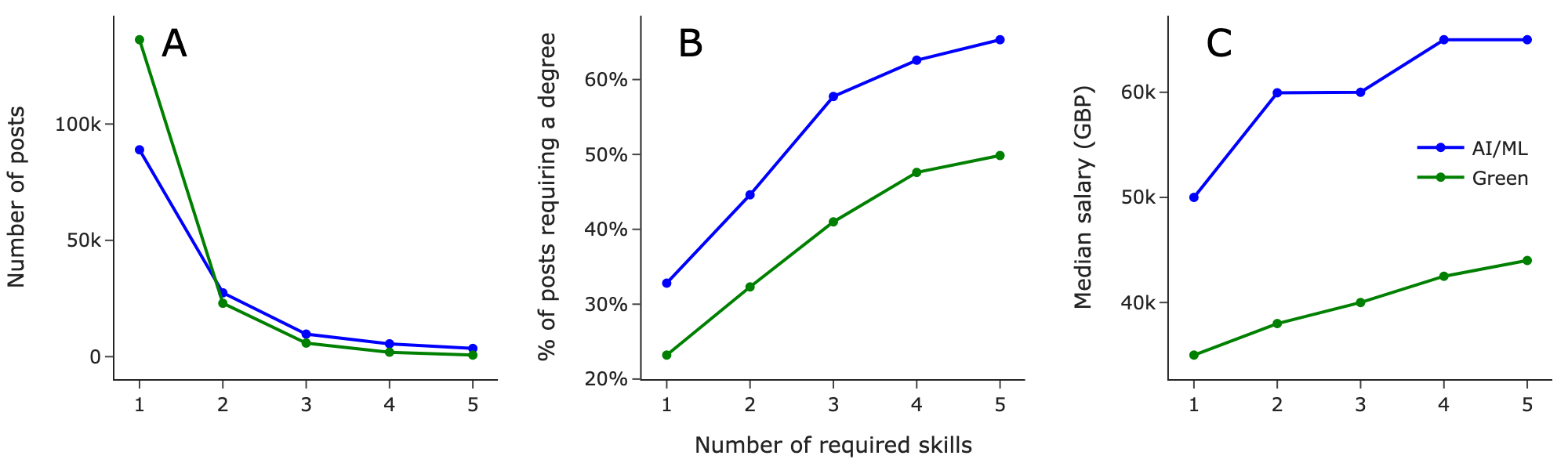
“On the other hand, we notice that for both AI and green postings, the educational requirements (B) and the offered wages (C) increases with the number of respective skills required in the OJVs.”
§ Skills or Degree? The Rise of Skill-Based Hiring for AI and Green Jobs* > Conclusion and Policy Recommendations
plaindirect- Asserted: passes — The authors put it forward as true.
- Checkable: passes — It can be checked against evidence.
- Load-bearing: passes — The paper’s conclusions depend on it.
- Based: passes — The paper gives a reason why it holds.
It may state two separate claims as one.
A result the paper reports from its own data — it cites no other source for it, so there is none to check. The quote shows it is in the paper.
In the paper
“In the case of green roles, formal education is still associated with higher wages overall, but the educational gradient has flattened.”
§ Skills or Degree? The Rise of Skill-Based Hiring for AI and Green Jobs* > Is the degree premium lower for AI and green roles?
plaincorrelational- Asserted: passes — The authors put it forward as true.
- Checkable: passes — It can be checked against evidence.
- Load-bearing: passes — The paper’s conclusions depend on it.
- Based: passes — The paper gives a reason why it holds.
It may state two separate claims as one.
A result the paper reports from its own data — it cites no other source for it, so there is none to check. The quote shows it is in the paper.
In the paper
“Nevertheless, C1 and C3 in Figure 3, support our hypothesis that skill premiums increase with, and degree premiums decrease with, demand for AI skills.”
§ Skills or Degree? The Rise of Skill-Based Hiring for AI and Green Jobs* > Does higher demand lead to skill-based hiring?
hedgeddirect- Asserted: passes — The authors put it forward as true.
- Checkable: passes — It can be checked against evidence.
- Load-bearing: passes — The paper’s conclusions depend on it.
- Based: passes — The paper gives a reason why it holds.
It may state two separate claims as one.
A result the paper reports from its own data — it cites no other source for it, so there is none to check. The quote shows it is in the paper.
In the paper
“Our analysis further suggests that employers are seeking AI and green skills differently, reducing degree requirements for AI roles while increasing wages for green roles.”
§ Skills or Degree? The Rise of Skill-Based Hiring for AI and Green Jobs* > Conclusion and Policy Recommendations
hedgeddirect- Asserted: passes — The authors put it forward as true.
- Checkable: passes — It can be checked against evidence.
- Load-bearing: passes — The paper’s conclusions depend on it.
- Based: passes — The paper gives a reason why it holds.
It may state two separate claims as one.
A result the paper reports from its own data — it cites no other source for it, so there is none to check. The quote shows it is in the paper.
In the paper
“The highest-paying positions tend to require a master's degree, but roles with no formal degree requirement also offer relatively high wages, comparable to those with technical, bachelor's, or PhD qualifications.”
§ Skills or Degree? The Rise of Skill-Based Hiring for AI and Green Jobs* > Does education still matter for green and AI roles?
hedgedcorrelational- Asserted: passes — The authors put it forward as true.
- Checkable: passes — It can be checked against evidence.
- Load-bearing: passes — The paper’s conclusions depend on it.
- Based: passes — The paper gives a reason why it holds.
It may state two separate claims as one.
A result the paper reports from its own data — it cites no other source for it, so there is none to check. The quote shows it is in the paper.
In the paper
“This is also the region with the largest share of AI and Green postings.”
§ Skills or Degree? The Rise of Skill-Based Hiring for AI and Green Jobs* > Additional information
plain- Asserted: passes — The authors put it forward as true.
- Checkable: passes — It can be checked against evidence.
- Load-bearing: fails — The paper’s conclusions may not depend on it.
- Based: passes — The paper gives a reason why it holds.
Probably not a substantial claim. The paper’s conclusions may not depend on it.
A result the paper reports from its own data — it cites no other source for it, so there is none to check. The quote shows it is in the paper.
In the paper
“Panel A3 reflects a more consistent educational gradient for green roles, where higher education correlates with higher wages, although there is also a notable increase in wages for roles without formal degree requirements.”
§ Skills or Degree? The Rise of Skill-Based Hiring for AI and Green Jobs* > Does education still matter for green and AI roles?
plaincorrelational- Asserted: passes — The authors put it forward as true.
- Checkable: passes — It can be checked against evidence.
- Load-bearing: passes — The paper’s conclusions depend on it.
- Based: passes — The paper gives a reason why it holds.
It may state two separate claims as one.
A result the paper reports from its own data — it cites no other source for it, so there is none to check. The quote shows it is in the paper.
In the paper
“AI skills show a significant wage premium of 23%, second only to holding a PhD (33%) and higher than a master's degree (13%) (Models 3 and 4).”
- Also stated in: § What is the premium of AI and green skills? · plain
“For example, even when controlling for geographical, sectorial, occupational, and educational variance, AI skills exhibit a wage premium on offering wages of 23% -second only to having a PhD (33%) -and significantly higher than for a master's degree (13%).”
§ Skills or Degree? The Rise of Skill-Based Hiring for AI and Green Jobs* > What is the premium of AI and green skills?
plaincorrelational- Asserted: passes — The authors put it forward as true.
- Checkable: passes — It can be checked against evidence.
- Load-bearing: passes — The paper’s conclusions depend on it.
- Based: passes — The paper gives a reason why it holds.
It may state two separate claims as one.
- Also stated in: § What is the premium of AI and green skills? · plain
A result the paper reports from its own data — it cites no other source for it, so there is none to check. The quote shows it is in the paper.
In the paper
“On the other hand, we notice that for both AI and green postings, the educational requirements (B) and the offered wages (C) increases with the number of respective skills required in the OJVs.”
§ Skills or Degree? The Rise of Skill-Based Hiring for AI and Green Jobs* > Conclusion and Policy Recommendations
plaindirect- Asserted: passes — The authors put it forward as true.
- Checkable: passes — It can be checked against evidence.
- Load-bearing: passes — The paper’s conclusions depend on it.
- Based: passes — The paper gives a reason why it holds.
It may state two separate claims as one.
A conclusion the paper draws from its own results — it cites no other source for it, so there is none to check. The quote shows it is in the paper.
In the paper
“in our interpretation stemming from a period of tech layoffs in the UK during that year.”
§ Skills or Degree? The Rise of Skill-Based Hiring for AI and Green Jobs* > Green and AI roles are on the rise
hedgeddirect- Asserted: passes — The authors put it forward as true.
- Checkable: passes — It can be checked against evidence.
- Load-bearing: fails — The paper’s conclusions may not depend on it.
- Based: fails — The paper may give no reason why it holds.
Probably not a substantial claim. The paper’s conclusions may not depend on it. The paper may give no reason why it holds.
What the paper did — it cites no source for this, so there is none to check. The quote shows it is in the paper.
In the paper
“Additionally, for the UK, the database contains data on the salaries advertised within these vacancies for about 39% of the sample.”
§ Skills or Degree? The Rise of Skill-Based Hiring for AI and Green Jobs* > Online job vacancies
plain- Asserted: passes — The authors put it forward as true.
- Checkable: passes — It can be checked against evidence.
- Load-bearing: fails — The paper’s conclusions may not depend on it.
- Based: passes — The paper gives a reason why it holds.
Probably not a substantial claim. The paper’s conclusions may not depend on it.
In the paper
“Globally, education and training institutions are struggling to keep pace with AI development, resulting in curricula being misaligned from industry needs.”
§ Skills or Degree? The Rise of Skill-Based Hiring for AI and Green Jobs* > Is the workforce ready for change?
What the sources say
- Not matchedcites UNESCO, 2022
Couldn’t be matched to a paper in Crossref, so it can’t be checked.
plaindirect- Asserted: passes — The authors put it forward as true.
- Checkable: passes — It can be checked against evidence.
- Load-bearing: passes — The paper’s conclusions depend on it.
- Based: passes — The paper gives a reason why it holds.
It may state two separate claims as one.
- Not matched
In the paper
“Similarly, Russia's invasion of Ukraine in 2022 motivated many governments to boost alternative energy resources such as solar and wind energy in order to reduce gas imports from Russia (IEA, 2023).”
§ Skills or Degree? The Rise of Skill-Based Hiring for AI and Green Jobs* > Green and AI roles are on the rise
What the sources say
- Not matchedcites IEA, 2023
Couldn’t be matched to a paper in Crossref, so it can’t be checked.
plaindirect- Asserted: passes — The authors put it forward as true.
- Checkable: passes — It can be checked against evidence.
- Load-bearing: fails — The paper’s conclusions may not depend on it.
- Based: passes — The paper gives a reason why it holds.
Probably not a substantial claim. The paper’s conclusions may not depend on it.
- Not matched
In the paper
“Additionally, at higher education level, where the UK has advanced AI programmes and a large percentage of graduates on STEM programmes, academics´focus and research also differs from industry´s priorities, meaning scholar research is not always pertinent or directly applicable to the needs of the economy and the private sector (Al-Sulaiti, Khalid & Dwivedi, Yogesh, 2024).”
§ Skills or Degree? The Rise of Skill-Based Hiring for AI and Green Jobs* > Is the workforce ready for change?
What the sources say
- Not matchedcites Al-Sulaiti, Khalid & Dwivedi, Yogesh, 2024
Couldn’t be matched to a paper in Crossref, so it can’t be checked.
plaindirect- Asserted: passes — The authors put it forward as true.
- Checkable: passes — It can be checked against evidence.
- Load-bearing: passes — The paper’s conclusions depend on it.
- Based: passes — The paper gives a reason why it holds.
It may state two separate claims as one.
- Not matched
In the paper
“Saussay et al. (2022) developed a methodology to accurately isolate low-carbon activities in online job vacancy data, producing a list of 445 low-carbon skills that can be used as low-carbon job identifiers.”
§ Skills or Degree? The Rise of Skill-Based Hiring for AI and Green Jobs* > A skill-based approach to identify AI and green roles
What the sources say
- Not matchedcites Saussay et al. (2022)
Couldn’t be matched to a paper in Crossref, so it can’t be checked.
plaindirect- Asserted: passes — The authors put it forward as true.
- Checkable: passes — It can be checked against evidence.
- Load-bearing: passes — The paper’s conclusions depend on it.
- Based: passes — The paper gives a reason why it holds.
It may state two separate claims as one.
- Not matched
In the paper
“Approximations indicate that overall, the digital skills gap in the UK inflicts an economic damage of over 60 billion GBP per year on the country's GDP (Department for Digital, Culture, Media and Sport, 2022).”
§ Skills or Degree? The Rise of Skill-Based Hiring for AI and Green Jobs* > Is the workforce ready for change?
What the sources say
- Not matchedcites Department for Digital, Culture, Media and Sport, 2022
Couldn’t be matched to a paper in Crossref, so it can’t be checked.
hedgeddirect- Asserted: passes — The authors put it forward as true.
- Checkable: passes — It can be checked against evidence.
- Load-bearing: fails — The paper’s conclusions may not depend on it.
- Based: passes — The paper gives a reason why it holds.
Probably not a substantial claim. The paper’s conclusions may not depend on it.
- Not matched
In the paper
“The COVID-19 pandemic of 2020, for example, increased the reliance on digital technologies (OECD, 2023) and pressured companies across all sectors to enhance their use of technology and data at a faster pace.”
§ Skills or Degree? The Rise of Skill-Based Hiring for AI and Green Jobs* > Green and AI roles are on the rise
What the sources say
- Not matchedcites OECD, 2023
Couldn’t be matched to a paper in Crossref, so it can’t be checked.
plaindirect- Asserted: passes — The authors put it forward as true.
- Checkable: passes — It can be checked against evidence.
- Load-bearing: fails — The paper’s conclusions may not depend on it.
- Based: passes — The paper gives a reason why it holds.
Probably not a substantial claim. The paper’s conclusions may not depend on it. It may state two separate claims as one.
- Not matched
A conclusion the paper draws from its own results — it cites no other source for it, so there is none to check. The quote shows it is in the paper.
In the paper
“In this context, the success of the UK in the transition towards AI and green jobs will depend on the capacity of the workforce to meet the needs of employers.”
§ Skills or Degree? The Rise of Skill-Based Hiring for AI and Green Jobs* > Is the workforce ready for change?
plaindirect- Asserted: passes — The authors put it forward as true.
- Checkable: passes — It can be checked against evidence.
- Load-bearing: passes — The paper’s conclusions depend on it.
- Based: fails — The paper may give no reason why it holds.
Probably not a substantial claim. The paper may give no reason why it holds.
A conclusion the paper draws from its own results — it cites no other source for it, so there is none to check. The quote shows it is in the paper.
In the paper
“Further, they also suggest that employers are striving to adopt sustainable practices, or at least to meet the legal regulations regarding environmental impact.”
§ Skills or Degree? The Rise of Skill-Based Hiring for AI and Green Jobs* > Green and AI roles are on the rise
hedged- Asserted: passes — The authors put it forward as true.
- Checkable: passes — It can be checked against evidence.
- Load-bearing: fails — The paper’s conclusions may not depend on it.
- Based: fails — The paper may give no reason why it holds.
Probably not a substantial claim. The paper’s conclusions may not depend on it. The paper may give no reason why it holds. It may state two separate claims as one.
A conclusion the paper draws from its own results — it cites no other source for it, so there is none to check. The quote shows it is in the paper.
In the paper
“Our findings are consistent with prior literature that shows that the impact of the green and AI roles in the labour market has become more evident in recent years, when specific events prompted and expedited the use of AI and the adoption of environmental policies.”
§ Skills or Degree? The Rise of Skill-Based Hiring for AI and Green Jobs* > Green and AI roles are on the rise
plaindirect- Asserted: passes — The authors put it forward as true.
- Checkable: passes — It can be checked against evidence.
- Load-bearing: fails — The paper’s conclusions may not depend on it.
- Based: passes — The paper gives a reason why it holds.
Probably not a substantial claim. The paper’s conclusions may not depend on it.
What the paper did — it cites no source for this, so there is none to check. The quote shows it is in the paper.
In the paper
“Some types of vacancies are heavily represented while others are less advertised, as shown in Table A3 in the Appendix.”
§ Skills or Degree? The Rise of Skill-Based Hiring for AI and Green Jobs* > Online job vacancies
plain- Asserted: passes — The authors put it forward as true.
- Checkable: passes — It can be checked against evidence.
- Load-bearing: fails — The paper’s conclusions may not depend on it.
- Based: passes — The paper gives a reason why it holds.
Probably not a substantial claim. The paper’s conclusions may not depend on it.
In the paper
“For instance, a survey conducted by UNESCO, found that in 2022, across 190 countries only 15 were developing AI curricula in schools, and the UK was not among them.”
§ Skills or Degree? The Rise of Skill-Based Hiring for AI and Green Jobs* > Is the workforce ready for change?
What the sources say
- Not matchedcites UNESCO
Couldn’t be matched to a paper in Crossref, so it can’t be checked.
plain- Asserted: passes — The authors put it forward as true.
- Checkable: passes — It can be checked against evidence.
- Load-bearing: unclear — It is unclear whether the paper’s conclusions depend on it.
- Based: passes — The paper gives a reason why it holds.
It may state two separate claims as one.
- Not matched
A conclusion the paper draws from its own results — it cites no other source for it, so there is none to check. The quote shows it is in the paper.
In the paper
“This suggests that both green and AI roles are more skill-intensive than average, underscoring the importance of a diverse skill set in these rapidly growing fields.”
§ Skills or Degree? The Rise of Skill-Based Hiring for AI and Green Jobs* > Green and AI roles are on the rise
hedgedcorrelational- Asserted: passes — The authors put it forward as true.
- Checkable: passes — It can be checked against evidence.
- Load-bearing: passes — The paper’s conclusions depend on it.
- Based: passes — The paper gives a reason why it holds.
It may state two separate claims as one.
A conclusion the paper draws from its own results — it cites no other source for it, so there is none to check. The quote shows it is in the paper.
In the paper
“Furthermore, given that this is not an isolated problem and a wide range of countries are facing similar skills mismatches, we can expect the increasing competitiveness to trigger a global competition for human capital, making the issue even more urgent.”
§ Skills or Degree? The Rise of Skill-Based Hiring for AI and Green Jobs* > Is the workforce ready for change?
plaindirect- Asserted: passes — The authors put it forward as true.
- Checkable: passes — It can be checked against evidence.
- Load-bearing: fails — The paper’s conclusions may not depend on it.
- Based: fails — The paper may give no reason why it holds.
Probably not a substantial claim. The paper’s conclusions may not depend on it. The paper may give no reason why it holds.
- Rests on an assumption: A wide range of countries are facing similar skills mismatches.
The paper states this without a source or data behind it here, so there is nothing to check it against. The quote shows it is in the paper.
In the paper
“Secondly, in situations where skills are relatively low in supply compared to high levels of demand, their market value increases and employers are compelled to adopt novel hiring practices to increase the talent pool.”
§ Skills or Degree? The Rise of Skill-Based Hiring for AI and Green Jobs* > The shift towards skill-based hiring
plaindirect- Asserted: passes — The authors put it forward as true.
- Checkable: passes — It can be checked against evidence.
- Load-bearing: passes — The paper’s conclusions depend on it.
- Based: unclear — It is unclear why the paper says it holds.
It may state two separate claims as one.
What the paper did — it cites no source for this, so there is none to check. The quote shows it is in the paper.
In the paper
“For industries, business admin and support services are significantly more prominent in OJV in contrast to motor trades, wholesale, and retail, which is underrepresented.”
§ Skills or Degree? The Rise of Skill-Based Hiring for AI and Green Jobs* > Additional information
plaincorrelational- Asserted: passes — The authors put it forward as true.
- Checkable: passes — It can be checked against evidence.
- Load-bearing: unclear — It is unclear whether the paper’s conclusions depend on it.
- Based: passes — The paper gives a reason why it holds.
It may state two separate claims as one.
A conclusion the paper draws from its own results — it cites no other source for it, so there is none to check. The quote shows it is in the paper.
In the paper
“Additionally, in emerging fields such as AI and the green domains, where employers are struggling to find the right talent, attracting and recruiting candidates based on skills rather than formal education degrees may contribute to increasing the size of the talent pool and potentially, tackling skills shortages.”
§ Skills or Degree? The Rise of Skill-Based Hiring for AI and Green Jobs* > Conclusion and Policy Recommendations
hedgedconditional- Asserted: passes — The authors put it forward as true.
- Checkable: passes — It can be checked against evidence.
- Load-bearing: passes — The paper’s conclusions depend on it.
- Based: passes — The paper gives a reason why it holds.
Probably not a substantial claim. It may state two separate claims as one.
- Rests on an assumption: The demand for green and AI skills far exceeds supply, making it hard for employers to find candidates with the needed skills.
What the paper did — it cites no source for this, so there is none to check. The quote shows it is in the paper.
In the paper
“However, it is worth noticing, as a limitation of this work, that we only observe offered salaries by the nature of the data.This means that the later negotiated salaries for the position advertised might differ from the wage levels considered in our analysis.”
§ Skills or Degree? The Rise of Skill-Based Hiring for AI and Green Jobs* > What is the premium of AI and green skills?
hedged- Asserted: passes — The authors put it forward as true.
- Checkable: passes — It can be checked against evidence.
- Load-bearing: fails — The paper’s conclusions may not depend on it.
- Based: passes — The paper gives a reason why it holds.
Probably not a substantial claim. The paper’s conclusions may not depend on it. It may state two separate claims as one.
A conclusion the paper draws from its own results — it cites no other source for it, so there is none to check. The quote shows it is in the paper.
In the paper
“By requesting a specific level of education, employers may limit the number of candidates and overlook individuals who have developed skills through alternative paths such as on-the-job learning, online courses and social interactions.”
§ Skills or Degree? The Rise of Skill-Based Hiring for AI and Green Jobs* > Conclusion and Policy Recommendations
hedgedconditional- Asserted: passes — The authors put it forward as true.
- Checkable: passes — It can be checked against evidence.
- Load-bearing: passes — The paper’s conclusions depend on it.
- Based: passes — The paper gives a reason why it holds.
Probably not a substantial claim. It may state two separate claims as one.
- Rests on an assumption: Employers place weight on university degrees.
A conclusion the paper draws from its own results — it cites no other source for it, so there is none to check. The quote shows it is in the paper.
In the paper
“This suggests that the demand for skills in AI has shifted away from formal educational qualifications, with a greater emphasis on practical skills and experience.”
§ Skills or Degree? The Rise of Skill-Based Hiring for AI and Green Jobs* > Is the degree premium lower for AI and green roles?
hedgeddirect- Asserted: passes — The authors put it forward as true.
- Checkable: passes — It can be checked against evidence.
- Load-bearing: passes — The paper’s conclusions depend on it.
- Based: passes — The paper gives a reason why it holds.
It may state two separate claims as one.
What the paper did — it cites no source for this, so there is none to check. The quote shows it is in the paper.
In the paper
“To control for potential confounders, such as industry type, occupational sector, or regional disparities, we run a regression model to explain wage premia for formal education across the AI and green roles:”
§ Skills or Degree? The Rise of Skill-Based Hiring for AI and Green Jobs* > What is the premium of AI and green skills?
plain- Asserted: passes — The authors put it forward as true.
- Checkable: passes — It can be checked against evidence.
- Load-bearing: passes — The paper’s conclusions depend on it.
- Based: passes — The paper gives a reason why it holds.
Probably not a substantial claim.
What the paper did — it cites no source for this, so there is none to check. The quote shows it is in the paper.
In the paper
“However, there are some notable exceptions: The capital, London, is slightly overrepresented in our data.”
§ Skills or Degree? The Rise of Skill-Based Hiring for AI and Green Jobs* > Additional information
plain- Asserted: passes — The authors put it forward as true.
- Checkable: passes — It can be checked against evidence.
- Load-bearing: fails — The paper’s conclusions may not depend on it.
- Based: passes — The paper gives a reason why it holds.
Probably not a substantial claim. The paper’s conclusions may not depend on it.
A conclusion the paper draws from its own results — it cites no other source for it, so there is none to check. The quote shows it is in the paper.
In the paper
“This indicates that AI may be enabling individuals without advanced degrees to perform complex tasks, thereby reducing the wage premium traditionally associated with higher education.”
§ Skills or Degree? The Rise of Skill-Based Hiring for AI and Green Jobs* > Does education still matter for green and AI roles?
hedgedconditional- Asserted: passes — The authors put it forward as true.
- Checkable: passes — It can be checked against evidence.
- Load-bearing: passes — The paper’s conclusions depend on it.
- Based: passes — The paper gives a reason why it holds.
It may state two separate claims as one.
What the paper did — it cites no source for this, so there is none to check. The quote shows it is in the paper.
In the paper
“We see that OJV data is mostly representative of the UK labour force regarding geography, industries, and occupations.”
§ Skills or Degree? The Rise of Skill-Based Hiring for AI and Green Jobs* > Additional information
plain- Asserted: passes — The authors put it forward as true.
- Checkable: passes — It can be checked against evidence.
- Load-bearing: passes — The paper’s conclusions depend on it.
- Based: passes — The paper gives a reason why it holds.
It may state two separate claims as one.
A conclusion the paper draws from its own results — it cites no other source for it, so there is none to check. The quote shows it is in the paper.
In the paper
“The study shows that the minimum level of education required within AI jobs wields diminished influence over the wage premium, which supports the idea that firms are applying skills-based hiring practices within their recruitment processes for AI jobs.”
§ Skills or Degree? The Rise of Skill-Based Hiring for AI and Green Jobs* > What is the premium of AI and green skills?
plain- Asserted: passes — The authors put it forward as true.
- Checkable: passes — It can be checked against evidence.
- Load-bearing: passes — The paper’s conclusions depend on it.
- Based: passes — The paper gives a reason why it holds.
It may state two separate claims as one.
A conclusion the paper draws from its own results — it cites no other source for it, so there is none to check. The quote shows it is in the paper.
In the paper
“By eliminating the minimum level of education from job postings, employers increase the talent pool and may be able to find more suitable candidates.”
§ Skills or Degree? The Rise of Skill-Based Hiring for AI and Green Jobs* > Does education still matter for green and AI roles?
hedgeddirect- Asserted: passes — The authors put it forward as true.
- Checkable: passes — It can be checked against evidence.
- Load-bearing: passes — The paper’s conclusions depend on it.
- Based: unclear — It is unclear why the paper says it holds.
It may state two separate claims as one.
A conclusion the paper draws from its own results — it cites no other source for it, so there is none to check. The quote shows it is in the paper.
In the paper
“A skills-based hiring approach can increase the number of potential candidates, the variety of workers' social backgrounds and add diverse insights to the workforce.”
§ Skills or Degree? The Rise of Skill-Based Hiring for AI and Green Jobs* > Conclusion and Policy Recommendations
plaindirect- Asserted: passes — The authors put it forward as true.
- Checkable: passes — It can be checked against evidence.
- Load-bearing: passes — The paper’s conclusions depend on it.
- Based: passes — The paper gives a reason why it holds.
It may state two separate claims as one.
- Rests on an assumption: The demand for green and AI skills far exceeds supply, making it hard for employers to find candidates with the needed skills.
None of the sources cited for this claim have been checked yet.
In the paper
“Thus, higher educational credentials have tended to be positively associated with employment rates and earning advantages (Mincer, 1974, Carbonaro, 2007;OECD, 2022).”
§ Skills or Degree? The Rise of Skill-Based Hiring for AI and Green Jobs* > Does education still matter for green and AI roles?
What the sources say
- Not matchedcites Mincer, 1974
Couldn’t be matched to a paper in Crossref, so it can’t be checked.
- Not checked — no full text of the sourcecites Carbonaro, 2007 source
- Not matchedcites OECD, 2022
Couldn’t be matched to a paper in Crossref, so it can’t be checked.
hedgedcorrelational- Asserted: passes — The authors put it forward as true.
- Checkable: passes — It can be checked against evidence.
- Load-bearing: fails — The paper’s conclusions may not depend on it.
- Based: passes — The paper gives a reason why it holds.
Probably not a substantial claim. The paper’s conclusions may not depend on it.
- Not matched
A conclusion the paper draws from its own results — it cites no other source for it, so there is none to check. The quote shows it is in the paper.
In the paper
“This indicates that employers looking for AI skills are already applying skill-based hiring while this doesn't seem to be the case for Green skills.”
§ Skills or Degree? The Rise of Skill-Based Hiring for AI and Green Jobs* > Does higher demand lead to skill-based hiring?
hedged- Asserted: passes — The authors put it forward as true.
- Checkable: passes — It can be checked against evidence.
- Load-bearing: passes — The paper’s conclusions depend on it.
- Based: passes — The paper gives a reason why it holds.
It may state two separate claims as one.
In the paper
“Data indicates that over 70% of workers learn through their job and interactions with others, compared to only 8% who are enrolled in formal education programmes (OECD, 2020).”
§ Skills or Degree? The Rise of Skill-Based Hiring for AI and Green Jobs* > Does education still matter for green and AI roles?
What the sources say
- Not matchedcites OECD, 2020
Couldn’t be matched to a paper in Crossref, so it can’t be checked.
hedged- Asserted: passes — The authors put it forward as true.
- Checkable: passes — It can be checked against evidence.
- Load-bearing: passes — The paper’s conclusions depend on it.
- Based: passes — The paper gives a reason why it holds.
It may state two separate claims as one.
- Not matched
What the paper did — it cites no source for this, so there is none to check. The quote shows it is in the paper.
In the paper
“Lastly, OJVs show more postings in professional occupations and less than average job offers for elementary occupations.”
§ Skills or Degree? The Rise of Skill-Based Hiring for AI and Green Jobs* > Additional information
plaincorrelational- Asserted: passes — The authors put it forward as true.
- Checkable: passes — It can be checked against evidence.
- Load-bearing: fails — The paper’s conclusions may not depend on it.
- Based: passes — The paper gives a reason why it holds.
Probably not a substantial claim. The paper’s conclusions may not depend on it. It may state two separate claims as one.
The authors state this as an assumption.
AI and green skills contribute positively to firms' profitability and are progressively being demanded by employers while remaining relatively scarce in supply.
“assuming that AI and green skills contribute positively to firms' profitability and are progressively being demanded by employers while remaining relatively scarce in supply, we anticipate an increase in their market value, leading to wage premium offerings and a limited focus on candidates' qualifications for AI and green jobs as well as an adoption of skills-based hiring for jobs in these”
The paper relies on this without support.
Posted salaries serve as an indicator of companies' willingness to compensate for specific skill sets demanded in job postings.
“Although these posted salaries may not reflect the accurate remuneration received by hired employees, they serve as an indicator of the companies' willingness to compensate for specific skill sets demanded in the job postings.”
The paper relies on this without support.
A wide range of countries are facing similar skills mismatches.
“Furthermore, given that this is not an isolated problem and a wide range of countries are facing similar skills mismatches, we can expect the increasing competitiveness to trigger a global competition for human capital, making the issue even more urgent.”
The paper relies on this without support.
Job vacancy postings accurately reflect employers' demand for skills and their hiring practices.
“By analysing job vacancies with the lists of skills, we found that employers are looking for a wide variety of skills related to the development and implementation of AI.”
The paper relies on this without support.
The UK job vacancy data is representative of the UK labour market.
“Our analysis of eleven million OJVs reveals a rising demand for AI and green skills in the UK, reflecting the continuous efforts of firms to adopt AI -and the AI-human complementarity-and meet environmental sustainability targets.”
The paper relies on this without support.
The demand for green and AI skills far exceeds supply, making it hard for employers to find candidates with the needed skills.
“As mentioned above, the literature suggests that the demand for green and AI skills is far exceeding supply, making it hard for employers to find candidates with the skills needed to navigate societal and technological change.”
The paper relies on this without support.
Employers place weight on university degrees.
“Given the weight placed by employers on university degrees, a good avenue for doing so might be through higher education.”
The paper relies on this without support.
Education and industry will keep evolving at uneven paces.
“Given that education and industry will keep evolving at uneven paces, employers should progressively focus on candidates' skills rather than on their formal qualifications.”
The paper relies on this without support.
Employers will not immediately respond to a tight labour market by increasing offered wages.
“We used a two-year lag variable as employers will not immediately respond to a tight labour market by increasing offered wages”
Self-check
Percentages, sums and reported differences re-computed from the paper’s own numbers.
Each contradiction between two passages listed here was confirmed by an independent check.
Rated major: it would touch a result — a value a result rests on, reported and recomputed p-values on opposite sides of the significance level, two passages that conflict with no sign which is right, or a cited work retracted before this paper was published.
In the paper
§ Skills or Degree? The Rise of Skill-Based Hiring for AI and Green Jobs* > Does higher demand lead to skill-based hiring?
“For both AI and green skills, our model shows that wage premium for a respective skill increases with the demand for it.”
§ Skills or Degree? The Rise of Skill-Based Hiring for AI and Green Jobs* > Summary: Skill-based hiring for AI roles, mixed results for green jobs
“For green skills, however, the relationship between demand and premium is flat.”
Rated major: it would touch a result — a value a result rests on, reported and recomputed p-values on opposite sides of the significance level, two passages that conflict with no sign which is right, or a cited work retracted before this paper was published.
In the paper
§ Skills or Degree? The Rise of Skill-Based Hiring for AI and Green Jobs* > Introduction
“Our results show that vacancies demanding these disruptive skills are also associated with significant wage premiums.”
§ Skills or Degree? The Rise of Skill-Based Hiring for AI and Green Jobs* > What is the premium of AI and green skills?
“Green skills do not exhibit a significant wage premium (Models 4 and 5).”
Citations
Cites
The future of employment: How susceptible are jobs to computerisation?
Frey, C. B., & Osborne, M. A. (2017) · Technological Forecasting and Social Change · doi:10.1016/j.techfore.2016.08.019 · Cited by 8,727
The Skill Content of Recent Technological Change: An Empirical Exploration
Autor, D. H., Levy, F., & Murnane, R. J. (2003) · The Quarterly Journal of Economics · doi:10.1162/003355303322552801 · Cited by 6,205
Artificial Intelligence in Education: A Review
Chen, L., Chen, P., & Lin, Z. (2020) · IEEE Access · doi:10.1109/access.2020.2988510 · Cited by 4,133
Why Are There Still So Many Jobs? The History and Future of Workplace Automation
Autor, D. H. (2015) · Journal of Economic Perspectives · doi:10.1257/jep.29.3.3 · Cited by 3,917
The growth of low-skill service jobs and the polarization of the US labor market
Autor, D. H., & Dorn, D. (2013) · American Economic Review · doi:10.1257/aer.103.5.1553 · Cited by 3,824
Skills, Tasks and Technologies: Implications for Employment and Earnings
Acemoglu, D., & Autor, D. (2011) · Handbook of Labor Economics · doi:10.1016/s0169-7218(11)02410-5 · Cited by 3,799
Wage Inequality and the Rise in Returns to Skill
Juhn, C., Murphy, K., & Pierce, B. (1993) · Journal of Political Economy · doi:10.1086/261881 · Cited by 2,794
Automation and New Tasks: How Technology Displaces and Reinstates Labor
Acemoglu, D., & Restrepo, P. (2019) · Journal of Economic Perspectives · doi:10.1257/jep.33.2.3 · Cited by 2,612
Explaining Job Polarization: Routine-Biased Technological Change and Offshoring
Goos, M., Manning, A., & Salomons, A. (2014) · American Economic Review · doi:10.1257/aer.104.8.2509 · Cited by 2,111
Human Capital, A Theoretical and Empirical Analysis with Special Reference to Education
Caire, G., & Becker, G. S. (1967) · Revue économique · doi:10.2307/3499575 · Cited by 1,993
Research works printed but not linked: 4
- Cambridge Industrial Innovation Policy
- Fuller, 2022, Skills-based hiring is on the rise, Harv. Bus. Rev., 11, 1
- Illanes, 2018, 8(1), 1
- Lancaster, V. A., Mahoney-Nair, D., and Ratcliff, N. (2021) Review of burning glass job-ad data. Proceedings of the biocomplexity institute 2021-013, biocomplexity institute.
Cited by
Sorted by citations
Items 101–128 of 128
Shahin, M. (2026) · SSRN Electronic Journal · doi:10.2139/ssrn.7439321
AI Workforce Trends and Business Skill Requirements in Indonesia: A Job Posting–Based Analysis
Koswara, A. (2025) · Synergy Journal of Business Finance and Management · doi:10.68111/sjbfm.v1i1.9
Andini, R., & Harianto, E. (2026) · Journal of Economics and Management Scienties · doi:10.37034/jems.v8i4.530
Governing Digital‐Green Transitions: A Configurational Synthesis of Employment Outcomes
Ly, B. (2026) · Journal of Public Affairs · doi:10.1002/pa.70157
The Impact of Artificial Intelligence on Labor, Employment Contracts, and Professional Identity
Makinde, O. F. (2026) · Advances in computational intelligence and robotics book series · doi:10.4018/979-8-3373-4642-7.ch006
Xiao, W., 韦韩韫, Wu, M., & Deng, L. (2026) · Finance research letters · doi:10.1016/j.frl.2026.110804
Muñoz-Mera, E. L. (2026) · Research Club Scientia · doi:10.65415/csdcx253
Supporting Microlearning Ecosystems Through Verifiable Digital Credentials
Urem, F., Gundić, A., & Jureković, D. (2026) · International Conference on Advanced Computer Information Technologies (ACIT) · doi:10.1109/acit69831.2026.11700048
Chantika, I. P. (2026) · Journal of Social Science and Business Studies · doi:10.61487/jssbs.v4i3.243
Salazar, J. K. F., Bautista, L. A., Zelada, P. V., Licapa-Redolfo, G. S., Carrera, J. A. T., & Montoya, I. D. M. T. (2026) · Encyclopedia · doi:10.3390/encyclopedia6100216
Rajagukguk, S. A. (2026) · International Conference on ICT for Smart Society (ICISS) · doi:10.1109/iciss71466.2026.11715117
(2026) · Issues in Information Systems · doi:10.48009/2_iis_2026_113
Radonjić-Petrović, D. (2026) · Ekonomika · doi:10.5937/ekonomika2603103r
Aleryani, A. Y. (2026) · E-Learning Innovations Journal. · doi:10.57125/elij.2026.09.25.07
Mughal, M., & Qureshi, H. A. (2026) · Journal of Information Technology Case and Application Research · doi:10.1080/15228053.2026.2745304
How digital workplace conditions shape career adaptability: the mediating role of job satisfaction
Nguyễn, T. L., Ha, T. T. A., Ma, T.-N., Phương, L. L., & Pham, M. H. (2026) · Journal of Organizational Effectiveness People and Performance · doi:10.1108/joepp-03-2026-0353
Kurroh, K., Ningtias, I. W., Rosadi, S. A. R., Khomariyah, N., & Anshori, M. I. (2026) · Pajak dan Manajemen Keuangan · doi:10.61132/pajamkeu.v3i5.2640
Artificial Intelligence Policy and Wage Gaps: Evidence from China
Li, J., Huang, J., & 杨, 欢. (2026) · Asia Pacific Economic and Management Review · doi:10.62177/apemr.v3i5.1737
Horváth, L., & Simon, Á. (2026) · GiLE Journal of Skills Development · doi:10.52398/gjsd.2026.v6.i2.pp233-239
Microcredentialing Framework for On-demand Learning: Easing Tensions and Expanding Learning Pathways
Bandalaria, M. D. P., & Almodiel, M. C. (2026) · Lecture notes in educational technology · doi:10.1007/978-981-92-5197-1_8
On-Demand Learning for Lifelong and Responsive Education
Liu, D., Prinsloo, P., Kanwar, A. S., Kalim, U., & Zhang, Y. (2026) · Lecture notes in educational technology · doi:10.1007/978-981-92-5197-1
YUQORI MALAKALI KADRLAR UCHUN GLOBAL RAQOBAT: MARKAZIY OSIYO MISOLIDA
Habibullayev, K. (2026) · Labor Economics and Human Capital · doi:10.67668/lehc/vol5iss4/357
AI Pilot Zones and Labor Market Demand: Evidence from China
Wei, J. (2026) · Advances in Economics Management and Political Sciences · doi:10.54254/2754-1169/2026.38359
How Digital Skills Reshape the Quality of Youth Employment
Li, Y. (2026) · SHS Web of Conferences · doi:10.1051/shsconf/202624204024
Microcredenciales en la educación superior ecuatoriana: calidad, trazabilidad y gobernanza.
Molina, O. A. M., Villegas, R. A. M., Fernández, J. R. U., & Castillo, O. S. C. (2026) · Innova Science Journal · doi:10.63618/omd/isj/v4/n4/429
Ogbo, O. S., Nwogboji, E. U., & Sunday, I. E. (2026) · IIAR Journal of Education Learning and Human Development · doi:10.68854/fpn69z64
Metadata
- Authors
- Bone, M., González Ehlinger, E., & Stephany, F.
- Affiliations
- University of Oxford (GB)
- Bruegel (BE)
- Corresponding author
- Stephany, Fabian
- ORCID
- Stephany, Fabian
- Venue
- Technological Forecasting and Social Change
- Publisher
- Elsevier BV
- Published
- 2025-05
- Volume
- 214
- Pages
- 124042
- ISSN
- 0040-1625 (ISSN-L)
- OpenAlex
- W4407964516
- Cited by
- 130
- References
- 47
- Citations by year
- 2026: 96 · 2025: 32
- FWCI
- 92.06
- Type
- journal article
- Language
- en
- Open access
- hybrid
- doi.org
- Licence
- Locations
- Technological Forecasting and Social Change (publishedVersion, cc-by)
- RePEc: Research Papers in Economics (submittedVersion)
- arXiv (Cornell University) (submittedVersion, cc-by)
- arXiv (Cornell University) (cc-by)
- Topics
- Social Sciences › Economics, Econometrics and Finance › Economics and Econometrics › Labor market dynamics and wage inequality
- Social Sciences › Education › Higher Education and Employability
- Social Sciences › Business, Management and Accounting › Organizational Behavior and Human Resource Management › Employer Branding and e-HRM
- Keywords
- degree requirements, green jobs, labor shortage, job vacancies, wage premium, emerging professions, human capital, vocational education and training, apprenticeship, MOOCs, UK labour market
About these checks
Registry, retraction, Cites and statistics results are computed, not judged, with one exception: a printed reference that no index lists is read once by a model before it counts as a citation error. Claims are extracted by a model and kept only when their quote appears verbatim in the text; each cited source is then checked, with a model’s help, for whether it says what the claim relies on. Those verdicts can be wrong — read the claim’s quote and the cited source before relying on one.
A language model drew the claims from the paper on 2026-11-06, under version 3 of the claim definition (model deepseek-v4.1-flash, prompt extract-v3).
A second model labelled each claim on 2026-11-06 (model jev-1.13-20260917, definition revision gold-guideline-v0.2).
Cited sources are checked with a language model’s help (gpt-6-sol).
Statistics and arithmetic are recomputed, not judged.
Confidence bands are shown only for fields calibrated on our annotated test set. None is calibrated yet, so no band is shown.
What counts as a claim ›How we measure confidence ›How we check this ›
Are you an author, or do you see a problem with this page? Request a review
