

The DOI matches its Crossref record; 42 of the 42 references it cites were found in a registry or an index.
The age-well randomized controlled trial of the Medit-ageing European project: effect of meditation or foreign language training on brain and mental health in older adults
Open accessAbstract
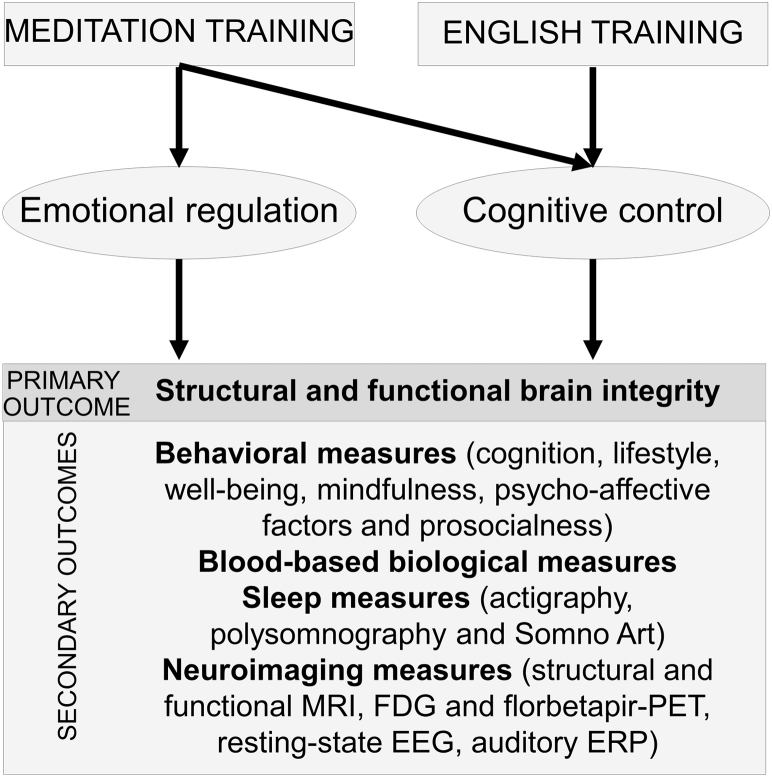
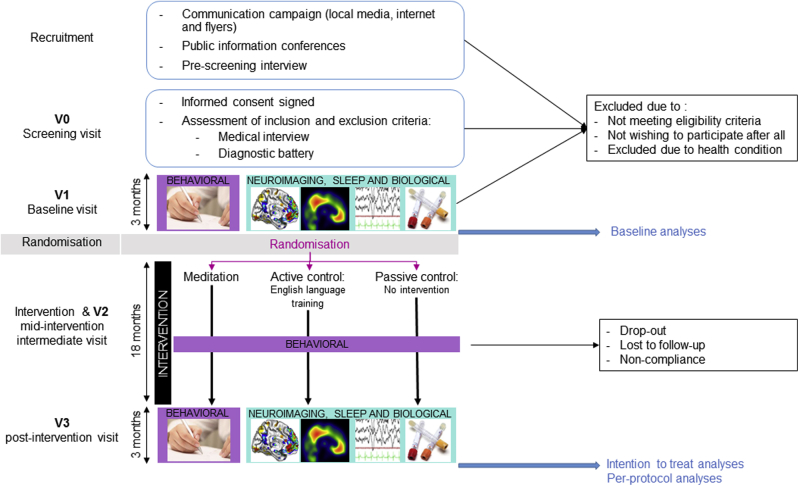
INTRODUCTION: The Age-Well clinical trial is an ongoing monocentric, randomized, controlled trial aiming to assess an 18-month preventive meditation-based intervention directly targeting the attentional and emotional dimensions of aging to promote mental health and well-being in elderly people. METHODS: One hundred thirty-seven cognitively unimpaired older adults are randomized to either an 18-month meditation-based intervention, a structurally matched foreign language training, or a passive control arm. The impact of the intervention and underlying mechanisms are assessed with detailed cognitive, behavioral, biological, neuroimaging and sleep examinations. RESULTS: Recruitment began in late 2016 and ended in May 2018. The interventions are ongoing and will be completed by early 2020. DISCUSSION: This is the first trial addressing the emotional and cognitive dimension of aging with a long-term nonpharmacological approach and using comprehensive assessments to investigate the mechanisms. Results are expected to foster the development of preventive strategies reducing the negative impact of mental conditions and disorders.
Overview
The claims and statistics of this paper haven’t been checked yet.
Run the check — free, no account needed. It reads the open-access text and checks the sources it cites.
Integrity signals
Registry
Cites
Statistics
Figures
Verification
Claims the paper makes
The claims and statistics of this paper haven’t been checked yet.
Run the check — free, no account needed. It reads the open-access text and checks the sources it cites.
Self-check
Percentages, sums and reported differences re-computed from the paper’s own numbers.
The self-check needs the paper’s full text.
Citations
Cites
Folstein, M. F., Folstein, S. E., & McHugh, P. R. (1975) · Journal of Psychiatric Research · doi:10.1016/0022-3956(75)90026-6 · Cited by 88,282
The assessment and analysis of handedness: The Edinburgh inventory
Oldfield, R. C. (1971) · Neuropsychologia · doi:10.1016/0028-3932(71)90067-4 · Cited by 35,900
Hirono, N., Mori, E., Ikejiri, Y., Imamura, T., Shimomura, T., Hashimoto, M., Yamashita, H., & Ikeda, M. (1997) · PubMed · Cited by 21,012
Kok, J. S., Berg, I. J., & Scherder, E. J. A. (2013) · Dementia and Geriatric Cognitive Disorders Extra · doi:10.1159/000353441 · Cited by 20,589
Older Adults' Reasons for Using Technology while Aging in Place
Peek, S. T. M., Luijkx, K. G., Rijnaard, M. D., Nieboer, M. E., van der Voort, C. S., Aarts, S., van Hoof, J., Vrijhoef, H. J., & Wouters, E. (2015) · Gerontology · doi:10.1159/000430949 · Cited by 19,852
Sensitivity and False Alarm Rate of a Fall Sensor in Long-Term Fall Detection in the Elderly
Kangas, M., Korpelainen, R., Vikman, I., Nyberg, L., & Jämsä, T. J. (2014) · Gerontology · doi:10.1159/000362720 · Cited by 19,007
A new depression scale designed to be sensitive to change
Montgomery, S. A., & Åsberg, M. (1979) · British Journal of Psychiatry · doi:10.1192/bjp.134.4.382 · Cited by 13,962
Dementia prevention, intervention, and care
Livingston, G., Sommerlad, A., Orgeta, V., Costafreda, S. G., Huntley, J., Ames, D., Ballard, C., Banerjee, S., Burns, A., Cohen-Mansfield, J., et al. (2017) · The Lancet · doi:10.1016/s0140-6736(17)31363-6 · Cited by 6,072
Ngandu, T., Lehtisalo, J., Solomon, A., Levälahti, E., Ahtiluoto, S., Antikainen, R., Bäckman, L., Hänninen, T., Jula, A., Laatikainen, T., et al. (2015) · The Lancet · doi:10.1016/s0140-6736(15)60461-5 · Cited by 3,689
The Neuroscience of Mindfulness Meditation
Tang, Y.-Y., Hölzel, B. K., & Posner, M. I. (2015) · Nature reviews. Neuroscience · doi:10.1038/nrn3916 · Cited by 2,889
Research works printed but not linked: 2
- Van der Linden M., 2004, et les membres du GREMEM, L’évaluation des troubles de la mémoire. Présentation de quatre tests de mémoire épisodique (avec leur étalonnage), 25
- Luborsky L., 1993, The Efficacy of Dynamic Psychotherapies: Is it True that “Everyone Has Won and All Must Have Prizes?”, 497
Cited by
Sorted by citations
The Role of Empathy and Compassion in Conflict Resolution
Klimecki, O. (2019) · Emotion Review · doi:10.1177/1754073919838609 · Cited by 243
André, C., Rehel, S., Kuhn, E., Landeau, B., Moulinet, I., Touron, E., Ourry, V., Du, G. L., Mézenge, F., Tomadesso, C., et al. (2020) · JAMA Neurology · doi:10.1001/jamaneurol.2020.0311 · Cited by 126
Wirth, M., Schwarz, C., Benson, G. S., Horn, N., Buchert, R., Lange, C., Köbe, T., Hetzer, S., Maglione, M., Michael, E., et al. (2019) · Alzheimer s Research & Therapy · doi:10.1186/s13195-019-0484-1 · Cited by 105
Stress and Mindfulness in Parkinson's Disease: Clinical Effects and Potential Underlying Mechanisms
van der Heide, A., Meinders, M. J., Speckens, A. E. M., Peerbolte, T. F., Bloem, B. R., & Helmich, R. C. (2021) · Movement Disorders · doi:10.1002/mds.28345 · Cited by 80
Touron, E., Moulinet, I., Kuhn, E., Sherif, S., Ourry, V., Landeau, B., Mézenge, F., Vivien, D., Klimecki, O., Poisnel, G., et al. (2022) · Molecular Psychiatry · doi:10.1038/s41380-022-01772-8 · Cited by 66
Zorn, J. V., Abdoun, O., Bouet, R., & Antoine Lutz, A. (2020) · European Journal of Pain · doi:10.1002/ejp.1576 · Cited by 61
Meditation and telomere length: a meta-analysis
Schutte, N. S., Malouff, J. M., & Keng, S. (2020) · Psychology and Health · doi:10.1080/08870446.2019.1707827 · Cited by 57
Effect of an 18-Month Meditation Training on Regional Brain Volume and Perfusion in Older Adults
Chételat, G., Antoine Lutz, A., Klimecki, O., Frison, É., Asselineau, J., Schlosser, M., Arenaza‐Urquijo, E. M., Mézenge, F., Kuhn, E., Moulinet, I., et al. (2022) · JAMA Neurology · doi:10.1001/jamaneurol.2022.3185 · Cited by 49
Klimecki, O., Marchant, N. L., Antoine Lutz, A., Poisnel, G., Chételat, G., & Collette, F. (2019) · Current Opinion in Psychology · doi:10.1016/j.copsyc.2019.01.006 · Cited by 58
Schlosser, M., Demnitz‐King, H., Whitfield, T. J., Wirth, M., & Marchant, N. L. (2020) · BMC Psychiatry · doi:10.1186/s12888-020-02884-7 · Cited by 51
Marchant, N. L., Barnhofer, T., Coueron, R., Wirth, M., Lutz, A., Arenaza-Urquijo, E. M., Collette, F., Poisnel, G., Demnitz-King, H., Schild, A.-K., et al. (2021) · Psychotherapy and Psychosomatics · doi:10.1159/000515669 · Cited by 40
Antoine Lutz, A., Chételat, G., Collette, F., Klimecki, O., Marchant, N. L., & Gonneaud, J. (2021) · Ageing Research Reviews · doi:10.1016/j.arr.2021.101495 · Cited by 48
Rapid Eye Movement Sleep, Neurodegeneration, and Amyloid Deposition in Aging
André, C., Champetier, P., Rehel, S., Kuhn, E., Touron, E., Ourry, V., Landeau, B., Du, G. L., Mézenge, F., Segobin, S. H., et al. (2023) · Annals of Neurology · doi:10.1002/ana.26604 · Cited by 37
Ware, C., Dautricourt, S., Gonneaud, J., & Chételat, G. (2021) · Frontiers in Aging Neuroscience · doi:10.3389/fnagi.2021.706672 · Cited by 53
Dynamic functional connectivity patterns associated with dementia risk
Dautricourt, S., Gonneaud, J., Landeau, B., Calhoun, V. D., de Florès, R., Poisnel, G., Bougacha, S., Ourry, V., Touron, E., Kuhn, E., et al. (2022) · Alzheimer s Research & Therapy · doi:10.1186/s13195-022-01006-7 · Cited by 41
Protocols for cognitive enhancement. A user manual for Brain Health Services—part 5 of 6
Guevara, A. B., Bieler-Aeschlimann, M., Altomare, D., Berthier, M. L., Csajka, C., Dautricourt, S., Démonet, J., Dodich, A., Frisoni, G. B., Miniussi, C., et al. (2021) · Alzheimer s Research & Therapy · doi:10.1186/s13195-021-00844-1 · Cited by 29
Baez-Lugo, S., Deza-Araujo, Y. I., Maradan, C., Collette, F., Antoine Lutz, A., Marchant, N. L., Chételat, G., Vuilleumier, P. O., Klimecki, O., Arenaza‐Urquijo, E. M., et al. (2023) · Nature Aging · doi:10.1038/s43587-022-00341-6 · Cited by 31
Strikwerda‐Brown, C., Ozlen, H., Binette, A. P., Chapleau, M., Marchant, N. L., Breitner, J. C. S., & Villeneuve, S. (2022) · Biological Psychiatry Global Open Science · doi:10.1016/j.bpsgos.2022.01.001 · Cited by 31
Champetier, P., André, C., Weber, F. D., Rehel, S., Ourry, V., Lanièpce, A., Antoine Lutz, A., Bertran, F., Cabé, N., Pitel, A., et al. (2022) · SLEEP · doi:10.1093/sleep/zsac282 · Cited by 26
Understanding mindfulness, one moment at a time: an introduction to the special issue
Bernstein, A., Vago, D. R., & Barnhofer, T. (2019) · Current Opinion in Psychology · doi:10.1016/j.copsyc.2019.08.001 · Cited by 28
Vanhoutte, M., Landeau, B., Sherif, S., Sayette, V. D. L., Dautricourt, S., Abbas, A., Manrique, A., Chocat, A., & Chételat, G. (2021) · NeuroImage Clinical · doi:10.1016/j.nicl.2021.102750 · Cited by 26
Felisatti, F., Gonneaud, J., Palix, C., Garnier-Crussard, A., Mézenge, F., Landeau, B., Chocat, A., Quillard, A., Ferrand-Devouge, E., de La Sayette, V., et al. (2022) · Neurology · doi:10.1212/wnl.0000000000200270 · Cited by 26
André, C., Kuhn, E., Réhel, S., Ourry, V., Demeilliez-Servouin, S., Palix, C., Felisatti, F., Champetier, P., Dautricourt, S., Yushkevich, P., et al. (2023) · Neurology · doi:10.1212/wnl.0000000000207421 · Cited by 21
Schlosser, M., Jones, R., Demnitz-King, H., & Marchant, N. L. (2022) · Current Psychology · doi:10.1007/s12144-020-00839-5 · Cited by 22
Ourry, V., Gonneaud, J., Landeau, B., Moulinet, I., Touron, E., Dautricourt, S., Du, G. L., Mézenge, F., André, C., Bejanin, A., et al. (2021) · NeuroImage · doi:10.1016/j.neuroimage.2021.117819 · Cited by 21
Demnitz‐King, H., Gonneaud, J., Klimecki, O., Chocat, A., Collette, F., Dautricourt, S., Jessen, F., Krolak‐Salmon, P., Antoine Lutz, A., Morse, R. M., et al. (2022) · Neurology · doi:10.1212/wnl.0000000000200951 · Cited by 19
Schlosser, M., Barnhofer, T., Requier, F., Deza-Araujo, Y. I., Abdoun, O., Marchant, N. L., Chételat, G., Collette, F., Klimecki, O., Antoine Lutz, A., et al. (2022) · Mindfulness · doi:10.1007/s12671-021-01816-0 · Cited by 25
Effects of Meditation Training and Non-Native Language Training on Cognition in Older Adults
Demnitz‐King, H., Requier, F., Whitfield, T. J., Schlosser, M., Gonneaud, J., Ware, C., Barnhofer, T., Coll‐Padrós, N., Dautricourt, S., Delarue, M., et al. (2023) · JAMA Network Open · doi:10.1001/jamanetworkopen.2023.17848 · Cited by 17
Palix, C., Chauveau, L., Felisatti, F., Chocat, A., Coulbault, L., Hébert, O., Mézenge, F., Landeau, B., Haudry, S., Fauvel, S., et al. (2025) · Frontiers in Aging Neuroscience · doi:10.3389/fnagi.2025.1508677 · Cited by 16
Watermeyer, T., Robb, C. E., Gregory, S., & Udeh‐Momoh, C. T. (2020) · Frontiers in Neuroendocrinology · doi:10.1016/j.yfrne.2020.100877 · Cited by 15
Bartrés‐Faz, D., Demnitz‐King, H., Cabello‐Toscano, M. R., Vaqué‐Alcázar, L., Saunders, R., Touron, E., Cattaneo, G., Gonneaud, J., Klimecki, O., Bargalló, N., et al. (2025) · Nature Mental Health · doi:10.1038/s44220-024-00361-8 · Cited by 18
Defining technology user needs of Indigenous older adults requiring dementia care
Starblanket, D., O’Connell, M. E., Gould, B., Jardine, M., Ferguson, M., & Bourassa, C. A. (2019) · Gerontechnology · doi:10.4017/gt.2019.18.3.002.00 · Cited by 14
Schlosser, M., Demnitz‐King, H., Barnhofer, T., Collette, F., Gonneaud, J., Chételat, G., Jessen, F., Kliegel, M., Klimecki, O., Antoine Lutz, A., et al. (2023) · PLoS ONE · doi:10.1371/journal.pone.0295175 · Cited by 15
Champetier, P., André, C., Rehel, S., Ourry, V., Landeau, B., Mézenge, F., Roquet, D., Vivien, D., Sayette, V. D. L., Chételat, G., et al. (2024) · SLEEP · doi:10.1093/sleep/zsae012 · Cited by 14
Schlosser, M., Pfaff, N. G., Schweinberger, S. R., Marchant, N. L., & Klimecki, O. (2021) · Current Psychology · doi:10.1007/s12144-020-01344-5 · Cited by 18
Ourry, V., Rehel, S., André, C., Mary, A., Paly, L., Delarue, M., Requier, F., Hendy, A. S., Collette, F., Marchant, N. L., et al. (2023) · Aging · doi:10.18632/aging.204943 · Cited by 12
Garnier‐Crussard, A., Desestret, V., Cotton, F., Chételat, G., & Krolak‐Salmon, P. (2020) · La Revue de Médecine Interne · doi:10.1016/j.revmed.2020.02.009 · Cited by 14
Crego, A., Yela, J. R., Gómez-Martínez, M. Á., Sánchez-Zaballos, E., & Vicente-Arruebarrena, A. (2025) · Frontiers in Psychology · doi:10.3389/fpsyg.2025.1597264 · Cited by 10
Men and women show partly distinct effects of physical activity on brain integrity
Gonneaud, J., Moreau, I., Felisatti, F., Arenaza‐Urquijo, E. M., Ourry, V., Touron, E., Sayette, V. D. L., Vivien, D., & Chételat, G. (2022) · Alzheimer s & Dementia Diagnosis Assessment & Disease Monitoring · doi:10.1002/dad2.12302 · Cited by 12
Ng, T. K. S., Feng, L., Fam, J., Rawtaer, I., Kumar, A. P., Rane, G., Cheah, I. K.-M., Mahendran, R., Lee, Y. K., Tan, E., et al. (2021) · International Journal of Environmental Research and Public Health · doi:10.3390/ijerph181910205 · Cited by 12
de Florès, R., Demeilliez-Servouin, S., Kuhn, E., Chauveau, L., Landeau, B., Delcroix, N., Gonneaud, J., Vivien, D., & Chételat, G. (2023) · Neurobiology of Disease · doi:10.1016/j.nbd.2023.106127 · Cited by 10
Deza-Araujo, Y. I., Baez-Lugo, S., Vuilleumier, P. O., Chocat, A., Chételat, G., Poisnel, G., & Klimecki, O. (2021) · Biological Psychology · doi:10.1016/j.biopsycho.2021.108051 · Cited by 10
Getting closer: compassion training increases feelings of closeness toward a disliked person
Curotto, P. C., Halperin, E., Sander, D., & Klimecki, O. (2023) · Scientific Reports · doi:10.1038/s41598-023-45363-1 · Cited by 9
Ourry, V., Marchant, N., Schild, A., Coll-Padros, N., Klimecki, O., Krolak-Salmon, P., Goldet, K., Reyrolle, L., Bachelet, R., Sannemann, L., et al. (2021) · Frontiers in Aging Neuroscience · doi:10.3389/fnagi.2021.740005 · Cited by 9
Prevost, V., Lefèvre‐Arbogast, S., Leconte, A., Delorme, C., Benoit, S., Tran, T., & Clarisse, B. (2022) · BMC Complementary Medicine and Therapies · doi:10.1186/s12906-022-03599-w · Cited by 8
Association Between Lifestyle at Different Life Periods and Brain Integrity in Older Adults
Turpin, A., Felisatti, F., Chauveau, L., Haudry, S., Mézenge, F., Landeau, B., Vivien, D., Sayette, V. D. L., Chételat, G., Gonneaud, J., et al. (2025) · Neurology · doi:10.1212/wnl.0000000000213347 · Cited by 8
Prevost, V., Clarisse, B., Leconte, A., Delorme, C., Benoit, S., & Tran, T. (2021) · BMJ Open · doi:10.1136/bmjopen-2020-048164 · Cited by 7
Requier, F., Hendy, A. S., Schlosser, M., Demnitz‐King, H., Whitfield, T. J., Chételat, G., Klimecki, O., Antoine Lutz, A., Marchant, N. L., & Collette, F. (2023) · Mindfulness · doi:10.1007/s12671-023-02077-9 · Cited by 7
Worry and ruminative brooding: associations with cognitive and physical health in older adults
Morse, R. M., Koutsoubelis, F., Whitfield, T. J., Demnitz‐King, H., Ourry, V., Stott, J. C. H., Chocat, A., Devouge, E. F., Walker, Z., Klimecki, O., et al. (2024) · Frontiers in Psychology · doi:10.3389/fpsyg.2024.1332398 · Cited by 9
Lehodey, A., Kaliman, P., Palix, C., de Florès, R., Touron, E., Turpin, A., Fauvel, S., Mézenge, F., Landeau, B., Chocat, A., et al. (2024) · Alzheimer s Research & Therapy · doi:10.1186/s13195-024-01635-0 · Cited by 7
Schlosser, M., Klimecki, O., Collette, F., Gonneaud, J., Kliegel, M., Marchant, N. L., Chételat, G., & Antoine Lutz, A. (2023) · PLoS ONE · doi:10.1371/journal.pone.0294753 · Cited by 6
Strikwerda‐Brown, C. (2022) · Neurology · doi:10.1212/wnl.0000000000201110 · Cited by 6
Touron, E., de Florès, R., Coulbault, L., Palix, C., Chocat, A., Kuhn, E., Landeau, B., Mézenge, F., Roquet, D., Chauveau, L., et al. (2025) · Alzheimer s Research & Therapy · doi:10.1186/s13195-024-01643-0 · Cited by 5
Lanièpce, A., Segobin, S. H., André, C., Bertran, F., Boudehent, C., Lahbairi, N., Maillard, A., Mary, A., Urso, L., Vabret, F., et al. (2023) · Journal of Clinical Medicine · doi:10.3390/jcm12062440 · Cited by 4
Lund, A. E., Ostheim, A. F. V. S. Z. N. U., Ridley, H., Bobyreva, K., Foster, J., & Russell, C. (2025) · BMJ Open · doi:10.1136/bmjopen-2024-097002 · Cited by 3
Prevost, V., Tran, T., Leconte, A., Lequesne, J., Fernette, M., Ségura, C., Chevigné, S., Gouriot, M., & Clarisse, B. (2024) · BMC Cancer · doi:10.1186/s12885-024-12521-1 · Cited by 3
Kaliman, P., Álvarez‐López, M. J., Lehodey, A., Fernández, D., Chocat, A., Schlosser, M., Sayette, V. D. L., Vivien, D., Marchant, N. L., Chételat, G., et al. (2024) · Biological Psychiatry Global Open Science · doi:10.1016/j.bpsgos.2024.100398 · Cited by 6
Chauveau, L., Gonneaud, J., Poisnel, G., Landeau, B., Garnier‐Crussard, A., Pitel, A., Roquet, D., Touron, E., Haudry, S., Mézenge, F., et al. (2025) · Alzheimer s Research & Therapy · doi:10.1186/s13195-025-01808-5 · Cited by 4
Munns, L., Demnitz‐King, H., André, C., Rehel, S., Ourry, V., Sayette, V. D. L., Vivien, D., Chételat, G., Rauchs, G., & Marchant, N. L. (2024) · Nature and Science of Sleep · doi:10.2147/nss.s441509 · Cited by 3
Haudry, S., Turpin, A., Landeau, B., Mézenge, F., Delarue, M., Hébert, O., Marchant, N. L., Klimecki, O., Collette, F., Gonneaud, J., et al. (2024) · Scientific Reports · doi:10.1038/s41598-024-79687-3 · Cited by 3
Haudry, S., Lambert, N., Gaser, C., Thirion, B., Landeau, B., Gonneaud, J., Poisnel, G., Champetier, P., Lehodey, A., Marchant, N. L., et al. (2025) · Scientific Reports · doi:10.1038/s41598-025-21490-9 · Cited by 2
Lehodey, A., Montagne, B., Rehel, S., Kaliman, P., Chocat, A., Mézenge, F., Landeau, B., Sayette, V. D. L., Chételat, G., Rauchs, G., et al. (2025) · Alzheimer s Research & Therapy · doi:10.1186/s13195-025-01923-3 · Cited by 3
Schlosser, M., Gonneaud, J., Poletti, S., Bouet, R., Klimecki, O., Collette, F., Marchant, N. L., Chételat, G., Antoine Lutz, A., André, C., et al. (2024) · Scientific Reports · doi:10.1038/s41598-024-77069-3 · Cited by 2
Sex differences in the association between repetitive negative thinking and neurofilament light
Lau, Y., Bansal, A., Palix, C., Demnitz‐King, H., Wirth, M., Klimecki, O., Chételat, G., Poisnel, G., Marchant, N. L., Chocat, A., et al. (2024) · npj Mental Health Research · doi:10.1038/s44184-024-00093-8 · Cited by 4
Touron, E., Gonneaud, J., Paly, L., Delarue, M., Hébert, O., Mézenge, F., Fauvel, S., Vivien, D., Sayette, V. D. L., Poisnel, G., et al. (2025) · Scientific Reports · doi:10.1038/s41598-025-99059-9 · Cited by 2
Liens entre apnées du sommeil et altérations cérébrales évaluées par imagerie chez le sujet âgé
André, C., Chételat, G., & Rauchs, G. (2020) · médecine/sciences · doi:10.1051/medsci/2020147 · Cited by 2
Effects of amyloid and APOE4 on medial temporal lobe subregions in cognitively unimpaired elderlyPreprint
de Florès, R., Demeilliez-Servouin, S., Kuhn, E., Chauveau, L., Landeau, B., Delcroix, N., Gonneaud, J., & Chételat, G. (2022) · medRxiv · doi:10.1101/2022.01.20.22269607 · Cited by 2
Smolka, M. (2022) · Research Publications (Maastricht University) · doi:10.26481/dis.20221011ms · Cited by 1
Felisatti, F., Chauveau, L., Marchant, N. L., Collette, F., Demnitz‐King, H., Whitfield, T. J., Requier, F., Mézenge, F., Landeau, B., Palix, C., et al. (2023) · medRxiv · doi:10.1101/2023.07.17.23292755 · Cited by 2
Garnier‐Crussard, A., Gonneaud, J., Felisatti, F., Palix, C., Devouge, E. F., Chocat, A., Rauchs, G., Sayette, V. D. L., Vivien, D., Demnitz‐King, H., et al. (2024) · BMC Geriatrics · doi:10.1186/s12877-024-05550-9 · Cited by 3
Haudry, S., Dautricourt, S., Gonneaud, J., Landeau, B., Calhoun, V. D., de Florès, R., Poisnel, G., Bougacha, S., Kuhn, E., Touron, E., et al. (2025) · Imaging Neuroscience · doi:10.1162/imag.a.33 · Cited by 1
Prevost, V., Tran, T., Clarisse, B., Leconte, A., Fernette, M., Grandazzi, G., & Gouriot, M. (2026) · Integrative Cancer Therapies · doi:10.1177/15347354261439128 · Cited by 1
Night‐to‐night rapid eye movement sleep variability: A relevant marker of early amyloid‐β deposition
Montagne, B., Boulin, M., Hamel, A., Champetier, P., Rehel, S., Mézenge, F., Landeau, B., Delarue, M., Hébert, O., Soussi, C., et al. (2026) · Alzheimer s & Dementia · doi:10.1002/alz.71376 · Cited by 2
Bilingualism and Language Education to Improve the Cognitive Health of Older Persons
Meulenberg, C. J. W. (2021) · Andragoška spoznanja · doi:10.4312/as/9577 · Cited by 1
Smolka, M., & Mesman, J. (2023) · Springer eBooks · doi:10.1007/978-3-031-44119-6_13 · Cited by 1
Requier, F., Demnitz‐King, H., Frison, É., Delarue, M., Gonneaud, J., Chételat, G., Klimecki, O., Salmon, É., Antoine Lutz, A., Marchant, N. L., et al. (2024) · Aging Neuropsychology and Cognition · doi:10.1080/13825585.2024.2376783 · Cited by 1
Liebscher, M., White, S., Hass, S., Chocat, A., Mézenge, F., Landeau, B., Delarue, M., Hébert, O., Turpin, A., Marchant, N. L., et al. (2024) · Biological Psychiatry Global Open Science · doi:10.1016/j.bpsgos.2024.100431 · Cited by 2
Hamel, A., Champetier, P., Rehel, S., André, C., Landeau, B., Mézenge, F., Haudry, S., Roquet, D., Vivien, D., Sayette, V. D. L., et al. (2025) · SLEEP · doi:10.1093/sleep/zsaf105 · Cited by 1
Francois, T. L., Hilberdink, C. E., Haelewyn, A., Lehodey, A., Soussi, C., Delarue, M., Hébert, O., Landeau, B., Chételat, G., & Bui, É. (2025) · Journal of Affective Disorders · doi:10.1016/j.jad.2025.05.042 · Cited by 1
de Florès, R., Blanchard, T., Foyard, E., Naveau, M., Delcroix, N., Chauveau, L., Landeau, B., Vivien, D., Yushkevich, P. A., & Chételat, G. (2025) · medRxiv · doi:10.1101/2025.01.08.25320149 · Cited by 1
Factors associated with transcendental meditation practice in older people
de Oliveira, D. V., Bertolini, S. M. M. G., Chatalov, E. G., Franco, M. F., de Lima, M. D. C. C., Freire, G. L. M., de Oliveira, R. V., & Júnior, J. R. A. D. N. (2020) · REVISTA CIÊNCIAS EM SAÚDE · doi:10.21876/rcshci.v10i3.942
Traitements non médicamenteux et neurochirurgicaux de la maladie de Parkinson
Houéto, J., & Erraud, J. (2022) · Elsevier eBooks · doi:10.1016/b978-2-294-76331-1.00024-0
Marchant, N. L., Lau, Y., Bansal, A., Palix, C., Demnitz‐King, H., Wirth, M., Klimecki, O., Chételat, G., Poisnel, G., & Medit‐Ageing Research Group (2024) · Research Square · doi:10.21203/rs.3.rs-4246401/v1
Lambert, N., Roquet, D., Mahaut, M., Bitouzé, N., Chételat, G., & Elmoataz, A. (2024) · International Conference on Computer Graphics and Image Processing (CGIP) · doi:10.1109/cgip62525.2024.00033
Touron, E., Gonneaud, J., Paly, L., Delarue, M., Hébert, O., Mézenge, F., Fauvel, S., Vivien, D., Sayette, V. D. L., Poisnel, G., et al. (2024) · Research Square · doi:10.21203/rs.3.rs-5157163/v1
Valuation Work in Mindfulness Research: Creating Patches of Religion in Modern Science
Smolka, M. (2024) · Springer eBooks · doi:10.1007/978-3-031-66387-1_8
Examining cognitive differences in expert meditators and non-meditators older adults
Requier, F., Mohammadi, H., Demnitz‐King, H., Schlosser, M., Poisnel, G., Salmon, É., Chételat, G., Marchant, N. L., Antoine Lutz, A., Collette, F., et al. (2025) · Scientific Reports · doi:10.1038/s41598-025-00226-9
EEG Brain Rhythms During Resting‐State Wakefulness and Sleep in Elderly Expert Meditators
Champetier, P., Hamel, A., André, C., Ourry, V., Lacroix, T., Rehel, S., Chauveau, L., Haudry, S., Bertran, F., Sayette, V. D. L., et al. (2025) · Journal of Sleep Research · doi:10.1111/jsr.70161
Hähnel, F. S., Antoine Lutz, A., Chételat, G., Gonneaud, J., Kanske, P., & Klimecki, O. (2025) · Scientific Reports · doi:10.1038/s41598-025-21058-7 · Cited by 1
Schlosser, M., Demnitz‐King, H., Whitfield, T. J., Wirth, M., & Marchant, N. L. (2020) · Figshare · doi:10.6084/m9.figshare.13076684
Prévost, V., Lefevre-Arbogast, S., Leconte, A., Delorme, C., Benoit, S., Tran, T., & Clarisse, B. (2022) · Figshare · doi:10.6084/m9.figshare.19791006
Brioschi Guevara, A., Bieler, M., Altomare, D., Berthier, M. L., Csajka, C., Dautricourt, S., Démonet, J., Dodich, A., Frisoni, G. B., Miniussi, C., et al. (2021) · Figshare · doi:10.6084/m9.figshare.16786938
Night-to-night REM sleep variability: a relevant marker of early amyloid-β depositionPreprint
Montagne, B., Boulin, M., Hamel, A., Champetier, P., Rehel, S., Mézenge, F., Landeau, B., Delarue, M., Hébert, O., Soussi, C., et al. (2025) · medRxiv · doi:10.64898/2025.12.19.25342684
Dautricourt, S. (2021) · theses.fr (ABES) · doi:10.70675/63472a25z31eaz4ebczaebdzd8d2e061b4b8
Poisnel, G., Lhérault, M., Palix, C., Turpin, A., Felisatti, F., Vrillon, A., Paquet, C., Chocat, A., Coulbault, L., Sayette, V. D. L., et al. (2026) · Alzheimer s & Dementia Translational Research & Clinical Interventions · doi:10.1002/trc2.70248
Metadata
- Authors
- Poisnel, G., Arenaza‐Urquijo, E., Collette, F., Klimecki, O. M., Marchant, N. L., Wirth, M., de La Sayette, V., Rauchs, G., Salmon, E., Vuilleumier, P., Frison, E., Maillard, A., Vivien, D., Lutz, A., Chételat, G., & Medit‐Ageing Research Group
- Affiliations
- Inserm (FR)
- University of Liège (BE)
- University of Geneva (CH)
- University College London (GB)
- Humboldt-Universität zu Berlin (DE)
- Université Normandie, Inserm, Université de Caen‐Normandie Inserm UMR‐S U1077, GIP Cyceron Caen France
- GIGA‐CRC, In Vivo Imaging Université de Liège Liège Belgium
- EUCLID/F‐CRIN Clinical Trials Platform University of Bordeaux, INSERM, Bordeaux Population Health Center Bordeaux France
- Université de Bordeaux (FR)
- Lyon Neuroscience Research Center INSERM U1028 CNRS UMR5292 Lyon University Lyon France
- Corresponding author
- Poisnel, Géraldine
- Chételat, Gaël
- ORCID
- Venue
- Alzheimer's & Dementia: Translational Research & Clinical Interventions
- Publisher
- Wiley
- Published
- 2018-01
- Volume
- 4
- Issue
- 1
- Pages
- 714-723
- ISSN
- 2352-8737 (ISSN-L)
- PMC
- PMC6296161
- OpenAlex
- W2904520264
- Cited by
- 103
- References
- 42
- Citations by year
- 2026: 5 · 2025: 18 · 2024: 17 · 2023: 13 · 2022: 15 · 2021: 14 · 2020: 14 · 2019: 7
- FWCI
- 10.28
- Type
- journal article
- Language
- en
- Open access
- gold
- doi.org
- Licence
- Locations
- Alzheimer s & Dementia Translational Research & Clinical Interventions (publishedVersion, cc-by-nc-nd)
- Europe PMC (PubMed Central) (publishedVersion, cc-by-nc-nd)
- PubMed Central (publishedVersion, cc-by-nc-nd)
- PubMed (publishedVersion)
- Archive ouverte UNIGE (University of Geneva) (publishedVersion, other-oa)
- ORBi (University of Liège) (submittedVersion, other-oa)
- HAL (submittedVersion, other-oa)
- UCL Discovery (University College London) (submittedVersion)
- Oskar-Bordeaux (Universite de Bordeaux) (submittedVersion, cc-by-nc-nd)
- Archive ouverte UNIGE (University of Geneva) (submittedVersion, cc-by-nc-nd)
- Funders
- Inserm
- Horizon 2020
- Topics
- Social Sciences › Psychology › Clinical Psychology › Mindfulness and Compassion Interventions
- Health Sciences › Medicine › Psychiatry and Mental health › Dementia and Cognitive Impairment Research
- Social Sciences › Psychology › Developmental and Educational Psychology › Aging and Gerontology Research
- Keywords
- meditation, foreign language training, older adults, mental health, well-being, aging, attention, emotion regulation, cognitive aging, neuroimaging, sleep, non-pharmacological treatment, preventive interventions
About these checks
Registry, retraction, Cites and statistics results are computed, not judged, with one exception: a printed reference that no index lists is read once by a model before it counts as a citation error. Claims are extracted by a model and kept only when their quote appears verbatim in the text; each cited source is then checked, with a model’s help, for whether it says what the claim relies on. Those verdicts can be wrong — read the claim’s quote and the cited source before relying on one.
Statistics and arithmetic are recomputed, not judged.
Confidence bands are shown only for fields calibrated on our annotated test set. None is calibrated yet, so no band is shown.
What counts as a claim ›How we measure confidence ›How we check this ›
Are you an author, or do you see a problem with this page? Request a review
