

The DOI matches its Crossref record; 89 of the 94 references it cites were found in a registry or an index, and 2 are not checked yet.
Artificial intelligence, ChatGPT, and other large language models for social determinants of health: Current state and future directions
Open accessAbstract
This perspective highlights the importance of addressing social determinants of health (SDOH) in patient health outcomes and health inequity, a global problem exacerbated by the COVID-19 pandemic. We provide a broad discussion on current developments in digital health and artificial intelligence (AI), including large language models (LLMs), as transformative tools in addressing SDOH factors, offering new capabilities for disease surveillance and patient care. Simultaneously, we bring attention to challenges, such as data standardization, infrastructure limitations, digital literacy, and algorithmic bias, that could hinder equitable access to AI benefits. For LLMs, we highlight potential unique challenges and risks including environmental impact, unfair labor practices, inadvertent disinformation or "hallucinations," proliferation of bias, and infringement of copyrights. We propose the need for a multitiered approach to digital inclusion as an SDOH and the development of ethical and responsible AI practice frameworks globally and provide suggestions on bridging the gap from development to implementation of equitable AI technologies.
Overview
The claims and statistics of this paper haven’t been checked yet.
Run the check — free, no account needed. It reads the open-access text and checks the sources it cites.
Integrity signals
Registry
Cites
Statistics
Figures
Verification
Claims the paper makes
The claims and statistics of this paper haven’t been checked yet.
Run the check — free, no account needed. It reads the open-access text and checks the sources it cites.
Claims other papers make about this one
Each is checked against this paper’s own text: does it say what the citing paper says it does?
The cited source says what the claim attributes to it.
In the citing paper
“Recent studies have utilized the use of large language models (LLMs) for the identification of SDoH factors19,24,45,46.”
From Social determinants of health extraction from clinical notes across institutions using large language models (2025) · cites this paper as [19]
The check wasn’t confident either way, so it gives no verdict — never disputed.
In the citing paper
“Firstly, many studies, even the recent ones19–25 have focused on a limited set of SDoH factors (up to 8 factors).”
From Social determinants of health extraction from clinical notes across institutions using large language models (2025) · cites this paper as [19]
Experimental — accuracy not yet measured
Self-check
Percentages, sums and reported differences re-computed from the paper’s own numbers.
The self-check needs the paper’s full text.
Citations
Cites
Vaswani, A., Shazeer, N., Parmar, N., Uszkoreit, J., Jones, L., Gomez, A. N., Kaiser, L., & Polosukhin, I. (2017) · arXiv · doi:10.48550/arxiv.1706.03762 · Cited by 120,404
Dissecting racial bias in an algorithm used to manage the health of populations
Obermeyer, Z., Powers, B., Vogeli, C., & Mullainathan, S. (2019) · Science · doi:10.1126/science.aax2342 · Cited by 7,137 · cited 1×
“75 This will remain a pervasive problem since more than half of the datasets used for clinical AI development originate from either the USA or China.”
BackgroundOn the Dangers of Stochastic Parrots: Can Language Models Be Too Big? 🦜
Bender, E. M., Gebru, T., McMillan-Major, A., & Shmitchell, S. (2021) · Proceedings of the 2021 ACM Conference on Fairness, Accountability, and Transparency · doi:10.1145/3442188.3445922 · Cited by 6,988 · cited 2×
“52,64 Particular to LMICs, the engagement of low-cost workers to perform annotation of toxic language (including text embedding hate speech, sexual abuse, violence) may contribute to negative psychological health outcomes among these workers.”
BackgroundThe global landscape of AI ethics guidelines
Jobin, A., Ienca, M., & Vayena, E. (2019) · Nature Machine Intelligence · doi:10.1038/s42256-019-0088-2 · Cited by 6,220
Actual causes of death in the United States
McGinnis, J. M. (1993) · JAMA: The Journal of the American Medical Association · doi:10.1001/jama.1993.03510180077038 · Cited by 5,480
Large language models in medicine
Thirunavukarasu, A. J., Ting, D. S. J., Elangovan, K., Gutierrez, L., Tan, T. F., & Ting, D. S. W. (2023) · Nature Medicine · doi:10.1038/s41591-023-02448-8 · Cited by 3,944
Self-citationThe social determinants of health: It’s time to consider the causes of the causes
Braveman, P., & Gottlieb, L. (2014) · Public Health Reports® · doi:10.1177/00333549141291s206 · Cited by 3,861
The COVID-19 pandemic and health inequalities
Bambra, C., Riordan, R., Ford, J., & Matthews, F. (2020) · Journal of Epidemiology and Community Health · doi:10.1136/jech-2020-214401 · Cited by 2,118
Sheller, M. J., Edwards, B., Reina, G. A., Martin, J., Pati, S., Kotrotsou, A., Milchenko, M., Xu, W., Marcus, D., Colen, R. R., et al. (2020) · Scientific Reports · doi:10.1038/s41598-020-69250-1 · Cited by 1,646 · cited 1×
“82,83 Block-chain technology facilitates secure and auditable exchange of sensitive patient data, safeguarding data integrity and immuta-bility.”
BackgroundPrivacy in the age of medical big data
Price, W. N., & Cohen, I. G. (2019) · Nature Medicine · doi:10.1038/s41591-018-0272-7 · Cited by 1,522
Schmidt, M., Schmidt, S. A. J., Adelborg, K., Sundbøll, J., Laugesen, K., Ehrenstein, V., & Sørensen, H. T. (2019) · Clinical Epidemiology · doi:10.2147/clep.s179083 · Cited by 1,427
COVID-19 and smoking: A systematic review of the evidence
Vardavas, C. I., & Nikitara, K. (2020) · Tobacco Induced Diseases · doi:10.18332/tid/119324 · Cited by 1,421
Digital technology and COVID-19
Ting, D. S. W., Carin, L., Dzau, V., & Wong, T. Y. (2020) · Nature Medicine · doi:10.1038/s41591-020-0824-5 · Cited by 1,413
Self-citationEnsuring fairness in machine learning to advance health equity.
Rajkomar, A., Hardt, M., Howell, M. D., Corrado, G., & Chin, M. H. (2018) · Annals of Internal Medicine · doi:10.7326/m18-1990 · Cited by 1,341
Assessing differential impacts of COVID-19 on black communities
Millett, G. A., Jones, A. T., Benkeser, D., Baral, S., Mercer, L., Beyrer, C., Honermann, B., Lankiewicz, E., Mena, L., Crowley, J. S., et al. (2020) · Annals of Epidemiology · doi:10.1016/j.annepidem.2020.05.003 · Cited by 1,217
Lead neurotoxicity in children: basic mechanisms and clinical correlates
Lidsky, T. I., & Schneider, J. S. (2002) · Brain · doi:10.1093/brain/awg014 · Cited by 1,169
Nagendran, M., Chen, Y., Lovejoy, C. A., Gordon, A. C., Komorowski, M., Harvey, H., Topol, E. J., Ioannidis, J. P. A., Collins, G. S., & Maruthappu, M. (2020) · BMJ · doi:10.1136/bmj.m689 · Cited by 1,152
We can do better―improving the health of the American people
Schroeder, S. A. (2007) · New England Journal of Medicine · doi:10.1056/nejmsa073350 · Cited by 1,065
Vasey, B., Nagendran, M., Campbell, B., Clifton, D. A., Collins, G. S., Denaxas, S., Denniston, A. K., Faes, L., Geerts, B., Ibrahim, M., et al. (2022) · Nature Medicine · doi:10.1038/s41591-022-01772-9 · Cited by 1,039
Self-citationA governance model for the application of AI in health care
Reddy, S., Allan, S., Coghlan, S., & Cooper, P. (2020) · Journal of the American Medical Informatics Association · doi:10.1093/jamia/ocz192 · Cited by 979
Artificial intelligence and the future of global health
Schwalbe, N., & Wahl, B. (2020) · The Lancet · doi:10.1016/s0140-6736(20)30226-9 · Cited by 956
Collins, G. S., Dhiman, P., Andaur Navarro, C. L., Ma, J., Hooft, L., Reitsma, J. B., Logullo, P., Beam, A. L., Peng, L., Van Calster, B., et al. (2021) · BMJ Open · doi:10.1136/bmjopen-2020-048008 · Cited by 852
Genetic Misdiagnoses and the Potential for Health Disparities
Manrai, A. K., Funke, B. H., Rehm, H. L., Olesen, M. S., Maron, B. A., Szolovits, P., Margulies, D. M., Loscalzo, J., & Kohane, I. S. (2016) · New England Journal of Medicine · doi:10.1056/nejmsa1507092 · Cited by 808
Digital inclusion as a social determinant of health
Sieck, C. J., Sheon, A., Ancker, J. S., Castek, J., Callahan, B., & Siefer, A. (2021) · npj Digital Medicine · doi:10.1038/s41746-021-00413-8 · Cited by 597
Daniel, H., Bornstein, S. S., & Kane, G. C. (2018) · Annals of Internal Medicine · doi:10.7326/m17-2441 · Cited by 590
Sources of bias in artificial intelligence that perpetuate healthcare disparities—A global review
Celi, L. A., Cellini, J., Charpignon, M.-L., Dee, E. C., Dernoncourt, F., Eber, R., Mitchell, W. G., Moukheiber, L., Schirmer, J., Situ, J., et al. (2022) · PLOS Digital Health · doi:10.1371/journal.pdig.0000022 · Cited by 576
Harrer, S. (2023) · eBioMedicine · doi:10.1016/j.ebiom.2023.104512 · Cited by 480
Ethical and social risks of harm from Language Models
Weidinger, L., Mellor, J., Rauh, M., Griffin, C., Uesato, J., Huang, P.-S., Cheng, M., Glaese, M., Balle, B., Kasirzadeh, A., et al. (2021) · arXiv · doi:10.48550/arxiv.2112.04359 · Cited by 477
Health system-scale language models are all-purpose prediction engines
Jiang, L. Y., Liu, X. C., Nejatian, N. P., Nasir-Moin, M., Wang, D., Abidin, A., Eaton, K., Riina, H. A., Laufer, I., Punjabi, P., et al. (2023) · Nature · doi:10.1038/s41586-023-06160-y · Cited by 460
Creation and Adoption of Large Language Models in Medicine
Shah, N. H., Entwistle, D., & Pfeffer, M. A. (2023) · JAMA · doi:10.1001/jama.2023.14217 · Cited by 435
Shifting machine learning for healthcare from development to deployment and from models to data
Zhang, A., Xing, L., Zou, J., & Wu, J. C. (2022) · Nature Biomedical Engineering · doi:10.1038/s41551-022-00898-y · Cited by 420
Bellemo, V., Lim, Z. W., Lim, G., Nguyen, Q. D., Xie, Y., Yip, M. Y. T., Hamzah, H., Ho, J., Lee, X. Q., Hsu, W., et al. (2019) · The Lancet Digital Health · doi:10.1016/s2589-7500(19)30004-4 · Cited by 419
Self-citationLarge language models propagate race-based medicine
Omiye, J. A., Lester, J. C., Spichak, S., Rotemberg, V., & Daneshjou, R. (2023) · npj Digital Medicine · doi:10.1038/s41746-023-00939-z · Cited by 417
Liu, Y., Kohlberger, T., Norouzi, M., Dahl, G. E., Smith, J. L., Mohtashamian, A., Olson, N. H., Peng, L. H., Hipp, J., & Stumpe, M. C. (2018) · Archives of Pathology & Laboratory Medicine · doi:10.5858/arpa.2018-0147-oa · Cited by 413
Winkler, J. K., Fink, C., Toberer, F., Enk, A., Deinlein, T., Hofmann-Wellenhof, R., Thomas, L., Lallas, A., Blum, A., Stolz, W., et al. (2019) · JAMA Dermatology · doi:10.1001/jamadermatol.2019.1735 · Cited by 365
Global developments in social prescribing
Morse, D. F., Sandhu, S., Mulligan, K., Tierney, S., Polley, M. J., Giurca, B. C., Slade, S., Dias, S., Mahtani, K. R., Wells, L., et al. (2022) · BMJ Global Health · doi:10.1136/bmjgh-2022-008524 · Cited by 363
Considerations for addressing bias in artificial intelligence for health equity
Abràmoff, M. D., Tarver, M. E., Loyo-Berrios, N., Trujillo, S., Char, D., Obermeyer, Z., Eydelman, M. B., Foundational Principles of Ophthalmic Imaging and Algorithmic Interpretation Working Group of the Collaborative Community for Ophthalmic Imaging Foundation, W., & Maisel, W. H. (2023) · npj Digital Medicine · doi:10.1038/s41746-023-00913-9 · Cited by 349
Bastawrous, A., Rono, H. K., Livingstone, I. A. T., Weiss, H. A., Jordan, S., Kuper, H., & Burton, M. J. (2015) · JAMA Ophthalmology · doi:10.1001/jamaophthalmol.2015.1468 · Cited by 338
Xie, Y., Nguyen, Q. D., Hamzah, H., Lim, G., Bellemo, V., Gunasekeran, D. V., Yip, M. Y. T., Qi Lee, X., Hsu, W., Li Lee, M., et al. (2020) · The Lancet Digital Health · doi:10.1016/s2589-7500(20)30060-1 · Cited by 288
Self-citationLarge language models to identify social determinants of health in electronic health records
Guevara, M., Chen, S., Thomas, S., Chaunzwa, T. L., Franco, I., Kann, B. H., Moningi, S., Qian, J. M., Goldstein, M., Harper, S., et al. (2024) · npj Digital Medicine · doi:10.1038/s41746-023-00970-0 · Cited by 278
CheXclusion: Fairness gaps in deep chest X-ray classifiers
Seyyed-Kalantari, L., Liu, G., McDermott, M., Chen, I. Y., & Ghassemi, M. (2020) · Biocomputing 2021 · doi:10.1142/9789811232701_0022 · Cited by 275 · cited 1×
“For instance, chest X-ray classifiers trained using datasets dominated by White patients performed poorly in Medicare patients, 74 and a risk prediction algorithm trained using large datasets failed to triage African Americans for necessary care.”
BackgroundGPT-4 is here: what scientists think
Sanderson, K. (2023) · Nature · doi:10.1038/d41586-023-00816-5 · Cited by 262 · cited 1×
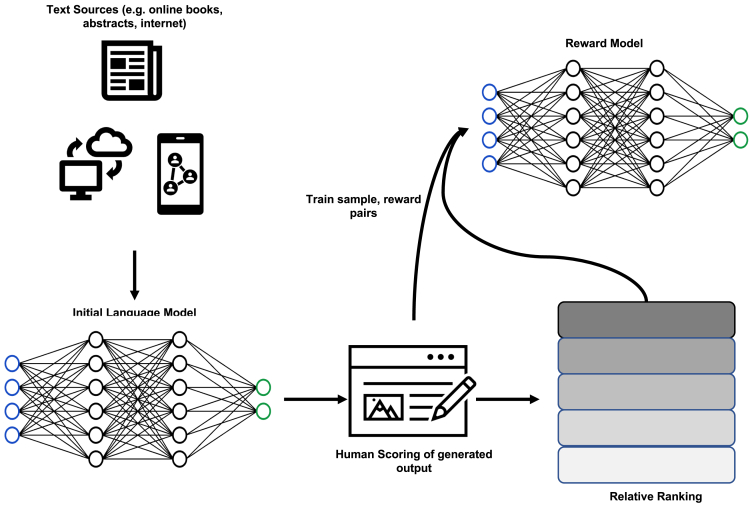
“22 The development of ChatGPT is outlined in Figure 1, illustrating the concept of reinforcement learning with human in the loop.”
BackgroundHealth intelligence: how artificial intelligence transforms population and personalized health
Shaban-Nejad, A., Michalowski, M., & Buckeridge, D. L. (2018) · npj Digital Medicine · doi:10.1038/s41746-018-0058-9 · Cited by 252
Patra, B. G., Sharma, M. M., Vekaria, V., Adekkanattu, P., Patterson, O. V., Glicksberg, B., Lepow, L. A., Ryu, E., Biernacka, J. M., Furmanchuk, A., et al. (2021) · Journal of the American Medical Informatics Association · doi:10.1093/jamia/ocab170 · Cited by 248
Scaling Language Models: Methods, Analysis & Insights from Training Gopher
Rae, J. W., Borgeaud, S., Cai, T., Millican, K., Hoffmann, J., Song, F., Aslanides, J., Henderson, S., Ring, R., Young, S., et al. (2021) · arXiv · doi:10.48550/arxiv.2112.11446 · Cited by 235
Steiger, M., Bharucha, T. J., Venkatagiri, S., Riedl, M. J., & Lease, M. (2021) · Proceedings of the 2021 CHI Conference on Human Factors in Computing Systems · doi:10.1145/3411764.3445092 · Cited by 222 · cited 1×
“65,66 It is thus imperative to examine the impact of the aforementioned labor practices to ensure that advancements in AI do not come at the expense of employee well-being.”
BackgroundSalehinejad, H., Valaee, S., Dowdell, T., Colak, E., & Barfett, J. (2018) · IEEE International Conference on Acoustics Speech and Signal Processing · doi:10.1109/icassp.2018.8461430 · Cited by 221
Gama, F., Tyskbo, D., Nygren, J., Barlow, J., Reed, J., & Svedberg, P. (2022) · Journal of Medical Internet Research · doi:10.2196/32215 · Cited by 216
2008 IEEE international conference on acoustics, speech, and signal processing
(2008) · IEEE International Conference on Acoustics Speech and Signal Processing · doi:10.1109/icassp.2008.4517523 · Cited by 213
Truong, H. P., Luke, A. A., Hammond, G., Wadhera, R. K., Reidhead, M., & Joynt Maddox, K. E. (2020) · Medical Care · doi:10.1097/mlr.0000000000001418 · Cited by 203
Borys, K., Schmitt, Y. A., Nauta, M., Seifert, C., Krämer, N. C., Friedrich, C. M., & Nensa, F. (2023) · European Journal of Radiology · doi:10.1016/j.ejrad.2023.110787 · Cited by 186
Does “ AI ” stand for augmenting inequality in the era of covid-19 healthcare?
Leslie, D., Mazumder, A., Peppin, A., Wolters, M. K., & Hagerty, A. (2021) · BMJ · doi:10.1136/bmj.n304 · Cited by 177
The clinical imperative for inclusivity: Race, ethnicity, and ancestry (REA) in genomics
Popejoy, A. B., Ritter, D., Crooks, K., Currey, E., Fullerton, S. M., Hindorff, L. A., Koenig, B. A., Ramos, E. M., Sorokin, E. P., Wand, H., et al. (2018) · Human Mutation · doi:10.1002/humu.23644 · Cited by 174
Tan, T., Anees, A., Chen, C. H., Li, S., Xu, X., Li, Z., Xiao, Z., Yang, Y., Lei, X., Ang, M., et al. (2021) · The Lancet Digital Health · doi:10.1016/s2589-7500(21)00055-8 · Cited by 166
Self-citationThe promise of large language models in health care
Arora, A., & Arora, A. (2023) · The Lancet · doi:10.1016/s0140-6736(23)00216-7 · Cited by 153
Digital health during COVID-19: lessons from operationalising new models of care in ophthalmology
Gunasekeran, D. V., Tham, Y. C., Ting, D. S. W., Tan, G. S. W., & Wong, T. Y. (2021) · The Lancet Digital Health · doi:10.1016/s2589-7500(20)30287-9 · Cited by 151
Self-citationGomez Rossi, J., Rojas-Perilla, N., Krois, J., & Schwendicke, F. (2022) · JAMA Network Open · doi:10.1001/jamanetworkopen.2022.0269 · Cited by 141
Syrowatka, A., Kuznetsova, M., Alsubai, A., Beckman, A. L., Bain, P. A., Craig, K. J. T., Hu, J., Jackson, G. P., Rhee, K., & Bates, D. W. (2021) · npj Digital Medicine · doi:10.1038/s41746-021-00459-8 · Cited by 130
d’Elia, A., Gabbay, M., Rodgers, S., Kierans, C., Jones, E., Durrani, I., Thomas, A., & Frith, L. (2022) · Family Medicine and Community Health · doi:10.1136/fmch-2022-001670 · Cited by 129
Generative Artificial Intelligence Through ChatGPT and Other Large Language Models in Ophthalmology
Tan, T. F., Thirunavukarasu, A. J., Campbell, J. P., Keane, P. A., Pasquale, L. R., Abràmoff, M. D., Kalpathy–Cramer, J., Lum, F., Kim, J. E., Baxter, S. L., et al. (2023) · Ophthalmology Science · doi:10.1016/j.xops.2023.100394 · Cited by 124
Self-citationA Blockchain‐Based Federated Learning Method for Smart Healthcare
Chang, Y., Fang, C., & Sun, W. (2021) · Computational Intelligence and Neuroscience · doi:10.1155/2021/4376418 · Cited by 119
Universal health coverage and social determinants of health
Marmot, M. G. (2013) · The Lancet · doi:10.1016/s0140-6736(13)61791-2 · Cited by 110
Kino, S., Hsu, Y., Shiba, K., Chien, Y.-S., Mita, C., Kawachi, I. I., & Daoud, A. (2021) · SSM - Population Health · doi:10.1016/j.ssmph.2021.100836 · Cited by 103
A Primer on Pretrained Multilingual Language Models
Doddapaneni, S., Ramesh, G., Khapra, M. M., Kunchukuttan, A., & Kumar, P. (2025) · ACM Computing Surveys · doi:10.1145/3727339 · Cited by 96
Yang, W. T., Li, C., Zhang, J., & Zong, C. (2023) · arXiv (Cornell University) · doi:10.48550/arxiv.2305.18098 · Cited by 93
Lybarger, K., Mari Ostendorf, E., & Yetişgen, M. (2020) · Journal of Biomedical Informatics · doi:10.1016/j.jbi.2020.103631 · Cited by 87
AI Estimation of Gestational Age from Blind Ultrasound Sweeps in Low-Resource Settings
Pokaprakarn, T., Prieto, J. C., Price, J. T., Kasaro, M. P., Sindano, N., Shah, H. R., Peterson, M., Akapelwa, M. M., Kapilya, F. M., Sebastião, Y. V., et al. (2022) · NEJM Evidence · doi:10.1056/evidoa2100058 · Cited by 80
When Doctors and AI Interact: on Human Responsibility for Artificial Risks
Verdicchio, M., & Perin, A. (2022) · Philosophy & Technology · doi:10.1007/s13347-022-00506-6 · Cited by 79
Contribution of Residential Exposures to Asthma in US Children and Adolescents
Lanphear, B. P., Kahn, R. S., Berger, O. G., Auinger, P., Bortnick, S. M., & Nahhas, R. W. (2001) · PEDIATRICS · doi:10.1542/peds.107.6.e98 · Cited by 78
Trust in AI: why we should be designing for APPROPRIATE reliance
Benda, N. C., Novak, L. L., Reale, C., & Ancker, J. S. (2021) · Journal of the American Medical Informatics Association · doi:10.1093/jamia/ocab238 · Cited by 76
A framework for digital divide research
van Dijk, J. A. G. M. (2002) · University of Twente Research Information · Cited by 76
Talking About Large Language ModelsPreprint
Shanahan, M. (2022) · arXiv (Cornell University) · doi:10.48550/arxiv.2212.03551 · Cited by 69
Dacal, E., Bermejo-Peláez, D., Lin, L., Álamo, E., Cuadrado, D., Martínez, Á., Mousa, A., Postigo, M., Soto, A., Sukosd, E., et al. (2021) · PLoS neglected tropical diseases · doi:10.1371/journal.pntd.0009677 · Cited by 62
Bompelli, A., Wang, Y., Wan, R., Singh, E., Zhou, Y., Xu, L., Oniani, D., Kshatriya, B. S. A., Balls-Berry, J. (. E., & Zhang, R. (2021) · Health Data Science · doi:10.34133/2021/9759016 · Cited by 58
Stemerman, R., Arguello, J., Brice, J., Krishnamurthy, A., Houston, M., & Kitzmiller, R. (2021) · JAMIA Open · doi:10.1093/jamiaopen/ooaa069 · Cited by 54
A Primer on Pretrained Multilingual Language ModelsPreprint
Doddapaneni, S., Ramesh, G., Khapra, M. M., et al. (2021) · arXiv (Cornell University) · doi:10.48550/arxiv.2107.00676 · Cited by 41
Making universal digital access universal: lessons from COVID-19 in Singapore
Ng, I. Y. H., Lim, S. S., & Pang, N. L.-S. (2022) · Universal Access in the Information Society · doi:10.1007/s10209-022-00877-9 · Cited by 38
ChatGPT is not the solution to physicians’ documentation burden
Preiksaitis, C. M., Sinsky, C. A., & Rose, C. C. (2023) · Nature Medicine · doi:10.1038/s41591-023-02341-4 · Cited by 36
Han, J. E., Liu, X., Bunce, C., Douiri, A., Vale, L. D., BLANDFORD, A. E., Lawrenson, J. G., Hussain, R., Grimaldi, G., Learoyd, A., et al. (2022) · BMJ Open · doi:10.1136/bmjopen-2021-055845 · Cited by 33
Challenges in digital medicine applications in under-resourced settings
(2022) · Nature Communications · doi:10.1038/s41467-022-30728-3 · Cited by 29
Ugarte‐Gil, C., Icochea, M., Otero, J. C. L., Villaizan, K., Young, N. R., Cao, Y., Liu, B., Griffin, T., & Brunette, M. (2020) · Health Informatics Journal · doi:10.1177/1460458220938535 · Cited by 24
Goh, O. Q. M., Islam, A. M., Lim, J. C. W., & Chow, W. C. (2020) · BMJ Global Health · doi:10.1136/bmjgh-2020-003054 · Cited by 22
Jani, A. R., Liyanage, H., Okusi, C., Sherlock, J., Hoang, U., Ferreira, F. M., Yonova, I., & de Lusignan, S. (2020) · Journal of Medical Internet Research · doi:10.2196/23721 · Cited by 22
Leveraging Digital Health for Global Chronic Diseases
Were, M. C., Kamano, J. H., & Vedanthan, R. (2016) · Global Heart · doi:10.1016/j.gheart.2016.10.017 · Cited by 19
Unruh, L. H., Dharmapuri, S., Xia, Y., & Soyemi, K. L. (2022) · PLoS ONE · doi:10.1371/journal.pone.0268317 · Cited by 19
Improving Risk Stratification Using AI and Social Determinants of Health
Carroll, N. W. (2022) · The American Journal of Managed Care · doi:10.37765/ajmc.2022.89261 · Cited by 18
Reexamining Social Determinants of Health Data Collection in the COVID-19 Era
Mullangi, S., Aviki, E. M., & Hershman, D. L. (2022) · JAMA Oncology · doi:10.1001/jamaoncol.2022.4543 · Cited by 11
Sun, C., van Soest, J., Koster, A., Eussen, S. J. P. M., Schram, M. T., Stehouwer, C. D. A., Dagnelie, P. C., & Dumontier, M. (2022) · Journal of Biomedical Informatics · doi:10.1016/j.jbi.2022.104194 · Cited by 10
Torres, I., Thapa, B. B., Robbins, G., Koya, S. F., Abdalla, S. M., Arah, O. A., Weeks, W. B., Zhang, L., Asma, S., Morales, J. V., et al. (2021) · Journal of Urban Health · doi:10.1007/s11524-021-00558-7 · Cited by 8
SHAP Model Explainability in ECMO – PAL mortality prediction: A Critical Analysis. Author’s reply
Stephens, A. F., Šeman, M., Hodgson, C. L., & Gregory, S. D. (2023) · Intensive Care Medicine · doi:10.1007/s00134-023-07237-y · Cited by 4
Gibbons, M. C. (2007) · Springer eBooks · doi:10.1007/978-0-387-72815-5_8 · Cited by 2
Research works printed but not linked: 3
- 2017, Social Determinants of Health (SDOH), NEJM Catalyst
- Zelmer, 2022, Transforming Care and Outcomes with Digital Health Through and Beyond the Pandemic, NEJM Catalyst
- Perrigo, 2023, Exclusive: The $2 Per Hour Workers Who Made ChatGPT Safer, Time
Cited by
Sorted by citations
Zhui, L., Li, F., Wang, X., Fu, Q., & Wei, R. (2024) · Journal of Medical Internet Research · doi:10.2196/60083 · Cited by 110
Yau, J. Y.-S., Saadat, S., Hsu, E., Murphy, L. S.-L., Roh, J., Suchard, J. R., Tapia, A., Wiechmann, W. F., & Langdorf, M. I. (2024) · Journal of Medical Internet Research · doi:10.2196/60291 · Cited by 89
Guo, S., Liu, D., Fang, X., Meng, Y. G., Zhou, Z.-Z., Li, J., Li, M., Luo, L. Q., Li, H.-L., Cai, X.-Y., et al. (2025) · International Journal of Surgery · doi:10.1097/js9.0000000000003668 · Cited by 83
Huang, Y., Wu, R., He, J., & Xiang, Y. (2024) · Journal of Global Health · doi:10.7189/jogh.14.04070 · Cited by 72
Medical Ethics of Large Language Models in Medicine
Ong, J. C. L., Chang, Y., Wasswa, W., Butte, A. J., Shah, N. H., Chew, L. S. T., Liu, N., Doshi‐Velez, F., Lu, W., Savulescu, J., et al. (2024) · NEJM AI · doi:10.1056/aira2400038 · Cited by 62
Self-citation
Metadata
- Authors
- Ong, J. C. L., Seng, B. J. J., Law, J. Z. F., Low, L. L., Kwa, A. L. H., Giacomini, K. M., & Ting, D. S. W.
- Affiliations
- SingHealth (SG)
- National University of Singapore (SG)
- University of California, San Francisco (US)
- Corresponding author
- Ting, Daniel Shu Wei
- ORCID
- Venue
- Cell Reports Medicine
- Publisher
- Elsevier BV
- Published
- 2024-01
- Volume
- 5
- Issue
- 1
- Pages
- 101356
- ISSN
- 2666-3791 (ISSN-L)
- PMC
- PMC10829781
- OpenAlex
- W4390921272
- Cited by
- 111
- References
- 94
- Citations by year
- 2026: 32 · 2025: 51 · 2024: 28
- FWCI
- 2.53
- Type
- journal article
- Language
- en
- Open access
- gold
- doi.org
- Licence
- Locations
- Cell Reports Medicine (publishedVersion, cc-by-nc-nd)
- PubMed Central (publishedVersion, cc-by-nc-nd)
- PubMed (publishedVersion)
- Funders
- Agency for Science, Technology and Research (A20H4g2141, H20C6a0032, MOH-CIAINV21nov-001)
- Topics
- Health Sciences › Medicine › Health Informatics › Artificial Intelligence in Healthcare and Education
- Physical Sciences › Computer Science › Artificial Intelligence › Ethics and Social Impacts of AI
- Health Sciences › Health Professions › Health Information Management › Artificial Intelligence in Healthcare
- Keywords
- social determinants of health, large language models, ChatGPT, artificial intelligence in healthcare, health disparities, digital health, disease surveillance, algorithmic bias, digital literacy, digital inclusion, environmental impact of AI, AI hallucination, copyright infringement, AI ethics framework, COVID-19 pandemic
- MeSH terms
- COVID-19, Artificial Intelligence, Humans, Language, Pandemics, Social Determinants of Health
About these checks
Registry, retraction, Cites and statistics results are computed, not judged, with one exception: a printed reference that no index lists is read once by a model before it counts as a citation error. Claims are extracted by a model and kept only when their quote appears verbatim in the text; each cited source is then checked, with a model’s help, for whether it says what the claim relies on. Those verdicts can be wrong — read the claim’s quote and the cited source before relying on one.
Statistics and arithmetic are recomputed, not judged.
Confidence bands are shown only for fields calibrated on our annotated test set. None is calibrated yet, so no band is shown.
What counts as a claim ›How we measure confidence ›How we check this ›
Are you an author, or do you see a problem with this page? Request a review
