

Regulation of Cell Adhesion Receptors by Transforming Growth Factor-β
Open accessThe DOI matches its Crossref record; 27 of the 27 references it cites were found in a registry or an index.
Abstract
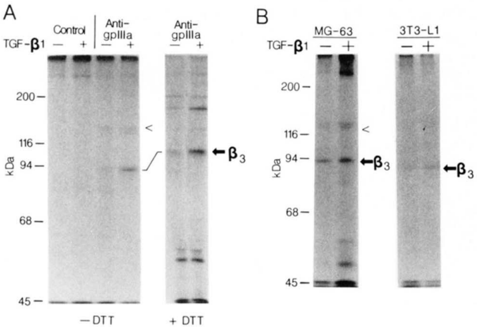
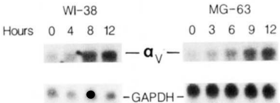
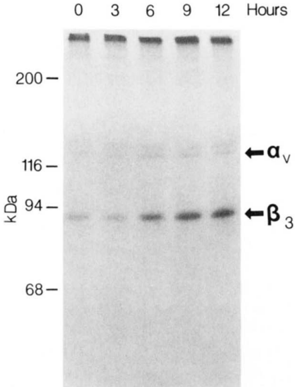
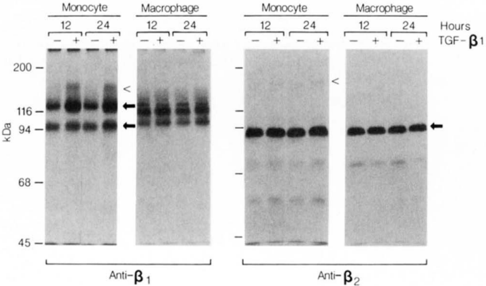
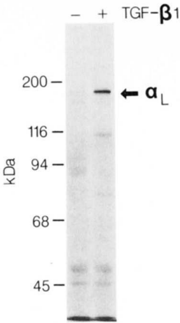
We have examined the ability of transforming growth factor-beta 1 (TGF-beta 1) to regulate the expression of members of the alpha beta 2 and alpha beta 3 families of integrins. TGF-beta 1 elevates the expression of vitronectin receptors (alpha v beta 3 integrin) in all cells examined including WI-38 human lung fibroblasts, 3T3-L1 mouse fibroblasts, and MG-63 human osteogenic sarcoma cells. TGF-beta 1 action increases the level of mRNA and the synthesis of vitronectin receptor subunits with t1/2 o 3-4 h and 6 h, respectively. TGF-beta 1 up-regulates expression of the intercellular adhesion receptor, LFA-1 (alpha L beta 2), in THP-1 human monocytic leukemia cells by increasing the synthesis of alpha L subunit but not beta 2 subunit. The increase in alpha L synthesis and assembly into LFA-1 complexes induced by TGF-beta 1 occurs in parallel with elevated fibronectin receptor synthesis in THP-1 cells. These responses to TGF-beta 1 are lost upon phorbol ester-induced differentiation of THP-1 cells into the macrophage phenotype. The results suggest a role of TGF-beta in the regulation of cell-matrix interactions mediated by vitronectin receptors and cell-cell interactions mediated by LFA-1 in the immune system.
Overview
The claims and statistics of this paper haven’t been checked yet.
Free: it reads the open-access text and checks the first 5 claims that cite a source we can check. Create a free account to check every claim.
Integrity signals
Registry
Cites
Statistics
Figures
Verification
Claims the paper makes
The claims and statistics of this paper haven’t been checked yet.
Free: it reads the open-access text and checks the first 5 claims that cite a source we can check. Create a free account to check every claim.
Claims other papers make about this one
Each is checked against this paper’s own text: does it say what the citing paper says it does?
The source backs part of the claim, not all of it — or backs it for a different population, condition or comparison.
In the citing paper
“TGF-b has been found to increase expression of integrins that bind collagen, fibronectin, and vitronectin.”
From Interactions between extracellular matrix and growth factors in wound healing (2009) · cites this paper as [82]
Experimental — accuracy not yet measured
Self-check
Percentages, sums and reported differences re-computed from the paper’s own numbers.
The self-check needs the paper’s full text.
Citations
Cites
New Perspectives in Cell Adhesion: RGD and Integrins
Ruoslahti, E., & Pierschbacher, M. D. (1987) · Science · doi:10.1126/science.2821619 · Cited by 4,865
Integrins: A family of cell surface receptors
HYNES, R. (1987) · Cell · doi:10.1016/0092-8674(87)90233-9 · Cited by 4,249
Fort, P., Marty, L., Piechaczyk, M., Sabrouty, S. E., Dani, C., Jeanteur, P., & Blanchard, J. M. (1985) · Nucleic Acids Research · doi:10.1093/nar/13.5.1431 · Cited by 2,099
Pytela, R., Pierschbacher, M. D., Ginsberg, M. H., Plow, E. F., & Ruoslahti, E. (1986) · Science · doi:10.1126/science.2420006 · Cited by 925
Tamkun, J. W., DeSimone, D. W., Fonda, D., Patel, R. S., Buck, C., Horwitz, A. F., & Hynes, R. O. (1986) · Cell · doi:10.1016/0092-8674(86)90744-0 · Cited by 871
Regulation of Cell Adhesion Receptors by Transforming Growth Factor-β
Heino, J., Ignotz, R. A., Hemler, M. E., Crouse, C., & Massagué, J. (1989) · Journal of Biological Chemistry · doi:10.1016/s0021-9258(17)31269-3 · Cited by 670
Self-citationICAM-1 a ligand for LFA-1-dependent adhesion of B, T and myeloid cells
Makgoba, M. W., Sanders, M. E., Luce, G. E. G., Dustint, M. L., Springer, T. A., Clark, E. A., Mannoni, P., & Shaw, S. (1988) · Nature · doi:10.1038/331086a0 · Cited by 573
Rook, A. H., Kehrl, J. H., Wakefield, L. M., Roberts, A. B., Sporn, M. B., Burlington, D. B., Lane, H. C., & Fauci, A. S. (1986) · The Journal of Immunology · doi:10.4049/jimmunol.136.10.3916 · Cited by 570
Cheresh, D. A. (1987) · Proceedings of the National Academy of Sciences · doi:10.1073/pnas.84.18.6471 · Cited by 561
KISHIMOTO, T. (1987) · Cell · doi:10.1016/0092-8674(87)90246-7 · Cited by 517
Research works printed but not linked: 3
- Springer, T. A., and Anderson, D. C. (1986) Ciba Found. Symp.
- Chirgwin, J. M., Przybyla, A. E., MacDonald, R. J., and Rutter, W. J. (1979) Biochemistry 1 0 , 5291-5299
- Tsuchiva. S.. Kobavashi. Y.. Goto. Y.. Okumura. H.. Nakae. H.. " , I Konno, T., and Tada, K. (1982) 'Cancer Res. 42, 1530-1536 '
Cited by
Items 201–269 of 269
TGF-β1 reverses PDGF-stimulated migration of human aortic smooth muscle cells in vitro
Engel, L., & Ryan, U. (1997) · In Vitro Cellular & Developmental Biology - Animal · doi:10.1007/s11626-997-0062-x · Cited by 15
Association study of integrins beta 1 and beta 2 gene polymorphism and papillary thyroid cancer
Eun, Y., Kim, S. K., Chung, J., & Kwon, K. H. (2013) · The American Journal of Surgery · doi:10.1016/j.amjsurg.2012.05.035 · Cited by 14
The vitronectin receptor (αVβ3) as an example for the role of integrins in T lymphocyte stimulation
Halvorson, M. J., Coligan, J. E., & Sturmhöfel, K. (1996) · Immunologic Research · doi:10.1007/bf02918281 · Cited by 14
Herrera, A. L., Faal, H., Moss, D., Addengast, L. A., Fanta, L., Eyster, K. M., Huber, V. C., & Chaussee, M. S. (2018) · Scientific Reports · doi:10.1038/s41598-018-29714-x · Cited by 13
Granulation Tissue Formation and Remodeling
Häkkinen, L., Larjava, H., & Koivisto, L. (2012) · Wiley eBooks · doi:10.1002/9781118704509.ch6 · Cited by 17
Feedback Inhibitors in Normal and Tumor Tissues
Marshall, E., & Lord, B. I. (1996) · International review of cytology · doi:10.1016/s0074-7696(08)61348-0 · Cited by 13
Heymann, D., Harb, J., Ringeard, S., Blanchard, F., Lassort, D., Raher, S., & Godard, A. (1995) · Journal of Cellular Biochemistry · doi:10.1002/jcb.240580305 · Cited by 12
Regulation of keratin and integrin gene expression in cancer and drug resistance
Daly, N., Meleady, P., Walsh, D., & CLYNES, M. M. (1998) · Cytotechnology · doi:10.1023/a:1008066216490 · Cited by 13
Endothelial cell TIMP-1 is upregulated by shear stress via Sp-1 and the TGFβ1 signaling pathways
Uchida, C. L., & Haas, T. L. (2013) · Biochemistry and Cell Biology · doi:10.1139/bcb-2013-0086 · Cited by 11
Integrins and disintegrins: the candidate molecular players in sperm-egg interaction.
Shrimali, R. K., & Reddy, K. V. R. (2000) · PubMed · Cited by 11
Nambu, M., Mayumi, M., & Mikawa, H. (1992) · Cellular Immunology · doi:10.1016/0008-8749(92)90030-s · Cited by 11
Regulation of transcription by transforming growth factor-β
Edwards, D. R., & Heath, J. K. (1991) · Molecular aspects of cellular regulation · doi:10.1016/b978-0-444-81382-4.50022-0 · Cited by 11
Integrin Structure and Ligand Specificity in Cell–Matrix Interactions
Kramer, R. H., Enenstein, J., & Waleh, N. S. (1993) · Elsevier eBooks · doi:10.1016/b978-0-12-593165-6.50018-8 · Cited by 11
Nejjari, M., Anderson, W., Pourreyron, C., Jacquier, M., Scoazec, J., & Rémy, L. (2004) · International Journal of Cancer · doi:10.1002/ijc.20444 · Cited by 10
Luddington, S., Qwarnström, E. E., Page, R. C., & Bordin, S. (1993) · Journal of Cellular Physiology · doi:10.1002/jcp.1041550120 · Cited by 10
Transforming growth factor βS: Biochemistry and biological activities in vitro and in vivo
Cui, W., & Akhurst, R. J. (1996) · Growth factors and cytokines in health and disease · doi:10.1016/s1874-5687(96)80015-2 · Cited by 13
Das, S., Paria, B. C., Andrews, G. K., & Dey, S. K. (1993) · The Journal of Steroid Biochemistry and Molecular Biology · doi:10.1016/0960-0760(93)90160-x · Cited by 9
Nsaibia, S., Wagner, S., Rondé, P., Warter, J., Poindron, P., Aouni, M., & Dorchies, O. M. (2006) · Virus Research · doi:10.1016/j.virusres.2006.07.016 · Cited by 11
Island, E. R., Wu, H., Warburton, D., Anderson, K. D., & Tuan, T. (1999) · Wound Repair and Regeneration · doi:10.1046/j.1524-475x.1999.00467.x · Cited by 9
Jin, D., Kim, Y., Mauer, M. S., Fioretto, P., Vats, A. N., & Fish, A. (1998) · American Journal of Kidney Diseases · doi:10.1053/ajkd.1998.v31.pm9469500 · Cited by 9
Transforming growth factor-? receptors
Segarini, P. R. (1989) · Cytotechnology · doi:10.1007/bf00364995 · Cited by 9
Pontbriant, C. M., Chen, J., & Orlando, J. A. (1990) · Journal of Cellular Physiology · doi:10.1002/jcp.1041450314 · Cited by 10
Cellular Processes in Lung Repair
Roman, J. R., & McDonald, J. A. (1991) · CHEST Journal · doi:10.1378/chest.100.1.245 · Cited by 11
Boku, N., Yoshida, S., Ohtsu, A., Fujii, T., Koba, I., Oda, Y., Ryu, M., MATSUMOTΟ, T., Hasebe, T., Hosokawa, K., et al. (1995) · Japanese Journal of Cancer Research · doi:10.1111/j.1349-7006.1995.tb03004.x · Cited by 8
Lauweryns, B., van den Oord, J. J., & Missotten, L. (1992) · Graefe s Archive for Clinical and Experimental Ophthalmology · doi:10.1007/bf00176302 · Cited by 8
The potential and therapeutic advances of the integrin family in neurological disorders
Zhang, X., Gao, L., Wang, Y., Meng, Q., Bai, M., Xu, D., Wang, Y., Wang, J., Bi, H., & Ding, Y. (2025) · Neural Regeneration Research · doi:10.4103/nrr.nrr-d-25-00020 · Cited by 10
Differences in Wound Healing between Horses and Ponies
Wilmink, J. M. (2016) · Wiley eBooks · doi:10.1002/9781118999219.ch2 · Cited by 11
Adhesive glycoproteins and receptors
Hughes, R. C. (1997) · New comprehensive biochemistry · doi:10.1016/s0167-7306(08)60627-4 · Cited by 8
Chronic Renal Failure: An Overview from a Pediatric Perspective
Saborío, P., Hahn, S.-H., Hisano, S., Latta, K., Scheinman, J. I., & Chan, J. C. M. (1998) · The Nephron journals/Nephron journals · doi:10.1159/000045157 · Cited by 7
Suzuki, K., Kunisada, Y., Miyamura, N., Eikawa, S., de Mendoza, T. H., Mose, E. S., Lu, C., Kuroda, Y., Ruoslahti, E. I., Lowy, A. M., et al. (2023) · bioRxiv (Cold Spring Harbor Laboratory) · doi:10.1101/2023.05.24.542137 · Cited by 7
Physiology and Pathophysiology of Wound Healing
Falanga, V. (2002) · Humana Press eBooks · doi:10.1007/978-1-59259-168-8_3 · Cited by 7
Conejo, R., Valverde, A. M., Benito, M., & Lorenzo, M. (2001) · Journal of Cellular Physiology · doi:10.1002/1097-4652(200101)186:1<82::aid-jcp1001>3.0.co;2-r · Cited by 136
Role of Growth Factors and Their Receptors in the Development and Progression of Melanoma.
Shih, I., & Herlyn, M. (1993) · Journal of Investigative Dermatology · doi:10.1111/1523-1747.ep12465183 · Cited by 6
Biological roles of carboxymethyl‐chitin associated for the growth factor production
Kariya, H., Kiyohara, A., Masuda, S., Yoshihara, Y., Ueno, M., Hashimoto, M., & Suda, Y. (2007) · Journal of Biomedical Materials Research Part A · doi:10.1002/jbm.a.31202 · Cited by 5
Klein, J. L., Hamel, E., Tayot, J. L., & Yamasaki, H. (1991) · Journal of Cancer Research and Clinical Oncology · doi:10.1007/bf01625424 · Cited by 5
Influence of β3 Integrin Gene Leu33/Pro33 Polymorphism on Primary Glomerulonephritis
Bantis, C., Heering, P., Aker, S., Kuhr, N., Grabensee, B., & Ivens, K. (2004) · Nephron Experimental Nephrology · doi:10.1159/000082867 · Cited by 4
Begara, I., Luján, L., McLaren, L., Collie, D., Miller, H. R. P., & Watt, N. J. (1995) · Veterinary Immunology and Immunopathology · doi:10.1016/0165-2427(95)05443-a · Cited by 4
Clinical Significance of Integrin Cell Adhesion Molecules as Markers of Endometrial Receptivity
Lessey, B. A., Castelbaum, A. J., Somkuti, S. G., Yuan, L., & Chwalisż, K. (1997) · Springer eBooks · doi:10.1007/978-3-662-10323-4_10 · Cited by 4
Cancer Cell Chemotaxis: Mechanisms and Influence on Site-Specific Tumor Metastasis
Orr, F. W. (1994) · Advances in molecular and cell biology · doi:10.1016/s1569-2558(08)60384-7 · Cited by 4
The cytoskeleton in the biology of bone cells
Lomri, A., & Marie, P. J. (1996) · The Cytoskeleton · doi:10.1016/s1874-6020(96)80010-3 · Cited by 4
Endothelial Cell Adhesive Interactions
Dejana, E., Needham, L. A., & Gordon, J. L. (1992) · Springer eBooks · doi:10.1007/978-1-4899-0721-9_9 · Cited by 4
Integrin Expression and Epithelial Cell Differentiation
Quaranta, V. (1993) · Springer eBooks · doi:10.1007/978-1-4615-2830-2_2 · Cited by 2
Bazzoni, G., Martín-Padura, I., Beltrán-nuñez, A., & Dejana, E. (1993) · Journal of Surgical Oncology · doi:10.1002/jso.2930530508 · Cited by 2
Steroid modulation of the expression of growth factors and oncogenes in breast cancer
McCarty, K. S., & McCarty, K. S. (1991) · Cancer treatment and research · doi:10.1007/978-1-4615-3940-7_9 · Cited by 2
Development of Lymphopoiesis as a Function of the Thymic Microenvironment
(2006) · Kluwer Academic Publishers eBooks · doi:10.1007/1-4020-2185-2_5 · Cited by 2
Adhesion Molecules and Tumor Cell-Vasculature Interactions: Modulation by Bioactive Lipid Molecules
Tang, D. G., & Honn, K. V. (1996) · Current topics in microbiology and immunology · doi:10.1007/978-3-642-61109-4_4 · Cited by 2
HL‐60 Cell Differentiation and Osteopontin Expression
Berry, J. E., Somerman, M. J., Khalkhali‐Ellis, Z., Osdoby, P., & Simpson, R. U. (1995) · Annals of the New York Academy of Sciences · doi:10.1111/j.1749-6632.1995.tb44641.x · Cited by 1
Molecular factors in human implantation: adhesion molecules, proteases and cytokines.
Lim, K. J. H. (2003) · PubMed · Cited by 3
TGF-β Signaling in Fibroblastic Cells and Oncogenesis
Bhowmick, N. A. (2008) · Humana Press eBooks · doi:10.1007/978-1-59745-292-2_12 · Cited by 1
Regulation of keratin and integrin gene expression in cancer and drug resistance
Daly, N., Meleady, P., Walsh, D., & CLYNES, M. M. (1998) · Springer eBooks · doi:10.1007/978-94-017-2374-9_22 · Cited by 1
Growth Factors in the Fetal-Placental Unit
Gruppuso, P. A. (1998) · Springer eBooks · doi:10.1007/978-1-4612-1642-1_20 · Cited by 1
Growth factors and cytokines in tumor invasion and metastasis
Beckner, M. E., & Liotta, L. A. (1997) · Growth factors and cytokines in health and disease · doi:10.1016/s1874-5687(97)80014-6 · Cited by 3
Growth of only highly tumorigenic cell lines is inhibited by EAP, a human placental fraction
Klein, J. L., Chiodino, C., & Yamasaki, H. (1993) · Cancer Letters · doi:10.1016/0304-3835(93)90079-o · Cited by 1
Rajagopal, S., & Chakrabarty, S. (2001) · Cell Communication & Adhesion · doi:10.3109/15419060109080709 · Cited by 1
Testican-2 - Studien zu Expression und Funktion eines neuen Proteoglykans
Schnepp, A. (2004) · Kölner Universitäts PublikationsServer (Universität zu Köln) · Cited by 1
A Twenty-First Century Approach to the Management of Keloids and Hypertrophic Scars
Sadick, N. S. (2001) · The American Journal of Cosmetic Surgery · doi:10.1177/074880680101800306 · Cited by 1
Spurzem, J. R., & Rennard, S. I. (2002) · Elsevier eBooks · doi:10.1016/b978-012079028-9/50090-9 · Cited by 1
Bologna, S. B. (2013) · Digital Library of Theses and Dissertations (Universidade de São Paulo) · doi:10.11606/t.5.2013.tde-05022014-110422
Dey, S. K., Das, S. K., Paria, B. C., Flanders, K. C., & Andrews, G. K. (1993) · Springer eBooks · doi:10.1007/978-1-4612-2716-8_13
Developing a Scaffold from Porcine Adipose Tissue
Roehm, K. D. (2014) · SHAREOK (University of Oklahoma; Oklahoma State University; Central Oklahoma University)
RET Mediated Gene Expression and Cell-Migration
Cockburn, J. (2011) · QSpace (Queen's University Library)
Guha, P., Gupta, S., Majumder, S., Chakraborty, A., Nath, D., & Mukherjee, D. (2018) · Proceedings of the Zoological Society · doi:10.1007/s12595-018-0281-z
The Reticulo-Epithelial (Re) Cellular Network of the Mammalian Thymus
(2006) · Kluwer Academic Publishers eBooks · doi:10.1007/1-4020-2185-2_3
RNA-seq of THP-1 and U937 exposed to enamel matrix derivativePreprint
Panahipour, L., Huang, X., Miron, R. J., & Gruber, R. (2025) · Research Square · doi:10.21203/rs.3.rs-7240030/v1
Micro-engineered substrates as bone extracellular matrix mimics
Bilem, I. (2016) · theses.fr (ABES) · doi:10.70675/d5c22b5az47b2z4e35zb444z0fd49ec1166b
Ajalbert, G., Yao, Y., Rohrer, S., Caretti, M., Sundaramoorthy, S., Rigkou, A., Stumpe, M., Ming, X., Potenza, D. M., & Yang, Z. (2026) · Journal of Biomedical Science · doi:10.1186/s12929-026-01278-3
Frye, C. A. (1994) · UA Campus Repository (The University of Arizona)
Endothelial Cell-Matrix Interactions in Health and Disease
Dejana, E., Zanetti, A., Domínguez-Jiménez, C., & Conforti, G. (1991) · Springer eBooks · doi:10.1007/978-1-4615-3736-6_18
Metadata
- Authors
- Ignotz, R. A., Heino, J., & Massagué, J.
- Affiliations
- University of Massachusetts Chan Medical School (US)
- ORCID
- Venue
- Journal of Biological Chemistry
- Publisher
- Elsevier BV
- Published
- 1989-01
- Volume
- 264
- Issue
- 1
- Pages
- 389-392
- ISSN
- 0021-9258 (ISSN-L)
- OpenAlex
- W1502130152
- Cited by
- 269
- References
- 27
- Citations by year
- 2026: 1 · 2025: 2 · 2023: 1 · 2022: 1 · 2019: 1 · 2018: 4 · 2016: 3 · 2015: 1 · 2014: 2 · 2013: 5 · 2012: 3
- FWCI
- 6.80
- Type
- journal article
- Language
- en
- Open access
- hybrid
- doi.org
- Licence
- cc-by
- www.elsevier.com/tdm/userlicense/1.0/ (tdm)
- www.elsevier.com/legal/tdmrep-license (tdm)
- creativecommons.org/licenses/by/4.0/ (vor, 11627 d)
- Locations
- Journal of Biological Chemistry (publishedVersion, cc-by)
- PubMed (publishedVersion)
- eScholarship@UMassChan (submittedVersion, cc-by)
- Funders
- National Cancer Institute (CA 39240)
- Topics
- Health Sciences › Medicine › Immunology and Allergy › Cell Adhesion Molecules Research
- Life Sciences › Biochemistry, Genetics and Molecular Biology › Molecular Biology › TGF-β signaling in diseases
- Life Sciences › Immunology and Microbiology › Immunology › T-cell and B-cell Immunology
- Keywords
- TGF-β1, integrins, integrin αvβ3, alpha v beta 3 integrin, LFA-1, alpha5beta1 integrin, integrin subunit expression, cell adhesion receptors, macrophage differentiation, phorbol ester, cell-matrix interactions, cell-cell adhesion, immune cells
- MeSH terms
- Animals, Antigens, Differentiation, Antigens, Surface, Cell Adhesion, Cell Line, Humans, Membrane Glycoproteins, Receptors, Immunologic, RNA, Messenger, Transforming Growth Factors, Cell Adhesion Molecules, Lymphocyte Function-Associated Antigen-1, Receptors, Vitronectin, Macromolecular Substances, Mice
About these checks
Registry, retraction, Cites and statistics results are computed, not judged, with one exception: a printed reference that no index lists is read once by a model before it counts as a citation error. Claims are extracted by a model and kept only when their quote appears verbatim in the text; each cited source is then checked, with a model’s help, for whether it says what the claim relies on. Those verdicts can be wrong — read the claim’s quote and the cited source before relying on one.
Statistics and arithmetic are recomputed, not judged.
Confidence bands are shown only for fields calibrated on our annotated test set. None is calibrated yet, so no band is shown.
What counts as a claim ›How we measure confidence ›How we check this ›
Are you an author, or do you see a problem with this page? Request a review
Data sources
Bibliographic data: Semantic Scholar, OpenAlex, Crossref.
Contains information from the Semantic Scholar Academic Graph Datasets, made available under the ODC Attribution License (ODC-BY 1.0).
Semantic Scholar’s data is described in: Kinney, R., et al. (2023). The Semantic Scholar Open Data Platform. arXiv:2301.10140.
