

Jasplakinolide, a cytotoxic natural product, induces actin polymerization and competitively inhibits the binding of phalloidin to F-actin.
Open accessThe DOI matches its Crossref record; 21 of the 21 references it cites were found in a registry or an index.
Abstract
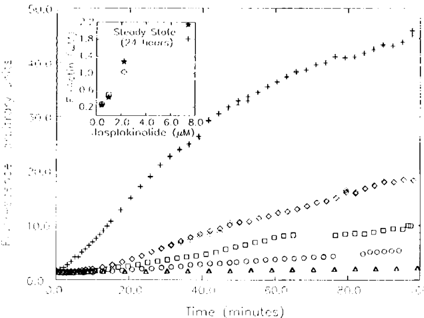
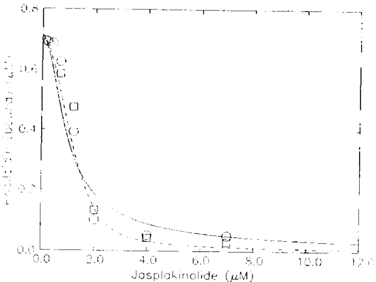
Jasplakinolide, a naturally occurring cyclic peptide from the marine sponge, Jaspis johnstoni, has both fungicidal and antiproliferative activity.We now report that this peptide is a potent inducer of actin polymerization in vitro.The peptide has a much greater effect on Me-actin than on Ca2+-actin.Competitive binding studies using rhodamine-phalloidin suggest that jasplakinolide binds to F-actin competitively with phalloidin with a dissociation constant of approximately 15 MI.This compares favorably to the previously reported IC, of 35 MI for the antiproliferative effect of jasplakinolide on PC3 prostate carcinoma cells.The binding curve suggests that nearest neighbor positive cooperativity influences the binding of jasplakinolide (and perhaps also phalloidin) to F-actin.These results imply that jasplakinolide may exert its cytotoxic effect in vivo by inducing actin polymerization and/or stabilizing pre-existing actin filaments.Jasplakinolide is a cyclic peptide with a 15-carbon macrocyclic ring containing three amino acid residues: L-alanine, N-methyl-2-bromotryptophan, and 0-tyrosine (1, 2).The function of the native molecule in the organism from which it is isolated, the marine sponge, Jaspis johnstoni, is unknown, but recent studies using purified jasplakinolide have demonstrated both fungicidal and antiproliferative activity (3, 4).In the current work, we show that jasplakinolide dramatically decreases the critical concentration of rabbit skeletal muscle actin and competes with rhodamine-phalloidin for F-actin.We suggest that jasplakinolide and phalloidin bind to F-actin by similar mechanisms.The pharmacologic and biochemical implications of these findings are discussed.EXPERIMENTAL PROCEDURES Materials-Rabbit skeletal muscle actin was prepared from frozen muscle (Pel-Freez, Rogers, A R ) as previously described and stored in a * The costs of publication of this article were defrayed in part by the payment of page charges.This article must therefore be hereby marked "advertisement" in accordance with 18 U.S.C.Section 1734 solely to indicate this fact.
Overview
The claims and statistics of this paper haven’t been checked yet.
Free: it reads the open-access text and checks the first 5 claims that cite a source we can check. Create a free account to check every claim.
Integrity signals
Registry
Cites
Statistics
Figures
Verification
Claims the paper makes
The claims and statistics of this paper haven’t been checked yet.
Free: it reads the open-access text and checks the first 5 claims that cite a source we can check. Create a free account to check every claim.
Claims other papers make about this one
Each is checked against this paper’s own text: does it say what the citing paper says it does?
The source backs part of the claim, not all of it — or backs it for a different population, condition or comparison.
In the citing paper
“Jasplakinolide is more membrane permeable than phalloidin but competes with phalloidin for the same binding site on actin filaments.It is also more effective at stabilizing actin filaments in vitro (Bubb et al., 1994).”
From Regulation of F-Actin Stability in Dendritic Spines by Glutamate Receptors and Calcineurin (1998) · cites this paper as Bubb et al., 1994
Experimental — accuracy not yet measured
Self-check
Percentages, sums and reported differences re-computed from the paper’s own numbers.
The self-check needs the paper’s full text.
Citations
Cites
Cleavage of Structural Proteins during the Assembly of the Head of Bacteriophage T4
LAEMMLI, U. K. (1970) · Nature · doi:10.1038/227680a0 · Cited by 249,961
The Regulation of Rabbit Skeletal Muscle Contraction
Spudich, J. A., & Watt, S. (1971) · Journal of Biological Chemistry · doi:10.1016/s0021-9258(18)62016-2 · Cited by 4,493
McGhee, J. D., & von Hippel, P. H. (1974) · Journal of Molecular Biology · doi:10.1016/0022-2836(74)90031-x · Cited by 2,952
Kouyama, T., & Mihashi, K. (1981) · PubMed · Cited by 805
KOUYAMA, T., & MIHASHI, K. (1981) · European Journal of Biochemistry · doi:10.1111/j.1432-1033.1981.tb06167.x · Cited by 714
Jasplakinolide, a cyclodepsipeptide from the marine sponge, SP.
Crews, P., Manes, L. V., & Boehler, M. (1986) · Tetrahedron Letters · doi:10.1016/s0040-4039(00)84645-6 · Cited by 317
Jaspamide, a modified peptide from a Jaspis sponge, with insecticidal and antifungal activity
Zabriskie, T. M., Klocke, J. A., Ireland, C. M., Marcus, A. H., Molinski, T. F., Faulkner, D. J., Xu, C., & Clardy, J. (1986) · Journal of the American Chemical Society · doi:10.1021/ja00271a062 · Cited by 290
Cooperativity Theory in Biochemistry
Hill, T. L. (1985) · Springer eBooks · doi:10.1007/978-1-4612-5082-1 · Cited by 282
Mechanism of action of phalloidin on the polymerization of muscle actin
Estes, J. E., Selden, L. A., & Gershman, L. C. (1981) · Biochemistry · doi:10.1021/bi00507a006 · Cited by 211
Phalloidin enhances actin assembly by preventing monomer dissociation.
Coluccio, L. M., & Tilney, L. G. (1984) · The Journal of cell biology · doi:10.1083/jcb.99.2.529 · Cited by 131
Research works printed but not linked: 3
- 4. Senderowicz, A. M. J., Kaur, G., Sainz, E., Sausville, E. A., and Duncan, K. L. K. (1994) Proc. Am. Assoc. Cancer Res. 36,409
- 9. Hill, T. L. (1985) Cooperatiuity Theory in Biochemistry, pp. 327-334, Springer- 10.
- 20. Wehland, J., Osborn, M., and Weber, K. (1980) Eur. J. Cell Biol. 21, M a 1 9 4
Cited by
Items 401–500 of 813
Direct interaction of Cucurbitacin E isolated from Alsomitra macrocarpa to actin filament
Momma, K., Masuzawa, Y., Nakai, N., Chujo, M., Murakami, A., Kioka, N., Kiyama, Y., Akita, T., & Nagao, M. (2007) · Cytotechnology · doi:10.1007/s10616-007-9100-5 · Cited by 35
Fibrinogen binding to the integrin αIIbβ3 modulates store-mediated calcium entry in human platelets
Rosado, J. A., Meijer, E. M. Y., Hamulyák, K., Nováková, I. R. O., Heemskerk, J. W. M., & Sage, S. O. (2001) · Blood · doi:10.1182/blood.v97.9.2648 · Cited by 35
Pointed-end processive elongation of actin filaments by Vibrio effectors VopF and VopL
Kudryashova, E., Ankita, Ulrichs, H., Shekhar, S., & Kudryashov, D. S. (2022) · Science Advances · doi:10.1126/sciadv.adc9239 · Cited by 34
The actin cortex acts as a mechanical memory of morphology in confined migrating cells
Kalukula, Y., Luciano, M., Simanov, G., Charras, G., Brückner, D. B., & Gabriele, S. (2025) · Nature Physics · doi:10.1038/s41567-025-02980-z · Cited by 37
Contrasting roles for actin in the cellular uptake of cell penetrating peptide conjugates
He, L., Sayers, E. J., Watson, P., & Jones, A. T. (2018) · Scientific Reports · doi:10.1038/s41598-018-25600-8 · Cited by 38
Chvanov, M., Faveri, F. D., Moore, D., Sherwood, M. W., Awais, M., Voronina, S. G., Sutton, R., Criddle, D. N., Haynes, L. P., & Tepikin, A. V. (2018) · The Journal of Physiology · doi:10.1113/jp275879 · Cited by 34
A Novel Actin Binding Drug withIn VivoEfficacy
Ravichandran, A., Geng, M., Hull, K. G., Li, J., Romo, D., Lu, S., Albee, A., Nutter, C., Gordon, D. M., Ghannoum, M. A., et al. (2018) · Antimicrobial Agents and Chemotherapy · doi:10.1128/aac.01585-18 · Cited by 37
Paran, Y., Ilan, M., Kashman, Y., Goldstein, S., Liron, Y., Geiger, B., & Kam, Z. (2007) · Journal of Structural Biology · doi:10.1016/j.jsb.2006.12.013 · Cited by 34
Ghosh, A. K. (2010) · The Journal of Organic Chemistry · doi:10.1021/jo101606g · Cited by 37
Regulation of T‐cell receptor signaling by the actin cytoskeleton and poroelastic cytoplasm
Beemiller, P., & Krummel, M. F. (2013) · Immunological Reviews · doi:10.1111/imr.12120 · Cited by 43
Rho and Rac promote acinar morphological changes, actin reorganization, and amylase secretion
Bi, Y., Page, S. L. L., & Williams, J. A. (2005) · American Journal of Physiology-Gastrointestinal and Liver Physiology · doi:10.1152/ajpgi.00508.2004 · Cited by 34
Malerba, M., Contran, N., Tonelli, M., Crosti, P., & Cerana, R. (2008) · Physiologia Plantarum · doi:10.1111/j.1399-3054.2008.01085.x · Cited by 34
Calcium transients regulate patterned actin assembly during myofibrillogenesis
Li, H., Cook, J. D., Terry, M., Spitzer, N. C., & Ferrari, M. B. (2003) · Developmental Dynamics · doi:10.1002/dvdy.10428 · Cited by 34
The anti-proliferative agent jasplakinolide rearranges the actin cytoskeleton of plant cells
Sawitzky, H., Liebe, S., Willingale, J., & Menzel, D. (1999) · European Journal of Cell Biology · doi:10.1016/s0171-9335(99)80085-5 · Cited by 35
Filamentous particle formation by human parainfluenza virus type 2
Yao, Q. C., & Compans, R. W. (2000) · Microbiology · doi:10.1099/0022-1317-81-5-1305 · Cited by 34
ELLIS, P. D., Martin, K. M., Rickman, C., Metcalfe, J. C., & Kemp, P. R. (2002) · Biochemical Journal · doi:10.1042/bj20020269 · Cited by 34
A delayed response enhancement during hippocampal presynaptic plasticity in mice
Jensen, V., Walaas, S. I., Hilfiker, S., Ruiz, A., & Hvalby, Ø. (2007) · The Journal of Physiology · doi:10.1113/jphysiol.2007.131300 · Cited by 33
Developments and Future Trends in Anticancer Natural Products Drug Discovery
Cragg, G. M. L., & Newman, D. J. (2005) · CRC Press eBooks · doi:10.1201/9781420039658.ch26 · Cited by 33
Appreciating the small things in life: STED microscopy in living cells
Stockhammer, A., & Bottanelli, F. (2020) · Journal of Physics D Applied Physics · doi:10.1088/1361-6463/abac81 · Cited by 38
Manipulation of Focal Adhesion Signaling by Pathogenic Microbes
Murphy, K. N., & Brinkworth, A. J. (2021) · International Journal of Molecular Sciences · doi:10.3390/ijms22031358 · Cited by 44
New jaspamide derivatives with antimicrofilament activity from the sponge Jaspis splendans
Gala, F., D’Auria, M. V., Marino, S. D., Zollo, F., Smith, C. D., Copper, J. E., & Zampella, A. (2007) · Tetrahedron · doi:10.1016/j.tet.2007.03.162 · Cited by 37
Holst, J., Sim, A. T. R., & Ludowyke, R. I. (2002) · Molecular Biology of the Cell · doi:10.1091/mbc.01-12-0587 · Cited by 33
TORC2: a novel target for treating age-associated memory impairment
Johnson, J. L., Huang, W., Roman, G., & Costa‐Mattioli, M. (2015) · Scientific Reports · doi:10.1038/srep15193 · Cited by 31
Actin and myosin II modulate differentiation of pluripotent stem cells
Boraas, L. C., Pineda, E. T., & Ahsan, T. (2018) · PLoS ONE · doi:10.1371/journal.pone.0195588 · Cited by 35
Interferon-gamma inhibits influenza A virus cellular attachment by reducing sialic acid cluster size
Fong, C. H.-Y., Lu, L., Chen, L., Yeung, M. L., Zhang, J., Zhao, H., Yuen, K., & To, K. K. (2022) · iScience · doi:10.1016/j.isci.2022.104037 · Cited by 34
Gao, N., Raduka, A., & Rezaee, F. (2022) · Journal of Cell Science · doi:10.1242/jcs.259871 · Cited by 33
Zhang, X., Cui, X., Cheng, L., Guan, X., Li, H., Li, X., & Cheng, M. (2012) · PLoS ONE · doi:10.1371/journal.pone.0050899 · Cited by 33
Rab11 Regulates the Mast Cell Exocytic Response
Wilson, J. D., Shelby, S. A., Holowka, D., & Baird, B. A. (2016) · Traffic · doi:10.1111/tra.12418 · Cited by 34
Zou, S., Jha, S., Kim, E. Y., & Dryer, S. E. (2007) · Molecular Pharmacology · doi:10.1124/mol.107.039743 · Cited by 32
Jasplakinolide reversibly disrupts actin filaments in suspension-cultured tobacco BY-2 cells
Ou, G., Chen, Z. L., & Yuan, M. (2002) · PROTOPLASMA · doi:10.1007/s007090200018 · Cited by 31
Zhou, G., Cao, F., & Du, S. (2015) · Biomedicine & Pharmacotherapy · doi:10.1016/j.biopha.2015.02.025 · Cited by 32
Valencia, S. M., & Hutt‐Fletcher, L. M. (2011) · Journal of Virology · doi:10.1128/jvi.05883-11 · Cited by 32
Wang, Q., Downey, G. P., Choi, C. H., Kapùs, A., & McCulloch, C. A. (2003) · The FASEB Journal · doi:10.1096/fj.03-0069fje · Cited by 31
Pathogenic tau decreases nuclear tension in cultured neurons
Sohn, C., Ma, J., Ray, W. J., & Frost, B. E. (2023) · Frontiers in Aging · doi:10.3389/fragi.2023.1058968 · Cited by 29
GSK3, Snail, and Adhesion Molecule Regulation by Cyclosporine A in Renal Tubular Cells
Berzal, S., Alique, M., Ruiz‐Ortega, M., Egido, J., Ortíz, A., & Ramos, A. M. (2012) · Toxicological Sciences · doi:10.1093/toxsci/kfs108 · Cited by 30
Caballero, B., Olguín, N., Campos, F., Farina, M., Ballester, F., López-Espinosa, M.-J., Llop, S., Rodríguez-Farré, E., & Sunol, C. E. (2016) · NeuroToxicology · doi:10.1016/j.neuro.2016.05.018 · Cited by 32
Morphological profiling of human T and NK lymphocytes by high-content cell imaging
German, Y., Vulliard, L., Kamnev, A., Pfajfer, L., Huemer, J., Mautner, A.-K., Rubio, A., Kalinichenko, A., Boztuǧ, K., Ferrand, A., et al. (2021) · Cell Reports · doi:10.1016/j.celrep.2021.109318 · Cited by 38
Patrón‐Soberano, A., Mondragón-Castelán, M. E., González, S., Ambrosio, J. R., Guerrero-Barrera, A. L., & Mondragón, R. (2005) · International Journal for Parasitology · doi:10.1016/j.ijpara.2005.03.016 · Cited by 30
Investigating the Role of F-Actin in Human Immunodeficiency Virus Assembly by Live-Cell Microscopy
Rahman, S. A., Koch, P., Weichsel, J., Godinez, W. J., Schwarz, U. S., Rohr, K., Lamb, D. C., Kräusslich, H., & Müller, B. (2014) · Journal of Virology · doi:10.1128/jvi.00431-14 · Cited by 33
The actin cytoskeleton inhibits pore expansion during PIV5 fusion protein-promoted cell–cell fusion
Wurth, M. A., Schowalter, R. M., Smith, E. C., Moncman, C. L., Dutch, R., & McCann, R. O. (2010) · Virology · doi:10.1016/j.virol.2010.04.024 · Cited by 30
Still, P. C., Johnson, T. A., Theodore, C. M., Loveridge, S. T., & Crews, P. (2014) · Journal of Natural Products · doi:10.1021/np500041x · Cited by 34
Marine Depsipeptides as Promising Pharmacotherapeutic Agents
Rangel, M., de Santana, C. J. C., Pinheiro, A., Anjos, L., Barth, T., Júnior, O. R. P., Fontes, W., & Castro, M. S. (2016) · Current Protein and Peptide Science · doi:10.2174/1389203717666160526122130 · Cited by 33
AIP1 and cofilin ensure a resistance to tissue tension and promote directional cell rearrangement
Ikawa, K., & Sugimura, K. (2018) · Nature Communications · doi:10.1038/s41467-018-05605-7 · Cited by 30
Singh, T. K., Abonyo, B. O., Narasaraju, T. A., & Liu, L. (2003) · Cellular Signalling · doi:10.1016/s0898-6568(03)00089-5 · Cited by 30
Target identification of bioactive compounds
Tashiro, E., & Imoto, M. (2011) · Bioorganic & Medicinal Chemistry · doi:10.1016/j.bmc.2011.10.081 · Cited by 42
Total Synthesis and Configurational Assignment of Chondramide A
Schmauder, A., Sibley, L. D., & Maier, M. E. (2010) · Chemistry - A European Journal · doi:10.1002/chem.200903500 · Cited by 33
Discovery and Biological Activity of New Chondramides from Chondromyces sp.
Herrmann, J. E., Hüttel, S., & Müller, R. (2013) · ChemBioChem · doi:10.1002/cbic.201300140 · Cited by 29
Brückner, B. R., Nöding, H., Skamrahl, M., & Janshoff, A. (2018) · Progress in Biophysics and Molecular Biology · doi:10.1016/j.pbiomolbio.2018.08.010 · Cited by 28
SASH1 suppresses triple-negative breast cancer cell invasion through YAP-ARHGAP42-actin axis
Jiang, K., Liu, P., Xu, H., Liang, D., Fang, K., Du, S., Cheng, W., Ye, L., Liu, T., Zhang, X., et al. (2020) · Oncogene · doi:10.1038/s41388-020-1356-7 · Cited by 34
Chan, K., Lin, M., Huang, C., Chang, W.-C., & Wang, C. (2013) · Journal of Agricultural and Food Chemistry · doi:10.1021/jf403636z · Cited by 29
Volovyk, Z. M., Wolf, M. J., Prasad, S. V. N., & Rockman, H. A. (2006) · Journal of Biological Chemistry · doi:10.1074/jbc.m511435200 · Cited by 36
Jaspamides H–L, new actin-targeting depsipeptides from the sponge Jaspis splendans
Gala, F., D’Auria, M. V., Marino, S. D., Sepe, V., Zollo, F., Smith, C. D., Copper, J. E., & Zampella, A. (2008) · Tetrahedron · doi:10.1016/j.tet.2008.05.037 · Cited by 29
Role for Actin in the Polarized Release of Rotavirus
Gardet, A., Breton, M., Trugnan, G., & Chwetzoff, S. (2007) · Journal of Virology · doi:10.1128/jvi.02698-06 · Cited by 29
Terracciano, S., Bruno, I., D’Amico, E., Bifulco, G., Zampella, A., Sepe, V., Smith, C. D., & Riccio, R. (2008) · Bioorganic & Medicinal Chemistry · doi:10.1016/j.bmc.2008.05.019 · Cited by 29
Function of the cytoskeleton in human neutrophils and methods for evaluation
Torrès, M., & Coates, T. D. (1999) · Journal of Immunological Methods · doi:10.1016/s0022-1759(99)00168-4 · Cited by 36
Sud’ina, G. F., Brock, T. G., Pushkareva, M. A., Galkina, S. I., Turutin, D. V., Peters-Golden, M. L., & Ullrich, V. (2001) · Biochemical Journal · doi:10.1042/0264-6021:3590621 · Cited by 29
Krogh, K. A., Lyddon, E., & Thayer, S. A. (2014) · Journal of Neurochemistry · doi:10.1111/jnc.12936 · Cited by 32
Trivedi, N., Ramahi, J. S., Karakaya, M., Howell, D., Kerekes, R. A., & Solecki, D. J. (2014) · Neural Development · doi:10.1186/1749-8104-9-26 · Cited by 35
Kacena, M. A., Eleniste, P. P., Cheng, Y., Huang, S., Shivanna, M., Meijome, T. E., Mayo, L. D., & Bruzzaniti, A. (2012) · Journal of Biological Chemistry · doi:10.1074/jbc.m111.309880 · Cited by 29
Actin-dependent regulation of the cardiac Na+/Ca2+ exchanger
Condrescu, M., & Reeves, J. P. (2005) · American Journal of Physiology-Cell Physiology · doi:10.1152/ajpcell.00232.2005 · Cited by 34
Sakai, N., Kodama, N., Ohmori, S., Sasaki, K., & Saito, N. (2000) · Neurochemistry International · doi:10.1016/s0197-0186(99)00160-6 · Cited by 29
Amphidinolide H, a novel type of actin-stabilizing agent isolated from dinoflagellate
Saito, S., Feng, J., Kira, A., Kobayashi, J., & Ohizumi, Y. (2004) · Biochemical and Biophysical Research Communications · doi:10.1016/j.bbrc.2004.06.050 · Cited by 39
Jasplakinolide reduces actin and tropomyosin dynamics during myofibrillogenesis
Wang, J., Fan, Y., Dube, D. K., Sanger, J. M., & Sanger, J. W. (2014) · Cytoskeleton · doi:10.1002/cm.21189 · Cited by 27
Different effects of cytochalasins on the growth and differentiation of Entamoeba invadens
Makioka, A., Kumagai, M., Kobayashi, S., & Takeuchi, T. (2004) · Parasitology Research · doi:10.1007/s00436-004-1106-8 · Cited by 27
Glushakova, S. E., Busse, B. L., Garten, M., Beck, J. R., Fairhurst, R. M., Goldberg, D. E., & Zimmerberg, J. J. (2017) · Scientific Reports · doi:10.1038/s41598-017-12258-x · Cited by 27
Role of Ca2+ and calmodulin‐dependent enzymes in the regulation of glycine transport in Müller glia
Gadea, A., López, E., Hernández‐Cruz, A., & López-Colomé, A. M. (2002) · Journal of Neurochemistry · doi:10.1046/j.0022-3042.2001.00735.x · Cited by 31
Yarmola, E. G., & Bubb, M. (2004) · Journal of Biological Chemistry · doi:10.1074/jbc.m404392200 · Cited by 27
Self-citationRole of LPS-induced microfilament depolymerization in MIP-2 production from rat pneumocytes
Isowa, N., & Liu, M. (2001) · American Journal of Physiology-Lung Cellular and Molecular Physiology · doi:10.1152/ajplung.2001.280.4.l762 · Cited by 27
Mechanics regulates ATP-stimulated collective calcium response in fibroblast cells
Lembong, J., Sabass, B., Sun, B., Rogers, M. E., & Stone, H. A. (2015) · Journal of The Royal Society Interface · doi:10.1098/rsif.2015.0140 · Cited by 30
Investigations of the marine flora and fauna of the Islands of Palau
Faulkner, D. J., Newman, D. J., & Cragg, G. M. L. (2004) · Natural Product Reports · doi:10.1039/b300664f · Cited by 26
Jasplakinolide induces primary cilium formation through cell rounding and YAP inactivation
Nagai, T., & Mizuno, K. (2017) · PLoS ONE · doi:10.1371/journal.pone.0183030 · Cited by 29
Cohen, J., Raviv, S., Adir, O., Padmanabhan, K., Soffer, A., & Luxenburg, C. (2019) · The Journal of Cell Biology · doi:10.1083/jcb.201807216 · Cited by 26
Xu, R., & Du, S. (2021) · Frontiers in Cell and Developmental Biology · doi:10.3389/fcell.2021.746818 · Cited by 27
HIV-1 diverts cortical actin for particle assembly and release
Dibsy, R., Brémaud, E., Mak, J., Favard, C., & Muriaux, D. M. (2023) · Nature Communications · doi:10.1038/s41467-023-41940-0 · Cited by 25
Holzinger, A., & Blaas, K. (2015) · Methods in molecular biology · doi:10.1007/978-1-4939-3124-8_13 · Cited by 33
Sherlekar, A., & Rikhy, R. (2016) · Molecular Biology of the Cell · doi:10.1091/mbc.e15-09-0656 · Cited by 26
Frostesj�, L., & Heby, O. (2000) · Journal of Cellular Biochemistry · doi:10.1002/(sici)1097-4644(20000101)76:1<30::aid-jcb4>3.0.co;2-u · Cited by 14
Hajdú, P., Martin, G. V., Chimote, A. A., Szilágyi, O., Takimoto, K., & Conforti, L. (2015) · Molecular Biology of the Cell · doi:10.1091/mbc.e14-07-1195 · Cited by 26
Malek, A. M., Lee, I. W., Alper, S. L., & Izumo, S. (1997) · American Journal of Physiology-Cell Physiology · doi:10.1152/ajpcell.1997.273.5.c1764 · Cited by 26
Wülfing, C., Tskvitaria‐Fuller, I., Burroughs, N. J., Sjaastad, M. D., Klem, J., & Schatzle, J. D. (2002) · Immunological Reviews · doi:10.1034/j.1600-065x.2002.18907.x · Cited by 26
Cong, L., Sugden, S., Leclair, P., Lim, C. J., Pham, T. N. Q., & Cohen, É. A. (2021) · mBio · doi:10.1128/mbio.01920-21 · Cited by 35
Hunziker, A., Glas, I., Pohl, M. O., & Stertz, S. (2022) · Cell Reports · doi:10.1016/j.celrep.2022.110306 · Cited by 24
Mechanism of Acetylcholine Receptor Cluster Formation Induced by DC Electric Field
Zhang, H., & Peng, H. B. (2011) · PLoS ONE · doi:10.1371/journal.pone.0026805 · Cited by 30
Giardia lamblia behavior under cytochalasins treatment
Corrêa, G., & Benchimol, M. (2005) · Parasitology Research · doi:10.1007/s00436-005-0065-z · Cited by 25
Native and Cloned 5-HT3A(S) Receptors Are Anchored to F-Actin in Clonal Cells and Neurons
Emerit, M. B., Doucet, E., Darmon, M. C., & Hamon, M. (2002) · Molecular and Cellular Neuroscience · doi:10.1006/mcne.2002.1133 · Cited by 25
Fabian, I., Halperin, D., Lefter, S., Mittelman, L. A., Altstock, R. T., Seaon, O., & Tsarfaty, I. (1999) · Blood · doi:10.1182/blood.v93.11.3994 · Cited by 24
Antifungal peptides in marine invertebrates
Fusetani, N. (2010) · Invertebrate survival journal · Cited by 28
Starke, J., Wehrle‐Haller, B., & Friedl, P. (2014) · Biochemical Society Transactions · doi:10.1042/bst20140139 · Cited by 26
Sun, L., Cao, X., Lechuga, S., Feygin, A., Naydenov, N. G., & Ivanov, A. I. (2019) · Cells · doi:10.3390/cells9010084 · Cited by 26
Adhesion‐dependent modulation of actin dynamics in Jurkat T cells
Hui, K. L., Kwak, S. I., & Upadhyaya, A. (2013) · Cytoskeleton · doi:10.1002/cm.21156 · Cited by 26
Sung, H., Chandra, P. K., Treiser, M. D., Liu, E., Iovine, C. P., Moghe, P. V., & Kohn, J. (2008) · Journal of Cellular Physiology · doi:10.1002/jcp.21629 · Cited by 24
Kavanagh, E. T., Engskog‐Vlachos, P., Emourgeon, V., Rodhe, J., & Joseph, B. (2012) · Cell Death and Disease · doi:10.1038/cddis.2012.51 · Cited by 24
Validation of an Algorithm to Quantify Changes in Actin Cytoskeletal Organization
Vindin, H., Bischof, L., Gunning, P. W., & Stehn, J. R. (2013) · SLAS DISCOVERY · doi:10.1177/1087057113503494 · Cited by 24
Desouza, M., Gunning, P. W., & Stehn, J. R. (2017) · Cytoskeleton · doi:10.1002/cm.21367 · Cited by 28
Monteith, A. J., Vincent, H. A., Kang, S., Li, P. W. F., Claiborne, T. M., Rajfur, Z., Jacobson, K., Moorman, N. J., & Vilen, B. J. (2018) · The Journal of Immunology · doi:10.4049/jimmunol.1701712 · Cited by 27
Sadeghipour, E., García, M. Á., Nelson, W. J., & Pruitt, B. L. (2018) · eLife · doi:10.7554/elife.39640 · Cited by 28
Mechanical Signaling: Molecular Mechanisms, Biological Functions, Diseases, and Therapeutic Targets
Long, Y., Wang, P., Lei, J., Su, B., Wei, Q., & Liu, X. (2025) · MedComm · doi:10.1002/mco2.70523 · Cited by 32
Early and nonredundant functions of dynamin isoforms in clathrin-mediated endocytosis
Bhave, M., Mettlen, M., Wang, X., & Schmid, S. L. (2020) · Molecular Biology of the Cell · doi:10.1091/mbc.e20-06-0363 · Cited by 26
Neurite retraction and regrowth regulated by membrane retrieval, membrane supply, and actin dynamics
Prager‐Khoutorsky, M., & Spira, M. E. (2008) · Brain Research · doi:10.1016/j.brainres.2008.10.049 · Cited by 26
Miyoshi, H., Satoh, S. K., Yamada, E., & Hamaguchi, Y. (2006) · Cell Motility and the Cytoskeleton · doi:10.1002/cm.20118 · Cited by 24
Metadata
- Authors
- Bubb, M. R., Senderowicz, A. M., Sausville, E. A., Duncan, K. L., & Korn, E. D.
- Affiliations
- National Institutes of Health (US)
- ORCID
- Venue
- Journal of Biological Chemistry
- Publisher
- Elsevier BV
- Published
- 1994-05
- Volume
- 269
- Issue
- 21
- Pages
- 14869-14871
- ISSN
- 0021-9258 (ISSN-L)
- OpenAlex
- W1560179018
- Cited by
- 811
- References
- 21
- Citations by year
- 2026: 14 · 2025: 22 · 2024: 11 · 2023: 13 · 2022: 21 · 2021: 27 · 2020: 29 · 2019: 15 · 2018: 30 · 2017: 29 · 2016: 23 · 2015: 28 · 2014: 39 · 2013: 35 · 2012: 33
- FWCI
- 1.94
- Type
- journal article
- Language
- en
- Open access
- hybrid
- doi.org
- Licence
- cc-by
- www.elsevier.com/tdm/userlicense/1.0/ (tdm)
- www.elsevier.com/legal/tdmrep-license (tdm)
- creativecommons.org/licenses/by/4.0/ (vor, 9678 d)
- Locations
- Journal of Biological Chemistry (publishedVersion, cc-by)
- PubMed (publishedVersion)
- Topics
- Life Sciences › Biochemistry, Genetics and Molecular Biology › Cell Biology › Cellular Mechanics and Interactions
- Life Sciences › Biochemistry, Genetics and Molecular Biology › Biotechnology › Marine Sponges and Natural Products
- Physical Sciences › Chemistry › Organic Chemistry › Chemical Synthesis and Analysis
- Keywords
- jasplakinolide, actin polymerization, F-actin binding, phalloidin, cyclic peptides, marine sponges, critical concentration, cooperative binding, antiproliferative activity, cytotoxicity, rhodamine-phalloidin
- MeSH terms
- Actins, Animals, Binding, Competitive, Biopolymers, Cytotoxins, Kinetics, Peptides, Cyclic, Phalloidine, Porifera, Rabbits, Spectrometry, Fluorescence, Depsipeptides
About these checks
Registry, retraction, Cites and statistics results are computed, not judged, with one exception: a printed reference that no index lists is read once by a model before it counts as a citation error. Claims are extracted by a model and kept only when their quote appears verbatim in the text; each cited source is then checked, with a model’s help, for whether it says what the claim relies on. Those verdicts can be wrong — read the claim’s quote and the cited source before relying on one.
Statistics and arithmetic are recomputed, not judged.
Confidence bands are shown only for fields calibrated on our annotated test set. None is calibrated yet, so no band is shown.
What counts as a claim ›How we measure confidence ›How we check this ›
Are you an author, or do you see a problem with this page? Request a review
Data sources
Bibliographic data: Semantic Scholar, OpenAlex, Crossref.
Contains information from the Semantic Scholar Academic Graph Datasets, made available under the ODC Attribution License (ODC-BY 1.0).
Semantic Scholar’s data is described in: Kinney, R., et al. (2023). The Semantic Scholar Open Data Platform. arXiv:2301.10140.
