

Comparative efficacy and acceptability of 21 antidepressant drugs for the acute treatment of adults with major depressive disorder: a systematic review and network meta-analysis
Open accessThe DOI matches its Crossref record; 32 of the 33 references it cites were found in a registry or an index; 15 of the 26 sources its claims cite were checked for support.
Abstract
Summary Background Major depressive disorder is one of the most common, burdensome, and costly psychiatric disorders worldwide in adults. Pharmacological and non-pharmacological treatments are available; however, because of inadequate resources, antidepressants are used more frequently than psychological interventions. Prescription of these agents should be informed by the best available evidence. Therefore, we aimed to update and expand our previous work to compare and rank antidepressants for the acute treatment of adults with unipolar major depressive disorder. Methods We did a systematic review and network meta-analysis. We searched Cochrane Central Register of Controlled Trials, CINAHL, Embase, LILACS database, MEDLINE, MEDLINE In-Process, PsycINFO, the websites of regulatory agencies, and international registers for published and unpublished, double-blind, randomised controlled trials from their inception to Jan 8, 2016. We included placebo-controlled and head-to-head trials of 21 antidepressants used for the acute treatment of adults (≥18 years old and of both sexes) with major depressive disorder diagnosed according to standard operationalised criteria. We excluded quasi-randomised trials and trials that were incomplete or included 20% or more of participants with bipolar disorder, psychotic depression, or treatment-resistant depression; or patients with a serious concomitant medical illness. We extracted data following a predefined hierarchy. In network meta-analysis…
Overview
CoChat Summary
TL;DR
In this systematic review and network meta-analysis of 522 double-blind randomised trials (116,477 participants), all 21 antidepressants were more efficacious than placebo for acute treatment of adults with major depressive disorder, though effect sizes were mostly modest. Some drugs showed more favourable efficacy/acceptability profiles, but many comparative estimates had wide credible intervals and certainty of evidence was moderate to very low.
Key findings
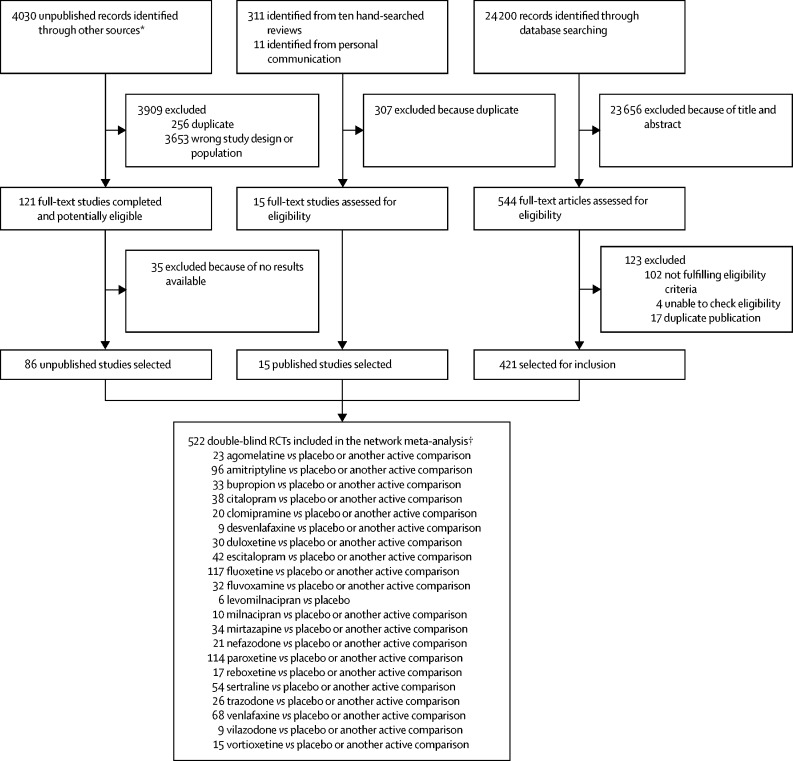
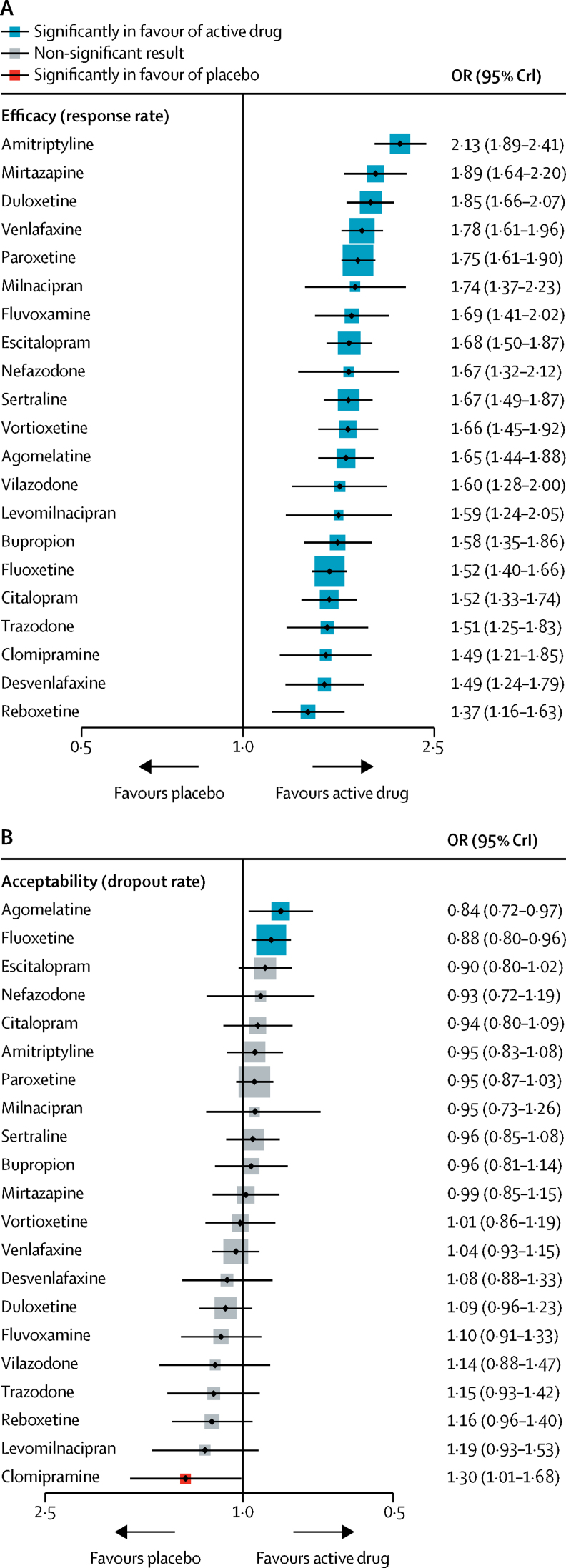
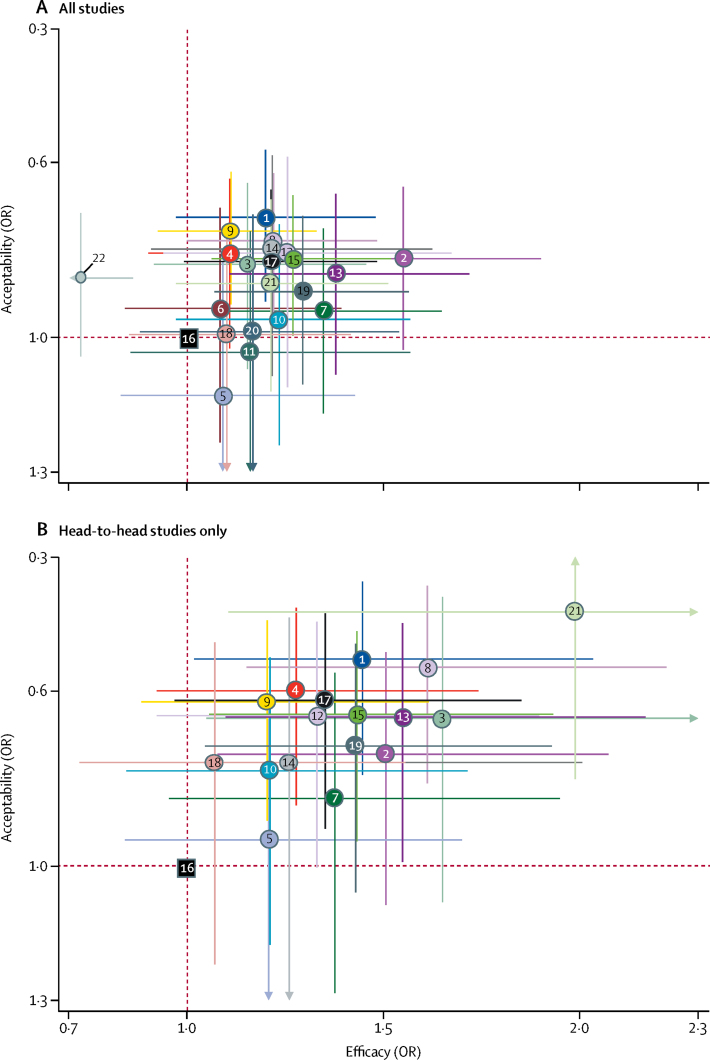
- Across 522 trials and 116,477 participants, all antidepressants were more effective than placebo, with ORs ranging from 2·13 (95% CrI 1·89–2·41) for amitriptyline to 1·37 (1·16–1·63) for reboxetine.
- For acceptability, only agomelatine (OR 0·84, 95% CrI 0·72–0·97) and fluoxetine (0·88, 0·80–0·96) were associated with fewer dropouts than placebo, whereas clomipramine was worse than placebo (1·30, 1·01–1·68).
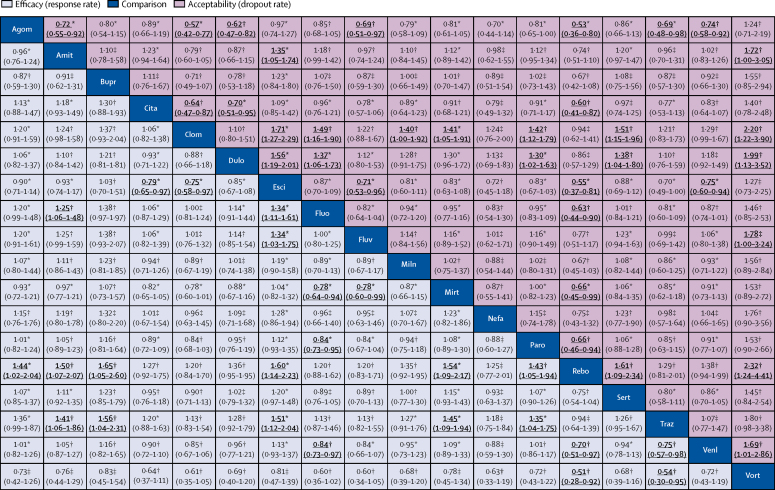
- In head-to-head studies, agomelatine, amitriptyline, escitalopram, mirtazapine, paroxetine, venlafaxine, and vortioxetine were more effective than other antidepressants (ORs 1·19–1·96), while fluoxetine, fluvoxamine, reboxetine, and trazodone were least efficacious (0·51–0·84). For acceptability, agomelatine, citalopram, escitalopram, fluoxetine, sertraline, and vortioxetine were more tolerable (0·43–0·77), while amitriptyline, clomipramine, duloxetine, fluvoxamine, reboxetine, trazodone, and venlafaxine had the highest dropout rates (1·30–2·32).
- Risk of bias was high in 46 (9%) of 522 trials, moderate in 380 (73%), and low in 96 (18%); certainty of evidence was moderate to very low, and differences between active drugs ranged from 1·15 to 1·55 for efficacy and 0·64 to 0·83 for acceptability, with wide CrIs on most comparative analyses.
Methods
- Systematic review and network meta-analysis; searched Cochrane Central Register of Controlled Trials, CINAHL, Embase, LILACS, MEDLINE, MEDLINE In-Process, PsycINFO, regulatory agency websites, and international registers from inception to Jan 8, 2016.
- Included double-blind randomised controlled trials of 21 antidepressants or placebo as oral monotherapy for acute treatment of adults (≥18 years, both sexes) with major depressive disorder diagnosed by standard operationalised criteria; excluded quasi-randomised trials and trials with ≥20% bipolar disorder, psychotic depression, treatment-resistant depression, or serious concomitant medical illness.
- Primary outcomes were efficacy (response rate, ≥50% reduction on a standardised observer-rating scale) and acceptability (all-cause treatment discontinuation); estimated summary ORs using random-effects pairwise and network meta-analysis, assessed risk of bias and GRADE certainty, and ranked treatments with SUCRA; PROSPERO CRD42012002291.
Limitations
- Stated by the paper: many comparisons were low or very low certainty (e.g., involving amitriptyline, bupropion, venlafaxine); many trials did not report adequate information about randomisation and allocation concealment; analyses covered only average treatment effects and could not investigate individual-patient modifiers; patients with psychotic or treatment-resistant depression were excluded; trials were short duration; unpublished data were incomplete for some drugs; no formal cost-effectiveness analysis; and results cannot guide next-step choices after first treatment failure.
- Evident from the text: most comparative analyses had wide credible intervals; 9% of trials were high risk of bias and 73% moderate; network meta-analysis depends on transitivity and consistency assumptions; and placebo-controlled versus head-to-head results differed, including a novelty effect favouring experimental drugs.
Model-written summary. Check it against the paper before relying on it.
Integrity signals
Registry
Cites
Statistics
Figures
Verification
Claims the paper makes
15 Valid · 0 Not valid · 10 Not checked · 93 Own results and interpretations
Every source the paper cites for this claim was checked and supports it.
In the paper
“However, there is a long-lasting debate and concern about their efficacy and effectiveness, because short-term benefits are, on average, modest; and because long-term balance of benefits and harms is often understudied.4”
§ Comparative efficacy and acceptability of 21 antidepressant drugs for the acute treatment of adults with major depressive disorder: a systematic review and network meta-analysis > Introduction
What the sources say
- Supportedcites [4] Ioannidis JP Effectiveness of antidepressants: an evidence myth constructed from a thousand randomized trials? Philos Ethics Humanit Med 3 2008 14 18505564 PMC2412901 source
The Abstract explicitly states that the long-term balance of antidepressants’ benefits and harms is understudied. The Background sections on short follow-up and unknown harms explain that trials are typically brief and provide limited information on harms. (LLM, conf=0.95)
plain- Asserted: passes — The authors put it forward as true.
- Checkable: passes — It can be checked against evidence.
- Load-bearing: unclear — It is unclear whether the paper’s conclusions depend on it.
- Based: passes — The paper gives a reason why it holds.
- Supported
The cited sources support only part of this claim — read each source’s verdict below.
In the paper
“We considered only double-blind trials because we included placebo in the network meta-analysis, and because this study design increases methodological rigour by minimising performance and ascertainment biases.7”
§ Comparative efficacy and acceptability of 21 antidepressant drugs for the acute treatment of adults with major depressive disorder: a systematic review and network meta-analysis > Methods > Search strategy and selection criteria
What the sources say
- Partly supportedcites [7] Hróbjartsson A Thomsen AS Emanuelsson F Observer bias in randomized clinical trials with measurement scale outcomes: a systematic review of trials with both blinded and nonblinded assessors CMAJ 185 2013 E201 E211 23359047 PMC3589328 sourceExperimental — accuracy not yet measured
The Abstract says blinding outcome assessors helps avoid ascertainment bias, and the Conclusion reports a high risk of bias when assessors are not blinded in trials with subjective measurement-scale outcomes. The paper does not establish that double-blind design minimises performance bias; it also cautions in the Abstract that “double-blind” is an ambiguous term. (LLM, conf=0.87)
plainstates a cause- Asserted: passes — The authors put it forward as true.
- Checkable: passes — It can be checked against evidence.
- Load-bearing: passes — The paper’s conclusions depend on it.
- Based: passes — The paper gives a reason why it holds.
- Partly supported
A result the paper reports from its own data — it cites no other source for it, so there is none to check. The quote shows it is in the paper.
In the paper
“We found that all antidepressants included in the meta-analysis were more efficacious than placebo in adults with major depressive disorder”
§ Comparative efficacy and acceptability of 21 antidepressant drugs for the acute treatment of adults with major depressive disorder: a systematic review and network meta-analysis > Discussion
plainstates a cause- Asserted: passes — The authors put it forward as true.
- Checkable: passes — It can be checked against evidence.
- Load-bearing: passes — The paper’s conclusions depend on it.
- Based: passes — The paper gives a reason why it holds.
A result the paper reports from its own data — it cites no other source for it, so there is none to check. The quote shows it is in the paper.
In the paper
“Adjusting for this novelty effect diminished the differences between antidepressants.”
§ Comparative efficacy and acceptability of 21 antidepressant drugs for the acute treatment of adults with major depressive disorder: a systematic review and network meta-analysis > Results
plainstates a cause- Asserted: passes — The authors put it forward as true.
- Checkable: passes — It can be checked against evidence.
- Load-bearing: passes — The paper’s conclusions depend on it.
- Based: passes — The paper gives a reason why it holds.
A result the paper reports from its own data — it cites no other source for it, so there is none to check. The quote shows it is in the paper.
In the paper
“In our analyses, funding by industry was not associated with substantial differences in terms of response or dropout rates.”
§ Comparative efficacy and acceptability of 21 antidepressant drugs for the acute treatment of adults with major depressive disorder: a systematic review and network meta-analysis > Discussion
plain- Asserted: passes — The authors put it forward as true.
- Checkable: passes — It can be checked against evidence.
- Load-bearing: unclear — It is unclear whether the paper’s conclusions depend on it.
- Based: passes — The paper gives a reason why it holds.
49 more claims
Create a free account to see all 118 claims and every source verdict.
- Probably not a substantial claim. 39
- It may state two separate claims as one. 33
Claims other papers make about this one
Each is checked against this paper’s own text: does it say what the citing paper says it does?
The source backs part of the claim, not all of it — or backs it for a different population, condition or comparison.
In the citing paper
“Previous findings suggest that escitalopram and vortioxetine have inherently greater efficacy and acceptability than other antidepressants.7”
From A Randomized Controlled Study of Efficacy and Cognitive Function Improvement of Vortioxetine and Escitalopram in Patients with Depression in Chinese Han Nationality (2024) · cites this paper as [7]
Experimental — accuracy not yet measuredThe source backs part of the claim, not all of it — or backs it for a different population, condition or comparison.
In the citing paper
“Antidepressants are more efficacious than placebo in LLD127.”
From Mechanisms and treatment of late-life depression (2019) · cites this paper as [127]
Experimental — accuracy not yet measuredThe source backs part of the claim, not all of it — or backs it for a different population, condition or comparison.
In the citing paper
“It is wellestablished that psychotherapies and pharmaco logical therapies are effective in the treatment of adult depres sion.”
From A network meta‐analysis of the effects of psychotherapies, pharmacotherapies and their combination in the treatment of adult depression (2020) · cites this paper as [6]
Experimental — accuracy not yet measuredThe source backs part of the claim, not all of it — or backs it for a different population, condition or comparison.
In the citing paper
“The primary limitation of all the available evidence on the effects of antidepressants is that the majority of previous trials assessing the effects of antidepressants have been at high or unclear risk of bias.”
From Should antidepressants be used for major depressive disorder? (2020) · cites this paper as [35]
Experimental — accuracy not yet measuredThe source backs part of the claim, not all of it — or backs it for a different population, condition or comparison.
In the citing paper
“Results of a network meta-analysis of adults with acute MDD also revealed that desvenlafaxine, paroxetine, venlafaxine, and vortioxetine had good efficacy and acceptability [8].”
From Antidepressants for the treatment of adults with major depressive disorder in the maintenance phase: a systematic review and network meta-analysis (2023) · cites this paper as [8]
Experimental — accuracy not yet measured
27 more claims about this paper
Create a free account to see every claim other papers make about this one.
Self-check
Percentages, sums and reported differences re-computed from the paper’s own numbers.
Each contradiction between two passages listed here was confirmed by an independent check.
Rated minor: it would not touch a result — a value no result rests on, a p-value that stays on the same side of the significance level, or a conflict that is clerical, resolved elsewhere in the paper, or outside its own findings.
In the paper
§ Comparative efficacy and acceptability of 21 antidepressant drugs for the acute treatment of adults with major depressive disorder: a systematic review and network meta-analysis > Results
“Only levomilnacipran was not directly compared with at least another active drug in any of the networks.”
§ Comparative efficacy and acceptability of 21 antidepressant drugs for the acute treatment of adults with major depressive disorder: a systematic review and network meta-analysis > Results
“Desvenlafaxine, levomilnacipran, and vilazodone were not included in the head-to-head analysis because these three antidepressants had only placebo-controlled trials.”
Citations
Cites
Salanti, G., Ades, A. E., & Ioannidis, J. P. A. (2011) · Journal of Clinical Epidemiology · doi:10.1016/j.jclinepi.2010.03.016 · Cited by 3,766
Self-citationChecking consistency in mixed treatment comparison meta-analysis
Dias, S., Welton, N. J., Caldwell, D. M., & Ades, A. E. (2010) · Statistics in Medicine · doi:10.1002/sim.3767 · Cited by 2,521
Graphical tools for network meta-analysis in STATA
Chaimani, A., Higgins, J. P. T., Mavridis, D., Spyridonos, P., & Salanti, G. (2013) · PLoS ONE · doi:10.1371/journal.pone.0076654 · Cited by 2,473
Self-citationSelective publication of antidepressant trials and its influence on apparent efficacy
Turner, E. H., Matthews, A. M., Linardatos, E., Tell, R. A., & Rosenthal, R. (2008) · New England Journal of Medicine · doi:10.1056/nejmsa065779 · Cited by 2,435
Self-citationThapar, A., Collishaw, S., Pine, D. S., & Thapar, A. K. (2012) · The Lancet · doi:10.1016/s0140-6736(11)60871-4 · Cited by 2,365
Kassebaum, N. J., Arora, M., Barber, R. M., Bhutta, Z. A., Brown, J., Carter, A., Casey, D. C., Charlson, F. J., Coates, M. M., Coggeshall, M., et al. (2016) · The Lancet · doi:10.1016/s0140-6736(16)31460-x · Cited by 2,163
Consistency and inconsistency in network meta-analysis: concepts and models for multi-arm studies
Higgins, J. P. T., Jackson, D., Barrett, J. K., Lu, G., Ades, A. E., & White, I. R. (2012) · Research Synthesis Methods · doi:10.1002/jrsm.1044 · Cited by 2,098
Self-citationMurray, C. J. L., Barber, R. M., Foreman, K. J., Ozgoren, A. A., Abd-Allah, F., Abera, S. F., Aboyans, V., Abraham, J. P., Abubakar, I., Abu-Raddad, L. J., et al. (2015) · The Lancet · doi:10.1016/s0140-6736(15)61340-x · Cited by 1,964
The BUGS project: evolution, critique and future directions
Lunn, D., Spiegelhalter, D., Thomas, A., & Best, N. (2009) · Statistics in Medicine · doi:10.1002/sim.3680 · Cited by 1,876
Cipriani, A., Furukawa, T. A., Salanti, G., Geddes, J. R., Higgins, J. P., Churchill, R., Watanabe, N., Nakagawa, A., Omori, I. M., McGuire, H., et al. (2009) · The Lancet · doi:10.1016/s0140-6736(09)60046-5 · Cited by 1,654
Self-citation
Cited by
Items 2,401–2,500 of 3,536
蒋宗辰, Qu, X., Yan, Z., Fang, J., Lan, J., Zhao, X., & Qi, W. (2026) · Frontiers in Pharmacology · doi:10.3389/fphar.2026.1776959 · Cited by 1
Beneath the tip of the iceberg: treatment of neuropsychiatric comorbidities in tic disorders
Abi‐Jaoude, E., Gorman, D. A., & Sandor, P. (2026) · Handbook of clinical neurology · doi:10.1016/b978-0-443-13554-5.00008-0 · Cited by 1
Lu, C. T., Tian, L., Wei, Z., Jiang, Y., Shao, M., Zhu, Y., & Wu, L. (2026) · Journal of Ethnopharmacology · doi:10.1016/j.jep.2026.121330 · Cited by 2
Yang, J., Jia, Y., Chen, K., Liang, W., Long, J., Li, M., Wei, Q., Wang, J., Yan, B., Li, K., et al. (2026) · Frontiers in Psychiatry · doi:10.3389/fpsyt.2025.1740789 · Cited by 1
Biography as the dark matter of treatment response
Horwitz, R. I., Conroy, A. H., Cullen, M. R., & Sim, I. (2026) · The American Journal of Medicine · doi:10.1016/j.amjmed.2026.01.044 · Cited by 3
The first on the dark side of the moon: Revisiting the first nonblind placebo trial
Gaab, J., Nascimento, A. F., Wehlage, C., & Park, L. C. (2026) · Journal of Psychosomatic Research · doi:10.1016/j.jpsychores.2026.112565 · Cited by 1
Dong, M., Zhang, X., & Lu, S. (2026) · BMC Endocrine Disorders · doi:10.1186/s12902-026-02193-2 · Cited by 3
Stark, C., Beck, J., Oswald, A., Rogausch, A., Schreiner, A.-K., Cody, R., Hohberg, V., Knappe, F., Kreppke, J.-N., Ludyga, S., et al. (2026) · Trials · doi:10.1186/s13063-026-09500-1 · Cited by 1
Öz, S., Bahar, M. R., Özkaya, S. N., et al. (2026) · İnönü Üniversitesi Sağlık Hizmetleri Meslek Yüksek Okulu Dergisi · doi:10.33715/inonusaglik.1776547 · Cited by 1
Pereira, L. R. F., de Lira-Bandeira, W. G., Medeiros-Bandeira, A. S., de Mendonça, L. A. C., Ladd, F. V. L., Grilo, M. L. P. D. M., Cavalcante, J. S., Coelho, N. L. G., & Júnior, E. S. D. N. (2026) · Translational Psychiatry · doi:10.1038/s41398-026-03887-w · Cited by 2
Liu, X., Huang, F., He, Y., Hur, J., Wang, J., Xian, Y., Yin, B., Lei, T., Zhang, H., Li, X., et al. (2026) · Brain Behavior and Immunity · doi:10.1016/j.bbi.2026.106512 · Cited by 4
Zhao, Y., Hong, W., Chen, Y., Chen, S., Liu, Q., Liao, Z., Mao, Y., & Qiu, T. (2026) · Journal of Ethnopharmacology · doi:10.1016/j.jep.2026.121440 · Cited by 1
Scarante, F. F., Lopes, V. D., Fusse, E. J., Vicente, M. A., de Abreu, G. H. D., Nardini, V., Sorgi, C. A., Lirio, P. H. C., Guo, F., Lu, H., et al. (2026) · Neuropharmacology · doi:10.1016/j.neuropharm.2026.110894 · Cited by 8
Wu, W., Chen, Z., Xu, Y., Xie, X., Tan, A., Hu, M., Xu, D., Lv, X., Chen, W., Zhou, J., et al. (2026) · Free Radical Biology and Medicine · doi:10.1016/j.freeradbiomed.2026.03.024 · Cited by 2
Brache, K., & Diazgranados, M. (2026) · Frontiers in Pharmacology · doi:10.3389/fphar.2026.1729887 · Cited by 1
Kappa opioid receptor antagonism in neuropsychiatry: from molecular mechanisms to clinical prospects
Wang, H., Ji, Y., Huang, J., Yang, S., Zhang, Q., Hu, S., Xu, X., & Yang, C. (2026) · European Archives of Psychiatry and Clinical Neuroscience · doi:10.1007/s00406-026-02216-y · Cited by 1
Li, B., Fu, J., Wang, S., Bi, X., Xu, D., Wang, L., & Qiao, D. (2026) · Journal of Affective Disorders · doi:10.1016/j.jad.2026.121717 · Cited by 2
Tapia-Alzuguren, B., Canga-Espina, C., Molero, P., & Aldaz, A. (2026) · Psychiatry Research · doi:10.1016/j.psychres.2026.117134 · Cited by 1
Alcalde, E., Leckie, G., Wiernik, E., Jolidon, V., & Rigal, L. (2026) · BMC Public Health · doi:10.1186/s12889-026-27208-4 · Cited by 1
Varsha, P., & Venkateswarlu, C. (2025) · International Journal of Judicial Science Research Studies (IJJSRS) · doi:10.63090/ijjsrs/3049.0618.0038 · Cited by 1
Bonnet, U. (2026) · Clinical Neuropharmacology · doi:10.1097/wnf.0000000000000681 · Cited by 1
CYP2C19 Genotype is Associated with Citalopram Treatment Outcomes in a Real‐World Setting
Park, Y., Zhou, Y., & Lauschke, V. M. (2026) · Clinical Pharmacology & Therapeutics · doi:10.1002/cpt.70285 · Cited by 1
An, J., Li, X., Li, Z., Wang, J., & Pan, Y. (2026) · Journal of Nanobiotechnology · doi:10.1186/s12951-026-04417-y · Cited by 5
Qiu, G., Ye, D., & Xu, X. (2026) · Frontiers in Pharmacology · doi:10.3389/fphar.2026.1772885 · Cited by 1
Rapid rescue of despair behaviors by sonogenetic neuromodulation of the mPFC-DRN pathway
Lei, T., Xian, Q., Li, D., Su, M., Wu, Y., Hou, X., Jing, J., Jiang, Y., Huang, X., Wong, K. F., et al. (2026) · Molecular Psychiatry · doi:10.1038/s41380-026-03616-1 · Cited by 4
Robinson, J., Wallace, N., Cassidy, E. K., Lake, S., & Lucas, P. (2026) · Contemporary Drug Problems · doi:10.1177/00914509261444382 · Cited by 1
Sun, Y., Cheng, Y., Guo, Y., Guo, Y., & Sa, Y. (2026) · Current Opinion in Pharmacology · doi:10.1016/j.coph.2026.102634 · Cited by 1
Edwards, L., Bentley, C., O’Doherty, K. C., Bunka, M., Pistawka, C. A., Riches, L., Ridgway, L., Bousman, C., Austin, J., & Bryan, S. (2026) · Journal of Affective Disorders · doi:10.1016/j.jad.2026.121910 · Cited by 1
Bayas, M., Auerbach, J., Diekamp, B., Fomenko, M., Baune, B. T., Repple, J., Reif, A., & Reif-Leonhard, C. (2026) · European Neuropsychopharmacology · doi:10.1016/j.euroneuro.2026.112846 · Cited by 2
Shenoy, S., Belle, V. S., Munoli, R. N., Sharma, M., & Praharaj, S. K. (2026) · Asian Journal of Psychiatry · doi:10.1016/j.ajp.2026.105014 · Cited by 2
Huang, X., Li, C., Lin, J., Zhang, X., Xu, Y., & Zhang, Y. (2026) · Pharmacological Research · doi:10.1016/j.phrs.2026.108246 · Cited by 2
Tapia-Alzuguren, B., Canga-Espina, C., Molero, P., & Aldaz, A. (2026) · PLoS ONE · doi:10.1371/journal.pone.0351241 · Cited by 1
Krupa, A. J., Kania, M. J., Podkowa, K., Krawczyk, E., Plencler, I., & Siwek, M. (2026) · Frontiers in Pharmacology · doi:10.3389/fphar.2026.1770558 · Cited by 1
Blocking 5-HT2B receptors abolishes psilocybin’s efficacy in the rat forced swim test
Seillier, L., Seillier, A., Zvolska, M. A., & Šlamberová, R. (2026) · Journal of Psychopharmacology · doi:10.1177/02698811261458349 · Cited by 1
Regen, F. (2026) · Springer eBooks · doi:10.1007/978-3-662-72452-1_1 · Cited by 1
Yu, M., Chang, Y., Kang, H., & 毛武杨 (2026) · Addiction Biology · doi:10.1111/adb.70172 · Cited by 1
“…having low ROB if none of the domains above was rated as high ROB and three or less were rated as unclear risk, and as moderate ROB if one was rated as high ROB or none was rated as high ROB, but four or more were rated as unclear risk, and all other cases were assumed to pertain to high ROB [40].”
Kršák, M., Sparrow, D., ROSNER, B. A., DeMolles, D. A., & Shannon, S. (2026) · Therapeutic Advances in Psychopharmacology · doi:10.1177/20451253261470523 · Cited by 2
Maruthy, G. B., Himes, L. M., Hubbard, N. A., Spence, J. S., & Rypma, B. (2026) · Journal of Affective Disorders · doi:10.1016/j.jad.2026.122331 · Cited by 1
Fornaro, M., Lorenzo, C. D., Núñez, N. A., Miola, A., Calati, R., Carvalho, A. F., Steardo, L., Stubbs, B., Mischoulon, D., Correll, C. U., et al. (2026) · Molecular Psychiatry · doi:10.1038/s41380-026-03759-1 · Cited by 1
Lyus, R. J., Naudet, F., van Valkenhoef, G., & Plöderl, M. (2026) · Cochrane Evidence Synthesis and Methods · doi:10.1002/cesm.70108 · Cited by 1
Lundgren, O. (2018) · Linköping University medical dissertations · doi:10.3384/diss.diva-148332 · Cited by 1
Rudorfer, M. V. (2018) · CNS Drugs · doi:10.1007/s40263-018-0563-z · Cited by 1
Farmakoterapia depresji u pacjentów z zaawansowanymi chorobami
Grabowski, J., & Przybylak, M. (2019) · Palliative Medicine in Practice · doi:10.5603/pmpi.2019.0012 · Cited by 3
Compliance among patients with depressive and anxiety disorders
Gorostowicz, A., Wasik, A., Krupa, A. J., Oddział Kliniczny Psychiatrii Dorosłych, D. I. M., & Siwek, M. (2019) · Psychiatria i Psychologia Kliniczna · doi:10.15557/pipk.2019.0018 · Cited by 4
A Behavior Analytic Translation of Erving Goffman's Frame Analysis
Chi, T. (2019) · Digital Commons - DU (University of Denver) · Cited by 2
Abdi, M., Piri, S., Mohammadian, R., et al. (2018) · Preventive Care In Nursing and Midwifery Journal · doi:10.29252/pcnm.8.2.1 · Cited by 1
Randomized Controlled Trials and the Efficacy of Psychotropic Medications
Dunlop, B. W., & Ribeiro, C. M. D. F. (2019) · Springer eBooks · doi:10.1007/978-3-319-56015-1_4-1 · Cited by 2
Psychopharmacology: A Brief Overview of Its History
Foley, P. B. (2020) · Springer eBooks · doi:10.1007/978-3-319-56015-1_12-1 · Cited by 1
Sportliche Aktivität und psychische Erkrankungen
Wolf, S., Zeibig, J., Giel, K. E., Granz, H., Sudeck, G., & Thiel, A. (2020) · PSYCH up2date · doi:10.1055/a-0973-1982 · Cited by 1
Ferguson, W., & Clapshaw, L. (2020) · Therapeutic Advances in Psychopharmacology · doi:10.1177/2045125320927309 · Cited by 2
Ooi, S. L., & Pak, S. C. (2020) · Cambridge University Press eBooks · doi:10.1017/9781108650182.033 · Cited by 1
Dieppe, P. A., Goldingay, S., & Warber, S. L. (2020) · Cambridge University Press eBooks · doi:10.1017/9781108650182.042 · Cited by 3
Emotional Intelligence and Its Role in Sustaining Fulfillment in Life
Sax, H. C., & Gewertz, B. L. (2020) · Cambridge University Press eBooks · doi:10.1017/9781108650182.038 · Cited by 1
Baseline reliability and early response in clinical trials of major depressive disorder
Targum, S. D. (2020) · Medical Research Archives · doi:10.18103/mra.v8i10.2241 · Cited by 2
Deep Learning: A New Horizon for Personalized Treatment of Depression?
Benrimoh, D., Fratila, R., Israel, S., & Perlman, K. (2018) · McGill Journal of Medicine · doi:10.26443/mjm.v16i1.99 · Cited by 1
ANALYSIS OF AGOMELATINE TREATMENT WITH DEPRESSIVE SYMPTOMS
Lu, L., & TSAI, C.-C. (2021) · International Journal of Applied Pharmaceutics · doi:10.22159/ijap.2021.v13s1.y0110 · Cited by 1
Agomelatine: Profile and applications to depression
Norman, T. R. (2021) · Elsevier eBooks · doi:10.1016/b978-0-12-817933-8.00032-3 · Cited by 2
Pharmacogenetics of antidepressants: A step to individualized therapy
Samardžić, J. (2020) · Srpski medicinski casopis Lekarske komore · doi:10.5937/smclk2001013s · Cited by 1
Palliative Medicine: A Holistic Framework for Compassionate Care
Schlögl, M. (2021) · Journal of Palliative Medicine · doi:10.1089/jpm.2021.0139 · Cited by 1
Magnetic resonance imaging in mood disorders: a bibliometric analysis from 1999 to 2020
Gao, M., Sun, H. J., Cheng, X., Gao, D., & Qiao, M. (2021) · Clinical and Translational Imaging · doi:10.1007/s40336-021-00425-0 · Cited by 2
Pharmacological and psychological interventions for depression in people with tuberculosis
Nava-Ruelas, R., Jarde, A., Elsey, H., Siddiqi, K., Todowede, O. O., Zavala, G. A., & Siddiqi, N. (2021) · Cochrane Database of Systematic Reviews · doi:10.1002/14651858.cd014848 · Cited by 4
Partial Personalization of Medical Treatment Decisions: Adverse Effects and Possible Solutions
Weyant, C., & Brandeau, M. L. (2021) · Medical Decision Making · doi:10.1177/0272989x211013773 · Cited by 1
Claros-Erazo, M., Li, H., Schulman, I. H., & Musselman, D. L. (2021) · Personalized Medicine in Psychiatry · doi:10.1016/j.pmip.2021.100083 · Cited by 1
Psychopharmacology and Neurotherapeutics
Seiner, S. J., Baldessarini, R. J., Camprodon, J. A., Dougherty, D. D., Givon, L., DeVido, J. J., & Alpert, J. E. (2021) · Cambridge University Press eBooks · doi:10.1017/9780511846403.015 · Cited by 1
Global Health and Mental Health Care Delivery in Low-Resource Settings
Raviola, G. J. (2021) · Cambridge University Press eBooks · doi:10.1017/9780511846403.020 · Cited by 1
La reforma educativa en centros penitenciarios: ¿Hacia un modelo de apertura a la comunidad?
Jiménez, J. J. V. (1998) · Dialnet (Universidad de la Rioja) · Cited by 1
Esketamine for treatment-resistant depression in adults
Gastaldon, C., Laurenzi, P. F., Schoretsanitis, G., Papola, D., Cristea, I. A., Naudet, F., Ostuzzi, G., & Barbui, C. (2022) · Cochrane Database of Systematic Reviews · doi:10.1002/14651858.cd015071 · Cited by 2
Laux, G., & Klimke, A. (2022) · Springer eBooks · doi:10.1007/978-3-319-56015-1_414-1 · Cited by 2
Вербицкая, М. С., Tyuvina, N. A., Tyulpin, Y. G., & Krenkel, G. L. (2022) · Neurology neuropsychiatry Psychosomatics · doi:10.14412/2074-2711-2022-1-52-59 · Cited by 2
Senior Residents’ Perceived Competence in Evidence-Based Treatments for Major Depressive Disorder
Ng, E., Teshima, J., Tan, A., Steinberg, R. J., Zhu, A., & Giacobbe, P. (2022) · Academic Psychiatry · doi:10.1007/s40596-022-01605-4 · Cited by 1
Major depression disorder in Costa Rica: epidemiological and neurobiological aspects
Sequeira‐Cordero, A., Blanco-Vargas, M., & Brenes, J. C. (2021) · Población y Salud en Mesoamérica · doi:10.15517/psm.v19i2.48038 · Cited by 4
Beach, S. R., Huffman, J. C., Baek, J. H., Treadway, M. T., Nierenberg, A. A., & Alpert, J. E. (2021) · Cambridge University Press eBooks · doi:10.1017/9780511846403.004 · Cited by 2
Regen, F., & Benkert, O. (2020) · Springer eBooks · doi:10.1007/978-3-662-61753-3_1 · Cited by 2
Intervening in the psychopath’s brain
Glannon, W. (2018) · Oxford University Press eBooks · doi:10.1093/med/9780198758853.003.0007 · Cited by 1
Praktische Psychopharmakologie
Schu, U. (2021) · Elsevier eBooks · doi:10.1016/b978-3-437-21352-6.00008-0 · Cited by 1
Parikh, S. V., Riba, M., & Greden, J. F. (2019) · American Psychiatric Association Publishing eBooks · doi:10.1176/appi.books.9781615371501.lr12 · Cited by 1
Comment to “Requiem or resurrection: Classic monoamine oxidase inhibitors revisited”
Birkenhäger, T. K., & Ruhé, H. G. (2022) · European Neuropsychopharmacology · doi:10.1016/j.euroneuro.2022.07.001 · Cited by 1
Self-citationPrescribing Antidepressant Medication
Kroll, D. S. (2022) · Springer eBooks · doi:10.1007/978-3-031-08495-9_3 · Cited by 1
Adherence to antidepressant therapy: clinical experience on the example of agomelatine
Петрова, Н. Н. (2022) · Neurology neuropsychiatry Psychosomatics · doi:10.14412/2074-2711-2022-4-82-86 · Cited by 1
A vueltas con la hipótesis bioquímica de la depresión: Bilis negra y serotonina
Sierra, M. D. C. (2022) · Clínica Contemporánea · doi:10.5093/cc2022a22 · Cited by 1
Psychopharmacology: A Brief Overview of Its History
Foley, P. B. (2022) · Springer eBooks · doi:10.1007/978-3-030-62059-2_12 · Cited by 2
Antidepressiva – State of the Art
Lange‐Asschenfeldt, C. (2023) · Zeitschrift für Gerontologie und Geriatrie · doi:10.1007/s00391-023-02169-0 · Cited by 1
THERAPY OF POST-COVID DEPRESSION: A PROACTIVE PSYCHOSOMATIC APPROACH
Khaustova, O. O., Omelyanovich, V., Assonov, D. O., & Asanova, A. (2023) · Polski Merkuriusz Lekarski · doi:10.36740/merkur202301101 · Cited by 1
Depressionen bei Diabetes mellitus (Teil 2): Praxis der Diagnostik und Behandlung
SCHMITT, A. J., Kulzer, B., Kruse, J., Ehrmann, D., Haak, T., & Hermanns, N. (2023) · Die Diabetologie · doi:10.1007/s11428-023-01015-6 · Cited by 1
Haaren, P. C. F. V., Tijdink, J. K., & Gerritse, F. L. (2023) · Journal of Clinical Psychopharmacology · doi:10.1097/jcp.0000000000001690 · Cited by 1
Depression in patients with cerebral microangiopathy
Bogolepova, A. N. (2023) · Neurology neuropsychiatry Psychosomatics · doi:10.14412/2074-2711-2023-2-83-90 · Cited by 2
Medication for Depression: Monoamine Enhancers and Esketamine (Antidepressants)
Park, S., & Shen, W. W. (2023) · Springer eBooks · doi:10.1007/978-3-030-42825-9_133-1 · Cited by 5
Psychological treatment outcomes for outpatients in a clinical context
Lundkvist, J. E., Georgsson, K., Carlbring, P., Borg, E., Ramnerö, J., Johansson, R., Ljungberg, T., & Anderbro, T. (2023) · Nordic Psychology · doi:10.1080/19012276.2023.2206540 · Cited by 1
Поєднання тривоги та депресії: чому іноді лікування не допомагає?
О.А., С. (2023) · Український медичний часопис · doi:10.32471/umj.1680-3051.153.241623 · Cited by 2
Recommendations for treatmenf of unipolar depressive disorder
Ilješ, A. P., Radobuljac, M. D., Plesničar, B. K., Pregelj, P., Škodlar, B., Terzić, T., & Bon, J. (2023) · Slovenian Medical Journal · doi:10.6016/zdravvestn.3431 · Cited by 2
Repercusión de vortioxetina sobre la función sexual frente a otros antidepresivos
Sánchez-Sánchez, F., Ponce-Buj, B., Montejo, A. L., Sipán-Sarrión, Y., Gimeno-Marqués, A., & Merino-Gámez, A. (2023) · Medicina de Familia SEMERGEN · doi:10.1016/j.semerg.2023.101997 · Cited by 1
Suicidality Screening Guidelines Highlight the Need for Intervention Studies
Perlis, R. H. (2023) · JAMA Network Open · doi:10.1001/jamanetworkopen.2023.18773 · Cited by 1
Ezeaka, U. C., Kim, H. J. J., & Laprairie, R. B. (2023) · Current Topics in Medicinal Chemistry · doi:10.2174/1568026623666230705151922 · Cited by 2
Therapiemöglichkeiten der Depression nach Non-Response: Ein Update für die Praxis
Walter, H., Haaf, R., & Köhler, S. (2023) · Nervenheilkunde · doi:10.1055/a-2103-7920 · Cited by 1
Wesley, M. J., & Lile, J. A. (2023) · Frontiers in Neuroscience · doi:10.3389/fnins.2023.1150109 · Cited by 1
Murawiec, S., Olejnik, N., & Kudlik, A. (2023) · Psychiatria Spersonalizowana · doi:10.5114/psychs.2023.125705 · Cited by 1
Research Progress in Massage Therapy for Depression
李, 辉. (2023) · Traditional Chinese Medicine · doi:10.12677/tcm.2023.1210427 · Cited by 1
Diagnosis and treatment of depression according to the functional recovery paradigm
Михайлович, У. Г. (2023) · Neurology neuropsychiatry Psychosomatics · doi:10.14412/2074-2711-2023-5-79-86 · Cited by 1
Neuropsychological Effects of Antidepressants: Translational Studies
Kamenish, K., & Robinson, E. S. J. (2023) · Current topics in behavioral neurosciences · doi:10.1007/7854_2023_446 · Cited by 1
Arai, K., Nonaka, M., Shimada, S., & Nakamura, M. (2023) · Psychiatry and Clinical Neurosciences Reports · doi:10.1002/pcn5.158 · Cited by 1
Metadata
- Authors
- Cipriani, A., Furukawa, T. A., Salanti, G., Chaimani, A., Atkinson, L. Z., Ogawa, Y., Leucht, S., Ruhe, H. G., Turner, E. H., Higgins, J. P. T., Egger, M., Takeshima, N., Hayasaka, Y., Imai, H., Shinohara, K., Tajika, A., Ioannidis, J. P. A., & Geddes, J. R.
- Affiliations
- Oxford Health NHS Foundation Trust (GB)
- Kyoto University (JP)
- University of Bern (CH)
- Inserm (FR)
- Warneford Hospital (GB)
- Technical University of Munich (DE)
- Oregon Health & Science University (US)
- University of Bristol (GB)
- Stanford University (US)
- Corresponding author
- Cipriani, Andrea
- ORCID
- Venue
- The Lancet
- Publisher
- Elsevier BV
- Published
- 2018-04
- Volume
- 391
- Issue
- 10128
- Pages
- 1357-1366
- ISSN
- 0099-5355 (ISSN-L)
- 0140-6736
- PMC
- PMC5889788
- OpenAlex
- W2788337440
- Cited by
- 3,541
- References
- 33
- Citations by year
- 2026: 383 · 2025: 472 · 2024: 469 · 2023: 426 · 2022: 399 · 2021: 423 · 2020: 475 · 2019: 322 · 2018: 163
- FWCI
- 40.44
- Type
- journal article
- Language
- en
- Open access
- hybrid
- doi.org
- Licence
- cc-by
- www.elsevier.com/tdm/userlicense/1.0/ (tdm)
- creativecommons.org/licenses/by/4.0/ (vor)
- Locations
- The Lancet (publishedVersion, cc-by)
- FOCUS The Journal of Lifelong Learning in Psychiatry (publishedVersion, cc-by)
- Europe PMC (PubMed Central) (publishedVersion, cc-by)
- PubMed Central (publishedVersion, cc-by)
- PubMed (publishedVersion)
- PubMed Central (publishedVersion)
- Institutional Repositories DataBase (IRDB) (submittedVersion, cc-by)
- Bern Open Repository and Information System (University of Bern) (submittedVersion, cc-by)
- mediaTUM – the media and publications repository of the Technical University Munich (Technical University Munich) (submittedVersion)
- mediaTUM – the media and publications repository of the Technical University Munich (Technical University Munich) (submittedVersion, other-oa)
- Kyoto University Research Information Repository (Kyoto University) (submittedVersion, cc-by)
- Radboud Repository (Radboud University) (submittedVersion)
- Explore Bristol Research (submittedVersion, cc-by)
- Radboud Repository (Radboud University) (submittedVersion, other-oa)
- Funders
- National Institute for Health and Care Research (BRC‐1215‐20005, NF-SI-0617-10145)
- Japan Society for the Promotion of Science (17K19808, 16K09033)
- Topics
- Health Sciences › Medicine › Pharmacology (medical) › Treatment of Major Depression
- Health Sciences › Medicine › Psychiatry and Mental health › Mental Health Treatment and Access
- Social Sciences › Psychology › Clinical Psychology › Psychotherapy Techniques and Applications
- Keywords
- major depressive disorder, antidepressants, acute treatment, antidepressant efficacy, treatment discontinuation, placebo response, amitriptyline, reboxetine, agomelatine, fluoxetine, venlafaxine, escitalopram, mirtazapine, paroxetine, sertraline, bupropion
- MeSH terms
- Antidepressive Agents, Major Depressive Disorder, Double-Blind Method, Humans, Patient Dropouts, Randomized Controlled Trials as Topic, Treatment Outcome, Evidence-Based Medicine
About these checks
Registry, retraction, Cites and statistics results are computed, not judged, with one exception: a printed reference that no index lists is read once by a model before it counts as a citation error. Claims are extracted by a model and kept only when their quote appears verbatim in the text; each cited source is then checked, with a model’s help, for whether it says what the claim relies on. Those verdicts can be wrong — read the claim’s quote and the cited source before relying on one.
The claim verdicts this report counts are experimental: their accuracy is not yet measured.
A language model drew the claims from the paper on 2026-10-10, under version 3 of the claim definition (model deepseek-v4.1-flash, prompt extract-v3).
A second model labelled each claim on 2026-10-10 (model jev-1.13-20260917, definition revision gold-guideline-v0.2).
Cited sources are checked with a language model’s help (gpt-6-sol).
Statistics and arithmetic are recomputed, not judged.
Confidence bands are shown only for fields calibrated on our annotated test set. None is calibrated yet, so no band is shown.
What counts as a claim ›How we measure confidence ›How we check this ›
Are you an author, or do you see a problem with this page? Request a review
Data sources
Bibliographic data: Semantic Scholar, OpenAlex, Crossref.
Contains information from the Semantic Scholar Academic Graph Datasets, made available under the ODC Attribution License (ODC-BY 1.0).
Semantic Scholar’s data is described in: Kinney, R., et al. (2023). The Semantic Scholar Open Data Platform. arXiv:2301.10140.
