

Comparative efficacy and acceptability of 21 antidepressant drugs for the acute treatment of adults with major depressive disorder: a systematic review and network meta-analysis
Open accessThe DOI matches its Crossref record; 32 of the 33 references it cites were found in a registry or an index; 15 of the 26 sources its claims cite were checked for support.
Abstract
Summary Background Major depressive disorder is one of the most common, burdensome, and costly psychiatric disorders worldwide in adults. Pharmacological and non-pharmacological treatments are available; however, because of inadequate resources, antidepressants are used more frequently than psychological interventions. Prescription of these agents should be informed by the best available evidence. Therefore, we aimed to update and expand our previous work to compare and rank antidepressants for the acute treatment of adults with unipolar major depressive disorder. Methods We did a systematic review and network meta-analysis. We searched Cochrane Central Register of Controlled Trials, CINAHL, Embase, LILACS database, MEDLINE, MEDLINE In-Process, PsycINFO, the websites of regulatory agencies, and international registers for published and unpublished, double-blind, randomised controlled trials from their inception to Jan 8, 2016. We included placebo-controlled and head-to-head trials of 21 antidepressants used for the acute treatment of adults (≥18 years old and of both sexes) with major depressive disorder diagnosed according to standard operationalised criteria. We excluded quasi-randomised trials and trials that were incomplete or included 20% or more of participants with bipolar disorder, psychotic depression, or treatment-resistant depression; or patients with a serious concomitant medical illness. We extracted data following a predefined hierarchy. In network meta-analysis…
Overview
CoChat Summary
TL;DR
In this systematic review and network meta-analysis of 522 double-blind randomised trials (116,477 participants), all 21 antidepressants were more efficacious than placebo for acute treatment of adults with major depressive disorder, though effect sizes were mostly modest. Some drugs showed more favourable efficacy/acceptability profiles, but many comparative estimates had wide credible intervals and certainty of evidence was moderate to very low.
Key findings
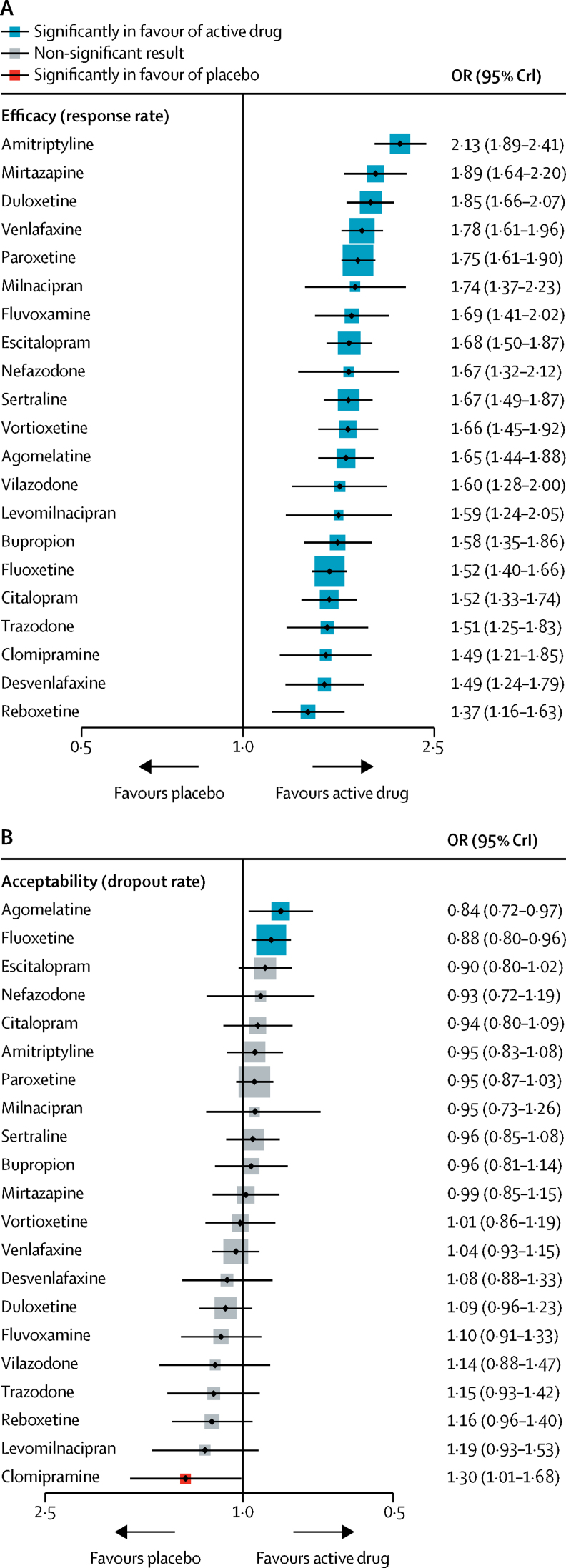
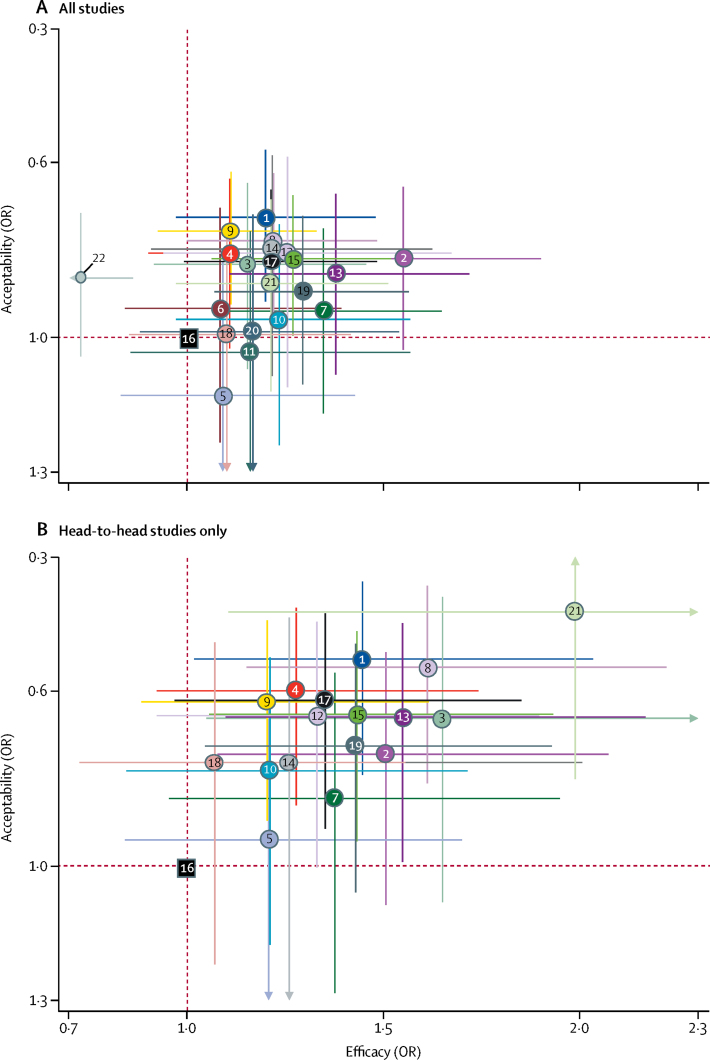
- Across 522 trials and 116,477 participants, all antidepressants were more effective than placebo, with ORs ranging from 2·13 (95% CrI 1·89–2·41) for amitriptyline to 1·37 (1·16–1·63) for reboxetine.
- For acceptability, only agomelatine (OR 0·84, 95% CrI 0·72–0·97) and fluoxetine (0·88, 0·80–0·96) were associated with fewer dropouts than placebo, whereas clomipramine was worse than placebo (1·30, 1·01–1·68).
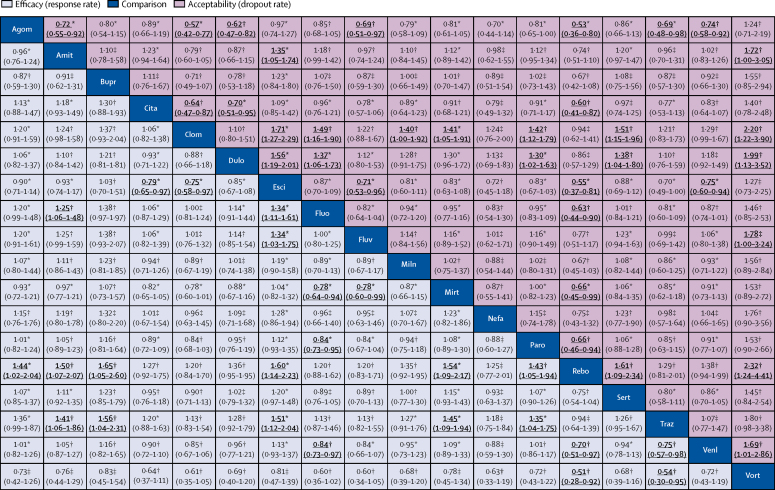
- In head-to-head studies, agomelatine, amitriptyline, escitalopram, mirtazapine, paroxetine, venlafaxine, and vortioxetine were more effective than other antidepressants (ORs 1·19–1·96), while fluoxetine, fluvoxamine, reboxetine, and trazodone were least efficacious (0·51–0·84). For acceptability, agomelatine, citalopram, escitalopram, fluoxetine, sertraline, and vortioxetine were more tolerable (0·43–0·77), while amitriptyline, clomipramine, duloxetine, fluvoxamine, reboxetine, trazodone, and venlafaxine had the highest dropout rates (1·30–2·32).
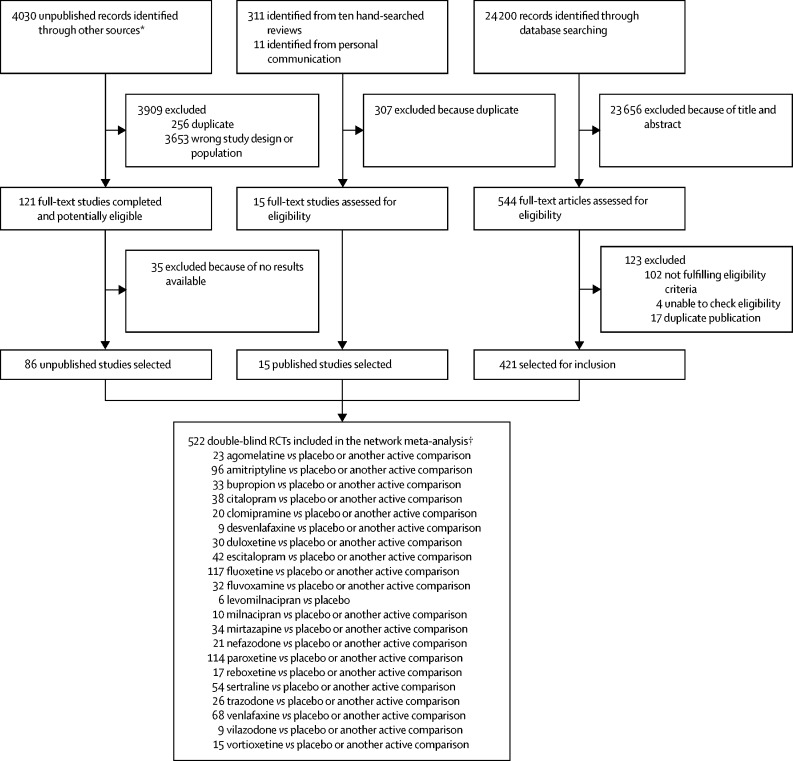
- Risk of bias was high in 46 (9%) of 522 trials, moderate in 380 (73%), and low in 96 (18%); certainty of evidence was moderate to very low, and differences between active drugs ranged from 1·15 to 1·55 for efficacy and 0·64 to 0·83 for acceptability, with wide CrIs on most comparative analyses.
Methods
- Systematic review and network meta-analysis; searched Cochrane Central Register of Controlled Trials, CINAHL, Embase, LILACS, MEDLINE, MEDLINE In-Process, PsycINFO, regulatory agency websites, and international registers from inception to Jan 8, 2016.
- Included double-blind randomised controlled trials of 21 antidepressants or placebo as oral monotherapy for acute treatment of adults (≥18 years, both sexes) with major depressive disorder diagnosed by standard operationalised criteria; excluded quasi-randomised trials and trials with ≥20% bipolar disorder, psychotic depression, treatment-resistant depression, or serious concomitant medical illness.
- Primary outcomes were efficacy (response rate, ≥50% reduction on a standardised observer-rating scale) and acceptability (all-cause treatment discontinuation); estimated summary ORs using random-effects pairwise and network meta-analysis, assessed risk of bias and GRADE certainty, and ranked treatments with SUCRA; PROSPERO CRD42012002291.
Limitations
- Stated by the paper: many comparisons were low or very low certainty (e.g., involving amitriptyline, bupropion, venlafaxine); many trials did not report adequate information about randomisation and allocation concealment; analyses covered only average treatment effects and could not investigate individual-patient modifiers; patients with psychotic or treatment-resistant depression were excluded; trials were short duration; unpublished data were incomplete for some drugs; no formal cost-effectiveness analysis; and results cannot guide next-step choices after first treatment failure.
- Evident from the text: most comparative analyses had wide credible intervals; 9% of trials were high risk of bias and 73% moderate; network meta-analysis depends on transitivity and consistency assumptions; and placebo-controlled versus head-to-head results differed, including a novelty effect favouring experimental drugs.
Model-written summary. Check it against the paper before relying on it.
Integrity signals
Registry
Cites
Statistics
Figures
Verification
Claims the paper makes
15 Valid · 0 Not valid · 10 Not checked · 93 Own results and interpretations
Every source the paper cites for this claim was checked and supports it.
In the paper
“However, there is a long-lasting debate and concern about their efficacy and effectiveness, because short-term benefits are, on average, modest; and because long-term balance of benefits and harms is often understudied.4”
§ Comparative efficacy and acceptability of 21 antidepressant drugs for the acute treatment of adults with major depressive disorder: a systematic review and network meta-analysis > Introduction
What the sources say
- Supportedcites [4] Ioannidis JP Effectiveness of antidepressants: an evidence myth constructed from a thousand randomized trials? Philos Ethics Humanit Med 3 2008 14 18505564 PMC2412901 source
The Abstract explicitly states that the long-term balance of antidepressants’ benefits and harms is understudied. The Background sections on short follow-up and unknown harms explain that trials are typically brief and provide limited information on harms. (LLM, conf=0.95)
plain- Asserted: passes — The authors put it forward as true.
- Checkable: passes — It can be checked against evidence.
- Load-bearing: unclear — It is unclear whether the paper’s conclusions depend on it.
- Based: passes — The paper gives a reason why it holds.
- Supported
The cited sources support only part of this claim — read each source’s verdict below.
In the paper
“We considered only double-blind trials because we included placebo in the network meta-analysis, and because this study design increases methodological rigour by minimising performance and ascertainment biases.7”
§ Comparative efficacy and acceptability of 21 antidepressant drugs for the acute treatment of adults with major depressive disorder: a systematic review and network meta-analysis > Methods > Search strategy and selection criteria
What the sources say
- Partly supportedcites [7] Hróbjartsson A Thomsen AS Emanuelsson F Observer bias in randomized clinical trials with measurement scale outcomes: a systematic review of trials with both blinded and nonblinded assessors CMAJ 185 2013 E201 E211 23359047 PMC3589328 sourceExperimental — accuracy not yet measured
The Abstract says blinding outcome assessors helps avoid ascertainment bias, and the Conclusion reports a high risk of bias when assessors are not blinded in trials with subjective measurement-scale outcomes. The paper does not establish that double-blind design minimises performance bias; it also cautions in the Abstract that “double-blind” is an ambiguous term. (LLM, conf=0.87)
plainstates a cause- Asserted: passes — The authors put it forward as true.
- Checkable: passes — It can be checked against evidence.
- Load-bearing: passes — The paper’s conclusions depend on it.
- Based: passes — The paper gives a reason why it holds.
- Partly supported
A result the paper reports from its own data — it cites no other source for it, so there is none to check. The quote shows it is in the paper.
In the paper
“We found that all antidepressants included in the meta-analysis were more efficacious than placebo in adults with major depressive disorder”
§ Comparative efficacy and acceptability of 21 antidepressant drugs for the acute treatment of adults with major depressive disorder: a systematic review and network meta-analysis > Discussion
plainstates a cause- Asserted: passes — The authors put it forward as true.
- Checkable: passes — It can be checked against evidence.
- Load-bearing: passes — The paper’s conclusions depend on it.
- Based: passes — The paper gives a reason why it holds.
A result the paper reports from its own data — it cites no other source for it, so there is none to check. The quote shows it is in the paper.
In the paper
“Adjusting for this novelty effect diminished the differences between antidepressants.”
§ Comparative efficacy and acceptability of 21 antidepressant drugs for the acute treatment of adults with major depressive disorder: a systematic review and network meta-analysis > Results
plainstates a cause- Asserted: passes — The authors put it forward as true.
- Checkable: passes — It can be checked against evidence.
- Load-bearing: passes — The paper’s conclusions depend on it.
- Based: passes — The paper gives a reason why it holds.
A result the paper reports from its own data — it cites no other source for it, so there is none to check. The quote shows it is in the paper.
In the paper
“In our analyses, funding by industry was not associated with substantial differences in terms of response or dropout rates.”
§ Comparative efficacy and acceptability of 21 antidepressant drugs for the acute treatment of adults with major depressive disorder: a systematic review and network meta-analysis > Discussion
plain- Asserted: passes — The authors put it forward as true.
- Checkable: passes — It can be checked against evidence.
- Load-bearing: unclear — It is unclear whether the paper’s conclusions depend on it.
- Based: passes — The paper gives a reason why it holds.
49 more claims
Create a free account to see all 118 claims and every source verdict.
- Probably not a substantial claim. 39
- It may state two separate claims as one. 33
Claims other papers make about this one
Each is checked against this paper’s own text: does it say what the citing paper says it does?
The source backs part of the claim, not all of it — or backs it for a different population, condition or comparison.
In the citing paper
“Previous findings suggest that escitalopram and vortioxetine have inherently greater efficacy and acceptability than other antidepressants.7”
From A Randomized Controlled Study of Efficacy and Cognitive Function Improvement of Vortioxetine and Escitalopram in Patients with Depression in Chinese Han Nationality (2024) · cites this paper as [7]
Experimental — accuracy not yet measuredThe source backs part of the claim, not all of it — or backs it for a different population, condition or comparison.
In the citing paper
“Antidepressants are more efficacious than placebo in LLD127.”
From Mechanisms and treatment of late-life depression (2019) · cites this paper as [127]
Experimental — accuracy not yet measuredThe source backs part of the claim, not all of it — or backs it for a different population, condition or comparison.
In the citing paper
“It is wellestablished that psychotherapies and pharmaco logical therapies are effective in the treatment of adult depres sion.”
From A network meta‐analysis of the effects of psychotherapies, pharmacotherapies and their combination in the treatment of adult depression (2020) · cites this paper as [6]
Experimental — accuracy not yet measuredThe source backs part of the claim, not all of it — or backs it for a different population, condition or comparison.
In the citing paper
“The primary limitation of all the available evidence on the effects of antidepressants is that the majority of previous trials assessing the effects of antidepressants have been at high or unclear risk of bias.”
From Should antidepressants be used for major depressive disorder? (2020) · cites this paper as [35]
Experimental — accuracy not yet measuredThe source backs part of the claim, not all of it — or backs it for a different population, condition or comparison.
In the citing paper
“Results of a network meta-analysis of adults with acute MDD also revealed that desvenlafaxine, paroxetine, venlafaxine, and vortioxetine had good efficacy and acceptability [8].”
From Antidepressants for the treatment of adults with major depressive disorder in the maintenance phase: a systematic review and network meta-analysis (2023) · cites this paper as [8]
Experimental — accuracy not yet measured
27 more claims about this paper
Create a free account to see every claim other papers make about this one.
Self-check
Percentages, sums and reported differences re-computed from the paper’s own numbers.
Each contradiction between two passages listed here was confirmed by an independent check.
Rated minor: it would not touch a result — a value no result rests on, a p-value that stays on the same side of the significance level, or a conflict that is clerical, resolved elsewhere in the paper, or outside its own findings.
In the paper
§ Comparative efficacy and acceptability of 21 antidepressant drugs for the acute treatment of adults with major depressive disorder: a systematic review and network meta-analysis > Results
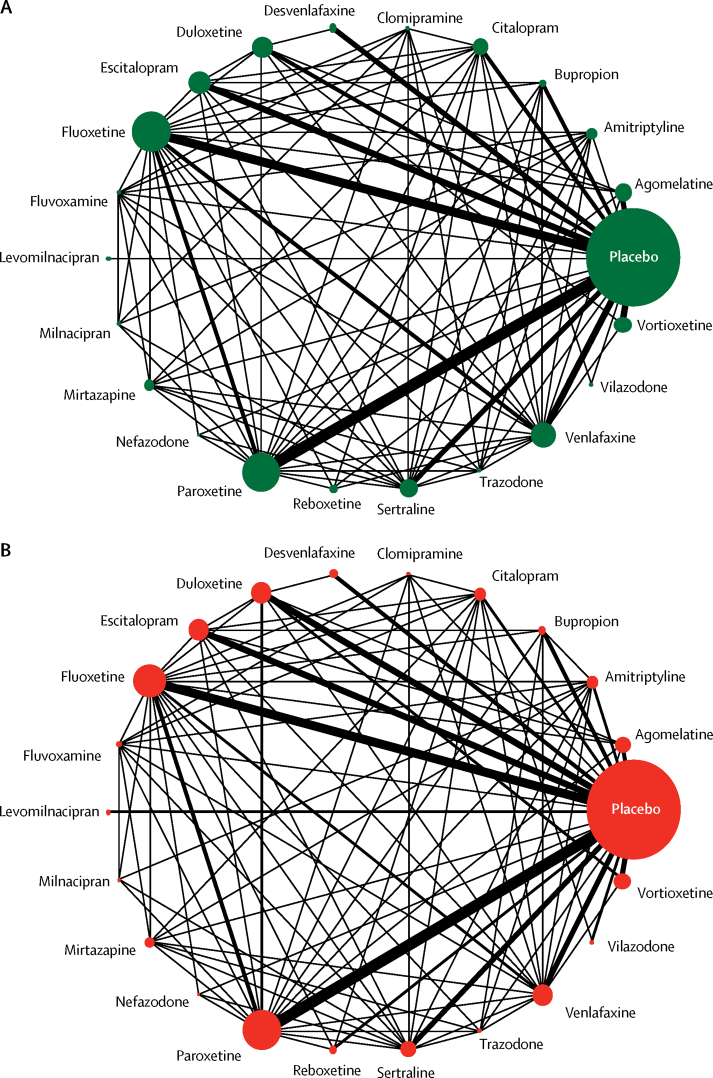
“Only levomilnacipran was not directly compared with at least another active drug in any of the networks.”
§ Comparative efficacy and acceptability of 21 antidepressant drugs for the acute treatment of adults with major depressive disorder: a systematic review and network meta-analysis > Results
“Desvenlafaxine, levomilnacipran, and vilazodone were not included in the head-to-head analysis because these three antidepressants had only placebo-controlled trials.”
Citations
Cites
Salanti, G., Ades, A. E., & Ioannidis, J. P. A. (2011) · Journal of Clinical Epidemiology · doi:10.1016/j.jclinepi.2010.03.016 · Cited by 3,766
Self-citationChecking consistency in mixed treatment comparison meta-analysis
Dias, S., Welton, N. J., Caldwell, D. M., & Ades, A. E. (2010) · Statistics in Medicine · doi:10.1002/sim.3767 · Cited by 2,521
Graphical tools for network meta-analysis in STATA
Chaimani, A., Higgins, J. P. T., Mavridis, D., Spyridonos, P., & Salanti, G. (2013) · PLoS ONE · doi:10.1371/journal.pone.0076654 · Cited by 2,473
Self-citationSelective publication of antidepressant trials and its influence on apparent efficacy
Turner, E. H., Matthews, A. M., Linardatos, E., Tell, R. A., & Rosenthal, R. (2008) · New England Journal of Medicine · doi:10.1056/nejmsa065779 · Cited by 2,435
Self-citationThapar, A., Collishaw, S., Pine, D. S., & Thapar, A. K. (2012) · The Lancet · doi:10.1016/s0140-6736(11)60871-4 · Cited by 2,365
Kassebaum, N. J., Arora, M., Barber, R. M., Bhutta, Z. A., Brown, J., Carter, A., Casey, D. C., Charlson, F. J., Coates, M. M., Coggeshall, M., et al. (2016) · The Lancet · doi:10.1016/s0140-6736(16)31460-x · Cited by 2,163
Consistency and inconsistency in network meta-analysis: concepts and models for multi-arm studies
Higgins, J. P. T., Jackson, D., Barrett, J. K., Lu, G., Ades, A. E., & White, I. R. (2012) · Research Synthesis Methods · doi:10.1002/jrsm.1044 · Cited by 2,098
Self-citationMurray, C. J. L., Barber, R. M., Foreman, K. J., Ozgoren, A. A., Abd-Allah, F., Abera, S. F., Aboyans, V., Abraham, J. P., Abubakar, I., Abu-Raddad, L. J., et al. (2015) · The Lancet · doi:10.1016/s0140-6736(15)61340-x · Cited by 1,964
The BUGS project: evolution, critique and future directions
Lunn, D., Spiegelhalter, D., Thomas, A., & Best, N. (2009) · Statistics in Medicine · doi:10.1002/sim.3680 · Cited by 1,876
Cipriani, A., Furukawa, T. A., Salanti, G., Geddes, J. R., Higgins, J. P., Churchill, R., Watanabe, N., Nakagawa, A., Omori, I. M., McGuire, H., et al. (2009) · The Lancet · doi:10.1016/s0140-6736(09)60046-5 · Cited by 1,654
Self-citation
Cited by
Items 2,801–2,900 of 3,536
Mental Health in Parkinson’s Disease
Jones, S., Torsney, K., Scourfield, L., Berryman, K., & Henderson, E. J. (2020) · Cambridge University Press eBooks · doi:10.1017/9781108594714.011
Mitchell, A. J. (2020) · Cambridge University Press eBooks · doi:10.1017/9781108594714.014
Challenges of Mood Disorders Care
(2020) · FOCUS The Journal of Lifelong Learning in Psychiatry · doi:10.1176/appi.focus.18202
Avancées scientifiques de 2018 en médecine interne générale ambulatoire
Gouveia, A., Pasche, O., Auer, S., Chenal, R., Alencastro, L. D., Fierz, Y., Gray, R., Koehli, L., Monney, C., Selby, K. J., et al. (2019) · JMIG · doi:10.53738/revmed.2019.15.634.0129
Modern Antidepressants in the Treatment of Mental Disorders in Post-COVID Conditions
Кирпиченко, А. А. (2021) · Психиатрия психотерапия и клиническая психология · doi:10.34883/pi.2021.12.4.011
Residence Capacity: Its Nature and Assessment
Hughes, J. C., Poole, M., Louw, S., Greener, H., & Emmett, C. (2020) · Cambridge University Press eBooks · doi:10.1017/9781108594714.026
Lilford, P. (2020) · Cambridge University Press eBooks · doi:10.1017/9781108594714.028
Series, H. G., & Esiri, M. M. (2020) · Cambridge University Press eBooks · doi:10.1017/9781108594714.005
Selvaraj, S., Brambilla, P., & Soares, J. C. (2021) · Cambridge University Press eBooks · doi:10.1017/9781108623018.022
IsHak, W. W. (2020) · Cambridge University Press eBooks · doi:10.1017/9781108650182.051
Hughes, J. C. (2020) · Cambridge University Press eBooks · doi:10.1017/9781108594714.003
Supporting Self-Management in Early Dementia: A Contribution Towards ‘Living Well’?
Cheffey, J., Hill, L., & Roberts, G. A. (2020) · Cambridge University Press eBooks · doi:10.1017/9781108594714.017
Deprivation of Liberty: Where Are We Now?
Brindle, N., & Walsh, C. (2020) · Cambridge University Press eBooks · doi:10.1017/9781108594714.025
Controlling the Confusion: Using Barrier Analysis in the Care Home Sector
Colgate, R., Turner, A., & Rafferty, D. (2020) · Cambridge University Press eBooks · doi:10.1017/9781108594714.023
The Home Assessment in Old Age Psychiatry: A Practical Guide
Ng, B., & Atkins, M. (2020) · Cambridge University Press eBooks · doi:10.1017/9781108594714.012
Jefferies, K., & Agrawal, N. (2020) · Cambridge University Press eBooks · doi:10.1017/9781108594714.006
Richards, F., & Curtice, M. J. R. (2020) · Cambridge University Press eBooks · doi:10.1017/9781108594714.008
Palliative Care in Dementia: Issues and Evidence
Hughes, J. C., Jolley, D. J., Jordan, A., & Sampson, E. L. (2020) · Cambridge University Press eBooks · doi:10.1017/9781108594714.020 · Cited by 1
Lundy, J. (2020) · Cambridge University Press eBooks · doi:10.1017/9781108650182.022
Alcohol Misuse in Older People
Rao, R., & CROME, I. B. (2020) · Cambridge University Press eBooks · doi:10.1017/9781108594714.009 · Cited by 1
Drug Misuse in Older People: Old Problems and New Challenges
Wagle, A. C., & Badrakalimuthu, V. R. (2020) · Cambridge University Press eBooks · doi:10.1017/9781108594714.010
Psychopharmacotherapy of Depressive Disorders
Kavakbasi, E., & Baune, B. T. (2021) · Springer eBooks · doi:10.1007/978-3-319-56015-1_427-1
Meagher, D. J., O'Connell, H. P., Cullen, W., & Adamis, D. (2020) · Cambridge University Press eBooks · doi:10.1017/9781108594714.022
Gupta, S., Fiertag, O., Thanulingam, T., Strange, B. A., & Warner, J. P. (2020) · Cambridge University Press eBooks · doi:10.1017/9781108594714.007
Driving in Dementia: A Clinician’s Guide
Wilson, S., & Pinner, G. (2020) · Cambridge University Press eBooks · doi:10.1017/9781108594714.013
Alloy, L. B., Chat, I. K.-Y., Grehl, M. M., Kautz, M. M., Dunning, E. E., Adogli, Z. V., Smith, L. T., Walsh, R. F. L., & Stephenson, A. R. (2021) · Elsevier eBooks · doi:10.1016/b978-0-12-818697-8.00225-9
Selvaraj, S., Brambilla, P., & Soares, J. C. (2021) · Cambridge University Press eBooks · doi:10.1017/9781108623018.001
Hughes, J. C., & Lilford, P. (2020) · Cambridge University Press eBooks · doi:10.1017/9781108594714.001
Biomarkers and the Diagnosis of Preclinical Alzheimer’s Disease
Lilford, P., & Hughes, J. C. (2020) · Cambridge University Press eBooks · doi:10.1017/9781108594714.015
IsHak, W. W., Mann, A., Manoukian, V., Pakhdikian, S., Chaudhry, M., Liu, A., & Bart, R. (2020) · Cambridge University Press eBooks · doi:10.1017/9781108650182.001 · Cited by 2
Understanding the Person with Dementia: A Clinico-Philosophical Case Discussion
Hughes, J. C., & Beatty, A. (2020) · Cambridge University Press eBooks · doi:10.1017/9781108594714.027 · Cited by 1
Hughes, J. C., & Lilford, P. (2020) · Cambridge University Press eBooks · doi:10.1017/9781108594714.002
To Scan or Not to Scan: Neuroimaging in Mild Cognitive Impairment and Dementia
Sullivan, V., Majumdar, B., Richman, A. V., & Vinjamuri, S. (2020) · Cambridge University Press eBooks · doi:10.1017/9781108594714.016
Psychosocial Dimension in Older Adults with Cancer and Frailty
Bjerre-Real, C., Shah, N., & Alici, Y. (2022) · Springer eBooks · doi:10.1007/978-3-030-89162-6_5
Depressive Erkrankungen in der Hausarztpraxis
Schulz, S., & Wolf, F. (2022) · Allgemeinmedizin up2date · doi:10.1055/a-1398-4588
Afbouwen van antidepressivaPreprint
Brouwer, S. (2022) · Authorea · doi:10.22541/au.164882447.77664965/v1
Rasmijn, A. (2022) · Research Publications (Maastricht University) · doi:10.26481/dis.20220315ar · Cited by 1
Metaloproteinases de matriz e depressão: influência genética e impacto clínico
Pereira, S. C. (2021) · Digital Library of Theses and Dissertations (Universidade de São Paulo) · doi:10.11606/t.17.2021.tde-14042022-125011
Depressão em pacientes com diabetes mellitus: contexto, diagnóstico e tratamento
Franquez, R. T., Silva, M. T., & Bergamaschi, C. D. C. (2022) · Farmacoterapêutica · doi:10.14450/2763-7654.v25.e3.a2021.pp5-13
ОСОБЛИВОСТІ ВИВЧЕННЯ ЕФЕКТИВНОСТІ АНТИДЕПРЕСАНТІВ НА ОСНОВІ МЕТА-АНАЛІЗІВ
Венгер, О. П., & Grinko, N. (2022) · Вісник соціальної гігієни та організації охорони здоров я України · doi:10.11603/1681-2786.2021.4.12862
P.193 Reboxetine, but not paroxetine enhances the endurance capacity in treadmill test in rats
Bucă, B. R., Popa, E. G., Fotache, P. A., et al. (2019) · European Neuropsychopharmacology · doi:10.1016/j.euroneuro.2019.09.237
Tracy, D. K., Joyce, D. W., & Shergill, S. S. (2018) · The British Journal of Psychiatry · doi:10.1192/bjp.2018.75
Glannon, W. (2018) · Oxford University Press eBooks · doi:10.1093/med/9780198758853.003.0005
Walker, A., Schlozman, S. C., & Alpert, J. E. (2021) · Cambridge University Press eBooks · doi:10.1017/9780511846403.001
Bibliography: Psychotherapy: Access to Effective Treatments
(2018) · FOCUS The Journal of Lifelong Learning in Psychiatry · doi:10.1176/appi.focus.16401
Tracy, D. K., Joyce, D. W., & Shergill, S. S. (2018) · The British Journal of Psychiatry · doi:10.1192/bjp.2018.95
Köhler‐Forsberg, O., & Mors, O. N. (2020) · The British Journal of Psychiatry · doi:10.1192/bjp.2020.24
Wróbel, A., Serefko, A., Szopa, A., Ulrich, D., Poleszak, E., & Rechberger, T. (2020) · Vide Leaf, Hyderabad eBooks · doi:10.37247/up.1.2020.15
Forester, B. P., Marouf, F., Legesse, B., Okereke, O. I., & Blacker, D. (2021) · Cambridge University Press eBooks · doi:10.1017/9780511846403.011
Dinger, U., & Schauenburg, H. (2021) · Elsevier eBooks · doi:10.1016/b978-3-437-22601-4.00005-x · Cited by 1
Charney, M. E., Bui, É., Goetter, E. M., Salzman, C., Worthington, J. J., Marques, L. M., Rosenbaum, J. F., & Simon, N. M. (2021) · Cambridge University Press eBooks · doi:10.1017/9780511846403.006
Unipolar depression and dysthymia
Symonds, C. S. (2020) · Medicine · doi:10.1016/j.mpmed.2020.08.002
Carreno, F. R., & Frazer, A. (2021) · Elsevier eBooks · doi:10.1016/b978-0-12-820472-6.00044-x · Cited by 1
Hughes, J. C., & Lilford, P. (2020) · Cambridge University Press eBooks · doi:10.1017/9781108594714.029
Zingg, P. (2019) · pharma-kritik · doi:10.37667/pk.2018.1063
Sontheimer, H. W. (2021) · Elsevier eBooks · doi:10.1016/b978-0-12-821228-8.00015-9
Young, A. H. (2018) · Journal of Psychopharmacology · doi:10.1177/0269881118788823a
Chang, S. M., & Winkelman, J. W. (2021) · Cambridge University Press eBooks · doi:10.1017/9780511846403.014 · Cited by 1
Glannon, W. (2018) · Oxford University Press eBooks · doi:10.1093/med/9780198758853.003.0001
Walker, A., Schlozman, S., & Alpert, J. E. (2021) · Cambridge University Press eBooks · doi:10.1017/9780511846403.021
Forstein, M., Marguiles, A., Goisman, R. M., Simpson, E. B., Counselman, E. F., Tepper, M. C., Greenwold, J., Schuman‐Olivier, Z., & Mehta, D. H. (2021) · Cambridge University Press eBooks · doi:10.1017/9780511846403.016 · Cited by 2
(2018) · Drug and Therapeutics Bulletin · doi:10.1136/dtb.2018.6.0627
IsHak, W. W. (2020) · Cambridge University Press eBooks · doi:10.1017/9781108650182.053
Salanti, G., & Higgins, J. P. T. (2022) · Systematic Reviews in Health Research · doi:10.1002/9781119099369.ch13
Self-citationLinking GWAS to pharmacological treatments for psychiatric disordersPreprint
Arnatkevičiūtė, A., Fornito, A., Tong, J., Pang, K. C., Fulcher, B., & Bellgrove, M. A. (2022) · medRxiv · doi:10.1101/2022.05.11.22274981
Knudsen, J. K. (2021) · VBN Forskningsportal (Aalborg Universitet) · doi:10.54337/aau455013245
Exploring the role of health apps in supporting young people with depression: a mixed methods study
Martinengo, L. (2021) · DR-NTU (Nanyang Technological University) · doi:10.32657/10356/157124
Afbouwen van antidepressivaPreprint
Brouwer, S. (2022) · Authorea · doi:10.22541/au.164882447.77664965/v2
Yotebieng, M., Zotova, N., Watnick, D. L., Goodrich, S., Awoh, A. R., Nsonde, D., Moungang, E. F. T., Noumedem, J. L. N., Mbongo’o, G. C. N., Gandou, P., et al. (2022) · SSRN Electronic Journal · doi:10.2139/ssrn.4109089
Gruber, J., Lordan, G., Pilling, S., et al. (2022) · SSRN Electronic Journal · doi:10.2139/ssrn.4114741
Opioids: what can be done about long-term prescribing?
(2022) · Pharmaceutical journal/The pharmaceutical journal · doi:10.1211/pj.2022.1.145544 · Cited by 1
Psychological Features of Infertility
Rahman, K. M. A. (2021) · Scientia Psychiatrica · doi:10.37275/scipsy.v3i2.73
Cheng, Y., Huang, W., Chen, W., Kuo, P., & Tu, Y. (2022) · SSRN Electronic Journal · doi:10.2139/ssrn.4147533
Insomnia: Large study shows how well different drugs work
Wise, J. (2022) · BMJ · doi:10.1136/bmj.o1758
The Patient With Depression: Assessment and Management
(2022) · The Singapore Family Physician · doi:10.33591/sfp.48.4.u2
The serotonin theory of depression: how the media got it all wrong
(2022) · Pharmaceutical journal/The pharmaceutical journal · doi:10.1211/pj.2022.1.153955 · Cited by 1
Pharmacological interventions for depression in adults with chronic hepatitis B or C
Akhter, Z., Todowede, O. O., Brown, J. V. E., Jarde, A., Mazhar, L., Narasimha, V. L., Muhammad, S., Fazid, S., Rehman, K., Deshmukh, C. P., et al. (2022) · Cochrane Database of Systematic Reviews · doi:10.1002/14651858.cd015037
Karageorgiou, V., Casanova, F., O’Loughlin, J., Green, H., McKinley, T. J., Bowden, J., & Tyrrell, J. (2022) · Research Square · doi:10.21203/rs.3.rs-1985746/v1
Movement Disorders Associated With SSRIs
Goldman, J. G., & Galicia, C. M. G. (2022) · Oxford University Press eBooks · doi:10.1093/med/9780197574317.003.0007 · Cited by 2
Treatment of adjustment disorders in mental health crisis care: a reflective case study
Loader, K. (2022) · British Journal of Mental Health Nursing · doi:10.12968/bjmh.2021.0002
van Leeuwen, A. E., Tempelaar, W. M., Reichart, C. G., Ruhé, H. G., Schoevers, R. A., Hoogendijk, W. J. G., Birkenhäger, T. K., & Tijdink, J. K. (2022) · Bohn Stafleu van Loghum eBooks · doi:10.1007/978-90-368-2801-7_4
Self-citationPhillips, T., Castro, M. R., Vas, R., et al. (2022) · doi:10.31234/osf.io/xwt4j
Alternative Ligands at Melatonin Receptors
Legros, C., Yous, S., & Boutin, J. A. (2022) · Methods in molecular biology · doi:10.1007/978-1-0716-2593-4_19
Volz, H. (2022) · DNP – Die Neurologie & Psychiatrie · doi:10.1007/s15202-022-5517-0
Pharmakotherapie: Akuttherapie
Reif-Leonhard, C., & Reif, A. (2022) · Elsevier eBooks · doi:10.1016/b978-3-437-23031-8.00016-9
Pharmakotherapie: Allgemeine Aspekte
Keck, M. E. (2022) · Elsevier eBooks · doi:10.1016/b978-3-437-23031-8.00015-7
La epidemia de la depresión: cuando la ciencia no se revisa a sí misma
Monterde-Fuertes, A. (2022) · ArtefaCToS Revista de estudios sobre la ciencia y la tecnología · doi:10.14201/art2022112528 · Cited by 1
Rakesh, G., Cordero, P., Khanal, R., Himelhoch, S., & Rush, C. (2022) · medRxiv · doi:10.1101/2022.11.03.22281857
Chin, T., Huyghebaert, T., Svrcek, C., & Oluboka, O. J. (2022) · Canadian Family Physician · doi:10.46747/cfp.6811e301 · Cited by 2
Interventions for Adult Depression in Primary Health-Care Clinics
Martínez, P., & Rojas, G. (2022) · Depression and personality · doi:10.1007/978-3-031-13029-8_7
Alhlayl, A. S., Alzghaibi, H., & Jamal, Q. M. S. (2022) · Healthcare · doi:10.3390/healthcare10122421 · Cited by 1
Jensen, I. (2022) · eDiss (Georg-August-Universität Göttingen) · doi:10.53846/goediss-9601
Antidepresan İlaç Kullanımı ve İlişkili Faktörler: Türkiye ve Almanya Karşılaştırması
Zengin, O., Aslan, Y., & KANMAZ, L. (2022) · Türkiye Sağlık Enstitüleri Başkanlığı Dergisi · doi:10.54537/tusebdergisi.1106047 · Cited by 1
Rujescu, D., Röttig, S., & Krause, T. J. (2022) · Springer eBooks · doi:10.1007/978-3-030-62059-2_83
Laux, G. (2022) · Springer eBooks · doi:10.1007/978-3-030-62059-2_111
Antidepressants: Course and Duration of Therapy, Withdrawal Syndromes, and Resistance to Therapy
Brandt, L., Heinz, A., & Henssler, J. F. (2022) · Springer eBooks · doi:10.1007/978-3-030-62059-2_28
Metadata
- Authors
- Cipriani, A., Furukawa, T. A., Salanti, G., Chaimani, A., Atkinson, L. Z., Ogawa, Y., Leucht, S., Ruhe, H. G., Turner, E. H., Higgins, J. P. T., Egger, M., Takeshima, N., Hayasaka, Y., Imai, H., Shinohara, K., Tajika, A., Ioannidis, J. P. A., & Geddes, J. R.
- Affiliations
- Oxford Health NHS Foundation Trust (GB)
- Kyoto University (JP)
- University of Bern (CH)
- Inserm (FR)
- Warneford Hospital (GB)
- Technical University of Munich (DE)
- Oregon Health & Science University (US)
- University of Bristol (GB)
- Stanford University (US)
- Corresponding author
- Cipriani, Andrea
- ORCID
- Venue
- The Lancet
- Publisher
- Elsevier BV
- Published
- 2018-04
- Volume
- 391
- Issue
- 10128
- Pages
- 1357-1366
- ISSN
- 0099-5355 (ISSN-L)
- 0140-6736
- PMC
- PMC5889788
- OpenAlex
- W2788337440
- Cited by
- 3,541
- References
- 33
- Citations by year
- 2026: 383 · 2025: 472 · 2024: 469 · 2023: 426 · 2022: 399 · 2021: 423 · 2020: 475 · 2019: 322 · 2018: 163
- FWCI
- 40.44
- Type
- journal article
- Language
- en
- Open access
- hybrid
- doi.org
- Licence
- cc-by
- www.elsevier.com/tdm/userlicense/1.0/ (tdm)
- creativecommons.org/licenses/by/4.0/ (vor)
- Locations
- The Lancet (publishedVersion, cc-by)
- FOCUS The Journal of Lifelong Learning in Psychiatry (publishedVersion, cc-by)
- Europe PMC (PubMed Central) (publishedVersion, cc-by)
- PubMed Central (publishedVersion, cc-by)
- PubMed (publishedVersion)
- PubMed Central (publishedVersion)
- Institutional Repositories DataBase (IRDB) (submittedVersion, cc-by)
- Bern Open Repository and Information System (University of Bern) (submittedVersion, cc-by)
- mediaTUM – the media and publications repository of the Technical University Munich (Technical University Munich) (submittedVersion)
- mediaTUM – the media and publications repository of the Technical University Munich (Technical University Munich) (submittedVersion, other-oa)
- Kyoto University Research Information Repository (Kyoto University) (submittedVersion, cc-by)
- Radboud Repository (Radboud University) (submittedVersion)
- Explore Bristol Research (submittedVersion, cc-by)
- Radboud Repository (Radboud University) (submittedVersion, other-oa)
- Funders
- National Institute for Health and Care Research (BRC‐1215‐20005, NF-SI-0617-10145)
- Japan Society for the Promotion of Science (17K19808, 16K09033)
- Topics
- Health Sciences › Medicine › Pharmacology (medical) › Treatment of Major Depression
- Health Sciences › Medicine › Psychiatry and Mental health › Mental Health Treatment and Access
- Social Sciences › Psychology › Clinical Psychology › Psychotherapy Techniques and Applications
- Keywords
- major depressive disorder, antidepressants, acute treatment, antidepressant efficacy, treatment discontinuation, placebo response, amitriptyline, reboxetine, agomelatine, fluoxetine, venlafaxine, escitalopram, mirtazapine, paroxetine, sertraline, bupropion
- MeSH terms
- Antidepressive Agents, Major Depressive Disorder, Double-Blind Method, Humans, Patient Dropouts, Randomized Controlled Trials as Topic, Treatment Outcome, Evidence-Based Medicine
About these checks
Registry, retraction, Cites and statistics results are computed, not judged, with one exception: a printed reference that no index lists is read once by a model before it counts as a citation error. Claims are extracted by a model and kept only when their quote appears verbatim in the text; each cited source is then checked, with a model’s help, for whether it says what the claim relies on. Those verdicts can be wrong — read the claim’s quote and the cited source before relying on one.
The claim verdicts this report counts are experimental: their accuracy is not yet measured.
A language model drew the claims from the paper on 2026-10-10, under version 3 of the claim definition (model deepseek-v4.1-flash, prompt extract-v3).
A second model labelled each claim on 2026-10-10 (model jev-1.13-20260917, definition revision gold-guideline-v0.2).
Cited sources are checked with a language model’s help (gpt-6-sol).
Statistics and arithmetic are recomputed, not judged.
Confidence bands are shown only for fields calibrated on our annotated test set. None is calibrated yet, so no band is shown.
What counts as a claim ›How we measure confidence ›How we check this ›
Are you an author, or do you see a problem with this page? Request a review
Data sources
Bibliographic data: Semantic Scholar, OpenAlex, Crossref.
Contains information from the Semantic Scholar Academic Graph Datasets, made available under the ODC Attribution License (ODC-BY 1.0).
Semantic Scholar’s data is described in: Kinney, R., et al. (2023). The Semantic Scholar Open Data Platform. arXiv:2301.10140.
